California State University, San Bernardino California State University, San Bernardino
CSUSB ScholarWorks
CSUSB ScholarWorks
Theses Digitization Project John M. Pfau Library
1995
Isometries in three space and the seven solid crystal systems
Isometries in three space and the seven solid crystal systems
Iris Magee
Follow this and additional works at: https://scholarworks.lib.csusb.edu/etd-project Part of the Mathematics Commons
Recommended Citation Recommended Citation
Magee, Iris, "Isometries in three space and the seven solid crystal systems" (1995). Theses Digitization Project. 1110.
https://scholarworks.lib.csusb.edu/etd-project/1110
ISOMETRIES IN THE SEVEN SOLID CRYSTAL SYSTEMS
A Project ■.
Presented to the
Faculty of
Galifornia State University,
Sari Bernardino
in Partial Fulfillment
of the Reguirements for the Degree
Master of Arts ^,in':;^: .
Mathematics
Iris Magee
ISOMETRIES IN THREE SPACE AND THE SEVEN SOLID CRYSTAL SYSTEMS
A Project
Presented to the
California state University,
V San Bernardino
by
Iris Magee September 1995
Approved by:
DrVJoan T* Hallett, Chair, Mathematics D te
riffin
.ABSTRACT■;
My project is exppsitpry on crystallographic groups. T
look at the isometries of three spaced with my main
concentration on both direct and opposite isometries of
finite order. I show that isometries are described by
products of reflections. The introduction of regular
polyhedra and their rotations will also be included in this
review of direct finite isometries.
I prove that the number of orbits of the direct finite
isometries must be 2 or 3. This leads to the crystallographic
restriction that reguires any rotation must be of order 1, 2,
3, 4, or 6. I discuss those finite groups of isometries which
contain opposite isometries.
I discuss lattice group symmetry which in turn
determines the seven solid crystal systems.
I discuss the subgroup relations for the 32 point
groups. 1 include a discussion of Yale's diagram showing
these,.:teiatidns.o ^
TABLE OF CONTENTS
ABSTRACT... .. .ill
LIST OF TABLES ... vi
INTRODUCTION
Preview 1
Symmetries in Tliree Space 2
CHAPTER ONE
Euclidean Symmetry Groups of Finite Order..,...10
Direct Finite Isometries in Three Space...11
Introduction To Symmetries of Regular Polyhedra. 12
CHAPTER TWO
Finite Direct Isometry Groups Defining a Pole and its
Orbit .16
How The Groups are Categorized...21
CHAPTER THREE
Point Groups .26
Translation Symmetry...* v...27
Introduction of Rotational Symmetry in a Lattice...30
Crystallographic Restriction 31
Groups of Direct Tsometry in Crystal Lattices...33
inversion Synmietry in crystal Lattices...V... y v...34
Isometries in Crystals which do riot Contain Rotatory Inversions....i...35
The Tliiri;y-two Point Groups...,35
Direct Isometries.. v.'. ....,3;9-:
Those Point Groups which contain a Rotatory
Reflection...^..45 Relating the Thirty-two Point Groups to a Crystal
System. 48
The Bravis Lattices grouped by Crystal Systems...54
CHAPTER FOUR
Yales Diagram of the Subgroup Relations for the Thirty-^
two Point Groups...57
CONCLUSION
Relating the Systems to Chemistry...70
LIST OF TABLES
Table 1. List of direct isometry groups.
....17
Table 2. List of possible rotations in a crystal lattice..33
Table 3. List of meaning of symbols used in
international notation...36
Table 4. List of the thirty-two point groups including
three different symbol notations...37
Table 5. List of the seven crystal systems, their
holohedry and generators 53
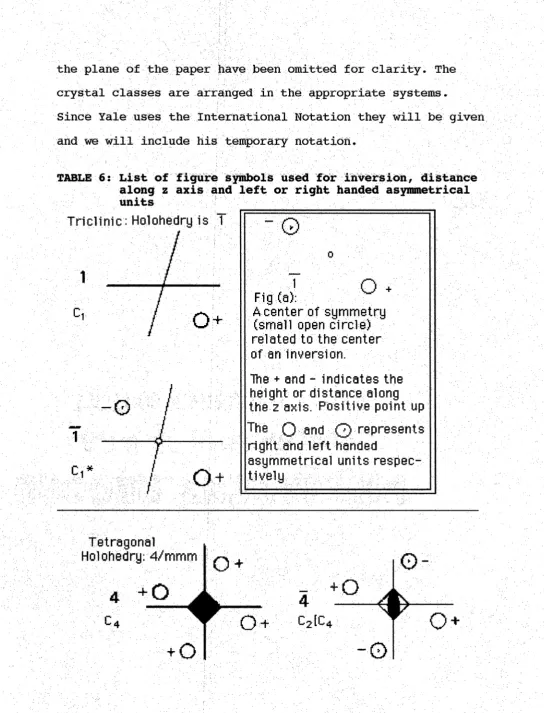
Table 6. List of figure symbols used for inversion, distance along z axis and left or right handed
asymmetrical units. ...58
Table 7. List of mirror symbols...^...60
Table 8. List of rotatory inversion symbols...60
"Synunstry is a vast subjeGt, significant in art and nature.
Mathematics lies at its root, and it would be hard to find a
better one on which to demonstrate the workings of the
mathematical intellect,"
Herman Weyl, Symmetry
Introduction
Home of the earliest studies of crystals were motivated
by observation of their external symmetry ot morphology,
Snowflakes are in hexagonal shape, sodium chloride in perfect
cubes, and the crystals of alum are frequently regular
cxitahedra. We will investigate how these outward symmetirical
shapes are really manifestations of the internal structures
of crystals. This is the study of crystallography from the
our investigation Will include a brief look at the
syrametries of three space with emphasis of only isometries
groups of finite order. Through the crystallographic
restriction our study will define for us the thirty-two
crystallographic point groups. The point group to which a
crystal belongs is referred to as its crystal class. Each
crystal class has u unique space lattice and we will look at
each. We will show how these are related to the seven solid
crystal systems. We will investigate a crystal's system or
its holohedry. we will also include a comprehensive
two point groups to their holohedry. The final step is
relating our results to Chemistry.
Syniiiietries in Three Space
A trahsforHiation that preserves distance and inaps
segments to segments, rays to rays and planes to planes define an isometry. It has been said that in 1776 Euler determined that an isometry of space is exactly one of the
following: reflection, translation, rotation, glide
reflection, screw displacement or rotatory reflection
(Coolidge 273).
Isometries of three space are either a direct isometry
(one that preserves direction) or an opposite isometry (does
not preserve direction). If G is the group of isometries in
three Space and H consists of all direct isometries then
there exists some geG such that gH consists of all opposite
isometries. A rotation, translation or screw displacement is a direct isometry. A reflection, glide reflection or a
rotatory reflection is an opposite isometry. A rotatory
inversion is an example of an opposite isometry, since it is
a s|)ecial rotatorsr reflection.
The basic isometry is the reflection. The other types
of isometries can be derived from a product Of reflections,
so we will first define the mapping of points under a
reflection. Given a plane D, the reflection denoted by is
point p lies on D and if p doess not lie on D then O0(p) = q
and D is the perpendicular bisector of pq.
We refer to George Martin for the details of a
discussion of isometries as the product of reflections. He
shows that the reflections are building blocks for the
isometries as follows.
Let a be an isometry which takes points p,q,r,t not all
of which are coplanar, to points p',q',r',s',respectively. It
is determined that a is the unique isometry to do this, for
if a and p are isometries such that a(p) = P(p), a(q) = P(q),
a(r) = P(r), <x(s) = p(s) then a = p. It is only the identity
which keeps four nonplanar points invariant. Now let us consider the following five cases.
Case 1: p = p',q = q', r = r', s=s'. Here a = e = apjOf^.
Where A is any plane thrpu^h p (4-points held invariant).
Case 2: p = p', q - q', r = r', but s ^ s' then the
plane B containing p>q,r is the perpendicular bisector of
ss'. Therefore a =og.(3-points held invariant).
Case 3: p - p'/ q = q^*> but r 9^ r'. Here> the points p
and q lie in the plane A that is the perpendicular bisectpr
pi rr'i A reflection in A then reducee the problem to Case 1
or tp case 2 listed above, so a is a product of at most two
Case 4: p = p' but q Point iie on the
plane C that is the perpendieu bisector of qq'> and a
relection in c then i^duces^^^^tt problem to one of the cases
above, therefore d is a pro^ of at most three reflections
in planes through p. (l-point held invs^
Case 5s p # p' A rdflectidn in the pldnn "that is the
perpendicular bisector of pp' reduces the problem to one of
the other four cases mentioned previously. Therefore, every
isometry is the product of at most four reflections.
(O-points held invariant).
Having sho^ that an isometry is the product of at ffiost
four reflections we now look at each case to identify which
isomefry it describes. It can be seen that an isometry which
holds no points fixed is a screw displacement or a
translation. JUiy isometry that holds at least one point p
fixed is the product of at the most three reflections in planes through p. An isometry that fixes two points is a rotation, reflection, or the identity. If three noncollinear
points are held fixed then the isometry is a reflection or
the identity. An isoiftetry that fixes four noncollinear
points is the identity (185).
Before looking at other isometries and how they are
translation, glide retleGtion/ rotatory refleetionr rotatory
inversion arid screw displacement.
A rotation is the product of two reflections through
intersecting planes B and A. Then o^^og is Galled a rotation
about the axis of intersection. We reflect through plane B
■first.' ■ • ' ■■ ■ '
X B • 8=0 A • S-cst
iqtatioh
A translation is the product of two reflections through two
parallel planes B and A. So we call og og a translation along
orAdD(p)
A :y=k
B:y=0
Translation ,
A glide reflection is the product of three reflections.
If Band C are two parallel planes perpendicular to a third
plane A, then 0^0000 is called a glide reflection, where we
transleite first, then
/I
•arCoB(p)
A
arAdGQB(p)
Glidi Reflection
A rotatory reflection is the product of three
reflections. If we have
B and C intersecting and
perpendicular to a third
plane A, then oq og is called am
A /
Rotatory Refleclion
•
b(p)
A rotatory inversion is also a product of three
reflections. It is a spScial cAse pf a rotatory reflection.
since it can be realized as the product of the rotation and a
reflection. How if B and C are two perpendicular intersecting
planes 'Which are mutually perpendicular to a third plane A,
then we call opCQ og a rotatory inversion about the point
coinmon to planes B, C, and A.
pc^Btp)
point in
common A
■WC^B(p)
Rotatory inversion
A screw displacement denotes the product of four
reflections, in this case it is a translation and rotation,
applyihg the translation first. If C and D are two
perpendicular to two planes A and B, then ODOcO0Op), is
called a screw displacement.
7
A
/c
\
D C
A ^P^
/
k'
^
Screw Displacement
Recalling as previously described a rotatory reflection
is the product of a reflection with a rotation whose axis is
perpendicular to the mirror. Any rotatory reflection can be defined as a central inversion and a residual rotation (a
rotation whose axis passes through the center). If the
rotation is through an angle 6, then we can regard it as the product of a half-turn and a rotation through Q + jt (orS-jt).
To show that a rotatorv inversion, px, can be defined as
a special rotatory reflection, cf^ocobj note that an inversion
is the product Of three reflections o^acog or one reflection
followed by one rotation, (0000)00,or one rotation followed
by a reflection, ogCoQOg). If this product is through three
inversion px, where "p" is a rotation and x equals the
inversion about the point common to planes B D A. A simple
inversion or a central inversion is the equivalent of a
rotatory inversion with 0^ rotation or a totatory reflection
With 180® rotation. Because we require the planes to be
mutually perpendicular the angle of rotation is 180® and
therefore we will refer to a rotatory inversion to specify a
central inversion in the remainder of the report.
a
^
e
Inversion tbronqh a point (with point O in center as shown)
To better visualize a rotatory inversion, the process
of inverting all points in a body about some center, let us
think of a point p and a point 0. With 0 as the center, then
any point p is moved to p' on a line pO such that Op'= Op.
Another Way to look at it is if a set of Cartesian axes have
their origin at O, a point with coordinates (x,y,z) is moved
to (-x,-y,-z). if we apply this operation twice it would be
Chapter Otte: Euclidean Symnetry Groups of Finite Order
We will limit our discussion to groups of symmetries
that are finite as a preliminary to showing how they relate
to the classification of crystallographic point groups. If G
is a finite subgroup of the group of isometries, then it has
at least one point, the centroid, which is left fixed by all
the isometries in that group. In discussing finite isometries
we? need to define how they will be classified,
the geometric aspect of the groups of three space isometries
then, fot an ex^ple, we can dis^t
between the cyclic
group of order 2 generated by a half-turn from that generated
;by .;a''-reflectibn.^^--.
we shall Show that if G is a finite group of isometries
all of which hold a point fix^^ and G* is the group of direct
isometries in G and x an inversion through the fixed point,
then one of the following statements must be trOet
1) G = G"*^ (Direct isometries, x ^ G). C4 is an example.
2) G = G"^ U xG''" (G cohtalns X, a rotatory inversion about the
fixed point) C2U XC2 =
3) G s*' G"*" and x ^ G. Denoted by G^[G, it is a group of
isometries derived from G"^ and G. G"^ is of incfex two^^ to
(Contain opposite isometries, but no rotatory inversions).
C2[C4 is an example.
Looking at case 1, G fits only if it contains no
in either case 2 or case 3 (iepfehciing on is^ether x (a rotatory
inversion) is an element of G or not. This would ekhaust
all possible cases and therefore proves that these are the
only three cases. Our first task is to look at all pdssible
groups of direct isometries.
Direct Finite Isimietries in Three Space
Suppose we look first at rotations in orthogbhai three
space which we will denote O(R^). Let a be a rotation
keeping a plane D fixed. Let {v^, V2, V3} be three mutually
orthogonal unit vectors, where V2 and V3 lie in D. Then the
rotation, a, may be represented with the following matrix A,
relative to v^, V2, V3.
A = 1 0 0
0 cos 0 -sin 0
0 sin 0 cos 0
If we take 0 then the corresponding matrix A
generates a cyclic subgroup of order n, which will be denoted
by Cp,. This group is referred to as a finite group of direct
isometries.
A finite direct isometry group designated as the
dihedral group is denoted by Dp. It is the group of
three-dimensional rotations transforming a regular n-gon into
itself (Janssen 77). It is any group generated by distinct
rotations a and p , where p has finite order and both a and
inl^roduction to Symnietries of Regular Polyhedra
To look at other finite direct isometries we will look
at the symmetries of three space that are the group of
rotatiohs leaving regular polyhedra invariant. We will
include their orders in our discussion.
There are exactly five regular polyhedra (a regular
poiyhedron is defined as a closed conVex figure with all
faces regular p-gons, for some fixed p, and the same number g
of these faces meet at each vertex). These are the regular tetrahedron. the cube, regular octahedron, dodecahedron, and
the icosahedron. It might be noted that the first three are
the only regular polyhedra that occur naturally in common
crystals. This can be explained by the crystailogfaphic
restriction that will be discussed later.
In our discussion of regular polyhedra we need the known
properties of a coordinate system in R^ with an x> y, z set
of axis, where we can define the point of origin.
Each of these polyhedra can be inscribed in a sphere
and any vertex v of the polyhedon can be brought to different vertex v' by a rotation about the axis of the sphere perpendicular to a plane containing v and v', and
passing through the center of the sphere. If we center this
sphere at the origin in R^ > then the rotations in O(R^) that
carry the polyhedron into itself define a finite subgroup of
y
/
/
Pictured is a cul>e inscribed in a sphere.
It turns out that of the finite direct isonietry groups there are exactly three of these groups of rotations, those
corresponding to the tetrahedron, the octahedron and the
icosahedron that we call respectively the Tetrahedral group.
Octahedral (or cube) group and the icoSahedrai group and are
denoted T, O, I.
The octahedron and the cube are dual to each other,(a polyhedron with edges obtained by joining the centers of
adjacent faces of a given regular polyhedron) and as a result
has the same synunetry group. Similarly, the symmetry group of
the regular dodecahedron is that of the regular icosahedron
since they are dual. Also, the dual of the tetrahedron is another tetrahedron, so we will only be concerned with the
symmetry of these three distinct polyhedra.
The vertices of the tetrahedron are among those of the
cube. The symmetry group of the cube contains those of the
regular tetrahedron. Moreover, the syiraaetry group of the
pctahedroii, v?hich contains the symmetry group of a cube that
contains the symmetry group of the regular tetrahedron.
Pictured are some eraAples of the dual pClyhedra and shared
s]nnmetry within the ciibe and tetrahedrohV the cube and
-''dodecahedron'
The subgroups of rptatiohs of the tetrahedron, centered
at the origin as the center of the sphere in which leave
the tetrahedron invariant, is denoted by T. It consists of rotations through angles of 23t/3 and 43t/3 about each four
axes joining vertices with centers of opposite faces,
rotations through the angle re about each of three axes
joining the midpoints of opposite edges, and the identity.
So, |T| = 4*2 + 3*1 + 1 = 12.
The group of rotations of a cube (or octohedra),
centered at the origin, denoted as O, are rotations of three
distinct types and the identity. There are rotations through
the centers of opposite faces, rotations through angles of
2%I2 and 431/3 about each of four axes joining extreme
opposite vertices, and rotations through angle 3t about each
of six joining midpoints of diagonally opposite edges. So,
|0j == 3*3 + 4*2 + 6*1 + 1 = 24,
The icbsahedron has 20 faces and each face is an
equilateral triangle. It has 30 edges and 12 vertices. The
rotation group I of the icosahedron consists of rotations
through angles 23t/5, 43i/5, 63t/5 and 83i/5 about each of 6 axes
joining extreme opposite vertices. There are also rotations
through angles of 23t/3 and 43t/3 about each of 10 axes joining
centers of opposite faces, rotations through the angle 3t
about each of 15 axes joining midpoints of opposite edges,
and the identity. As a result, |l| = 6*4 + 10*2 + 15*1 t 1 =
60.
We will show that these groups T, o, I, and Dn are
indeed all the finite direOtisometry groups. First as an
introduction we will define the terms pole, stabilizer and
Chapter Two: Finite Direct isometry Groups Defining a Pole
and its Orbit
To define what a pole is, we let G be a group of direct isometries all leaving the point w fixed. These isometries
are knpwci as the stabilizer of the pole. Let § be a sphere
centered at w. A pbint x on ^ is a pole if some nontrivial
rotation in G leaves x fixed. Let X be the set of
" T
FftGie pole wttK axis of fdtat
Edge pole with axis of rotation
Vertex pole with
axis of rotation
we nee<i to also define what the orbit of an eie®ent is
with respect to the permutation groups on their sets of
poles. Suppose that G is a finite rotation group with the
mapping t(x) = y (where teG, t^^l, and xeX is a pole in G).
is called the orbit of x, denoted by Orb(x). The orbit is the
set of places G sends x. If Orb(x) = X for each xsx then 6 is said to be transitive on X. It might be noted that if xeX,
then the subset of G, consisting of all teG for which t{x) =
x^ is a subgroup called the Stabilizer of x, denoted by
Stab(x).
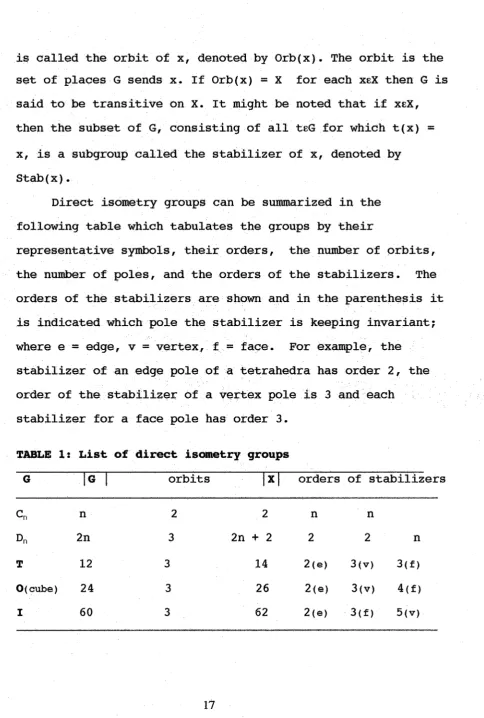
Direct isometry groups can be summarized in the
following table which tabulates the groups by their
representative symbols, their orders, the number of prbits,
the number of poles, and the orders of the stabilizers. The
orders of the stabilizers are shown and in the parenthesis it is indicated which pole the stabilizer is keeping invariant;
where e = edge, v = vertex, f= face. For example, the
stabilizer of an edge pole of a tetrahedra has order 2, the
order of the stabilizer of a vertex pole is 3 and each stabilizer for a face pole has order 3.
TABLE 1: List of direct isometry groups
orbits
fxl orders of stabilizers
n 2 2 n n
Cn
2n 3 2n + 2 2 2 n
Dn
T 12 3 14 2(e) 3(v) 3(f)
0(dube) 24 3 26 2(e) 3(v) 4(f)
If G is a nontrivial, finite group of direct isometries
all of which lea,ve the point w fixed, and ^
is a sphere
centered at w, then we will show that the number of orbits of
poles on § is either 2 or 3. Therefore, the group G must
coincide with the data of one of the groups on the above
table.
We let X|,i = 1,2,...k be a set of poles on § one
from each orbit of poles on $, and shall show that k = 2 or
3, Let a, be the number of isometries in G, leaving the ith
pole fixed. By the definition of a pole Wi > 2 is true. Let Pi
be the number of poles in the ith orbit and let n = |G|.
We need to establish the result that if G is a group of isometries on a set X and xeX then the number of group
elements leaving x fixed times the number of places x is sent
is n. i.e. |stab(x)
|
|orb(x)
|- |G|. The proof is as follows:
Let H = Stab(X). If r,teG and rH = tH,then t'VeH or t"Vx = x;
so rH—+rX defines a mapping M from the left cosets of H onto
the orbit of x. If rx = tx, then t~V eH and rH = tH. So M is
also 1-1. Thus showing |stab(x)||orb(x)|- |G| to be true.
Thus for each of the selected poles Xj, i = l,2,..k,
ajPi = n for i = 1,2,.,.k. Also since aj is the number
isometries in G leaving Xj fixed and there are Pj poles in
(X|)G, then we can write Pj(aj - 1) as the number of nontrivial
isometries in G (counting repetitions) leaving at least one
v':
v'v
■ ■ ■
j=v /
■/;'
i=i
■;>.
■;■•;■ ■ ■ ■
find the tot^^
of nontrivial elements iii G leaving
at least one |)ple fixedf again counting each isonetry once
for each pole it leaves fixed. Since each nontrivial element
in G is a rotation leaving exactly two poles on § fixed,
another way to denote the sum is 2(n ?- 1) v/e then can ata^
■;it;an'■follows.:.
2(n - 1) == ^ (n ^ 0j)
inIf we then divide both sides of this eguatioh by n, and
substitute h = ajP| we get the new equation:
..n'-' ■■ ; .
;; V :
■ ■ ■ '' ■ ■ ■ ■ ■ ■
■y'::t2u-*2.)/n
^
V
k
■. "y' - >' i. - -;-,- '. ' '
y
that is
2 - (2/n) =
(1 - (l/a,))
Eq.(l)
Since n > 2, (G is nontrivial), 1 < 2 - (2/n) < 2.
Since each «[ > 2, we have 1/2 < 1 - (l/aj) < 1,
i== 1,2 i
If we sum this over the ic orbits and equation
(:il\i«te:'.have k/2 < 2
(2/n)
-k, :
k/2 < 2 - 2/n < k, v?e have k/2 < 2 and 1 < k so that, k < 4
and k > 1.
Alternatively, if we look at the graphs for values of k;
where k = 1
1/2 < 2 - 2/n <1 solving the inequality for n, we get no
solution since n is an integer and n > 2
r qoa; )
No intersection
0 1 2
where k=2
2/2 < 2 - (2/n) <2 gives us 1 < 2 - (2/n) < 2 with n > 2
f goal y Perfect match
'l 2
where k=3
3/2 < 2 - (2/n) < 3, n > 2
1 ssai- L
[_ _r ) _) intersection
0 1 2 3
I
comp
I '
■
where k > 4
4/2 <2 - (2/n) < 4 we get 2 <2 - (2/n) <4 so fails when
k > 3 since n > 2
No intersection
_[ r goal > f computation I )
Thus showing that if G is a finite direct isometry of R"
the number of orbits on a set of poles is either 2 or 3. The next step is to show that the number of orbits and the order of the stabilizer must coincide with the data of one of the
groups listed in the table. We shall show this by looking at
where the groups fall by using the following equation.
How the Groups are Categorized
2 - 2/n =^( 1 - l/aj )
i=l
If k = 2
2 - 2/n = ^ (1 ^ l/ttj) = (1 - l/ai) + (1
i=1
Simplifying: 2 = n/ai + n/a2 and since n = ajp,
then P2 2. The only way for this to be true is if
§1 ~ P2 =
Thus if k = 2 the group has two 1-orbit poles
and is the cyclic group, of order n. Since each cyclic
group Cpi has exactly two poles and no rotation carries either
pole to the other, X has two one element orbits. Pictured is an representative of Gn where n-2
The two poles with axis of rotation are shown
I''
on the three-dimensional figure, this figure
represents a rotation through 36OV2
If k == 3 that there exists an order such that
^^ 3 then we have:
2(1
- l/»i) k 2]^
2 but ^ (1 - l/di> < 2 =»[<=
■k^T^ ■ ■■
• ■..;■ ■■ . .. ; ■ :: 1<=1
V; •
■■ >, , :
^
'k.r j V,; • ' ;■
- v
SO if ai = 2, 2 - 2/n = (1 - 1/2) + (1 - 1/02} + (1 — i/«3)
so that 1/2 + 2/n = 1/02 +1/03
But if 02 > 4 (then 03 > 4) so that 1/02 + 1/as < 1/2. So a2
2 or 02 = 3 which gives us a contradiction.
Let «2~ 2, then 1/2 + 2/n = 1/2 + 1/03 , this implies 2/n =
1/03, 03= n/2; so the order of stabilizers are 2, 2, n/2
•k ' ;p|■ ''=? .h/d|:■=!..r/2^'2:^
■
P2 = n/a2 = n/2 : the order of orbits
P3 = n/a3 = n/(n/2) = 2
This is the dihedral group. Dp The dihedral group Dp
will have n axes of rotation in the plane W on which D^, acts,
and one axis of rotation orthogonal to W, as a result Dp has
2n + 2 poles. The two poles on the axis orthogonal to W count
as one orbit in X. Whether n is odd or even, it can be seen above that has three orbits, and the stabilizer of the
elements of each of the thfe^ orbits have orders n> 2 and 2
respectively.
Let d2 = 3 1/2 + 2/n - 1/3 +
Clearly if a3 2.6
then 1/6 +
So we consider in turn the cases 03 = 3, 4, 5
if 03 = 3, 1/6 + 2/n =1/3 or 2/n =1/6 so n = 12 and
—
^3' =';i2/C=.', -4.,
This can be represented by the symmetry of the Tetrahedron
If a3 = 4, 1/6 + 2/n =1/4 or 2/n =1/12 so n = 24. This
can be simiiarly represented by the symmetries of the Cube
and can be thought of 12 rotations leaying the vertex and midpoint of opposite faces fixed. It also can be thought of 6
rotations leaving the midpoints of opposite edges fixed.
If a3 5, 1/6 + 2/n = 1/5 or 2/n = 1/30 so n = 60. This
can be similarly represented by the symmetries of the
Icosahedron.
To summarize: ■
If fc = 2/ ct| = 2 and pt = P2 = i r>then G is isomorphic to <3^,
If k = 3, ai = 2, 0.2= 2, a3 = n/2 and = P2 ~ ^/2, P3 = 2,
then G is isomorphic to Dp. 2 2
If k = 3/ 01 = 2, oj2 = 3, then we have three cases
corresponding to a3 = 3,4,5.
We have the following if (X3 = 3, n = 12 so P] = 12/2 = 6,
P2 = 12/3 = 4, P3 = 12/3 = 4
is isomorphic to
: a3; =
,:-i.,2h;-■■■2i aO;;:P2='\24/2 ■■;=■'•
24/3 = Z p^^ 2€H = 6,
If ag == 5, ri = 60 so = 60/2 == 3Q> p2
12, then G is Isomorphic to I.
iteasaining Finite isonietries: contain opposite ifometries.
There are no two groups in the above list which are
isomorphic, so this is tlio classificatiph into isomorphism
classes (that is the mapping is onto and one to one) and into
similarity classes for finite groups of direct isometries.
Next is to look at the remaining finite isometry groupsr
which are those that contain opposite isometries with a
rotatoty inversions and those which do not contain an
rotatory inversion. Since they fall into the two remaining
groups of finite isometries by whether they contain an
inversion or not, then any finite isometry group that contains an inversion x, must be similar to one of the following groups:
Cjr| LJ, xOp.. n * 1,2,3,...^
LJ xO^, n ~ 2r.3,4.,.•.j T LJ xT,
O U xO and I U xl.
Since no group containing an rotatory inversion can be similar to a group without a rotatory inversion then no two groups in the combined list can be similar. There can be
some isomorphic pairs of groups such as U xCp — C2n if n is
odd, C2 U XC2 — D2 and Dp U xDn — D2n/ if u is odd [n ^ 1]
^
The only remaining finite groups of isometries must then
an involution
which is
a rotatory
inversion.
is a
subgroup of
index 2
in a.
These groups
are
Cnlbn/
C>nE^2n' ^bd
T[OV The
groups G^ia
and a
are isomorphic
in an
alc|^raic sense, but are
distinguishable geometrically. For
an exan^le
C2[C^^^
isomorphic to
the cyclic
group of
direct
rotations of order 4,
however it is generated
by a rotatory
inversion (an opposite isometry)
of order
4. Thus
the only
possible isomorphism between
groups in this classification
is betv^eri
G2nlf>2h a
Dn[D2nf (for
n «
2y3i-i;v) .
®
list up
to isomorphism of all
the
finite groups
of is^netries in three
spacev
25
Chapter Threet Point Groups
fhe doroplete set of operations that leave an object invariant has be®n defined as the syitimetry group of the
object. If it is reguired that during every syinnietry
operation one point always remain fixed in space, the group
is designated as a point group. (The collection of symmetry
elements possessed by a molecule of a crystal is called its
point gronp. The term point group indicates that at least
one point remains fixed under all of the symmetry
Let us look at the symmetry operations which leave a cube invariant by seeing where the yertices of the cube are moved under each symmetry operation.
8
1 6
7
I
Ileniity 4-foll rotiiltioa. 2-fDll rotlAioik. 2-foli rDtatioa
1. ' '
6 2
4
X 7
■v 8
4
5 3
A 8
5-■ ■■
I>uigip]ud Rotatory lovordon Rotatory Rofleptiorrii
Plane
Each syiMietry operations has left at least one point of
an object unchanged. For example a point or pole left fixed
in the 4-fold rotation is the center of the top face,
translation Symmetry
Another type of symmetry of an object is that with
respect to translations. If we move from one point in an
object to some other point in the same object and the
environment about the two ppihtS is exactly the same, then
this is the symmetry of ah object with respect to a
translation V ;
We first think of a net which is a two dimensional array
of points spaced in the form of the vertices of
parallelograms. Each set of points on the net displaying the
same symmetry. If we choose a point A in an object with
translational symmetry, and then move point A an integral
number of unit spaces on the net to the point we will note as
A', then the environment would be the same as before the
movement. It might be noted that had we imaved point by
not appear the same. If we speGif^^
directi.on and unit displacement and call the magnitude of
this displacement in one direction a, and then specify some
direction and unit displacement in a second direction calling
the magnitude of this second displacement as b we can draw an
infinite set of spaced points that display the same symmetry
as a ^-dimensional net.
in n
n
f
If we then stack these nets layer upon layer, and
specify the magnitude between these nets as c and specify
the angle between th^se layers, we would then form stacks of
congruent parallelepipeds. We will end up with a
three-dimensional figure called a lattice. A lattice is defined as
an arrangement of points such that the environment of every
point is exactly the same as that of all other points.
Looking at how many different types of 3-dimensional
lattices exist is related to a particular array specified by
the telationship of the directions or angle between any pair,
ab, ac> be. We denote these angles to be
S
sHctured is partofa3-D lattice
It is in^rtant to note tiiat we caniiot just assuine if
the lengths of a pair of axes are made egual that it is just
a special case of the more general condition where the
lengths have arbitrary t^alues. Ra.ther, it must be considered
as being a different case. This occurs when we denote a pair
of axis lengths to be egual and as a result it introduces
different planes of symmetry. It can be shown by observation
that this special relationship will result in figures of
higher symmetry,
Doited lines represemts 39nimetr y
Dotted lines
repmefrt summetrg
Jc
3!
b = a
The second array has two planes of synmetry.
Introduction of Rbtational Syinnetry in h liattice
If the angle between the directibn of axis a and b is
reguired to be an angle of 90®' then the array has rotational
syiniRetry hs well as reflectional syifflnetry. in the following
array the angle between a, b is required to be 90®,the
reflection planes are indiGated by the dotted lines as well
as to represent the rotational symmetry (perpendicnlar to the
b - a
90° a
It is apparent that there is a conneetion between
rotational and translational Symmetry. This relation is so
restrictive that it confines it to a few number of types of
rotational syiraietry which can exist in lattices. It can be
shown that there can only be 2-fold, 3-fold, 4-fold and 6
fold rotations in a crystal. Crystallographic Restriction
We look at a lattice with an n-fold rotational symmetry
operation through one of the lattice points cind consider two
points A and B which are two nearest points or nearest
neighbors* By requirement each point on the lattice has the
same environment> so therefore must have the same n-fold
perform a eounterelQckwise r tturbvigh a.n
angle © which will represent a measure of 23i/n about ap axl^
perpendicular to the paper and through point A, then the line
jy3 is Carried into the line AB' and the point iS is
transfbrroed into point B'. Since the inverse of a symmetry
operation exists (rotation in the opposite direction) we can
perform at B the inverse of the operation performed at A. This carries the line BA to BA', and the point A is
transformed into point A'. The points A' and B' must be
points of the lattice with the same environments as the
original points. Renumber that the distance between points
B' and A' must be an integral distance between A and B. Since the lines AB and B'A' are parallel we can construct
perpendiculars from the points A and B to the line A'B" and
Our translational symmetry requirement is that ma represents
some integral length of B'A'.
B'A' = ma = a + 2b. Solving for b we get
b = a[sin(0 - nl2)\, sin^lifying we get b = -a[cos(0)].
So ma = a - 2acQs(0). Simplifying and using the equation
cos 0 = (1 - m)/2 we find the only possible values for m give
us the identity and n-fold rotations where n = 2, Z, 4, 6.
Looking at the following table we see that there is no
rotation greater than sixfold and a 5~fold rotation does not
exist. It is therefore impossible to construct a lattice by
stacking pentagons together. This restriction is known as the
Crystalloaraphic Restriction. The following table shows the
allowed rotations in lattices. The identity is not included
on the table.
taBl^ 2! hist of possible rbtatatioos ib a crystal lattice
B'A' m cos 0 = (1 - m)/2 0 (2jt/n) Type of Rotation
s'.' 1/2 siJcfold,
a, :';-;
v'.!-:
fourfold
■
;
v2a'' v:
.
■ .■-i;/2 :
^
3a
3
-1
180°
twofold
Croups of Direct Isometry in Crystal Lattices
This implies that not all finite groups of rotations are
crystallographic point groups, for the order of a rotation in
spaqer we note that among ail liriite subgroups of only direct
isometries the following satisfy the requirements on orders
■ Of •-elements.:
;a,).-€|>. \C2:/.-G3;,/;C4,v Gg, ;i)2f
•%
Inversion Symmetry in Grystal i^
opposite /
isometries):.V;; '
It might be noted that one symmetry element
to
all lattices is the operation of inversion through a lattice
poiht.
operation is built into the lattiqe*
We
Start at any one point we will call the origin (point O) and
move to any other p<ii-nt (point A> o^ lattice by any path
of tfte bet* if we go back to the origin and follow the
original pafch in reverse we end up at another point site (we
call h* > which is exactly the same distance from the origin
as the first point, but it is in the opposite direction.
These two points are related to one anpther by an inversion
in a lattice, through the point we call the origin. The least
symmetrical lattice is one where the only symmetry element is
inversion symmetry.
If g is a rotatory inversion in a crystallographic point
group, then the rotational
g must also be of order 1,
2, 3, 4 or 6. Therefore only the following finite opposite
isometries groups which include a rotatory inversion and
satisfy the order requirement where Gi* = Gj U kC]are as
follows:
Isometries in Crystals which do not contain Rotatory^^
Inversionst
The last set of groups of finite isometries that satisfy
the crystaliographiG restriction are those which contain
opposite isometries, but do not contain a rotatory inversion.
An example is a group containing only a reflection is denoted
by Cf {€2. It is isomorphic to C2. Its subgroup of direct
isometries is Cf which is of index twO in the group of direct
isometries. In general the subgroup of direct isometries must
be one of the types previously described and is of index two
in the group of isometries. This means the only possible
types are as follows:
c) C-\ [C2f C2[C4, C3[Cgf C2[^2f ^3 ^4 1^4' ^6[^6' D2[^4'
D3[Ds, T [O.
The Thirty-two Point Groups: Further analysis of the
thirty-two point groups
Various notations have been used to denote each point
group. Detailed explanation of the notations will appear in
connection with the presentation preceding the individual
point groups. Although the notation most commonly adopted by
chemists is the Schoenflies notation, Yale uses the International notation in his diagram showing subgroup
relations for the 32 point groups. The International notation
symbols were chosen to give some idea about the operators of
TAfiLE 3: List of meaning Of SYmbols used in international
notation
Symbol Meaniiiuj
X or X_ Eoafeion or rotatory inyersion axis respeotively.
X2 or 12 Subsidiary two-fold rotat.xou axis or asses exists
perpendicular to X or X.
Xm or Im
The m denotes a symme^y plane or planes contain
ing the axis of X or X.X/m Symmetry plane perpendicular to the axis X.
X/mm A cDmhination of Xm and X/m.
mm Two mutually perpendicular symmetry planesj these
intersect in a two-fold rotation axis and hence the
symbols, 2mm and mm2 are sometimes used
X2m Xm2
The symmetry planes contain the axis X where_the
two-fold rotation axes are perpendicular to X. m3 23, The first symbol is m if there are symmetry planes23 perpendicular to the x-axis. Cxiibic system always
contain 3 as the second symbol as the second symbol
denoting the four three-fold rotation axes.
43m, 432 The symbol m denotes tbe rotation axes parallel to
the X-axis if m is not the first symbol.
m3m A third symbol refers to the xy-axis symmetry (axis between the x-axis and y-axis) a two-fold rotation axis parallel or a symmetry plane perpendicular to these directions.
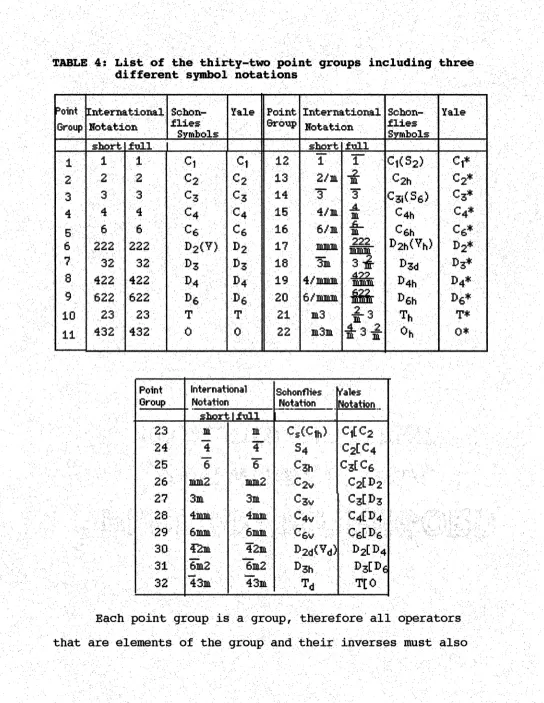
George F. Roster has the following table listing the
thirty-two point groups with Yale's notation and numbering
added (Roster 29). The list is numbered by grouping the sets
according to only direct finite isometries, containing
opposite finite isometries with a rotatory inversion and
those with opposite finite iSometries not containing a
TABLE 4: List of the thirty-two point groups including three
different symbol notations
'oint Interim,tional Scbon- Yale Point Internationai Schon- Yale
flies Group flies
Group Hotetion Notation
Symbols Symbols
short full short full
1 1 1 Ci Ci 12 T Ci(S2) Ci*
-2. .
2 2 2 C2 ^2 13 2/m m ^2h C2*
3 3 3 C3 *^3 14 T
CsiCSe)
C3*4 4 C4 C4 15 4/m A. C4h C4*
. jS— .
4 m
5 6 6 Ce C6 16 6/m m Gah Cfi*
6 222 222 D2(V) D2 17 TOiurm 222 ©2h(^h> D2*
KUKUft
7 32 32 18 3m
3#
D3 »3 T>Z*
. A?2.
8 422 422 D4 D4 19 4/iaaiLu
mmm i l'4h D4*
9 822 622 20 fi/TOnmiin
iiir
I>6*10 23 23 T 21 m3 f*
432 432 0 0 22 m3m 0*
11 %
Point Internatibnal SchonfliOs Vales
Group Notation Notation Notation short/Ifull
23 m m CsCCih) CiECs
24 "4 T" 84
e2CC4
25 "6 ¥ *^3h GsECs
mm? C2v
26 G2EP2
27 3m 3m <^3v C3[D3
28 4mm 4mm C4[D4
29 6mm fimm CeEPs
30 fSm 42m I>2d(Vd) D2[D4
to2 6m2 PsEPg
32 43m 43m Td T[0
Each point group is a group, therefore all operators
be a member of the group. We need to include the notation for
the inverse of the group operators. When referring to a
specific operator we will enclose the notation in parentheses
to distinguish it from the group notation. The notation for
the inverse of (Cg), a rotation of 60°, which is one of the
operators of the point group Cg, is denoted to be (Cg~^) and
is a rotation through -60° (Kosher 3). We will look at each
point group relative to its axes. The following figures show
the axes of rotation for each gro^^^ description.
If the reader is interested in looking at the character
tables, the multiplication tables and the compatibility
tables for the thirty-two point groups see Koster's book
(KOster 29). Two point groups which are isomorphic have the
same multiplication teible (Janssen 72).
+ Z
■r-'
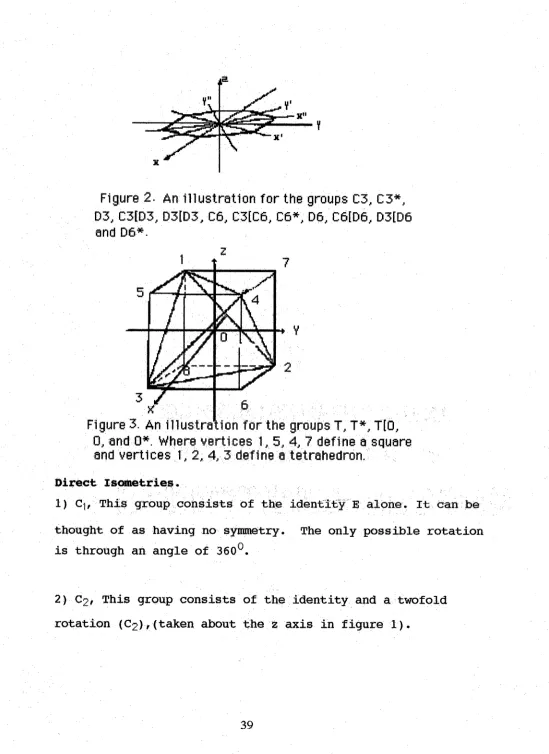
Figure 1. An Tllustratton for the groups C2, CUC2,
K"
X'
Figure 2. An illustration for the groups C3, C3*,
D3/C31D3: D31D3,€6;C3[C6, C6*,06;C:6[D6, D3ID6
and 06*.
z . ■
5
4
Figure 3. An illustration for the groujis T,T*,T[0,
0, antl O*. Where vertices t, 5,4,? define a square
vertices
2, 4/3 define a t^trahed^^^
i#raAietz^ie&|.
1) This group consists of the identity E alone. It can be
thought of as having no syinmetry. The only possible rotation
is thrdugh an angle of 360^.
2} C2f This group consists of the identity and a twofold
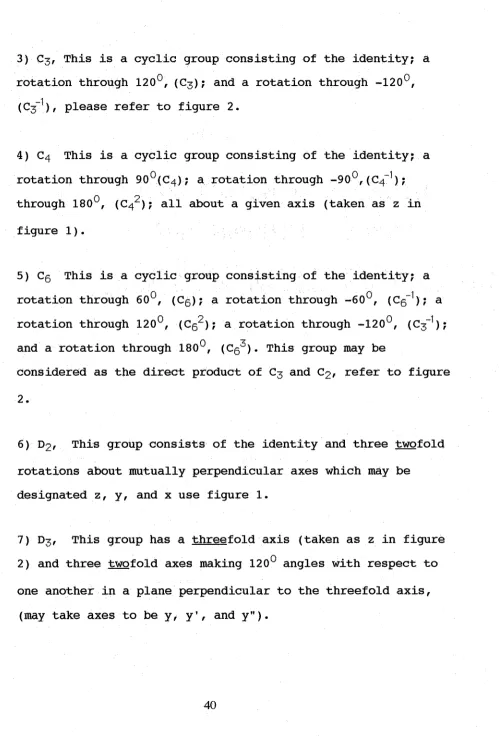
3) Cjf This is a cyclic group consisting of the identity; a
rotation through 120^,(C3); and a rotation through -120^,
( )/ please refer to figure 2.
4) C4 This is a cyclic group consisting of the identity; a
rotation through 90®(C4); a rotation through -90®,(€4"');
through 180®, (04^); all about a given axis (taken as z in
figure 1).
5) Cs This is a cyclic group consisting of the identity; a
rotation through 60®, (C5); a rotation through -60®, (Cs~^); a
rotation through 120®, (C^); a rotation through -120®, (€3"^);
and a rotation through 180®, (€5^). This group may be
considered as the direct product of C3 and C2, refer to figure
2.
6) D2, This group consists of the identity and three twofold
rotations about mutually perpendicular axes which may be designated z, y, and x use figure 1.
7) D3, This group has a threefold axis (taken as z in figure
2) and three twofold axes making 120® angles with respect to
8) ©4/ This group consists of a fourfold axis z and four
twofold axes perpendicular to the fourfold axis. The twofold
axes ape taken as the x arid y axes and further the two
twofold axes are taken as the axes 1 and 2 in figure 1 which
make 45^ angles with the x and y axes and are mutually
perpendicular.
9) D5, This group consists of a sixfold axis z and six
twofold axes lying in a plane perpendicular to the sixfold
axis and making 60^ angles with one another, in figure 2 we
may take the axes of operations to be y, y', and y" and those
to be X, X', and x". This may be considered as the direct
product of D3 and C2.
10) T> This is the group of all direct isometries which send
a regular tetrahedron into itself. There are four threefold axes and three twofold axes, refer to figure 3.
11) O, This group consists of all direct isometries which send a cube into itself. There are four threefold axes with
poles at opposite corners (vertices) thesp axes 01^02,03, and
04 in figure 3, three fourfold axes at the x,y z axes
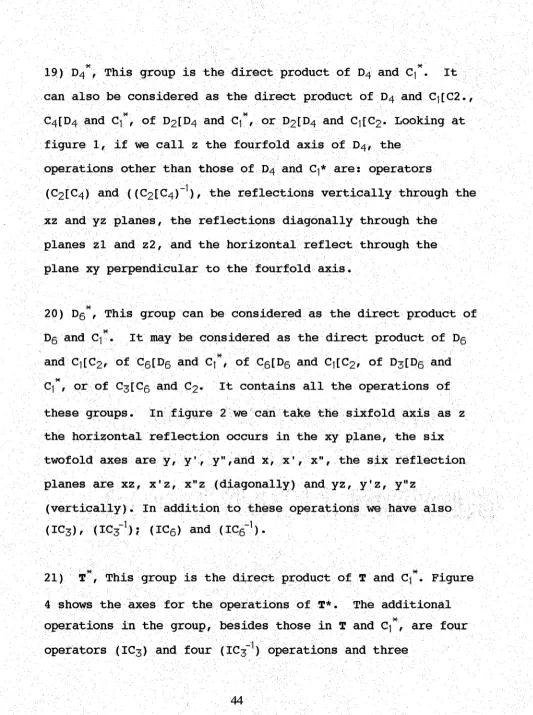
(through poles on opposite faces), and six twofold axes which
passes through the origin O and bisect the opposite edges of
of T, six Operations (C4) and (€4 ^) about the X/ y,and z axes
and six operations (C2) cibout the six^^^t
Zsontetries a ttotatory Inversidn, I
12)
UxG|, This group consist of the identity and the
.-inversibn>' I/' '
13) C2 r This group consists of the identity/ a twofold
rotation (taken about z in figure 1V and a reflection in a
plane perpendicular to this axis (xy plane), and the
inversion, I. It can be considered as the direct product of
the two groups G2 and G|* also it can be considered as the
direct product of G2 and^^%^^
14) G3, This group is the direct product of G3 and
C] . In addition to the operators of G3 and G|* it contains the
operators (IG3) and (IG3~^), refer to figure 2.
15) G4^, This group is the direct product of G4 and G^*. It
can also be considered as the direct product of G2[G4 and G^*,
or of G2[G4 and GdG2. In addition to the operators of G4 and
Gi* it contains a subgroup isoinorphic to G2[G4, a reflection
horizontally through a plane perpendicular to the axis of
rotation, xy plane, refer to figure 1.
G5 , This group is the direct product of G5 and Gf .It
of C3[C6 and C^*, of C^tCg or C2/ or C3* and G2. The reflection
plane is perpendicular to the sixfold axis. The group
contains in addition to the operations of C5, the
inversion, the horizontal reflection and operators (IC3),
(IC3"^),
and (lGg)>^ refer to figure 2.
17) D2*r This group is the direct product of D2 and Gf**. It
can be considered the direct product of D2 and G|tG2; of G2ID2
and G|* or of G2[I>2 Gi[G2. In addition to the operations of
D2 and G^ it contains reflections through the planes
perpendicular to the three twofold rotations of D2. These
planes are mutually perpendicular and each contain two
rotation axes (planes xy,xZ/ and yz in figure 1).
18) 03'^, This group is the direct product of D3 and G|^. It
can be considered as the direct product of G3|;D3 and G^*. It
contains all the operations of D3, G3[D3, and G|*, and in
addition the operators (IC3) and (IG3~^). in figure 2 we may
tafce the threefold axis as z. The three twofold axes
perpendicular to this and making 120® angles with respect to
one another may be taken as y, y', and y". The three
reflection planes contain the z axis, make 120® angles with
respect to each other and are each perpendicular to one of
the twofold axes. These planes may be taken as xz, x'z, and
©4 ^ This jfrbtip is the direch pioduct
and C|. it
can also bd considered as the direct product of D4 and G|[C2.>
€4104 tod G]'*, of P2ID4 a'tid
or P2ID4
hooking at
figure 1, if we call z the fourfoid axis of P4/ the
operations other than those of P4 and c^* are; operators
(C2IC4) and ((C2EC4)^)/ the reflections vertically through the
xz and yz planes, the reflections diagonally through the
pianes zl and z2, and the horizontal reflect through the
plane xy perpendicular to the fourfold axis.
20) Pg'^/ This group can be considered as the direct product of
Pg and It hiay be considered as tto direct pirodUct of i>g
and C^[C2, Of CgfPg and
of Gg{Pg and C][C2, of PgEPg and
or of CgECg and C2« It contains all the operations of
these groups. In figure 2 we can take the sixfold axis as z
the horizontal reflection occurs in the xy plane, the six
twofold axes are y, y', y",and x, x', x", the six reflection planes are xz, x'z, x"z (diagonally) and yz, y'z, y"z
(vertically). In addition to these operations we have also
.<iG3;);''':(iGg^j
21)
, This group is the direct product of T and G^*. Figure
4 shows the axes for the operations of T*. The additional
operations in the group, besides those in T and C|^> are fonr
reflections through the xy, yz, and zx plaiies
shown in figure 3.
22) 6^> This group is the direct product of O and Cj* and
consists of ail operations which send a gube into itself, It
may also be considered as the direct product of T[0 and
and contains all the operation of O, T[0, and T- ^refer to
■figure-\3-* ■ \ -v
Those Point Groups which contain a Rotatory Reflection;
indicates rotation 23t/n followed by a refleptioh in a piane
perpendicular to the axis of rotation
23) Ci[C2f This group is iScxi©
to C2f consists Of
identity and a reflection (taken in the xy plane) (C| )
24) C2[C4, This is a cyclic group isofflorphiO to C4, consisting
of the identity; the rotatory reflection (C47, a twofold
rotation/ (€4^1; and the Operation ot (C'r') '
rotations
are taken about the z axis in figure 1.
25) C3tC6/ This group is isomorphic to Cs, and consists of a
rotation about the threefold axis z, and a reflection in a
plane perpendicular to the z axis , refer to figure 2. In
operators (C3) and (C3 , Shis group may he considered as
the direct product of C3 and C][C2.
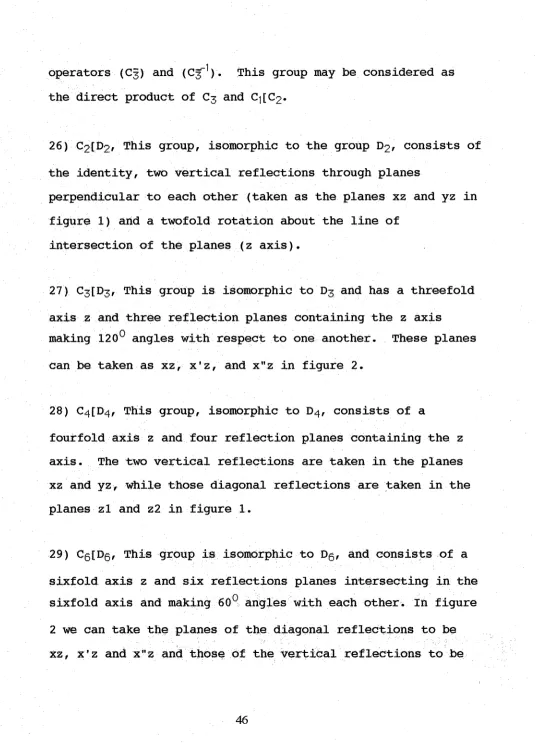
26) C2tD2, T'^is group, isomorphic to the group D2, consists of
the identity, two vertical reflections through planes
perpendicular to each other (taken as the planes xz and yz in
figure 1) and a twofold rotation about the line of
intersection of the planes (z axis).
27) C3[D3, This group is isonrarphic to D3 and has a threefold
axis z an<i three reflection planes containing the z axis
making 120® angles with respect to one another. These p]
can be taken as xz, x'z, and x"z in figure 2.
28) €4(04, This group, isomorphic to D4, consists of a
fourfold axis z and four reflection planes containing the z axis. The two vertical reflections are taken in the planes xz and yz, while those diagonal reflections are taken in the planes zl and z2 in figure 1.
29) GglDe, This group is isomorphic to Dg, and consists of a
sixfold axis z and six reflections planes intersecting in the
sixfold axis and making 60® angles with each other. In figure
2 we can take the planes of the diagonal reflections to be
y'zv y CsEDg may^^ as the direct
product of C3tP3 and C2.
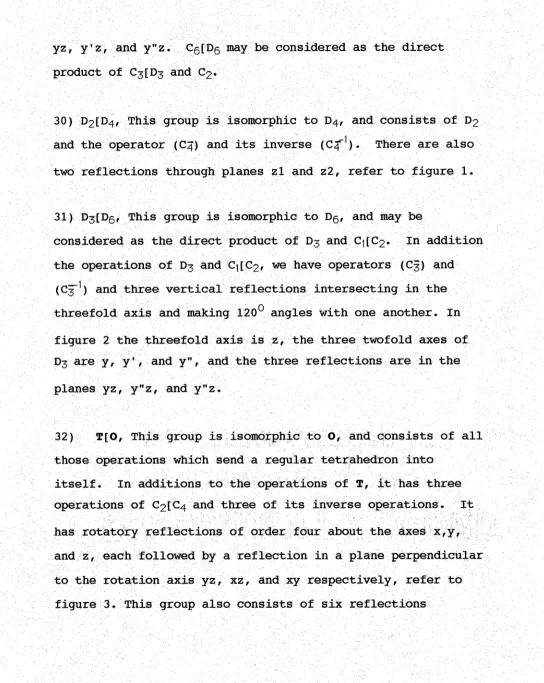
02[04/ This group is isoroorphic to 04/ and consists of 02
and the Operator (C4) and its inverse
). jPhere are also
two reflections through planes zl and z2, refer to figure 1,
31) D3[D6, This group is isomorphic to Dg/ and raay be
considered as the direct product of D3 and C|[02. In addition
the operations of D3 and C][C2, we have operators (C3) and
and three vertical reflections intersecting in the
threefold axis and making 120® angles with on^ another. In
figure 2 tbe tbreefold axis is z> the three twofold axes of
03 ars y/ y', and y", and the three reflections are in the
■planes yz,
32) T[0, This group is isomorphic to O, and consists of all
those operations which send a regular tetrahedron into
itself. In additions to the operations of T, it has three
operations of C2[C4 and three of its inverse operations. It
has rotatory reflections of order four about the axes x,y,
and z, each followed by a reflection in a plane perpendicular
to the rotation axis yz, xz, and xy respectively, refer to
diagonally in the six planes which pass through the center of
the cube and Contain the six edges of the tetrahedron.
Relating the Thirty-two Point Groups to a Crystal Syst^
It can be shown for each of the groups listed there is
an invariant space lattice that satisfies the symmetry of
each point group and thus there are exactly thirty-tWO
geoDaetrically distinct finite orYstallographic point groups
in three-dimension. Gadolin emphasized that the point group
symmetry determihes the physical properties of a crystal
(ingel 120)
in crystallography the group elements are
non-translational symmetry operations. These symmetry operations
form a finite group, in this case a point group> for this
type of group maps a point to a finite number of positions,
and this in^lies that all symmetry elements in a class have
at least one fixed point ih common (Jong 20).
Just a note further concerning the symmetry operation.
Bishop pointed out that such an operation can have no effect
on any physical property of the crystal molecule. He also
notes that the operation is applied to the molecule itself
and not the set of spatial axes (10).
There are five different types of symmetry operations
which we have established as finite direct isometries whose
subgroups must satisfy the crystallographic restriction, that
Siace Grystais are formed by the repetition in three
dimensions of a unit structure, the limiting surfaces depend
in part on the shape of the unit. Each lattice is the
framewc»rk on which a crystal is built and is referred to as
its space lattice. As a tesult, we can determine the unit
cell (or primitive lattice) of the space lattice, which is
the smallest parallelepiped outlined by the space lattice
that fc€5eps exactly one point invariant. A unit cell of a
crystal is defined as any polyhedron with the following tvx)
properties, where a translation or symmetry operation is
defined as that Operation by which point A is moved to point
A' to an identical environment such that A' = A +nja + n^b +
nsc and n^, 1x2, and ng are arbitrary integers and a, b, c are
basis vectors of the parallelepiped.
t) None of the translation operations, other than the
identity operations, m = 02 = hg = 0, results in a translated
parallelepiped which overlaps the original one.
it) The complete set of jpafalleiepipeds^ g
from it by
all the cibove translation operations cover all points in
space. ■ ' /I'
The most convenient way to select a unit cell is to associate an arbitrary point with its origin? the infinite
array of translated points Aj, with A chosen to be the origin,
then constitute the crystal lattice. Let A be a point and g^ a
Ai(the translated A by g^), then we choose 92, again of minimal
not in the direction of L and let B be the plane
determined by A, A^ and A2(the translated A by g2). Next we
choose g3 whose direction is not along plane B and is of
minimal length. The point A and its seven images under g^, g2.
93f 91 + 92/ 9t + 93/ 92+ 93/ 9i + 92 93 are the vertices
of a closed parallelepiped and contain no other points in the
mapping of A. If we let g be any translation in G, then
since
g2f and g3 are independent there are real numbers,
a|, a2r and a3, such that g = aig^ + a2g2 + a3g3. Some non
trivial g, generates G and clearly a point A and its three
images under g^, g2/ and g3are independent. Therefore if G is
a three-dimensional lattice group then the parallelepiped
formed by a point A and its images under the simplest sevett
combincitions of the generators is called a primitive cell
(Yale 100-101)
in some simple structures the origin is chosen to
coincide with the center of an atom of a crystal but this is
not necessary since the essential property of a lattice is
that every lattice point has the same environment in the same orientation. The external inorphology of the crystal may show other additional symmetry than those displayed by a
parallelepiped where vectors a. ^ h ^ c and angles a* p?' y.
The arrangement of lattice points must possess all the
symmetry of the external morphology and it is appropriate to
the presence of a fourfold rotation axis enables a cell which
is a tetragonal prism to be identified*
A three dimensional lattice A is completely determined
by a point p and a discrete group U of translations in three
independent directions (vectors a, b, c) applied to p. This
group 0 is a lattice point group. Conversely, if we are given
a three-dimensional lattice A and a point p taken to be the
origin of A, the lattice group u can then be completely
determined.
Tl^iree diiaensiohal lattices are classified into crystal
systems determined by the largest crystallographic point
group leaving the lattice invariant. To show how these
thirty-two crystallographic point groups are related to
exactly seven crystal systems we need to first define the
holohedlry of a lattice group.
If we are given a lattice A we can define the holohedry
of A, v^hich is the largest crystallographic point group
leavincf a point p fixed and preserving the lattice point
group V as a whole. We say two lattices are geometrically
eguivalent if their holohedries are geometfically equivalent.
This raeans there exists a nonsingular transfofraation S such
that tine holohedries H and H' are related by H' = S~%S. This
is true when there are bases for the vector space such that
the matrix groups corresponding to the holohedries are the
seven systems. For each crystal system the holohedry is
determined.
Tl^e next process is to determine those Constraints
placed on choosing the crystallographic point group that
satisfies as a holohedry. Since, as previously remarked on
page 34|, of the thirty-two crystallographic point groups,
only those containing an inversion can be a candidate for a
holohed^. This iamiediate^^ limits oui poisi^^
the
eleven point groups Cj:, U
C^*, n = 1,2,3,4,5. 0^0 x^^
n = 2, 3, 4, 6? T '
■U ' -xT'
Q*:\^^''The next"'
requirement is that it must contain a mirror plane
perpendicular to the axis of rotation [Yale, 109]. So among
the eleven classes of crystallographic point groups
containing a rotatory inversion the groups C3*, C4*, Cs*, and
T* are Eliminated as possibilities for a holohedry. Each
remaining seven point groups can be associated with at least
one three-dimensional lattice which represents one of the
seven hblohedries or crystal systems. The simplest of each of
these ate listed below by specifing the relation of the
lengths; and angles between the set of three axes. These
lattices are known as primitive lattices.
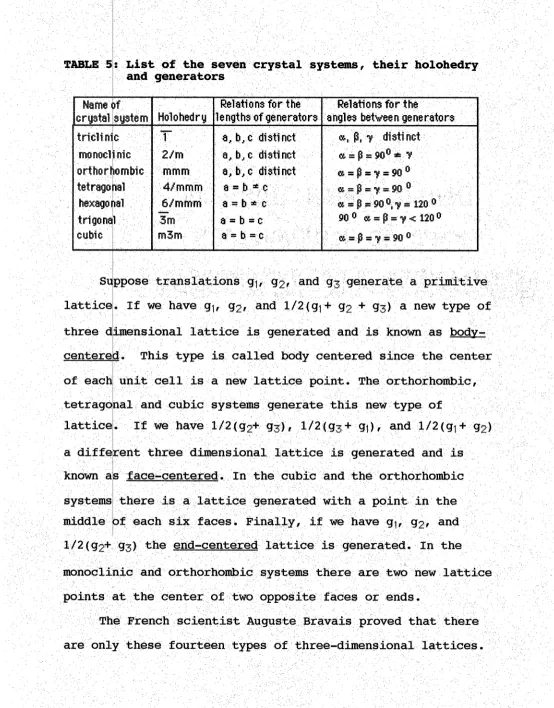
Tlie following table lists the seven crystal systems,
their Irolohedry and generators [or the relationship of the
TABLE 5t List Qf the seven crystal systenui, their holohedry
ancl generators
Name of Relations for the Relations for the
crystal system Holohedry lengths of generators angles between generators
triclln 1 a; b,c distinct tt, (J, -y distinct
monod mc 2/m a, b,c distinct ft =|J = 9oO* T
orthorhombic mmm a; b:,c distinct
tt =(J =7=9Q ®
tetragonal 4/mmm a = b * chexagonal 6/mmm a - b * c
« = p s
= 120 b'
900 ft = p = y< 120®trigonal 3m a = b = c
cubic m3m a = b = c (»sp = y = 90®
Suppose translations g2, and q-^ generate a primitive
lattice. If we have g^, g2f and 1/2(g^+ g2 + g^) a new type of
three dimensional lattice is generated and is Hnbwn as
body-centered. This type is called body centered since the center
of each unit cell is a new lattice point. The orthorhombic, tetragonal and cubic systems generate this new type of
lattice If we have 1/2(g2+ gs), 1/2(g3+ g^), and 1/2(g^t g2)
a different three dimensional lattice is generated and is
known as face-centered. In the cubic and the orthorhonflsic
systems there is a lattice generated with a point in the
middle of each six faces. Finally, if we have g^, g2, and
1/2(g2+ g3) the end-centered lattice is generated. In the
monoclinic and orthorhombic systems there are two new lattice
points at the center of two opposite faces or ends.
The French scientist Auguste Bravais proved that there
There are seven different shapes of primitive unit cells. Each of these unit cells exhibits the highest symmetry
possibie, that is its holohedry (Brown 4). The remaining of
the fourteen Bravais lattices Contain at least one additional lattice point in the unit cell, and therefore are not true
primitive unit cells. The interpretation of the additional
lattices in terms of the seven primitive lattices are chosen by Bravais in order to bring out more clearly the
relationship between the lattice and the crystal symmetry.
Pictured are the Bravis lattices, grouped by holohedry or crystal system (Brown 4).
The Bravis Lattices grouped by Crystals Systerns
P
D
h
PrimHiva
/
Primitive End-cetitfiFed
Unit CEll UnitCETl
9CP Primitlva Unit'Cell Face-centered or Primitive HEXAGONAL 90 Primitive Unit dell i^.'
.:<■
'JV, V
i''14
.X
i'/
r I'V
l" X L bV
Q \ ■ J".
7
End-centared
Body-centered
FaDed-centered
ORTHORHOMBIC
71
i ' »/
\
90'
Primitive Body-centered
o j a
RhombDhedral Unit Cell
TRIGONAL (RHOMBOHEDRAL) TETRAGONAL
^V-\ ^
/X,
fl Vv"
t I ■. . a
^ a V
i^/7tr^T~z
If''
Body-CBniered Face-Gentered
Having looked at the symmetry operations of the
thirty-two point groups we will now discuss EaulB. Yale's diagram
of the subgroup relations for these point groups. A detailed diagram for each point group's symmetry axes will be
Chapti^r Four: Yales pl^gram of 'the Subgroup Rel