STUDENT PERCEPTIONS OF INSTRUCTOR IMMEDIACY IN ONLINE PROGRAM COURSES
by
Anthony Charles Saba
A dissertation
submitted in partial fulfillment of the requirements for the degree of Doctor of Education in Educational Technology
Boise State University
© 2018
DEFENSE COMMITTEE AND FINAL READING APPROVALS
of the dissertation submitted by
Anthony Charles Saba
Dissertation Title: Student Perceptions of Instructor Immediacy in Online Program Courses
Date of Final Oral Examination: 14 September 2018
The following individuals read and discussed the dissertation submitted by student Anthony Charles Saba, and they evaluated his presentation and response to questions during the final oral examination. They found that the student passed the final oral examination.
Patrick R. Lowenthal, Ph.D. Chair, Supervisory Committee Chareen Lee Snelson, Ed.D. Member, Supervisory Committee Ross Perkins, Ph.D. Member, Supervisory Committee
iv DEDICATION
v
ACKNOWLEDGEMENTS
I would also like to acknowledge my dissertation committee: Dr. Patrick
Lowenthal, who guided me from obscurity, captured my intent, directed me to the topic of immediacy, and provided extensive feedback; Dr. Ross Perkins who actively cheered me on throughout the years and encouraged me to apply for a position at eCampus; and Dr. Chareen Snelson who has demonstrated to me what encompasses a truly dedicated faculty member. I would also like to acknowledge all those in the EDTECH program at Boise State for inspiring me to grow throughout the years, including: Dr. Lisa Dawley who demonstrated fantastic leadership and inspiration at the outset; Dr. Jui-long (Andy) Hung who spent many hours talking with and encouraging me; Dr. Yu-Chang Hsu who challenged me to improve my academic writing; and Dr. Barbara Schroeder who guided me through the teaching of many courses. Additionally, I would like to thank all the folks at eCampus, especially: Dr. Christine Bauer for her sponsorship and support, Dr. Lisa Berry for her advice, Dr. Rob Nyland for connecting me with the right people, Alan Copeland for helping identify my sample, Tyler Winchester for last minute help on my video, Nicolle Dickey for expressing genuine interest, and Dr. Eulho Jung for his friendship, advice and support. I would also like to acknowledge Dr. Kirk Ketelson for his guidance on the quantitative aspects of my paper and Dr. Nick Warcholak for helping me with my sample. Additionally, I would also like to acknowledge the students who responded to my survey and participated in interviews. Finally, I would like to
vi
vii ABSTRACT
The first online course was taught over 30 years ago. Over that time, instructors have primarily used text-based asynchronous communication in the online courses they teach. However, advances in technology over the last ten years have given rise to more
opportunities to use new synchronous and semi-synchronous communication
technologies (e.g., video, mobile and social networking technologies) in online courses. These advances in technology are likely to not only influence how instructors today communicate in the online courses they teach but ultimately influence their instructor immediacy. Instructor immediacy is the degree of psychological closeness students perceive there to be with their instructor. Overall, though, there has been very little research conducted on instructor immediacy in online learning. Given this, the purpose of this study was to explore behaviors that students perceive to contribute to or detract from instructor immediacy. More specifically, I conducted a sequential explanatory mixed methods research study to investigate student perceptions of instructor immediacy in online programs. Quantitative results found significant and moderate correlations
viii
TABLE OF CONTENTS
DEDICATION ... iv
ACKNOWLEDGEMENTS ...v
ABSTRACT ... vii
LIST OF TABLES ... xiv
LIST OF FIGURES ... xvi
LIST OF ABBREVIATIONS ... xviii
CHAPTER ONE: INTRODUCTION ...1
Benefits of Instructor Immediacy ...3
Instructor Immediacy and Online Learning ...4
Distinguishing Between Immediacy and Social Presence ...6
Statement of the Problem ...10
Theoretical Framework ...12
Learning and Arousal Models of Immediacy ...12
Motivation Model of Immediacy ...14
Arousal and Motivation Combined Model ...16
Affect Model of Immediacy...18
Model Grounding this Study ...19
ix
Research Questions ...21
Overview of Methods ...21
Sample...22
Data Collection and Analysis...22
Reliability and Validity ...24
Significance of the Study ...24
Chapter Summary ...25
CHAPTER TWO: REVIEW OF THE LITERATURE ...27
Immediacy Theory Overview ...27
Abbreviated Approach-Avoidance ...31
Proximity, Synchronicity, and Sensory Stimulation ...32
Immediacy and Medium Effects ...33
Instructor Immediacy Research in Higher Education ...36
Perceptions of Cognitive Learning ...40
Nonverbal Immediacy Measures ...44
Verbal Immediacy Measure ...46
Criticisms of Immediacy Research in Higher Education ...49
Criticisms of Nonimmediacy Research ...49
Criticisms of Verbal Immediacy Research ...52
Synthesis of Findings of Instructor Immediacy Research ...53
Immediacy as a Nonlinear Phenomenon...55
Differing Effects of Verbal and Nonverbal Immediacy ...58
x
Medium Effects ...63
Ethnic and Cultural Effects ...64
Instructor Immediacy and Perceptions of Power ...67
Immediacy and Instructor Credibility ...72
Immediacy and Clarity ...75
Immediacy and Receiver Apprehension ...76
Immediacy and Face Threat Mitigation ...77
Instructor Immediacy in Online Instruction ...82
Verbal Immediacy in Text-based Online Learning ...83
Nonverbal Immediacy in Synchronous (Video-based) Online Courses ....85
Social Presence and Immediacy in Online Courses ...86
Student-Student Immediacy ...89
Verbal and Nonverbal Immediacy in Online Learning ...90
Gaps in the Literature...93
Chapter Summary ...95
CHAPTER THREE: METHODS ...96
Research Questions ...96
Research Design and Rationale ...97
Survey Design ...102
Verbal and Nonverbal Immediacy Measures ...103
Cognitive Learning Measure...107
Affective Learning Measure ...108
xi
Participants ...109
Data Collection ...112
Phase One (Quantitative): Survey ...112
Phase Two (Qualitative): Follow Up Interviews ...114
Data Analysis ...118
Phase One Data Analysis (Quantitative)...118
Phase Two Data Analysis (Qualitative) ...119
Validity and Reliability ...120
Credibility and Transferability ...120
Delimitations ...121
Limitations ...123
Role of the Researcher ...123
Biases ...124
Chapter Summary ...125
CHAPTER FOUR: RESULTS ...127
Phase One Data Analysis ...127
Factor Analysis Results...129
Cronbach’s Coefficient of Reliability ...135
Findings Related to Research Question 1 ...136
Findings Related to Research Questions 2 and 3 ...138
Findings Related to Research Question 4 ...141
Summary of Phase One Results ...147
xii
Commitment to the Role ...150
Student Advocate ...154
Accessible and Responsive ...161
Extensive and Continuous Guidance and Feedback ...170
Encouraging and Reassuring...179
Chapter Summary ...185
CHAPTER FIVE: DISCUSSION ...187
Key Findings ...188
Verbal and Nonverbal Immediacy in Online Courses ...189
Engagement and Interaction Cycle ...194
Synchronous and Asynchronous Communication ...201
Instructor Videos ...205
Threshold Effect...206
Positive Tone ...208
“Middleness”...210
Humor ...212
Summary of Key Findings ...214
Theoretical Contributions ...215
Immediacy and Objective Cognitive Learning ...216
Elaborated Model of Immediacy Theory ...221
Limitations of Study ...227
Concluding Thoughts and Implications ...230
xiii
APPENDIX A ...259
Initial Email Cover Letter ...260
Survey Link Email Cover Letter ...261
Informed Consent...262
Survey Instructions ...263
Survey Questions ...264
APPENDIX B ...267
APPENDIX C ...269
APPENDIX D ...274
APPENDIX E ...277
APPENDIX F...286
Engagement and Interaction Cycle Checklist ...287
Initiation Stage: Indicate Immediacy ...287
First Stage: Encourage Approach ...287
Second Stage: Engage and Interact ...288
Third Stage – Fulfill Immediacy Proposition ...288
APPENDIX G ...290
The Advocate at my Side ...291
The Guide on the Side...291
xiv
LIST OF TABLES
Table 2.1 Nonverbal Immediacy Measures ... 46
Table 3.1 Data Collection Matrix ... 100
Table 3.2 Survey Sample Participant Frequency by Degree Program ... 113
Table 3.3 Number of Semesters in Online Program ... 114
Table 3.4 Interview Participant’s Listed by Total Immediacy Rank ... 116
Table 4.1 Pattern Matrix of Verbal and Nonverbal Immediacy Variables Forced onto Two Factors ... 132
Table 4.2 Factor Matrix of Verbal and Nonverbal Immediacy Variables Forced onto One Factor ... 134
Table 4.3 Verbal Immediacy Item Response Frequencies and Measures of Central Tendency ... 137
Table 4.4 Nonverbal Immediacy Item Response Frequencies and Measures of Central Tendency ... 138
Table 4.5 Pearson’s Correlation Analysis of Verbal Immediacy Variables ... 140
Table 4.6 Pearson’s Correlation Analysis – Nonverbal Immediacy Variables... 141
Table 4.7 Split Sample Ranking of Variables by Total Verbal Immediacy Mean . 142 Table 4.8 Split Sample Ranking of Nonverbal Immediacy Variables by Their Means ... 143
Table 4.9 Instructor Reply Speed on Questions in the Course and Feedback on Assignments ... 144
xv
Table 5.1 Comparison of Pearson’s Correlation Coefficients (r) Immediacy and Learning ... 190 Table 5.2 Immediacy Behaviors Most Frequently Used by High Immediacy
xvi
LIST OF FIGURES
Figure 1.1 Formal and informal instructor roles (Arbaugh, 2010, p. 1235) ... 10
Figure 1.2 Immediacy directly affecting cognitive and affective learning, e.g., the Learning Model ... 13
Figure 1.3 Motivation Model of Immediacy ... 14
Figure 1.4 Combined Immediacy Model (Frymier, 1994) ... 16
Figure 1.5 Combined Immediacy Model (Christophel and Gorham, 1995) ... 17
Figure 1.6 Affective Learning Model (Rodriguez et al., 1996) ... 18
Figure 2.1 Relation of Pleasure and Arousal with Liking (Mehrabian, 1981) ... 28
Figure 2.2 Basic Approach-Avoidance Model as described by Mehrabian (1981) ... 29
Figure 2.3 Approach-Avoidance as the Dominant Person's Prerogative ... 30
Figure 2.4 Approach When Power is Symmetrical and Autonomous (Mehrabian, 1981) ... 31
Figure 2.5 Effect of Medium Selection on Perceived Immediacy ... 34
Figure 2.6 Communication Adaptations for Low Proximity Medium to Signify Immediacy... 36
Figure 2.7 Immediacy Learning Model ... 37
Figure 3. 1 Procedures and Products for Each Phase of this Sequential Explanatory Mixed Methods Study ... 99
Figure 4.1 Scree Plot for Factor Analysis ... 131
Figure 4.2 Frequency of Communication Channels Reported to be Used ... 145
xvii
xviii
LIST OF ABBREVIATIONS BAT Behavior Alteration Techniques BII Behavioral Indicants of Immediacy
CMIB Computer-Mediated Immediacy Behaviors
CoI Community of Inquiry
GI General Immediacy measure
KMO Kaiser-Meyer-Olkin measure of sampling adequacy
LMS Learning Management System
NBI Nonverbal Immediacy Behaviors measure
NIM Nonverbal Immediacy Measure
O Other
P Person
CHAPTER ONE: INTRODUCTION
Between 2012 and 2015, the total enrollments in higher education in the United States dropped by 3.2% to 20,266,367 students while during that same period, the number of students taking distance education courses grew by 11% reaching a total of six-million students, representing 29.7% of all students in higher education in the Fall of 2015 (Allen & Seaman, 2017). Due to this growth, coupled with decreases in enrollments overall, universities have been looking to online learning as a way to increase enrollments while also reaching previously underserved communities. Online learning has become popular for students as well, particularly those who cannot attend traditional face-to-face classes, due to its potential to provide “flexible access to content and instruction at any time, from any place” (Means, Toyama, Murphy, Bakia, & Jones, 2010, p. 1).
2009). Initiatives to improve online course design, such as the Quality Matters framework (Shattuck, 2012), have helped improve learning outcomes, student satisfaction, and student retention in online courses (Martin, Ndoye, & Wilkins, 2016). Despite many improvements in online course design, online learner retention rates still remain
significantly lower than face-to-face courses across disciplines and universities (Allen & Seaman, 2013; Glazier, 2016); while the numbers vary, retention rates for online courses are between 10% and 35% lower than in-class retention rates (Glazier, 2016; Smart & Saxon, 2016).
One explanation for lower retention rates in online courses could be the sense of isolation and lack of guidance that students often report feeling when courses have low levels of student-instructor interaction (Cole, Shelley, & Swartz, 2014; Jackson, Jones, & Rodriguez, 2010; Kim, Liu, & Bonk, 2005; Kruger-Ross & Waters, 2013; Richardson, Koehler, Besser, Caskurlu, Lim, & Mueller, 2015; Tichavsky, Hunt, Driscoll, & Jicha, 2015). Research suggests that student-instructor relationships can promote student retention, engagement, and overall academic success (Andersen, Lampley, & Good, 2013; Kim & Lundberg, 2016). By building personal relationships with students, instructors can convey a sense of empowerment and mutual investment in students’ education (Crosnoe, Johnson, & Elder, 2004; McKinsey, 2016). Students report wanting instructors who are willing to listen to their concerns, provide them with timely and high quality feedback, and provide them with guidance on how they can improve (Gaytan, 2015; Lee, Srinivasan, Trail, Lewis, & Lopez, 2011; Vesely, Bloom, & Sherlock, 2007). At the heart of the matter is that students want instructors who they perceive are
2016). When students feel that their instructors are approachable, they are more motivated to persist and succeed in a course (Glazier, 2016). One way in which instructors communicate that they are approachable to their students is through immediacy (Ellis, 1995).
Benefits of Instructor Immediacy
Immediacy refers to communication behaviors that reduce social and
participation (Roberts & Friedman, 2013; Rocca, 2009), decreased anxiety and communication apprehension (Chesebro & McCroskey, 1998, 2001; Ellis, 1995;)
improved perceptions of instructors as caring, competent, trustworthy, and credible (e.g., Guerrero & Miller, 1998; Kerssen-Griep & Witt, 2012; Schrodt & Witt, 2006; Teven & Hanson, 2004; Thweatt & McCroskey, 1998) and higher perceptions of homophily and interpersonal attraction (e.g., Edwards & Edwards, 2001; Rocca & McCroskey, 1999). In addition, it has been found that immediacy is a skill that can be taught (Jensen, 1999).
Instructor Immediacy and Online Learning
Although there has been extensive research on instructor immediacy in the
such as health, engaging low-participation students, and treating student questions with importance.
In another recent study, Campbell (2014) pointed out that few researchers have focused specifically on instructor immediacy in online learning environments. In his study, Campbell used a semi-experimental design to look at the level of student
participation in discussion boards in an online course. In the discussion boards, half of the class received a higher immediacy treatment from their course teaching assistants while the other half received “normal” levels of immediacy from their teaching assistants. No statistically significant differences were found in the frequency of postings or course outcomes between the two groups. Campbell attributed the lack of any difference between the groups to possibly being a result of a weak manipulation of instructor immediacy.
Distinguishing Between Immediacy and Social Presence
Instructor immediacy is related to social presence, as well as instructor social presence, and teaching presence (cf. Garrison et al., 2000; Richardson & Lowenthal, 2017; Short, Williams, & Christie, 1976). Social presence is a popular construct used to understand how people socially communicate in online learning environments (Anderson, Rourke, Garrison, & Archer, 2001; Garrison, Anderson, & Archer, 2000; Gunawardena & Zittle, 1997; Swan, 2003). Social presence dates back to the 1970s when Short et al. (1976) introduced the construct. Short et al. conceptualized social presence as the “degree of salience of the other person in the interaction and the consequent salience of the
interpersonal relationships…” (p. 65). Garrison et al. (2000) popularized social presence by including it as one of the three presences of their Community of Inquiry (CoI)
framework. The CoI consists of three core elements: teaching presence, cognitive presence, and social presence. However, CoI research has centered primarily on the development of social presence through positive student-student interaction within a course (Garrison & Arbaugh, 2007). Although instructors are considered part of the dynamic, their interaction with students has been largely minimized in the CoI literature (Pollard, Minor, & Swanson, 2014; Swan, 2003). More recently, researchers have highlighted the importance of instructor social presence (Arbaugh, 2010; Pollard et al., 2010; Richardson & Lowenthal, 2017).
considered immediacy and social presence to be essentially the same thing as well. For example, she stated that “Research on social presence/immediacy [emphasis added] in online environments… has accordingly concerned itself with the immediacy behaviors of all discussion participants” (p. 15). Short et al. (1976) also recognized some similarities between the two constructs. They described immediacy as being particularly relevant to social presence theory and distinguished between two types of immediacy: social
immediacy and technological immediacy (p. 73). Social immediacy, they claimed, is the relational aspects of communication that are conveyed through implicit verbal and non-verbal cues, as conceptualized by Weiner and Mehrabian (1968) and Mehrabian (1966, 1969, 1971, 1972, 1981). Technological immediacy, Short et al. asserted, is the objective immediacy which is afforded by the medium itself such that “the more information a medium can transmit, the greater its immediacy” (p. 73). They pointed out that
technological immediacy may seem similar to their own theory of social presence (p. 73). In order to distinguish between the two theories, Short et al. argued, like
Mehrabian (1981) later did, that the selection, itself, of a communication channel by a communicator may be construed by the addressee as connoting more or less approach-avoidance and like-dislike. For example, if one were to telephone another who is close-by, the other person might construe that as nonimmediate behavior by the addressee. Conversely, telephoning someone who is physically very distant would not carry such connotations since it is a matter of practicality. Thus, the distinction made is that, with the immediacy construct, an addressee makes judgements as to the intentions and
motivated to select one medium over another based on the desired degree of immediacy or nonimmediacy conveyed (i.e., the desired level of positive or negative socio-emotional interaction) with the addressee. Social presence, Short et al. claimed, does not carry such connotations. They asserted that the social presence afforded by a telephone would be the same whether someone is nearby or distant – unless the quality of the sound is poor (p. 73).
Short et al.’s distinction is that while both constructs focus on the ability of the medium to convey socio-emotional cues through implicit verbal and nonverbal
communication, immediacy-nonimmediacy is a construct of positive-negative affect (Gottlieb, Wiener, & Mehrabian, 1967; Wiener & Mehrabian, 1968) where coded and decoded implicit messages are interpreted to signal like/dislike and approach/avoidance; on the contrary, social presence is a neutral construct focusing on the level of “salience” of the other, necessary to task achievement, which is affected by the degree to which the medium affords the communication of socio-emotional cues (Short et al., 1976). In other words, social presence, as conceived of by Short et al., is not concerned with how
positive or negative feelings are communicated across a medium or how the medium affects positive and negative feelings, intended or perceived. From Short et al.’s perspective, social presence is focused on the nature of the task where the socio-emotional cues required for the task achievement are viewed in utilitarian terms. This contrasts with immediacy theory which is focused on how the implicit aspects of communication reveal and convey information about feelings of like and dislike.
presence and immediacy literature have pointed out a need to more clearly define social presence and distinguish it from other constructs such as immediacy (Lowenthal, 2009; Richardson & Lowenthal, 2017). Moreover, social presence and CoI researchers have also pointed out that there has been a minimization of the unique role that instructor’s play in online learning (Arbaugh, 2010; Pollard et al., 2014; Richardson & Lowenthal, 2017). Such researchers have pointed out a need to distinguish between teaching
Figure 1.1 Formal and informal instructor roles (Arbaugh, 2010, p. 1235)
Both the immediacy and the social presence literature have pointed to either immediacy or instructor presence as an informal role of the instructor that takes place during the instructional process. While the distinction between immediacy and social presence is still not clear, what is clear is that there is a need for more research on the unique role of the instructor in online courses and how their communication behaviors during course delivery contribute to student learning and satisfaction.
Statement of the Problem
learn how to incorporate such behaviors into their instruction due to the fact that there is little understanding of what immediacy behaviors look like in an online context (Baker, 2010; Campbell, 2014; Fahara & Castro, 2015).
The little immediacy research in online learning that has been conducted has generally focused on verbal immediacy in text-based discussion boards. This is because early immediacy researchers claimed that nonverbal immediacy could not be established in online courses due to the lack of socio-emotional cues in text-based, asynchronous communication (e.g., Baker, 2004; Hutchins, 2003; Jensen, 1999). However, classroom-based research has found that the greatest associations between immediacy and learning have been found when both verbal and nonverbal immediacy are combined (Witt et al., 2004). Recent researchers have begun to note that it is likely that nonverbal immediacy can be communicated in online learning, particularly due to recent technological advancements that allow for synchronous and video-based communication (Ghamdi et al., 2016). Such technologies also would allow for new dimensions of verbal immediacy to be conveyed in online courses. How such technologies contribute to instructor
immediacy, however, is not known.
Although there has been little immediacy research in online learning, there has been extensive research on social presence (Pollard et al., 2014; Swan & Ice, 2010). However, social presence research has focused primarily on the formal roles of
Richardson & Lowenthal, 2017). The construct of social presence, itself, is not clear, and is often described in ways that confound it with immediacy (Lowenthal, 2009). This is partially due to the fact that Short et al.’s (1976) original construct was closely related to immediacy. Adding to this confusion is the fact that measures of social presence are often based on the construct of verbal immediacy (Gunawardena & Zittle, 1997; Swan, 2003). What instructor immediacy is, particularly in the online learning environment, and how it is distinct from social presence, needs to be clarified.
Given this, the research and practice of online learning can benefit by focusing on the role of instructor immediacy in online learning environments. As such, I conducted mixed methods, sequential explanatory study of instructor immediacy in fully online program courses in order to learn more about student perceptions of specific immediacy behaviors that instructors use that contribute to their learning and course satisfaction.
Theoretical Framework
There are several models that describe how instructor immediacy contributes to student learning. However, each of these models in and of themselves is incomplete (Witt et al., 2010). Proposals for a combined, or integrated, model of immediacy (Christophel, 1990; Frymier, 1994; Witt et al., 2010; Zhang et al., 2007) form the theoretical
framework of this study. A description of the history of the development of models of immediacy are described in the following sections; however, the immediacy literature will be described in greater detail in Chapter 2.
Learning and Arousal Models of Immediacy
McDowell et al., 1980). Such models have been broadly labeled “learning models” (Rodriguez, Plax, & Kearney, 1996). Figure 1.2 depicts the learning model of immediacy. Although early researchers were able to find a direct relationship between immediacy and affective learning, they were not able to find a direct relationship between immediacy and cognitive learning (Andersen, 1978; Andersen, Andersen, & Jensen, 1979).
Figure 1.2 Immediacy directly affecting cognitive and affective learning, e.g., the Learning Model
In order to explain how immediacy could have a direct effect on cognitive learning, Kelley and Gorham (1988) presented a learning model, now known as the arousal model. Working from an information processing perspective, they argued that “immediacy is related to arousal, which is related to attention, which is related to memory, which is related to cognitive learning” (p. 201). To test their model, they
condition had only 11 instances of incorrect sequencing while the subjects in the low immediacy condition had 37 instances of incorrect sequencing. Kelley and Gorham explained that the immediacy behaviors likely provided cues to the subjects that another sequence was coming which allowed them time to prepare to encode for memory storage. Thus, the immediacy cues aroused the subjects and gained their attention, which gave them time to prepare to encode for memory storage, which led to increased learning. Motivation Model of Immediacy
Drawing from motivation research, Christophel (1990) presented a model that depicted immediacy as being mediated by student state motivation rather than acting directly on affective and cognitive learning (see Figure 1.3). In this sequential model, immediacy increases students’ state motivation, which in-turn increases cognitive and affective learning. Christophel (1990) defined state motivation as having “specific directive and stimulating properties…[that] can lead students to arousal and instigative behaviors, give direction and purpose to their behaviors, allow behaviors to persist, and lead to choices of preferred behaviors” (p. 324). This was contrasted with trait
motivation, which has been defined as a more enduring predisposition toward learning (Christophel & Gorham, 1995). Christophel (1990) theorized that immediacy behaviors could “impact levels of learning by modifying student classroom motivation” (p. 325).
Figure 1.3 Motivation Model of Immediacy
cognitive learning. She found that instructor immediacy was positively associated with perceived learning, but that nonverbal immediacy was more predictive of perceived learning than verbal immediacy. Additionally, she also found that most of the variance of nonverbal immediacy was attributable to the state motivation, which she claimed
indicated that nonverbal immediacy must first modify student state motivation (pp. 331-332). Incidentally, she also found that a significant portion of the variance in affective learning could be predicted by nonverbal immediacy, meaning that nonverbal immediacy was mediated through motivation while also having a direct effect on affective learning. However, the direct link between immediacy and affective learning was generally dismissed by Christophel.
In order to test between the learning model and the motivation model, Frymier (1994) conducted a path analysis. She found that verbal and nonverbal immediacy had stronger paths with state motivation than with either affective or cognitive learning; however, similar to Christophel (1990), she also found that immediacy had a direct and significant path with affective learning as well - but in her study, she found verbal
immediacy, though not nonverbal immediacy, influenced affective learning. Frymier, like Christophel (1990), generally dismissed this aspect of the finding.
& Cano, 2008). For instance, Frymier (1993b) found that students with initially low or moderate state motivation at the beginning of the semester had increased levels of state motivation later in the semester when exposed to a highly immediate instructor, while students who were highly motivated at the beginning of the semester maintained high motivation regardless of the instructor’s level of immediacy. Gorham and Christophel (1992) looked at both motivating factors and demotivating factors and found instructor immediacy behaviors accounted for 34% of overall motivators. Additionally, they found that students attribute their lack of motivation in a college class to what the instructor does and attribute their being motivated to more personal factors. In another study, Christophel and Gorham (1995) found consistent results. In their study, 63% of students attributed motivation to self-owned sources while 62% of students attributed
demotivation to instructor-owned sources. Arousal and Motivation Combined Model
Citing Kelley and Gorham’s 1988 study, which established a direct connection between immediacy and cognitive learning, Frymier (1994) suggested combining the motivation model with the arousal model, as depicted in Figure 1.4, stating that:
“immediacy arouses students, gets their attention, which enhances motivation, which in turn increases learning” (p. 141).
Figure 1.4 Combined Immediacy Model (Frymier, 1994)
their attention and enhances their motivation, (c) which increases learning (affective and cognitive).”
Figure 1.5 Combined Immediacy Model (Christophel and Gorham, 1995)
While similar, there are some notable differences between these two combined models. Christophel and Gorham specifically included affective and cognitive learning, while Frymier focused just on learning. Moreover, Gorham has previously argued that Bloom, Englehart, Furst, Hill, and Krathwohl’s (1956) conception of affective and cognitive learning were not mutually exclusive (Kelley & Gorham, 1987), which Christophel and Gorham’s model supports. Christophel and Gorham spoke of directing attention while Frymier spoke of getting attention. Additionally, Christophel and Gorham described immediacy as directing attention and enhancing motivation while Frymier places the getting of attention as a separate step between motivation and immediacy. In other words, in Frymier’s model, the arousal that occurs as a result of instructor immediacy activates the student’s motivation while in Christophel and Gorham’s model the arousal that occurs as a result of instructor immediacy works to both direct the student’s attention and
in Christophel and Gorham’s model, the instructor’s immediacy has two functions - to act as a cue to direct cognitive attention while also acting as a motivational device to foster learning. Although this distinction has not been explicitly described in the literature, it is nonetheless important.
Affect Model of Immediacy
The learning model of immediacy and the motivation model of immediacy were both challenged by Rodriguez et al. (1996). They argued that “affective learning is the central causal mediator between nonverbal immediacy and cognitive learning” (p. 296). In this model, depicted in Figure 1.6, immediacy is conceived of as working to enhance affect for instruction and course content, which in turn influences cognitive learning (Allen et al., 2006; Rodriguez et al., 1996; Witt et al., 2010).
Figure 1.6 Affective Learning Model (Rodriguez et al., 1996)
into a causal chain as Frymier (1994) had done. They claimed that since affective learning is the domain that focuses on the adoption of beliefs and attitudes, “affect is by definition, an intrinsic motivator” (p. 297).
Allen et al. (2006) conducted a test of the affect model using data from Witt et al.’s (2004) seminal meta-analysis. They looked at the average correlations between measures of immediacy and cognitive learning, immediacy and affective learning, and cognitive and affective learning. They found that the data were consistent with a model where instructor immediacy behaviors predict or cause a level of affective learning and that the level of affective learning predicts or causes the level of cognitive learning. Moreover, they interpreted the results, saying “teacher behavior creates a motivational affective outcome that substantially contributes to the generation of a cognitive outcome” (p. 26). In another study, Allen et al. (2007) described immediacy as “a positive
reinforcement that creates a motivation for the student to interact with the instructor and creates a sense of reward or positive valence. The likely result of high immediacy is an increase in the desire of the student to perform the role of student or learner in the classroom” (p. 24).
Model Grounding this Study
Rodriguez et al.’s (1996) first argument that the affect model is more parsimonious with Bloom et al.’s (1956) taxonomy is not supported. Bloom et al. conceived of the two domains as not being mutually exclusive and conceived of each domain as influencing and reinforcing the other. While affective learning contributes to cognitive learning, as Rodriguez et al.’s model depicts, cognitive learning also
second argument that immediacy has been consistently associated with affective learning, but less so with cognitive learning does not support their model, but rather contradicts it. By pointing out that immediacy is less associated with cognitive learning, Rodriguez et al. are at the same time acknowledging that immediacy has been found to have some direct effect on cognitive learning. The relationship between immediacy and cognitive learning has been found to be supported in several studies, including Witt et al.’s (2004) seminal meta-analysis. Rodriguez et al.’s model does not account for immediacy’s direct influence on cognitive learning. Finally, Rodriguez et al.’s third argument is that affect and motivation are the same thing since affect “is by definition, an intrinsic motivator” (p. 297). This contrasts with Bloom et al.’s (1956) construct of affective learning, which considers affective learning to be a process of internalization of initially external values, through various stages leading to intrinsic valuing, e.g., characterizing. Moreover, claiming that affect is, by definition intrinsic motivation, does not account for extrinsic motivation nor varying degrees of motivation from extrinsic to intrinsic, as modeled in Ryan and Deci’s (2000) self-determination theory.
Purpose of the Study
The lack of research on instructor immediacy in online learning represented a gap in the literature. Given the aforementioned problems, the purpose of this study was to explore what behaviors students perceived contribute to instructor immediacy in online learning environments.
Research Questions
The overarching research question for this study was, what behaviors do students perceive develop instructor immediacy and supports their learning in fully online programs? More specifically, this study sought to answer the following five sub-questions:
1. To what degree do students perceive instructor immediacy in fully online program courses?
2. What is the relationship between perceived instructor immediacy and learning in fully online program courses?
3. What is the relationship between instructor immediacy and student satisfaction in fully online program courses?
4. What instructor behaviors do students perceive contribute to immediacy in fully online program courses?
5. How do students feel instructor immediacy supports their learning in an online course?
Overview of Methods
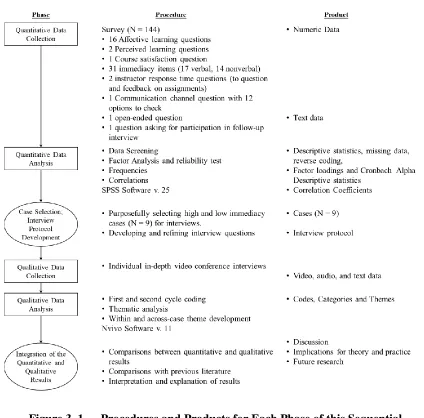
used a sequential explanatory mixed-methods research design (Creswell, 2008; Ivankova, Creswell, & Stick, 2006). Sequential explanatory research uses a two-phase model where quantitative data is collected in the first phase and qualitative data is collected in a second phase in order to further elaborate on the quantitative results (Creswell, 2008; Ivankova, et al., 2006). The combination of both methods takes advantage of the strengths of each and allows for a more robust analysis (Ivankova et al., 2006).
Sample
There were 2,216 students enrolled in courses in fully online programs at Boise State University at both the graduate and undergraduate level at the time of this study. In the first quantitative phase, a survey was sent to 422 students who have completed at least one course in an online program and 177 students responded, representing a 42%
response rate. In the second qualitative phase of the study, nine students were purposefully selected to take part in a follow up interview.
Data Collection and Analysis
qualitative research, is a purposeful sampling method in which participants are selected in a way that maximizes variation based on a set of criterion so as to reflect differences or different perspectives (Creswell, 2013). By maximizing variation, any common patterns that are found are of particular interest because of the fact that they emerged despite great variation (Patton, 2002).
The goal of the interviews was to develop themes though the use of constant comparative method. When using the constant comparative method, “the researcher attempts to ‘saturate’ the categories – to look for instances that represent the category and to continue looking (and interviewing) until the new information obtained does not provide further insight into the category” (Creswell, 2013, Chapter 8, Grounded Theory Analysis and Representation, para. 2). By the end of the ninth interview, I determined that saturation had been achieved, based on two criteria: first, no new themes were emerging by the ninth interview despite the wide variance in demographics of student interviewees; second, I had achieved a high level of elaboration in describing the
achieved was sufficient to answer the focused research questions for this study which were not comparing groups.
An initial set of interview questions was developed based on the research questions. Additionally, follow up questions explored themes that emerged during interviews. Interviews were conducted and recorded using the video-conferencing software Zoom. Recordings were transcribed and analyzed using first and second cycle coding to develop categories and major and minor themes (Saldana, 2016). Themes were layered upward and interrelated in order to develop a more complex understanding of them (Creswell, 2008). Five themes emerged, including: Commitment to the role, student advocate, accessible and responsive, extensive guidance and feedback, and encouraging and reassuring. The results described in Chapter Four of this paper and elaborated on in Chapter Five.
Reliability and Validity
In order to validate the findings, the study was guided by the theoretical framework of the study. Moreover, findings were corroborated through member checking, comparisons with the quantitative data and the open-ended question on the survey from phase one, and comparisons with the literature. Additionally, rich and thick descriptions are provided in the narrative descriptions in Chapter Four.
Significance of the Study
how instructor immediacy is perceived by students in fully online programs. Additionally, it sheds some light on the distinction between the constructs of social presence and immediacy. The results of this study can also be used to help improve the design and delivery of online courses to better support student learning outcomes.
Moreover, understanding how instructors can improve their immediacy in online courses can potentially improve student satisfaction and retention.
Chapter Summary
Online learning in higher education has grown tremendously over the last 20 years and continues to do so. Although online learning has been found to be as effective as traditional classroom-based instruction in achieving learning outcomes, retention rates of online courses are much lower. One explanation for the lower retention rates may have to do with a lack of student-instructor interaction, particularly informal communication. Students want instructors whom they perceive as being approachable. When students feel that their instructors are approachable, they are more motivated to persist and succeed in a course. One way in which instructors communicate that they are approachable to their students is through immediacy.
CHAPTER TWO: REVIEW OF THE LITERATURE Immediacy Theory Overview
Immediacy is defined as behaviors that reduce the physical and/or psychological distance between people (Mehrabian, 1971, 1981; Wiener & Mehrabian, 1968). Central to immediacy theory is the proposition that the closer one is to another person the more sensory-stimulus they can exchange while communicating. The theory draws from Hall’s (1966) construct of proximity which classifies the distance people choose to converse with each other, though varying from culture to culture, (Hofstede, Hofstede, & Minkov, 2010; Mehrabian, 1981) as ranging from intimate, to personal, to social, and to public. Mehrabian also drew from Argyle and Dean’s (1965) approach-avoidance theory which described people as being both attracted and repelled by others simultaneously.
According to the theory, when two or more people enter into an interaction with each other, each adjusts their distance from the other(s) until an equilibrium of appropriate distance of sensory-stimulus exchange is established among them (Short et al., 1976).
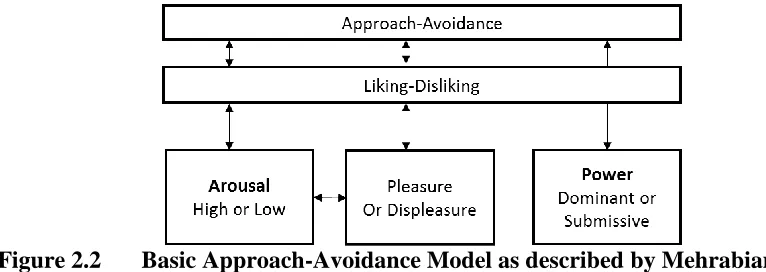
Mehrabian (1981) described three factors as affecting the approach and avoidance of others: feelings of arousal, pleasure, and power (dominance or submissiveness). When one is faced with the potential to interact with another person, one considers how
stated, “People are drawn towards persons and things they like, evaluate highly, and prefer; they avoid or move away from things they dislike, evaluate negatively, or do not prefer” (p. 1). When people move towards things and people they like, the increased physical proximity conveys to others a message of liking; likewise, moving away from others and decreasing of physical proximity conveys a message of dislike (Mehrabian, 1972; Mehrabian, 1981).
Figure 2.1 Relation of Pleasure and Arousal with Liking (Mehrabian, 1981)
Figure 2.2 Basic Approach-Avoidance Model as described by Mehrabian (1981)
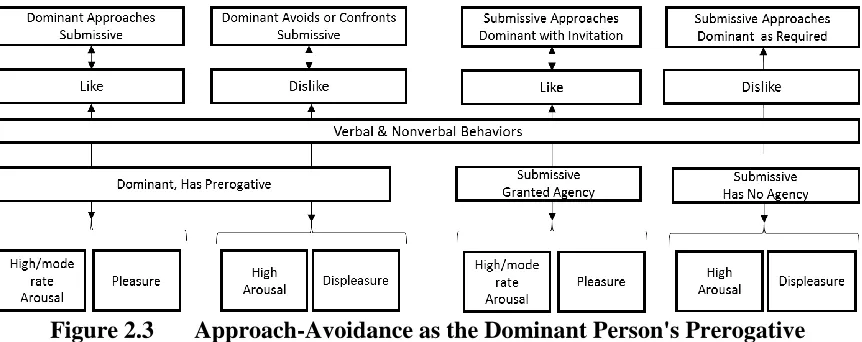
submissive to approach them through an invitation to do so. However, as Mehrabian (1981) pointed out, often refusal of the invitation is not considered a realistic response. Thus, in either case, the submissive is compelled to approach the dominant.
Figure 2.3 Approach-Avoidance as the Dominant Person's Prerogative
Figure 2.4 Approach When Power is Symmetrical and Autonomous (Mehrabian, 1981)
Proximity between people is a negotiation where interlocutors evaluate the arousal of others and the power-differentials between them, conduct an analysis of the mutual pleasure or displeasure (i.e., the fulfillment of needs) that interaction would incur, and the degree of autonomy they have in choosing or demanding approach and avoidance of the interaction. While this negotiation may involve communication that is verbally explicit (e.g., “come here”) or nonverbally explicit (e.g., motioning for someone to stop), a large part of the verbal and nonverbal communication involves subtle implicit
phenomena where information about power, feelings, and like-dislike attitudes are encoded and decoded between interactants (Mehrabian, 1971, p. 3).
Abbreviated Approach-Avoidance
contact with another, and paying attention to someone. Examples of abbreviated
nonverbal avoidance behaviors include: leaning and turning away from another, avoiding eye contact, remaining silent, and feigning preoccupancy with other things or people (Mehrabian, 1981).
Abbreviated verbal linguistic structures also indicate like and dislike and approach and avoidance (Mehrabian, 1966, 1967, 1971, 1981; Mehrabian & Wiener, 1966; Weiner & Mehrabian, 1968). For example, saying or writing, “These people need help” is more immediate than “Those people need help;” “I want to see X” is more immediate than “I have to see X;” and “I am dancing with X” is more immediate than “X and I are dancing” (Mehrabian & Wiener, 1966, p. 421). In each of these cases, the speaker is using language variations to metaphorically indicate greater or lesser proximity between the subject and the object of the sentence.
Proximity, Synchronicity, and Sensory Stimulation
According to immediacy theory, each of our senses provides a channel for sensory stimulation and therefore a channel of communication for explicit and implicit messages. Closer proximity allows for greater sensory exchange (with touch being the most intimate) and subsequently greater arousal. The more communication channels that are available between interactants (i.e., visual, tactile, auditory, and olfactory
information), the greater the degree of arousal, like-dislike, and approach-avoidance that can be communicated (Mehrabian, 1981). Moreover, whilst the physical and
(synchronicity-asynchronicity) one puts between the stimulus and response conveys like-dislike and approach-avoidance.
Regarding proximity and synchronicity of communication, Mehrabian (1981) described the degree of approach as being influenced by the actual and psychological distance between communicators, the time it takes for information to be exchanged, as well as the number of channels of sensory stimulus between two communicators.
Therefore, a medium that allows faster feedback, higher actual or perceived physical and psychological proximity, and more channels of sensory stimulus, involves more
immediacy; conversely, a medium that allows for slower feedback, lower actual or perceived physical and psychological proximity, and less channels of sensory stimulus involves less immediacy. Thus, a letter received via mail would be both objectively and subjectively less immediate than a telephone call due to the slower feedback time involved, a lower sense of the actual proximity, as well as fewer channels of sensory stimulus that the two communication mediums convey. In contrast, face-to-face communication affords close proximity and high synchronicity, as well as the greatest number of channels through which to arouse the other through explicit and implicit stimuli across the five senses, and subsequently, convey feelings of like-dislike and approach-avoidance.
Immediacy and Medium Effects
intentions of the other (i.e., what do they want), the level of mutual reciprocation (i.e., symmetrical or asymmetrical) that will be involved in an interaction, as well as the degree of autonomy they have to stipulate, reject or accept terms offered. In the exchange, the proximity and time one places between the self and other carries
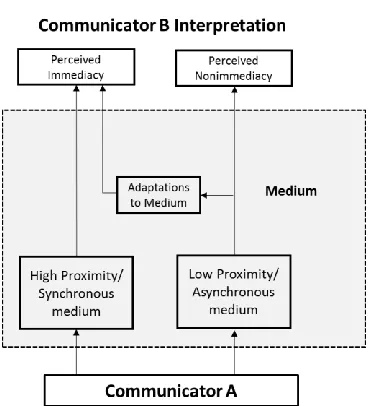
connotations of like-dislike. Likewise, the selection of a medium of communication can be used as part of the exchange negotiation, as each party considers and interprets the intentions and motivations for selecting a given communication medium (Mehrabian, 1981), as is depicted in Figure 2.5. For example, when one is within close proximity of another but chooses to make a telephone call rather than go to the other physically, an impression of non-approach, and therefore dislike, displeasure and/or disrespect, may be perceived by the addressee (Mehrabian, 1981). Similarly, when a person chooses to call someone by beeping a car horn rather than walking up and ringing their doorbell, intentions and feelings of like and dislike are implicitly communicated and perceived through the choice of the communication technology used (Mehrabian & Wiener, 1966).
Figure 2.5 Effect of Medium Selection on Perceived Immediacy
medium can also connote higher or lower proximity and therefore immediacy or non-immediacy (Mehrabian, 1967; Mehrabian, 1981; Weiner & Mehrabian, 1968). Thus, while the selection of a medium may connote immediacy or nonimmediacy, verbal and nonverbal cues transmitted through a given medium also influence the degree of
content of the message, both verbal (written and spoken) and nonverbal, where available, will be interpreted as to the intentions and feelings of the communicator.
Figure 2.6 Communication Adaptations for Low Proximity Medium to Signify
Immediacy
Instructor Immediacy Research in Higher Education
The construct of immediacy was first applied to higher education by Andersen (1978) in her seminal dissertation, “The Relationship between Teacher Immediacy and Teaching Effectiveness.” Looking to improve instructor effectiveness, Andersen examined how nonverbal immediacy behaviors could be used to produce positive interpersonal relationships between instructors and students. Andersen argued that scholars, up to that time, had held to a “myth” that nonverbal variables in the classroom were not worthy of attention (p. 4). Andersen drew from Mehrabian’s (1969) conception that immediacy was related to behaviors that indicate physical or psychological
described immediacy as a construct which is subsumed within the concept of solidarity where immediacy behaviors are “one way to demonstrate solidarity” (p. 9).
In her study, Andersen focused on nonverbal immediacy behaviors, while recognizing that Mehrabian’s (1967, 1971, 1972) construct of immediacy could also be expressed through implicit verbal communication behaviors. She hypothesized a linear combination of student perceptions of instructor immediacy as being directly correlated with student affective and cognitive learning (p. 12). This is represented by what
Rodriguez, Plax and Kearney (1996) called “the learning model” (p. 294) and is depicted in Figure 2.7.
Figure 2.7 Immediacy Learning Model
In order to measure immediacy, Andersen (1978) needed to generate measures for it. As described in a later publication (Andersen et al., 1979), Andersen developed three ways in which to measure immediacy: first, through a subjective gestalt measure of immediacy, which led to the General Immediacy (GI) scale; second, through the measure of low-inference behavioral indicants of immediacy that students subjectively report on, which led to the behavioral indicants of immediacy (BII) scale, and, third, through objective counting and coding of individual nonverbal immediacy behaviors
The GI scale was a nine-item semantic differential scale that measured the general immediacy of the instructor as a gestalt. The BII scale was a 28-item, low-inference measure which asked students to rate the extent to which their instructors engaged in specific immediacy behaviors (see Table 2.1 below for an overview of immediacy
measures). Andersen developed the BII scale based on Mehrabian’s (1972) description of the immediacy construct, which she defined as:
those communication behaviors manifested and perceived when a person maintains closer physical distance, uses direct body orientation, is relaxed, uses overall purposeful body movement, gestures, engages in positive head nods, smiles, uses eye contact and is vocally expressive. (p. 17)
In order to validate the BII scale, Andersen (1978) had students rate instructor immediacy using the BII scale while trained observers simultaneously rated the same instructors using the RI scale. The result was that the BII and the RI scales had a correlation of .80, which when correcting for attenuations had a correlation of .92. Andersen et al. (1979) concluded that the high correlation between the measures “suggests that students perceive instructor immediacy behaviors in the same way that trained raters perceive immediacy behaviors” (p. 60).
In order to measure affective learning, Andersen (1978) used a measure developed by Osgood, Suci, and Tannenbaum (1957) that included four seven-step evaluative semantic differential scales. The four scales were: affect toward
communication practices suggested in the course, affect toward the subject matter or content of the course, affect toward the instructor of the course, and overall affect towards the course in general (pp. 20-22). Additionally, two measures of behavioral commitment were used: likelihood of actually attempting to engage in the
in another course or related content if a schedule so permits (p. 22). Scores from a course exam with 50 multiple-choice items were used to measure cognitive learning.
Andersen (1978) found that nonverbal immediacy was related to both affective and behavioral learning, but no relationship was found between instructor immediacy and cognitive learning. Andersen speculated that one reason for not finding a relationship between immediacy and cognitive learning might have been because the students were tested too early in the semester, meaning immediacy may not have had enough time to have had an effect. A second interpretation was that perhaps there is no relationship between affective learning and cognitive learning. A third interpretation was that it was due to the nature of the course being a mastery level course where a high number of student scores fell into the higher end of the bell-curve, thus reducing the predictive power of the instrument (pp. 36-38). Another interpretation that has been put forth by Richmond, Gorham, and McCroskey (1987) was that since most instructors may already use moderate immediacy behaviors, there frequently is not enough variation among populations of instructors to detect a difference.
Since Andersen’s (1978) finding of a relationship between immediacy and affective learning, as many as 200 studies on instructor immediacy have found various positive associations (Witt et al., 2010). Several early studies of instructor immediacy using Andersen’s GI and BII measures produced similar results, finding consistently that nonverbal immediacy was related to affective learning but not cognitive learning
student final grades. Their study was different because it was conducted at the middle school and high school level where students spent more time with their instructors. This addressed Andersen’s speculation that the students in her study may not have had enough time with their instructor for immediacy to have an effect.
Studies up until the present have consistently found immediacy to be strongly correlated with affective learning (Baker, 2010; LeFebvre & Allen, 2014; Richmond et al., 1987; Schrodt, Witt, Turman, Myers, Barton, & Jernberg, 2009; Witt et al., 2004; Witt et al., 2010). However, there have been mixed results in trying to directly link immediacy to cognitive learning based on objective measures of cognitive gains. While direct measures have had mixed results, measures that have used student perceptions of their own cognitive learning have consistently been found to be highly correlated with instructor immediacy.
Perceptions of Cognitive Learning
A connection between immediacy and cognitive learning was first established when Richmond et al. (1987) measured cognitive learning based on students’ perceptions of their learning rather than objective measures such as test scores or course grades. They justified the use of perceived measures of cognitive learning by arguing that it is
to their argument, affective learning is integrated with cognitive learning, with each impacting the other. They cited McDowell et al.’s (1980) speculation that students may have studied harder for exams in courses with instructors whom they liked and wished to please. Based on these justifications, Richmond et al. (1987) introduced their measure of cognitive learning based on student perceptions of their own learning. In their 1987 study, they found that the correlation between perceived cognitive learning and total immediacy indicated approximately 50% shared variance. They measured learning based on a differential between how much students believed they learned and how much they felt they could have learned from an ideal instructor. The difference between the two scores were calculated to form a third variable termed, “learning loss.”
The measure of learning loss represented a shift in the measure of cognitive learning in the immediacy literature and the field of communications overall. Subsequent to Richmond et al.’s (1987) study, many other immediacy researchers have used the learning loss method in order to measure perceptions of cognitive learning (e.g.,
Chesebro & McCroskey, 2001; Fayer, Gorham, & McCroskey, 1988; Gendrin & Rucker, 2004; Gorham, Cohen, & Morris, 1999; Hinkle, 1998; McCroskey et al., 1996; Messman & Jones-Corley, 2001; Myers, Zhong, & Guan, 1998; Neuliep, 1995; Neuliep, 1997; Ni & Aust, 2008; Witt & Wheeless, 2001). This research has consistently found a
(cognitive learning) and independent variable (immediacy). They argued that students’ memories may have been affected by the grades the instructors gave them on assignments and the course, which in turn may have been influenced by the instructor’s affect toward the students. Additionally, they contended that perceptions of learning should not be the “sole basis for knowledge claims regarding teacher immediacy and cognitive learning” (p. 252) and called for more empirical studies.
Hess and Symthe (2001) also criticized the lack of empirical studies on
immediacy and cognitive learning citing Chesebro and McCroskey’s (2001) study as the only one that had done so. In their study, Chesebro and McCroskey compared measures of performance on a quiz as well as student perceptions of their learning using the learning loss measure. They found a strong positive correlation between the two, which subsequently has been cited as evidence to support the use of measures of student
perceptions of cognitive learning. However, Hess and Smythe (2001) countered that there were design flaws in Chesebro and McCroskey’s study. First, they pointed out that
students had calculated their degree of learning after having taken a quiz, which would be influenced by perceptions as to how well they felt they had performed on it. They also pointed out that the students viewed recorded lectures rather than live lectures, which lacks ecological validity. Hess and Smythe (2001) replicated Chesebro and McCroskey’s (2000) study and found, consistent with the literature, that perceived immediacy
While there has been criticism of the learning loss measure, others have argued in support of the use of student perceptions of their learning. McCroskey et al. (1996) made a robust argument that there is solid justification to accept student reports of cognitive achievement. Additionally, other research has replicated Hess and Smythe’s (2001) study and have found, like Chesebro and McCroskey (2000), a correlation between student perceptions of cognitive learning and objective measures. Witt and Wheeless (2001), for example, used an experimental design and randomly assigned students to four different manipulations of a video lecture. They measured student recall of the content of the video lecture using a quiz. Additionally, they measured perceived cognitive learning based on learning loss. They found that both recall and perceived learning had a positive
relationship with instructor immediacy.
related to either verbal or nonverbal immediacy alone, but were significantly correlated with recall when combined.
Nonverbal Immediacy Measures
In addition to introducing the perceived learning (i.e., learning loss) measure to the field of study, Richmond et al. (1987) adapted Andersen’s (1978) behavioral indicants of immediacy (BII) scale and introduced a 14-item instrument to measure nonverbal immediacy called the nonverbal immediacy behavioral (NIB) indicants measure (Witt et al., 2010). Their instrument included seven indicators for immediacy that were drawn from Mehrabian’s (1971) conceptualization of the construct as relating to physical proximity and perceptual stimulation: direction of one’s body in relation to others, proximity with others, touch, eye contact, smiling, physical movement, and nonverbal vocalics (paralinguistic factors). The instrument was found to have an alpha reliability of .87 in their first study and .80 in their second study. Using the NIB, they found a strong positive correlation between instructor nonverbal immediacy and learning loss.
Additionally, they found that “vocal expressiveness, smiling at the class, and having a relaxed body position had the highest positive association with learning” (p. 585). They also found that it was very unusual for the college instructors in their study to touch the students and rare for them to stand behind or sit on a desk or have a tense body position. Richmond et al.’s (1987) NIB items included:
1. Sits behind desk when teaching. * 2. Gestures when talking to the class.
3. Uses monotone/dull voice when talking to the class. * 4. Looks at the class when talking.
5. Smiles at the class as a whole, not just individual students. 6. Has a very tense body position when talking to the class. * 7. Touches students in the class.
9. Sits on a desk or in a chair when teaching. *
10. Looks at board or notes when talking to the class. * 11. Stands behind podium or desk when teaching. *
12. Has a very relaxed body position when talking to the class. 13. Smiles at individual students in the class.
14. Uses a variety of vocal expression when talking to the class. * Presumed to be nonimmediate
Instruments used to measure nonverbal immediacy have gone through several iterations since Andersen’s (1978) BII scale and Richardson et al.’s (1987) NIB measure (see Table 2.1 below). In 1990, Gorham and Zakahi made minor modifications to the NIB which they renamed the nonverbal immediacy measure (NIM). Modifications included dropping the “Sits on desk or in a chair when teaching” and changing instances of the term “when” to “while.” The 13-item measure was revised again by Thomas, Richmond, and McCroskey (1994) and renamed the revised nonverbal immediacy measure (RNIM). Modifications to this measure included dropping three additional items: “Sits behind desk while teaching,” “Touches students in the class,” and “Stand behind podium or desk while teaching.” Moreover, “Smiles at the class as a whole, not just individual students” was contracted to “Smiles at the class as a whole.” The four items were dropped because they dealt with touch, standing and seating which did not contribute to reliability or validity of the measure when used in college classrooms (p. 109). Another revision led to the development of the nonverbal immediacy scale (NIS) which was developed by Richmond, McCroskey, and Johnson (2003). The NIS has two versions, a self-report of immediacy (NIS-S) and an other-report of immediacy (NIS-O). The NIS has 26-items which are designed to be applicable to contexts beyond the
Table 2.1 Nonverbal Immediacy Measures
Measure Name Author(s) Number of
Items General Immediacy (GI) measure Andersen (1978) 9 Behavioral Indicants of Immediacy
(BII) measure
Andersen (1978) 28
Nonverbal Immediacy Behaviors (NIB) measure
Richmond et al. (1987) 14
Nonverbal Immediacy Measure (NIM)
Gorham and Zakahi (1990) 13
Revised Nonverbal Immediacy Measure (RNIM)
Thomas, Richmond, and McCroskey (1994)
10
Nonverbal Immediacy Scale (NIS) Richmond et al. (2003) 26
Verbal Immediacy Measure
In addition to the NIB measure of immediacy (Richmond et al., 1987), Gorham (1988) explored verbal immediacy and its influence on learning in her pivotal 1988 study. While Andersen (1978) had recognized that Mehrabian’s (1968, 1971) construct of immediacy included verbal aspects of communication that indicate like-dislike, Andersen chose not to look at it in her research. Gorham (1988) pointed out that Andersen
recommended future research look into verbal immediacy, and, moreover, that
model. In her study, Gorham set out to identify low-inference verbal immediacy variables that signal approach, as was done with Andersen’s (1978) BII scale and Richmond et al.’s (1987) NIB for verbal immediacy. In order to develop a low-inference measure, Gorham (1988) drew from Mehrabian’s (1967, 1971, 1972, 1981) conception of verbal immediacy where approach-avoidance are signaled through verbal language constructs including:
variations in adjectives (This person needs help” vs. “That person needs help”), verb tense (present vs. past), order of occurrence of references, inclusivity (“we” vs. “I”), mutuality (“Judy and I do X” vs. “I do X with Judy”), implied
voluntarism (“want to” vs. “have to” or “should”), probability (“will” vs. “may”), conditionality (“I would like to see you again” vs. “I want to see you again”), and responsibility (“I conclude” vs. “The results lead me to conclude;” “I don’t like her” vs. “Most people find her an intolerable bore”). (p. 42)
In order to generate low-inference verbal immediacy items, Gorham asked forty-seven undergraduate students to “think of the best teachers they had had throughout all their years of school and list the specific behaviors which characterized those teachers” (p. 43). The result was a list of 17 low-inference verbal immediacy behaviors (VIB) of instructors. The items included:
1. Uses personal examples or talks about experiences she/he has had outside of class.
2. Asks questions or encourages students to talk.
3. Gets into discussions based on something a student brings up even when this doesn’t seem to be part of his/her lecture plan.
4. Uses humor in class.
5. Addresses students by name. 6. Addresses me by name.
7. Gets into conversations with individual students before or after class. 8. Has initiated conversations with me before, after or outside of class. 9. Refers to class as “our” class or what “we” are doing.
10. Provides feedback on my individual work through comments on papers, oral discussions, etc.
11. Calls on students to answer questions even if they have not indicated that they want to talk. *
12. Asks how students feel about an assignment, due date, or discussion topic. 13. Invites students to telephone or meet with him/her outside of class if they have
questions or want to discuss something.
15. Praises students’ work, actions or comments.
16. Will have discussions about things unrelated to class with individual students or with the class as a whole.
17. Is addressed by his/her first name by the students. * Presumed to be nonimmediate
After creating the VIB, Gorham used it, in addition to the 14-item NIB (Richmond et al., 1987), to measure student perceived cognitive learning, based on Richmond et al.’s (1987) learning loss measure, and affective learning, based on McCroskey, Richmond, Plax, and Kearney’s (1985) affective learning instrument. The results of the study
indicated “substantial relationships between immediacy and learning” (p. 46). Among the correlations, several were particularly strong, including: praise of students’ work, actions, or comments; humor; frequency of initiating conversations; and, being willing to become engaged in conversations with students before, during, after and outside of class.
Additionally, Gorham (1988) reported several other items that correlated moderately with learning, including: instructor self-disclosures; asking questions and encouraging students to talk; soliciting viewpoints and opinions; following up on student-initiated topics; providing feedback on student work; asking how students feel about assignments, due dates and discussion topics; referring to the class as “our” class and what “we” are doing; and inviting students to telephone or meet outside of class (pp. 47-48).