application of fuzzy analytical hierarchical process (FAHP)
Subroto Chowdhury
and Bidhan Chandra Roy
1Department of EES, Institute of Agriculture, Visva Bharati University, Santiniketan, IndiaABSTRACT
The theory of microcredit is not new a concept, but its applicability in the field of poverty alleviation was made publicly acceptable by the renowned professor Mohammed Yunus whose noble effort has given micro credit its due recognition. The noble prize to Professor Yunus along with the UN recognition of the year 2005 as the year of micro credit bears testimony of the fact that micro credit has taken the centre stage. The evolution of microcredit to microfinance was due to the need of the market. The quantum of money following into the sector and the significant business opportunity has motivated many business models to step in into the sector. The advent of Micro Finance Institutions (MFI) in this regard under various legal entities as Non Banking Finance Corporation (NBFC), Societies, Trust, Cooperatives, and Section 25 companies ushered in a new era into the microfinance sector. Investors as well as the common people are provided with choices. All MFI claims to be the best. The availability of more choices makes the process of selection even complicated. Thus it becomes very arduous task to select from the array of choices. Decision making process thus becomes a complicated phenomenon. The people are uncertain about their choices. Many factors are involved in choosing a MFI thus selection of best MFI falls into the category of Multi-criteria Analysis (MA) problem. It is difficult to map human perception to particular number or a ratio due to vagueness in the decision making process. To solve such problems, the Analytical Hierarchical Process (AHP) was developed. Moreover, if an individual is supposed to take any decision, he specifies his preferences using linguistic variables instead of assigning any crisp score to the preference. These linguistic terms are nothing but imprecise and dubious values. To deal with such fuzziness, several researchers extended AHP by incorporating fuzzy characteristics into it and developed a new process known as Fuzzy Analytical Hierarchical Process (FAHP). FAHP thus helps the decision makers to deal with imprecision and subjective-ness in pair-wise comparison process. The reason to include fuzzy is to reflect the pessimistic, more likely and optimistic decision making environment. This paper has been developed based upon the views of various experts in the field of banking and microfinance along with real time data gathered from MIX Market. The various criteria for selection process are based on the criteria as used in SIDBI’s SMERA rating methodology. Then the generation of criteria weight using Fuzzy Analytical Hierarchical Process (FAHP) is done. Finally the alternative MFIs are prioritized taking all the criteria into account.
Keywords: Fuzzy analytical hierarchy process, ranking, MFI
Address for correspondence
Subroto Chowdhury: Institute of Agriculture, Visva Bharati University, Santiniketan, India E-mail: [email protected]
Access this article online
Publisher Website:
http://www.ndpublisher.in
DOI: 10.5958/0976-4666.2016.00015.2
but its applicability in the field of poverty alleviation was widely made publicly acceptable by the renowned professor Mohammed Yunus whose noble effort has given micro credit its due recognition. The noble prize to Professor Yunus along with the UN recognition of the year 2005 as the year of micro credit bears testimony of the fact that micro credit has taken the centre stage. The morphing of microcredit to microfinance was due to the need of the market. The quantum of money following into the sector and the significant business opportunity has motivated many business models to step in into the sector. The advent of Micro Finance Institutions (MFI) in this regard under various legal entities as Non Banking Finance Corporation (NBFC), Societies, Trust, Cooperatives, and Section 25 companies ushered in a new era into the microfinance sector. Undoubtedly, the entry of Microfinance institutions into the arena of micro finance has brought with itself more professionally managed organization into the field. The so called financially non-viable people had array of choices in front of them to choose from. The scenario changed to the extent that the previously persons not getting any loan from institutional sources were now offered loans from many sources.
The popular controversy regarding the model of microfinance, its double bottom line approach, the rate of interest to be charged, the coercive recovery mechanism are yet to reach any consensus. However, as a pitfall of this controversy there is wider intuitive belief which might have crept into the minds of stake holders is that microfinance itself is not so acceptable a practice as it was projected. The proverbial “meteoric” rise of the sector must not end up into the proverbial “throwing the baby with the bath water”.
There have been issues in the micro finance sector but it is an acceptable fact that micro finance has had a considerable impact on the rural well being both in the rural and the urban sector. The issue is therefore of finding out the good one from the not so good ones from the array of choices. The theory of choice is associated with the theory of decision which again is rooted into the choice of criteria on which such decisions will be based. As academic practitioners our effort is to design a mathematical model taking into consideration the
imprecision of the decision making process. The present paper aims at designing a model for mapping human perception into the decision making process.
Decision making process is a complicated phenomenon. The people are uncertain about their choices. Many factors are involved in choosing a MFI thus selection of best MFI falls into the category of Multi-criteria Analysis (MA) problem. Thus it is imperative to design a model which can map human perception. The attempt of this paper is to map human perception to particular number or a ratio and also to consider the vagueness in the decision making process. The organization of the Paper is as follows. First, the main and sub criteria for the evaluation of MFI performance are discussed along with the alternative MFIs. In the second step the literature for the selection of Banks through its performance are given. In the third step fuzzy sets, triangular fuzzy numbers and fuzzy AHP are introduced. In the fourth step an evaluation methodology based on fuzzy-AHP is developed for an effective evaluation of MFI’s performance. Finally the ranking of the MFI is done based on the final score obtained by each MFI.
R
eview ofl
iteRatuRe ona
pplicationahp &
f
uzzyahp
Application of Fuzzy AHP in financial studies mainly occurred after 1990. The application of Fuzzy AHP in the selection of MFI is still scarce. In order to justify our selection of the methods on scientific lines we have assumed the services of MFI to be kind of a banking business. Thus the review of application of AHP and Fuzzy AHP in the banking is focused in the first part. In the second part we have tried to deliberate upon the application of AHP in Microfinance studies.
in a developing country (Vargas and Roura-Agusti, 1989), selecting priority industry for investment (Rashid and Tabucanon, 1991), selecting a financial instrument for foreign investment (Meziani and Rezvani, 1990), international investment risk analysis (Jensen, 1987), evaluation of clients in financial houses (Jablonsky, 1993), prediction of corporate bankruptcy (Hogan et al. 2000) and bank strategic planning for merger and acquisition (Arbel and Orger, 1990). The two AHP applications categorized as application in banking include work on bank strategic planning focusing on merger and acquisitions process (Arbel and Orger, 1990) and setting up development goals in low-income developing countries (Ehie, et al. 1990). The AHP application in banking are reflected in the studies conducted by (Frei and Harker, 1998), (Macerinskiene et al. 2004), (Domański and Kondrasiuk, 2005), (Korhonen and Raimo, 2004), (Bernè et al. 2006) and (Lee and Jao-Hong, 2008). Specific work on AHP application in banking with collection of application examples (simple and ready to use kind of problems for real life banking decision problems) are rarely seen in literature, however the work by (Domański and Kondrasiuk, 2005) is the one among few identified. The various areas of decision problem where application of AHP is demonstrated are: establishing bank deposit interest rates, price assessment of bank deposits, base loan rate determination, bank marketing strategy decisions, merger related decisions, bank head office location decision, bank departments evaluation, bank IT system selection decisions, bank human resources decisions which include board members and key employee selection as well are presented in the studies conducted by (Domański and Kondrasiuk, 2005). Utilization of AHP for measuring aggregate performance and a methodology taking empirical example of retail banking industry is presented in the study conducted by (Frei and Harker, 1998).
While assessing the most preferred alliances between banks and insurance companies (Korhonen and Raimo, 2004) re-insisted that application of AHP is much less frequent in financial problems, which can be observed on the work by (Steuer and Na, 2003) as well. Expert panel assisted by the AHP was a successful approach
in searching most preferred structure between banks and insurance companies (Korhonen and Raimo, 2004). Global competitiveness of local companies, with specific reference to banking industry in Thailand is accessed on work by (Sirinaovakul, 2002). AHP in addition to other statistical tools were utilized while developing multi criteria credit rating (MCCR) process based on Basel II guidelines (Bernè et al. 2006).The work by (Bernè et al. 2006) is an integrated methodology combining conventional credit rating with numerical methods and AHP to assess distress of industrial companies according to Basel II guidelines. Critical factors in selecting high yield bonds (HYBs) using fuzzy AHP (Lee and Jao-Hong, 2008) is evaluated. (Fan and Cheng, 2009) utilized AHP along with TOPSIS to evaluate curriculum in Department of Risk Management and Insurance at Universities.
There are ample number of studies available on the application of AHP and Fuzzy AHP in the domain of banking and other financial studies. There are not many studies on application of AHP and Fuzzy AHP in the Micro finance Institution framework. But on review few studies are observed to be based on application of multi criteria framework in the decision making process. The application of multi criteria framework can be observed in the decisions of bank loan portfolio management acting as a decision support system (Macerinskiene et al. 2004). The AHP kind of multi criteria tool for complex modern bank loan portfolio management decision-making is also emphazied in the study conducted by (Macerinskiene et al. 2004). Discriminant Analysis along with AHP has been used by Aouam et al. (2009) in quantification and selection of potential borrowers. The application of Fuzzy Analytical Hierarchy Process (FAHP) and Data Envelopment Analysis (DEA) can be found in the study conducted by (Che et al. 2010).
M
ethodologyFeedback from Community (Experts)
the following. While most agree that there exists system that helps to take decision (MIS, DSS etc) but is not adequate. The inability of the existing framework to take crucial complex decision coupled with the crisis that Micro finance sector is undergoing, it paves the way for conducting the study. The availability of information is important but to use this information in making balance decision is more important. Thus the need arise to frame some model which can effectively use the information as well map the complexity in human decision making. The following are the perception of the experts for the need to design a need based decision system.
1. The need is there for a system which can integrate both the objective and subjective information onto a single framework to make informed decision. 2. Transparency, consensus building and taking all
the stakeholders view is important in making decision so that people can make informed choices.
The utility of the FAHP kind of decision support system is well supported by the above mentioned thoughts. In this study both the subjective judgments of human decision making as well as objective parameters of MFI performance are used to finally rank the MFIs.
A. Data Set
In this paper expert opinion is collected for the generation of criteria and sub criteria weights through a questionnaire containing fuzzy pair wise comparisons using linguistic terms. Further the alternative MFIs are given weights based on the secondary data published by MIX market (http://www.mixmarket.org/mfi/country/ India/report).
B. Selection of MFI for the purpose of the study
In order to design comprehensive rating methodology the need of systematically and coherently collected data over a period of time for the variables is of utmost importance. The Micro finance sector from its beginning has witnessed a scattered growth in terms of its institutional structure as well as functioning. There was little effort made by the MFIs to regularly publish their
financial as well as other information mainly due to the non requirement of any statuary obligation and also due to small scale of operations. However, with the growth of the sectors from early 2000, has motivated several agencies to maintain database of the MFI. Mainly there are three sets of data on MFIs—the annual data that Sa-Dhan brings out based on the details furnished by its members, the data compiled by Microfinance Information Exchange (MIX) quarterly and annually and the member data that Micro Finance Institutions Network (MFIN) published quarterly. MIX is supported by SIDBI since April 2012 to maintain the Indian Micro Finance Platform (IMFP) that disseminates financial and operational information on MFIs. Other potential sources of information on MFI are Institute for Financial Management and Research (IFMR) Capital, Micro-Credit Ratings International Ltd (M-CRIL) and Micro-Credit Rating Information Services of India Limited (CRISIL), but in these data sources periodicity is a problem. The availability of the data set is one issue but due to lack of uniformity in referral periods, reporting formats and inconsistency with respect to the institutions covered have made the use of the data set for credible conclusion highly complicated. In order to broaden transparency, market insight, establish reporting standards, alleviate reporting burden, and promote responsible investment the MIX in collaboration with its partners have made an effort to publish information related to MFI in a uniform format in the MIX platform. MIX is a non-profit organization headquartered in Washington, DC with regional offices in Africa, Asia, Europe, and Latin America and is incorporated in the year 2002. This effort is appreciated by most of the MFI functioning across globe and the data sets are highly consistent in terms of its reporting and are used in numerous studies related to micro finance and Micro finance institution.
containing information relating to 40 member MFIs and two non-members. The MFIs selected for the purpose of the study are SRFS, Bandhan, BSFL, BSS, Casphor MC, GFSPL, GVMFL, SKS, VFS and SNFL.
C. Selection of variables
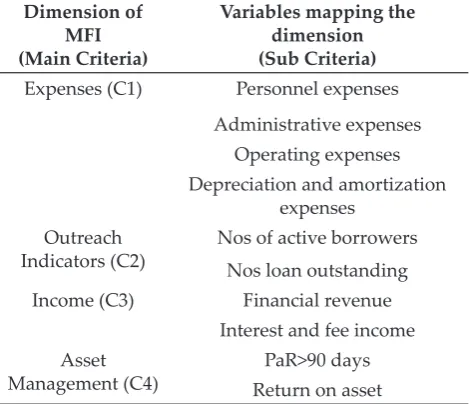
The selection of variables is based on the standardized format as designed by Small and Medium Enterprise Rating Agency (SMERA) MFI rating with necessary adjustments made to suite the purpose of this study. Mainly four dimensions of MFIs are covered which are considered as main criteria in the study. The variables mapping each of the main criteria are categorized as sub criteria for the purpose of this study. The following table will elucidate the dimension of MFI covered and main criteria and the corresponding variables (which are considered as sub criteria) mapping the main criteria.
Dimension of
MFI
(Main Criteria)
Variables mapping the dimension (Sub Criteria)
Expenses (C1) Personnel expenses
Administrative expenses Operating expenses Depreciation and amortization
expenses
Outreach
Indicators (C2) Nos of active borrowersNos loan outstanding
Income (C3) Financial revenue
Interest and fee income
Asset
Management (C4) Return on assetPaR>90 days
D. Discussion about FAHP
D.1. Discussion about Fuzzy sets, TFN and FAHP To deal with vagueness of human thought, Zadeh first introduced the fuzzy set theory, which was oriented to the rationality of uncertainty due to imprecision or vagueness. A major contribution of fuzzy set theory is its capability of representing vague data. A fuzzy set is a class of objects with a membership function ranging between zero and one. Fuzzy set theory resembles
human reasoning in its use of approximate information and uncertainty to generate decisions. It was specifically designed to mathematically represent uncertainty and vagueness. Fuzzy set theory implements groupings of data with boundaries that are not sharply defined (i.e. fuzzy). Any methodology or theory implementing “crisp” definitions such as classical set theory, arithmetic, and programming, may be “fuzzified” by generalizing the concept of a crisp set to a fuzzy set with blurred boundaries. The benefit of extending crisp theory and analysis methods to fuzzy techniques is the strength in solving real-world problems, which inevitably entail some degree of imprecision in the variables and parameters measured and processed for the application (Bohui Pang, 2007).
A triangular fuzzy number (TFN) is the special class of fuzzy number whose membership is defined by three real numbers, expressed as (l, m, u). Although many types of treatment are available in the literature, triangular fuzzy number (TFN) is used in this study for the ease of handling of such triangular fuzzy number (TFN). Figure 1.1 displays the structure of a Triangular Fuzzy Number (TFN). According to Tae-heon Moon (1999), the triangular fuzzy numbers is represented as follows.
...
,
, ...
.
...(1)
0 ,
A
x l
l x m m l
u x
m x u u m
otherwise µ
−
≤ ≤
− −
= − ≤ ≤
The operational laws between two triangular fuzzy numbers M1 and M2 are as follows
1 2 1 2 1 2 1 2
1 2 1 2 1 2 1 2
( , , )
( , , )
M M l l m m u u
M M l l m m u u
+ = + + +
× =
2
3
D.2. Analytic Hierarchy Process (AHP)
AHP is a method for ranking decision alternatives and selecting the best one when the decision maker has multiple criteria (Taylor, 2004). It answers the question, “Which one?” With AHP, the decision maker selects the alternative that best meets his or her decision criteria developing a numerical score to rank each decision alternative based on how well each alternative meets those (Askin et al. 2007).An analytical way to reach the best decision is more preferable in many platforms. When variables are quantitative and number of criteria is not high, then one can use several analysis tools (For example: Multi factor evaluation process) and make his/her decision and solve the problem. However, many times beside the measurable variables, there exist qualitative variables, or people are supposed to prefer the best among the many choices, thus, an analytical way to make a successful decision is needed. In situations often decision makers may have difficulties in accurately determining the various factor weights and evaluations. In such cases, the Analytic hierarchy process (AHP) can be used. Thomas L. Saaty developed this process in 1977. This process has been used to assist numerous corporate & Govt. decision makers. In Analytical Hierarchy Process the decision maker starts by laying out the overall hierarchy of the decision. This hierarchy reveals the factors to be considered as well as the various alternatives in the decision. Here both qualitative and quantitative criteria can be compared using a number of pair wise comparisons, which result in the determination of factor weights and factor evaluations. Finally the alternative with the highest total weighted score is selected as the best alternative.
D. 3. Fuzzy- Analytic Hierarchy Process (Fuzzy AHP)
The conventional AHP method is incapable of handling the uncertainty and vagueness involved in the mapping of one’s preference to an exact number or ratio. The major difficulty with conventional AHP is its consistency. The inconsistency there in is due to the transitivity property involved in the pair wise comparisons.
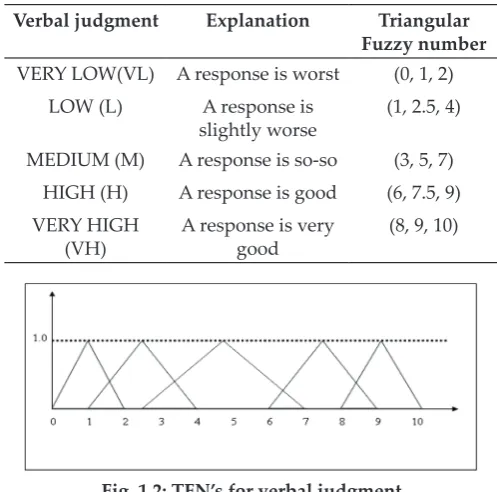
In Fuzzy-AHP, pair wise comparisons are done using fuzzy linguistic scale ranging from 0 to 10. Table 1.1 displays the fuzzy linguistic scale within 0 to 1.
For consistency, the reciprocal fuzzy numbers are removed from the pair wise comparison matrix by using Triangular Fuzzy Numbers (Nang-fei Pan, 2008) corresponding to each linguistic variables used in the scale. The triangular fuzzy numbers corresponding to different verbal judgment is demonstrated using Table1.1 and Figure 1.2.
Table-1.1 Fuzzy linguistic preference scale Verbal judgment Explanation Triangular
Fuzzy number
VERY LOW(VL) A response is worst (0, 1, 2)
LOW (L) A response is
slightly worse (1, 2.5, 4)
MEDIUM (M) A response is so-so (3, 5, 7)
HIGH (H) A response is good (6, 7.5, 9)
VERY HIGH
(VH) A response is very good (8, 9, 10)
Fig. 1.2: TFN’s for verbal judgment E. Evaluation Methodology
Construction of Hierarchy
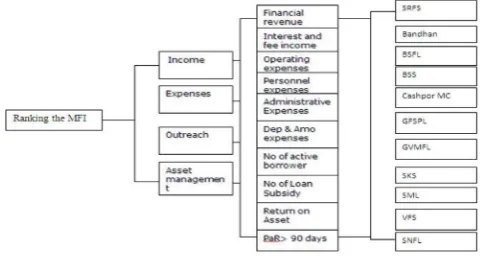
The first step of the proposed model is to determine all the important criteria and their relationship with the decision variables in the form of a hierarchy. This step is crucial because the selected criteria can influence the final choice. The hierarchy is structured from the top (the overall goal of the problem) through the intermediate levels (criteria and sub-criteria on which subsequent levels depend) to the bottom level (the list of alternatives). The structure of the above mentioned hierarchy is given in Figure 1.3.
F. Evaluation of Fuzzy pair wise comparison
of the hierarchy are compared by the experts. A pair wise comparison is performed by using Fuzzy linguistic terms in the scale of 0 – 10 described by the Triangular Fuzzy Numbers in the Table 1.1. Several methods are available in the literature for finding out the pair wise comparison in case of AHP, but, the issue of transitivity poses an evaluative problem in case of calculation of the results. However, the problem has been tackled by giving appropriate mathematical treatment and is widely available in the literature. In Buckley’s method, the element of the negative judgment is treated as an inverse and reversed order of the fuzzy number of the corresponding positive judgment. Thus it requires not only a rigorous manipulation in the construction of reciprocal matrix but also due to transitivity the result becomes inconsistent. Again to reflect pessimistic, most likely and optimistic decision making environment, triangular fuzzy numbers with minimum value, most plausible value & maximum value are considered. The questionnaire of such evaluation is given in Annexure 1.
Fig. 1.3: The overall hierarchy of the problem
Here the fuzzy comparison matrix is defined as
12 1
21 2
31 32 3
1 1 ....
1 .... 1...
.. .. 1
n n n nn a a a a A
a a a
a − = (1)
Where ( L , M , U )
ij ij ij ij
a = a a a is the relative importance of each criterion in Pair wise comparison and the minimum value, most plausible value & maximum value of the triangular fuzzy number are described by L, M, U
ij ij ij
a a a respectively.
To simplify the calculation of element weight, the fuzzy pair wise comparison matrix is broken into crisp matrices A A AL, M, U where A A AL, M, U are the crisp
matrices formed by taking the minimum values, most plausible values & maximum values from the triangular fuzzy numbers.
F.1. Calculation of element weight
The Normalization of the Geometric Mean (NGM) method (Buckley et al. 1985) is applied to compute weights from the fuzzy pair wise comparison matrices
which is given by
1 i n i i i a a w = =
∑
where1/ 1 n n i ij j a a = =
∏
In the above equations, i aij is geometric mean of criterion i. aij is the comparison value of criterion i to criterion j. isthe ith criterion’s weight, where w
i > 0 and and
1 1 n i i w = =
∑
.For group evaluation, it is required to aggregate evaluator’s opinions into one. Considering the evaluation given by expert ( ( )i, ( )i, ( )i)
i L M U
E = a a a the aggregate of all experts’ judgments can be calculated using average means
( ) ( ) ( )
1 1 1
1 1 1
, ,
n n n
i i i
L M U
i i i
A a a a
n = n = n =
=
∑
∑
∑
(2)
The weight of ith sub criteria under kth main criteria is
obtained by
(wk ×ski) (3)
where wk is the kth main criteria weight and S
ki is the weight of ith sub criteria with respect to kth main criteria.
The crisp weight of the sub criteria finally generated by defuzzifying (Mehdi et al. 2008) the product of fuzzy numbers obtained in equation number (4) as
( ) ( ) ( )
1 1 1
1 1 1
2
4
n n n
l l l
L M U
l l l
l
a a a
n n n
s = = =
+ + =
∑
∑
∑
(4)defuzzified value are shown in Table 1.2 to Table 1.3 respectively.
Table 1.2: Main criteria weights
Main Criteria Local weight
(l) m (u)
Expenses (C1) 0.374564 0.30266 0.290968
Outreach (C2) 0.260702 0.2467 0.248888
Income (C3) 0.244831 0.24593 0.245998
Asset management (C4) 0.119902 0.2047 0.214146
Finally the overall weight of mth alternative is obtained
by
1
N
m l ml l
A s a
=
=
∑
× (5)where Sl is the weight of lthsub criteria and aml is the weight of mth alternative with respect to
lth sub criteria and the result is shown in Table 1.5.
G. Ranking the alternatives
To rank the alternative MFIs based on the fuzzy AHP method, the researcher have used the MIX data and converted those metric data into alternative weights by the method of normalization.
Table 1.3: Sub criteria weights
Criteria Global weight Defuzzified weight
(l) (m) (u) (w)
Operating
Expenses 0.10677 0.080299049 0.076073 0.085860248
Personnel
Expenses 0.1101 0.08242511 0.077346 0.088073896
Dep& Amo
Expenses 0.093788 0.077648446 0.074598 0.080920709
Administrative
Expenses 0.063908 0.062290246 0.06295 0.062859616
No of active
borrower 0.146783 0.133267517 0.131911 0.136307279
No of Loan
subsidy 0.113919 0.113436291 0.116977 0.114442234
Financial
revenue 0.18167 0.154147307 0.146712 0.159169051
Interest and fee
income 0.063162 0.091782107 0.099287 0.086503071
ROA 0.100003 0.138910005 0.136088 0.128477738
PaR>90 days 0.019899 0.065793922 0.078058 0.057386158
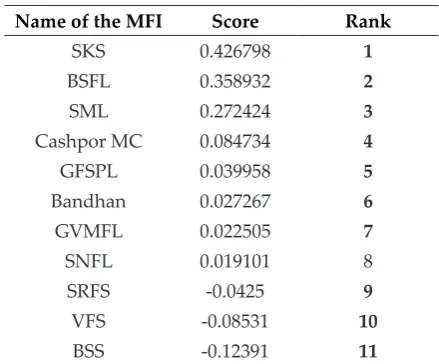
Finally the last row of the Table 1.4 describes the ranking of the MFI with respect to their overall performance. The final ranking of the MFIs along with their respective score are presented in Table 1.5.
Table 1.5: Overall Ranking of the MFI
Name of the MFI Score Rank
SKS 0.426798 1
BSFL 0.358932 2
SML 0.272424 3
Cashpor MC 0.084734 4
GFSPL 0.039958 5
Bandhan 0.027267 6
GVMFL 0.022505 7
SNFL 0.019101 8
SRFS -0.0425 9
VFS -0.08531 10
Table 1.4: Overall Scor
es of the
Alternatives Criteria/ Alternatives SRFS Bandhan BSFL BSS Cashpor MC GFSPL GVMFL SKS SML VFS SNFL
Operating expense
0.000361 0.011099 0.011635 0.001936 0.003254601 0.003162525 0.005992 0.0340839 0.0139795 0.0000235 0.000334
Personnel expense
0.000384 0.011551 0.009231 0.001975 0.004189435 0.002961987 0.006299 0.0365913 0.0145075 0.00002584 0.000358 Depreciation and
amortisation expense
0.000181 0.028612 0.008082 0.002531 0.001839328 0.002329148 0.007666 0.0244548 0.0050922 0.0000147 0.000118 Administrativ e expense 0.000393 0.005936 0.012110 0.001337 0.002093811 0.0026788 0.003922 0.0233053 0.010698 0.0000260 0.00036 Number of activ e borrow ers 0.001981 0.023236 0.010232 0.002163 0.005542129 0.003456851 0.008041 0.0506586 0.0270823 0.0019124 0.002002
Number of loans outstanding
0.00172 0.019838 0.007164 0.001968 0.004679372 0.004196248 0.008428 0.0371751 0.0260551 0.0017722 0.001449
Financial rev
enue 0.001104 0.037483 0.014077 0.003153 0.005228478 0.004956906 0.009236 0.05236 0.0305725 0.0000403 0.000959
Interest and fee
income 0.000622 0.019977 0.007218 0.001788 0.002944616 0.002669172 0.005031 0.0285318 0.017155 0.0000216 0.000545
Return on assets
-0.054334 -0.13058 0.258264 -0.14106 0.053399584 0.012999352 -0.03269 0.1384066 0.1062441 -0.090353 0.008179
Portfolio at risk > 90 days
0.005091 0.000113 0.020919 0.000303 0.001562315 0.000547368 0.000577 0.0012303 0.0210373 0.0012084 0.004797 Ov erall score
of the MFI
c
onclusionThe application of FAHP in study of financial system gathered momentum after 1990. Very few attempts were made before to use FAHP in MFI, this study focused on the use of qualitative judgments of experts as well as quantitative parameters of the concerned MFIs in order to rank them. The recent crisis in the Micro finance sector has increased the need to develop an integrated framework of MFI ranking taking all factors of decision making. After considering the dimension of human decision making and mapping the vagueness, the framework considered the quantitative parameters of MFIs performance. SKS emerged as the first rank holder with overall score of 0.4267 followed by BSFL with score of 0.3589. BSS was ranked last amongst the selected MFIs with overall score of -0.1239. Several other methods can be used to find the score of the MFI and the results can be compared to build in robustness in the empirical study. The model developed for the purpose of the study can provide meaningful insights in the evaluation of MFI’s performance.
b
ibliogRaphyArbel, A. and Orger, Y.E. 1990. An application of AHP to bank strategic planning: The merger and acquisitions process,
European Journal of Operational Research48(1): 27–37.
Askin Ozdagoglu and Guzin Ozdagoglu 2007. “Comparison of AHP and Fuzzy AHP in decision making process with linguistic evaluations”, Istambul Ticaret university fen Bilimleri Dergisi, pp. 65-85.
Aouam, T., Lamrani, H., Aguenaou, S., Diabat, A. 2009. A benchmark based AHP model for credit evaluation.
International Journal of Applied Decision Sciences2(2): 151-166.
Bernè, F., Mattia C., Maurizio F., Daria M. and Pediroda V. 2006. Multi Criteria Credit Rating (MCCR): A Credit Rating Assignment Process for Italian Enterprises According to Basel II, Proceedings of MCDM 2006, June 19-23, 2006, Chania, Greece.
B.W. Taylor 2004. Introduction to Management Science, Pearson Education Inc., New Jersey, 2004.
Che, Z., Wang, H. and Chuang, C.L. 2010. A fuzzy AHP and DEA approach for making bank loan decisions for small and medium enterprises in Taiwan. Expert Systems with Applications
37: 7189–7199.
Domański, Cz. and Kondrasiuk, J. 2005. Analytic Hierarchy Process - Applications in Banking, in Baier D., Wernecke K.D. (ed.): Innovations in Classification, Data Science, and Information Systems, Springer.
Ehie, I.C., Benjamin C.O., Y. Omurtag an Clarke, L. 1990. Prioritizing development goals in low-income developing countries, Omega 18(2): 185–194.
Fan, Chiang Ku and Cheng, Shu Wen 2009. Using Analytic Hierarchy Process Method and Technique for Order Preference by Similarity to Ideal Solution to Evaluate Curriculum in Department of Risk Management and Insurance, Journal of
Social Sciences19(1): 1-8.
Frei, Frances, X. and Harker, Patrick, T. 1998. Measuring Aggregate Process Performance Using AHP, Working Paper, Wharton Financial Institutions Center, The Wharton School, University of Pennsylvania,Philadelphia, PA 98-07.
George and Maria Bojadziev, “Fuzzy sets, fuzzy logic, applications”, World Scientific, 2000.
Hogan, K.M., Olson, G.T. and Rahmlow H.F. 2000. A Model for the Prediction of Corporate Bankruptcy Using the Analytic Hierarchy Process. In K. D. Lawrence, G.R. Reeves, and R. K. Klimberg (eds.), Multi- Criteria Applications, JAI/Elsevier, Amsterdam, pp. 85-102.
Jablonsky, J. 1993. Multicriteria Evaluation of Clients in Financial Houses, Central European Journal for Operations Research and
Economics2(3): 257-264.
Jensen, R.E. 1987. International Investment Risk Analysis: Extensions for Multinational Corporation Capital Budgeting Models, Mathematical Modelling 9: 3-5, pp. 265-284.
Korhonen, Pekka & Raimo, V. 2004. Finding the Most Preferred Alliance Structure between Banks and Insurance Companies, Helsinki School of Economics, Working Papers, W-386. Lee, Chen-Yu and Cheng, Jao-Hong 2008. A fuzzy AHP
application on evaluation of high-yield bond investment,
WSEAS Transaction on Information Science and Applications5(6):
1044-1056.
Macerinskiene, I., Ivaskeviciute, L. and Babarskas, J. 2004. Multiple Criteria in Bank Loan Portfolio Management, Ekonomika 67: ISSN 1392-1258.
Meziani, A.S. and Rezvani, F. 1990. Using the Analytic Hierarchy Process to Select a Financial Instrument for a Foreign Investment, Mathematical and Computer Modelling13(7): 77-82. Min Chang Lee and Jung-Fang chen, “Application of fuzzy
multiple attribute decision making method to evaluate customer satisfaction”, Fooying University.
Mehdi and Farzad 2008. “The fuzzy evaluation of E-Commerce customer satisfaction”-, world appl sc journal 4(2): 164-168. Nang-Fei Pan 2008. “Fuzzy-AHP approach for selection of bridge
construction method”, Automaton in construction17: 958-965. Rashid, M. and Tabucanon M.T. 1991. An Integrated Multi-Criteria
Approach for Selecting Priority Industries for Investment Promotion, Information and Management Sciences2(2): 73-90. Saaty, T. 1977. “A scaling method for priorities in hierarchical
Saaty, T.L. 1990. “How to Make A Decision: The Analytic Hierarchy Process”, European journal of Operational Research48: 9-26. Sirinaovakul, B. 2002. Analytic hierarchy process model for global
competitiveness of local companies a case for Thai banking business, IEEE International, IEMC ‘02, 2: 242-847.
Steuer, R.E. and Na, Paul 2003. Multiple criteria decision making combined with finance: A categorized bibliographic study,
European Journal of Operational Research150(3): 496–515.
Tien-Chin wang and Yueh-Hsiang Chen, “Applying fuzzy linguistic preference relations to the improvement of consistency of fuzzy AHP”, Information Science 178: 3755-3765.
Ulengin, F. and Ulengin, B. 1994. Forecasting foreign exchange rates: A comparative evaluation of AHP, Omega 22(5): 505–519. Vargas, L. and Roura-Agusti J.B. 1989. Business Strategy
Formulation for a Financial Institution in a Developing Country, in: Golden, B.L. Wasil, E.A. and Harker, P.T. (eds.), Applications of the Analytic Hierarchy Process, Springer-Verlag, New York, 251-265.
ANNEXURE-1 QUESTIONNAIRE OF PAIR WISE COMPARISON
The respondents are requested to give response by putting a tick mark in the appropriate box. It is assured that the data will not be used anywhere other than research work.
Question: 1- Main Criteria
Criteria Scale
Ext
Un-imp ImpUn Equally Imp Moderately Imp ImpExt
Income Expenses
Income Outreach
Income Asset management
Expenses Outreach
Expenses Asset management
Outreach Asset management
Question: 2- Sub Criteria (Expenses)
Criteria Scale
Ext
Un-Imp ImpUn Equally Imp Moderately Imp Ext Imp
Operating expense Personnel expense
Operating expense Administrative expense
Operating expense Dep & Amo expenses
Personnel expense Administrative expense
Personnel expense Dep & Amo expenses
Dep & Amo expenses Administrative expense
Question: 3- Sub Criteria (Outreach)
Criteria Scale
Ext
Un-Imp ImpUn Equally Imp Moderately Imp ImpExt
Question: 4- Sub Criteria (Income)
Criteria Scale
Ext
Un-Imp ImpUn Equally Imp Moderately Imp ImpExt
Financial revenue Interest and Fee
income
Question: 5- Sub Criteria (Asset Management)
Criteria Scale
Ext Un-Imp Un Imp Equally Imp Moderately Imp Ext Imp