R E S E A R C H A R T I C L E
Open Access
Application of latent class analysis in
assessing the competency of physicians
in China
Zhuang Liu
1, Yue Zhang
1, Lei Tian
2, Baozhi Sun
2, Qing Chang
3and Yuhong Zhao
3*Abstract
Background:The physicians’competency is an important public health issue around the world. Several international organizations have taken the lead in examining the competencies required to be a physician. The purpose of this study is to identify subgroups of physicians’competency based upon the importance results of competency evaluation and provide a scientific basis for the qualitative research of the competency of physicians.
Methods:A cross-sectional study was conducted on a large population-based sample in 31 provinces, autonomous regions and municipalities directly under the central government in China. The latent class analysis was performed to identify patterns of physicians’competency using M-plus software.
Results:In this study, the latent class analysis was adopted to identify the appropriate number of distinct latent classes of physicians’competency based on eight competency dimensions, and a four-class model best fit the data, which are excellent competency group, lack of professionalism competency group, individual competency driven group, and lack of competency cognitive group. Therefore, 6247 physicians can be divided into four latent classes based on the importance results of competency evaluation, and the number of each class is 5684, 284, 215 and 64, respectively.
Conclusion:These findings suggested that latent class analysis can be used to study the competency of physicians, and four distinct subgroups were identified. Therefore, we can effectively understand the patterns of physicians’ competency, and the health administrative departments could utilize more specific measures according to their different competency subgroups, and providing individualized training schemes in the future training and management of physicians.
Keywords: Physicians, Competency, Latent class analysis
Background
Along with an elevated level of economic development is the improvement of social security systems and ad-vances in medical technology. As well as a diversified public demand for clinical medical services, the demand for clinical medical professionals has also been increas-ing. Clinical medicine is recognized as the science with dual characteristics of both scientific knowledge systems and practical activities, and the comprehensive ability of physicians is closely associated with the quality of health care. In 2010, the global medical education leaders
published a report in the Lancet, which proposed the concept of the third medical education reform: based on
the education system and health system, with
competency-orientation, to establish occupational ability requirements with specific targets to improve the per-formance of the whole health system [1].
Around the world, several international organizations have taken the lead in examining the competencies re-quired to be a physician. The United States, Canada and United Kingdom basically completed the competence index system and guidelines for physicians. The USA’s Accreditation Council for Graduate Medical Education (ACGME) has identified 6 domains of clinical competen-cies for all GME specialties [2, 3]. The Royal College of Physicians and Surgeons of Canada (RCPSC) developed * Correspondence:[email protected]
3Department of Clinical Epidemiology, Shengjing Hospital, China Medical
University, No.36, Sanhao Street, Heping District, Shenyang, Liaoning Province 110004, People’s Republic of China
Full list of author information is available at the end of the article
Canadian Medical Education Directives for specialists (CanMEDS) framework, which was a guide to the essen-tial abilities physicians need for optimal patient out-comes [4]. The General Medical Council (GMC) of the United Kingdom has published a version of Good Medical Practice (GMP) for each specialty [5, 6]. In May 2012, Chinese Ministry of Education and Health launched the “excellent physicians training program”, aimed to reform the training mode of clinical medical personnel, and to train high-level, international physi-cians who would adapt to development and social needs. This is of important strategic significance in deepening the medical system reform and improving the quality of medical professional training [7, 8].
In the research of competency, usually indirect meas-urement of the latent or implicit competency of the indi-vidual can be obtained through the observed and measurable behavior of the samples. Latent class analysis (LCA) is a person-centered statistical method, which as-sumes that individuals can be grouped into classes with similar patterns of some behaviors according to their re-sponse to a set of observed indicators [9, 10]. Therefore, the LCA based on statistical models has important methodological significance for the research of the phy-sicians’competency [11]. To date, some studies have uti-lized LCA as a way to describe and identify subgroups of medical students, patients and nurses based on their characteristics and behaviors. For example, the LCA identified three hypothetical classes in the unprofes-sional behaviors of medical students according to a tem-plate of 109 behaviors [12]. Another study suggested four distinct subgroups of complementary medicine users among patients with breast cancer using LCA [13]. Three subgroups were identified for head nurses’ compe-tency based on characteristics of compecompe-tency self-reported questionnaire [14]. Likewise, researchers have used LCA to explain co-morbidity or to study subtypes based on combinations of emotional and behavioral situ-ations [15–17]. However, these studies did not examine the classes of physicians’competency. Thus, further re-search is needed to identify subgroups of physicians based on competency. As a first step in the process of developing competency model, different subtypes of physicians’competency will have different training and evaluation programs. Therefore, the aim of this study was to explore whether distinct subgroups of physicians’ competency could be defined.
Methods
Questionnaires
The questionnaire used was“Chinese physician’s compe-tency questionnaire”, developed by North Medical Education Development Center of China Medical Uni-versity. The physicians needed to rank the importance of
competency items. The questionnaire used a 5-point Likert-scale [18], ranked the items’ importance from 1 (definitely not important), 2 (not important), 3 (neutral), 4 (important) to 5 (definitely important). The question-naire divided the competency of physicians into eight di-mensions, which are: clinical skills and patient care, professionalism, interpersonal communication, master of medical knowledge, teamwork, health promotion and dis-ease prevention, information and management, academic research. There were a total of 103 items, due to the large number of questionnaire items, the current study per-formed latent class analysis on the average importance scores for each dimension in the questionnaire. The form of the questionnaire is presented in Additional file 1.
Participants
The approval of the survey was obtained from China Medical University Review Board. Each participant gave verbal and written consent. Participants could retreat from the research at any time. We performed the multi-stage stratified sampling research in 31 cities in all 31 provinces, municipalities and autonomous regions con-ducted from October 2012 to June 2013. Among the total of questionnaires distributed in the formal survey, 6247 valid questionnaires (89.0%) were collected.
Data collection
The data was first stratified according to the region and hospital grade, and further stratified according to the title of physicians within the hospital for random sam-pling. The studied subjects are mostly physicians who have completed 3-years resident standardized training, general rotation or with equivalent qualifications, cover-ing internal medicine, surgery, gynecology and obstet-rics, pediatrics and other clinical departments.
Before the investigation, the investigators were uni-formly trained with standardized survey language and methods, and the survey questionnaires were numbered. During on-site investigation, the investigators would ex-plain and guide the filling of questionnaires. After the investigation, the questionnaires were reviewed again to sort out incomplete ones. The data input was performed by two trained investigators, with 25% of the question-naires being randomly selected for double checks to en-sure consistency of data entry, and that the data information was true and reliable.
Data analysis
Descriptive analysis and test
Basic model of latent class analysis
The LCA was realized by a latent variable analysis model: the latent class model (LCM), which mainly ex-plains and estimates the relationship between observed class variables through latent class variables, and to fur-ther maintain the local-independence of the explicit vari-ables. The LCA is a potentially useful characteristics categorization technique for effectively mining class vari-able data information, which can also make up for the deficiency that category variables can’t be analyzed by other methods, such as factor analysis and structural equation model [19, 20]. It makes up for the deficiency of the structural equation model, which can only deal with the continuous latent variables, and more importantly, the research of the classification latent variables improves the analysis value of the class variables, so that the researchers can more deeply understand the latent impact factors of the class variables through probability [21–23].
The LCA assumes that the relationship between any two observed variables can be explained by the latent variable. Assume that the latent variable X has t latent classes; A, B, C are three explicit variables with a level of I, J, K. The most basic latent class model is:
πABC
ijk ¼
XT t¼1π
X
tπAXit πBXjt πCXkt
In the equationπABC
ijk stands for the joint probability of a LCA, πX
t is the probability of observation data belong-ing to a specific latent variable x,πAX
it stands for the con-ditional probability of a subject belongs to the t-th latent class reacted to the i-th A explicit variable.
Model fitting and parameter estimation
The LCA mainly uses the maximum likelihood method to estimate the parameters. The evaluation methods for model fitting include the Pearson test, likelihood ratio chi-square test and information evaluation criteria. AIC (Akaike information criterion) and BIC (Bayesian informa-tion criterion) are the most widely used evaluainforma-tion criteria in LCA selection, both are built based on the likelihood chi-square test and can be used to compare models with a different limitation on parameters, in both of which smaller results mean better fitting. Some researchers have pointed out that the BIC index is more reliable when the sample size is in several thousands. Therefore, the sub-group evaluation in our study is mainly based on the BIC index [24]. In order to more easily explain and understand the LCA, the current study re-categorized the importance evaluation into two relevant competency groups: unim-portant and imunim-portant groups. The unimunim-portant group in-cluded the importance evaluation for 1 (unimportance) and 2 (less importance). The important group included
the importance evaluation for 3 (general importance), 4 (important) and 5 (very important).
Latent classification
After determination of the optimal model, the final step is to assign the observed values into the appropriate la-tent classes, and to explain the posterior classification properties of the observed value, which is the latent clustering analysis. The LCA was conducted using M-plus V6 [25]. The classification is based on the Bias the-ory, with the calculation formula as follows:
πXABC
tijk ¼
πXABC tijk
PT
t¼1πXABCtijk
Results
Demographic characteristics and comparison of physicians’competency
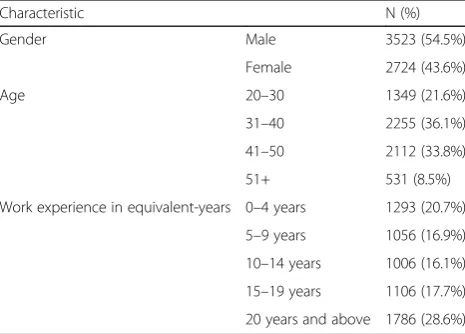
The average age of the physicians was 38.98 years (SD = 8.71). The demographic characteristics of physi-cians were shown in Table 1.
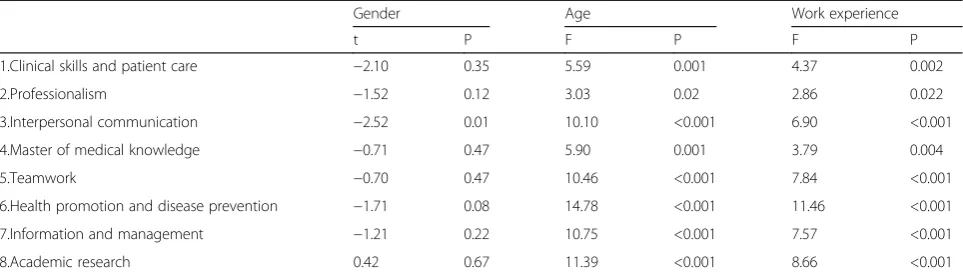
As shown in Table 2, the results suggested that no sig-nificant differences were observed in different gender ex-cept for competency of interpersonal communication. For the different age groups and years of working experi-ences, significant differences were found in the import-ance evaluation of eight dimensions among physicians.
Exploratory latent class analysis
Based on the importance results of the 103 competency items by physicians in China, the current study selected the average importance scores for each dimension in the questionnaire. The mean and standard deviation of each dimension of physicians’ competency were shown in Table 3. The first three dimensions of importance evalu-ation were clinical skill and patient care, professionalism, and interpersonal communication.
Table 1Demographic characteristics of physicians
Characteristic N (%)
Gender Male 3523 (54.5%)
Female 2724 (43.6%)
Age 20–30 1349 (21.6%)
31–40 2255 (36.1%)
41–50 2112 (33.8%)
51+ 531 (8.5%)
Table 4 lists the LCA results of the competency indica-tors for importance evaluation of physicians. By explora-tory LCA, one to eight cluster models were fitted. According to the model fit parameter and theory, BIC gradually reduced from the baseline model to the four-class model, and then began to rise with five-four-class model. Among the eight models, the four-class one is the best model with the smallest BIC value, suggesting satisfactory fitting of the original data. Therefore, the four-class model was chosen as fitting the final model.
Latent classification probability and conditional probabilities of the selected model
The four-class LCA chosen as described above was uti-lized to calculate the corresponding latent classification probability and conditional probabilities. The compe-tency of physicians was evaluated based on their import-ance evaluation of the eight competency dimensions.
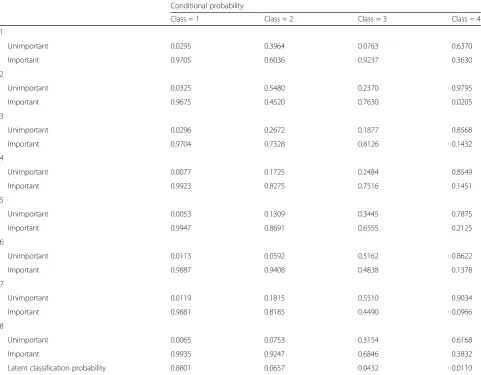
As shown in Table 5, in Class 1, importance evaluation of the physicians suggested eight competency dimensions were all important, which can be determined as“excellent competency” group. In Class 2, importance evaluation of the physicians suggested that seven competency dimen-sions were important, and the dimension of professional-ism was evaluated as unimportant, which was determined as the “lack of professionalism competency” group. In
Class 3, importance evaluation of the physicians suggested six competency dimensions were important, but the dimen-sions of teamwork and academic research were evaluated as unimportant, therefore these physicians were determined to be the“individual competency driven”group. In Class 4, im-portance evaluation of the physicians suggested the eight competency dimensions were all unimportant, which can be determined to be the“lack of cognitive competency”group.
Latent class categorization of the physicians’competency
The final step of the LCA is to categorize all the individ-uals into appropriate groups of latent classification, and to calculate the probability of dividing the different com-binations of eight dimensions into each latent class.
Table 6 lists the categorization results of different combinations of eight dimensions. For example, if a physician evaluated the competency dimensions as “ im-portant” in all eight factors, the probability of being cat-egorized into the latent Class 1 is 0.9890, which is higher than the probabilities of other categories, and therefore grouped into latent Class 1. Based on the same theory, 6247 physicians can be divided into four latent classes based on their importance evaluation results of competency dimensions, and the number of each class is 5684, 284, 215 and 64, respectively.
Table 2The comparison of physicians’competency in the importance evaluation of eight dimensions
Gender Age Work experience
t P F P F P
1.Clinical skills and patient care −2.10 0.35 5.59 0.001 4.37 0.002
2.Professionalism −1.52 0.12 3.03 0.02 2.86 0.022
3.Interpersonal communication −2.52 0.01 10.10 <0.001 6.90 <0.001
4.Master of medical knowledge −0.71 0.47 5.90 0.001 3.79 0.004
5.Teamwork −0.70 0.47 10.46 <0.001 7.84 <0.001
6.Health promotion and disease prevention −1.71 0.08 14.78 <0.001 11.46 <0.001
7.Information and management −1.21 0.22 10.75 <0.001 7.57 <0.001
8.Academic research 0.42 0.67 11.39 <0.001 8.66 <0.001
Table 3Importance evaluation of physicians’competency in eight dimensions
Mean Standard deviation
1.Clinical skills and patient care 4.54 0.42
2.Professionalism 4.50 0.45
3.Interpersonal communication 4.46 0.50
4.Master of medical knowledge 4.42 0.50
5.Teamwork 4.43 0.51
6.Health promotion and disease prevention 4.34 0.57
7.Information and management 4.35 0.53
8.Academic research 4.38 0.58
Table 4Fitness indicators of different latent class models
BIC AIC df P-value
1-Class 20,258.18 20,204.26 247 <0.001
2-Class 17,428.45 17,313.87 238 <0.001
3-Class 17,275.14 17,099.91 229 <0.001
4-Class 17,238.98 17,003.08 220 <0.001
5-Class 17,241.09 16,944.54 211 0.020
6-Class 17,293.57 16,936.36 202 0.094
7-Class 17,353.99 16,936.12 193 0.180
Discussion
Currently, the selection, training, and performance evalu-ation of physicians in China are mainly based on their basic medical knowledge, skills and work performance. Knowledge and skills are easy to be trained, which can be evaluated through examinations. However, the real work performance of many seemingly capable people can turn out to be disappointing. The reason behind such phenomenon may be the ignorance of other competency elements. How to objectively evaluate the physicians, and
how to effectively design specific training programs for the physicians, depends on the establishment of a phys-ician competency model with Chinese characteristics [26]. The research on competency models of physicians in China is still at the early stage, which is far from being able to provide a full-range, objective and standard evalu-ation system for the selection, training and evaluevalu-ation of physicians, the establishment of the evaluation compe-tency model is a key issue to be solved in our current soci-ety. However, before the establishment of the competency
Table 5Latent classification probability and conditional probabilities of the eight competency dimensions of the physicians
Conditional probability
Class = 1 Class = 2 Class = 3 Class = 4
1
Unimportant 0.0295 0.3964 0.0763 0.6370
Important 0.9705 0.6036 0.9237 0.3630
2
Unimportant 0.0325 0.5480 0.2370 0.9795
Important 0.9675 0.4520 0.7630 0.0205
3
Unimportant 0.0296 0.2672 0.1877 0.8568
Important 0.9704 0.7328 0.8126 0.1432
4
Unimportant 0.0077 0.1725 0.2484 0.8549
Important 0.9923 0.8275 0.7516 0.1451
5
Unimportant 0.0053 0.1309 0.3445 0.7875
Important 0.9947 0.8691 0.6555 0.2125
6
Unimportant 0.0113 0.0592 0.5162 0.8622
Important 0.9887 0.9408 0.4838 0.1378
7
Unimportant 0.0119 0.1815 0.5510 0.9034
Important 0.9881 0.8185 0.4490 0.0966
8
Unimportant 0.0065 0.0753 0.3154 0.6168
Important 0.9935 0.9247 0.6846 0.3832
Latent classification probability 0.8801 0.0657 0.0432 0.0110
Table 6Individual categorization results of the latent class model
Combination of variables Frequency Posterior Probability Class
{1,2,3,…7,8} C1 C2 C3 C4
{2,2,2,…,2,2} 4854 0.9890 0.0087 0.0023 0 1
{2,2,2,…,2,1} 41 0.7833 0.0858 0.1309 0 1
… … … …
{1,1,1,…,1,2} 10 0 0.0007 0.0021 0.9972 4
evaluation model, we still need to estimate the subgroups of physicians’competency.
The LCA can be used to measure and analyze a number of abstract indicators that could not be directly observed, which can simplify and integrate complex human behavior experience and social phenomenon data [27]. To our knowledge, no previous studies have identified classes of physicians’competency. The aim of this study was to iden-tify subgroups of physicians’competency based upon the importance evaluation of competency questionnaire. The latent clustering numbers were not pre-set before analysis, nor were specific limits set for parameters.
According to the importance evaluation results in eight dimensions, the competency of physicians can be divided into four classes: excellent competency, lack of professionalism competency, individual compe-tency driven, and lack of cognitive compecompe-tency. The physicians in Class 1, named “excellent competency” group, with competency evaluation of important in eight dimensions. The physicians in this group are equipped with good awareness of competency import-ance. The physicians in Class 2 mainly lacked aware-ness of importance of professionalism competency. The professionalism competency emphasized that physicians should regard serving for people’s health as the highest standards of ethics. In the medical career, physicians need to have the ultimate faith, comprom-ising altruism, pursuit of excellence, sincere and trust-worthy, strong sense of responsibility. Medical professionalism is the basis for the trust in patient-physician relationship. The view of improving health care through increasing medical professionalism has been gaining momentum among physician organiza-tions [28–30]. Especially in China, physicians find it increasingly difficult to meet their responsibilities to patients and society. In these circumstances, physi-cians should reaffirm the fundamental and universal principles and values of medical professionalism, which remain ideals to be pursued [31, 32]. Likewise, the medical universities must do more to ensure that medical professionalism among trainees is understood, discussed and practiced.
The physicians in Class 3 lacked awareness of im-portance of teamwork and academic research compe-tency. The teamwork competency mainly includes good coordination with team members, willingness to help colleagues, and building good relationships with other departments. It is effective to develop a pa-tient’s treatment plan in the form of teamwork, which improves patient safety, increase job satisfaction and maintain the stability of the medical team. Each med-ical unit has a complete consultation referral system, physicians should maintain an objective and impartial attitude in consultation with other departmental
patients, and work out the treatment plan together [33, 34]. Academic research includes reading academic literature, cultivating innovation ability, participating in scientific research, and actively writing research ar-ticles. The physicians should take an active part in academic conferences, so as to broaden the profes-sional academic vision and increase the breadth and depth of thinking. Therefore, the health administrative departments should highlight teamwork and academic research training to promote physicians’ competency for this subgroup in the future. In Class 4, the physi-cians lacked awareness of importance of eight dimen-sions. Few physicians belong to this subgroup, but in the process of clinical diagnosis and treatment, medical negligence will endanger the patient health [35]. The health administrative departments should emphasize the training and assessment of physicians’ competency to meet the demands of clinical practice especially for this subgroup. Moreover, the health ad-ministration could provide detailed training plans for this subgroup, and offering comprehensive assessment in the future training and management.
There are several limitations in our study. Firstly, the cross-sectional design was used in this study, which precluded the analysis of causality. Future lon-gitudinal studies are needed to further explore the re-lationship between physicians’ competency and their associated factors. Secondly, this study relied on phy-sicians’ importance evaluation data from competency questionnaires in China, although the instruments used were standardized and validated. Future research could benefit from using a more detailed data-collection method such as 360-degree assessment for physicians. Thirdly, the application of the research was not studied, and the hospital should provide indi-vidualized training schemes for different physicians’ competency subgroups [36].
Conclusions
Additional file
Additional file 1:Chinese physician’s competency questionnaire.
(DOCX 29 kb)
Abbreviations
ACGME:Accreditation Council for Graduate Medical Education; AIC: Akaike information criterion; BIC: Bayesian information criterion; CanMEDS: Canadian Medical Education Directives for Specialists; CMB: China Medical Board; GMC: General Medical Council; GMP: Good Medical Practice; LCA: latent class analysis; LCM: latent class model; RCPSC: Royal College of Physicians and Surgeons of Canada
Acknowledgments
We thank the participants in the study.
Funding
This study was financed by the National Science Foundation of China (Grant No.71473268), Foundation of China Medical Board (CMB#11–077), and Foundation of China Medical Board (CMB#11–047).
Availability of data and materials
The datasets were analyzed during the current study available from the corresponding author on reasonable request.
Authors’contributions
ZL and YZ ran the statistical analysis and drafted the paper. LT and QC conducted the investigation and collected the data. YHZ and BZS had the original idea for this paper, made substantial contributions to the study design and interpretation of the data. All authors commented on and contributed to the final version of the manuscript. All authors read and approved the final manuscript.
Ethics approval and consent to participate
This study was approved by the Bioethics Advisory Commission of China Medical University. Written informed consent was obtained from each participant.
Consent for publication Not applicable.
Competing interests
The authors declare that they have no competing interests.
Publisher’s Note
Springer Nature remains neutral with regard to jurisdictional claims in published maps and institutional affiliations.
Author details
1School of Public Health, China Medical University, Shenyang, Liaoning,
China.2Research Center for Medical Education, China Medical University, Shenyang, Liaoning, China.3Department of Clinical Epidemiology, Shengjing Hospital, China Medical University, No.36, Sanhao Street, Heping District, Shenyang, Liaoning Province 110004, People’s Republic of China.
Received: 23 August 2016 Accepted: 2 November 2017
References
1. Frenk J, Chen L, Bhutta ZA, Cohen J, Crisp N, Evans T, et al. Health professionals for a new century: transforming education to strengthen health systems in an interdependent world. Lancet. 2010;376:1923–58. 2. Accreditation Council for Graduate Medical Education (ACGME), Chicago,
USA. http://www.acgme.org/acgmeweb/. Accessed 20 Aug 2016. 3. Swing SR. The ACGME outcome project: retrospective and prospective.
Medical Teacher. 2007;29:648–54.
4. Frank JR. The CanMEDS 2005 physician competency framework. Better standards. Better physicians. Better care. Ottawa: the Royal College of Physicians and Surgeons of Canada; 2005.
5. Palmer KT, Harling CC, Harrison J, Macdonald EB, Snashall DC. Good medical practice: guidance for occupational physicians. Occup Med. 2002;52:341–52. 6. Irvine D. Doctors in the UK: their new professionalism and its regulatory
framework. Lancet. 2001;358:1807–10.
7. Wai-Ching L. Competency based medical training: review. BMJ. 2002; 325:693–5.
8. Carraccio C, Wolfsthal SD, Englander R, Ferentz K, Martin C. Shifting paradigms: from Flexner to competencies. Acad Med. 2002;77:361–7. 9. Muthen B, Muthen LK. Integrating person-centered and variable-centered
analyses: growth mixture modeling with latent trajectory classes. Alcohol Clin Exp Res. 2000;24:882–91.
10. Ghosh JK. Latent class and latent transition analysis: with applications in the social, behavioral, and health sciences by Linda M. Collins, Stephanie T. Lanza. Int Stat Rev. 2010;78:449–50.
11. Hagenaars JA, Mccutcheon AL. Applied latent class analysis. England: Cambridge University Press; 2002. p. 304–41.
12. Mak-van der Vossen MC, van Mook WN, Kors JM, van Wieringen WN, Peerdeman SM, Croiset G, et al. Distinguishing three unprofessional behavior profiles of medical students using latent class analysis. Acad Med. 2016;91:1276.
13. Strizich G, Gammon MD, Jacobson JS, Wall M, Abrahamson P, Bradshaw PT, et al. Latent class analysis suggests four distinct classes of complementary medicine users among women with breast cancer. BMC Complement Altern Med. 2015;15:1–10.
14. Zhang H, Zhang GP, Li Y, Cheng SY. Current situation of competency distribution of nursing supervisors in secondary hospitals based on the latent class analysis. Chinese Journal of Health Policy. 2010;5:37–41. 15. Weich S, McBride O, Hussey D, Exeter D, Brugha T, McManus S. Latent class
analysis of co-morbidity in the adult psychiatric morbidity survey in England 2007: implications for DSM-5 and ICD-11. Psychol Med. 2011;41:2201–12. 16. Hamza CA, Willoughby T. Nonsuicidal self-injury and suicidal behavior: a
latent class analysis among young adults. PLoS One. 2013;8:e59955. 17. Rodgers S, Grosse Holtforth M, Muller M, Hengartner MP, Rossler W,
Ajdacic-Gross V. Symptom-based subtypes of depression and their psychosocial correlates: a person-centered approach focusing on the influence of sex. J Affect Disord. 2014;156:92–103.
18. Sun BZ, Li JG, Wang QM. Establishment and application of clinical competency model in China. Beijing: People's Medical Publishing House; 2015.
19. Neuhaus V, Ring DC. Latent class analysis. J Hand Surg. 2013;38:1018–20. 20. Rosato NS, Baer JC. Latent class analysis: a method for capturing
heterogeneity. Soc Work Res. 2012;36:61–9.
21. Kaufman L, Rousseeuw PJ. Finding groups in data: an introduction to cluster analysis. DBLP. 1990;
22. Meng C, Wu JQ, Li YY, Zhou Y, Li N, Zhang YF, et al. Principle of latent class analysis and their application for classification. Chinese Journal of Health Statistics. 2010;27:237–9.
23. Vermunt JK, Magidson J. Latent class models for classification. Comput Stat Data Anal. 2003;41:531–7.
24. Lin TH, Dayton CM. Model selection information criteria for non-nested latent class models. J Educ Behav Stat. 1997;22:249–64.
25. Muthén LK, Muthén BO. Mplus User’s Guide. 6th ed. Muthén & Muthén: Los Angeles; 1998.
26. Zhao L, Sun T, Sun BZ, Zhao YH, Norcini J, Chen L. Identifying the competencies of doctors in China. BMC Medical Education. 2015;15:207. 27. Fairley L, Cabieses B, Small N, Petherick ES, Lawlor DA, Pickett KE, et al.
Using latent class analysis to develop a model of the relationship between socioeconomic position and ethnicity: cross-sectional analyses from a multi-ethnic birth cohort study. BMC Public Health. 2014;14:835.
28. Campbell EG, Regan S, Gruen RL, Ferris TG, Rao SR, Cleary PD, et al. Professionalism in medicine: results of a national survey of physicians. Ann Intern Med. 2007;147:795–802.
29. Breen P, Murphy K. Developing professionalism in our student clinicians. Perspectives on Issues in Higher Education. 2009;12:64–8.
30. Plochg T, Klazinga NS, Starfield B. Transforming medical professionalism to fit changing health needs. BMC Med. 2009;7:64.
31. Hu LY, Yin XY, Bao XL, Nie JB. Chinese physicians' attitudes toward and understanding of medical professionalism: results of a national survey. J Clin Ethics. 2014;25:135–47.
33. Patel MR, Wheeler JR. Physician-patient communication on cost and affordability in asthma care: who wants to talk about it and who's actually doing it. Ann Am Thoracic Soc. 2014;11:1538.
34. Ravitz P, Lancee WJ, Lawson A, Maunder R, Hunter JJ, Leszcz M, et al. Improving physician-patient communication through coaching of simulated encounters. Acad Psychiatry. 2013;37:87–93.
35. Oyebode F. Clinical errors and medical negligence. Med Princ Pract. 2013;22:323–33.
36. Lanza ST, Rhoades BL. Latent class analysis: an alternative perspective on subgroup analysis in prevention and treatment. Prev Sci. 2013;14:157–68.
• We accept pre-submission inquiries
• Our selector tool helps you to find the most relevant journal
• We provide round the clock customer support
• Convenient online submission
• Thorough peer review
• Inclusion in PubMed and all major indexing services
• Maximum visibility for your research
Submit your manuscript at www.biomedcentral.com/submit