DECOMPOSING & MAPPING NEURAL SYSTEMS
ONTO
GENERAL-PURPOSE PARALLEL MACHINES
Magali E. Azema Barac
Submitted for the degree of
Doctor o f Philosophy in Computer Science
' University of London
Department of Computer Science
University College London
ProQuest Number: 10044362
All rights reserved
INFORMATION TO ALL USERS
The quality of this reproduction is dependent upon the quality of the copy submitted.
In the unlikely event that the author did not send a complete manuscript and there are missing pages, these will be noted. Also, if material had to be removed,
a note will indicate the deletion.
uest.
ProQuest 10044362
Published by ProQuest LLC(2016). Copyright of the Dissertation is held by the Author.
All rights reserved.
This work is protected against unauthorized copying under Title 17, United States Code. Microform Edition © ProQuest LLC.
ProQuest LLC
789 East Eisenhower Parkway P.O. Box 1346
ABSTRACT
Simulations of neural systems on sequential computers are computationally expensive. For exam ple, a single experiment for a typical financial application, e.g. exchange rate time series analysis, requires about ten hours of CPU time on a Sun workstation. Neural systems are, however inherently parallel, and would thus benefit from parallel implementations. Therefore, this thesis investigates the problem of decomposing and mapping neural systems onto general-purpose parallel machines. It presents a Mapping System capable of decomposing neural network systems, and mapping them onto a range of general-purpose parallel machines; both MIMD and SIMD.
Firstly, taxonomies of neural network systems and parallel machines are provided, as well as descriptions of typical examples of both. Secondly, parallelism in neural systems and machines is analysed. The dif ferent types of parallelism exhibited by neural systems are identified. This allows a classification of neural systems on the basis of their parallelism and in accordance with their taxonomy. Parallel machines and the approaches to parallel programming are then analysed to identify the features of parallel machines involved in the mapping process.
From this analysis of parallelism in neural systems and machines, the characteristics required for decom posing and mapping neural systems are identified, and a Mapping System for decomposing and mapping neural systems onto general-purpose parallel machines is described. The Mapping System consists of two modules: a machine independent Abstract Decomposition module, and a Machine Dependent Decompo sition module. The Abstract Decomposition (AD) module describes a specification for neural systems. The AD specifies a finite set of schemes for decomposing neural systems according to the required exploi tation of neural systems’ parallelism; e.g. connection, neuron, cluster. The Machine Dependent Decom position (MDD) analyses the decomposition schemes in conjunction with the features of parallel machines; e.g. processors’ features, communications schemes, and specifies the most suitable mapping scheme to implement.
To validate the Mapping System, prototype mapping software for MIMD machines has been imple mented. The MIMD mapping software is able to automatically map static neural systems onto a 48- processor Parsys SNIOOO Transputer machine. This mapping software was developed as part of the CEC-funded Esprit 11 Pygmalion Neurocomputing Project, and is incorporated in the Pygmalion Neural Network Environment
The Machine Dependent Decomposition (MDD) module is improved by the development of an analytical framework for evaluating the speedup of neural systems’ mapping schemes, based on the integration of machine-dependent features with the alternative decomposition schemes. The various mapping schemes for the classical backpropagation neural systems were hand-coded onto a 64x64-processor Distributed Array of Processors (DAP). The analytical framework is then used to evaluate the speedups of the dif ferent mapping schemes. This shows that the expected speedups agree with the results obtained when implementing the mapping schemes.
A formal specification for neural network systems which uses the Abstract Syntax Notation One (ASN.l) as the syntactic construct is then presented. The innovative use of ASN.l, previously dedicated to the specification of communication protocols by the Open 5'ystem /nterconnection, provides a formal basis for specifying neural systems and their parallelism.
ACKNOWLEDGEMENT
Table o f Contents
1. Introduction... :... 9
1.1. Neural Computing... 9
1.1.1. Neural Network Systems ... 9
1.1.2. Neural Computing Field ... 13
1.2. Parallel Computing ... 14
1.2.1. Neural Computing and Parallel Computing ... 14
1.2.2. Parallel Machines... 16
1.3. Thesis Motivations & Aims... 19
1.4. Thesis Outline... 21
1.5. Thesis Contributions... 23
2. Neural Network Systems & Parallel M achines... 24
2.1. Related W ork... 24
2.2. Neural Networks... 26
2.2.1. Survey of Neural Network Systems... 26
2.2.2. Taxonomy... 30
2.3. Parallel Machines... 32
2.3.1. Survey of Parallel Machines... 32
2.3.2. Taxonomy... 35
2.4. Summary... 36
3. Parallelism in Neural Systems & Parallel M achines... 37
3.1. Overview... 37
3.2. Parallelism in Neural Systems... 38
3.2.1. Types of Parallelism in Neural Systems... 38
3.2.2. Parallelism across Neural Systems... 41
3.2.3. Conclusion ... 42
3.3. Parallelism in Machines... 43
3.3.1. Types of Parallelism ... 43
3.3.2. Parallelism in Languages... 44
3.3.3. Approaches for Programming & Exploiting Parallel Machines... 47
3.4. Mapping Neural Systems onto Parallel Machines... 49
3.4.1. Expression of Parallelism ... 49
3.4.2. Exploitation of Parallelism... 50
3.5. Summary... 51
4.1. Overview... 53
4.2. Abstract Decomposition ... 56
4.2.1. nC: The Pygmalion Specification for Neural Network Systems ... 56
4.2.2. Neural System Decomposition Schemes... 61
4.3. Machine Dependent Decomposition... 67
4.3.1. Overview... 67
4.3.2. Neural System Mapping Schemes... 68
4.4. Summary... 72
5. Prototype for MIMD M achines... 73
5.1. Objectives ... 73
5.2. PYGMALION Project ... 74
5.3. Mapping System ... 76
5.3.1. The Parsys SNIOOO... 77
5.3.2. Processing-based Abstract Decomposition... 79
5.3.3. Machine Dependent Decomposition... 83
5.3.4. Mapping Software & the SNIOOO ... 84
5.4. Implementation ... 85
5.4.1. nC Extensions ... 86
5.4.2. Automatic Generation... 88
5.4.3. Experiments ... 96
5.5. Summary... 97
6. Machine Dependent Decomposition: Analytical Framework... 100
6.1. Overview... 99
6.2. Analytical Framework ... 101
6.2.1. Objectives & Basis ... 101
6.2.2. Analytical Selection of the Optimal Mapping Scheme ... 103
6.3. Backpropagation Decoihposition Schemes ... 109
6.3.1. Backpropagation Neural Systems... 109
6.3.2. Decomposition Schemes... 110
6.4. Analytical Speedup Evaluation... 112
6.4.1. Distributed Array of Processors... 113
6.4.2. Relative & Absolute Speedup... 114
6.4.3. Mapping Schemes... 116
6.4.4. Analytical Selection... 121
6.5. Experimental Results... 123
6.6. Summary... 127
7. ASN.l based Specification for Neural Network Systems... 129
7.1. Objectives ... 129
7.2. The Abstract Syntax Notation One (ASN.l) ... 129
7.4. Summary... 139
8. Assessment... 140
8.1. Neural Systems & Parallel Machines :... 140
8.2. System for Decomposing & Mapping Neural Systems... 141
8.3. MIMD Prototype... 142
8.3.1. Achievements... 142
8.3.2. Comparison with Existing Moping Systems ... 143
8.4. Analytical Framework on SIMD ... 144
8.4.1. Achievements... 144
8.4.2. Comparison with Existing Implementations ... 145
8.5. Specifications for Neural Systems... 147
8.5.1. ASN.l based Specification ... 147
8.5.2. ASN. 1 & n C ... 148
9. Conclusion ... 150
9.1. Thesis Summary ... 150
9.2. Future W ork... 152
References... 154
Appendix 5.1 - Backpropagation in nC with Extensions for Parallélisation - ... 162
Appendix 5.2 - Automatic Generation of TaskID - ... 171
Appendix 5.3 - Transputer Network Topology: Hypercube.map - ... 174
Appendix 5.4 - Automatic Generation of Tasks Code - ... 176
Appendix 5.5 - Application of Backpropagation: Created Files & Tasks Code - ... 181
Appendix 6.1 - DAP Code for the Matrix-matrix Mapping - ... 187
Appendix 6.2 - DAP Code for the Matrix-vector Mapping - ... 190
List of Figures
Figure 1.1 - Neural Network Model, Application and System - ... 10
Figure 1.2 - Basic Elements o f a Neural Network - ... 11
Figure 1.3 - Classification of Parallel Machine Architectures - ... 17
Figure 1.4 - System for Decomposing & Mapping Neural Systems onto Parallel Machines -... 21
Figure 2.1 - The SNIOOO Parsys Machine - ... 33
Figure 2.2 - The Connection Machine -... 34
Figure 2.3 - The DAP Machine - ... 35
Figure 3.1 - Decomposing and Mapping Neural Systems onto Parallel Machines - ... 37
Figure 3.2 - Types of Parallelism versus Neural Systems' Components - ... 38
Figure 3.3 - Intra-neuron Parallelism - ... 39
Figure 3.4 - Training Parallelism - ... 40
Figure 3.5 - Matrix Multiplication on Transputer Grid - ... 45
Figure 3.6 - Matrix Multiplication on Processor Array - ... 46
Figure 3.7 - Expressing & Exploiting the Parallelism o f Neural Systems - ... 52
Figure 4.1 - The System for Mapping Neural Systems - ... 55
Figure 4.2 - The nC Data Structure & Declaration of the Neuron C Data Structure - ... 57
Figure 4.3 - Rule Body o f a Standard Neuron State Update - ... 58
Figure 4.4 - Rule Class: Examples -... 59
Figure 4.5 - The Initialisation o f a Data Rule - ... 59
Figure 4.6(a) - The Extension o f a Data Rule - ... 60
Figure 4.6(b) - The Extension o f a Rule Applying to other Rules - ... 60
Figure 4.7 - Connection Decomposition Scheme - ... 65
Figure 4.8 - Neuron Decomposition Scheme -... 65
Figure 4.9 - Net Replication Scheme - ... 65
Figure 4.10 - Combination o f Neuron Decomposition & Net Replication Schemes - ... 66
Figure 4.11 - The MDD Module: Selection & Translation - ... 67
Figure 4.12 - Neural Network Mapping Schemes: Selection Process -... 72
Figure 5.1- PYGMALION Neural Network Programming Environment -... 75
Figure 5.2 - Design o f the Mapping Software - ... 77
Figure 5.3 - TINY + 3L Parallel C Environment -... 78
Figure 5.4 - Example o f Sequential Computation S - ... 80
Figure 5.5 - Example o f a Parallel Computation P -... 80
Figure 5.6 - Computation Tree and Processing-based Decomposition - ... 81
Figure 5.7 - From A Neural Network System to its Transputer-Based Machine Specification -... 84
Figure 5.9 - Keep-init Mechanism -... 87
Figure 5.10 - Rule-based Decomposition of an nC Rule Hierarchy - ... 89
Figure 6.1 - The MDD Module: Performance Forecaster & Translator -... 100
Figure 6.2 - DAP System Overview -... 113
Figure 6.3 - Parallelism as Denoted in Fortran Plus - ... 114
Figure 6.4 - Matrix-Vector Mapping Scheme -... 118
Figure 6.5 - Matrix-matrix Mapping Scheme -... 120
Figure 7.1 - ASN.l Types: An Example -... 131
Figure 7.2 - The Integration of Macros and ASN.1 -... 132
Figure 7.3 - An Example of ASN.l Macro: The INTERACTION macro - ... 134
Figure 7.4 - Structured Representation of a Two-Layers Neural Model & its Computa tions - ... 135
List of Tables
Table 1.1 - A Framework for Neural Network System - ... 12
Table 2.1 - Neural Network Systems: Common Features & Examples - ... 31
Table 2. 2- General Purpose Parallel Machines: Common Features & Examples - ... 36
Table 3.1 - Types o f Parallelism in Neural Systems - ... 40
Table 3.2 - Neural Systems & Types of Parallelism -... 42
Table 4.1 - Spatial & Temporal Information for Decomposition Schemes - ... 63
Table 4.2 - Basic Mapping Schemes & Machines Features - ... 70
Table 5.1 - Decomposition Schemes on MIMD machines - ... 82
Table 6.1 - Spatial & Temporal Information for the Basic Decomposition Schemes - ... I l l Table 6.2 - The Set of Mapping Schemes to be Evaluated -... 117
Table 6.3 - Optimal Mapping Scheme & Criteria - ... 123
Table 6.4 - Implementation Results - ... 125
Table 6.5 - Performances for a 64x32x64 Backpropagation Neural System -... 126
Table 6.6 - Performances for a 96x32x96 Backpropagation Neural System - ... 126
Table 6.7 - Performances for a 96x50x96 Backpropagation Neural System - ... 127
Chapter 1
Introduction
This chapter presents the motivations and aims o f this thesis in decomposing and mapping neural systems on parallel architectures. A brief analysis o f neural systems and how they relate to parallel computing is given. From this, the aims o f this thesis are presented. Finally, the contents o f the thesis are outlined.
1.1. Neural Computing
Neural computing attempts to mimic information processing and the cognition tasks of the brain via computer simulation [Ama77a]. The resulting computer models, called neural networks, are massively parallel interconnected networks of simple adaptive ele ments (neurons and connections) and their hierarchical organisations. These models are intended to process information in a “brain-hke" manner in order to perform analogous functions, such as elementary memory functions [Koh87a]. The simulations of these models on sequential computers are computationally expensive. For example, a medium-size application, e.g. neural networks apphed to exchange rates forecasting, would typically involve a sample size of 6000 to 10000 patterns. One single experiment requires, on a SUN workstation, approximatively ten hours of CPU time [Ref92a]. Neural networks, however are inherently parallel; they involve large numbers of local computations that can, in principle, be carried out in parallel. The advent of parallel computers, such as the Transputer array [Kno89a], Connection Machine [Hil85a], or Dis tributed Array of Processors [Par90a] makes parallel implementations of neural net works possible. This thesis aims to analyse neural computing and the parallelism it embodies in order to exploit it uniformly across a range of general-purpose parallel
machines. ^
1.1.1. Neural Network Systems
X ( X X )
I n Y (y. •y)n
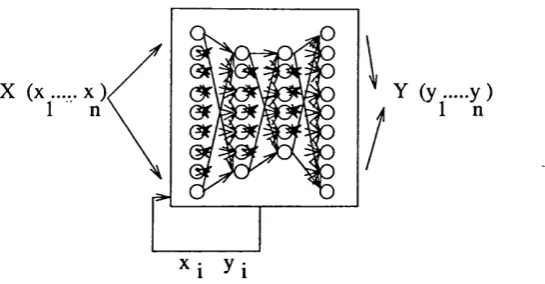
Figure 1.1 - Neural Network Model, Application and System -
A neural network system is formed by the integration o f a neural network model and application. The neural model is composed o f a hierarchical set o f neurons and connections, depicted within the square box. The neural application determines the input and output data, shown as X,Y in the figure.
A neural network model is the description of the hierarchical organisation of the neu rons, the network interconnectivity, the local operations of neurons, the local adaptation of connections, and their overall dynamic behaviour (i.e. learning). In other words, the neural model is the algorithm of a neural network system.
A neural network application is the description of the interactions between the model and its external environment. The model interacts with its environment via its input and output neurons, as shown in Figure 1.1. The input neurons receive inputs X from the environment, and the output neurons provide outputs Y to the environment.
A neural network system consists of the integration between a neural model and neural application. It specifies how the different elements forming the input (%i • • • Xn) and out put (y, • • y^) interfere with the learning operation of the neural model.
The next sections present the basic elements of neural network systems, and a framework for describing them.
l . l . l . l . Basic Elements
neuron
net input
Figure 1.2 - Basic Elements o f a Neural Network -
A processing unit or neuron receives a signal via its weighted connections Wij. It
then computes its activation state Xi by generally applying a non linear transform f to its net input ILjWijXj.
A neuron /, indicated by a circle in Figure 1.2, has a state of activation at a each point in time. Associated with each connection there is a weight w/; which defines the effect of the unit j on the unit i. The new activation at t+l of a neuron is generally obtained by applying a function / on the weights Wij and activation of neurons j which connect to the neuron i. This function is referred to as activation rule and is of the form:
Xi{t+\)=f{xi{t),'Lwij'X.Xj) Activation Rule (1.1) The weights Wij undergo modification so as to construct an internal representation of their environment. The concept of learning is related to this adaptation of the weights, referred to as the learning rule [Hin87a]. The learning rule typically modifies the weights according to their previous value and the state or other variables associated with the neurons they are connecting.
Wij(r+1 )=Wij(t) = Awij ; Awÿ = g ( wi j , x i , x j , • • • ) Learning Rule ( 1.2) The weighted synapses (connections) between neurons specify the interactions that occur within a network and govern the influence of each particular neuron onto the oth ers, i.e. the weights contribute to the input signals that a neuron receives. The modification of these weights over a time span represents the modification of the knowledge (i.e. learning) that a neural network exhibits. Taking these basic elements, i.e., neurons and connections, a neural network system is fully described by specifying its neurons and connections, the network connectivity pattern and its adaptation, and finally the interaction with the external environment, i.e. neural application. A framework for describing the range of neural network systems is now presented.
1.11.2. Framework
function the neural model performs, it specifies the data to give to the network and the data to obtain from it. For example, in the case of a pattern associator, the application aims to retain a set of input-output pattern associations. Lastly, in order to integrate an application and a model, one has to specify how the operations of the model are to be organised and controlled, this is referred to as system processing because it is concerned with the high level transform performed by a model. Consequently, the description of neural network systems involves the specification of the model it uses, the application it intends to perform, and the associated system processing as summarised in the following table.
Neural Network System Example Neural Model Local Components
Neuron’s type
Neuron’s Activation Rule Connection’s Adaptation Rule
Global Components
Organisation of Network of Neurons Networic Interconnectivity Network Dynamic Processing
binary 0-1
Xi = \ ! Wij = Wij -I- Aÿ A/y = axi Xj
Layered
Full connectivity inter layers Adaptation of the weights Neural Application Data to the model
Data from the model
Patterns (e.g. set of pixels)
System Processing Control of die Network Dynamic Processing Batch learning of a set of patterns
Table 1.1 - A Framework for Neural Network System -
A neural system is described by the model it uses, the application it performs, and the processing necessary fo r the achievement o f the application. The neural model describes the behaviour o f the network o f neurons and connections, both locally and globally. The application specifies the data to give to and retrieve from the net. Finally, the system processing specifies the neural model processing to operate in order to perform the application.
As shown in Table 1.1, the spécification of the model comprises local components and
global components:
Local components’.
Local components are the neurons and connections and their respective computations. A neuron is specified by its type, for example binary, and its computational or activation rule. This describes the neuron’s response to its input signal, and is a combination of the weights and neurons it is connected with, as described by Equation (2.1). Different types of neurons, both in terms of operations they perform and in terms of their type (binary or continuous) can coexist within a same model. Standard activation rules include functions such as step function, and sigmoids both symmetrical (tanh) or asymmetrical ( ^ - L ) . A connection is specified by its adaptation or learning rule which describes the modification process of its weight value, i.e. the computation to perform to obtain Aw/y, such that
activation state, error value, previous weight change, as described in Equation (1.2).
Global components
Global components are the organisation of the network of neurons, the interconnectivity of the network, and the network dynamic behaviour (i.e. processing of the model). The neurons’ network organisation specifies how the neurons are (or not) hierarchically con structed, whilst the network interconnectivity describes the pattern of weighted connec tions which links neurons. For example, neurons can be organised in slabs with weighted connections linking neurons within different slabs. Moreover, the interconnectivity affects the way neurons interact with each other, i.e. neurons’ local rules are contingent to their weighted connections. The network dynamic behaviour specifies the processing occurring within the network. It describes how the local rules of the network’s elements operate and cooperate so as to achieve learning and storage. It specifies the processing order of neurons’ rules (e.g. on the basis of their dependence to a slab), and connections’ rules (e.g. on the basis of the neurons they are connecting).
The neural application is the description of the function the model intends to per form. This is complemented by the description of the data to give to, and obtain from the model. Then, once the application is defined, the overall processing, i.e. the processing required for the achievement of the application must be specified. This system process ing indicates how the network dynamic behaviour (global component of a neural model) is to be controlled in order to perform the application. For example, in the case of a neural system used as a pattern associator, the neural model performs the learning of one pattern. The system processing specifies how this learning is controlled to achieve the learning of a set of patterns.
This section has presented the neural network paradigm and the resulting neural systems. It has also proposed a framework for their description which makes a distinction between neural model and neural application and system. The usage of neural network systems, i.e., the neural computing field is now examined.
1.1.2. N eural Computing Field
With regard to neural systems, the neural computing field can be divided into two basic areas:
• The study and application of neural network systems,
• The development of software and/or hardware tools to support this study and appli cation.
enhanced convergence and generalisation properties. These new neural models need to be validated via simulations. Simple benchmarks are thus used, and the simulation results are analysed [Fal87a]. The properties performed by the neural network are com pared with those expected by the theory to determine the correctness of the model. The whole process is largely experimental and is computationally intensive. Secondly, there are developers who build non trivial applications o f neural models. Initially, they iden tify applications whose characteristics fit neural networks properties [Hop82a]. Then, because of the different properties available, developers experiment with various models in order to find the model with optimal convergence and generalisation, as shown in Fig ure 1.2.
Thus, for both researchers and practitioners, the investigation of neural network sys tems by means of software and hardware tools is of major importance. These tools allow the analysis and validation of new neural models, and the investigation of neural network capabilities for various applications. In recent years, quite a large number of such tools have been developed [Tre92a]. They range from educational tools to sophisticated neural programming environments. A good example of an educational tool is the Parallel Distributed Processing Environment (POP) [Rum87a]. This environment provides a basic range of neural models and associated applications in order for its user to acquire knowledge in neural network systems. However, it gives no consideration to the parallel nature of neural systems. There also exist commercial neural systems tools, such as Nes tor [Nestor]. However, they often lack flexibility in that they are generally application oriented. For example, Nestor is a pattern recognition environment. Lastly, there are more complex environments for neural networks which may provide both software and hardware tools. A typical example is the ANNE environment which comprises a net work description and intermediate level language, and a mapper with a physical architec ture descriptor to partition the network amongst iPSC processors [Bah88a]. Our interest lies in environments that provide mechanisms for exploiting the parallelism exhibited by neural systems. A detailed review of neural environments can be found in [Tre89aj.
1.2. Parallel Computing
This thesis studies the parallel computing domain with respect to the neural comput ing field. Thus, the relations between neural computing and parallel computing are now examined.
1.2.1. Neural Computing & Parallel Computing
groups of high-performance machines which support neural computing: • co-processor accelerators,
• neurocomputers,
• general-purpose parallel machines.
Co-processor accelerators are typically single boards that plug into the backplane of an IBM PC, or interface to a SUN Workstation. These boards might contain, for example a Motorola MC68020 plus a floating-point co-processor together with a large memory for implementing the neurons and connections [Tre90a]. They accelerate specific operations performed by a neural network simulation. However, they are inherently sequential and thus they can only partially exploit the potential for parallelism of neural networks.
Neurocomputers are the result of the investigation of new architectural designs for building hardware tools dedicated to neural network simulation [TreS9b]. The work done in this area can be divided into two parts: i) the development of specialised VLSI neuro-chips, and ii) the development of general-purpose neurocomputers. Specialised VLSI neuro-chips are often application-specific, and are developed to speed up a specific neural network, for example the Kohonen neural network. In this respect, they provide good performance but lack flexibility. On the other hand, general-purpose neurocomput ers are generic in that various neural networks can be implemented on them. For exam ple, Adaptive Solution Inc [Sol91a], has developed neuron-based neurocomputer, named CNAPS, Connected Network of Adaptive Processors. This neurocomputer is optimised for traditional neural network systems, e.g. fully connected networks, but is general enough to support more complex neural systems [Hec90a]. However, the usefulness of developing dedicated hardware is debatable, and its cost/effectiveness has yet to be vali dated [Ref90a].
• One-to-One: mapping the parallelism of a particular neural system onto a particular parallel machine [Ric89a],
• Many-to-One: mapping a range of neural systems onto a particular parallel machine [Mig90a],
• One-to-Many: mapping a specific neural system onto a small set of different parallel machines [Obe90a],
• Many-to-Many: mapping a range of neural systems onto a range of parallel machines.
The work done in this thesis falls into the last category: the many-to-many mapping. That is, for virtually any neural system the aim is to develop a mechanism able to produce an efficient mapping onto a range of general-purpose parallel machines. Hence, the objec tives are the expression of parallelism across a range of neural systems, and the exploita-tion of parallelism across a range of parallel machines. Before specifying the objectives further, the range of parallel machines considered in this thesis is reviewed.
1.2.2. Parallel Machines
The purpose of this section is to classify parallel machines according to their archi tectures in order to identify which class of parallel machines this thesis addresses. A wide variety of parallel architectures has been proposed. Attempts to classify their designs unequivocally have somewhat failed, and as such there are no complete and accepted classification schemes [Hoc84a]. Classification schemes have shown their limi tations in that there will always be a particular parallel architecture that will not fit into the classification. However, these classifications are recognised by the whole parallel computing community, and provide useful tools for expending our understanding of parallel processing and give a background analysis for decomposition strategies.
execute autonomously on different data streams. This classification is a useful shorthand for characterising different architectures [Dun90a]. It is however incomplete. Pipelined vectors processors, such as the Cray [Hwa84a], recognised as parallel architectures (they allow concurrent arithmetic execution), do not belong to any of the four classes [Hoc87a]. They are not SIMD because there are no processors that execute the same instructions, they are not MIMD either because processors have no autonomy as such. Secondly, there exists recent classification schemes which attempt to merge the proper ties and components that have been defined as characteristics of parallel architectures in previous schemes. Duncan provides a high level classification aiming to encompass all existing parallel architectures. [Dun90a]. This distinguishes three high level classes: • the synchronous architectures,
• the MIMD architectures, • the MIMD-based architectures. They are summarised in Figure 1.3.
Parallel Architectures
Synchronous MIMD MIMD-based
Vector SIMD Systolic Distributed Shared Hybrid Dataflow Reduction Wavefront
Figure 1 3 - Classification o f Parallel Machine Architectures -
The Synchronous class incorporates the vector processors, the processor array and associative memory (part o f the SIMD Flynn's class), and the systolic architectures. The MIMD class incorporates distributed memory and shared memory systems. The MIMD-based architectures incorporates the dataflow architecture, the reduction and the wavefront architectures.
t
Synchronous architectures
The synchronous class is composed of parallel architectures that operate con currently in lockstep through either global clocks, central control unit, or vector unit con trollers. It is further divided into three sub-classes: the vector architectures, the SIMD architectures, and the systolic architectures.
The vector architectures are characterised by pipelined multiple arithmetic units that operate concurrently. They provide parallel vector processing by "chaining" results of units into inputs for the following units. The Cray architectures are typical examples [Hwa84a].
architectures. The Distributed Array of Processors (DAP) is a typical example of proces sors array, while the PEPE architecture is representative of the associative memory archi tectures [Par88a].
The systolic architectures were initially built to solve the problems associated with demanding Input/Output (I/O) bandwidth systems. They are pipelined multiprocessors in which data is fed into the processors in rythmic fashion; a datum enters the systolic array and is then passed to any processor that requires it. Thus, only boundary processors per form VO operations to and from the memory. The Warp is an example of reconfigurable systolic architecture [Kun87a].
M IMD architectures
The MIMD architectures are architectures composed of a set of processors that can execute independently using local data. They are asynchronous with decentralised hardware control; their synchronisation is effectively performed either by message pass ing through an interconnection network or by accessing data in shared memory units. Thus, this class comprises distributed memory architectures and shared memory architec tures.
In the case of distributed memory MIMD, processing nodes; i.e. processor + local memory, are connected with processor-to-processor interconnection network. There exist a wide variety of interconnection networks, each of which defines a different inter- processor communication pattern. The typical ones are the ring interconnection network where nodes form a ring; the mesh interconnection network where individual nodes are connected to their four immediate neighbours; and the hypercube interconnection net work which arrange the nodes so to form a n-dimensional cube. The Parsys and Ncube are typical examples of this class.
The shared memory MIMD architectures involve multiple processors sharing memory. The access to shared memory units acts as the synchroniser. In these architectures, pro cessors are general purpose rather than just composed of a CPU and peripheral VO pro cessors. An interconnection network is provided by the architecture to support memory access. For example, the Alliant FX/8 uses a crossbar scheme to connect processors and cache memories [Per86a]. The crossbar prevents contention for communication links by providing a dedicated path way between each possible processor/memory pairing.
M IM D-based architectures
The hybrid MIMD/SIMD architectures are partly MIMD and partly SIMD; i.e a group of its processors are independent and "obey" MIMD rules, while another set is globally controlled (for example, by one of the MIMD processors). The Texas Reconfigurable Array Computer is an example of such an hybrid parallel architecture [Lip87a].
The dataflow architectures are based on data dependencies; that is executions of instruc tions occur as soon as their operands are available [Tre82a]. The Manchester Dataflow computer is an example of the practical realisation of the dataflow principle.
The reduction architectures are demand-driven architectures, and are based on data requirements. That is, an instruction is enabled if its results are required by another enabled instruction. Historically, they have been developed to provide architectural sup port for functional languages.
Lastly, it is worth mentioning the wavefront array architectures which are a combination of systolic data pipelining and asynchronous dataflow execution principle. These archi tectures were developed for special-purpose systems that balance intensive computations with I/O bandwidth. They are characterised by modular processors and local intercon nection networks with handshake mechanism that sequences the computations. The John Hopkins university built such a parallel architecture, however these architectures are still in an evaluation state.
In summary, the above classification groups architectures in three main classes: synchro nous, MIMD, and MIMD-based. The MIMD-based class incorporates all unclassifiable architectures; e.g. the hybrid MIMD/SIMD, This classification permits us to identify some basic parameters which define parallel architectures such as, for example the pro cess synchronisation (e.g. synchronous, asynchronous, hybrid), and inter-processor com munication (e.g. interconnection network, array-based). More importantly, it allows the specification of the type of p ia lle l architectures this thesis considers. Both the basic synchronous and MIMD architectures are targeted in this thesis, this covers quite a wide spectrum of alternative parallel architectures. Moreover, the hybrid architectures because combining SIMD and MIMD characteristics is also part of our universe of paral lel architectures. Finally, it shall be noted that architectures which allow Input/Output operations and computations to occur in parallel are not considered as parallel.
After this introduction to the neural computing field and its relations to the parallel com puting field, the motivations and aims of this thesis are presented.
1.3. Thesis Motivations & Aims
• There are only a few languages dedicated to neural networks which express their parallelism,
• There are no generic systems or tools which enable the exploitation of the parallel ism in a range of neural networks across a range of general-purpose parallel machines.
Initially, the neural computing community focused on the development of neural pro gramming environments, ranging from educational environments such as the PDP environment [Rum87a], to commercial environments such as the Nestor Development System [Nes88a]. However, these environments are largely dedicated to sequential machines [Aze92a]. Similarly for the representation and programming of neural net works, i.e. few specifications provide methods for expressing their parallelism. Firstly, because neural environments are executable only on sequential machines, parallelism is not considered as an issue, and thus specifications do not support parallelism. Secondly, environments that execute on specific parallel computers provide specifications for neural networks which support the parallelism of the targeted machine, for example the CARELIA environment [Koi89a]. Furthermore, once a working neural application is constructed, its specification is often tailored for implementation on a specific parallel machine, i.e. dedicated parallélisation. For example, Zhao in [Zha90b] describes the implementation of the Traveling Salesman Problem on a Meiko parallel computer. Con sequently, the work done has not provided any kind of formal or in-depth investigation of the parallelism of neural networks.
This thesis aims:
• To analyse and extract the parallelism found in neural networks, • To exploit it across a range of general-purpose parallel machines.
The ultimate goal is to constmct a mapping software that exploits the intrinsically paral lel nature of neural networks across a range of conventional (non dedicated) parallel machines. This mapping software adapts jointly to the neural network and its parallelism
and to the parallel machine. It analyses and extracts the parallelism of any neural net work and deduces a mapping which is the most suitable for the type of parallelism of the targeted machine.
NS NS NS
SIM D
M apping for NS onto M
Sim d 0 M im d 0
M im d n Sim d n
A bstract Decom position
M achine D ependent D ecom position
M IM D
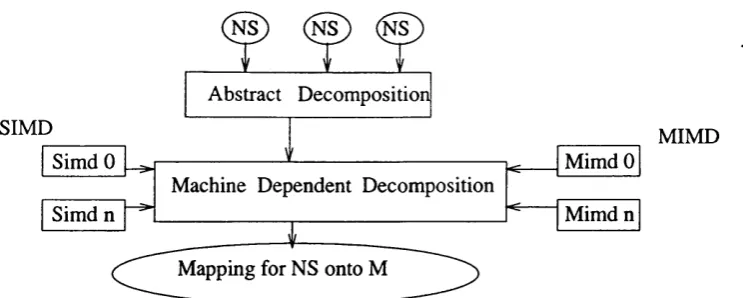
Figure 1.4 - System fo r Decomposing & Mapping Neural Systems onto Parallel Machines Via the Abstract Decomposition module, the System fo r decomposing and mapping devises the alternative decomposition schemes o f a neural system. Then, the Machine Dependent Decomposition analyses the various decompositions relative to the targeted parallel machine, and decides upon the mapping scheme to implement.
As shown in Figure 1.4, the System divides the mapping task into two modules: a neural Abstract Decomposition and a Machine Dependent Decomposition. The AD is responsi ble for extracting the parallelism that neural systems exhibit and for identifying the asso ciated alternative decomposition schemes. The MDD considers the targeted parallel machine and produces the specification of the neural systems onto the machine. The Sys tem provides a framework for decomposing and mapping neural networks which aims to combine genericity with efficiency, i.e. enabling the mapping of virtually any neural net work onto virtually any parallel machine while optimising the exploitation of the avail able parallelism.
1.4. Thesis Outline
This thesis is divided into nine chapters. This chapter has introduced the neural computing research field, its relations with the parallel computing field, and has explained the aims of the research.
Chapter 2 firstly reviews the work done in the area of neural systems and parallel machines. This reveals weaknesses in current systems for describing and exploiting the parallel nature of neural networks. Secondly, in order to have a common set of refer ences, this chapter surveys both neural network systems and general-purpose parallel machines.
Chapter 4 proposes a Mapping System for decomposing and mapping neural net work systems. The Mapping System divides the mapping task into two: a neural system Abstract Decomposition (AD) and a Machine Dependent Decomposition (MDD). The Abstract Decomposition analyses the parallelism exhibited by neural systems and specifies possible decomposition schemes. The Machine Dependent Decomposition deduces a suitable neural system’s mapping scheme according to the targeted parallel machine.
Chapter 5 describes the construction of a prototype system that automatically maps neural systems onto a Transputer-based machine. The mapping software has been developed within the Esprit project Pygmalion [Tre89c], and is targeted to Transputer- based machines which are representative of the MIMD machines. It implements an automatic translation from a neural network specification to its equivalent on a Transputer-based machine, namely the Parsys SNIOOO.
Based on the Mapping System proposed in Chapter 4 and on its prototype implementation described in Chapter 5, two major improvements are made. The first one concerns the optimisation of the mapping process and is presented in Chapter 6, while the second one concerns the optimisation of the expression of neural systems parallelism and is presented in Chapter 7.
Chapter 6 optimises the exploitation of parallelism by developing an analytical framework for forecasting the speed-up of neural systems mapping schemes. This addi tional tool is able to select a particular neural network mapping scheme according to its predicted performances. The usage and validity of this tool is demonstrated for an SIMD machine, namely the Distributed Array of Processors.
Chapter 7 focuses on the expression of neural systems parallelism. It introduces a specification for neural systems with explicit support for parallelism. The specification uses the Abstract Syntax Notation One (ASN.l) as the syntactic constructs. The interest of this work resides in the innovative use of ASN.l for specifying neural systems; i.e. so far, ASN.l has been dedicated to the specification of communication protocols.
Chapter 8 evaluates the thesis’s research, covering five areas of work. Firstly, the analysis of parallelism in neural systems and machines is assessed. Secondly, the Map ping System and its two modules; the AD and MDD, are assessed. Thirdly, the MIMD prototype is evaluated, and compared with existing mapping softwares. Fourthly, the analytical framework and the experiments carried out on an SIMD machine are evaluated. Lastly, the specifications for neural systems: nC and ASN.l-based are assessed and compared.
1.5. Thesis Contributions
This thesis develops a solution for decomposing and mapping neural systems onto general-purpose parallel machines. In doing so, this thesis makes three major contribu tions: i) a general-purpose Mapping System for mapping neural systems onto parallel machines, ii) an analytical framework for evaluating the speedup of alternative neural system’ mappings, and iii) an ASN.l-based specification for neural systems with explicit support for parallelism. Based on this, the research reported in this thesis can be divided into five areas:
• The analysis of parallelism in both neural systems and parallel machines. This sys tematic analysis demonstrates the need and identifies the requirements for a mechanism for expressing and exploiting the parallelism of neural systems onto parallel machines.
• The development of a Mapping System for decomposing and mapping neural sys tems onto general-purpose parallel machines. This Mapping System is applicable to virtually any neural system and parallel machine.
• The implementation of a mapping software for neural systems onto a typical MIMD machine. This mapping software, developed as part of the Esprit Pygmalion Neurocomputing project, automatically decomposes neural systems, and generates their parallel specification on the 48-processor Parsys SNIOOO Transputer-based machine.
• The development of an analytical fram ework for evaluating the speedup of alterna tive mapping schemes of neural systems onto parallel machines. The validity of this additional tool is demonstrated using an SIMD machine; the Distributed Array of Processors (DAP).
Chapter 2
Neural Network Systems & Parallel Machines
This chapter firstly reviews the work done in the area o f mapping neural network systems onto parallel machines. Secondly, it presents some typical examples o f neural systems and parallel machines, and derives a taxonomy fo r both o f them.
2.1. Related Work
As indicated in Chapter 1, the objective of this thesis is to develop mechanisms for analysing and exploiting the parallelism of neural network systems across a range of parallel machines. Thus, to motivate the work done in this thesis, the various approaches in dealing with the mapping of neural systems onto parallel machines are reviewed. Four kinds of mappings are identified:
• One-to-One: - mapping the parallelism of a particular neural system onto a particular parallel machine [Ric89a], and [Zha90b], and [Bod90a], and [Wit89a]. • Many-to-One: - mapping a range of neural systems onto a particular parallel
machine [Mig90a], and [For87a], and [Em90a].
• One-tO'Many: - mapping a specific neural system onto a small set of different parallel machines [Obe90a], and [J.B90a].
neural parallelism on a range of parallel machines.
The many-to-one category consists of a machine-specific strategy for mapping aspects of neural systems [For87a]. Specific features of the target machine are provided in a software framework. Furthermore, these frameworks specify the means for data placement, communication schemes, control of the neural system processing, etc. More specifically, they present approaches for specifying neural systems that support the expression and exploitation of parallelism. The Carelia simulator [Koi89a] describes a neural networks development environment designed to run in a multi-transputer processor network. Within this environment, the neural systems are expressed using a Communicating Sequential Processing (CSP) formalism [Hoa78a]. Thus, the basic features of the specification, the approach used to describe neural systems, makes the exploitation of their parallelism strongly biased towards CSP-based machines, i.e. message-passing multicomputers. In conclusion, this category is targeted to a specific machine, whereas this thesis intends to consider a whole range of machine-specific elements that intervene when mapping neural systems.
The one-to-many category includes mapping a specific neural system onto a range of parallel machines. This allows, for example, comparisons to be made between different machines. In [Obe90a], the simulation of a self-organising system onto a Transputer ring and a Connection Machine CM-2 are compared. The parallelism exhibited by the self organising feature maps; developed by Kohonen [Koh87b], is analysed. Then, its exploitation on both machines is described, and their respective performances presented. The performances are expressed as a function of machine’s parameters, it is therefore useful because important machine criteria are thus identified. In this case, different criteria are devised for the different machines; giving thus some information about which criteria are crucial for which parallel machine. However, firstly this category is restricted to particular neural system, and secondly does not provide a ’unified’ framework for the performances of each implementation (often, criteria are machine dependent, thus too specific to be applied to a range of machines)
Before focusing on the parallelism of neural network systems and parallel machines, it is useful to provide a taxonomy of both neural systems and parallel machines; this allows us to have a common framework for references.
2.2. Neural Network Systems
Based on the framework presented in Chapter 1, this section describes typical examples of neural network systems which have been selected to form a representative range of their abilities and characteristics. It permits us to present a taxonomy of neural network systems and also to have a basic set of neural systems for reference when analysing parallelism.
2.2.1. Survey of Neural Network Systems
Within the literature, two main classes of neural systems are defined: supervised
systems and unsupervised systems. Supervised systems use neural models in which the external environment, i.e. the application dictates the input and output of the model. The objective of such systems is thus to learn input-output associations. On the other hand, unsupervised systems are "free" systems; they produce their own response to input from the environment. Another class of neural systems is worth mentioning: the combinatorial optimisers which are able to solve combinatorial optimisation problems. In this case, it is the state of the neural system itself that represents the solution [Aar89a].
The neural systems described below are representative of each class. These are respectively: the Hopfield neural system as a combinatorial system, the backpropagation as a supervised system, and the Self Organising Maps as an unsupervised system. Their description follows the framework introduced in the previous section. The neural models are determined in terms of focal and global components, and an example of their integration with an application is given. The following notation is used:
X i = activation state for neuron (unit) i d i = desired state (output) for neuron i
ei = error term for neuron /
Wij = connection weight from neuron j to neuron i
e = a threshold value
x = a scaling factor, referred to as learning rate
2 2.1.1. Combinatorial Optimiser: Hopfield
optimisation [Aar87a].
Neural Model
The Hopfield model is made of binary neurons (of +1/-1 spins) with fixed connections. The connections take real values of either sign and are set to embed the constraints of the optimisation problem. Furthermore, the connections are symmetric
(wÿ = W ji if z z j , Wii = 0). Neurons obey the following activation rule:
Xi = 1 i f Zw/y X j > 0
Xi = 0 Otherwise Hopfield Activation Rule
The model is made of one set of neurons with full connectivity in between. Because the connections are fixed, the model performs one simple computation referred to as
relaxation computation, in which neurons evolve by computing their activation state. It should be noted that neurons can compute their new state in parallel.
Neural Application & System
The application sets the connections weights to represent the constraints of the optimisation problem. For example, in the case of Hopfield applied to the Travelling Salesman Problem the weights are set so as to ensure that each city is traversed only once [Aar89a]. The computations performed by the Hopfield system simply leaves the model to evolve until the model stabilises. It has been shown that ultimately, the network of neurons (the model) converges to a stable state which corresponds to a minimum point of an energy function of the form: E = - y Xj w,y.
2.2.1.2. Supervised Systems: Backpropagation
The hidden components of a neural system are not directly exposed to the external environment. The problem of how to govern their influence initiated research [Wer88a], and [Par85a], and [Rum87a], and resulted in the description of a neural model aiming to give better control over the knowledge encoded by the hidden components. The basis is to compute a measure of the error; the learning process is then about reducing this error measure. The backpropagation system described here is referred to, in the literature, as the standard backpropagation [Rum87a]. Multiple variations of this system exist, they are however not considered here
Neural Model
Neurons take real values and perform two rules; the activation rule and a rule for computing the neurons’ local error. The activation rule, which determined the actual activation state of a neuron, is a non-linear function of the neurons input signals, and is typically of the form:
Xi = 1 + Backpropagation Activation Rule
For the computations of the neurons’ error, distinction is made between the visible neurons and the hidden neurons. The error for an hidden neuron is determined recursively in terms of the error signals of the neurons to which it connects 5;, and the weight of these connections wy, . For an output neuron, the error is based on the difference between the desired state of the neuron d, and its actual state jc,. Formally, this gives:
6/ = ( d i - Xi ) x x i x ( i - X i ) Output Neuron
6/ = Ey ( wy, X 6y ) X X, X ( 1-a I ) Hidden Neuron Backpropagation Error Computation
Weights are modified according to the derivative of a global error measure E along w
(set of weights) as defined above. This gives:
Wÿ = Wi j + Aw/y
where Aw,y = X5, oj + aAw,y Backpropagation Learning
Neural Application & System
The computations performed by backpropagation systems aim to train the model (and recall) on a set of patterns, as defined by the application. The training involves the presentation, in turn, of each training pattern. If the set of training patterns T is defined such that: r = ri,..., r,...., . The system processing consists of training the model for each
ti&T, this is repeated for the whole set T. Indeed, when the model is trained for a pattern
ti such that i>k then the model enforces the representation of the pattern /, within the model, and thus reduces the representation of the patterns tk. In consequence, the system has to process the whole set of patterns more than once. Furthermore, it is possible to learn each training pattern independently, this allows the system to operate in parallel over the training patterns [Par90b].
The overall processing of both optimisation and supervised neural network systems is driven by the application. There exist neural systems which produce their own response from the environment: the unsupervised systems.
2.2.1.3. Unsupervised Systems: Self Organising Map
Unsupervised neural systems are systems that self organise and produce their own response to their environment. For any type of neural system, supervised or not, it is the specification of the dynamic behaviour of the system’s elements that controls its response. Examples of such neural systems are Self Organising Map system [Koh87b], Competitive Learning [Rum87a], and Adaptive Resonance Theory (ART) [Gro88a]. The Self Organising Map system (SOM) is based on the assumption that the brain realises a topology-preserving mapping from the sensory environment to sensory-specific areas, i.e. the brain forms topographically ordered maps which are assumed to organise themselves.
Neural Model
In the SOM model, both neurons and connections take real values. Neurons, referred to as topological neurons compute their distance to an input vector relative to their weighted connections. The computation of this distance measure is:
di = I Xj - Wij I SOM Distance Computation
The neuron with the minimal distance (min,- {di ) ), and its neighbours, XjENi adapt their weights. Weights connecting neurons that do not respond to the input data (not minimal or neighbour) stay unchanged. Formally, for a neuron k, it gives:
Wjt;(/+1) = Wkj{t) + X {Xj - Wkj{t)) if neuron k in neighbourhood Ni
The SOM model is organised in two layers with full connectivity. The first layer acts as a relay layer, while the second layer acts as the topological map. The SOM model performs two global computations: clustering and matching. Clustering involves the identification of the winner neuron and the adaptation of its own weights and the weights of its neighbour. Matching simply involves the identification of the winner neuron. Firstly, to identify the winner neuron, neurons in the first layer propagate the input; they transmit their value directly to the second layer of neurons. Each neuron within this layer can transmit in parallel. Secondly, all topological neurons compute their distance, and the one with the minimal distance is marked. The computations of distance by the neurons can be performed in parallel. Once a neuron is declared winner, its neighbourhood Ni is identified. Ni is defined such that all neurons which lie within a certain radius from neuron i are included within. Kohonen showed that best results in self organisation are obtained if the topological neighbourhood is a function of a discrete time index t such that Ni is selected fairly wide at the start and then slowly decreases with time [Koh87b]. The update phase requires the weights connected to the winner neuron and its neighbours to update their value according to the SOM learning rule, as defined above.
Neural Application & System
SOM is generally applied to classification problems. An SOM system takes a set of input data, defined by the application, and processes each data item through the clustering process of the SOM model. By repetitive iterations of this process input data are finally clustered. Even though an SOM system processes a set of patterns, it is not possible to learn each pattern independently (and thus in parallel), as in backpropagation systems.
2.2.2. Taxonomy
Example Neural Network System
Neural Model Neural System
Configuration Processing Processing Application
Global Local
Connections Neurons Hopfield Non-layered, Full
& Symmetric
evolve fixed
'LjWijXj>Q
binary Annealing Optimisation
Backpropagation Layered, Full or Sparse forward backward weight update
Awij=}JdiOj continuous
f ( X j , W i j )
Learn Input-Output Mapping
Self Organising Map Layered, Full winner weight update
Awij=X(Xj—Wij) continuous 2 ; Xj-Wij
Cluster Classification
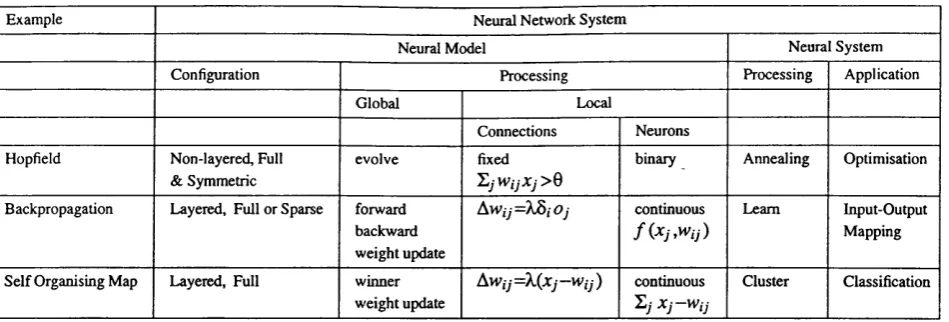
Table 2.1 - Neural Network Systems: Common Features and Examples -
Any neural system is formed by the integration o f a neural model with a neural application. Any neural model is determined by its configuration, and its processing. Its configuration determines the organisation o f the neurons (for example organised in layers), and the interconnectivity pattern. It processing is divided into global (network) processing and local processing (neurons and connections). An application defines the data given to and retrieved from the model. A neural system processing defines the series o f network processing to operate in order to perform the application.
Table 2.1 displays the features common to all neural systems, and gives an example of their values for the Hopfield, Backpropagation and Self Organising Map neural systems. Neural systems are composed of a neural model, an application and the processing to operate to perform the application. For example, the Hopfield neural system applies to optimisation applications, as shown in Table 2.1, and operates a simulated annealing process to achieve the optimisation (referred to as annealing in the table). A neural model provides configuration and processing information. The configuration describes the organisation of the neurons and the connectivity pattern, for example layered dudfull
in the case of backpropagation in the Table 2.1. The processing specifies the computations performed by the network, referred to as global in the table, and by the neurons and connections, referred to as local in the table. For example in Table 2.1, the Self Organising Map model performs two global/network computations: winner which extracts the winner neuron of the clusters, and weight update which adapts the connection weights. In this case, local processing refers to the standard computations performed by the neurons and connections.
parallel machines are surveyed.
2.3. Parallel Machines
This thesis considers what is often referred to as general-purpose parallel machines, in the sense that they are accepted as workable general-purpose parallel computers [Bel92a]. The purpose of this section is to identify the parameters that characterise such a machine; this is necessary for developing a System for decomposing and mapping onto general-purpose parallel machines. The Chapter 1 has presented parallel architectures, this section concentrates onto parallel machines; i.e. their architecture and software environment.
2.3.1. Survey of Parallel Machines
Parallel machines may be defined as the combination of an architecture and software tools to support their exploitation. A possible definition is as follows:
Parallel machines provide an explicit framework fo r the development o f parallel programming solutions by providing multiple processors whether simple or
complex, which cooperate to solve problems through concurrent execution.
Parallelism is sometimes referred to as the execution of a concurrent model. In this case, concurrency is thus defined as the abstract property leading to parallel execution. The need to enforce such definitions in this thesis is seen as adding complexity rather than information, and is thus not enforced. Three typical parallel machines, their architecture and their software support are now presented. These machines are representative of various architectures: the Parsys SNIOOO machine is a MIMD distributed memory machine [Par89a], the Connection Machine is a SIMD configurable machine [Hil85a], and finally the DAP, standing for Distributed Array of Processors is a SIMD processor- array machine [Par88a].
2 3.1.1. MIMD Distributed Memory: Transputer-based Machine
Transputer-based machines correspond to a realistic implementation of the Multiple Instruction Multiple Data (MIMD) concept associated with a pure distributed memory model. Their design is based on the theory of Communication Sequential Processes (CSP) introduced by Hoare [Hoa78a]. CSP defines sequential processes that can transfer information between other parallel processes using message channels. These basic features are included in the design of the basic processor, the Transputer device.
crossbar switch that provides interconnections between workers so that any N link can connect to any S link, and any W link can connect to any E link. The switch is fully programmable, providing the ability to dynamically reconfigure the network. All processors also have a control bus interface, which can be used for supervising the system, synchronisation and monitoring of applications. A Niche board is used to provide an interface to the Sun host The T800-25 acts as the root processor for the network; one of its links is taken to a control Transputer, one to the T800-20, one connects into the worker network and the fourth to the SCSI disk server card.
Figure 2.1 presents an overview of the SNIOOO machine in use at University College London.
o o o
SUNhost ROOT
Figure 2.1 - The SNIOOO Parsys Machine -
The SNIOOO Transputer-based machine corresponds to a network o f 48-mode worker Transputer devices associated with a root processor. The root processor is the only processor able to communicate with the external environment.
The SNIOOO machine can be used in conjunction with the 3L Parallel C & Tiny environment which controls both communication and synchronisation. This environment offers a complete software package that allows the development of parallel applications. Such applications are composed by a set of concurrent processes; the 3L tasks, that communicate with each other through their associated Tiny task, and the configuration specification that describes the actual location of each of the previously defined tasks.
2.3.I.2. SIMD Configurable: the Connection Machine
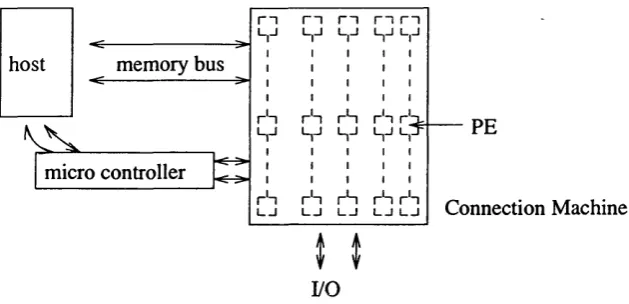
The Connection Machine (CM) is a Single Instruction Multiple Data (SIMD) machine configurable with up to 65,536 processors. Each processor has a single-bit processing unit and up to 256K bits of local memory, it is generally referred to as processor/memory cell. All the processors are controlled by a single instruction stream broadcast from a microcontroller.