673 | P a g e
MINING HIGH UTILITY ITEMSET FROM LARGE
DATABASE USING EFFICIENT ALGORITHM
Miss. Snehal D. Ambulkar
1, Dr. Prashant N. Chatur
2 1,2Department of Computer Science and Engineering,
Government College of Engineering, Amravati, (India)
ABSTRACT
In the recent year, mining important pattern from a transaction database is a fundamental topic in data mining. Mining important and interesting pattern from a large database is important to many applications and helps to effectively improve a business strategy. While mining high utility itemset frequent itemset mining (FIM) does not consider quantity and profit of item it only considers the frequency of item appear in a transaction. To tackle this problem of frequent itemset mining, Utility itemset mining has been proposed which consider both profit and quantity of item from a transaction database. But utility itemset mining has a one problem, it does not support downward closure property. To solve this problem utility itemset mining uses the transaction weighted utility property (TWU). On the contrary, most of the algorithms generate plenty of high utility itemset which degrade the performance of mining process and require lots of execution time. To solve this problem, in this paper various strategy has been proposed to easily discovers high utility itemset from a large database and improve a mining process efficiently and effectively and requires less database scans.
Keywords: Data mining, Frequent itemset mining, High utility itemset mining, Transaction
weighted utility, Utility mining.
I.
INTRODUCTION
To increase the business profit it is very important to mine useful and hidden information from a large database.
To increase the business profit data mining technique play an important role. Data mining technique uses the
various algorithm and strategies to mine useful information which is very important to improve business
strategy. Data mining technique uses the frequent itemset mining (FIM) [1] to mine the useful itemset from a
large data but frequent itemset mining only consider the frequency of item. Because of that frequent itemset
mining losses the useful information and it affect to increase business profit. To solve this problem utility
itemset mining (UIM) has been proposed. Utility itemset mining consider both the external utility (importance,
profit of item) and internal utility (Quantity) of item. Utility of an item is calculated by considering both the
quantity and profit of item and hence utility itemset mining helps to improve a business profit in comparison to
frequent itemset mining. Itemset is called high utility itemset (HUI) [2] if its utility value is greater than user
specified threshold value. To set a proper threshold value user need to try and gauss multiple threshold value
this is a time consuming process. While doing this utility itemset mining algorithm generates large amount of
674 | P a g e
value. If threshold value is set small plenty of high utility itemset are generated and if it set large it may be thecase that no high utility itemset are discover. To solve this problem Top-k high utility itemset mining is
proposed [1,2]. Setting k value is easier than setting threshold value, because k value indicates the number of
high utility itemset that user wants to find. Initially k value is taken from a user then raise gradually to
effectively prone high utility itemset.
High utility itemset mining is use in various applications such as business analysis [3, 4], biomedicine, and
streaming analysis [5]. Downward closure property helps to prone high utility itemset effectively from a large
database. Frequent itemset mining support downward closure property but high utility itemset mining does not
support downward closure property. It is not easy to find high utility itemset in the absence of downward closure
property. To simplify this problem concept of transaction weighted utility (TWU)property is use.
This paper suggests a framework for finding high utility itemset effectively from a large database. Various
strategies are proposed to raise utility threshold value effectively.
II.
RELATED
WORKS
In this section, discuss all research which is done on frequent itemset mining, high utility itemset mining, Top-k
itemset mining, and Top-k High utility itemset mining and potential Top-k high utility mining which are as
follows.
Frequent pattern mining is one of the data mining techniques which support the downward closure property to
effectively find high utility pattern from transaction database. Frequent pattern mining only consider frequency
of item in transaction. The Apriori algorithm [6] is used in frequent pattern mining, which scans the database
several times as the maximum length of frequent pattern. FP-growth [7] data structure is a part of frequent
pattern mining which scans the database twice and uses depth-first algorithm. Frequent pattern mining does not
consider the quantity and profit that is, it does not consider the external and internal utility of item of item as we
discuss above. Because of that it is unable to discover high utility itemset and does not satisfy the user
requirement.
Many research works have been done for discovering high utility itemset from transaction database. High utility
itemset mining algorithm overcomes the limitation of frequent itemset mining by considering both the quantity
and profit of item as we discus above. Two-Phase [8], IHUP [5], UP-Growth [9], d2HUP [10], HUI-Miner [11]
has been proposed for mining high utility itemset from large database. The two phase algorithms consist of two
phases for mining high utility itemset from a database. In first phase, they discover potential high utility itemset
and in second phase calculate utility of itemset discover in first phase. In one phase algorithm they discover the
high utility pattern in only one phase. d2HUP, HUI-Miner is one phase algorithm for mining high utility itemset.
d2HUP is a novel algorithm convert the horizontal database into a tree based data structure called CAUL.
HUI-Miner algorithm uses the vertical data representation technique and covert the data into utility list [11]. Utility
mining does not support downward closure property to solve this problem transaction weighted utilization
approach has been proposed. HUG-Miner and GHUI-Miner are also proposed to mine high utility itemset from
a transaction database. HUG-Miner and GHUI-Miner algorithm is work on incremental database to reduce the
675 | P a g e
Top-k itemset mining discovers the Top-k itemset by a user specified value k by considering the utility of itemsin a transaction database. Many studies has been proposed for mining Top-k itemset [1], such as Top-K high
utility itemset [2], Top-k frequent itemsets [12], Top-k frequent closed itemset [13,14], top-k closed sequential
patterns [15], Top-k association rule [16], Top-k sequential rule [17]. The algorithms use various strategies for
discovering Top-k patterns. Some algorithm uses FP-tree data structure for finding Top-k itemset from
transactional database. In Top-k high utility itemset mining initially K value is taken from a user and the K
value is increase or decrease according to requirements.
Many researchers have been done for discovering Top-k high utility pattern from transaction database. It
considers both the internal utility and external utility of item. To support downward closure property, it uses the
technique of transaction weighted utility (TWU). T-HUDS algorithm [18] has been proposed for mining Top-k
high utility patterns from a data streams. Recently, TKU and TKO algorithm [1, 2] has been proposed for
mining Top-k high utility itemset. TKU is two phase algorithm and it uses five strategies named PE, NU, MD,
MC and SE to raise the border minimum utility threshold effectively to handle large number of high utility
itemset. TKO algorithm is one phase algorithm and it uses novel strategies named RUC, RUZ, EPB to greatly
improve the performance of algorithm and reduce the execution time.
III.
MATHEMATICALBACKGROUND
In this section, define the related mathematical definitions for discovering interesting and useful information
from a transaction database. Table 1 is an example of transaction database and Table 2 contain the unit profit of
each item.
TABLE: 1 TRANSACTIONAL DATABASE
Tid Transaction
T1 (P,1)(R,1)(S,1)
T2 (P,2)(R,6)(X,2)(Z,5)
T3 (P,1) (Q,2)(R,1)(S,6) (X,1)(Y,5)
T4 (Q,4)(R,3)(S,3)(X,1)
T5 (Q,2)(R,2)(X,1)(Z,2)
TABLE: 2 PROFIT TABLE
Item P Q R S X Y Z
Unit Profit 2 4 7 1 5 6 3
Let I be a set of itemset and I = {i1, i2, i3, i4…... in} and each and every item ib∈ I where 1 ≤ b ≤ n. D is a
transaction database and D = {t1, t2, t3, t4…….tm} such that each transaction ∈ D where 1 ≤ v ≤ m. Each item
ij∈ has a positive real value q(ij, ) it is call internal utility of item . Each item ij∈ I is associated with
positive real value p(ij, I) it is external utility of item.
Definition 1: Utility of an item ib in a transaction tv is denoted as u(ib, tv) and defined as
u(ib, )= Q(ij, ) P(ij, I) (1)
For example, u(P, T3) = 2 1 = 2 this is calculated from Table 1 and Table 2. Internal utility value of q(P,T3)
676 | P a g e
Definition 2: Utility of itemset C in transaction ts is denoted as u(C, tv) and defined as followsu(C, ) = (2)
For example, u(PR, T2) = 2 2 + 6 7 = 46, u(PR, T1) = 12 + 1 7 = 2 + 7 = 9, u(PR, T3) = 12 + 1 7 = 2 +
7 = 9.
Definition 3: utility of itemset C in database D is denoted as u(C) and defined as follows.
u(C) = (3)
For example, u(PR) = u(PR, T1) + u(PR, T2) + u(PR, T3) = 9 + 46 + 9 = 64.
Definition 4: The transaction utility of a transaction is denoted as TU ( ) and defined as follows
TU ( ) = (4)
For example, TU(T1) = u(P,T1) + u(R,T1) + u(S,T1) = 2 + 7 + 1 = 10. Transaction utility of transaction is
shown in Table
TABLE 3: TRANSACTION UTILITY
Tid T1 T2 T3 T4 T5
TU 10 71 58 45 33
Definition 5: Total utility of a database D is denoted as TotalD and defined as
TotalD = (5)
For example, from Table 1 TotalD = TU(T1) + TU(T2) + TU(T3) + TU(T4) + TU(T5) = 10 + 71 + 58 + 45 + 33
= 217.
Definition 6: Relative utility of itemset C in a database D is denoted as Rtu and defined as follows
Rut(C) = u(C) / TotalD (6)
For example, utility of itemset u(PR) = 64 and total utility of database is 217 from this relative utility of itemset
is 29%.
Definition 7: The transaction weighted utility (TWU) of an itemset C is sum of transaction utility of all
transaction that belong to C and denoted as TWU(C) and defined as follows
TWU(C) = (7)
For example, Transaction weighted utility of P is TWU(P) = TU (T1) + TU (T2) + TU (T3) = 10 + 71 + 58 =
139. Transaction weighted utility of itemset is shown in Table 4.
TABLE 4: TWU OF ITEMSETS
Item P Q R S X Y Z
TWU 139 136 217 113 207 58 104
Definition 8: An itemset is called high utility itemset if Rtu(C) is greater than user define threshold
min_threshold i.e. Rtu(C) ≥ min_threshold. Otherwise itemset is called low utility itemset.
For Example, if min_threshold is set to 40 , the set of high utility itemset from table 1 are HUI =
{({PQY},40),({PQRY},47),({PRXZ},71),({R},42),({PR},46),({PRX},51)}.
Definition 9: An itemset C from a transaction database is called high transaction weighted utilization itemset if
677 | P a g e
Definition 10: An itemset C is called Top-k high utility itemset in D if there are not more than k itemsets whoseutility is larger than u(C) in fHUI(D,0).
Definition 11: The Minimum utility of an item denoted as MIU(I) defined as follows
MIU(I) = Min{u(I, ) | ∈ D and v ∈ g(I)}. (8)
Table 5 shows the minimum utility of item. The minimum utility of item P is miu({P}) = min{u({P},T1), u({P
},T2), u({P},T3)}= min{2,4,2} = 2. The minimum utility of itemset {PR} is MIU({PR}) = [MIU({P}) +
MIU({R})] SC ({PR}) = (2 + 7) 3 = 27.
TABLE 5: ITEMS AND THEIR MIUS
Item P Q R S X Y Z
Miu 2 8 7 1 5 30 6
Definition 12: The minimum utility of itemset C = {Y1, Y2, Y3,..., Ym} is denoted as MIU(C) and defined as
follows
MIU(C)= (9)
Definition 13: The Maximum utility of an item is denoted as MAU(I) and defined as follows
MAU(I) = Max{u(I, ) | ∈ D and v ∈ g(I)} (10)
Table 6 shows the maximum utility of item. The maximum utility of item P is mau({P}) = max{u({P},T1), u({P
},T2), u({P},T3)} = max{2, 4, 2 } = 4.
TABLE 6: ITEMS AND THEIR MAUS
Item P Q R S X Y Z
Mau 4 16 42 6 10 30 15
Definition 14: The Maximum utility of itemset C = {Y1, Y2, Y3,..., Ym} is denoted as MAU(C) and defined as
follows
MAU(C) = (11)
Definition 15: The itemset is called potential Top-k high utility itemset if its TWU value and MAU are more
than min_thresholdborder.
Definition 16: Remaining utility of an itemset C in a transaction is denoted as RU(C, ) and defined as
follows
RU(C, ) = (12)
Definition 17: Remaining utility of an itemset in a database D is denoted as RU(C) and defined as follows
RU(C) = (13)
For example, remaining utility of itemset {P} in transaction T2 is RU(P, T2) = u(R,T2) + u(X,T2) + u(Z,T2)=
42 + 10 + 15 = 67. The remaining utility of itemset {P} in a database D is RU({P}) = RU({P},T1) +
RU({P},T2) + RU({P},T3) = 8 + 67 + 56 = 131. The remaining utility of {QR} is RU({QR}) = RU({QR},T4)
+ RU({QR},T5) = 8 + 11 = 19.
Definition 18: Utility-list of an itemset C is denoted as UL(C). Utility list is a one type of list containing |g(C)|
678 | P a g e
IV.
PROPOSED METHOD
FIG. 1: SYSTEM ARCHITECTURE
The above fig. 1 shows the system architecture for mining high utility item from a transaction database. In the
first step the customer purchase history and unit profit of each item is passing to the transaction database. Then
in the next step the transaction database is passing to the TKU Miner Algorithm. TKU miner algorithm is a two
phase mining algorithm. In TKU Miner Algorithm first calculate the transaction weighted utility (TWU) by
using the definition 7. By using TWU the utility mining support downward closure property. After the
calculation of TWU, arrange the item in decreasing order according to their transaction weighted utility as
shown in Table 7. And then construct the UP-Tree. UP-Tree is constructed by scanning the database twice. The
next step is MIU and MAU calculation. This is calculated by using the definition 11, definition 12, definition 13
and definition 14. Construction of UP-Tree is shown in Fig 3.
TABLE 7: ARRANGE TWU IN DESCENDING ORDER
Tid TWU
R 217
X 207
P 139
Q 136
S 113
Z 104
Y 58
The last step in TKU miner Algorithm is the construction of pre-evaluation matrix. Each entry in pre-evaluation
matrix is in the form PEM[x][y], where x, y ∈ I. When the transaction TP = {a1,a2,a3,…...,an} (ai ∈ I, 1< i ≤ n) is
taken from the database in first scans. Then the utility of {a1} {ai} (1< i ≤ n) in Tp is inserted into the
corresponding entry of PEM[a1][ ai] in pre-evaluation matrix. After scanning all the transactions of PEM, if the
Customer Purchase Items
Transaction History
Profit Table
TKU Miner Algorithm
MIU TWU
MAU
Pre-Evaluation Matrix
TKO Miner Algorithm
Construction of Utility list
Generate Top-K list
679 | P a g e
k-th highest value in PEM is greater than the min_thresholdborder then min_thresholdborder is raised to k-th highestvalue in PEM. The Pre-evaluation matrix is shown in Fig.2.
Item Q R S X Y Z
P 10 64 11 7 32 19
Q 59 19 21 0 14
R 0 0 0 0
S 0 0 0
X 0 0
Y 0
Z
FIG.2. PRE-EVALUATION MATRIX (PEM)
The next algorithm applies is a TKO Miner Algorithm which is a one phase algorithm. In this algorithm there is
a construction of Utility list. Utility list is constructed to effectively find high utility itemset and to reduce a
database scans.
{Root}
{R/5}
{P/1} {X/4}
{S/1} {P/2} {Q/2}
{Z/1} {Q/1} {S/1} {Z/1}
{S/1}
{Y/1}
FIG.3. UP TREE
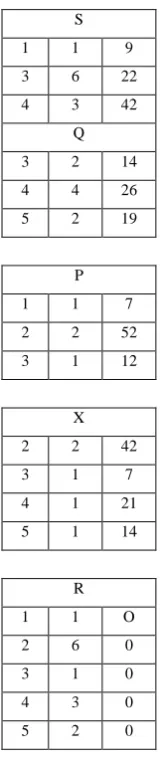
The Fig. 4 shows utility list structure of transactional database. The transaction database is taken from Table 1.
The utility list structure contains the tuple Tid, iutil, rutil. Tid represents the identifier of transaction Tp, iutil
represents the utility of item X in transaction Tp and rutil represents remaining utility. The remaining utility is
calculated by using the definition 16, definition 17
Y
3 5 28
Z
2 5 56
680 | P a g e
S1 1 9
3 6 22
4 3 42
Q
3 2 14
4 4 26
5 2 19
P
1 1 7
2 2 52
3 1 12
X
2 2 42
3 1 7
4 1 21
5 1 14
R
1 1 O
2 6 0
3 1 0
4 3 0
5 2 0
FIG 4: UTILITY LIST
V.
CONCLUSIONS
In this paper, we studied the various data mining algorithm for mining important and relevant information from
a transactional database. The algorithm such as TKU and TKO are use to mine top-k high utility itemsets from a
transaction database. TKU miner algorithm and TKO miner algorithm is novel algorithm for mining potential
Top-k high utility itemset without any need to set threshold value. The TKU is a two phase mining algorithm
and TKO is one phase mining algorithm. The TKU algorithm uses various strategies to effectively raise the
border minimum threshold. To improve the performance of system TKO algorithm uses the strategies such as
RUC, RUZ and EPB. The proposed algorithm uses the UP-Tree data structure to effectively prune the potential
high utility itemset by scanning the database twice. In the first scan it calculate the TWU and in second scan it
rearrange the TWU in descending order and then insert into the UP-Tree The proposed algorithm reduces
database scans, required less memory consumption on incremental database and required less computational
681 | P a g e
REFERENCES
[1] Serin Lee, Jong Soo Park, Top-K High Utility Itemset Mining Based On Utility List Structures, IEEE
International Conference on Data Mining (ICDM), Maebashi, pp. 101 - 108, 2016.
[2] Vincent S. Tseng, Cheng-wei Wu, Philippe Fournier-Viger and Philip S. Yu, Efficient Algorithms For
Mining Top-K High Utility Itemsets, In IEEE Transactions on Knowledge and Data Engineering, vol.28
no.1,2015.
[3] Y. Liu, W. Liao, and A. Choudhary, A Fast High Utility Itemsets Mining Algorithm, Utility-Based Data
Mining Workshop, pp. 90-99, 2005.
[4] H. Ryang, U Yun and K. Ryu, Discovering High Utility Itemsets with Multiple Minimum Supports,
Intelligent Data Analysis, Vol. 18(6), pp. 1027-1047, 2014.
[5] C. Ahmed, S. Tanbeer, B. Jeong and Y. Lee, Efficient Tree Structures for High-utility Pattern Mining in
Incremental Databases, IEEE Transactions on Knowledge and Data Engineering, Vol. 21(12), pp.
1708-1721, 2009.
[6] R. Agrawal and R. Srikant, Fast Algorithms For Mining Association Rules, 20th International Conference
on Very Large Data Bases, Santiago, Vol. 1215, pp. 487-499, 1994.
[7] J. Han, J. Pei and Y. Yin, Mining Frequent Patterns without Candidate Generation, ACM SIGMOD
international Conference on Management of Data, pp. 1-12, 2000.
[8] Y. Liu, W. Liao, and A. Choudhary, A Two-phase algorithm for fast discovery of high utility itemsets, 9th
Pacific-Asia Conference on Knowledge Discovery and Data Mining, Springer, Vol. 3518, pp. 689-695,
2005.
[9] V. S. Tseng, C. Wu, B. Shie, and P. S. Yu, UP-Growth: An Efficient Algorithm for High Utility Itemset
Mining, ACM SIGKDD international Conference on Knowledge Discovery and Data Mining, pp. 253–262,
2010.
[10]J. Liu, K. Wang and B. Fung, Direct Discovery of High Utility Itemsets without Candidate Generation,
IEEE international Conference on Data Mining, pp. 984-989 , 2012.
[11]M. Liu and J. Qu, Mining High Utility Itemsets without Candidate Generation, ACM international
Conference on Information and Knowledge Management, pp. 55-64, 2012.
[12]K. Chuang, J. Huang and M. Chen, Mining Top-K Frequent Patterns in the Presence of the Memory
Constraint, The VLDB Journal, Vol. 17, pp. 1321-1344, 2008.
[13]J. Han, J. Wang, Y. Lu and P. Tzvetkov, Mining Top-K Frequent Closed Patterns without Minimum
Support, International Conference on Data Mining, pp. 211-218, 2002.
[14]J. Wang and J. Han, TFP: An Efficient Algorithm for Mining Top-K Frequent Closed Itemsets, IEEE
Transactions on Knowledge and Data Engineering, Vol. 17(5), pp. 652-664, 2005
[15]P. Tzvetkov, X. Yan and J. Han, TSP: Mining Top-K Closed Sequential Patterns, Knowledge and
Information System, Vol. 7(4), pp. 438-457, 2005.
[16]P. Fournier-Viger, C. Wu, V. S. Tseng, Mining Top-K Association Rules, International Conference on
Canadian conference on Advances in Artificial Intelligence, pp. 61–73, 2012.
[17]P. Fournier-Viger, V. S Tseng, Mining Top-K Sequential Rules, International Conference on Advanced