11
Designing A Nonlinear Integer Programming
Model For A Cross-Dock By A Genetic Algorithm
Bahareh Vaisi, Reza Tavakkoli-Moghaddam
Abstract: This paper presents a non-linear integer programming model for a cross-dock problem that considers the total transportation cost of inbound and outbound trucks from an origin to a destination and the total cost of assigning strip and stack doors to trucks based on their number of trips and the distance between doors in cross-dock. In previous studies, these two cost-based problems are modeled separately; however, it is more realistic and practical to use both of them as an integrated cross-docking model. Additionally, this model is solved for a randomly generated numerical example with three suppliers and two customers by the use of a genetic algorithm. By comparing two different parameter levels (i.e., low and high numbers of populations), the optimum solution is obtained considering a high level population size. A number of strip and stack doors are equal to a number of inbound and outbound trucks in the same sequence as 4 and 6, respectively. Finally, the conclusion is presented.
Index Terms: Cross-docking, Genetic algorithm, Non-linear integer programming, Strip and stack doors, Transportation cost.
————————————————————
1
I
NTRODUCTIONKinnear provided a definition of a cross-docking system as ―receiving product from a supplier or manufacturer for several end destinations and consolidating this product with other suppliers’ product for common final delivery destinations‖. He focused on the consolidation of shipments to achieve economies in transportation costs. The Material Handling Industry of America (MHIA) defines cross-docking as ―the process of moving merchandise from the receiving dock to shipping [dock] for shipping without placing it first into storage locations‖ [1]. Cross-docking is a relatively new logistics system used in the retail and trucking industries to rapidly consolidate shipments from disparate sources and realize economies of scale in outbound transportation. Cross-docking essentially eliminates the inventory-holding steps of a warehouse while it allows serving the consolidation and shipping functions. The idea is to transfer incoming shipments directly to outgoing trailers without storing them in between. Shipments typically spend less than 24 hours at the facility, sometimes less than an hour. The improvements that are possible to obtain from cross-docking are important not only from an economic point of view, but also it gives the possibility to produce a reduction of noise pollution, road accident and urban blight. Therefore, it is important to reduce the transportation cost considering a number of trips between dock doors in a cross-dock. In a study the total weighted travel distance is minimized by using a genetic algorithm to assign doors in less-than-truck-load break bulk terminals [2].
In a study considering a truck scheduling problem during a fixed time window and capacity in a shipment network through a cross-docking system with more trucks than available docks, a model is formulated as an integer programming problem considering integer programming constraints that minimizes the total travel distance [3]. The model is solved by tabu search and genetic algorithms. Although the travel time of the freight between dock doors was ignored, they considered this term in their next studies and used the same methods for solving the problem minimizing the operational costs. It seems that in this case tabu search is better than the genetic algorithm [4]. In a study a comprehensive literature review about mathematical models in cross-docking scheduling was provided. They categorized models in three different levels based on their decision levels and specified each subject to its level [5]. A cross-dock door assignment problem (CDAP) is considered in the case of serving more than one origin (destination) by strip (stack) door [6]. Two heuristics are proposed, in which the first one is a multi-start local search and the second one uses the convex hull relaxation to linearize the quadratic CDAP function. Then, the proposed heuristics are compared with one exact solution method to optimize door assignments in a cross-dock layout [7]. An extensive review is provided over cross-docking that deal with the scheduling of inbound and outbound trucks precisely [8]. In another study a time-indexed formulation for scheduling trucks in cross-docking terminals is proposed. They tested integer programming formulation and used a branch-and-bound method for solving it [9]. A hybrid meta-heuristic algorithm is presented for planning the trucks in cross-docking systems. This algorithm consists of three parts, namely ant colony optimization (ACO) as an initial population generation method, simulated annealing (SA) as an evolutionary algorithm to employ a certain probability avoiding being trapped in local optimum, and variable neighborhood search (VNS) to improve the population [10]. The algorithms are compared with the heuristic algorithm proposed by Yu and Egbelu (2008) [11]. Utilizing mixed-integer programming with two-dimensional loading constraints, a mathematical model is proposed for minimizing the total transportation costs in a cross-docking network [12]. A two-stage mixed-integer programming (MIP) model for cross-docking center location and vehicle routing scheduling problem is considered in a supply chain. They proposed a two-stage hybrid simulated annealing (HSA) embedded by tabu search [13]. A scheduling problem is considered in a multi-product cross-docking system with __________________________________
Author name is currently pursuing PhD degree program in Industrial engineering in School of Industrial Engineering, South Tehran Branch, Islamic Azad University, Tehran, Iran. E-mail: [email protected]
deliveries and pickups in order to minimize the total transportation and holding costs. An imperialist competitive algorithm is proposed to solve the model [14]. This paper is presented as follows. Section 2 presents the structure of our mathematical model and its advantages. Section 3 describes a genetic algorithm. Section 4 shows the computational results and sensitive analysis. Conclusions and further research recommendations are presented in section 5.
2
P
ROBLEM DESCRIPTION2.1 Mathematical model
In this study, it is considered M suppliers (origins), N customers (destinations) for a cross-dock. Product flow is done from origins to destinations through cross-dock considering customers demand and strip (stack) doors capacity. Therefore, the objective is to find the best trucks transshipment plan from origins to cross-dock, then from cross-dock to destinations; so that, the total transportation cost be minimized. The cross-dock door assignment problem and costs created regarding (1), the distance between strip doors and stack doors, (2), number of trips required by trucks to move products between origins and destinations through cross-dock, is the second objective of our problem, that we try to cover both of these objectives as one objective, model the problem, then, solve it. A schematic picture of the cross-docking system is depicted as follows.
From M origins to strip doors
Stack doors to N destinations
Fig. 1 Schematic picture of a cross-dock
Concerning the above assumptions and using the following notations, the problem can be formulated as a non-linear integer programming model.
Notations:
M Number of suppliers (origins), N Number of customers (destinations), I Number of strip doors,
J Number of stack doors,
P Number of trucks at origin m (inbound trucks), where m ≤ M
Q Number of trucks at a cross-dock (outbound trucks), wmn Number of trips required by trucks to move items from
origin m to cross-dock, in which items are destined for destination n,
dij Distance between strip door i and stack door j,
c*pmi Cost of truck p used for strip door i at origin m,
cqnj Cost of truck q used for destination n at stack door j,
sm Volume of goods from origin m,
si Capacity of strip door i,
rn Demand from destination n,
Rj Capacity of stack door j.
Decision variables:
xmi=1 If origin m is allocated to strip door i,
ynj=1 If destination n is allocated to stack door j,
v*pmi=1 If truck p is used for strip door i at origin m,
vqnj=1 If truck q is used for destination n at stack door j.
The mathematical model can be formulated as follows:
(1)
s.t.
i=1,……,I (2)
m=1,……,M (3)
j=1,……,J (4)
n=1,……,N (5)
i=1,……,I &
m=1,……,M
(6)
j=1,……,J & n=1,……,N
(7)
xmi=0 or 1 (8)
ynj=0 or 1 (9)
vpmi=0 or 1 (10)
vqnj=0 or 1 (11)
Objective function (1) is to minimize the total transportation
cost of inbound and outbound trucks from an origin to a destination, considering the total cost of assigning strip and stack doors to trucks based on their number of trips and the distance between doors. The constraints make sure that conditions be true. Constraints (2) show that the volume of goods from each origin is not exceeded si. Constraints (3)
ensure that each origin is allocated to only one strip door. Constraints (4) show that a demand from each destination is not exceeded Rj. Constraints (5) show each destination is
allocated to only one stack door. Constraints (6) guarantee that each inbound truck is allocated to the maximum one strip door. Constraints (7) make sure that each outbound truck is allocated to the maximum one stack door.
2.2 Advantages of the model
The proposed model is a modified model based on the cross-dock door assignment problem ([6]) and the mathematical model for a two-dimensional loading problem in a cross-docking network ([12]). The purpose of the presented model is to benefit the objectives of both of them. It is to minimize the total transportation cost of inbound and outbound trucks from an origin to a destination and minimize the total cost of assigning strip and stack doors to trucks based on their number of trips and the distance between doors. The previous studies suggested each of these objectives in separate from each other. The model presented by Zhu et al. (2009) ([6]) was a cross-dock door assignment and the model presented by Küçükoğlu et al. (2013) [12] considered the total transportation costs in a cross-docking network. Therefore, it is the first time that the problem is designed in this paper in order to present Strip (stack) doors
Cross-dock
13 the model more realistic and practical in real life.
3
G
ENETIC ALGORITHMA genetic algorithm (GA) was introduced for the first time by John Holland in 1975 [15]. It is a heuristic search technique that mimics the process of natural evolution and has been successfully used to generate solutions to optimization and search problems. The GA population consists of a number of chromosomes (i.e., solutions). At first, an initial population of possible solutions is randomly generated, in which the best candidates are selected to be parents to create offspring via a crossover operator. Based on the objective function, each chromosome is assessed and given a fitness score. Crossover and mutation operators are used to produce better offspring, whose fitness scores are better than the fitness scores of their parents. Then, the offspring are placed in the current population to develop a new population for the next generation. The process is iterated until the stopping criterion is met [16].
4
C
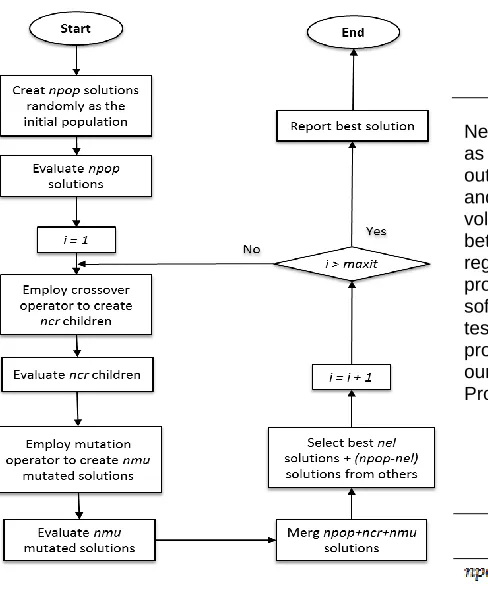
OMPUTATIONAL RESULTSTo express the performance of the proposed model, we test the proposed GA on a set of random instances used in the previous studies. The GA procedure is shown in Figure 2.
Fig. 2 Genetic algorithm flowchart
Parents’ selection is done based on binary tournament selection. In this variant, two individuals are chosen at random and the better of the two individuals is selected with fixed probability p, (where, 0.5 < p ~ 1). The procedure of selection is stated as follows. Firstly, select two solutions from the population, secondly compare their objective function values, then choose the best one as a parent, and finally the process is finished if ncr parents have been selected; otherwise, the
procedure is repeated. The initial amounts of the parameters used in our model are shown in Table 1. Based on the previous studies, our test problems are presented in Table 2.
TABLE 1
ASSUMED PARAMETERS
Parameter Pattern
TABLE 2
TEST PROBLEMS USED IN THIS STUDY
Problems M I N J P Q
1 1 1 5 5 2 5
2 2 2 6 5 2 5
3 3 2 4 4 4 4
4 3 4 2 6 4 6
5 5 5 3 5 6 7
6 6 2 3 3 5 3
7 7 2 2 3 2 3
8 9 2 4 2 7 4
Necessary assumptions and parameters are considered, such as the distance matrix, transportation costs of inbound and outbound trucks used at origins and each destination, strip and stack doors capacity, destinations demands, origins volume of goods, flow matrix shown the number of trips between origins and destinations, and the like. Finally, regarding Table 3, we use the proposed to solve the given problem. All the computations are obtained by the Matlab software. To find the best solutions by the proposed GA for our test problems considering levels shown in Table 3, we run the program by 100 times and the best solutions are included in our analysis. Based on our computations, the results for Problem 1, as one of our test problems, are shown in Table 4.
TABLE 3
SELECTING 2 CLASS LEVELS IN GA REGARDING TO OUR TEST
PROBLEMS
Level 1(low level)
Level 2(high level)
25 200
25 200
0.25 0.75
0.1 0.5
TABLE 4
BEST GA RESULTS FOR PROBLEM 1
OFV OFV OFV OFV
0.25 0.1
0.1 40908 43500 31216 32498
0.5 36132 35202 32196 32576
0.9 34730 50506 31422 33878
0.3
0.1 38452 36052 31932 34428
0.5 35710 37414 31932 31950
0.9 31950 45055 33294 33294
0.5
0.1 45606 55541 31462 33390
0.5 50748 35222 29818 31746
0.9 33674 36356 33614 35710
0.5 0.1
0.1 42193 33126 31764 32274
0.5 44276 39036 31726 35180
0.9 35258 36788 34202 34752
0.3
0.1 59370 38510 32234 36318
0.5 35318 48275 34770 33576
0.9 35318 35524 33878 35672
0.5
0.1 40146 36602 32010 32156
0.5 33576 40150 32010 35426
0.9 36698 36944 34938 31686
0.75 0.1
0.1 41356 58448 32196 33312
0.5 44148 33350 33312 36904
0.9 35426 31950 33048 30384
0.3
0.1 34124 57114 33692 31500
0.5 33576 52782 34674 32576
0.9 46686 47108 33390 33350
0.5
0.1 33144 35486 32010 31950
0.5 40805 33106 30100 31892
0.9 42024 53234 32234 36582
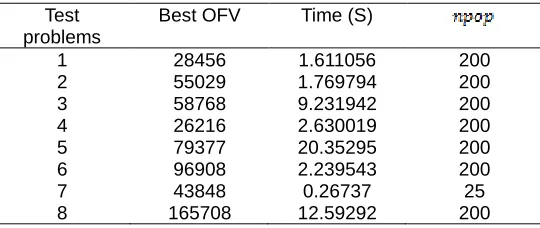
All the test problems are calculated and the best solution of each problem is summarized in Table 5. As we can observe from the results, Problem 4 has the optimum solution. It is clear that in higher levels we have better solutions; however, longer time is taken to find the answer and the solutions are not optimal.
TABLE 5
BEST GA RESULTS FOR THE TEST PROBLEMS
Test problems
Best OFV Time (S)
1 28456 1.611056 200
2 55029 1.769794 200
3 58768 9.231942 200
4 26216 2.630019 200
5 79377 20.35295 200
6 96908 2.239543 200
7 43848 0.26737 25
8 165708 12.59292 200
5
C
ONCLUSIONThis study considered a cross-dock problem for the first time that minimizes the total transportation cost of inbound and outbound trucks from origin to destination and minimizes the total cost of assigning strip and stack doors to trucks based on their number of trips and the distance between doors simultaneously. Therefore, the problem became more realistic and practical in real life and the presented model could be used to find applicable solutions in cross-docking operations. As discussed before, in the model presented by Zhu et al. (2009) ([6]), minimizing the number of trips required by trucks to move items from origin to destination through cross-dock was considered, while in our model minimizing the total transportation cost considering the volume of goods from origin and demand of them from destination is perceived in addition to their model. In the model presented by Küçükoğlu et al. (2013) ([12]), the objective is only minimizing the total transportation cost, whereas in our model minimizing the total transportation cost regarding the volume of goods from origin and demand of them from destination is modeled and minimizing the number of trips required by trucks to move items from origin to destination through cross-dock is another objective in our model. As it is taken from the results, the minimum transportation cost under the given assumptions was obtained by the proposed genetic algorithm (GA). The main parameters were set as =50, =0.5, =0.3 and =0.9. This study can be extended for future studies in different ways. It is possible to use other meta-heuristics in order to find the good solutions in a cross-dock system and analyze the results in large-scale problems. Additionally, the problem can be modeled as a multi-objective one in cross-docking operations and scheduling.
R
EFERENCES[1] Kinnear, E. (1997).Is there any magic in cross-docking? Supply Chain Management: An International Journal, 2(2): 49–52.
[2] Bermudez, R. and Cole, M.H., A genetic algorithm approach to door assignment in break bulk terminals, Available at: http://ntl.bts.gov/lib/200207/15cb008.doc.
15 [4] Lim. A, Ma. H and Miao. Z. (2006). Truck dock assignment
problem with operational time constraint within crossdocks. In: Advances in applied artificial intelligence. Lecture Notes in Artificial Intelligence, 4031: 262–71.
[5] Agustina, D., Lee, C.K.M. and Piplani, R. (2010). A review: Mathematical models for cross docking planning. International Journal of Engineering Business Management, 2(2): 47–54.
[6] Zhu,Y. R., Hahn, P.M., Liu,Y. and Guignard, M. (2009). New approach for the cross-dock door assignment problem. In: Anais do XLI Simp´osio Brasileiro de Pesquisa Operacional, Porto Seguro, Bahia, Brazil.
[7] Guignard, M., Hahn, P. M., Pessoa, A. A. and da Silva, D.C. (2012). Algorithms for the cross- dock door assignment problem. Proceedings of the Fourth International Workshop on Model-Based Metaheuristics, Angra dos Reis, Rio de Janeiro, Brazil, September 17 to 20.
[8] Van Belle, J., Valckenaers, P. and Cattrysse, D. (1992). Cross-docking: State of the art. Omega, 40: 827–846.
[9] Berghman, L., Briand, C., Leus, R. and P. Lopez. (2012). The truck scheduling problem at cross-docking Terminals. International Conference on Project Management and Scheduling (PMS 2012), Louvain: Belgium.
[10] Vahdani, B., Tavakkoli-Moghaddam, R. and Mousavi, S.M. (2013) Scheduling of trucks in cross-docking systems:a hybrid meta-heuristic algorithm. Lecture Notes in Management Science, Vol. 5, 125–132.
[11] Yu, W. and Egbelu, P.J. (2008). Scheduling of inbound and outbound trucks in cross docking systems with temporary Storage. European Journal of Operational Research, 184, 377–396.
[12] Küçükoğlu, İ., Aksoy, A., Ene, S. and Öztürk, N. (2013). A mathematical model for two-dimensional loading problem in cross-docking network design. Mathematical and Computational Applications, 18(3): 273–282.
[13] Mousavi, S.M. and Tavakkoli-Moghaddam, R. (2013). A hybrid simulated annealing algorithm for location and routing scheduling problems with cross-docking in the supply chain, J. of Manufacturing Systems, 32: 335-347.
[14] Javanmard, S., Vahdani, B. and Tavakkoli-Moghaddam, R. (2014). Solving a multi-product distribution planning problem in cross docking networks: an imperialist competitive algorithm, Int. J. of Advanced Manufacturing Technology, 70: 1709–1720.
[15] Holland, J.H. (1975). Adaptation in natural and artificial systems: an introductory analysis with applications to biology, control, and artificial intelligence, MIT Press, Cambridge, (2nd edition in 1992).
[16] Sivaraj, R. and Ravichandran, T. (2011). A review of selection methods in genetic algorithm. International