IJEDR1702150
International Journal of Engineering Development and Research (www.ijedr.org)896
Object Extraction Using Image Segmentation and
Adaptive Constraint Propagation
1
Rajeshwary Patel,
2Swarndeep Saket
1
Student,
2Assistant Professor 12Department of Computer Engineering,1 2 L. J. Institutes of Engineering and Technology, Gujarat Technological University
Ahmedabad, Gujarat, India
Abstract— Object Extraction is a closely related issue with the segmentation process. Image Segmentation is a process of dividing an image into sub partition based on some characteristics like color, intensity etc. The main goal of object extraction is to change the representation of an image into something more meaningful. To extract an object from the image first we have to segment the entire image. User select the region as background and foreground by using the markers and then the algorithm will segment the image and the foreground region will be extracted from the image. The key to success in interactive image segmentation is to preserve characteristics of the user’s interactive information and maintain global data effectively. This paper provides a review on current trends in object or foreground extraction together with a study on technologies implemented by some researchers in this area. This will help to predict, pointing towards a number of areas of future research in the field of Object extraction with Image segmentation.
Index Terms—Object Extraction, Interactive Image segmentation, Adaptive Constraint Propagation
______________________________________________________________________________________________________
I.INTRODUCTION
Image segmentation is a fundamental step in many areas of computer vision including object recognition, video surveillance, face recognition, fingerprint recognition etc. It provides additional information about the contents of an image by identifying edges and regions of similar color and texture. Although a first step in high level computer vision tasks, there are many challenges to ideal image segmentation. Segmentation subdivides an object into its constituent regions or objects. The level of detail to which the subdivision is carried on depends on the problem being solved. That is the segmentation should stop when regions or objects of interest have been detected. For example, if an image consists of a tree, the segmentation algorithm may either stop after detecting the entire tree or further divide the tree into trunk and leaves.
Interactive image segmentation is a way to extract foreground objects in complex scenes using simple user interaction. The key to success in interactive image segmentation is to preserve characteristics of the user’s interactive information and maintain global data effectively.
It is explained as follows: Section 1 gives introduction to the area. Section 2 provides classification of Image Segmentation. Section 3 explains the related work of image segmentation. Section 4 provides the comparative study of different image segmentation methods. Section 5 presents methodology of the proposed work. Section 6 gives the analysis of proposed approach.
II. IMAGE SEGMENTATION
Image Segmentation can be classified as follows: • Region Based
• Edge Based • Threshold
• Feature Based Clustering • Model Based
1. Region Based [8]:
In this technique pixels that are related to an object are grouped for segmentation. The Thresholding technique is bound with region based segmentation. The area that is detected for segmentation should be closed. Region based segmentation is also termed as “Similarity Based Segmentation”. There won’t be any gap due to missing edge pixels in this region based segmentation. The boundaries are identified for segmentation. In each and every step at least one pixel is related to the region and is taken into consideration. After identifying the change in the color and texture, the edge flow is converted into a vector. From this the edges are detected for further segmentation.
2. Edge Based [8]:
IJEDR1702150
International Journal of Engineering Development and Research (www.ijedr.org)897
3. Threshold Based [8]:
Thresholding is the easiest way of segmentation. It is done through that threshold values which are obtained from the histogram of those edges of the original image. The threshold values are obtained from the edge detected image. So, if the edge detections are accurate then the threshold too. Segmentation through Thresholding has fewer computations compared to other techniques. Segmentation is based on “his ton”. For a particular segment there may be set of pixels which is termed as “his ton”. Roughness measure is followed by a Thresholding method for image segmentation. Segmentation is done through adaptive Thresholding. The gray level points where the gradient is high, is then added to Thresholding surface for segmentation The drawback of this segmentation technique is that it is not suitable for complex images.
4. Feature Based Clustering:
Segmentation is also done through Clustering. They followed a different procedure, where most of them apply the technique directly to the image but here the image is converted into histogram and then clustering is done on it. Pixels of the color image are clustered for segmentation using an unsupervised technique Fuzzy C. This is applied for ordinary images. If it is a noisy image, it results to fragmentation.
A basic clustering algorithm i.e., K-means is used for segmentation in textured images. It clusters the related pixels to segment the image Segmentation is done through feature clustering and there it will be changed according to the color components. Segmentation is also purely depending on the characteristics of the image. Features are taken into account for segmentation. Difference in the intensity and color values are used for segmentation.
For segmentation of color image they use Fuzzy Clustering technique, which iteratively generates color clusters using Fuzzy membership function in color space regarding to image space. The technique is successful in identifying the color region. Real time clustering based segmentation. A Virtual attention region is captured accurately for segmentation. Image is segmented coarsely by multithresholding. It is then refined by Fuzzy C-Means Clustering. The advantage is applied to any multispectral images.
Segmentation approach for region growing is K-Means Clustering. A Clustering technique for image segmentation is done with cylindrical decision elements of the color space. The surface is obtained through histogram and is detected as a cluster by Thresholding. Seeded Growing Region (SRG) is used for segmentation. It has a drawback of pixel sorting for labeling. So, to overcome this boundary oriented parallel pixel labeling technique is obtained to SRG.
5. Model Based:
Markov Random Field (MRF) based segmentation is known as Model based segmentation. An inbuilt region smoothness constraint is presented in MRF which is used for color segmentation. Components of the color pixel tuples are considered as independent random variables for further processing. MRF is combined with edge detection for identifying the edges accurately. MRF has spatial region smoothness constraint and there are correlations among the color components. Expectation-Maximization (EM) algorithm values the parameter is based on unsupervised operation. Multiresolution based segmented technique named as “Narrow Band”. It is faster than the traditional approach.
III. RELATED WORK
3.1 Region Fusion and Grab-cut based Salient Object Segmentation [1]
Authors [1] have proposed an approach in which the input image is segmented into superpixels. And then the region fusion method we apply in that we use a graph and MST model. By using that we get a fusion image as a result. Now the saliency map will be made and by using that we get the segment salient object.
3.2 Interactive Image segmentation by Dynamic Region Merging [2]
In this paper [2] authors proposed a dynamic region merging method. In the context of image segmentation, the observation of image is given but the partition is unknown. In this respect, it is possible to formulate the inference problem as finding some representation of the pixels of an image, such as label that each pixel is assigned. With these labels, an image is partitioned into a meaningful collection of regions and objects. The proposed predicate is based on measuring the dissimilarity between pixels along the boundary of two regions. For the convenience of expression, a region adjacency graph (RAG) is used to represent an image.
3.3Real time Interactive Image Segmentation Using Improved Superpixels [3]
Authors [3] proposed a superpixel refinement method in which first they perform the refinement process of the superpixels of the image. If some points within a superpixel were marked as the foreground part by the user, then the whole superpixel is treated as the foreground part. We call it the pre-marked foreground superpixel. Similarly, if some points were marked as the background part, then the whole superpixel is marked as the background part and we call it the pre-marked background superpixel. If no pixel within a superpixel is marked as the foreground or the ground part. With the refinement process, the boundaries of superpixels can well match the edges of objects and a much better segmentation result can be achieved.
IJEDR1702150
International Journal of Engineering Development and Research (www.ijedr.org)898
Authors [4] proposed a graph based segmentation method in that they use a Boruvka’s algorithms which form a minimum spanning tree. They tried to show how to extract an object from a segmented image by using this object extraction method and demonstrated that method is how efficient. Another characteristic of the method is that it is fast because of making a greedy algorithm and using only color differences and cluster size.3.5 Interactive Image Segmentation using Adaptive Constraint Propagation [5]
Authors [5] proposed ACP Cut to propagate characteristics of the user’s interactive information into the whole image successfully while maintaining global data coherence, as well as learn a global image discriminative structure for interactive image segmentation. ACP Cut adopts adaptive constraints instead of traditional hard constraints to learn a global discriminative structure. In our previous work we have provided the original ACP formulation for semi supervised kernel matrix learning (SS-KML). However, it has high computational complexity because its computational cost rises very rapidly as the number of samples is increased. Thus, it is not suitable for practical applications which need fast processing.
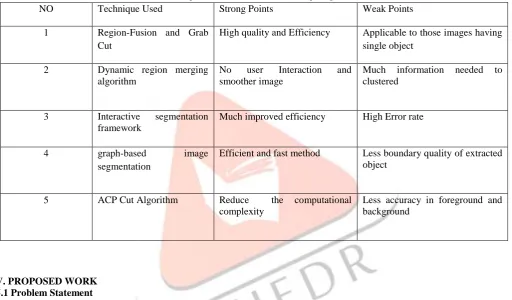
IV. COMPARATIVE STUDY
Table I: Comparison between different image segmentation Methods
NO Technique Used Strong Points Weak Points
1 Region-Fusion and Grab Cut
High quality and Efficiency Applicable to those images having single object
2 Dynamic region merging algorithm
No user Interaction and smoother image
Much information needed to clustered
3 Interactive segmentation framework
Much improved efficiency High Error rate
4 graph-based image
segmentation
Efficient and fast method Less boundary quality of extracted object
5 ACP Cut Algorithm Reduce the computational complexity
Less accuracy in foreground and background
V. PROPOSED WORK 5.1 Problem Statement
By using above algorithms we get the segmented images but still the smoothness, accuracy, error rate of the resulted image needed to be improved. Still there are some challenges like reducing use of simple and absolute markers and less user interaction for image segmentation with better result.
5.2 Proposed System
IJEDR1702150
International Journal of Engineering Development and Research (www.ijedr.org)899
Figure: 1. Proposed Model
So as that we first we have to take an image as input and then we have to find the features like contrast, distance and the color of the image. After that we have to find out the location of the object in the image and then show that location by using the rectangle box around the object or object boundary. Then we learn the structure of the image. After that we will assign the labels to the foreground and background pixels.
5.3 Algorithm
As the input is taken from the user in above methods still the accuracy and smoothness of the segmented result images are less. In order to increase the accuracy and smoothness a new segmentation technique has been proposed and following are the steps: Step 1:- Input is taken as an image
Step 2:- Search for the identical features like region boundary and color etc.
Step 3:- Check whether the image consists any object or not. If yes then go to the next step otherwise stop. Step 4:- Predict the location and scale of the object of image.
Step 5:- make a saliency map for the object we found.
Step 6:- for each superpixel we extracting the color histogram and learn the global image discriminative structure.
Step 7:- By using k-means algorithm we assign a label of foreground and background to each superpixel over a global image discriminative structure.
Step 8:- Extract the foreground superpixel and we will get the foreground extraction image as output.
So as we can do the segmentation without any input from the user and based on the salient object detection method which does not have any prior knowledge about the object and for segmentation we will use the adaptive constraint propagation approach. In this method the k-means algorithm is also used to differentiate between the foreground and background superpixel.
VI. EXPERIMENTAL ANALYSIS
To compute the accuracy, you should rely on Confusion Matrix, which includes two factors: True Positive Rate (TPR) and False Positive Rate (FPR). So the following steps compute the accuracy:
a) TPR: It is also called Recall that is representing the percentage of the images that classified within a class correctly, over the number of all that belong to that class. b) FPR: Represent the rate of images that were classified wrong within a specific class, while it is belong to another class, over all that are not belong to this class. c) The Precision is the proportion of the images, which belong to a class correctly, over entire images that were classified in that class. d) The F-Measure computes as a combined measure of precision and recall.
F − measure = 2*((recall × precision) / (recall + precision))
IJEDR1702150
International Journal of Engineering Development and Research (www.ijedr.org)900
Figure: 2. Proposed System’s Accuracy
VII. CONCLUSION
ACP cut enhances the global discrimination of foreground and background by learning with adaptive constraints and seed propagation and achieves good segmentation result. With the refinement process, the boundaries of superpixels can well match the edge of the objects and a much better segmentation result can be achieved. By using above algorithms we get the segmented images but still the smoothness, accuracy, error rate of the resulted image needed to be improved. Still there are some challenges like reducing use of simple and absolute markers and less user interaction for image segmentation with better result.
REFERENCES
[1]Wang Hailuo, Wang Bo, Zhou Zhiqiang, Song Lu, Li Sun, Wu Shujie “Region Fusion and Grab-cut Based Salient Object Segmentation”, IEEE(2014), DOI : 10.1109/IHMSC.2014.40, pp 131-135
[2]Sameena Banu, Apparao Giduturi, Syed Abdul Sattar “Interactive Image segmentation by Dynamic Region Merging”, IEEE(2014), DOI: 10.1109/ICDMIC.2014.6954246, pp 1-6
[3]Jian-Jiun Ding, Chia-Jung Lin, I-Fan Lu, Ya-Hsin Cheng “Real-time Interactive Image Segmentation Using Improved Superpixels”, IEEE(2015),DOI :10.1109/ICDSP.2015.7251974, pp 740-744
[4]Ali Saglam, Nurdan Akhan Baykan “An Efficient Object Extraction with Graph-Based Image Segmentation”, IEEE Advanced Computer Science Applications and Technologies (ACSAT), 2015 4th International Conference, DOI: 10.1109/ACSAT.2015.29, pp 86-91
[5]Meng Jian, Cheolkon Jung “Interactive Image Segmentation Using Adaptive Constraint Propagation”, IEEE transactions on image processing (2016), DOI: 10.1109/TIP.2016.2518480, pp 1301-1311
[6]R.Yogamangalam, B.Karthikeyan “Segmentation Techniques Comparison in Image Processing” International Journal of Engineering and Technology (IJET)
[7] Prof. S. T. Khandare1, Mr. Akshay D. Isalkar “A Survey Paper on Image Segmentation with Thresholding”, IJCSMC, Vol. 3, Issue. 1, January 2014, pg 441–s446