INTRODUCTION
Aryltellurium tryhalides are known to behave as Lewis acids and form molecular complexes with several nitrogen, oxygen and sulphur donor bases.
It has been reported1 that Lewis acidity of tellurium
atom falls significantly on going from RTeX3 to R2TeX2.
Kulkarni and coworkers screened the adducts of a,a’ –bis(3-nitro/amino benzoyl) tellurium dichloride with N donor bases for biological activity and were found
to be effective Ach E inhibiting agents2.
www.orientjchem.org
An International Open Free Access, Peer Reviewed Research Journal
2013, Vol. 29, No. (4): Pg. 1339-1349
Studies on the Pyrazine Complexes of
Some Diaryltellurium Dihalides
JITENDER KUMAR NARWAL*, SHASHI CHHABRA,
RAJESH KUMAR MALIK, SAPANA GARG and K.K. VERMA
*JVMGRR College, Department of Chemistry, CharkhiDadri, Haryana, India. Department of Chemistry, Maharshi Dayanand University, Rohtak, India.
*Corresponding author Email: [email protected]
http://dx.doi.org/10.13005/ojc/290409
(Received: Septembe 01, 2013; Accepted: October 15, 2013)
ABSTRACT
Nine new Pyrazine Complexes of diaryltelluriumdihalides, R2TeX2.Pyz (R =p-methoxyphenyl,
p-hydroxyphenyl and 3-methyl- 4-hydroxy phenyl; X=Cl, Br, I; Pyz = pyrazine) have been prepared by reactions of diaryltelluriumdihalides with pyrazine in 1:1 molar ratio. These complexes have been characterized by elemental analysis, conductance and cryoscopic measurements, infrared and proton magnetic resonance spectral studies. Conductance studies in nitrobenzene, acetone and acetonitrile predict their non-electrolyte type behaviour in these solvents, which is well supported by cryoscopic data in nitrobenzene. IR and 1H NMR studies suggest the unidentate nature of pyrazine in these complexes, involving only one nitrogen atom in coordination. Thus, tellurium in R2TeX2.Pyz complexes attains a coordination number of five probably in a square pyramidal.
Key words: Diaryltellurium dihalides, Pyrazine complexes.
ShekharSrivastava and coworkers3 have
prepared R2TeX2.L type compounds where R =
benzyl and L = 2,2'-bipridyl; 1,10-phenanthroline and neocuproine. In these adducts, donor ligands are coordinated to tellurium atom. In the view of
this and in continuation of our earlier work4,5 on
reactions of various diorganyltelluriumdihalides
R2TeX2with some N-donor bases we hereby, report
EXPERIMENTAL Materials and Methods
All the chemicals used were of Analytical Reagents grade. Solvents were purified and dried by conventional methods.
Preparations
All the preparations have been carried out in a dry conditions under inert atmosphere of dry nitrogen, as the compounds are sensitive to moisture and air.
Preparation of Diaryltellurium(IV) Dihalides Bis(p-hydroxyphenyl)tellurium dichloride, bis(3-methyl-4-hydroxyphenyl) tellurium dichloride and bis(p-methoxyphenyl)telIurium dichloride were obtained by reactions of tellurium tetrachloride
with phenol, o-cresol and anisole respectively.
The diaryltelluriumdichlorides were converted to corresponding dibromides and diiodides by halogen exchange processes by using KBr or KI in dry methanol.
Preparation of Pyrazine Complexes
Pyrazine Complexes of Bis(p-hydroxyphenyl) tellurium(IV) Dihalides
A saturated solution of pyrazine (0.40 gm, 5.0 mmol) in benzene (~10 ml) was added to
a saturated solution of 5.0 mmol of R2TeX2 (1.92
g, 2.37 g, 2.84 g for chloride, bromide and iodide respectively) in about 20 ml of methanol. The contents were stirred for about 3 h which resulted in the separation of a dark coloured solid product. This was filtered, extracted with diethyl ether and dried
over P4O10 in vacuum desiccator.
Pyrazine Complexes of Bis(3-methyl-4-hydroxyphenyl) tellurium(IV)Dihalides
A saturated solution of pyrazine (0.40 gm, 5.0 mmol) in benzene (~10 ml) was added to a saturated
solution of 5.0 mmol of R2TeX2 (2.06 g. 2.51 g. 2.98
g for chloride, bromide and iodide, respectively) in about 20 ml of dry methanol. The contents were stirred for 4 h. Brown coloured solid product thus obtained was filtered, washed with diethyl ether and
dried over P4O10 in vacuum desiccator.
Pyrazine Complexes of Bis(p-methoxyphenyl) tellurium(lV) Dihalides
A saturated solution of pyrazine (0.40 gm, 5.0 mmol) in benzene (~10 ml) was added to
a saturated solution of 5.0 mmol of R2TeX2 (2.06
g. 2.51 g. 2.98 g for chloride, bromide and iodide respectively) in methanol + chloroform (20:80). The contents were stirred of 4 h. Orange brown solid product obtained was filtered, extracted with diethyl
ether and dried over P4O10 in vacuum desiccators.
Physical studies
Elemental analysis for Carbon, hydrogen and nitrogen contents were got estimated from Sophisticated Analytical Instrumentation Facility, Punjab University, Chandigarh on a ELEMENTAR VARIO EL III or CARLO ERBA Model 1108. The conductance studies were carried out in acetone, nitrobenzene and acetonitrile on a highly sensitive Systronics Conductivity Bridge Type 305. A dip type cell with smooth platinum electrodes was used. The molecular weights of the complexes of diaryltellurium(IV) dihalides have been determined cryoscopically using purified nitrobenzene as the solvent. A Beckmann’s freezing point apparatus is used. Infrared spectra of the complexes of diaryltelluriumdihalides prepared during this course of study have been recorded
in the region 4000-400 cm-1 on a SHIMAZDU
FTIR-8300 or PERKIN ELMER Model 2000 FTIR Spectrometer using KBr pellet technique. The spectra were got recorded from Dr. B.R. Ambedkar Centre for Biomedical Research, University of Delhi, Kurukshetra University, Kurukshetra and Sophisticated Analytical Instrumentation Facility, Panjab University, Chandigarh. ‘H NMR spectra were recorded on a BRUKER AC-300F operating at 299.9486 MHz and BRUKER AVANCE II 400 NMR spectrometer operating at 400.13 MHz. The data were obtained from Sophisticated Analytical instrumentation facility, Punjab University, Chandigarh. The solutions were prepared in
deuterated DMSO-d6. Spectra were recorded at room
temperature immediately after preparing the solution using tetramethylsilane as an internal reference.
RESULTS AND DISCUSSION
These diaryltelluriumdihalides when reacted
with pyrazine give 1 : 1 type complexes, R2TeX2.L as
per scheme-1
Tab le 1: Anal ytical Data, Ph ysical Pr oper ties and Yields f
or Pyrazine Comple
xes of Diar
yltellurium(IV) Dihalides. R2 TeX 2 Comple x (Empirical Colour Anal
ysis Found (Calculated) %
Tab
le 2:
Molar Conductance Data f
or Pyrazine Comple
xes of Diar
yltelluriumDihalides R2 TeX 2 Comple x Nitr obenz ene Acetone Acetonitrile (R) Molar Conc. Molar Cond. Molar Conc. Molar Cond., Molar Conc. Molar Cond.,
C x 10
3
Λm
C x 10
3
Λm
C x 10
3 Λm mol L -1 ohm
2.50 1.32 2.50 9.21 2.50 16.34 2.71 1.14 2.71 9.01 2.71 12.23 R2 TeI 2 R2 Tel 2 .Pyz 1.00 2.73 1.00 18.00 1.00 32.66 (3 -meth yl -4-1.67 1.98 1.67 14.01 1.67 28.74 hydro xyphen yl) 2.14 1.40 2.14 12.09 2.14 20.22 2.50 1.29 2.50 12.48 2.50 18.26 2.71 1.21 2.71 12.40 2.71 10.73 R2 TeCl 2 R2 TeCl 2 .Pyz 1.00 4.80 1.00 6.06 1.00 12.00 (p-metho xy-1.67 4.31 1.67 5.78 1.67 9.34 phen yl) 2.14 3.93 2.14 5.53 2.14 8.69 2.50 3.34 2.50 4.84 2.50 8.63 2.71 3.76 2.71 4.39 2.71 8.18 R2 TeBr 2 R2 TeBr 2 .Pyz 1.00 5.40 1.00 72.45 1.00 18.76 ( p -metho xy-1.67 4.67 1.67 68.73 1.67 16.45 phen yl) 2.14 4.44 2.14 54.36 2.14 15.23 2.50 4.32 2.50 44.14 2.50 15.06 2.71 4.10 2.71 38.12 2.71 14.33 R2 TeI 2 R2 TeI 2 .Pyz 1.00 6.00 1.00 83.76 1.00 24.60 ( p -mctho xy-1.67 5.02 1.67 74.39 1.67 22.28 phen yl) 2.14 4.81 2.14 63.38 2.14 20.75 2.50 4.70 2.50 59.76 2.50 20.40 2.71 4.67 2.71 40.44 2.71 20.30
Pyz = p
yr
azine
Λm
repor
ted
2 for
1 :
1
electrolyte :
nitrobenz
ene =
20 - 30,
acetone =
100 - 140
and acetonitr
ile =
Table 3: Molecular Weight Data for Pyrazine Complexes of Diaryltellurium(IV) Dihalidcs
R2TeX2 Complex Formula Concentration Molecular
(R) Weight in mmoles/ weight
litre of solvent found
R2TeCl2 R2TeCl2.Pyz 466.0 1.421 412.4
(p-hydroxyphenyl) 2.137 439.9
2.953 459.8
3.131 470.4
R2TeBr2 R2TeBr2.Pyz 553.7 1.377 521.7
(p-hydroxyphenyl) 2.178 535.8
2.784 546.3
3.182 574.6
R2TeI2 R2Tel2.Pyz 647.7 1.276 601.4
(p-hydroxyphenyl) 2.047 620.3
3.009 628.8
3.921 654.6
R2TeCl2 R2TeCl2.Pyz 492.9 1.257 453.7
(3-methyl-4-hydroxyphenyl) 2.193 468.9
2.804 482.6
3.314 501.3
R2TeBr2 R2TcBr2.Pyz 581.8 1.078 548.7
(3-methyl-4-hydroxy phenyl) 1.931 560.4
2.487 579.9
3.208 588.3
R2TeI2 R2Tel2.Pyz 675.8 1.269 643.3
(3-methyl -4-hydroxyphenyl) 2.084 657.8
2.978 674.3
3.483 689.1
R2TeCl2 R2TeCl2.Pyz 492.9 1.374 451.4
(p-methoxyphenyl) 2.038 477.6
2.938 483.3
Where
R =p hy d r ox y p h e ny l , 3 m e t hy l 4 -hydroxyphenyl, p-methoxyphenyl
Pyz = pyrazine
X= Cl, Br, I
Scheme 1. Formation of Pyrazine complexes
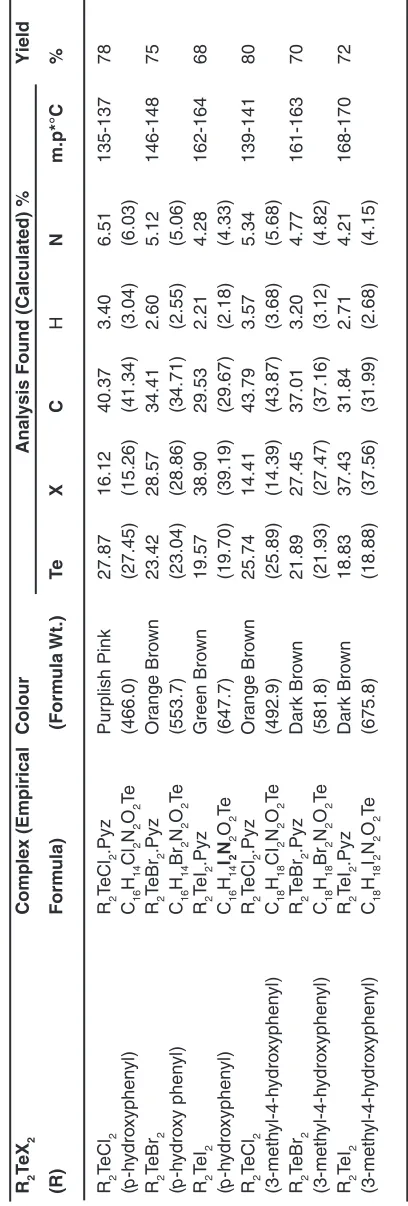
All the compounds were analysed for their tellurium and halogen contents and some for carbon, hydrogen, nitrogen contents as well(results are given in table l).These complexes of diaryltellurium(IV) dihalides are generally coloured, crystalline solid which are fairly stable in dry air. These are generally soluble in polar organic solvents and insoluble in non polar solvents.
Pyz = pyrazine
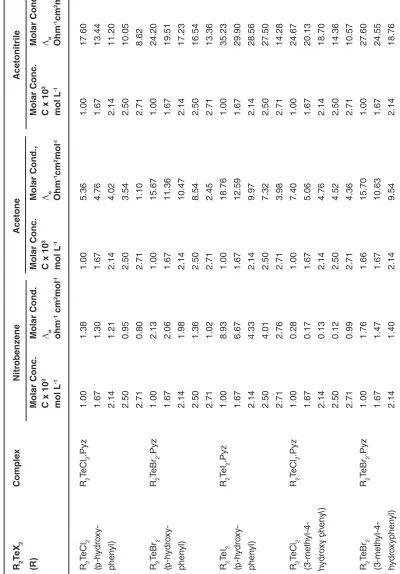
The Lmvalues for the pyrazine complexes in
nitrobenzene, acetone and acetonitrile are generally much lower than those reported for 1 : 1 electrolytes thus suggesting their non-electrolyte type behaviour
Tab
le 4:
IR Data (cm
-1) f
or Pyrazine Comple
xes of Diar
yltelluriumDihalides R2 TeCl 2 .Pyz R2 TeBr 2 .Pyz R2 TeI 2 .Pyz R2 TeCI 2 .Pyz R2 TeBr 2 .Pyz R2 Te I2 .Pyz Assignment
R = (
p
-h
ydr
oxy-R = (
p
-h
ydr
oxy-R = (
p
-h
ydr
oxy-R = (3-meth
yl-4-R = (3-meth
yl-4-R = (3-meth
yI-4-phen yl) phen yl) phen yl) hydr oxy phen yl) hydr oxyphen yl) hydr oxyphen yl)
3400-3200 s b
3414-3214 sb
3466-3287 s b
3413-3202 sb 3393-3195 sb 3454.3140 sb nO-H 3100m 3118m 2924 m 3117s 3112m 3100m aromatic C-H
3059 s b
3044 s
2880 s b
3100 m 3080 m 2925 s stretching + 3010 sb 2963 s 3054 s
3050 s b
2920 s n ( c H )ofPyz+n r -c H3
2978 s b
2913 m
3000 m
2930 s b
2880 s
2887 s b
2943 m
2870 m
2810m
2760 s b
2925 m 2910 m
2553 m b
2450 m b
2371 mb
2430 m b
2540 m b
2610 mb
ov
er
tones and
2490 m b
2371 mb
2350 m b
2180mb
2230 m b
2470 m b
combination bands
2400 m b
2248 m b
2310 mb
2100 m
2030 m b
2250 m b
2280 m b
2016 mb
2280 m b
2110mb
2036 m b 1640 w
1627 m 1628 m 1575 s 1573 s 1620 m νc=c 1569 s 1553 s 1560 s 1514s 1540 m 1495 vs 1492 s 1518m sym. r ing stretch 1488 s 1478 vs 1475 s 1480 vs 1477 vvs 1475 s 1448 s in p la n e a n ti s y m .
ring 1450 s
1418m 1403 m 1450 m 1420 sh st re tc h + a n ti sy m . CH3 1420 sh
bending + u
r ing of pyz. 1370 sh 1367 sh 1362 sh 1395 s 1394 m 1402 m d(OH)
+ in the plane
1245 sh
1240 m
1170 m
1239 m
1235 m
1244 m
aromatic in the plane
1168 s
1150 w
1104 m
1170 vs
1168 m
1156m
vib
. + r
ing of Pyz.
1102 m
1160 m
1150 w
1114s
1125 vs
1123 s
1051 m
1054 m
1060 m
1067 m
1065 m
1060 m
sym.
in plane r
ing
1001 sh
1034 m
1032 w
1020 w
breathing
1010w
1008 w
958 m
967 m
960 m
985 m
981 m
957 m
Pyz.
unidentate
925 m
886 s
741 m
919m
917m
898 s
C-H out of plane
H-831 m
826 m
912 m
879 s
872 s
bending vib + n
c
H
of
758 m
750 m
882 m
850 m
800 m
Pyz.
718 m
859 m
807 m
780 m
808 s
742 s
758 s
719 m
744 s 721 m
685 wb
644 m
615 m
681 w
680 m
646 m
ring
bending vib
.
607 m
524 m
550 sh
650 m
640 mb
580 sh
491 m
620 m
598 w
515 m
599 w
*
550 w
553 m
440 m
450 m437 s
455 m
phen
yl modes + g
ring of Pyz.
424 w
435 w
vvs = v
er
y v
er
y strong, vs = v
er
y strong, s = strong, sh = shoulder
, m = medium, vw= v
er
y w
Table 5: IR Data (cm-1) for Pyrazine Complexes of Bis(p-methoxyphenyl)tellurium Dihalides
R2TeCl2.Pyz R2TeBr2.Pyz R2TeI2.Pyz Assignment
3200 s 3178 s 3129 s aromatic C-H strech + n(cH)of Pyz.
3075 m 3096 m 3100 m
3010 m 2994 m 3000 m
2900 m b
2175 m 2184m 2200 m overtones and combination bands
2100 mb 2093 m b 2100 mb
2040 m 1988 m 2000 m
1900 m 1856 m 1975 m
1871 m 1743 m 1875 m
1800 m 1725 m
1600 m 1586 s 1582 vs νc=c skeletal in plane ring
1580 vs stretch
1492 s 1498 s 1500 s n ring of Pyz
1456 m 1460 m 1487 s
1410m 1457 m
1420 m
1399 m 1348 m 1300 s asym. C-O-C stretch
1301 s 1283 s 1275 s
1255 s 1258 s 1246 vs
1175 s 1178s 1179 vs g ring of Pyz. + aromatic in the plane vib. + sym.
C-O-C 1110m 1107 m 1110m stretch.
1053 m 1024 s 1023 vs
1021 vs 1000 w
965 s 953 s 957 s Pyz. unidentate
815 vs 835 s 880 C-H out of plane H-bending vib + gCH of Pyz.
780 s sh 800
776 m
715 m 718 w 712 m out of the plane ring bending vib.
690 w 640 w 610 w
610 w 580 w
vs = very strong, s = strong, sh = shoulder, m = medium, w = weak, vw = very weak, b = broad
solvent for pyrazine adducts varies in the order.
R2TeI2.Pyz > R2TeBr2.Pyz > R2TeCl2.Pyz
Cryoscopic measurements
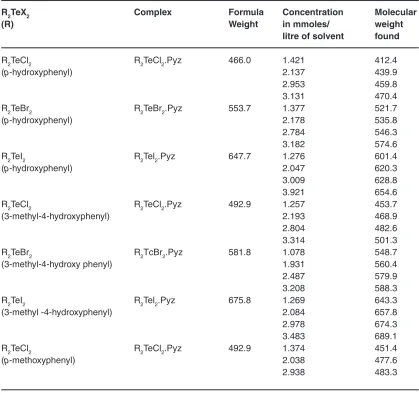
The cryoscopic data for the pyrazine complexes (Table III) show that molecular weights of these complexes arc quite close to the formula weights, thus suggesting their molecular monomeric nature in nitrobenzene, as predicted by conductance
studies as well.
IR Spectra
The important IR data (cm-1) for pyrazine
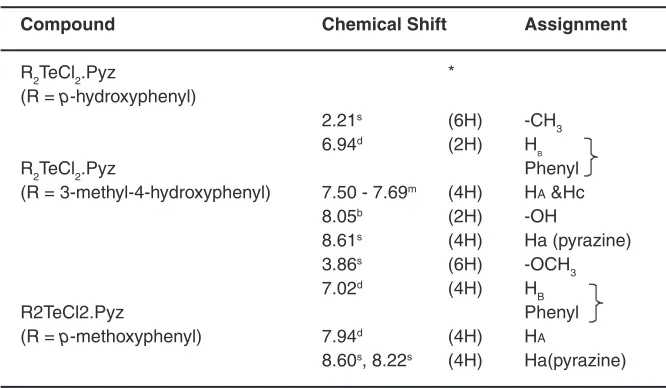
Table 6: 1H INMR Data (d ppm) for Pyrazine Complexes of
DiaryltelluriumDichlorides in DMSO-d6.
Compound Chemical Shift Assignment
R2TeCl2.Pyz *
(R = p-hydroxyphenyl)
2.21s (6H) -CH
3
6.94d (2H) H
b
R2TeCl2.Pyz Phenyl
(R = 3-methyl-4-hydroxyphenyl) 7.50 - 7.69m (4H) Ha &Hc
8.05b (2H) -OH
8.61s (4H) Ha (pyrazine)
3.86s (6H) -OCH
3
7.02d (4H) H
B
R2TeCl2.Pyz Phenyl
(R = p-methoxyphenyl) 7.94d (4H) Ha
8.60s, 8.22s (4H) Ha(pyrazine)
s = singlet, b = broad, m= multiple, cm = complex multiple, d = doublet * Spectra not well resolved.
based on comparison of spectra of parent R2TeX2and
pyrazine. The ring vibrations of these may be mixed with each other.
The pyrazine molecule (C4H4N2)has the
centrosymmetric and planar structure with D2h
symmetry in the vapour and solid phases. The assignments of the infrared spectra of pyrazine
in solid6, liquid7-8 and vapour9-10 phases and in
solution6,10,11 have been reported to be in accord with
the D2h symmetry. The important infrared frequencies
which are observed10,11 in free pyrazine are 3061,
3011 (nCH), 1483, 1412 (nring), 1150 (nring), 1130
(dcH)9 1061 (dcH), 1019 (dring), 785(ucm)and 418(nring).
In metal complexes in which both n-atoms of
pyrazine are coordinated to two metal atoms, the D2h
symmetry is preserved but is removed in unidentate coordination. Several modes of pyrazinein complexes have upward shift in wave number in comparison with those of free pyrazine. This blue shift in pyrazine bands in the complexes indicates the coordination
through n-atom as in pyridine12,13. This blue shift in
ppyrazine stretching may be due to back bonding
from tellurium to pyrazine ring through formation of extensive -bonding.
Lever et al14-17and Kantara18 have reported
that in complexes where pyrazine is bonded through
only one N-atom, the low local symmetry experienced by the pyrazine moiety atoms allows a band to appear
in the 950-1000 cm-1 region, which may be taken
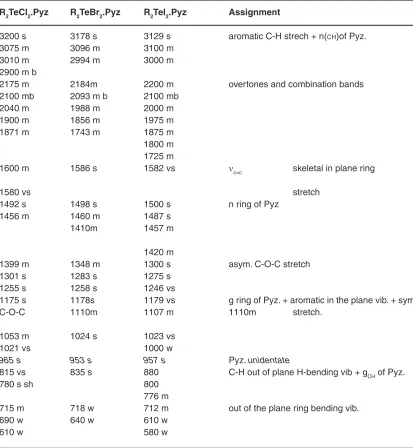
as an evidence for unidentate nature of pyrazine. This band is reported to be absent in the bridged polymers where pyrazine functions as bidentate ligand. In pyrazine complexes of diaryltellurium(IV) dihalides prepared during this course of study exhibit a medium to strong intensity band in this region, thereby confirming the unidentate nature of pyrazine
in these complexes. Thus, tellurium in R2TeX2.Pyz
complexes attains a coordination number of five probably in a square pyramidal environment.
1HNMR Spectra
The 1H NMR data for pyrazine complexes
are given in Table VI. The four equivalent protons
of free pyrazine which resonate at 8.5919d ppm
appear at slightly downfield side in R2TeCl2.Pyz
complexes due to shifting of electron density from
N of pyrazine to Te of R2TeCl2. Also in some cases
separation between the pyrazine protons has been observed which may be due to monodentate nature of pyrazine. Conversely, the aryl protons of
R2TeCl2group resonate at upfield side as compared
to the parent diaryltellurium dichloride, indicating thereby the shielding of phenyl protons especially
increase in electron density at the tellurium atom after accepting the electrons from the pyrazine molecule. Similar shift has also been reported for
pyridine complexes20,21 of RTeCl
3. Thus tellurium in
these pyrazine complexes acquires a coordination number of five.
CONCLUSION
Bis (p-hydroxyphenyl), bis (3-methyl-4-hydroxyphenyl) and bis(p-methoxyphenyl) tellurium (IV) dichlorides are obtained by direct reaction of
tellurium tetrachloride with phenol, o-cresol and
anisole respectively.
These diaryltelluriumdihalides have been reacted with pyrazine. The solution behaviour of complexes of diaryl tellurium (IV) dihalides has
been investigated by conductance measurement in nitrobenzene, acetone and acetonitrile and cryoscopic measurement in nitrobenzene. The Structural aspects of the complexes of diaryltelluriumdihalides have been investigated conjointly by infrared and proton magneticre-sonance spectroscopy. These complexes of diaryl tellurium (IV) dihalides are generally coloured, crystalline solid which are fairly stable in air. These are generally soluble in polar organic solvents and insoluble in non polar solvents.
ACKNOWLEDGEMENTS
The authors are thankful to Maharshi Dayanand University, Rohtak for providing the necessary facilities.
REFERENCES
1. G. Maslakov, E. Gresham, T. A. Hamor, W.
R. Mcwhinnie, M. C. Perry and N. Saikh, J.
Organometal. Chem., 480: 261 (1994).
2. Y. D. Kulkarni, Archana Rani and R. A. Siddiqui,
J. Indian Chem. Soc, 69: 353 (1992).
3. ShekharSrivastava, Dilip Kumar Soni and Hari
Shankar Gupta, J. Indian Chem. Soc., 73: 255 (1996).
4. K. K. Verma and Sunil Verma, Proc. Indian
Council of Chemist 27th Annual Conference,
GurukulKangri University, Haridwar, Dec. 26-28: paper no. IO-10, p. 23 (2008).
5. K. K. Verma and Sunil Verma, Proc. Indian
Council of Chemist 27th Annual Conference,
GurukulKangri University, Haridwar, Dec. 26-28, paper no. IO-17, p. 27 (2008).
6. G. Sbrana, V. S. Chettino and R. Righini, I
Chem. Phys., 59, 2441 (1973).
7. R. C. Loard, A. J. Marson and F. A. Miller,
Spectrochim., Acta, 9: 113 (1957).
8. J. Zarembowitch and L. Bokibza-Sebagh,
Spectrochim. Acta, A32: 605 (1976).
9. S. Califano. G. Adembri and G. Sbrana,
Spectrochim. Acta, 20: 385 (1964).
10. J. F. Arenas, J. J. Lopez-Navarrate, J. C. Otero,
J. I. Macros and A. Cardenate, J. Chem. Soc. Faraday Trans., 81: 405 (1985).
11. Z. Kantarci, B. Davarcioglu and C. Bayrak, J. of
Inc. Phenom. and Macr. Chem., 39: 115-121 (2001).
12. N. N. Greenwood and K. Wade, J. Chem. Soc,
A, 1130 (1960).
13. J. K. Wilmhurst and H. J. Bernsteim, Can. J.
Chem., 35: 1183 (1957).
14. B. P. Lever, J. Lewis and R. S. Nyholm, Nature
Lond., 189: 58 (1961).
15. B. P. Lever, J. Lewis and R. S. Nyholm, J.
Chem. Soc, 1235 (1962).
16. B. P. Lever, J. Lewis and R. S. Nyholm, J.
Chem. Soc, 3156 (1963).
17. B. P. Lever, J. Lewis and R. S. Nyholm, J.
Chem. Soc, 5042 (1963).
18. H. D. Stidham and J. A. Chandler, J. Inorg.
Nucl. Chem., 27: 397-403 (1964).
19. SDBS 3641
20. K. K. Verma, Reena and DayaSoni, Synth.
React. Inorg. Met. -Org. Chem., 29: 1033
(1999).
21. Reena, Ph.D. Thesis, M. D. University, Rohtak
(1998).
22. Om Prakash, S.A. Iqbal and G. Jacob, Orient
J. Chem., 29(3): 1079-1084 (2013).
23. Neeti Rathore and Bal Krishan, Orient. J.