ScholarlyCommons
ScholarlyCommons
Publicly Accessible Penn Dissertations
2019
The Role Of Intuitive Arithmetic In Developing Mathematical Skill
The Role Of Intuitive Arithmetic In Developing Mathematical Skill
Emily Maja Szkudlarek
University of Pennsylvania, [email protected]
Follow this and additional works at: https://repository.upenn.edu/edissertations
Part of the Cognitive Psychology Commons, and the Developmental Psychology Commons
Recommended Citation Recommended Citation
Szkudlarek, Emily Maja, "The Role Of Intuitive Arithmetic In Developing Mathematical Skill" (2019). Publicly Accessible Penn Dissertations. 3498.
https://repository.upenn.edu/edissertations/3498
This paper is posted at ScholarlyCommons. https://repository.upenn.edu/edissertations/3498
Abstract Abstract
Symbolic mathematics allows humans to represent and describe the logic of the world around us. Although we typically think about math symbolically, humans across the lifespan and a wide variety of animal species spontaneously exhibit numerical competence without reference to formal mathematics. This intuitive ability to approximately compare, estimate, and manipulate large non-symbolic numerical quantities without language or symbols is called the Approximate Number System. The four chapters of this dissertation explore whether non-symbolic, approximate calculation can function as a bridge between our Approximate Number System and symbolic mathematics for children at the beginning of formal math education and university undergraduates. Chapter 1 explores how non-symbolic and symbolic ratio reasoning relates to general math skill and Approximate Number System acuity in elementary school children. Chapter 2 examines whether children and adults can perform a non-symbolic, approximate division computation, and how this ability relates to non-symbolic and symbolic mathematical skill. Chapter 3 tests the robustness and mechanism of a non-symbolic, approximate addition and subtraction training paradigm designed to improve arithmetic fluency in university undergraduates. Chapter 4
investigates whether the negative relation between math anxiety and symbolic math performance extends to approximate, symbolic calculation. Together, Chapters 1 and 2 provide evidence that non-symbolic calculation ability functions as a mechanism of the relation between Approximate Number System acuity and symbolic math. Chapters 3 and 4 identify populations of students for whom practice with symbolic calculation may or may not be beneficial. In sum, this dissertation describes how non-symbolic, approximate calculation allows students harness their intuitive sense of number in a
mathematical context. Degree Type Degree Type Dissertation Degree Name Degree Name
Doctor of Philosophy (PhD)
Graduate Group Graduate Group Psychology
First Advisor First Advisor Elizabeth M. Brannon
Keywords Keywords
Approximate Number System, Arithmetic, Cognitive Development, Numerical Cognition
Subject Categories Subject Categories
Cognitive Psychology | Developmental Psychology
Emily Maja Szkudlarek
A DISSERTATION
in
Psychology
Presented to the Faculties of the University of Pennsylvania
in
Partial Fulfillment of the Requirements for the
Degree of Doctor of Philosophy
2019
Supervisor of Dissertation
__________________________
Elizabeth M. Brannon
Professor of Psychology
Graduate Group Chairperson
__________________________
John Trueswell, Professor of Psychology
Dissertation Committee
Daniel Swingley, Professor of Psychology
THE ROLE OF INTUITIVE ARITHMETIC IN DEVELOPING MATHEMATICAL SKILL
COPYRIGHT
2019
ACKNOWLEDGMENT
First, I would like to thank my advisor, Dr. Elizabeth Brannon, for her guidance and
support throughout my time in graduate school. I am forever grateful for the opportunity to work in
the Brannon lab. I would also like to thank the members of my committee, Dr. Daniel Swingley
and Dr. Allyson Mackey for their advice and feedback regarding this research. I am further
thankful to Dr. Whitney Tabor and Dr. Etan Markus for their endless support of my research
interests as an undergraduate at the University of Connecticut. Without their mentorship, this
dissertation would not be possible.
Many past and present members of the Brannon lab have offered help and advice
during my time in graduate school, and to all of them I am thankful. Two members of the lab in
particular, Nick DeWind and Stephanie Bugden, have contributed to the current work in
innumerable ways. I cannot imagine graduate school without either of them. Our near daily chats
about work and life (whether in the office or not) have impacted this research and beyond. I am
immensely grateful for our friendship.
I would also like to thank Eleni Kursten and Emily Kibbler for their consistent belief that I
am moving in the right direction.
I am also thankful to my family for their continual interest in what I’ve been working on,
especially Kim Szkudlarek, Celeste Truskolawski, Małgorzata Podłuska, Alicja Szkudlarek, Marek
Szyndel, and my grandmother, Valerie Truskolawski. Though my grandmother is not here to see
the end of my time in graduate school, I know she was already excited for the next things to
come.
To my parents, Justine and Lech Szkudlarek, thank you for everything. There are truly
too many things to list, but a few include helping me to move (three) times, timely reminders that
my car is due for an oil change, and sparking my interest in science.
Finally, thanks to my parakeets Pickle, Parsnip, and Ollie for their happy chirps each
ABSTRACT
THE ROLE OF INTUITIVE ARITHMETIC IN DEVELOPING MATHEMATICAL SKILL
Emily Maja Szkudlarek
Elizabeth M. Brannon
Symbolic mathematics allows humans to represent and describe the logic of the world around us.
Although we typically think about math symbolically, humans across the lifespan and a wide
variety of animal species spontaneously exhibit numerical competence without reference to
formal mathematics. This intuitive ability to approximately compare, estimate, and manipulate
large non-symbolic numerical quantities without language or symbols is called the Approximate
Number System. The four chapters of this dissertation explore whether non-symbolic,
approximate calculation can function as a bridge between our Approximate Number System and
symbolic mathematics for children at the beginning of formal math education and university
undergraduates. Chapter 1 explores how non-symbolic and symbolic ratio reasoning relates to
general math skill and Approximate Number System acuity in elementary school children.
Chapter 2 examines whether children and adults can perform a non-symbolic, approximate
division computation, and how this ability relates to non-symbolic and symbolic mathematical skill.
Chapter 3 tests the robustness and mechanism of a non-symbolic, approximate addition and
subtraction training paradigm designed to improve arithmetic fluency in university
undergraduates. Chapter 4 investigates whether the negative relation between math anxiety and
symbolic math performance extends to approximate, non-symbolic calculation. Together,
Chapters 1 and 2 provide evidence that non-symbolic calculation ability functions as a
mechanism of the relation between Approximate Number System acuity and symbolic math.
Chapters 3 and 4 identify populations of students for whom practice with non-symbolic calculation
may or may not be beneficial. In sum, this dissertation describes how non-symbolic, approximate
TABLE OF CONTENTS
ACKNOWLEDGMENT ...III
ABSTRACT ... IV
LIST OF TABLES ... VIII
LIST OF ILLUSTRATIONS ... IX
GENERAL INTRODUCTION ...1
Introduction to approximate number representations ... 1
Potential mechanisms of the link between the ANS and mathematics... 4
Non-symbolic, approximate calculation... 5
The relation between non-symbolic calculation and symbolic math ... 7
Dissertation approach... 9
CHAPTER 1: FIRST AND SECOND GRADERS SUCCESSFULLY REASON
ABOUT RATIOS WITH BOTH DOT ARRAYS AND ARABIC NUMERALS ...13
Introduction ... 13
Materials and Methods ... 19
Subjects ... 19
Procedure ... 20
Experimental Tasks ... 20
Analysis Plan... 24
Results ... 26
Symbolic and non-symbolic ratio comparison performance. ... 26
Non-symbolic ratio comparison facilitates symbolic ratio comparison ... 28
Alternative strategy analysis. ... 30
No evidence of a strategy shift after non-symbolic ratio practice ... 31
The relation between ANS acuity, non-symbolic ratio comparison, and symbolic math skills... 32
Discussion ... 34
CHAPTER 2: INTUITIVE DIVISION IN NON-SYMBOLIC AND SYMBOLIC
FORMAT WITHOUT INSTRUCTION ...39
Introduction ... 39
Child Experiment ... 45
Adult Experiment ... 52
Results ... 54
Non-symbolic Division Performance ... 54
Symbolic Division Performance ... 55
Adult and Child Division Format Effect ... 55
Child Division and Symbolic Math Knowledge ... 56
Alternative Strategy Analysis ... 58
Division Strategy Questionnaire Analysis ... 58
Effect of Divisor on Division Performance ... 59
The Relation between ANS acuity, Non-symbolic division, and Symbolic math... 60
Discussion ... 64
CHAPTER 3: APPROXIMATE ARITHMETIC TRAINING YIELDS NO
BENEFITS FOR SYMBOLIC ARITHMETIC FLUENCY IN ADULTS ...69
Introduction ... 69
Materials and Methods ... 73
Subjects. ... 74
Procedure. ... 75
Training Conditions ... 75
Pre and Post Tests ... 78
Analysis Plan... 80
Results ... 82
Analysis of Approximate Arithmetic Training Performance. ... 82
Experiment 1. ... 83
Experiment 2. ... 84
Experiment 3 ... 85
Experiment 4. ... 85
Bayesian Re-analysis of Park & Brannon 2013, 2014 ... 87
Combined Analysis. ... 88
Discussion ... 91
CHAPTER 4: MATH ANXIETY RELATES TO SYMBOLIC, BUT NOT
NON-SYMBOLIC CALCULATION ACCURACY ...96
Introduction ... 96
Materials and Methods ... 100
Subjects. ... 100
Procedure. ... 101
Adult Experimental Tasks. ... 102
Child Experimental Tasks. ... 105
Results ... 107
The relation between math anxiety, ANS acuity, approximate calculation, mathematics
performance and control measures... 107
Predicting symbolic and-non-symbolic math skills. ... 109
Gender differences in anxiety level ... 113
Discussion ... 113
GENERAL DISCUSSION ... 118
Chapter Summaries ... 118
Synthesis and future directions ... 122
Conclusions ... 126
APPENDIX ... 127
Appendix A.1. ... 127
Appendix A.2. ... 128
Appendix B.1 ... 129
Appendix B.2 ... 132
Appendix B.3 ... 135
Appendix B.4 ... 136
LIST OF TABLES
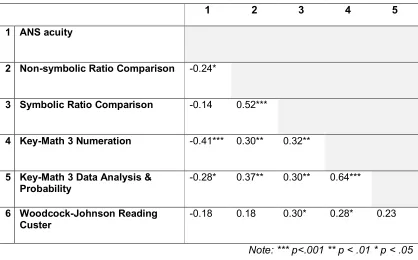
Table 1: Age and school location standardized Pearson correlations between each measure in
Chapter 1 ... 32
Table 2. Descriptive statistics and bivariate correlation matrix of the child datain Experiment 1 in Chapter 2 ... 61
Table 3. Descriptive statistics and bivariate correlation matrix of the adult datain Chapter 2 .... 62
Table 4. Methods for the original Park & Brannon 2013, 2014 experiments and the four experiments reported in Chapter 3... 73
Table 5. Subject demographics of the original Park & Brannon 2013, 2014 experiments and the four experiments reported in Chapter 3... 74
Table 6. Descriptive statistics and bivariate correlation matrix for adults in Chapter 4 ... 108
Table 7. Descriptive statistics and bivariate correlation matrix for children in Chapter 4 ... 109
Table 8. Multiple regression analyses predicting symbolic math in adults ... 111
Table 9. Multiple regression analyses predicting non-symbolic math in adults ... 111
Table 10. Multiple regression analyses predicting symbolic math in children ... 112
LIST OF ILLUSTRATIONS
Figure 1: Illustration of one trial of the A) non-symbolic ratio comparison task and B) symbolic ratio comparison task ... 20
Figure 2: A) Accuracy on both the non-symbolic and symbolic ratio comparison tasks. Error bars indicate SEM B) Performance on the symbolic and non-symbolic ratio comparison tasks were highly correlated ... 27
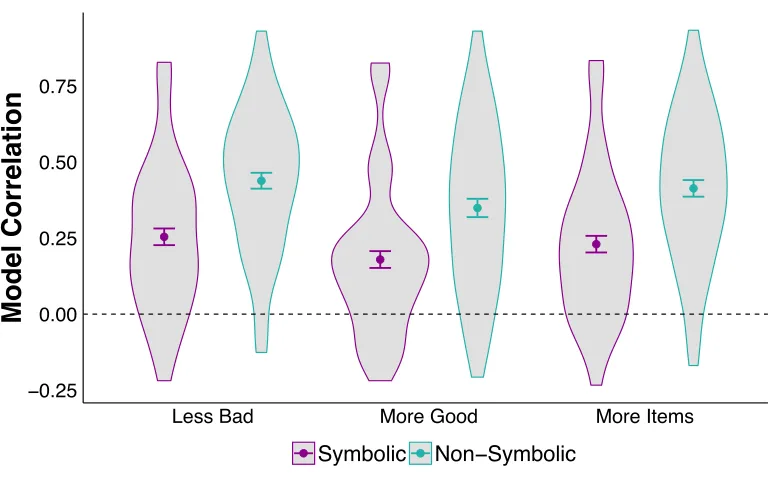
Figure 3. There is a significant interaction between task order and task format. Children who completed the non-symbolic ratio comparison task first were significantly more accurate on the symbolic ratio comparison task. Error bars indicate SEM ... 29 Figure 4. Correlation between performing a true ratio comparison and children’s actual choices on trials where a ratio comparison and each incorrect heuristic provided opposing answers. A
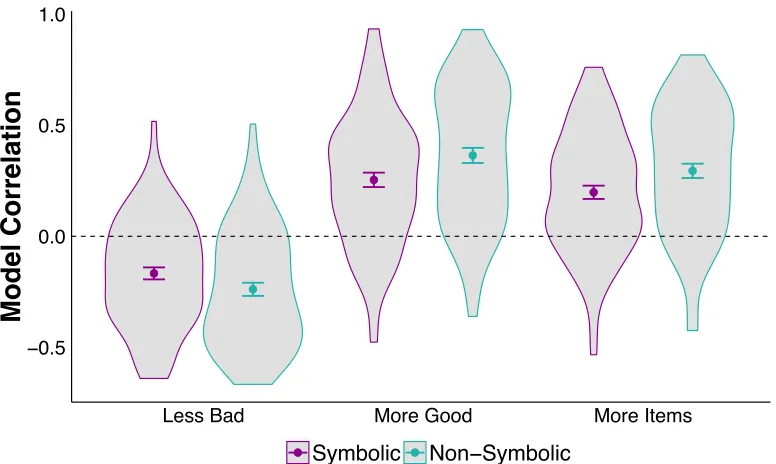
correlation significantly above zero indicates children made choices consistent with ratio comparison, even when controlling for the use of each incorrect heuristic. Points indicate the mean correlation of all subjects, and the grey area of the violin plot indicates the distribution of individual correlations. Error bars indicate SEM ... 29 Figure 5. Correlation between the errors a child would make if they were exclusively using a given strategy and the errors a child actually made on the non-symbolic and symbolic ratio comparison tasks. A correlation significantly above zero indicates use of the strategy. Points indicate the mean correlation of all subjects, and the grey area of the violin plot indicates the distribution of individual correlations. Error bars indicate SEM ... 31 Figure 6. A) Non-symbolic ratio comparison accuracy does not mediate the relation between ANS acuity and a child’s score on the Key-Math-3 Numeration section. The direct effect c’ remains significant. B) Non-symbolic ratio comparison accuracy fully mediates the relation between ANS acuity and a child’s score on the Key-Math-3 Data Analysis and Probability section. The
remaining direct effect (c’) is no longer significant, while the indirect effect (ab) is significant as tested with a bootstrap estimate approach ... 34 Figure 7. Schematic of the non-symbolic and symbolic division tasks ... 45 Figure 8. The stimulus space used in all experiments in Chapter 2 ... 50 Figure 9. Accuracy on the non-symbolic and symbolic division tasks for both the children
(Experiment 1) and adults. The dotted line depicts chance performance. Error bars represent SEM ... 54 Figure 10. Children’s performance on the non-symbolic and symbolic division tasks broken down by their performance on the formal division test ... 57
Figure 11. Performance of adults and children in Experiment 1 on the non-symbolic and symbolic division tasks broken down A) by the ratio between the quotient and target and B) by the divisor ... ... 60
Figure 13. Training trajectories of the approximate arithmetic training condition by experiment .. 83
Figure 14. Pretest arithmetic fluency scores by condition and experiment ... 87
Figure 15. Bar plot of arithmetic fluency gain score by condition and experiment ... 88
Figure 16. Arithmetic fluency gain score by condition collapsed across all experiments including the original Park and Brannon experiments ... 90 Figure 17. Math and reading anxiety levels plotted by gender and age. Women reported higher math and reading anxiety than men, but there was no significant gender difference among
GENERAL INTRODUCTION
Introduction to approximate number representations
Imagine that you are snorkeling and you encounter many schools of brightly colored
tropical fish. When you swim back to the beach, your friend asks whether you saw more black
angelfish or yellow butterfly fish. In this scenario you could probably provide an answer to this
question without too much thought. Moreover, if asked, you could likely provide an estimate of
how many yellow butterfly fish you saw, flexibly switch between comparing the relative number of
orange and red fish to the blue and yellow fish, and then compare these numbers to the
quantities you remember from your last snorkeling trip. This intuitive ability to approximately
compare, estimate, and manipulate large non-symbolic numerical quantities without language or
symbols is called the Approximate Number System (ANS; Feigenson, Dehaene, & Spelke, 2004).
Humans across the lifespan and a wide variety of animal species spontaneously exhibit this
numerical competence. For example, the ANS supports the ability of both wild North Island robins
and captive elephants to pick the greater quantity of food, newborn infants to match numerical
information across visual arrays of objects and a series of sounds, and child and adult members
of an indigene group in the Amazon to perform intuitive arithmetic without formal education in
mathematics (Garland, Low, & Burns, 2012; Izard, Sann, Spelke, & Streri, 2009; Perdue, Talbot,
Stone, & Beran, 2012; Pica, Lemer, Izard, & Dehaene, 2004). After practice comparing quantities
of dots in a laboratory setting, adults can successfully discriminate between 23 dots from 26 dots
when they are flashed on a screen for 500ms, even when the size, spatial layout, and total
surface area of the dots change (Cochrane, Cui, Hubbard, & Green, 2018; DeWind, Adams, Platt,
& Brannon, 2015). Thus, the ANS allows humans and non-humans to intuitively use numerical
information present in the world around us.
The approximate number system is not the only way in which humans represent number.
We can precisely enumerate collections of less than four items (Feigenson, Carey, & Hauser,
2002), and with the help of language we can exactly count how many objects there are, or we can
numerical representation, ANS representations are approximate and noisy. This quality results in
the behavioral hallmark of the ANS of ratio dependence, or Weber’s law. When we use the ANS
the difficulty in discriminating two numerical quantities is dependent on the ratio between the two
numerosities and not their absolute value. For example, it is hard to tell which school of fish is
larger when comparing 15 black fish and 16 yellow fish but it is much easier when comparing 25
black fish and 5 yellow fish. Moreover comparing 125 black fish and 25 yellow fish is just as easy
as comparing 25 and 5. Theoretically, this behavioral signature suggests that the ANS represents
numbers as a series of overlapping Gaussian distributions with logarithmic compression as
numerosity increases along an ordered mental number line (Piazza, Izard, Pinel, Le Bihan, &
Dehaene, 2004). In this model, there is more overlap in the distributions representing 15 and 16
than there are in in the distributions representing 25 and 5, and therefore 25 and 5 are easier to
tell apart. Individual differences in the acuity of the ANS are usually captured by modelling the
width of these distributions with a dot comparison task using the Weber fraction (w) (Halberda,
Ly, Wilmer, Naiman, & Germine, 2012). In this task subjects see two arrays of dots appear on a
screen for a short period of time. The goal is to pick which array of dots has the greater number.
Researchers manipulate the difficulty of this task by varying the ratio between the two dot arrays.
The closer the ratio is to one, the harder it is to discriminate between the two arrays. The weber
fraction corresponds to the ratio closest to one that a person can reliably discriminate, and
theoretically to the width of the Gaussian neural tuning curves that instantiate the ANS (Dehaene,
Piazza, Pinel, & Cohen, 2003; Piazza et al., 2004). ANS acuity varies meaningfully across the
population (Halberda et al., 2012; Halberda, Mazzocco, & Feigenson, 2008). More precise ANS
acuity corresponds to narrower Gaussian distributions with less overlap between numerosities,
while less precise ANS representations correspond to wider distributions for each numerical
value.
The abilities afforded by the ANS – non-symbolic and approximate representation of
number - is not a skill normally thought of as mathematics. Math is highly dependent on exact,
student needs to learn that the difference between 8 and 7 is the exact same difference as
between 1,000 and 1,001. Due to the approximate nature of ANS representations, this concept
cannot be represented using the ANS. Rather, a student must rely on symbolic methods of
representing number to capture this mathematical concept. Despite this fundamental difference
between math and our approximate number sense, there is evidence of a meaningful relationship
between mathematics and the ANS. Three meta-analyses on the relation between symbolic math
and ANS acuity have found evidence of a significant correlation between these skills from
preschool into adulthood (Chen & Li, 2014; Fazio, Bailey, Thompson, & Siegler, 2014; Schneider
et al., 2016). Work with children who have a math specific learning disability has suggested that
an ANS deficit plays a role in at least a subset of children with math learning disorders (Piazza et
al., 2010; Skagerlund & Träff, 2016). There is also some evidence for a neural representation of
number independent of symbolic or non-symbolic format in the intraparietal sulcus (Dehaene et
al., 2003; L. He, Zuo, Chen, & Humphreys, 2014; Lussier & Cantlon, 2016; Piazza, Pinel, Le
Bihan, & Dehaene, 2007). Taken together, this work suggests a meaningful link between the
approximate and symbolic systems of number representation and lends support to the prominent
theory that numerical symbols are grounded in approximate number representations (Dehaene,
1997; Gallistel & Gelman, 1992). This idea has important implications for math education.
Understanding the cognitive building blocks that underlie mathematical thought may allow
educational researchers and teachers to develop pedagogy that incorporates our understanding
of how the brain represents and processes numerical information. However, a substantial number
of studies have failed to find a relation between ANS acuity and mathematics (Bonny & Lourenco,
2013; Gilmore et al., 2013; Holloway & Ansari, 2009; Nosworthy, Bugden, Archibald, Evans, &
Ansari, 2013; Sasanguie, Göbel, Moll, Smets, & Reynvoet, 2013), an ANS acuity deficit in
children with math learning disability (Iuculano, Tang, Hall, & Butterworth, 2008), or a format
independent neural code for number (Lyons, Ansari, & Beilock, 2015). These mixed results in the
literature call for a deeper understanding of potential mechanisms of a link between ANS acuity
and symbolic mathematics to delineate the specificity and usefulness of this relation for improving
Potential mechanisms of the link between the ANS and mathematics
The mixed results on the relation between ANS acuity and math in the literature reflects the
fact that a prominent mechanistic theory for the relation between ANS acuity and symbolic math
skill has not yet emerged. Does ANS acuity correlate with all types of mathematics? Does
sharper ANS acuity only facilitate the acquisition of symbolic math as a child, and then lose
relevance into adulthood? Are there particular populations of students who tend to use their ANS
representations during math learning? Understanding why a relation between ANS acuity and
mathematics could exist is crucial for research that seeks to utilize the ANS to improve math
education.
One preliminary theory suggests the ANS could function as an online error detection system
during calculation (Feigenson, Libertus, & Halberda, 2013; Lourenco, Bonny, Fernandez, & Rao,
2012). Students that have a better representation of the numerical magnitudes involved in
calculation can imagine a better estimate of the correct solution to a math problem. Therefore,
these students would be able to more adeptly reject incorrect solutions resulting in higher
accuracy when solving calculation problems. This is an open possibility because there is currently
little empirical evidence to judge this claim.
Another theory suggests that children map number words onto ANS representations during
their initial acquisition. To understand the meaning of number words, children must acquire the
cardinal principle. This is the concept that the number of items in a set corresponds to the last
number produced when counting the objects in the set. Learning the cardinal principle is an
important milestone in children’s mathematical learning. The timing of cardinal principle
acquisition predicts later math achievement (Geary et al., 2017). If children base their
understanding of number words on their ANS representations, children with sharper ANS acuity
will have an easier time mapping to their more precise representations of number. In support of
this idea, the relation between ANS acuity and math achievement in preschool is mediated by a
children’s understanding of the cardinal principle (Chu, vanMarle, & Geary, 2015; van Marle, Chu,
improved ANS acuity coincided with the understanding of the cardinal principle (Shusterman,
Slusser, Halberda, & Odic, 2016). Thus, increased ANS acuity may facilitate acquisition of the
cardinal principle. However, if facilitating number word acquisition were the only function ANS
acuity played in symbolic math ability then we might expect the relationship to completely
dissipate by late childhood once number words are automatized. While the relationship may get
weaker over time, a positive correlation between the ANS and symbolic math skills has been
demonstrated in multiple adult samples (e.g, DeWind & Brannon, 2012; Halberda et al., 2012).
Another theory is based in the current evidence that practice with non-symbolic approximate
arithmetic tasks can improve the symbolic math skills of children and adults (Dillon, Kannan,
Dean, Spelke, & Duflo, 2017; Hyde, Khanum, & Spelke, 2014; Obersteiner, Reiss, & Ufer, 2013;
Park, Bermudez, Roberts, & Brannon, 2016; Park & Brannon, 2014; Szkudlarek & Brannon,
2018; Wilson, Revkin, Cohen, Cohen, & Dehaene, 2006). Sharper ANS acuity may allow for
better non-symbolic, approximate calculation skill because more precise numerical magnitude
representation yields a more accurate sense of the quantities involved in calculation. In turn,
better non-symbolic calculation skill allows children and adults to create conceptual models of
mathematical operations which may facilitate symbolic calculation understanding. The current
dissertation explores this hypothesis.
Non-symbolic, approximate calculation
Adults, children, and even infants can successfully calculate non-symbolically and
approximately. They can add and subtract arrays of objects (Barth et al., 2006; Barth, La Mont,
Lipton, & Spelke, 2005; Gunderson, Ramirez, Beilock, & Levine, 2012; Knops, Viarouge, &
Dehaene, 2009; McCrink & Wynn, 2004; McNeil, Fuhs, Keultjes, & Gibson, 2011; Pica et al.,
2004; Pinheiro-Chagas et al., 2014; Xenidou-Dervou, van Lieshout, & van der Schoot, 2014).
Rhesus macaques, honeybees, and robins also demonstrate basic addition and subtraction
ability, indicating this ability is not dependent on language or culture (Cantlon, Merritt, & Brannon,
2015; Garland & Low, 2014; Howard, Avarguès-Weber, Garcia, Greentree, & Dyer, 2019). Young
on large quantities of objects (Barth, Baron, Spelke, & Carey, 2009; McCrink, Shafto, & Barth,
2016; McCrink, Spelke, Dehaene, & Pica, 2013; McCrink & Spelke, 2010, 2016), solving addend
unknown algebra problems (Kibbe & Feigenson, 2015, 2017), placing a non-symbolic quantity on
a number line (Honoré & Noël, 2016), and comparing ratios (Falk, Yudilevich-Assouline, &
Elstein, 2012; Ruggeri, Vagharchakian, & Xu, 2018). The ability to represent non-symbolic ratios
is even shared by many non-human primates (Drucker, Rossa, & Brannon, 2015; Rakoczy et al.,
2014; Tecwyn, Denison, Messer, & Buchsbaum, 2016).
Non-symbolic and approximate calculation tasks are non-symbolic because the numerical
values involved in the computation are a concrete depiction of numerical magnitude. They are
approximate because a subject does not have to provide an exact answer, but instead compares
their answer to another quantity. For example, in one version of a non-symbolic, approximate
addition task an array of dots falls into an opaque bucket and then a second array of dots falls
into the same bucket. The subject imagines the sum of the two addends, which corresponds to
the total amount in the bucket. Then, the subject is asked to judge whether their imagined sum or
a new array of dots is greater in quantity. In contrast to this non-symbolic, approximate addition
task, you can create exact, symbolic calculation tasks (3 + 4 = 12) or approximate symbolic
calculation tasks (estimate the answer of 3 + 4 = ?), or exact non-symbolic tasks (tell me how
many objects are in the bucket). While all these tasks may have a place in math education, only
non-symbolic, approximate tasks require subjects to calculate with ANS representations.
The majority research on the ANS has focused on individual differences in ANS acuity, rather
than its affordance for non-symbolic calculation. Thus, the relation between ANS acuity and the
ability to symbolically and approximately calculate is not firmly established. While
non-symbolic and approximate calculation tasks use ANS representations by definition, it unclear
whether sharper ANS acuity results in better non-symbolic calculation skill. From a theoretical
perspective, sharper ANS acuity should allow for better representation of the quantities involved
in the calculation, and in turn should lead to better approximate computation. Indeed a few
performance (Matthews, Lewis, & Hubbard, 2016; Pinheiro-Chagas et al., 2014; Starr, Roberts, &
Brannon, 2016). Interestingly, this research has also found that non-symbolic calculation is a
better predictor of symbolic math than ANS acuity. This suggests that non-symbolic calculation
may be an important link between ANS acuity and symbolic mathematics. Sharper ANS acuity
creates better non-symbolic calculation skill. In turn, better non-symbolic calculation creates a
better conceptual scaffold for symbolic arithmetic. Interventions that attempt to improve ANS
acuity alone have largely failed to improve symbolic math skills (Cochrane et al., 2018; Maertens,
De Smedt, Sasanguie, Elen, & Reynvoet, 2016; Park & Brannon, 2014; Szűcs & Myers, 2017).
Creating tasks where students use ANS representations in a mathematical context rather than
attempting to change the acuity of their underlying numerical representations may be a better
strategy to increase transfer to symbolic math skills.
The relation between non-symbolic calculation and symbolic math
A small number of experiments have already investigated the link between non-symbolic,
approximate arithmetic and symbolic calculation. Children’s performance on a non-symbolic,
approximate addition task predicts their symbolic math achievement two months later at the end
of their kindergarten year (Gilmore, McCarthy, & Spelke, 2010). Children perform with higher
accuracy on non-symbolic, approximate addition trials that are arranged with the addends on the
left and the comparison array on the right than when the animation is presented on the reverse
side (i.e. addition on the right and the target array on the left) (McNeil et al., 2011). The canonical
presentation of symbolic addition problems is with the addition portion on the left and the answer
on the right (ex. 1 + 1 = 2). An overgeneralization of this convention suggests that children
connect their symbolic addition knowledge to the non-symbolic version of addition. Functional
MRI indicates common neural activation during non-symbolic and symbolic addition in the
bilateral intraparietal sulcus (Venkatraman, Ansari, & Chee, 2005). The activation patterns in the
intraparietal sulcus are more similar to each other during non-symbolic and symbolic addition
than when performing a color comparison with the same visual stimuli. This finding indicates
(Bugden, Woldorff, & Brannon, 2019). Finally, a small number of experiments have directly tested
whether there is a causal relation between non-symbolic, approximate arithmetic and symbolic
math skills using a pretest-training-posttest experimental design. In support of a causal relation
between non-symbolic, approximate arithmetic and math, practice adding and subtracting arrays
of dots has improved the arithmetic skills of both children and adults (Hyde, Khanum, & Spelke,
2014; Obersteiner, Reiss, & Ufer, 2013; Park, Bermudez, Roberts, & Brannon, 2016; Park &
Brannon, 2014; Szkudlarek & Brannon, 2018). Together, this is promising evidence that
non-symbolic and non-symbolic addition and subtraction share a meaningful link.
In further support of this relation, several existing math interventions have included an
ANS calculation task within a larger training regime. While a mixed format intervention cannot
provide conclusive evidence that the non-symbolic component is necessary for the improvement
of symbolic math skills, it does suggest that non-symbolic, approximate arithmetic tasks can be
successfully included into a broader math curriculum. Many of the current combined non-symbolic
and symbolic math interventions include some variation of a number line task. In a non-symbolic
number line task, children see dot arrays or Arabic numerals anchoring both ends of a number
line with the goal of placing another dot array on the correct place of the line. A non-symbolic
number line task as part of a larger intervention has improved the arithmetic skills and symbolic
number line skills of elementary school children (Käser et al., 2013; Kucian et al., 2011; Kuhn &
Holling, 2014; Maertens et al., 2016). Non-symbolic addition and subtraction problems as part of
a larger intervention have also proved successful at improving arithmetic and basic numeration
skills (Dillon et al., 2017; Obersteiner et al., 2013; Räsänen, Salminen, Wilson, Aunio, &
Dehaene, 2009; Sella, Tressoldi, Lucangeli, & Zorzi, 2016; Wilson, Dehaene, Dubois, & Fayol,
2009; Wilson et al., 2006). This is positive evidence that non-symbolic, approximate calculation
can be successfully incorporated into current math instruction.
The current literature on the relation between non-symbolic calculation and symbolic
math is still at an early stage. A handful of studies have begun to investigate approximate
that can be represented non-symbolically and approximately is unknown. It is an open question
as to whether more advanced math topics are usefully presented in a non-symbolic, approximate
format. There is no consensus on the math skills most malleable to non-symbolic calculation
intervention, or who is the ideal target for this training. It is unclear how ANS acuity relates to a
child’s ability to perform non-symbolic calculation. The current dissertation offers evidence for
novel non-symbolic, approximate calculation abilities, a meaningful relation between ANS acuity,
non-symbolic calculation skill, and symbolic mathematics, and explores which target populations
may benefit from practice with ANS calculation tasks.
Dissertation approach
The goal of this dissertation is to explore the relation between intuitive non-symbolic
calculation and symbolic mathematics. To examine this link this dissertation will take a behavioral
and psychophysical approach to understand how elementary school aged children and adults
solve symbolic calculation problems, and how this skill relates to the acuity of their
non-symbolic representations of quantity, and their non-symbolic mathematical skill. The first two chapters
examine the extent to which children and adults can calculate non-symbolically, and whether this
non-symbolic calculation skill functions as a link between ANS acuity and symbolic math. The
third chapter examines the limits of training with non-symbolic addition and subtraction to improve
the symbolic addition and subtraction ability of adults. The fourth chapter explores whether math
anxiety affects the accuracy of both symbolic and non-symbolic calculation. Taken together,
these studies provide insight into the relation between our intuitive and symbolic systems of
mathematics and identify novel targets and populations of students for whom non-symbolic
arithmetic interventions may be an effective way to improve math learning.
The first empirical chapter explores the ability of children to compare and calculate
non-symbolic ratios. Ratios are notoriously challenging for children to learn, but despite this, human
infants and non-human primates solve ratio comparisons non-symbolically using the ANS
(Denison & Xu, 2014; McCrink & Wynn, 2007; Siegler, Fazio, Bailey, & Zhou, 2013). This
possibility that intuitive ratio reasoning could be used as a scaffold for symbolic ratio learning.
Practice with non-symbolic, approximate ratio reasoning may strengthen a child’s conceptual ratio
reasoning skill, and in turn promote correct symbolic ratio reasoning strategies. To examine this
hypothesis, 6-8 year old children completed a binary choice ratio comparison task in two formats:
symbolic (numerals) and non-symbolic (dots). They also completed a measure of their ANS
acuity and a standardized symbolic math assessment of general math skills and probability
concepts. This chapter explores whether children can accurately compare non-symbolic and
symbolic ratios before formal mathematical instruction in ratio calculation, even when controlling
for the use of incorrect unidimensional heuristics. I also examine whether completing the
non-symbolic ratio comparison task first improves non-symbolic ratio comparison accuracy by reducing the
use of incorrect heuristics during the symbolic ratio comparison task. Finally, this chapter
investigates whether non-symbolic ratio comparison accuracy mediates the relation between ANS
acuity and math in the domain of probabilities and general numeration skills. A complete or partial
mediation is evidence that stronger non-symbolic calculation skill can function as a mechanism of
the relation between ANS acuity and symbolic math ability.
The second empirical chapter explores whether children and adults can use their
approximate number system to compute a division operation. Previous work has shown that
children can perform a scaling operation that increases or decreases dot arrays by a factor of 2 or
4 (McCrink et al., 2016; McCrink & Spelke, 2010, 2016). Scaling by a factor, however, is distinct
from true division where both the initial set and the divisor can vary. To examine whether children
have a true sense of intuitive division, this chapter describes performance on a novel approximate
division task in both 6 to 9 year-old children and college undergraduates. In this division task
subjects were presented with non-symbolic (dot arrays) or symbolic (Arabic numerals) dividends
ranging from 32 to 185, and non-symbolic divisors ranging from 2 to 8. Subjects compared their
imagined quotient to a comparison quantity. This chapter explores the degree to which children
and adults can successfully divide in both non-symbolic and symbolic format, and whether
intuitive division is dependent on formal knowledge of the division operation. Finally, this chapter
also tests whether non-symbolic division ability mediates the relation between ANS acuity and
math in both children and adults. In the same way as Chapter 1, a significant mediation effect is
evidence that non-symbolic calculation may be a mechanism of the relation between ANS acuity
and symbolic math.
The third chapter explores whether non-symbolic, approximate addition and subtraction
training can benefit the symbolic arithmetic skills of college undergraduates across four
experiments. Previous research demonstrated that non-symbolic, approximate addition and
subtraction training could improve symbolic arithmetic fluency in adults (Au, Jaeggi, &
Buschkuehl, 2018; Park & Brannon, 2013; Park & Brannon, 2014). In this paradigm, participants
who trained for 6 or 10 days with approximate arithmetic answered more symbolic addition and
subtraction problems correctly at post-test compared to pretest than participants who trained with
numeral ordering, knowledge training, dot comparison, or visual spatial short-term memory tasks.
To further investigate the extent of training necessary, the mechanism of this transfer, and the
robustness of the effect Chapter 3 reports four attempted extensions and replications of the
original effect using the exact same training and testing paradigms. Overall, this chapter explores
whether non-symbolic, approximate arithmetic training can benefit the basic arithmetic skills of
adult subjects already expert in arithmetic calculation.
The fourth and final chapter explores how non-symbolic and symbolic calculation relate to
math anxiety. Math anxiety is a negative reaction specific to situations involving numbers or
mathematics (Beilock & Maloney, 2015; Richardson & Suinn, 1972). Students high in math
anxiety tend to perform poorly on tests of mathematics (Ashcraft & Krause, 2007; Hembree,
1990; Lee, 2009; Ramirez, Gunderson, Levine, & Beilock, 2013). The cause of math anxiety and
its relation with math performance is complex and bidirectional. Extrinsic factors such as social
learning and aversive conditioning may lead to math-focused anxiety which functions to deplete
domain general cognitive skills necessary for mathematics (Ashcraft & Kirk, 2001; Ramirez,
poor representation of numerical magnitude may lead to math difficulties and math focused
anxiety (Dietrich, Huber, Moeller, & Klein, 2015; Maloney, Ansari, & Fugelsang, 2011;
Núñez-Peña & Suárez-Pellicioni, 2014). Chapter 4 examines whether the negative relation between
math anxiety and math performance extends to math calculation done without numerals.
Non-symbolic calculation requires participants to use their sense of numerical magnitude to calculate.
If the relation between math anxiety and math performance is due to weaker numerical
magnitude representation among math anxious students, there will be a correlation between math
anxiety and non-symbolic calculation accuracy. Alternatively, if math symbols (numerals) provoke
math anxiety and the corresponding depletion of domain general skills, there should be no
correlation between math anxiety and non-symbolic calculation. The same participants from
Chapters 1 and 2 and additional college undergraduates completed measures of math and
reading anxiety, symbolic math, non-symbolic math, and Approximate Number System (ANS)
acuity. I then test whether math anxiety level is correlated with calculation accuracy in both
non-symbolic and non-symbolic format. If non-non-symbolic calculation accuracy is relatively unrelated to math
anxiety level, non-symbolic calculation may be an effective way to introduce mathematical
13
CHAPTER 1: FIRST AND SECOND GRADERS SUCCESSFULLY REASON ABOUT
RATIOS WITH BOTH DOT ARRAYS AND ARABIC NUMERALS
Introduction
Ratio reasoning is prevalent in everyday life. We reason about ratios when we estimate
how long it will take to walk to the grocery store, decide how many hands we need to carry all the
grocery bags into the house, or when we slice a birthday cake to ensure that everyone at the
party will get a piece. Mathematics provides a symbolic system to calculate exact solutions to
these ratio reasoning problems, however, in everyday life we typically avoid such precise
calculations and instead arrive at an approximate, workable solution. These approximate ratio
reasoning skills are present from infancy and are shared with other animal species. Comparative
and developmental research demonstrates that animals and human babies possess an intuitive
capacity for ratio reasoning that is not dependent on language or knowledge of symbolic
mathematics. For example, when an ape is given a choice between two human hands that each
randomly drew one food item from one of two buckets, the ape will tend to pick the hand that
drew from the bucket that contained the more favorable ratio of banana pellets to carrots (Eckert,
Call, Hermes, Herrmann, & Rakoczy, 2018; Rakoczy et al., 2014). Similarly, rhesus macaques
can be trained to pick the array with the more favorable ratio of a rewarded shape, or to match
different colored line lengths based on ratio, for a juice reward (Drucker et al., 2015; Vallentin &
Nieder, 2008). When 6-month-old human infants are habituated to a particular ratio of yellow to
blue objects within an array, they look longer at a novel compared to a familiar ratio (McCrink &
Wynn, 2007). Ten to 12-month-old infants will reliably crawl toward a cup that contains a lollipop
drawn from a bucket with a more favorable ratio of their preferred color lollipop (Denison & Xu,
2014). Relatedly, it violates infants’ expectations when a sample is drawn from a population of
items that does not reflect the population distribution (Kayhan, Gredebäck, & Lindskog, 2017; Xu
where the majority is red and only a few are white, they look longer when 4 out of the 5 balls
randomly drawn from this box are white (Xu & Garcia, 2008). Thus, infants and non-human
primates are equipped with intuitive ratio reasoning skills that are flexible to probabilistic context
and the depiction of the ratio. An important question is whether this powerful ratio reasoning
mechanism can be harnessed to improve symbolic ratio reasoning ability in school-age children.
Children reason approximately about ratios before they are capable of calculating exact
ratios, and this intuitive ratio reasoning skill continues to grow during early education. Six year old
children can solve proportional reasoning problems displayed with continuous magnitudes (e.g.
line lengths), but continue to have difficulty with the same ratio problems presented with discrete
magnitudes (e.g. squares) until around age 10 (Boyer & Levine, 2015; Boyer, Levine, &
Huttenlocher, 2008). Seven and ten year old children can compare ratios of items when
presented as a frequency (Y out of X tokens are gold), but only 10 year old children succeed
when the ratio between the two proportions is small (Ruggeri et al., 2018). Elementary and
preschool aged children (6 to 11 years old) can successfully pick which of two jars has the more
favorable ratio of their preferred color object, but the strategies children use to solve this task
become more sophisticated with development (Falk et al., 2012; Yost, Siegel, & Andrews, 1962).
For example, four year-old children tend to use a unidimensional strategy based on the relative
number of the preferred (or non-preferred) color in each set and by around age 7 children tend to
use a true ratio strategy that compares the relation between relations of each set (Falk et al.,
2012). In sum, children’s intuitive grasp of ratio improves around the same period of time children
begin intensive formal math education. This timing suggests a link between symbolic and
non-symbolic ratio representations. But in contrast to children’s prodigious intuitive ratio reasoning
skill, exact, symbolic ratio reasoning is very difficult for children to acquire.
According to the US Common Core standards, children begin formal education about
ratio in 3rd grade, but by 4th grade only 32% of students are able to identify whether simple
fractions are greater or less than ½, and only 27% of 8th graders can successfully place a rational
2017). Ratios, fractions, and proportions are critically important for advanced math education,
thus deficits in symbolic ratio reasoning are a major challenge for math educators (Butterworth,
Varma, & Laurillard, 2011; Duncan et al., 2007; Parsons & Bynner, 2005; Siegler et al., 2012).
One possible way to improve children’s symbolic ratio reasoning is to use a child’s intuitive
understanding of ratio to scaffold their symbolic learning (Ahl, Moore, & Dixon, 1992; Falk &
Wilkening, 1998; Fujimura, 2001). Prior research has established that children are able to
approximately calculate over non-symbolic dot arrays by adding, subtracting, multiplying, dividing,
solving for unknown values in algebra problems, and placing dot arrays on a number line (Barth
et al., 2006; Honoré & Noël, 2016; Kibbe & Feigenson, 2017; McCrink et al., 2016; Park et al.,
2016). Moreover, training with some non-symbolic and approximate math operations yields
improvement in symbolic math ability. For example, practice adding and subtracting arrays of
objects improves the general math skill of preschoolers after 10 days of training (Park et al.,
2016; Szkudlarek & Brannon, 2018). Similarly, practice with a symbolic and non-symbolic number
line task improves number line and arithmetic performance in 8-10 year old children (Kucian et
al., 2011). It is therefore possible that practice with non-symbolic ratio reasoning could benefit
symbolic ratio reasoning in a similar way.
The first goal of the current study is to examine the non-symbolic ratio comparison skills
of children in early elementary school, and to test whether children can extend their intuitive ratio
reasoning ability to a ratio comparison task in a symbolic format. To this end, we created both a
non-symbolic and symbolic version of the same approximate ratio reasoning task. On each trial
children were presented with an illustration of two gumball machines both filled with blue and
white colored gumballs (dots) or blue and white numerals (Figure 1). The task was to pick the
machine with the best chance of producing a blue (or white, counterbalanced) gumball. Crucially,
the task did not require exact calculation of the ratio of ratios, but instead only required children to
identify which ratio of blue to white was more favorable. Due to the approximate nature of the
task, we predicted that children would perform above chance despite their lack of formal
McCarthy, & Spelke, 2007 for a similar finding with approximate addition and subtraction). We
further hypothesized that if children were able to connect their intuitive, non-symbolic ratio
reasoning skills to the symbolic version of the calculation, engaging in non-symbolic ratio
reasoning should provide a foothold for children as they attempt to make the isomorphic judgment
with symbols. To test this, each child completed both the symbolic and non-symbolic ratio
comparison tasks with order counterbalanced across children. If children’s symbolic ratio
reasoning can be scaffolded by engaging in the non-symbolic ratio reasoning task, then
performance on the symbolic task should be modulated by the order of the two tasks.
The second goal of the current study was to examine the degree to which children made
true ratio comparisons or instead relied on simpler unidimensional heuristics. Prior work found
that when children 7 years of age or younger were presented with two ratios they tend to
erroneously compare only the number of preferred items in an integer-based strategy (Clarke &
Roche, 2009; Falk et al., 2012; Jeong, Levine, & Huttenlocher, 2007; Obersteiner, Bernhard, &
Reiss, 2015; Shaklee & Paszek, 1985; Siegler, Strauss, & Levin, 1981). Slightly older children
tend to choose the stimulus with fewer non-preferred items, and/or the array with the overall
greater number of items. As children progress in their mathematical knowledge, they are more
likely to perform a true ratio comparison and consider both the preferred and non-preferred items
in each array. However, previous research on ratio comparison strategies has relied on
self-report or differences in accuracy between trial types to test for the use of a particular heuristic.
These approaches have serious drawbacks. First, self-report may be inaccurate, especially
among young children who have not yet learned formal ratio reasoning in school. Second, a
comparison of accuracy by trial type does not account for the fact that many binary choice ratio
comparisons can be solved using more than one strategy. For example, imagine two gumball
machines where the left machine has 25 blue gumballs and 15 white, and the right machine has
12 blue gumballs and 18 white. A child needs to pick the machine with the best chance of getting
a blue gumball on their first try. The correct answer based on a comparison of ratios is the left
gumballs, or because it has less white gumballs. Greater accuracy on trials of this type does not
disambiguate between the use of these three strategies. A more flexible analysis of strategy is
needed to describe the potential use of multiple strategies within one subject. Here, we
constructed the stimuli such that the correct answer was orthogonal to the total number of items
in a gumball machine, and the correlation between the correct choice and the one with more of
the preferred or non-preferred colored items was minimized. We then modeled the left/right
choices a child would make under each of three heuristics children are known to use on a binary
choice ratio comparison task. This stimulus structure allowed us to detect the degree to which
children used unidimensional heuristics and/or a ratio comparison to solve the ratio tasks by
looking at a child’s pattern of behavior across all trials instead of only a subset split by trial type.
Our strategy analysis had three goals. The first was to determine whether children perform a true
ratio comparison independent of incorrect heuristics in both symbolic and non-symbolic format.
The second was to determine whether there is evidence of incorrect heuristic use, again in both
task formats. The third was to assess the degree to which task order (non-symbolic or symbolic
first) affects not only overall accuracy, but the strategies children employ to complete the task.
We hypothesized that engaging in non-symbolic ratio comparison would shift the strategies
children use to solve the symbolic ratio task and lead to improved symbolic ratio reasoning. More
specifically, we expected that children might rely less on heuristics in the symbolic version of the
task if they first engaged in the non-symbolic task.
The third goal of the current study was to determine whether the Approximate Number
System (ANS) is a cognitive foundation underlying intuitive ratio reasoning. The ANS supports the
ability to represent numerical magnitude without symbols, and is present in infants, adults, and
many animal species (Feigenson et al., 2004). Previous work suggests that the ANS is involved
in binary choice ratio comparison tasks, because performance on these tasks is dependent on
the ratio of ratios being compared, as predicted by Weber’s law (Drucker et al., 2015; Eckert et
al., 2018; McCrink & Wynn, 2007). Ratio dependent numerical discrimination following Weber’s
effect, in the current study we independently measured each child’s ANS acuity to directly test
whether children with sharper ANS acuity are better at intuitive ratio reasoning.
We also examined the relationship between ratio reasoning skill, ANS acuity, and formal
math ability. A multitude of studies have linked individual differences in the acuity of ANS
representations to a variety of symbolic math skills, but the mechanism for this relation is
unknown (Halberda, Mazzocco, & Feigenson, 2008; see Schneider et al., 2016 for
meta-analysis). Recent work suggests that non-symbolic calculation may be a better predictor of
symbolic math ability than ANS acuity (Matthews et al., 2016; Pinheiro-Chagas et al., 2014; Starr
et al., 2016). Indeed, non-symbolic ratio comparison accuracy was a stronger predictor than ANS
acuity of a variety of symbolic math tasks in adults, leading to the proposal of a Ratio Processing
System separate from the ANS (Matthews et al., 2016). Here we test the possibility that
non-symbolic calculation is a mechanism of the relation between ANS acuity and non-symbolic math.
Specifically, we hypothesize that sharper ANS acuity allows for better non-symbolic ratio
calculation. In turn, better non-symbolic ratio calculation allows children to conceptually ground
symbolic ratio representations in their intuitive non-symbolic sense of ratio, leading to better
symbolic calculation skill. To test this, we asked whether non-symbolic ratio skill mediates the
relation between ANS acuity and symbolic math skill as measured by our symbolic ratio
comparison test and two subtests of the Key-Math-3 standardized test. The Key-Math-3 test is
divided into subtests that represent different symbolic math skills (numeration, algebra, geometry,
measurement, data analysis and probability). Based on our hypothesis that non-symbolic ratio
calculation leads to a conceptual grounding of ratio computation, we administered two subtests
with the goal of targeting both ratio based and non-ratio based symbolic math concepts. The Data
Analysis and Probability section includes questions about probability and graphical
representations of data. These math concepts overlap with the concepts involved in a
non-symbolic probabilistic ratio comparison judgement. We also administered the Numeration section,
which is a test of general counting and calculation skill. These general math skills do not involve
between ANS acuity and questions about Data Analysis and Probability but will not mediate the
relation between ANS acuity and general math skill.
To summarize, the present experiment was designed with three major goals. First, to
determine whether children’s intuitive ratio reasoning skill functions to scaffold symbolic ratio
reasoning. Second, to examine the degree to which children utilize true ratio reasoning or instead
rely on incorrect unidimensional heuristics to solve a binary choice ratio comparison task. Third,
to investigate the relationship between ANS acuity, intuitive ratio reasoning, and symbolic math
scores. Taken together, these questions have important implications for the value of including
non-symbolic ratio calculation in early math education.
Materials and Methods
Subjects
Eighty-five 6-8-year old children were tested (mean age = 7.6 years old, standard
deviation = .83 years; 35 female, 47 male, 3 chose not to report). Written parental consent and
children’s verbal assent were obtained in accordance with a protocol accepted by the University
of Pennsylvania’s Institutional Review Board. Ten additional children were consented but were
excluded from the final sample because they did not complete both the non-symbolic and
symbolic ratio comparison tasks. The parents of 43 children in our sample elected to fill out a
detailed demographics questionnaire. Of this subset of the sample, 37% identified as Hispanic or
Latino, 49% identified as African American, 21% as Caucasian, 5% as Asian, 12% as more than
one race, and 13% chose not to report. Our sample included a large proportion of children from
families with household incomes of 50,000 or less (12% $150,000+, 7% $100,000 - $150,000, 2%
$75,000 - $100,000, 5% $50,000 - $75,000, 42% $25,000 - $50,000, 23% $0 - $25,0000, and 9%
chose not to report). All subjects were recruited from six after school programs in the
Philadelphia, PA area. A subset of the children who completed both the non-symbolic and
symbolic ratio comparison tasks completed additional assessments (Dot comparison, n = 75;
Key-Math Numeration assessment, n = 78; the Key-Math Data Analysis and Probability
of numeral identification, n = 82). All participants received a small toy as a thank you gift after
completion of the experiment.
Procedure
Children completed all tasks individually with an experimenter in a quiet room at their
after school program. Children completed the non-symbolic and symbolic ratio comparison tasks
first and the order of the tasks was counterbalanced across children. All but 9 participants
received the two ratio comparison tasks on the same day. The order in which all other tasks were
administered was random across participants and was dependent on the child’s availability. Each
participant was tested for a total of 45-60 minutes across 2-3 days. Children also completed a
math anxiety questionnaire, but these results are not included in this paper. Children received
stickers throughout the session to maintain motivation.
Experimental Tasks
Both the symbolic and non-symbolic tasks were run in MATLAB and programmed using the
Psychophysics Toolbox extension (Brainard, 1997; Pelli, 1997; Kleiner et al, 2007). The programs
were run on a 15-inch touch screen laptop computer.
Figure 1. Illustration of one trial of the A) non-symbolic ratio comparison task and B) symbolic ratio comparison task.
Introduction to the Ratio Comparison Tasks: All children regardless of whether they were given
the symbolic or non-symbolic version of the ratio task first were introduced to an alien character
next to a single red and yellow gumball machine that held 11 orange colored gumballs (dots).
Children were shown that only one gumball comes out of the machine at a time and that the alien
doesn’t care if he gets a big or small gumball1. The child was also told that all of the gumballs
regardless of their placement in the machine have an equal chance of coming out.
Non-symbolic Ratio Comparison Task
Children were given 5 non-symbolic practice trials. On the first trial children were presented with
two gumball machines where one machine contained 10 green gumballs and the other contained
10 orange gumballs. The child was told that the alien’s favorite color gumball is orange. As the
experimenter pointed to each machine the child was told “There are this many green gumballs in
this machine and this many orange gumballs in this machine.” The child was then asked “Which
machine gives Mr. Alien the best chance of getting an orange gumball on his first try?” The child
was asked to touch the gumball machine of their choice. Children were given verbal feedback by
the experimenter. The remaining four practice trials all had mixed green and orange gumballs in
each machine. In one trial the correct choice had more orange gumballs, in one trial the correct
choice had more orange gumballs and a greater number of total gumballs, in one trial the correct
answer had fewer total items, and in the last trial the correct answer had fewer orange gumballs.
Regardless of accuracy on this last trial, the child was told “See, the machine with the most
orange gumballs is not always the one with the best chance of an orange gumball.” On all
practice trials the experimenter did not proceed until the child picked the correct machine. After
the practice trials children were told that the alien wants a blue or white gumball, counterbalanced
across participants. Children completed 60 trials. After a correct response, children saw three
smiling aliens, a spaceship blasting off, and the word “Great!”. After an incorrect response,
children saw a spaceship crashing into a planet, and the words “Let’s try again!”. The only
1Results suggest children understood this instruction. There was no significant difference in accuracy
instructions a child was given throughout testing were “Which machine has the best chance of
giving a (blue/white) color gumball?”. Children were instructed not to count the dots if they
appeared to be doing so, and to respond as quickly as possible. The dots moved altogether in a
circular motion on the screen for 300ms at the beginning of each trial to encourage interest.
There were 30 unique ratio comparisons, and each ratio comparison occurred twice. The number
of blue or white gumballs within one machine ranged from 1 – 30. The ratios of ratios (ratio of
preferred to non-preferred in machine 1 / ratio of preferred to non-preferred in machine 2) ranged
from 1.5 to 10. The correct answer was orthogonal to the total number of items in a gumball
machine (no correlation), and there was a small correlation between the correct choice and the
one with the greater number of the preferred color (r =.2) and between the correct choice and the
one with less of the non-preferred items (r =.2). The stimuli are provided in Appendix A2.
Symbolic Ratio Comparison Task
The procedure and numerical values were identical to that described for the
non-symbolic task. In the non-symbolic version of the task, the number of gumballs in each gumball
machine was represented by blue and white Arabic numerals 1 to 30, instead of dots (see Figure
1). The introduction to Mr. Alien and how the gumball machine works were shown with gumballs
(dots) in the machine to exactly match the non-symbolic version of the task. The five practice
trials used green and orange numerals, and as in the non-symbolic version, the experimenter did
not use number words when pointing to the contents of the gumball machines.
Dot Comparison Task
Two dots arrays appeared on a black screen for 750ms. The dot arrays were
subsequently occluded and the child was required to touch the array with the greater quantity.
Children completed 200 trials of this task, with feedback on every trial. The number of dots
ranged from 8 to 32. The stimuli were created to evenly sample a stimulus space that varied by
the ratio between the number, size, and the spacing of the dots. To encourage greater reliability
of the measurement, trial level difficulty was titrated (Lindskog, Winman, Juslin, & Poom, 2013).
the two dot arrays moved one log level farther apart if the accuracy was less than 70% and
moved one log level closer together if the accuracy was greater than 80%. A quantitative index of
each child’s ANS acuity was calculated with the Weber fraction (w) as specified in (DeWind et al.,
2015). This model accounts for the effects of non-numerical features of dot arrays on numerical
discrimination (DeWind et al., 2015).
Numeral Identification Task
Each child’s numeral recognition ability was assessed by presenting the numerals 1-30
individually on index cards. The numerals were displayed in random order, and the child was
asked “What number is this?” The accuracy of each child’s response was recorded.
Key Math-3 Diagnostic Assessment
The Numeration and Data Analysis and Probability sections of the Key Math-3
Diagnostic Assessment Form B (Connolly, 2007) were administered. The Numeration section is a
test of general basic math skills such as place value, counting, the relative magnitude of
numbers, and an understanding of fractions, decimals, and percentages. For example, children
are presented with 4 numerals and told “Read the numbers in order, from least to greatest”. The
Data Analysis and Probability section targets math content related to concepts of probability,
statistics, and graphical representations of data. For example, this section includes questions
such as “Which spinner gives you an equal chance of landing on green or white?”. We used the
age standardized scale score for both sections of the test.
Woodcock-Johnson IV Test of Cognitive Abilities
Participants’ reading abilities were assessed using the “Basic Reading Skills” cluster of
the Woodcock-Johnson. This cluster is comprised of the “Letter-Word Identification” and “Word
Attack” subtests. In the “Letter-Word Identification” subtest, participants named letters and read
words aloud. In “Word Attack,” participants read nonsense words and identified letter sounds. We