University of Pennsylvania University of Pennsylvania
ScholarlyCommons
ScholarlyCommons
Publicly Accessible Penn Dissertations
2019
Learning Transferable Knowledge Through Embedding Spaces
Learning Transferable Knowledge Through Embedding Spaces
Mohammad Rostami
University of Pennsylvania, [email protected]
Follow this and additional works at: https://repository.upenn.edu/edissertations
Part of the Computer Sciences Commons, and the Electrical and Electronics Commons
Recommended Citation Recommended Citation
Rostami, Mohammad, "Learning Transferable Knowledge Through Embedding Spaces" (2019). Publicly Accessible Penn Dissertations. 3525.
Learning Transferable Knowledge Through Embedding Spaces
Learning Transferable Knowledge Through Embedding Spaces
Abstract Abstract
The unprecedented processing demand, posed by the explosion of big data, challenges researchers to design efficient and adaptive machine learning algorithms that do not require persistent retraining and avoid learning redundant information. Inspired from learning techniques of intelligent biological agents, identifying transferable knowledge across learning problems has been a significant research focus to improve
machine learning algorithms. In this thesis, we address the challenges of knowledge transfer through embedding spaces that capture and store hierarchical knowledge.
In the first part of the thesis, we focus on the problem of cross-domain knowledge transfer. We first address zero-shot image classification, where the goal is to identify images from unseen classes using semantic descriptions of these classes. We train two coupled dictionaries which align visual and semantic domains via an intermediate embedding space. We then extend this idea by training deep networks that match data distributions of two visual domains in a shared cross-domain embedding space. Our approach addresses both semi-supervised and unsupervised domain adaptation settings.
In the second part of the thesis, we investigate the problem of cross-task knowledge transfer. Here, the goal is to identify relations and similarities of multiple machine learning tasks to improve performance across the tasks. We first address the problem of zero-shot learning in a lifelong machine learning setting, where the goal is to learn tasks with no data using level task descriptions. Our idea is to relate high-level task descriptors to the optimal task parameters through an embedding space. We then develop a method to overcome the problem of catastrophic forgetting within continual learning setting of deep neural networks by enforcing the tasks to share the same distribution in the embedding space. We further demonstrate that our model can address the challenges of domain adaptation in the continual learning setting.
Finally, we consider the problem of cross-agent knowledge transfer in the third part of the thesis. We demonstrate that multiple lifelong machine learning agents can collaborate to increase individual
performance by sharing learned knowledge in an embedding space without sharing private data through a shared embedding space.
We demonstrate that despite major differences, problems within the above learning scenarios can be tackled through learning an intermediate embedding space that allows transferring knowledge effectively.
Degree Type Degree Type Dissertation
Degree Name Degree Name
Doctor of Philosophy (PhD)
Graduate Group Graduate Group
Electrical & Systems Engineering
Second Advisor Second Advisor Daniel D. Lee
Keywords Keywords
Domain Adaptation, Embedding Space, Lifelong Machine Learning, Multitask Learning, Transfer Learning, Zero-shot Learning
Subject Categories Subject Categories
LEARNINGTRANSFERABLEKNOWLEDGE THROUGHEMBEDDINGSPACES
Mohammad Rostami
A DISSERTATION
in
Electrical and Systems Engineering
Presented to the Faculties of the University of Pennsylvania
in
Partial Fulfillment of the Requirements for the
Degree of Doctor of Philosophy
2019
Supervisor of Dissertation
Eric R. Eaton, Senior Lecturer of Computer and Information Science, University of Pennsylvania
Supervisor of Dissertation
Daniel D. Lee, Tisch University Professor of Electrical and Computer Engineering, Cornell University
Graduate Group Chairperson
Victor M. Preciado, Associate Professor of Electrical and Systems Engineering, University of Pennsylvania
Dissertation Committee
Kyungnam Kim, Vice President at SK Telecom
James L. McClelland, Lucie Stern Professor in the Social Sciences, Stanford University Manfred Morari, Distinguished Faculty Fellow, University of Pennsylvania
LEARNING TRANSFERABLE KNOWLEDGE THROUGH EMBEDDING SPACES
c
COPYRIGHT
2019
Mohammad Rostami
This work is licensed under the
Creative Commons Attribution
NonCommercial-ShareAlike 3.0
License
To view a copy of this license, visit
Õ
æk
QË
@ á
Ô
gQË
@ é
<Ë
@ Õ
æ.
Dedicated to the loving memory of courageous
souls who defended my homeland during eight
years of righteous defense
ACKNOWLEDGEMENT
I am grateful to many people who helped me to make this work possible. I apologize in advance to
those whom I have not mentioned in this part of my thesis. Hopefully, I can thank them in person.
First, I would like to appreciate my supervisors, Dr. Eric Eaton and Dr. Daniel Lee, who guided me
through my Ph.D. studies. It was a great experience to work with them all these years. Dr. Eaton
helped me to define the first exciting research questions that matched my interests and background.
I am profoundly grateful that he gave me the freedom to explore various research problems and
supported me to become an independent researcher. His advice on scientific writing through the
editing of my writing was crucial to improve my presentation skills, and I grew as a person beyond
academic topics through our discussions. Dr. Lee is a brilliant teacher, and I learned beyond my
research area during our weekly group meetings. His approach in explaining challenging concepts,
comprehensible by a broad audience, is an inspiration for me.
I want to thank Dr. Kyungnam Kim, Dr. James McCelland, Dr. Manfred Morari, and Dr. Peter Stone,
for serving as my doctoral committee. I feel privileged to have them on my committee, as all helped
me beyond their duties. Dr. Kim was directly involved in multiple research projects that I worked
on during these years. I am thankful for many brainstorming sessions that helped me to pursue
suitable research directions. Dr. McCelland enabled me to broaden my knowledge in neuroscience
and find connections of my research with neuroscience literature and theories. I am grateful for
his advice, which helped me to explore new questions during the past year. As the chair of my
committee, Dr. Morari always was available to help, and his advice helped me to deepen my research.
I am incredibly indebted to Dr. Stone for his guidance which helped to make my thesis coherent
and focused. Through his advice, I found a thesis topic that unified several independent projects,
providing the foundation for deeper explorations of these works during the final year of my doctoral
studies.
I also want to take the opportunity and thank all my professors and teachers before starting Ph.D.
Together, they introduced me to graduate-level research and taught me helpful skills that I still use. I
started doing research at the Sharif University of Technology during my undergraduate years. Thank
you to all my professors at the Sharif University of Technology. Comparing myself with fellow
graduate students who have studied at Ivy League schools, I think Sharif University provided me the
same quality of education, if not better, for almost no tuition fee. I also need to thank my high-school
teachers at Shahid Beheshti middle school and high school who were so humble to teach the students
beyond expectations without any further compensation.
Finally, my sincere gratitude goes to my family members. In particular: my parents and my beloved
wife. I am so lucky to have a wonderful family. When I was younger, I was not appreciative enough of
the role of my parents in my academic life. The more I grow up and explored the world and different
cultures, the more I came to the conclusion that a person’s upbringing and family environment
is probably the most important factor in pursuing higher education. I am grateful for all of their
sacrifices and their unconditional love. I wish I could at least partially return their support and love,
but I couldn’t as I was thousands of miles away during my graduate studies. I thank my brother,
who fulfilled duties that were also partially on me. I also thank my in-law family for supporting
my wife and me to pursue our education. Last but not least, I would like to thank my wife for her
unconditional support, patience, and the love she brought to our life. She managed to put up with all
of my deadlines and weekend working time, adapt to a new environment, and meanwhile to enjoy
our time together. Thank you for everything that we have achieved together and for more goals that
ABSTRACT
LEARNING TRANSFERABLE KNOWLEDGE THROUGH EMBEDDING SPACES
Mohammad Rostami
Eric R. Eaton
Daniel D. Lee
The unprecedented processing demand, posed by the explosion of big data, challenges researchers to
design efficient and adaptive machine learning algorithms that do not require persistent retraining
and avoid learning redundant information. Inspired from learning techniques of intelligent biological
agents, identifying transferable knowledge across learning problems has been a significant research
focus to improve machine learning algorithms. In this thesis, we address the challenges of knowledge
transfer through embedding spaces that capture and store hierarchical knowledge.
In the first part of the thesis, we focus on the problem of cross-domain knowledge transfer. We first
address zero-shot image classification, where the goal is to identify images from unseen classes using
semantic descriptions of these classes. We train two coupled dictionaries which align visual and
semantic domains via an intermediate embedding space. We then extend this idea by training deep
networks that match data distributions of two visual domains in a shared cross-domain embedding
space. Our approach addresses both semi-supervised and unsupervised domain adaptation settings.
In the second part of the thesis, we investigate the problem of cross-task knowledge transfer. Here, the
goal is to identify relations and similarities of multiple machine learning tasks to improve performance
across the tasks. We first address the problem of zero-shot learning in a lifelong machine learning
setting, where the goal is to learn tasks with no data using high-level task descriptions. Our idea is to
relate high-level task descriptors to the optimal task parameters through an embedding space. We
then develop a method to overcome the problem of catastrophic forgetting within continual learning
setting of deep neural networks by enforcing the tasks to share the same distribution in the embedding
continual learning setting.
Finally, we consider the problem of cross-agent knowledge transfer in the third part of the thesis. We
demonstrate that multiple lifelong machine learning agents can collaborate to increase individual
performance by sharing learned knowledge using an embedding space in a fully distributed learning
setting.
We demonstrate that despite major differences, problems within the above learning scenarios can be
TABLE OF CONTENTS
ACKNOWLEDGEMENT . . . iv
ABSTRACT . . . vi
LIST OF TABLES . . . xiv
LIST OF ILLUSTRATIONS . . . xvii
CHAPTER 1 : Introduction . . . 1
1.1 Knowledge Transfer through Embedding Space . . . 4
1.2 Thesis Structure and Organization . . . 6
1.2.1 Cross-Domain Knowledge Transfer . . . 7
1.2.2 Cross-Task Knowledge Transfer . . . 9
1.2.3 Cross-Agent Knowledge Transfer . . . 11
1.2.4 Thesis Organization . . . 11
CHAPTER 2 : Background and Related Work . . . 14
2.1 Knowledge Transfer through Shared Representation Spaces . . . 17
2.2 Cross-Domain Knowledge Transfer . . . 19
2.2.1 Zero-Shot Learning . . . 19
2.2.2 Domain Adaptation . . . 22
2.3 Cross-Task Knowledge Transfer . . . 24
2.3.1 Multi-Task Learning . . . 24
2.3.2 Lifelong Learning . . . 26
2.4 Cross-Agent Knowledge Transfer . . . 28
I Cross-Domain Knowledge Transfer 31
CHAPTER 3 : Zero-Shot Image Classification through Coupled Visual and Semantic
Em-bedding Spaces . . . 33
3.1 Overview . . . 34
3.2 Problem Formulation and Technical Rationale . . . 37
3.2.1 Proposed Idea . . . 38
3.2.2 Technical Rationale . . . 41
3.3 Zero-Shot Learning Using Coupled Dictionary Learning . . . 42
3.3.1 Training Phase . . . 42
3.3.2 Prediction of Unseen Attributes . . . 45
3.3.3 From Predicted Attributes to Labels . . . 47
3.4 Theoretical Discussion . . . 49
3.5 Experiments . . . 52
3.6 Conclusions . . . 55
CHAPTER 4 : Learning a Discriminative Embedding for Unsupervised Domain Adapta-tion . . . 59
4.1 Overview . . . 61
4.2 Related Work . . . 62
4.3 Problem Statement . . . 65
4.4 Proposed Framework . . . 67
4.4.1 Sliced Wasserstein Distance . . . 69
4.4.2 Conditional Distribution Alignment . . . 71
4.5 Theoretical Analysis . . . 74
4.6 Experimental Validation . . . 77
4.6.1 Experimental Methodology . . . 77
4.6.2 Digit Classification . . . 78
4.6.4 Sensitivity Study . . . 81
4.7 Conclusions and Discussion . . . 82
CHAPTER 5 : Few-Shot Image Classification through Coupled Embedding Spaces . . . 85
5.1 Overview . . . 86
5.2 Related Work . . . 90
5.3 Problem Formulation and Rationale . . . 92
5.4 Proposed Solution . . . 96
5.5 Theoretical Analysis . . . 99
5.6 Experimental Validation . . . 101
5.6.1 Ship Detection in SAR Domain . . . 102
5.6.2 Methodology . . . 103
5.6.3 Results . . . 105
5.7 Conclusions . . . 109
II Cross-Task Knowledge Transfer 111 CHAPTER 6 : Lifelong Zero-Shot Learning Using High-Level Task Descriptors . . . 113
6.1 Overview . . . 114
6.2 Related Work . . . 117
6.3 Background . . . 119
6.3.1 Supervised Learning . . . 120
6.3.2 Reinforcement Learning . . . 120
6.3.3 Lifelong Machine Learning . . . 122
6.4 Lifelong Learning with Task Descriptors . . . 125
6.4.1 Task Descriptors . . . 125
6.4.2 Coupled Dictionary Optimization . . . 126
6.5 Theoretical Analysis . . . 132
6.5.1 Algorithm PAC-learnability . . . 132
6.5.2 Theoretical Convergence of TaDeLL . . . 135
6.5.3 Computational Complexity . . . 136
6.6 Evaluation on Reinforcement Learning Domains . . . 136
6.6.1 Benchmark Dynamical Systems . . . 136
6.6.2 Methodology . . . 137
6.6.3 Results on Benchmark Systems . . . 139
6.6.4 Application to Quadrotor Control . . . 140
6.7 Evaluation on Supervised Learning Domains . . . 140
6.7.1 Predicting the Location of a Robot End Effector . . . 141
6.7.2 Experiments on Synthetic Classification Domains . . . 143
6.8 Additional Experiments . . . 145
6.8.1 Choice of Task Descriptor Features . . . 145
6.8.2 Computational Efficiency . . . 146
6.8.3 Performance for Various Numbers of Tasks . . . 147
6.9 Conclusions . . . 148
CHAPTER 7 : Complementary Learning Systems Theory for Tackling Catastrophic Forgetting . . . 151
7.1 Overview . . . 153
7.2 Related Work . . . 154
7.2.1 Model Consolidation . . . 155
7.2.2 Experience Replay . . . 156
7.3 Generative Continual Learning . . . 156
7.4 Optimization Method . . . 159
7.5 Theoretical Justification . . . 161
7.6.1 Learning Sequential Independent Tasks . . . 163
7.6.2 Learning Sequential Tasks in Related Domains . . . 166
7.7 Conclusions . . . 167
CHAPTER 8 : Continual Concept Learning . . . 169
8.1 Overview . . . 170
8.2 Related Work . . . 172
8.3 Problem Statement and the Proposed Solution . . . 173
8.4 Proposed Algorithm . . . 177
8.5 Theoretical Analysis . . . 179
8.6 Experimental Validation . . . 181
8.6.1 Learning Permuted MNIST Tasks . . . 181
8.6.2 Learning Sequential Digit Recognition Tasks . . . 185
8.7 Conclusions . . . 186
III Cross-Agent Knowledge Transfer 187 CHAPTER 9 : Collective Lifelong Learning for Multi-Agent Networks . . . 189
9.1 Overview . . . 190
9.2 Lifelong Machine Learning . . . 193
9.3 Multi-Agent Lifelong Learning . . . 196
9.3.1 Dictionary Update Rule . . . 200
9.4 Theoretical Guarantees . . . 201
9.5 Experimental Results . . . 205
9.5.1 Datasets . . . 205
9.5.2 Evaluation Methodology . . . 207
9.5.3 Results . . . 208
CHAPTER 10 : Concluding Remarks and Potential
Future Research Directions . . . 211
10.1 Thesis Summary and Discussions . . . 211
10.2 Future Research Directions . . . 215
LIST OF TABLES
TABLE 1 : Zero-shot classification and image retrieval results for the coupled
dictio-nary learning algorithm. . . 57
TABLE 2 : Zero-shot classification results for four benchmark datasets using VGG19
features . . . 58
TABLE 3 : Zero-shot classification results for three benchmark dataset Inception features. 58
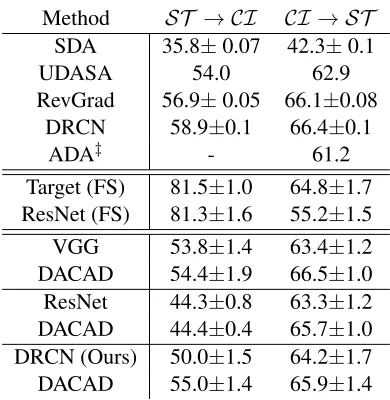
TABLE 4 : Classification accuracy for UDA between MNIST, USPS, and SVHN datasets. 79
TABLE 5 : Classification accuracy for UDA between CIFAR and STL object
recogni-tion datasets. . . 82
TABLE 6 : Performance sensitivity of unsupervised domain adaptation algorithm with
respect to learning parameters. . . 82
TABLE 7 : Comparison results for the SAR test performance using domain adaptation. 106
TABLE 8 : Regression performance on robot end effector prediction in both lifelong
learning and zero-shot settings. . . 142
TABLE 9 : Classification accuracy on Synthetic Domain 1. . . 144
TABLE 10 : Classification accuracy on Synthetic Domain 2. . . 145
TABLE 11 : Jumpstart comparison (improvement in percentage) on the Land Mine,
LIST OF ILLUSTRATIONS
FIGURE 1 : Quillian’s hierarchical model for the broad concept of animals . . . 5
FIGURE 2 : Contributions of the thesis. . . 13
FIGURE 3 : Knowledge transfer through an embedding space. . . 15
FIGURE 4 : Zero-shot learning through an intermediate embedding space. . . 34
FIGURE 5 : A high-level overview of our approach for zero-shot learning using cou-pled dictionaries. . . 39
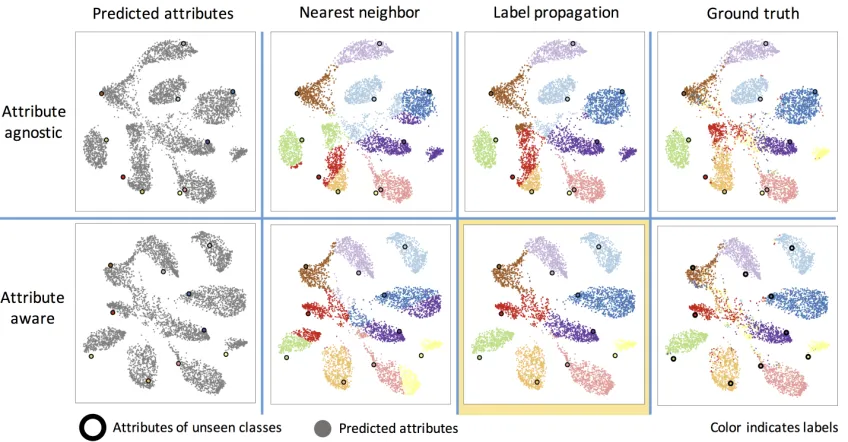
FIGURE 6 : Attributes predicted from the input visual features for the unseen classes of images for AWA1 dataset using our attribute-agnostic and attribute-aware formulations. . . 52
FIGURE 7 : Domain adaptation through an intermediate embedding space . . . 60
FIGURE 8 : The architecture of the unsupervised domain adaptation framework using a coupling shared encoder. . . 67
FIGURE 9 : Visualization of the slicing and empirical calculation of the sliced-Wasserstein distance. . . 69
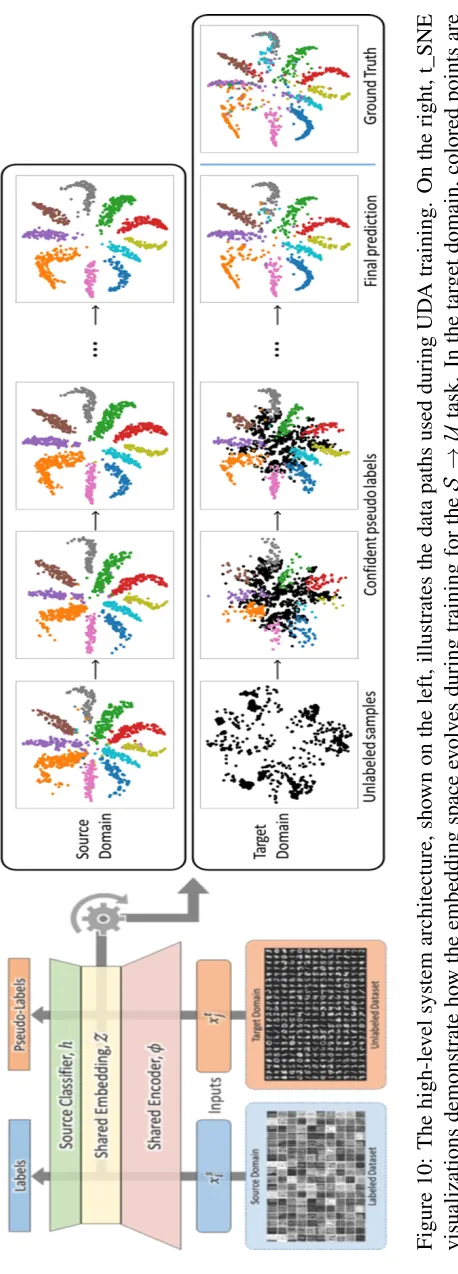
FIGURE 10 : Domain alignment using pseudo-data points. . . 84
FIGURE 11 : Block diagram architecture of the proposed domain adaptation framework for transferring knowledge from the EO to the SAR domain. . . 96
FIGURE 12 : The SAR test performance versus the dimension of the embedding space and the number of filters. . . 105
FIGURE 13 : The SAR test performance versus the number of labeled data per class. 107 FIGURE 14 : Umap visualization of the EO versus the SAR dataset in the shared embedding space. (best viewed in color.) . . . 108
FIGURE 16 : ero-shot learning of sequential tasks using task descriptors through an
embedding space. . . 114
FIGURE 17 : The lifelong machine learning process as based on ELLA framework [1]. 122
FIGURE 18 : The task specific model (or policy) parametersθ(t) are factored into a
shared knowledge repositoryLand a sparse codes(t). . . . 123
FIGURE 19 : The lifelong machine learning process with task descriptions. . . 125
FIGURE 20 : The coupled dictionaries of TaDeLL, illustrated on an RL task. . . 127
FIGURE 21 : Performance of multi-task (solid lines), lifelong (dashed), and single-task
learning (dotted) on benchmark dynamical systems. (Best viewed in color.)137
FIGURE 22 : Zero-shot transfer to new tasks. The figure shows the initial “jumpstart”
improvement on each task domain. (Best viewed in color.) . . . 138
FIGURE 23 : Learning performance of using the zero-shot policies as warm start
initial-izations for PG. The performance of the single-task PG learner is included
for comparison. (Best viewed in color.) . . . 138
FIGURE 24 : Warm start learning on quadrotor control. (Best viewed in color.) . . . . 140
FIGURE 25 : Example model of an 8-DOF robot arm. . . 142
FIGURE 26 : Performance of TaDeLL and ELLA as the dictionary sizekis varied for
lifelong learning and zero-shot learning. . . 142
FIGURE 27 : An ablative experiment studying the performance of TaDeLL as a function
of the dictionary sizek . . . 143
FIGURE 28 : Performance versus sample complexity on Synthetic Domain 2. . . 145
FIGURE 29 : Performance using various subsets of the SM system parameters (mass
M, damping constant D, and spring constant K) and Robot system
parameters (twistT, link lengthL, and offsetO) as the task descriptors. 146
FIGURE 30 : Runtime comparison. . . 147
FIGURE 31 : Zero-shot performance as a function of the number of tasks used to train
FIGURE 32 : Overcoming catastrophic forgetting through a task-invariant distribution
in an embedding space. . . 152
FIGURE 33 : The architecture of the CLEER framework for learning without forgetting. 158
FIGURE 34 : Performance results for learning without forgetting on permuted MNIST
tasks. . . 164
FIGURE 35 : UMAP visualization of CLEER versus FR for permuted MNIST tasks.
(Best viewed in color.) . . . 164
FIGURE 36 : Performance results on MNIST and USPS digit recognition tasks versus
learning iterations . . . 166
FIGURE 37 : UMAP visualization forM → U andU → Mtasks. (Best viewed in
color.) . . . 166
FIGURE 38 : The architecture of the proposed framework for continual concept learning.174
FIGURE 39 : Learning curves for four permuted MNIST tasks and UMAP visualization
of ECLA and FR in the embedding. . . 183
FIGURE 40 : Performance results on MNIST and USPS digit recognition tasks ((a) and
(b)). UMAP visualization forM → U andU → Mtasks ((c) and (d)).
(Best viewed in color.) . . . 184
FIGURE 41 : Performance of distributed (dotted lines), centralized (solid), and
single-task learning (dashed) algorithms on benchmark datasets. . . 204
FIGURE 42 : Performance of CoLLA given various graph structures (a) for three
Chapter 1 : Introduction
The emergence of data-driven industries, high-performance computing technologies, the Internet of
Things (IoT), and crowdsourcing platforms has led to the unprecedented deployment of Machine
Learning (ML) algorithms and techniques in a broad range of applications. These applications
include problems within computer vision, natural language processing, robotics, complex network
science, and decision-making, among many others. Despite the diversity of these applications, the
common goal for practical purposes is to develop algorithms and techniques that can mimic humans
and replace or augment them in tasks at which humans are slow, inefficient, or inaccurate.
Some of the current ML algorithms have reached human-level performance, readily are used in
practice, and their impact on the economy can be observed. In the consumer market, we can see that
commercial personal assistant robots are available to purchase, the first commercial drone delivery
service kicked off recently, autonomous vehicles are being tested at the moment, and even some
ML-based medical diagnosis algorithms are as good as trained specialists. Progress in ML and
Artificial Intelligence (AI) is not limited to handful of examples. In the stock market, we can see
that nine of the ten largest companies by market capital are companies that heavily invest in and
use ML [2]. In the labor market, a study predicts that if the current trend continues for another
decade, 30 percent of work activities in sixty percent of current occupations will be automated by
the year 2030 [3]. It is not easy to judge how accurate this or other similar predictions are, but there
are clear signs that demonstrate even the general public is concerned. For example, one key issue
in presidential campaigns is addressing the potential socioeconomical consequences of the rapid
changes that are going to happen to the labor force as a result of AI and ML advancement [4]. All
the above demonstrates that the importance of AI and ML has gone far beyond just a research area
and many unexplored aspects need to be addressed by people outside the AI academic community.
Unsurprisingly, research interest in ML has gained huge momentum in academic circles recently as
well, partially as the result of commercial successes of ML algorithms. For example, the number
attendance at the major AI and ML conferences has grown to unprecedented numbers. However,
despite their dramatic progress, current ML algorithms still need significant improvement to replace
humans in many applications; machine learning is still a fertile ground for academic research. A
major deficiency of ML is that current state-of-the-art ML algorithms depend on plentiful and
high-quality datasets to train ML models. Generating such datasets has been challenging until quite
recently when crowdsourcing platforms such as Amazon Mechanical Turk (AMT) were developed.
Since then, data labeling has become a business of its own. Although data labeling has been
resolved for common applications, generating high quality labeled datasets is still time-consuming
and potentially infeasible for many more specific applications [6]. Even if a model can be learned
using a high quality labeled training dataset, the data distribution may change over time. Drifts in data
distributions will result in distribution discrepancy for the testing data samples, leading to poor model
generalization and the need to continually retrain the model. Despite considerable advancement of
computing technologies, since ML models such as deep neural networks are becoming consistently
more complex and more challenging to train, continual model training is not feasible given the
current computational power resources. For these reasons, it is important to develop algorithms that
can learn selectively to use computational resources efficiently, reuse previously learned knowledge
for efficient learning, and avoid redundant learning.
Further improvement seems possible because, in contrast to current ML methods, humans are able to
learn much more efficiently. Humans can learn some tasks from only a few examples, generalize
their knowledge to conditions that have not been experienced before, and continuously adapt and
update their skills to perform a wide range of tasks and problems. This seems possible because
humans effectively use knowledge acquired from past experiences and identify similarities across
different learning problems. Humans also benefit from collective and collaborative learning by
sharing their expertise. Building upon the experiences of other humans eliminates the need to learn
everything from scratch. Inspired from these abilities of humans and due to the fact that performance
of single-task ML techniques is reaching theoretical learning upper-bounds, research in ML has
shifted from learning a single task in isolation to investigating how knowledge can be transferred
been used to refer to this broad research area. The goal of transfer learning is to improve learning
quality and speed of the current ML algorithm through overcoming labeled data scarceness, avoiding
redundant learning and model retraining, and using computational power resources efficiently. In
particular, since deep neural networks are becoming dominant models in machine learning, training
complex models with several millions of parameters has become a standard practice which makes
model retraining expensive. Transfer learning can be very useful since labeling millions of data
points is not practical for many real-world problems. For these reasons, it has been predicted that
“transfer learning will be the next driver of ML success” [7].
In a classic supervised learning setup, the goal is to train a model for a specific task or domain
using a labeled training data. In a broad class of ML algorithms, the model is parameterized to form
a hypothesis space. The model selection process is implemented by learning parameters through
solving an optimization problem over the set of the labeled training dataset. The idea behind this
process is that the training dataset represents the data distribution and hence, the optimal model
over this set approximates the Bayes-optimal solution. Under quite well-studied conditions, the
trained model will generalize well on testing data points that are drawn from the data probability
distribution. However, this framework is inapplicable when sufficient labeled data for the learning
problem does not exist, i.e., training dataset does not represent the data distribution well, or when the
data distribution changes after training the model. As a result, often trained models underperform
on new tasks and domains that are not encountered during training. Knowledge transfer techniques
tackle challenges of labeled data scarceness and distributional drifts through exploiting the knowledge
that is gained by learning related tasks or during past experiences.
Various learning scenarios and applications can benefit from knowledge transfer. For example,
in many multi-class classification problems in vision domain, there are classes without sufficient
labeled data points, potentially none. Learning to transfer knowledge from classes with sufficient
labeled data points can help to recognize images that belong to classes with few labeled data points.
In some problems within natural language processing, there exists sufficient labeled data in few
is desirable to transfer knowledge from more common-spoken languages with sufficient annotated
data to learn similar tasks on less common languages. In many robotics applications, e.g., rescue
robots, a robot explores the external world and almost certainly encounters situations and conditions
that are new and has not been explored before. Transferring knowledge from past experience can
help to learn to handle such conditions fast. Even when labeled training data is accessible, knowledge
transfer can help to learn more efficiently either in terms of starting from a better initial point, learning
speed, or asymptotic performance. We can use many ideas to implement and use knowledge transfer.
In this thesis, we focus on transferring knowledge through embedding spaces that relate several ML
problems and capture dependencies and structures across the ML problems. We demonstrate that
this common strategy can be used to address the challenges of various learning scenarios.
1.1. Knowledge Transfer through Embedding Space
In a knowledge transfer scenario, the problem that knowledge is gained from is called thesource
problem, and the problem that knowledge is transferred to is called thetarget problem. The primary
question that needs to be addressed is “how can we transfer knowledge successfully to the target
problem(s) given the source problems?". Many different approaches have been proposed to answer
this question. Since the goal of AI and ML is to mimic and replicate the abilities of humans, an
approach inspired by the nervous system can be helpful and lead to successful algorithms. Works
withinParallel Distributed Processing (PDP)framework suggest that embedding spaces can be used
to model cognitive processes as cognition is a result of representing data using synaptic connections
that are changed based on experiences [8]. An embedding space can be considered as a way of
representing data such that the data representations become meaningful and discriminative for a
particular task. Throughout the thesis, we loosely are inspired from this idea to find relations and
correspondences between ML problems by coupling their data representations in a shared embedding
space.
PDP framework has not been the dominant framework for AI. In the early days of AI, modal logic
was more a source of inspiration for AI researchers. Following modal logic, early AI models were
Figure 1: Quillian’s hierarchical model for the broad concept of animals (inspired and adapted from [8]). Each straight line denotes a proposition from the predicate in its start and the subject in its tail with the relation written on it, e.g. “can” and “has”. The arrows denote “IS A” relations and denote one more level of the hierarchy. In addition to direct propositions, hierarchical propositions can be deduced through the ancestor nodes, e.g. “salmon has gill” and salmon “can move”.
be organized in hierarchical tree structures similar totree of life, as denoted in Figure 1). In this
structure, specific categories are denoted by leaves of more general categories, then propositions that
are true about a group of concepts can be stored at the first common ancestor node that all those
concepts are leaves of it. Upon forming this structure, we can use it to answer whether a proposition
is true about a concept. It only suffices to start from the concept and look into its immediate ancestor
node to see if the proposition is stored in that node. If not, we can search the higher level ancestor
nodes until the proposition is found, or reaching the root node, which means the proposition is not
true.
Despite intuitiveness of Quillian’s framework, experiments on the human nervous system do not
confirm its predictions. For example, this model predicts that it is easier for humans to verify
more specific properties of concepts compared to boarder properties. Because these properties are
stored closer to the concepts, and hence, less search is required. But psychological experiments do
concept form a stronger bond with the concept compared to more general properties, but this does
not seem to be the case either. Findings related to a special type of neurological disorder, called
semantic dementia, provide evidence for an alternative model for cognition. Patients with this disease
progressively lose the ability to associate properties with concepts [8]. However, they lose specific
properties first, e.g., a zebra has stripes, and gradually lose more general properties, e.g., a zebra
has four legs. When the patients lose specific properties of two similar concepts, then he/she cannot
distinguish between the two concepts, e.g., a zebra versus a donkey. As a result, patients would draw
those concepts similarly which demonstrate that those concepts are encoded similarly in the nervous
system. These observations suggest that concepts are grouped according to their properties in the
brain in a hierarchical structure. However, concepts that have the same property are grouped such
that similar synaptic connections encode all those concepts. As we will see in the next chapters,
this process can be modeled mathematically, by assuming that those concepts are mapped in an
embedding space that is shared across those concepts. This means that if we represent the human
semantic space with a vector space in which each dimension denotes a specific property, e.g., having
stripes or being able to swim, then concepts that share many common properties, lie close to each
other in this space. An important advantage of this approach is that it is feasible to train models that
encode data according to abstract similarities in an embedding space.
Following the above discussion, our goal throughout this thesis is to represent the data from different
ML problems in an embedding space such that the resulting representations would capture relations
among several learning domains and tasks. Upon learning this embedding space, we can map data
points from different domains and tasks to the shared embedding space and use the relationships
in the embedding space to transfer knowledge from (a) source domain(s) to the target domain(s).
The common challenge that we need to address in different learning scenarios is how to enforce the
embedding space to capture hyper-relations among the ML problems.
1.2. Thesis Structure and Organization
Knowledge transfer problems and challenges can be manifested in a wide range of research areas and
cross-domain knowledge transfer, cross-task knowledge transfer, and cross-agent knowledge transfer.
1.2.1. Cross-Domain Knowledge Transfer
Knowledge transfer across related domains is our first focus, e.g., visual and textual domains,
which are the two dominant information domains. Cross-domain knowledge transfer is helpful in
performing tasks for which obtaining information in a particular domain might be challenging, but
easier in a related more accessible domain. Humans always benefit from this type of knowledge
transfer. For example, in dark lighting conditions, people usually rely on a combination of haptic
perception and imagination to improve their visual perception of an object. This is an example of
transferring knowledge from the haptic domain to the visual domain. This seems possible for humans
because the brain is able to relate haptic and visual sensory information. Similarly, consider image
retrieval ability of Google search engine for a query. Handling the image search query directly in
the visual domain is a challenging task, but the task becomes a lot easier through asking the user to
provide a textual description about the query or automatically extracting a textual description of the
input image and then transferring knowledge from textural domain, e.g. processing and comparing
the captions that are normally provided or the surrounding texts for images in the database against
the textual description for the query.
More specifically, we first focus on the problem of zero-shot learning for multi-class image
classifi-cation in chapter 3. The goal in this learning scenario is to recognize images from unseen classes,
i.e., without any labeled training data. Humans can easily recognize objects that they have not seen
before but are given their semantic descriptions. From ML perspective, successful implementation of
this strategy is highly beneficial because with the help of open-source web-based encyclopedias such
as Wikipedia, and recent NLP techniques, acquiring semantic descriptions of almost any class is very
cheap compared to acquiring a large number of annotated images. Data labeling is, in particular,
more challenging when classification involves a large number of classes or persistent emergence of
new classes. Our idea is to learn a shared embedding between these two domains that allows mapping
data from one domain to the other. To this end, we assume that for a subset of classes, both visual
that makes cross-domain knowledge transfer between the visual and textual domains feasible. We use
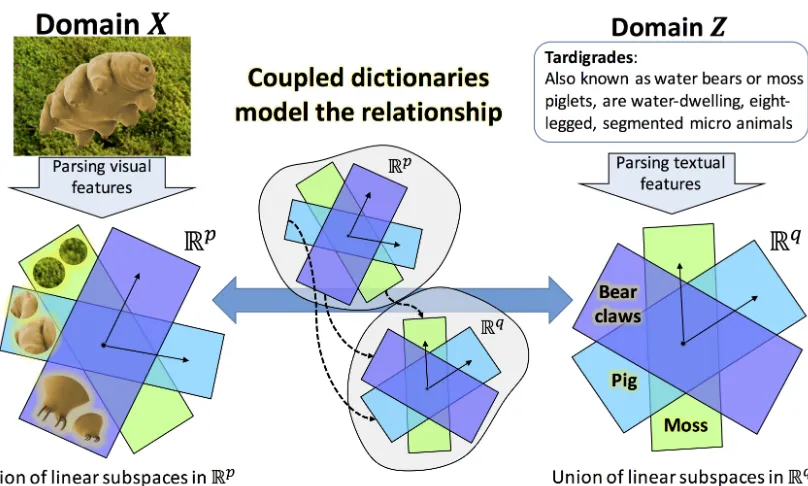
these seen classes to learn an embedding that couples the visual and semantic domain. In particular,
we learn two coupled dictionaries [11] that coupled the visual and the semantic domain knowledge.
Our contribution in chapter 3 is to train these two dictionaries jointly by enforcing the visual and the
semantic features for all seen images to share the same sparse vector in the embedding space. Upon
learning these dictionaries, we can map an unseen class image to the learned embedding using the
visual dictionary and sparse vector recovery methods. Classification then can be performed in the
embedding space by searching for the class with the closest semantic description in the embedding
space. Additionally, our approach is able to address the problems ofdomain shiftandhubnesswith
ZSL.
We then investigate the problem of domain adaptation through learning a domain-invariant embedding
space in chapter 4 and 5. In this learning setting the goal is to solve a task in a target domain, where
labeled data is scarce, by transferring knowledge from a source domain, where sufficient labeled data
is accessible to solve the task. We consider the multiclass classification task in two visual domains.
Humans always are very good at this task. For example, upon learning numeral characters, most
humans are able to classify numeral characters in a new domain, e.g., calligraphy font, very fast by
observing few and potentially no samples. This means that when a class concept is formed in the
human brain, this concept can be generalized and identified in new domains quite fast. This ability
suggests that the concepts are encoded in higher levels of the nervous system that can be modeled as
an embedding space. Inspired by this intuition, we propose to transfer knowledge by minimizing the
discrepancy between the probability distributions of the two source and target visual domains in an
intermediate embedding space. To this end, we consider deep encoders that map data points from two
domains to a joint embedding space in its output such that the discrepancy between the probability
distributions is minimized. A shared deep classifier network is trained to map the data points to
the labels. Learning a shared and domain-agnostic embedding space provides an effective solution
to use the deep classification network that is trained on the source domain on the target domain.
Due to minimal distribution discrepancy, the network will generalize well on the target domain with
the classifier network via solely labeled data from the source domain.
More specifically, our contribution is that we use a shared end-to-end model across the two domains
in chapter 4 and align the distributions of both domains class-conditionally in the embedding space.
We select two problems with small domain-gap which allows to use a shared end-to-end model. In
chapter 4, we use two domain-specific encoders that share their output and a shared classifier from
this shared output to the label space. This stricture allows for more domain gap. We consider a
few-shot domain adaptation setting and use the target domain labeled data to match the distributions
class-conditionally. In both of these chapters, we use the Sliced Wasserstein Distance metric to
minimize distribution discrepancy.
1.2.2. Cross-Task Knowledge Transfer
Our second area of focus is knowledge transfer across related tasks. We use the termtaskto refer to
a common problem in classic ML, e.g., regression, classification, or reinforcement learning tasks.
Humans extensively use cross-task knowledge transfer by identifying the prior learned skills that can
be used to solve a new task. This means that challenging tasks are broken into subtasks that are more
basic and can be used across different tasks. This suggests the existence of hierarchies in acquiring
skills that relate the tasks through embedding spaces that encode similarities.
We first investigate the problem of zero-shot learning within a multi-task learning setting in chapter 6.
Chapter 6 can be considered as an extension of chapter 3 to a continual learning setting. Here, the
goal is to transfer knowledge from past experiences to learn future tasks using no data. We consider
both sequential online lifelong learning setting and offline setting. In the offline setting, a group of
tasks is learned simultaneously before switching to tasks with no data. We assume that the tasks are
described using high-level descriptions. The core idea is to learn a mapping from the high-level task
descriptors to the optimal task parameters through an intermediate embedding space which couples
the optimal task parameters and the task descriptors. To learn this embedding, initially, some tasks
with both data and descriptors are used. Similar to chapter 3, we train two dictionaries jointly such the
space. We demonstrate that using task descriptors not only improves the learning performance but
upon learning this embedding, one can learn a task with no data, through recovering the optimal
parameter using high-level task descriptors. It suffices to recover the shared sparse vector using the
task descriptor dictionary and then recover the task optimal parameters through multiplication with
the optimal parameter distribution.
In chapter 7, we focus on addressing the problem ofcatastrophic forgettingin a sequential multi-task
learning setting. When humans learn a new task, more often they do not forget what they have
learned before. This is not the case with most ML algorithms that use non-linear models as usually
new learned knowledge interferes with what has been before, causing performance degradation
on previously learned task. To overcome this challenge, we explore the idea of mapping the tasks
to an intermediate embedding space such that the distributions of the tasks are matched, i.e., the
embedding space becomes invariant with respect to the input task. As a result, when a new task is
learned, the newly acquired knowledge is added to the past learned knowledge consistently, which in
turn prevents catastrophic forgetting. To implement this idea, we train a shared end-to-end model
across the tasks. We also amend this model with a decoder to make it generative. We learn a shared
multi-mode distribution in the embedding space to generate pseudo-data points that can represent
the past learned tasks. These data points are replayed along with the current task data to mitigate
catastrophic forgetting.
We then focus on the problem continual concept learning in chapter 8, where the goal is to extend
and generalize a concept to new domains using only a few labeled data points. This chapter can
be considered as an extension of chapter 5 to a sequential online learning setting. We use the
idea of chapter 7 to extend the learned distribution for a task to incorporate new instances of a
number of concepts in a new domain. Our architecture is similar to chapter 7, but we can learn the
shared distribution using few labeled data points in future tasks. Since the learned distribution in
the embedding is enforced to remain stable, the concepts can be generalized to new domains by
1.2.3. Cross-Agent Knowledge Transfer
Finally, we focus on the problem of distributed lifelong learning in chapter 9. Here, we assume
that multiple agents try to learn related tasks, and the goal is to improve learning quality and speed
through collaboration, i.e., cross-agent knowledge transfer. This area is less explored compared to
the previous two areas in the literature. But since IoT is becoming a common characteristic of daily
life, addressing ML problems in a distributed setting is becoming more important. We consider a
network of agents that learn sequential tasks in an online setting. Each agent is assumed to be a
lifelong learner which sequentially receives tasks and learns the current task through transferring
knowledge from past learned tasks and collaboration with neighboring agents. We extend the idea of
lifelong learning from a single agent to the network of multiple agents that potentially collectively
learn a series of tasks. Each agent faces some (potentially unique) set of tasks; the key idea is that
knowledge learned from these tasks may benefit other agents that are learning different (but related)
tasks. To enable knowledge transfer, we assume that a shared embedding can be learned for task
parameters. This embedding space captures structures of the tasks and allows knowledge transfer
among the agents. Our algorithm provides an efficient way for a network of agents to share their
learned knowledge in a distributed and decentralized manner while preserving the privacy of the
locally observed data as the data is not shared. We solve the learning problem in a decentralized
scheme, as a subclass of distributed algorithms, where a central server does not exist, and in addition
to data, computations are also distributed among the agents.
1.2.4. Thesis Organization
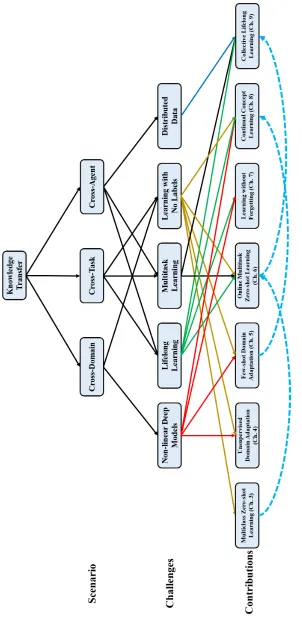
Figure 2 summarizes the problem and the challenges we address for each chapter of the thesis as
well as relations between the chapters in a nutshell. In this tree structure, we have listed the five
main challenges that need to be addressed in each part and chapter of the thesis. We have listed five
common ML topics to incorporate all challenges that need to be addressed in each chapter. These
topics are common in the machine learning literature, but our goal is to address them through learning
an intermediate embedding space. We have developed an ML algorithm in each of the chapters 3 to
challenges that need to be addressed for each chapter and part. The dotted blue arrows denote that in
some chapters, reading the previous chapters can be helpful to understand those chapters. Readers
who might be interested in reading a particular aspect of the thesis can use Figure 2 to identify the
Figure
2:
Contrib
utions
of
the
thesis
and
the
challenges
that
are
addressed
for
each
contrib
Chapter 2 : Background and Related Work
In this chapter, we explain and survey the machine learning problems that we investigate in this
thesis and survey recent related works that address challenges of knowledge transfer by learning an
embedding space to provide a background on prior similar works and introduce the specific problem
that we investigate throughout the thesis. We review the proposed algorithms in the literature that use
this strategy to address few- and zero-shot learning, domain adaptation, online and offline multi-task
learning, lifelong and continual learning, and collective and distributed learning. We mainly focus
on the works that are the most related works to the theme of the thesis and many important less
relevant works are not included in this chapter. For broad surveys on transfer learning/knowledge
transfer, interested readers may refer to the papers such as the paper by Pan et al. [12] or Taylor and
Stone [13].
From a numerical analysis point of view, most machine learning problems are function approximation
problems. Throughout the thesis, we assume that the goal for solving a single ML problem is to find
a predictive function given a dataset drawn from an unknown probability distribution. A single ML
problem can be a regression, classification, or reinforcement learning problem, where the goal is
to solve for an optimal parameter for the predictive function [14]. This function predicts the label
for an input data point for classification tasks, the suitable value for independent input variable for
regression tasks, and the corresponding action for an input state for reinforcement learning tasks. The
prediction of the function must be optimal in some sense; usually Bayes-optimal criterion is used,
and the broad challenge is to approximate such a function. Each problem is Probably Approximately
Correct (PAC)-learnable. This assumption means that given enough data and time, solving for an
optimal model for each problem is feasible. Due to the various types of constraints that we covered
in the previous chapter, our goal is to transfer knowledge across similar and related problems that are
defined over different domains, tasks, or agents to improve learning quality and speed, as compared
to learning the problems in isolation. The strategy that we explore for this purpose is transferring
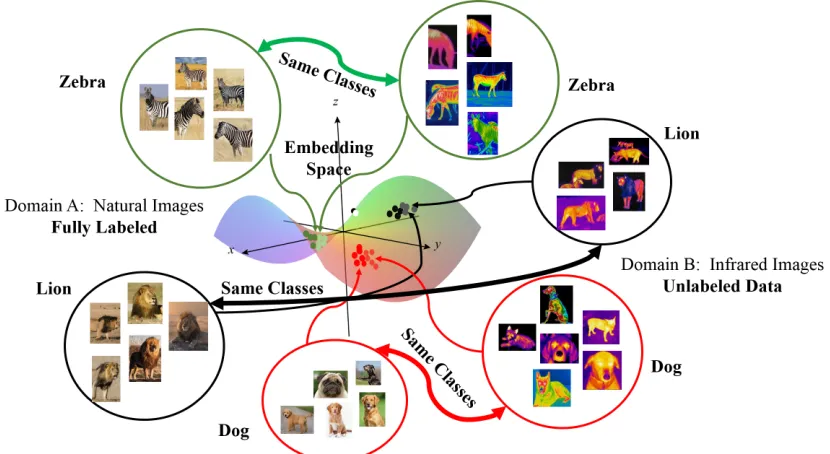
Figure 3: Knowledge transfer through an embedding space: in this figure, the solid arrows denote functions that map the abstract notions, e.g., images, into the embedding space, the dots in the embedding space denote the data representations in the embedding space, and the dotted arrows indicate correspondences among across two problems, e.g., two classes that are shared between two classification problems. Throughout this thesis, we focus on learning these arrows in terms of parametric functions. The global challenge that we address in this thesis is how to relate two problems through the embedding space.
The idea of learning a latent embedding space has been extensively used for single-task learning,
where the goal is to learn a mapping such that similar task data points lie nearby on a space which
can be models as lower-dimensional embedding space. The goal is to measure an abstract type of
similarity, e.g., objects that belong to a concept class, in terms of well-defined mathematical distances.
Figure 3 visualizes this idea using visual classification tasks. The notion of “zebra” and “lion” are
abstract concepts that form human mental representations which remain consistent for a large number
of input visual stimuli (for the moment, consider only problem 1 in Figure 3). Humans are able
to identify these concepts on a wide range of variations which supersede many current computer
vision algorithms. The idea that Figure 3 presents for solving a single classification problem is to
abstract similarities can be encoded according to geometric distance, as evident from Figure 3. We
have represented this procedure in Figure 3, by showing that images that belong to the same class in
problem 1 form a cluster of data points in the embedding space. Simultaneously, the class clusters
have more distance from each other, which means that geometric distance in the embedding space
correlates with similarities in the input space. We can see that instances of each concept form a
cluster in the embedding space. The hard challenge would be to learn the mapping, i.e., feature
extraction method, from the input data space to the embedding space. This process converts abstract
similarities to measurable geometric distances which makes data processing and model training a lot
more feasible as it is usually tractable to solve optimization problems using geometrical distance as a
similarity measure in the embedding space. As it can be seen in Figure 3, the abstract classes are
separable in the embedding space for problem 1. This has been inspired from the way that the brain
encodes and represents input stimuli in large populations of neurons [15]. Note that this idea can be
applied to a broader range of ML problems. We just used visual classification as an example which
gives a more intuitive explanation for this idea.
Knowledge transfer across several problems is a further step to learn a problem-level similarity
among multiple probability distributions and captures relations between several ML problems. In this
thesis, our goal is to extend the idea of learning a discriminative embedding space for a single ML
problem to transfer knowledge across several ML problems. We use a shared embedding space across
several machine learning problems to identify cross-problem similarities in order to make learning
more efficient in some problems. We have presented this idea in Figure 3. In this figure we see three
classes of “zebra”, “lion”, and “dog” in two ML problems. For each concept-class, we have two types
of input spaces: electro-optical (EO) and infrared (IR) images. In each input space, we can define
independent classification problems. However, these problems are related as they share the same
abstract concept-classes. As demonstrated in Figure 3, if we can learn problem-independent relations
between the classes in the embedding space, then we may be able to transfer knowledge from one
domain to the other domain. For example, if the geometric arrangement and relative location of
classes with respect to each other are similar (as in Figure 3), then it is easy to use knowledge about
of the strategy that we explore in this thesis to improve learning performance and speed in a target
domain(s) by transferring knowledge from the source domain(s). There are various approaches
to relate two ML problems. we As we will see, many learning scenarios may benefit from this
knowledge transfer strategy. In what follows, we explain about learning settings that can benefit from
this idea and survey the related papers in each scenario to give the reader an insight into the prior
works.
2.1. Knowledge Transfer through Shared Representation Spaces
LetZ(u)denote an ML problem with an unknown probability distributionp(u)(x,y)which is defined
over the input and output spacesX(u)andY(u). The goal of learning is to find a predictive function
f(u) :X(u) → Y(u)such that the true risk is minimizedR=
E(x,y)∼p(u)(`(f(u)(x),y)), where` is a point-wise loss function. For a single PAC-learnable problem, usually we are given a training
datasetD(u) =hX(u),Y(u)i, the functionf(u)(·)is parameterized to form a hypothesis class, and
the optimal parameterθ(u)is computed using Empirical Risk Minimization (ERM) to approximate
the Bayes-optimal predictive function. Almost all parametric ML algorithms can be fit into this
framework. Moreover, for many common base hypothesis classes there are learning bound that relate
the accuracy of ERM-optimal model to the accuracy of the Bayes-optimal model in terms of the size
of the the training dataset.
As we explained, we can benefit from knowledge transfer when the goal is to learn multiple learning
problems, i.e.,u ∈ Ufor countable setU. To implement the idea of “using a shared embedding
space for transferring knowledge”, we assume that the functions f(u)(·) can be decomposed as
f(u)(·) =h(u)(ψ(u)(·)), whereψ(u)(·) :X(u)→ Zmap data points of the corresponding problem
into the shared embedding spaceZ, where similarities and structures between the distributions of
knowledge transfer:
min
f(1),...,f(u)
U
X
u=1
λ(u)L(u)(f(u)(X(u)))
| {z }
Problem-Specific Regularization and Loss Terms +
U
X
u,v=1
γ(u,v)Mu,v(ψ(u)(X(u)), ψ(v)(X(v)))
| {z }
Problem Alignment Terms
,
(2.1)
whereλ(u)andγ(u,v)are trade-off parameters,Lis a loss function overD(u), andMis a functional
to measure some notion of pairwise-distance between two problems.
The terms in the first sum in Eq. 2.1 can be thought of regularization terms which are either computed
using some prior knowledge about the problem distribution or most often are empirical risk terms (if
Y(u)is available). These terms are problem-specific and are computed for each problem, irrespective
of other problems. The second sum consists of pairwise problem alignment terms that couple the
problems and are computed after mapping data into the shared embedding. The goal is to use
problem/class-wise relations and shared representations to enforce knowledge integration in the
embedding to transfer knowledge across the problems.
Given a specific learning setting and prior knowledge, a suitable strategy should be developed to
define the loss and alignment functions. Throughout this thesis, we investigate several important
knowledge transfer scenarios (analogous to categorizations that we provided in the previous chapter):
•If the input spaces are different, we face across-domain knowledge transfer scenario. In this
scenario, usually,U = 2(sometimes more for multi-view learning) and the problems are
mostly classification tasks. There may be data scarcity in all domains or, in one domain we
may have sufficient labeled data and labeled data maybe scarce in the other domain(s). Domain
adaptation, multi-view learning, and zero/few-shot learning are common settings where
cross-domain knowledge transfer is helpful. This area is becoming important as nowadays sensors
are becoming cheaper and usually various data modalities are recorded and processed to
perform a learning task.
problem can be either a classification, regression, or reinforcement learning task. Transfer
learning, multi-task learning, and lifelong learning are common settings for cross-domain
knowledge transfer. Cross-task knowledge transfer is in particular important when learning is
performed at extended time periods, where usually distributions change. Hence, even the same
task is not going to be the same in the future.
•Finally, the datasetsD(u)might not be centrally accessible and be distributed among a number
of agents. This would be across-agent knowledge transfer scenario, where the goal is to
learn the problems without sharing full data by sharing individual knowledge of the agents.
Distributed learning, collective learning, and collaborative learning are common settings for
this scenario. Development of wearable devices and Internet of Things (IoT) have made this
area an important learning scenario.
The above terminologies and categorizations are not universal, nor they are exclusive, but they help
to categorize the knowledge transfer literature, which covers a broad range of ML literature. For this
reason, we use this categorization to arrange the topics of the thesis.
2.2. Cross-Domain Knowledge Transfer
For cross-domain knowledge transfer, the challenge is to explore correspondences across domains
X(u)via prior information. In this thesis, we investigate two important sub-problems within
cross-domain knowledge transfer: zero-shot learning and cross-domain adaptation.
2.2.1. Zero-Shot Learning
In the zero-shot learning (ZSL) setting, the problem of multi-class classification is investigated,
where while for some classes sufficient labeled data is accessible (seen classes), for some classes,
no labeled data is accessible (unseen classes). ZSL is a common situation in modern applications
where new classes constantly emerge over time, and hence, continual data labeling is not feasible.
Additionally, even if data labeling is feasible, re-training a model from scratch to incorporate the new
transfer from the semantic textual domain. This is a helpful strategy as textual descriptions about
a category is easy to obtain nowadays, e.g., using the internet. A major line of ZSL methods
learn a shared embedding space to couple the visual and the semantic domains using the seen
classes as information about both domains is accessible for seen classes. LetX(v)denote the visual
domain andX(t)denote the textual domain. In a standard ZSL setting, we are given the training
datasetD(v)=hX(v),Y(v)i ∈
Rd×n×Rk×nwhich denotes visual features, e.g. deep net features,
and the labels of nimages for k seen classes. Additionally, we have a second training dataset
D(t) = hX(t),Y(v)i ∈
Rd
0×n
×Rk×n of textual feature descriptions for the same images in the
semantic domain, e.g. word vectors or binary semantic attributes. Note that textual descriptions
are mostly class-level and hence values inX(t) can be repetitive. For unseen classes, we have
access only to textual descriptions of the class in the semantic space. Since we have point-wise level
cross-domain correspondence for the data points of seen classes throughY(1), we can solve the
following instance of Eq. 2.1 to couple the two domains:
min
θ(v),θ(t)
X
i
`(ψ(θt()t)(x
(t)
i ), ψ
(v)
θ(v)(x
(v)
i )) , (2.2)
whereθ(v)andθ(t)are learnable parameters, and`is a point-wise distance functions, e.g. Euclidean
distance.
For simplicity, it is assumed that only unseen classes are present during testing in the standard ZSL
setting. Upon learningψ(v)andψ(t), zero-shot classification is feasible by mapping images from
unseen classes as well as semantic descriptions of all unseen classes to the embedding space using
ψ(v) andψ(t), respectively. Classification then can be performed by assigning the image to the
closest class description, using`. Variations of ZSL methods result from different selections for
ψ(v),ψ(2), and`. An important class of ZSL methods considers the semantic space itself to be the
embedding space and project the visual features to the semantic space. The pioneering work by
Lampert et al. [16] use a group of binary linear SVM classifiers, identity mapping, and Euclidean
distance (nearest neighbor), respectively. Socher et al. [17] use a shallow two-layer neural network,
identity mapping, and inner product similarity. Another group of ZSL methods, consider a shared
intermediate space as the embedding space. Zhang et al. [19] use the class-dependent ReLU and
intersection functions, sparse reconstruction based projection, and inner product similarity. Kodirov
et al. [20] train an autoencoder over the visual domain. In Eq. (2.1), this means ψt = (ψv)−1
andψt◦ψv(x(v)
i ) is enforced to match the semantic attribute. They use Euclidean distance for
classification.
ZSL algorithms that solely solve Eq. (2.2) face two major issues: domain shift and hubness problem.
Domain shift occurs when the visual feature mappingψ(v)is not discriminative for unseen classes.
As a result, the embedding space is not semantically meaningful for unseen classes. The reason is that
this mapping is learned only via seen classes during training, while the distribution of unseen classes
may be very different. To tackle this challenge, the mappingψ(v)that is learned using seen classes
attributes, needs to be adapted towards attributes of unseen classes. Kodirov et al. [21] use identity
function, linear projection, and Euclidean distance for ZSL. To tackle the domain shift problem, we
can learn the linear projection such that the visual features become sparse in the embedding. The
learned linear projection is then updated during testing by solving a standard dictionary learning
problem for unseen classes.
The hubness problem is a version of the curse of dimensionality for ZSL. It occurs because often the
shared embedding space needs to be high-dimensional to couple the semantic and the visual domains.
As a result, a small number of points, i.e., hubs, can be the nearest neighbor of many points. This
counterintuitive effect would make the search of the true label in the embedding space impossible
because the nearest neighbor search mostly recovers the hubs regardless of the test image class [22].
The hubness problem has been mitigated by considering the visual space as the embedding space [23].
More recent, ZSL methods focus on the more realistic setting of generalized zero-shot learning,
where seen classes are present during testing [24]. In this thesis, we consider ZSL in both chapter 3
and chapter 6. Chapter 3 considers a classic ZSL setting as we described above but chapter 6 focuses
on a cross-task ZSL scenario where the goal is to learn a task without data using what has been
![Figure 1: Quillian’s hierarchical model for the broad concept of animals (inspired and adaptedfrom [8])](https://thumb-us.123doks.com/thumbv2/123dok_us/9222339.1457739/26.612.166.475.73.285/figure-quillian-hierarchical-model-concept-animals-inspired-adaptedfrom.webp)