3150
Generational Differences İn Digital Age A
Research On Technology Experiences Of
Generations
Aysen TEMEL EGINLI, Selda ISIK
Abstract: Communities reformed after internet-the most important invention of the Digital Age, has taken part in our lives. The communities born in a similar time interval, are affected by similar economic and social formations and behave in a similar manner that constitutes the generations. The digital world has given birth to the concepts of ―digital native‖ and ―digital immigrant‖ among the generations. The last digital natives are the individuals of today's last generation Gen Z and continue to live as technology addicts. In this study, firstly, digital age concept is explained, digital native and digital immigrant concepts are defined and afterwards, generations are classified, intergenerational differences and generation Z are examined. This study focuses on examining the high school students as the last digital natives and their teachers as digital immigrants and their technological experiences as well as technological features. Therefore, a survey; ―Experience with Technology Questionnaire‖ was administered. The participants were a group of 10th grade high school students and their teachers. The survey aims to determine the technology usage features of those two groups.
Index Terms: Information society, digital age, digital native, digital immigrant, generations, generational differences, technology experience.
—————————— ——————————
1.
INTRODUCTION
AS a result of the changes and developments in Information Communication Technology since the last quarter of the 20th century, a new socio-economic period has started for communities. The most important feature of the digital age is ―information‖ [1], [2]. The digital age is defined as a period emerging as the most important value in terms of the ability to use information by reaching the best of it, and the new reality [3]. The digital age has led to the creation of new communication environments where information is quickly created and shared. Due to the characteristics of the digital age, the differences between generations have become apparent, even the differences began to be considered as inequalities due to the characteristics possessed [4]. There are significant differences in terms of using and experiencing the technology, between digital natives, who have been born and grown in the digital environment, and the digital immigrants, who have been accommodated to the digital age later [5].
2
LITERATURE
REVIEW
Differences between generations are clearly stated as definitions for digital natives and digital immigrants are considered. Intergenerational differences have been issued in some areas of science, during whole history, dating back to Ancient Greece, and in others to the ancient Egyptian civilization [6]. The concept of generation is based on grouping those who born in the same time period on the basis of some characteristics. There are some differences in each particular generation, as well as having more or less similar characteristics are attained considering the year of birth and naming. Generational classifications are explained as: Builders, Baby-Boomers, Gen X, Gen Y, Gen Z [7]; Traditionalist, Baby Boomers, Xers, Millennials [8], [9];
Mature Gen, Baby Boomer, Xers, Millenials, Post Millenials [4]; Silent Generation, Baby Boomers, Generation X, Generation Y, Generation Z [10]. According to Twenge et al. [10] each generation has its own unique values, perceptions, attitudes, and behaviors, nevertheless, each generation has its own strong and weak characteristics, each generation differs from the other generation with certain characteristics, constitutes a formation for the generation, while leading by its values. The Silent Generation (born between 1925 and 1945) [11] can be described as preferring to communicate face-to-face but eager to learn technology [12] as of the characteristics of generations in terms of using technology. Generation Baby Boomers (born between 1946-1964) and Gen X (born between 1965 and 1981) are trying to adapt to technological developments and related changes [13], [14], [15]. Gen Y (born between 1982-1999) is the generation that prefers to communicate via video calls, internet, e-mail, text message, and cannot give up social media in everyday life [16],[17], [18], [19]. Gen Z (born 2000 and later) represents the digital generation, which is born to technology, open to new ideas and adapts easily. Gen Z faces the fear of skipping/missing due to excessive use of technology; in other words, FOMO (Fear of Missing)‖ they live [19], [20]. According to Prensky generation Z who born after 2000 and the oldest is 19 years old is the member of the oldest of the average 39-year-old digital natives who are students, employees, or even parents in today's society. It is stated that there are differences between generations in terms of perception and behavior between generations for technology definition with regards to the usage characteristics. In this sense, Prensky [5] as of the fact that the digital native language being used, defined the Digital Natives those who transform internet, virtual games, smartphones into a digital language and use, born 1980 and later, those who born before the 1980 and feels out of the digital world, are defined as the Digital Immigrants. In other words, according to Prensky [5], while the generation that grows up with technology was ―digital natives‖, the generation that later met and tried to adapt to technology is ―digital immigrants‖. The basis of intergenerational classifications, members of Generation X born between 1980-1982, Generation Y 1982-1999, and Generation Z born 2000 and later [10] constitute the digital natives. The ―internet ————————————————
Assoc. Prof .Dr. Aysen TEMEL EGINLI, Ege University, Faculty of Communication, Turkey, E-mail: [email protected] MA. Selda ISIK, Ege University, Institute of Social Sciences,
generation‖ places digital tools and environments to the middle of their lives, thinks that technology is more a requirement of everyday life than a need, as well as being a computer, tablet or smartphone user, communicates through the digital language of the particular internet, social media, and virtual games [21].The concept of ―digital native‖ of Prensky is also called in other names such as ―the millennials, the net generation, the gamer generation, the next generation, the N-generation, cyber kids, the Homo zappiens, grasshopper mind‖ [2],[4]. As a generation that grew up with new communication technologies, digital natives are eager to use Web 2.0 technology [1], actively using internet broadcasts (podcasting), engaged in sharing over the internet, blog and social media digital tools to express themselves via technology, believes it is one of the necessities of daily life as considering the technology in the middle of their lives [21]. At the same time, digital natives use technology in their learning and socialization processes [22]. Therefore, digital natives also like to share their experiences with friends and to get ideas from their experiences, and they do so online [23]. The generation that was not born in the digital world, but was later influenced by technology and adopted technology, took ―digital‖ into their lives, is called as the ―Digital Immigrant‖[5], [1] refers to digital immigrants as ‖Finding their own way in the digital world" for those who are later acquainted with the internet and the web, with lower levels of technology literacy compared to digital natives [5]. Nevertheless, it appears that digital immigrants have difficulty using technological devices or programs, and need a guide on technology-related issues [24]. The main difference between digital natives and digital immigrants is due to the perception of using the digital world i.e. technology [23],[21]. The digital world, a big part of the lives of digital natives, is a form of benefit for digital immigrants [5], [24]. Schmidt and Cohen [25] state the pace of progress in technological innovation continues in the same way, most of the world's population, estimated to be eight billion, will go online without any interruption, via devices that fit in a palm in 2025. Therefore, Prensky [26] predicts that the difference between digital natives and immigrants would gradually decrease in the 21st century and that the concept of ―Digital Wisdom‖ would emerge accordingly.
3 RESEARCH
METHODOLOGY
3.1 Purpose and Method of Research
The purpose of this research is to describe the experiences/characteristics of digital natives (Generation Z) and digital immigrants (Silent Generation, Baby Boom generation, and Gen X) while using technology in the digital age. Therefore, high school students born after 1980 who are members of Generation Z are included as digital natives, and high school teachers born before 1980 as Silent Generation, Generation BB and Generation X are included as digital immigrants, as of the purposeful sampling method on the basis of Prensky's classification [5], [27]. However, teachers who were born between 1982-1999 as the members of Generation Y were also included in the sample of the research as digital natives. In this context, the sample of the research consists of 306 high school students, and 101 teachers working in two different high schools. The quantitative research method ‖Experience with Technology Questionnaire" developed by Kennedy et al. in 2007 was used. The technology experience survey consists of a Likert-scale in five
dimensions: "access to technology, use of technology, use of technology for course-related review and evaluation, use of technology to assist school work, use of technology to be useful to school work". The limitation of the research is that technology use/experience is limited only to questions in question form.
3.2 Data Analysis
The data obtained from the research were analyzed using SPSS for Windows 25.0. Descriptive statistical methods (number, percentage) were used when evaluating the data. The Likert scale used in the survey were considered suitable for the normal distribution. The demographic characteristics of the students involved in the study include 37.3% male and 67.7% female students. Besides, the distribution of the students by date of birth is found as 5.2% of the students were born in 2003, 93.1% were born in 2004 and 1.6% were born in 2005. It appears that all of the students were born in 2000 and later, and are digital natives. The gender distribution of teachers stated as 34.7% male and 65.3% female. As of the distribution of teachers according to their date of birth that 22.8% were born in 1965 and before, 20.8% were between 1966-1970, 26.7% were in between 1971-1976, 14.9% were in between1977-1979 and 14.9% were in 1980 and later. 85.2% of participant teachers, who were born in 1980 and before, is a digital immigrant.
TABLE 1
COMPARISON OF TECHNOLOGY USE SCORE MEANS OF DEMOGRAPHIC CHARACTERISTICS OF STUDENTS
*p<0.05
3152 course during the survey was higher than the students who
were in the history course. According to the results of the test, there is a statistically significant difference between the mean scores of the use of technology control forms as of the year of birth of the students (p<0.05). The average score for the use of technology control form of the students who were born in 2004, is higher than those who were born in 2003. In other words, students born in 2004 are using technology in a wider place. The findings indicate that the X School students who participated in the study used more technology diversity than the Y school students, that the use of technology places of the students in history class was less than the students in English class, and that the technology usage areas of the students whose birth year was 2004, were more than those of the students whose birth year was 2003, as well as pointing the fact that the students' digital native characteristics have changed in terms of the place of technology use.
TABLE 2
COMPARISON OF TECHNOLOGY USE SCORE MEANS OF DEMOGRAPHIC CHARACTERISTICS OF TEACHERS
*p<0.05
Independent t-test was applied to compare mean scores of technology use of 2 groups according to the demographic characteristics of the students involved in the study, whereas a one-way variance analysis method was applied to compare more than two groups. According to the results of the test, there was no statistically significant difference between the mean scores of the use of technology (p>0.05) according to the demographic characteristics of the teachers. It is seen that although the demographic changes, the characteristics of the participating teachers' use of technology does not change, as well as the fields in which the technology used, are not different from that 85% of the teachers who were accepted as the digital immigrant and born before 1980 and that 15% of those who born after 1980, accepted as a digital native.
TABLE 3
COMPARISON OF TECHNOLOGY USE MEANS
*p<0.05
The mean scores of students and teachers in terms of technology use were compared via the independent t-test, as a result, there was no statistically significant difference between technology use averages (p>0.05). As a result, the different fields where technology can be used among students and teachers (taking photos, uploading, sharing, sending mail, receiving web services via mobile phone, etc.) did not point a difference. In terms of the use of technology, it can be stated that the areas where technology is used are similar among digital natives and digital immigrants.
TABLE 4
COMPARISON OF COURSE REVIEW AND EVALUATION MEANS
*p<0.05
A statistically significant difference is found when students and teachers using technology for the purpose of review and evaluation in terms of the course are considered (p<0.05). As a result, the mean score of teachers using technology in terms of review and evaluation for courses was higher than that of the students. In order to be better in their respective branches, teachers placed more emphasis on criteria related to ―skills, technical knowledge and expertise/ natural ability/ appreciation, common sense and your thoughts and feelings about the field‖ than students. It can be interpreted as digital immigrants trying to get used to the use of technology.
TABLE 5
MEAN SCORES FOR STUDENTS’ USE OF TECHNOLOGY TO ASSIST SCHOOL WORK
Variables n SS F/t Değeri P
School X 119 1.88 0.77 t=1.020 0.308
Y 187 2.00 0.90
Course
Byology 33 1.93 0.86
F=0.964 0.440 English 43 1.86 0.67
Maths 28 1.87 0.87 Counseling 147 1.93 0.93 History 39 2.22 0.75 Others 16 2.04 0.73
Birh Date
2003 16 1.51 0.76
F=2.333 0.099 2004 285 1.98 0.86
2005 5 2.04 0.62 *P<0.05
T-test and one-way variance analysis were applied to compare the mean scores for the use of technologies that assist students at school works in terms of demographic characteristics of students participated in the study. As a result of the test, there was no statistically significant difference between the use of technologies to assist school work according to the demographic characteristics of the students (p>0.05). Therefore, it is found that there are no differences
Variables n SS T P
Student 306 2.82 0.66
-5.880 0.000*
among digital natives regarding the willingness to use technology in the school environment.
TABLE 6
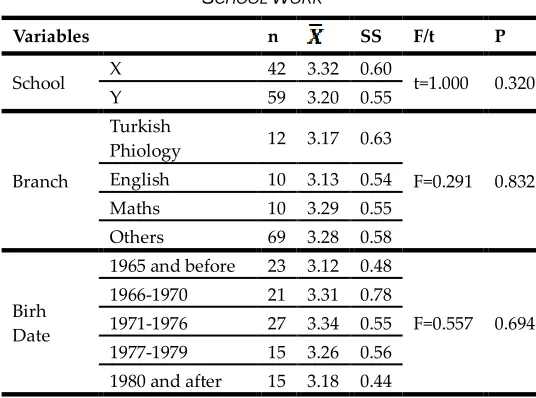
MEAN SCORES FOR TEACHERS'USE OF TECHNOLOGY TO ASSIST SCHOOL WORK
According to the test results, there was a statistically significant difference in the mean scores of teachers using technologies to assist school work according to their branches compared to the average of teachers using technologies to help school work on the basis of their demographic characteristics. The Bonferroni binary comparison method from Post Hoc tests was used to find the group that made the difference. Consequently, it is seen that teachers at the Turkish Language and Literature branch had a higher mean score for using technologies to assist school work than teachers at the English branch and others. In other words, it has been found that the Turkish language and literature teachers prefer to use technologies to assist their work than other branch teachers. Teachers behave digital native characteristics as they prefer to use technologies to assist their schoolwork. Nevertheless, it is seen that digital immigrants also differ among themselves since Turkish Language and Literature teachers use more technology than other branch teachers.
TABLE 7
COMPARISON OF MEAN USE OF TECHNOLOGIES TO ASSIST SCHOOL WORK
Variables n SS t P
Student 306 1.96 0.86
3.856 0.000* Teacher 101 1.59 0.70
*p<0.05
According to the test results that arose from the comparison of mean scores for participants' use of technologies that assist schoolwork, there was a statistically significant difference between the participants' use of technologies that assist schoolwork (p<0.05). The mean score of the scale of using technologies to help students' schoolwork was higher than the teachers'. As a result, it has been found that students want to use technology more in school work than teachers, as in this sense they behave digital native characteristics.
4
CONCLUSION
The main result of this study, which was carried out to describe the technology use/experience of digital natives and digital immigrants in the digital age, was that high school students identified as digital natives and high school teachers identified as digital immigrants showed similarities at some points in terms of technology use/experience. The research appears to be notable due to having the sample constituted from high school students, who are the digital natives according to the classification of Twenge et al. [10]as previous research on the use of technology were conducted on university students [22], [21], [28], [29]. Therefore, high school students who are digital natives can use technology very well, however, not to assist courses or benefit accordingly, in other words, it is found that students do not integrate the technology with education. On the other hand, high school teachers who are identified as digital immigrants are not different from students in terms of a variety of technologies they use, such as computers, phones, tablets, hand-held computers, and Mp3 players, and the internet. Teachers use technology for taking photos, uploading, sharing, sending mail, receiving web services via mobile phones as much as digital natives. In this case, Prensky's [5] digital immigrants, who were later introduced to technology, internet, and web and considered technology literacy as a lower level of individuals compared to digital native people, also include the diversity of technology use and access in their lives as much as the digital natives. Students participated in the research were more eager to use technology in terms of the school works as of the "it will help me get better results in my classes‖, "it will help me understand the content of the subject‖, ―it will make it easier for me to finish what needs to be done in my classes‖, "it will improve my IT (Information Technology) and information management capabilities in general‖, ―it will increase my career or employment opportunities in the long term‖. According to Palfrey& Gasser [1] who stated that students of this generation, growing up with new technologies, are eager to use Web 2.0 technologies in educational settings as digital natives of today's education system, similarly while participating students wanted to use the kinds of technology in their schoolwork, they did not consider it as useful as the participating teachers. Teachers think that the use of technology in school work such as sharing courses, preparing presentations, school-based services (registration, e-school, etc.), in-school communication, course updates, and course catalog is beneficial compared to the answers of students. Similarly, the result of the study conducted by McMahon and Pospisil [29], with university students on the ways of using mobile technologies and their digital lifestyles, the 99% of students want to use the latest technologies in the courses. This study also supports the belief that ―digital natives are willing to use technology in educational settings,‖ which Lei concluded in 2009 and Kennedy et al in 2007. The study concluded that unlike the others, ―digital natives are more willing to use technology in their school work, while digital immigrants find it more useful." Similarly, Lei [22]’s study conducted with teachers who are digital natives showed that digital natives are not fully qualified and inadequate in the more advanced uses of technology that are part of their daily lives, as well as digital natives are willing to use technology in their schoolwork but falling behind in terms of adequate knowledge, skills and experience to integrate technology in the schoolwork. This can be attributed to the fact that the
Variables n SS F/t P
School X 42 3.32 0.60 t=1.000 0.320
Y 59 3.20 0.55
Branch
Turkish
Phiology 12 3.17 0.63
F=0.291 0.832
English 10 3.13 0.54
Maths 10 3.29 0.55
Others 69 3.28 0.58
Birh Date
1965 and before 23 3.12 0.48
F=0.557 0.694
1966-1970 21 3.31 0.78
1971-1976 27 3.34 0.55
1977-1979 15 3.26 0.56
1980 and after 15 3.18 0.44
3154 research was conducted at the micro-level in the field of
education and the occupational characteristics and professional requirements of the participating digital immigrants. Furthermore, to underline the fact that technological inequality between digital immigrants and digital natives is decreasing day by day as one of the necessities of the digital age we are in.
REFERENCES
[1] J. Palfrey and U. Gasser, Born digital: Understanding the first generation of digital natives. NY: Basic Books, 2008. [2] F. Pedro,―The new millennium learners: Challenging our
Views on Digital Technologies and Learning‖, Digital Kompetanse, 4-2007, Vol.2, 244-264, 2006.
[3] W. Badke,―Why information literacy is invisible‖, Communications in Information Literacy, 4 (2), 129-141, 2010.
[4] D. Oblinger, and J.L. Oblinger, ―Is it Age or IT: First Steps Toward Understanding the Net Generation‖, D. Oblinger, and J.L. Oblinger (Eds.) Educating the Net Generation, EDUCAUSE, 2005.
[5] M. Prensky,―Digital Natives, Digital Immigrants Part I‖, On the Horizon, 9(5), 1-6, 2001.
[6] A. Joshi, J.C. Dencker and G. Franz, ―Generations in Organizations‖, Research in Organizational Behavior, 31,177-205., 2011.
[7] M. McCrindle and M. Beard, Seriously Cool – Marketing, Communicating and Engaging with the Diverse Generations, Australia: McCrindle Research Publication, 2007.
[8] L.Tanner,‖Who are the Millennials?‖ DRCD Centre for Operational Research & Analysis, 2010.
[9] M. McCrindle, ABC of XYZ, Understanding The Global Generations, Australia: McCrindle Research Publication, 2009.
[10] J.M. Twenge, S.M. Campell, B.J. Hoffman and C.E. Lance, ―Generational Differences in Work Values: Leisure and Extrinsic Values Increasing, Social and Intrinsic Values Decreasing‖, Journal of Management, 36(5). 1117-1142, 2010.
[11] T.M. DelahoydeGenerational Differences in Baccalaurate Nursing, Students’ Preferred Teaching Methods and Faculty Use of Teaching Methods, A Dissertation MSN, The Faculty of College of Saint Mary, 2009.
[12] G. Hammill, ―Mixing and Managing Four Generations of Employees‖, FDU Magazine Online(Winter/Spring), 2005. [13] A. Singh, ―Challenges and Issues of Generation‖, IOSR Journal of Business and Management,16(7):59-63, 2014. [14] C. Giunta, ―An Emerging Awareness of Generation Z
Students for Higher Education Professors‖, Archives of Business Research, 5(4), 90-104, 2017.
[15] M. Golovinski, Event 3.0: How Generation Y & Z are Re-shaping the Events Industry, London: Newtonstrand, 2011.
[16] A. Tolbize, Generational Differences in The Workplace, University of Minnesota, Research and Training Center on Community Living, 2008.
[17] R. Zemke, C. Raines and B. Filipczak, Generations at Work : Managing the Clash of Boomers, Gen Xers, and Gen Yers in the Workplace, USA: Amacom, 2013.
[18] J. Notter, ―Why Generations Matter, And Why They Don‟T: The Business Realities Of Diversity In The Workplace‖, Financial Management Symposium, 2005.
[19] D. Rothman, ―A Tsunami of Learners Called Generation Z‖, Public Safety Online Journal, 1(1), 2014.
[20] D. Stillman and J. Stillman, Gen Z @ Work: How the Next Generation Is Transforming the Workplace, USA: Harper Collins Publishers, 2017.
[21] G. Kennedy, B. Dalgarno, K. Gray, T. Judd, J. Waycott, S. Bennett, K. Maton, K-L. Krause, A. Bishop, R. Chang and A. Churchward, ―The Net Generation Are not Big Users of Web 2.0 Technologies: Preliminary Findings‖, Proceedings Ascilite Singapore, 517-25., 2007.
[22] J. Lei, ―Digital natives as preservice teachers: What technology preparation is needed?‖, Journal of Computing in Teacher Education, 25(3), 87-97,2009.
[23] D. Tapscott, Don, Grown Up Digital, New York: Mc Graw– Hill, 2009.
[24] M. Prensky, The Emerging Online Life of The Digital Native: What They Do Differently Because of Technology, and How They Do It, 2004.
[25] E. Schmidt and J. Cohen, The New Digital Age: Transforming Nations, Businesses, and Our Lives,USA: Vintage, 2014.
[26] M. Prensky, ―H. Sapiens Digital: From Digital Immigrants and Digital Natives to Digital Wisdom‖, Journal of Online Education, 5(3), Article 1, 2009.
[27] M. Prensky, ―Digital natives, digital immigrants, Part II: Do They Really Think Differently?‖. On the Horizon 9/6:1-6, 2001.
[28] R.B.Kvavik,―Convenience, Communications, and Control: How Students Use Technology‖, Educating the Net Generation, EDUCAUSE,2005.