Page 230 www.ijiras.com | Email: [email protected]
Advancements In Mechanical Engineering Practice And
Optimization Of Sustainable Economic Development: A
Comparative Analysis
E. E. Jumbo, PhD, PE.
Mechanical / Marine Engineering Department,
Niger Delta University, Wilberforce Island, Bayelsa State, Nigeria
I. INTRODUCTION
Mechanical engineering is a crucial aspect of human endeavor, and extends to the future and sustenance of society. In particular, engineering is the bedrock of human civilization and industrialization. Accordingly, it was observed, that the word „engineer‟ was first used at about 1325 AD when an engineer was defined as a „constructor of military engines‟. It is therefore important to note that the word “engineer” derives its root meaning from two Latin words “ingenium” meaning
cleverness and “ingeniare” meaning to contrive a device. In
perspective therefore, a combination of the English translation of these words imply that the technical professional that fits into this derivation is a person with the “cleverness to contrive
a device”. In support of this view, it has been opined that, the
ingenuity of the person so described by the term “engineer” should spur him to the point of exploiting the resources of nature in an intelligent and optimum manner.
Abstract: The practice of mechanical engineering has been discussed in the light of advancements in technology and competitive demands for efficient systems. The role of the mechanical engineer in the economic development and infrastructural stability of his environment in a sustainable manner has been x-rayed, giving rise to proactive efforts at taking control of the future of human existence by adequate and pragmatic deployment of science and technology in preparation for the future. Thus, mechanical engineers are presented with the strategic futuristic challenge of innovation in conjunction with other disciplines on the engineering platform to invent the future by constant review of trending technologies and relentless research into near-impossible horizons of human existence. Thus, the inevitable and crucial finding of newer engineering materials and their deployable possibilities is the foundation for limitless economic and infrastructural growth. Consequently, it was opined that public policy and legislations should be supportive of these advancements, although with the necessary cautions anticipatory of human survival concerns.
Page 231 www.ijiras.com | Email: [email protected]
Figure 1: Some hand tools of in typical Mechanical Engineering workshop. Courtesy: Dixit et al, Brief History of
Mechanical Engineering, Springer Int’l Publishing, 2017. p.21
Thus, the needs and desires of the human race resulted the impetus and challenges required to invent the solutions. Hence, beginning from the hand tools in Fig.1 below to the wheels, application of temperature, pressure and forces resulting various inter relationships, brought about mechanical motions, which forms the foundation for modern machines, mechanization and infrastructural development that has sustained progressive actualization of human comfort. Incidentally, at the heart of this development, is the mechanical engineer in the practice of mechanical engineering.
It should therefore be pointed that as at 1325 AD the word „engineer‟ was used to indicate a person who is trained to “construct military engines”. These engines were military weapons, which were used to shape the course of history and their deployment to quench armed aggressions all over the world have recorded significant success indicating the relevance of mechanical engineering to human existence and development.
Thus, the construction of military engines and armament falls within the scope of mechanical engineering and mechanical engineers and further suggest that this field of engineering forms the basis of all other complementary fields of engineering. Thus, under primordial technical practices, the closest to mechanical engineering in the historical development of engineering practice is civil engineering which according to John Smeaton (1724-1792) in Dixit et al
was a culmination of all engineering activities carried out by members of the public or the civil populace; and this „civil technical practice‟ is distinct from „military engineering‟.
In this regard and as in all other fields of engineering practice, core civil engineering practice became a separate practice over four century after mechanical engineering has been codified as a field of learning and utilized in the shaping of human societies. In view of the foregoing it should be pointed out that while, mechanical engineering was seen as the power house of military capability, certain devices and machines were also contrived which had no direct military applications and implication, but were deployed to satisfy and enhance human development. It was observed that this group of machines were of general applications and as such were civil in nature. According to Duckham (1965), John Smeaton thus grouped all such machines and their applications under what he called „civil engineering‟. Accordingly, Dixit et al
affirmed that based on John Smeaton‟s classification, all other fields of engineering apart from military (or mechanical) engineering were grouped under civil engineering, because they had direct application to the civil conditions of human existence.
In view of the forgoing historical facts, since the strength of nation states from time immemorial depended on their military capabilities and proficiencies, then mechanical engineering, as history has revealed is the foundation of that
success. It is further observed that outside of military
regimented training for engineers, there was the need to invent commercial oriented machines and equipment to sustain
industrial growth and developments. This need, especially in transportation and products developments fueled the desire to carve out a separate identity for mechanical engineering as to remove it from the concept of “military engineer” and it incidental restrictions. In support of this identity in 1847 the Institution of Mechanical Engineers was formed in the United Kingdom.
Having received a commercialized identity distinct from its military origin and orientation, mechanical engineering have continued to provide the needed leadership to all other aspects of the “engineering family”. This position derives strength from the UNESCO Report titled; Engineering: Issues Challenges and Opportunities for Development (2010) where it states at page 125 of the Report, that;
“Mechanical engineering is one of the oldest and most divers branches of engineering covering the design, production and use of tools, machines and engines, and can therefore be considered a central feature of the transition from ape to tool – designing and tool using human”
The implication of the foregoing assertion is the fact that mechanical engineering have been a “central feature” to human technological transformations and transitions and shall continue to be the leader of industrial revolution.
These fundamental views of this paper shall be further discussed under the following sub-titles;
II. SCOPE OF MECHANICAL ENGINEERING; THE GLOBAL FRAMEWORK
Over the years of evolution, mechanical engineering have proved to be fundamental to societal development as observed by Dixit et al (at p.5). It means that, apart from its primary constituency in industries such as automobiles and machine tools, “it finds supportive roles in virtually all engineering disciplines”. This eloquent testimony of Dixit et al finds better expression in the views enunciated in the UNESCO Report (supra) where it further observed (at p.125–126) that;
“Mechanical engineering underpins industrial
development in such areas as manufacturing and productions, energy generation and corrosion, transportation, automation and robotics.
From the development of early tools and machines, many of which had military applications as “engines of war” and were therefore used to destroy the creations of civil engineering………..”
In furtherance of the foregoing submission, the UNESCO Report (2010) examined the developmental relevance in terms of content and scope of the mechanical engineering field of practice by delving into the historical antecedents of global industrial revolutions when it stated as follows;
Page 232 www.ijiras.com | Email: [email protected]
from 1900 onward, all of which were based on mechanical engineering……….”
It is therefore heart warning for practitioners of this noble profession to hold themselves in high esteem as forming the base of application of relevant knowledge covering the entire fields of the engineering family. In furtherance of this view therefore, the American Society of Mechanical Engineers (ASME) in their October 2000 bulletin affirmed that;
Mechanical engineering play a dominant role in enhancing safety, economic vitality, enjoyment and overall quantity of life throughout the world.
According to the ASME bulletin, wherever natural principles such as force, energy, motion, thermal differences and other physical phenomena are to be used or controlled, then mechanical engineers are required to actualize that desire. The scope of mechanical engineering is therefore very wide starting from the design and construction of ultra large air crafts (used in cargo and military hardware transportations) to Turnkey Ocean and seagoing vessels, sub marine ships and uncountable undersea structures for energy processing and transportation. Who could have explored the universe and put astronauts in the moon and outer space without mechanical engineers?
Instructively, every other field of engineering develop concepts and designs and engage mechanical engineers to fine tune and construct them. Further, mechanical engineers have also ventured into medicine by understudying physiological conditions and consequently developing machines and mechanisms to aide quick recovery and medical support; the most intriguing being the invention and design of bionic chips
implants and nanofabricated machines that can detect
defective cells and tissues in the human body and isolate and destroy such decease causing agents, thus resulting quick recovery and good health.
Further, it is important to note that certain complicated systems do require joint participation of other disciplines with mechanical engineering playing the major role. This situation also find relevance in mechatronics where engineering materials respond in different manners to different values of electrical current and charges and the output is used to control or manipulate mechanical process variables.
In view of the foregoing, mechanical engineering operates under a continuously expanding scope which to a large extent depends on varying human needs and desire for higher comfort.
III. MECHANICAL ENGINEERING EDUCATION AND PRACTICE: THE NIGERIA POLICY
In order to become a Mechanical Engineer in Nigeria an interested candidate must begin with education and training as an engineering student in an approved university. The mode of this training is imbedded in the provisions of S.6(1) (a-c) the COREN Act which reads as follows:
Subject to S.16 and to rules made under S.4(4) of this Act, a person shall be entitled to be fully registered under this act if,
he has attended a course of training approved by the
Council under the next following section;
the course was conducted at an institution so approved or
partly at one such institution and partly at another or others
he holds a qualification so approved; and,
The foregoing stipulations thus imply that a prospective mechanical engineering student must enroll in an institution that is approved by the Council for the Regulation of Engineering in Nigeria (COREN). This means the candidate must be registerable as a mechanical engineer, with the Council. In the view of this study, the essence of this guideline and stipulation of law is to;
prevent quackery
criminalize any form of misrepresentation, impersonation, forgery, breach of trust and other forms of abnormalities incidental to the practice
maintain the ethical norms of the profession
practice within the limits of the engineer‟s registration increase efficiency and competence.
Thus, the proper education and training of the mechanical engineering personnel is fundamental to the practice of the profession. Secondly, adequate educational training is crucial to enable the candidate understand the underlying scientific principles and the technological applications arising from these principles. Thirdly, appropriate education or training is critical to enhancing the engineering personnel capability in “critical thinking” and the utilization of mathematical tools in the analysis of systems, trends and behavioral tendencies. Thus, the confinement of scientific knowledge within empirical ambits is necessary in the application of same during decision making, prediction and data regimented forecasting which forms the basis for industry and production stability.
Consequently, approved qualifications as required by law for registration as a Mechanical Engineer is a Bachelor‟s Degree from a COREN accredited or approved university or success at any other examination approved by the Nigeria Engineering Council. As evident in the COREN Act, other cadres of registration requiring other types of training are also available in the engineering family on the basis of approval from statutory engineering education regulatory institutions.
Page 233 www.ijiras.com | Email: [email protected] The implication of this development to the practice of
engineering is that the world of work is directly dependent on professionalism for survival. Thus, professional associations being the basis for the establishment of these professions are empowered by law and ethical codes of practice to sustain their individual development initiatives. This means that all over the world, mechanical engineering based professional associations are by law and ethics empowered to attract and engage mechanical engineers and allied professional disciplines to membership of their associations. As applicable in the UK all technologically developed nations, professionally well-structured peer-to-peer capacity building programs such as seminars, workshops, conferences, excursion visits, industry–academic collaborations, etc are multiple means of strengthening the mechanical engineering profession in addition to disseminating crucial research findings and product development. Further, in the UK members of the profession are by law and ethics required to protect and sustain their practice by insisting that the conventional requirements are implemented at all times.
V. STRICT APPLICATION OF ETHICS AGAINST QUACKERY
The implication of the forgoing position is that members of professional bodies are to also serve as the watchman to the practice of their professional. Consequently, every certified mechanical engineer is to ensure that quacks are not allowed to practice in the profession. Secondly the practice loses value when quacks are allowed to gain entry, as proper wages may not be paid to engineering personnel where cheaper alternatives are available from quacks. To this extent, sustainability of national economic and infrastructural development by mechanical engineering practice is a direct consequence of elimination of quackery. Quackery is a compromise of standards due to lack of training and competence. It is also a betrayal of trust due to lack of capacity. Hence a combination of “compromise of standards” and “betrayal of trust” is indicative of corrupt practices. Therefore, authorized or licensed professional engineers all over the world should maintain a stand against any corrupting influence on the engineering profession. By this stand mechanical engineers are to protect and advance the future of their profession.
VI. MECHANICAL ENGINEERING PRACTICE IN A DYNAMIC TECHNOLOGICAL ERA: THE
JAPANESE POST-WAR EXPERIENCE It should be noted that mechanical engineering practice in a world of “changing challenges” as observed by Hone draws attention to the fact that skill is the driving force to human development. In this regard, Hone observed as follows:
Since skills are required for virtually everything that is made, mechanical engineering is perhaps the broadest and
most diverse of engineering disciplines.
The foregoing implies that there is no limit to the deployment of mechanical engineering within the engineering
and allied professions. The relevance of this view lies in the fact that while scientific findings reveal the true state of nature, mechanical engineers utilize these findings to the benefit of the human race, for instance, Albert Einstein‟s field equation expressed as;
mc2 (1)
has been used to develop high caliber engineering systems that depends on mass mobility and every mechanical engineer is required to utilize these scientific finding for beneficial purposes. Further, sustainability of mechanical engineering practice in this dynamic era also require academia-industry collaborations and contacts. This is better achieved by means of public policy framework as applicable in places like Germany and Finland, where government policies compel industry-academic collaborations in research and training of manpower. In such situations, the professional bodies are directly saddled with the responsibilities to establish the standards and procedures of such ventures. This view accounts for ASME‟s position that;
“mechanical engineering is a profession requiring specific skills. These skills are acquired through education, training and experience”.
The foregoing draws relevance from the fact that beyond education at a higher institutions of learning, this era of dynamic technological innovations requires high level professionalism in the transfer of necessary skills that are geared towards sustainable experiential conditions, necessary for national development. Therefore, in modern technological era, society largely depends on the experiences of its
manpower to exist. For instance after World War II, part of the
reconstruction effort of the occupying forces and the United States in particular was to open up Japan to possibilities of the gains of democratization which later progressed to anti-communist ideologies for which educational aculturisation in all areas including technical educational was crucial. Interestingly, the Japanese technical education curriculum after World War II relied on the American model patterned after John Dewey‟s propositions. Under this reconstruction agreement the occupying forces were required to enhance foreign scholarships for Japanese students to other parts of the world in order to acquire among others, technological knowledge and experience. The Institute for International Cooperation, Japan further observed at page 29, that,
“The kind of rapid quantitative expansion described above did not necessarily form a precise match with the demands of the economic world or with government plans and expectations, but taking a broad view, there can be no doubt that it did constitute the driving force for economic, social and cultural development in Japan. Looked at as a whole, Japanese education was able to provide a large number of people who possessed the qualities wanted by the industrial world and Japanese society, specifically people who possessed the basic knowledge and skills to respond to technical change, who were disciplined and diligent, who had staying power, and who had the cooperative skills needed to work in a group situation.
Page 234 www.ijiras.com | Email: [email protected] a dynamic era as ours, mechanical engineers find placements
in teaching and research, banking and insurance, (where mechanical engineers use empirical tools to assess the capital worth of projects, plants and machines in order to technically guide the decision making processes for funding and acquisition).
In the medical field where biomedical implants are required to replace broken bones, and Nanomachines and Nanorobots are needed to identify diseased cells and tissues and microscopically administer treatments, mechanical engineers have lived up to expectation. Thus, governments involvement in the process of strengthening capacity for professional associations is critical, for instance in the Japanese case, the US National Research Council, observe that
“the growing availability of formally trained engineers was critical to the continued accumulation of technological capacity and the process of enterprise development”....” Through the 1930s and during World War II, Government involvement in the Japanese economy and innovation increased in such area as economic planning and control………….., and policies designed to encourage innovation. (at pg28)
The foregoing thus imply that deliberate government policies are required to enhance engineering practice especially in the core areas of competence with respect to design and manufacturing of economically viable products. As in the Japanese case where government policies in the 1920s were used to attract foreign investments and technology transfer for the sole purpose of knowledge acquisition for the citizens. Suffice therefore to say that the same inclination is necessary in modern technology driven era and it is incumbent on mechanical engineers to continue to set the pace.
As have been observed earlier, the Japanese model in this regard is worthy of emulation especially where it has shown that deliberate public policy was necessary to enhance professionalism and by extension achieve sustainable national economic and physical infrastructural growth and development. Further, since industrial revolution is all about independence of technical capacity, then the manufacturing and production sector which pivots squarely on mechanical engineers has the main job of that technical capacity innovation.
Again, US National Research Council reported that in Japan it is the industry that drive or shape Government policies. This assertion directly places corporate responsibility for national economic growth and development on the shoulders of engineers and allied professional for which, mechanical engineers, on account of their diversified expertise in virtually all spheres of human endeavors are crucial agents of national sustainable growth.
VII. SUSTAINABLE LANDMARK INVENTIONS IN MECHANICAL ENGINEERING
This study observes that over the years there have been crucial contributions of mechanical engineering to national development in all technologically advanced countries. These landmark inventions have been modified by reason of technological innovations, market or consumer driven
demands and specifications. In this regard, brief consideration of significant few of these inventions and how they have been used to re-direct the course of human sustainable development and civilization shall receive attention in the sections that follow below.
A. WHEEL INVENTION AND APPLICATIONS
In the history of developments in mechanical engineering and technology, the invention of wheel is fundamental to many aspects of the practice. It should be noted that ancient mechanical engineering history points to the potter‟s wheel which as at 3500BC were already in use, for making of earthen pot and goldsmith services.
Thus, mechanical engineers designed and developed the wheels for deployment in irrigation services, milling of grains, pottery making, etc. It was further observed that at about 350 years after the invention of wheels, it was deployed for transportation purposes. In support of this view, Dexit opined that the 19th century brought about continuous improvements in wheel design technologies and applications which has characteristically made the innovation of wheel by ancient mechanical engineers an indispensable part of modern technology and industrialization. Thus, wheels have been deployed in mechanical applications in the area of spinning wheel, water propellers to more advanced forms in the design of turbines, rotary engines, flywheels, automobiles, jet engines, clocks, toys, computers, nanomachines and industrial robots. Sometimes the designs of particular components and their interactions utilize wheel technology.
B. SCIENTIFIC FOUNDATION OF MECHANICAL ENGINEERING INVENTIONS
CASE STUDY OF THE APPLICATIONS OF WHEEL TECHNOLOGY
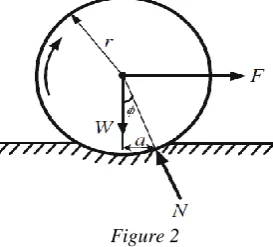
It has been noted that mechanical engineers utilize the multi-benefits applications resulting from invention of wheel. In order to achieve these benefits mechanical engineers utilize the scientific theories of “contact surface analysis”.
Figure 2
Page 235 www.ijiras.com | Email: [email protected] at figure 2 will indicate that if force F is more than the limiting
sliding frictional force, the wheel will skid thus providing the balance of forces stated as follows;
F = N Sin (2)
W = Ncos (3) Thus;
tan = F/W = μ = a/r (4)
where r is the radius of the wheel and a is the horizontal distance between the point of contact and the point through which the resultant of the ground forces passes. Shamesthus agrees with this study that is the non-dimensional coefficient of rolling resistance, while the variable a is called the coefficient of rolling resistance. It is instructive to note that mechanical engineers thus take advantage of the fact that compared to sliding friction of the wheel, the rolling resistance is much lower and depends on the nature of the contact surface, the structural/materials composition of the wheel, the nature of the ground surface, the contact force and the applied force/torque, etc to device very many systems that depends on these variables. They further find ways of manipulating these variables under defined constraints to create different motion syntaxes and by extension design systems that perform different tasks from a single scientific principle.
It is therefore important to note that all these parameters are closely studied and manipulated by mechanical engineers in the production of machines and other application components and operational conditions of engineered systems.
VIII. ADVANCES IN MECHANICAL ENGINEERING AND SUSTAINABLE GREENHOUSE SOLUTION It is important to further note that so many sub-disciplines exists in mechanical engineering practice and they are geared towards the expansion of the practice to areas of individual, corporate and national needs of individual nations. In this vein, mechanical engineering practice is divided into production engineering, industrial engineering, manufacturing engineering, automobile engineering, aerospace engineering, energy and power engineering, nuclear engineering, mechatronics engineering, maintenance engineering and nanotechnology, etc. Although this list is unending, mechanical engineering finds application in other fields of engineering practice, such as chemical engineering, where applied chemistry and mechanical engineering interact and instructively, metallurgists depends on mechanical engineering fundamentals to function and both marine and agricultural engineering are specialized forms of mechanical engineering.
Notwithstanding the contributions of mechanical engineering as enunciated in the foregoing, there is a clarion call for reduction in greenhouse effect by effective implementations of various ratified instruments of the UN and other international agencies. These global warming initiatives are directly dependent on solutions available within the dispositions of mechanical engineering practice, accordingly, the sustainability of this international order lies in the extent of allowable production process efficiencies that mechanical
engineering and allied fields of technical engagement can support. Thus, the sustainability of this international campaign against carbon emission is more familiarized in the position of the United States Environmental Protection Agency on the issue of Green Engineering, when the Agency observed that;
“green engineering is the design, commercialization and
use of processes and products, which are feasible and economical while minimizing (a) generation of pollution at the
source and (b) risk to human health and environment”
In addition to the foregoing definition, it has been suggested that sustainability in the foregoing circumstances is „the ability to maintain the desired living conditions for all times‟. Accordingly, Dixit et al observed that mechanical engineering finds a vital role in green and sustainable engineering and this is due to the effort of mechanical engineers all over the world in taking steps to improve on the efficiency of machines, productions units and facilities; thus reducing greenhouse effects and pollutions. These efforts in addition to researches and advancements in biofuels technology, wind and solar energy generation, nuclear power optimization, advanced battery technologies resulting automobiles and robots operated without engines, but battery banks and charge accumulators. The essence of these interesting innovations of mechanical engineers is the comfort of man in a constantly changing environment. Further, nature must be conquered for man to be comfortable. That is the crucial role of mechanical engineering in green engineering development.
The essence of these interesting innovations of mechanical engineers is to enhance human comfort and survival. Thus, advancements in science and technology, availability of materials with special properties, dynamics of human needs and expectations, lifestyle changes and globalization tendencies will continue to impact on the nature and quality of systems engineered for human comfort.
Instructively, just as stipulated in the 2011 ASME Report, the 2015-2016 Annual Report of the American Society of Mechanical Engineers (ASME) uncovered the crucial impact of mechanical engineering to the society and how this impact have resulted sustainable changes. The 2011 ASME study was to determine how predictably mechanical engineering would continue to strengthen the course of human development within the next 20 years. The survey brought together a total of 1,200 mechanical engineers from very many diverse environments such as industry, consultancy, allied technical services, business, insurance, banking, medicine etc. It should further be noted that the study concentrated on:
the structure and content of emerging fields in engineering with respect to the critical relevance of mechanical engineering in those fields
the ability of mechanical engineers to meet global challenges under changing circumstances
current advancements in tooling technologies and possible application methodologies
professional and personal skills development in furtherance of future changes and challenges
Page 236 www.ijiras.com | Email: [email protected] find mechanical engineering advancing in many cutting-edge
fields such as, virtual prototyping, motion simulation, animation, smart material, smart grid, Micro-Electro-Mechanical Systems (MEMS) green building technology, Nanomedicine, synthetic biology, greenhouse gas mitigation, etc.
The study further observed that interdisciplinary skills and collaborations with other relevant fields of engineering would be crucial to the achievement of these goals, in addition to corporate social responsibility, diplomacy, public policy initiatives, leadership quality, and cost consciousness in the design of systems. It is important to note therefore that these indices of globalization should directly impact on the content and structure of mechanical engineering teaching and research curriculums in higher institutions as to create investment opportunities in these emerging fields of the discipline.
In furtherance of the foregoing objectives of mechanical engineering practice, course structure of mechanical engineering should be dynamic as to conform to the changing technologies and industry demands. To this end, it is therefore the core responsibility of professional mechanical engineering associations all over the world to point the direction of technological growth and the pace of development alongside the various interfacing industries. This is one of the crucial measures towards relevance and sustainability, hence, if mechanical engineering wouldn‟t take the step, other fields of engineering will.
IX. SUSTAINABLE MECHANICAL ENGINEERING PRACTICE OF THE FUTURE
The hallmark of engineering practice is research, invention and innovation within the ambit of defined applications and statutory regulations. Thus, collaborations and partnership between research and educational institution, corporate organizations, industries and countries are important requirements to surpass the challenges of modern times.
In furtherance of the foregoing, Devim (2014) in Dexit et al observed that although, mechanical engineering is perceived as a discipline that utilize principles of physics, design, manufacturing and maintenance of mechanical systems, the knowledge of modern subjects in addition to fundamental classical subjects of mechanical engineering is critical to sustainable practice.
In view of Devim‟s assertion above, this paper posit that on account of the dynamics of current technological interests and global demand for efficient and smart systems, constant and concurrent inventions and innovations reviews are core areas of sustainable future practices that would further reshape and enhance the living conditions of humans. These areas of constant technological reviews includes:
A. RESEARCH AND DESIGNS OF SUSTAINABLE ENERGY SYSTEM:
It should be noted that mechanical engineers would be expected to put environmental consideration policies of national governments and international policy instruments under strict consideration as researches and facilities are
reviewed or redesigned. Consequently, compliance to international calls for manufacturers and their funding partners to “go green” in all manufactured units is critical to the survival of the environment. Thus, mechanical engineers and allied professions are called upon to explore possibilities of renewable sources of energy such as, wind, water, sun, green vegetables and other forms of biomass technologies. Interestingly, the UN Secretary General drew attention to the importance of this renewal energy initiative in order to reduce climate risk, low energy availability, thus creating safer environment and sustainable future prosperity.
In conclusion of this area of future demand on mechanical engineers, suffice to state that the fundamental of the philosophy of sustainable development lies in the fact, that in an attempt to advance or raise our current living standard we should do so with the interest of our future generations at heart. Thus, sustainability implies that the future of our children should not be mortgaged or sacrificed on the altar of present day comfort, especially as sustainability also extends to future environmental, economical and social considerations and concerns.
B. DESIGNS AND FABRICATIONS IN
NANOTECHNOLOGY AND
MICRO-MANUFACTURING
As process miniaturization advances beyond design to implementations; components designs in Nano-sizes and ranges would engage the attention of mechanical engineers. Thus, Nano-fabrication, Nano-machines, Nano-medicines and biomedical implants, including fluidized process tracing and in-process computational Nano-quality components and control strategies would form the basis of next industrial revolution.
This paper observes that the reason for this view is the fact that, nanotechnology principles depends on reduce material requirements, shorter production time and lower investment conditions over extended periods of expected returns on investment. The requirement for water and power are also minimal. In this vein, a Nano particle can be said to be an aggregate of atoms bonded together with a radius between 1 and 100nm (1nm = one billionth of a meter) and typically consisting of 10-105 atoms. It should be noted that a human hair has a diameter of 75,000nm. This implies that about eight pieces of nano electromechanical systems (NEMS) can be built within the size of the diameter of human hair. These very tiny machines can be used to render many services especially in biomedical situations. In support of this future prospects and benefits of nanotechnology on life, health and environments of humans, many studies by mechanical engineers and researchers are currently ongoing.
C. ADVANCEMENTS IN BIOENGINEERING AND BIOMECHANICS
Page 237 www.ijiras.com | Email: [email protected] and connecting joints and ligaments, thus analyzing the
generated force vectors to determine the stress and load carrying capacity of the human body. This finds more applications in sports medicine and well-being therapies.
This analysis also determines the impact of external forces to the physiological conditions of the human body. The results of these investigations are thus used in bioengineering processes to design artificial supporting replacements for various body parts of human beings. Thus, research in biomedical engineering in the future shall consolidate and advance in the areas of replacement of defective human parts, such as biomedical knee implant, ear plugs for hearing aids, prosthetics for body parts, cosmetic dentistry and composites design replacements for jaw, scalp, bones, etc.
Further bioengineered devices are currently being improved upon for the monitoring of brain functions, drug-tissue/cells interactions, drug-disease interactions, construction of neural networks to establish actionable human physiological and anatomical architecture. Consequently, records also show that mechanical engineers and allied scientists have ventured into researches dealing with the mechanics of brain functionalities, by the design of brain tissue simulation and monitoring head gears embedded with
neuromotive sensors for acquisition of brain activities data
resources, which are deployable for use in neuro-imaging feedback and diagnostics.
Further, there are mechanical engineering related advancements in bioengineering, more specifically in the area of intravenous (IV) therapy where flow/trace sensors in the form, design and composition of micro-electro-mechanical systems (MEMS) are infused into the human blood stream for study of human fluids, drug-to-tissue interactions, photographic imaging of cellular interfaces and monitoring of the quality of human health with the intent of prediction of failure tendencies of human body components, akin to real-time sensor applications in monitoring of machine transients and behaviors. It should be noted that these advancement into futuristic prediction of human anatomical and physiological concerns, is in closed collaboration with highly trained medical personnel some of whom are also mechanical engineers or members of allied engineering disciplines.
The foregoing thus imply that other crucial roles and intervention of mechanical engineering in the area of synthetic
biology has been fully documented. This area of involvement
of mechanical engineers deals with the design and fabrication of biologically simulated synthetic devices, such as synthetic limbs, hearts, lungs, etc, which have been designed to support ailing components of the human body.
D. 3-D PRINTING, ADDITIVE MANUFACTURING AND ADVANCED POWDER METALLURGY
In addition to the forgoing, mechanical engineers would be very busy in the future in the area of advancements of 3-D printing technologies, anchored under advanced manufacturing engineering, where parts and components are fabricated by layer-upon-layer depositing of molten or compressed powderized metals from 3-D computers aided designs (CAD). This process thus eliminates the need for conventional production of tools and also resolves the issues
of intricate parts designs, thus increasing the speed of manufacturing and assembling of parts at reduced cost over extended period of use.
Further, mechanical engineering researchers have advanced and shall remain in the realm of currency in the area of 3-D printing where the fabrication materials includes, the use of powderized metals, plastics, ceramics, glass, composites, and paper as raw materials for manufacturing of components and household items. There is also the report that MIT Computer Science and Artificial Intelligence Laboratory developed a 3-D printer that can multi-task the printing or production of ten different materials simultaneously in the deployment of advanced scanning methodology.
Further, studies have shown that additive manufacturing has been used to build microbots with complex materials shape orientations and functionalities. It is the view of industry specialists that additive manufacturing would set a higher target or agenda for rapid agile manufacturing processes, thus resulting fourth industrial revolution which would ignite leaner, faster and user customizable 3-D printing facilities, which would ultimately culminate into e-manufacturing with remote tasking and programming capabilities.
E. ADVANCEMENTS IN ROBOTICS,MECHATRONICS, AI AND NEURAL TECHNOLOGIES
It is also worthy of mention that mechanical engineers have undertaken researches and designs in the areas of robots and mechatronics, where programmes in forms of machine readable languages and codes are used to determine the progression of robots and process dependent mechatronic systems. Thus, mechanical engineers have developed expert devices in the areas of intelligent motion control, process automation, flexible manufacturing facilities, CAD/CAM integrated utilities, automated guided vehicles and sensor technologies.
Further, mechanical engineers have been known to utilize mechanical and electrical theories in conjunctions with structural mechanics to device specialized robots with reprogrammable manipulators and jigs; and incorporating artificial intelligence (AI) into robotic designs, have been shown to convert the robots into near-human-machines; such high capacity robots can therefore be deployed in military warfare, as currently noticed with the use of drones and unmanned aerodynamics in security area surveillance and consequent actions, medical surgery as applicable in degem
technologies, space and underwater exploration services.
Consequently, advancements in neural technologies by mechanical engineers have also seen the emergence of human contact encoding algorithms and biometics in the designing of touch sensitive technologies utilized in doors, machines and ATMs. These neural cognitive technologies shall continue to advance into areas of human brain content preservation even after the demise of a person. In this regard, Japanese engineers have developed robotic human-look alike called humanoids
Page 238 www.ijiras.com | Email: [email protected] engineering has significant contributions to make in many
other areas such as, molecular manufacturing, smart materials optimization, agile and lean manufacturing, remote inspection, greenhouse gas mitigation, etc.
X. CONCLUSION
In conclusion of this discussion, suffice to point that under the submissions of the Special Assessment Team for ASME Report “2028 Vision for Mechanical Engineering”, mechanical engineering as a specialized profession is charged with the core duty and mandate of inventing innovative technologies that guarantees healthy lifestyle, clean environment, safe workplace and existence including sustainable environment that also provides for the needs of the future generation. In this respect, the report posited that nanotechnology and biotechnology would be the drive force of further technological breakthroughs and this means that mechanical engineering would be at the center point of the development of cutting edge technologies of the future, and by extension remain the key driver in the area of sustainable societal development.
REFERENCES
[1] Baofu, P. (2009). The Future of Post–Human Engineering; A Preface to a New Theory of Technology, New Castle Upon Tyne: Cambridge Scholars Publishing, [2] Dixit, U.S, Hazarika, M. and Davim J.P. (2017) A Brief
History of Mechanical Engineering Springer International Pub., AG Switzerland, , p. 1–3
[3] Jumbo et al (2016) “Domestication and Codification of International Instruments on Crimes of Aggression: A Critical Appraisal of Euro-African Complementarity Legislations”, Legal Mirror, India, Vol. 2 Issue 2, Dec. 2016, p. 22-39
[4] It should further be noted that although various engineering practices cutting across all core fields of engineering existed along each other, pre-historic engineering practice implied that ancient engineers and scientists did not possess practice boundaries. This accounts for why scientists in such past generations were also inventors All that was necessary was invention for the good of mankind.
[5] Duckham, B. F. George, J.S.(1965) : The Father of English Civil Engineering, History Today. Vol. 15(3).
[6] For details see IMechE 2015:
www.imeche.org/knowledge/library/archive/institutio-and -engineering-history.
[7] UNESCO Report, published in France, 2010, p. 125) available at: www.unesco.doc.unesco.org Available at: www.asme.org/careers, visited 14th June, 2017.
[8] Dexit et al at p. 25
[9] S. 6 (1) (a-c) the Council for the Regulation of Engineering in Nigeria Act, Laws of the Federation of Nigeria, 2004
[10] S. 9(1)(a-c) of the COREN Act [11] S. 9 (6-8) COREN Act
[12] UNESCO Report p.5 126
[13] Details available at : www.ice.org.uk visited 10th April, 2018
[14] Hone J., Professor of Mechanical Engineering, Columbia University, “Insight on Mechanical Engineering” Available at www.columbia.edu/what-mechanical-engineering. Retrieved 16thJune, 2017.
[15] For details see ASME Report, available at: www.asme.org/careers, visited 14th June, 2017.
[16] Ikeno N., Hiroshima University, Japan in the Article: Citizenship Education In Japan After World War II, International Journal of Citizenship and Teacher Education, Vol 1, No. 2, p.94-96, December 2005, [17] Also available at: http://citeseerx.ist.psu.edu/viewdoc/
download?doi=10.1.1.514.4400&rep=rep1&type=pdf. Visited 15th June, 2017
[18] Institute for International Cooperation, The History of Japan‟s Educational Development: What implications can be drawn for developing countries today, Published by: Research Group, Institute for International Cooperation (IFIC), Japan International Cooperation Agency (JICA), 10-5, Ichigaya Honmura-cho, Shinjuku-ku, Tokyo 162-8433 Japan, p. 29-32, March, 2004
[19] National Research Council, “Maximizing US Interests in Science and Technology Relations with Japan”. Available at ww.nap.edu/read/5850/chapter5. Visited 14 June, 2017 [20] Ibid, at p. 20
[21] Full details available at:
www.localhistory.org/techhist.html.Accessed 17th June, 2017. Visited 15th June, 2017.
[22] Anthony, D.W. “The Horse, the Wheel and Language: How Bronze-age Rides From the Eurasian Steps Shaped the Modern World”. Princeton: Princeton University Press, 2007)
[23] Dexit et al at p. 16
[24] Shames, I. H., Engineering Mechanics: Statics and Dynamics, Singapore: Pearson Education, 1997.
[25] More details are available at: www.epa.gov/oppt/greenengineering/pubs/whats_ge.html. [26] Ibid, Dixit et al at p. 3
[27] ASME Annual Report 2015-2016, details are available at: https://www.asme.org/wwwasmeorg/media/
ASMEMedia/About%20ASME/WhoWeAre/Governance/ ASME-Annual-Report-2015-2016.pdf. Visited 16th June, 2017
[28] Đorđević, M., Vrekić, S., (2016) Impact of Mechanical Engineering on Quality of Life, 1st International Conference on Quality of Life, June 2016, Center for Quality, Faculty of Engineering, University of Kragujevac, p. 1-3,
[29] Ibid, Dexit et al at p. 167
[30] For more details on the UN Secretary General submission on the issue see: http://www.se4all.org/content/
unsecretary-general-urges-doubling-clean-energy-investment-2020. Visited 18th June, 2017
[31] Bhushan, B. (2010). Introduction to Nanotechnology. In B. Bhushan (Ed.), Springer Handbook of Nanotechnolgy (pp. 1–13). London: Springer
Page 239 www.ijiras.com | Email: [email protected] [33] More details of research development in this area is
available at: http://phys.org/news/2016-01-brain-lab.html [34] Details of these research strides are available at :
http://phys.org/news/2016-01-iv-infusion-cave-fish-inspired-sensor.html
[35] Details of these research activities and their results are available at: http://syntheticbiology.org/
[36] See full reports at: http://phys.org/news/2015-08-multifab3d-prints-materials-required-video.html
[37] Complete information available at: http://phys.org/news/ 2016-01-industryadditive.html
[38] For more details see: (http://www.theguardian.com/ technology/2015/dec/31/erica-the-most-beautiful-and-intelligent-android-everleads-japans-robot-revolution) [39] Jumbo, E. E. (2014) Quasi-Bivariant Potentiations and
Complexes in Molecular Manufacturing: International Journal of Engineering and Science (IJES) Volume 3 Issue 3, March 2014. ISSN (e):2319-1813 ISSN (p):2319-1805, also available at: theijes.com. pg 58-62 [40] Details are available at: http://newswise.com/articles/