PSO AND SURF ALGORITHM FOR COPY-MOVE FORGERY
DETECTION
K.Suresh1
1. INTRODUCTION
Forgery is the process of making, adapting, or imitating objects, statistics, or documents with the intent to deceive for the sake of altering the public perception, or to earn profit by selling the forged item. Copies, studio replicas, and reproductions are not considered forgeries, though they may later become forgeries through knowing and willful misrepresentations.As the use of images have been increasing day by day in our lives, with the introduction of digital technology. The forgery of digital image has become more and more simple and indiscoverable. Today's digital technology had begun to erode the integrity of images and image counterfeiting and forgeries with the move to the world of Megapixels, opens a new door to the dark-side of it. We are living in an age, where anything can be manipulated or altered with the help of modern technology. With the increasing applications of digital imaging, different types of software tools are introduced for processing images and photographs. They are used to make forge images to make it look real or objects can be added or deleted. For decades, photographs have been used to document and they have used as evidence in courts. Although photographers are able to create composites of analog pictures. But this process is very time consuming and requires expert knowledge so it is hard to implement than digital pictures. Today, however, powerful digital image editing software makes image modifications straightforward. Today’s digital technology has begun to remove trust in our knowledge, as from the magazines, to fashion world and in scientific journals, political campaigns, courts and the photo that come in our e-mail. In all of these forged photographs are appearing with a more frequencies and sophistication. In the increase in the availability of multimedia data in digital form has come to a tremendous growth of tools to manipulate digital multimedia contents.
2. SYSTEM MODEL
2.1 Existing System
The detection of copy–move image tampering is of paramount importance nowadays, mainly due to its potential use for misleading the opinion forming process of the general public. In this paper, we go beyond traditional forgery detectors and aim at combining different properties of copy–move detection approaches by modeling the problem on a multiscale behavior knowledge space, which encodes the output combinations of different techniques as a priori probabilities considering multiple scales of the training data. Afterward, the conditional probabilities missing entries are properly estimated through generative models applied on the existing training data.
2.2 Limitation
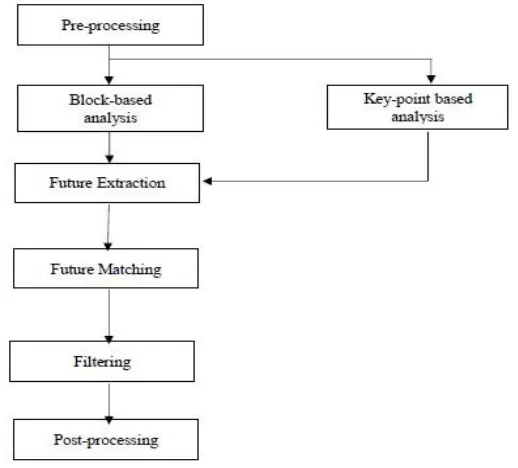
However, the method has two main drawbacks: the first one happens when there is no complementarity of the underlying methods to be combined. This happens when we combine block- and interest point-based methods and the evaluated image has several homogeneous regions, on which the block-based approaches fail and there are no interest points enough to be extracted from the image. Finally, the proposed method is slightly less efficient than its counterparts as it involves combining detection methods and evaluating the probability of their outcomes for defining the final detection map. With the proposed methods, we conclude that the tampering conditional analysis is essential, and this is done by the Behavior Knowledge Space Representation. Besides that, it is important to consider the pixel spatial
1 Department of Information Technology, Sri Venkateswara College of Engineering,Chennai, Tamilnadu, India.
DOI: http://dx.doi.org/10.21172/1.131.07
e-ISSN:2278-621X
Abstract- Digital images have become very important in our daily lives and some other important areas such as medicine, journalism and it can be also used as forensic evidence. However, the simplicity of using digital images with freely available software tools makes the authenticity of images questionable. The most common image forgery type is copy move forgery because it can be done easily but the detection of this type of forgery is hard. Various approaches are proposed in literature to detection of copy move forgery, but lots of them is not satisfy result especially smooth regions are used to hide objects. And lots of works use experience parameters values so sometimes they cannot detect forgery operations. To solve these problems, we proposed an optimized key point-based copy move forgery detection methods based on Speeded-Up Robust Features (SURF) algorithm and Particle Swarm Optimization(PSO).
dependency. The best classification results in all experiments showed that using the Local Variable Threshold multi- directional neighborhood analysis is suitable to this task.
Figure 2.1. Existing Architecture
2.3 Surf
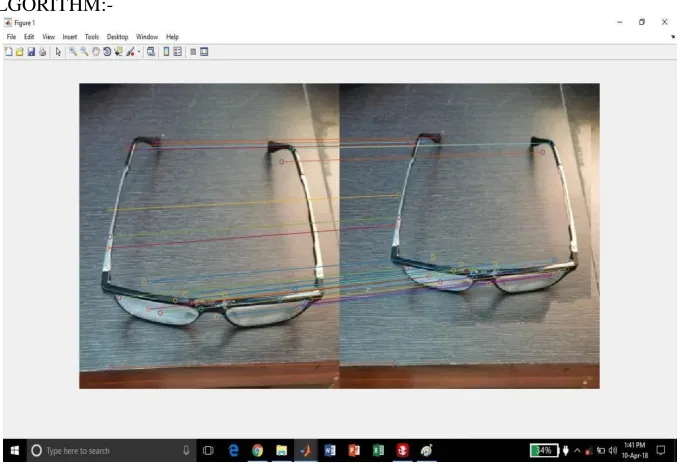
The SURF algorithm is based on the same principles and steps as SIFT; but details in each step are different. The algorithm has three main parts: interest point detection, local neighborhood description and matching. Interest points can be found at different scales, partly because the search for correspondences often requires comparison images where they are seen at different scales. In other feature detection algorithms, the scale space is usually realized as an image pyramid. Images are repeatedly smoothed with a Gaussian filter, then they are subsampled to get the next higher level of the pyramid. Therefore, several floors or stairs with various measures of the masks are calculated: The scale space is divided into a number of octaves, where an octave refers to a series of response maps of covering a doubling of scale. In SURF, the lowest level of the scale space is obtained from the output of the 9×9 filters. Hence, unlike previous methods, scale spaces in SURF are implemented by applying box filters of different sizes. Accordingly, the scale space is analyzed by up-scaling the filter size rather than iteratively reducing the image size. The output of the above 9×9 filter is considered as the initial scale layer at scale s =1.2 (corresponding to Gaussian derivatives with σ = 1.2). The following layers are obtained by filtering the image with gradually bigger masks, taking into account the discrete nature of integral images and the specific filter structure. This results in filters of size 9×9, 15×15, 21×21, 27×27,.... Non-maximum suppression in a 3×3×3 neighborhood is applied to localize interest points in the image and over scales. The maxima of the determinant of the Hessian matrix are then interpolated in scale and image space with the method proposed by Brown, et al. Scale space interpolation is especially important in this case, as the difference in scale between the first layers of every octave is relatively large. The goal of a descriptor is to provide a unique and robust description of an image feature, e.g., by describing the intensity distribution of the pixels within the neighbourhood of the point of interest. Most descriptors are thus computed in a local manner, hence a description is obtained for every point of interest identified previously.
The dimensionality of the descriptor has direct impact on both its computational complexity and point-matching robustness/accuracy. A short descriptor may be more robust against appearance variations but may not offer sufficient discrimination and thus give too many false positives.The first step consists of fixing a reproducible orientation based on information from a circular region around the interest point. Then we construct a square region aligned to the selected orientation and extract the SURF descriptor from it.
2.3.1 Orientation assignment
orientation of the point of interest. The size of the sliding window is a parameter that has to be chosen carefully to achieve a desired balance between robustness and angular resolution.
2.3.2Haar wavelet responses
To describe the region around the point, a square region is extracted, centered on the interest point and oriented along the orientation as selected above. The size of this window is 20s.The interest region is split into smaller 4x4 square sub-regions, and for each one, the Haar wavelet responses are extracted at 5x5 regularly spaced sample points. The responses are weighted with a Gaussian (to offer more robustness for deformations, noise and translation).
2.3.3 Matching
By comparing the descriptors obtained from different images, matching pairs can be found.
2.3.4 Particle Swarm Optimization
A basic variant of the PSO algorithm works by having a population (called a swarm) of candidate solutions (called particles). These particles are moved around in the search-space according to a few simple formulae.[8] The movements of the particles are guided by their own best known position in the search-space as well as the entire swarm's best known position. When improved positions are being discovered these will then come to guide the movements of the swarm. The process is repeated and by doing so it is hoped, but not guaranteed, that a satisfactory solution will eventually be discovered.
Formally, let f: ℝn → ℝ be the cost function which must be minimized. The function takes a candidate solution as an argument in the form of a vector of real numbers and produces a real number as output which indicates the objective function value of the given candidate solution. The gradient off is not known. The goal is to find a solution a for which f(a) ≤ f(b) for all b in the search-space, which would mean a is the global minimum.Maximization can be performed by considering the function h=-f instead.
2.4 Working Diagram
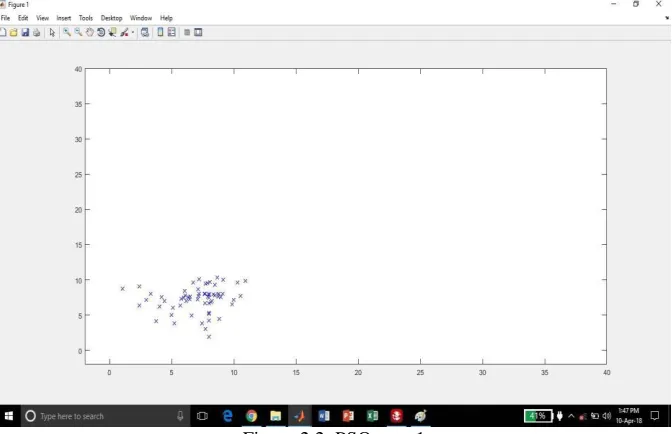
Figure2.3.PSOstep-2
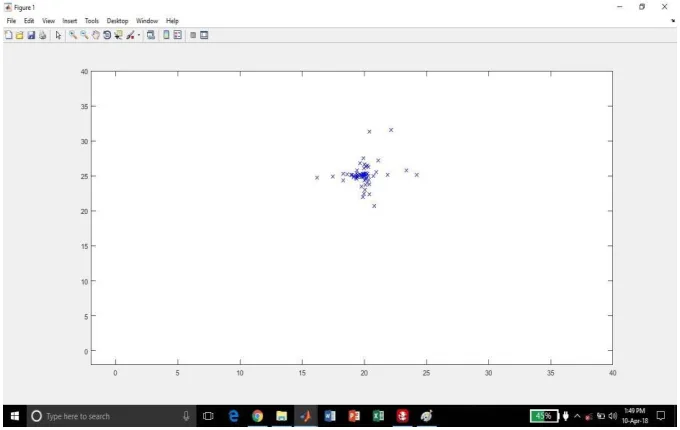
Fig:2.4 PSO step-3
Fig:2.6 PSO step-5
Figure 2.7. PSO step-6
3. PROPOSED SYSTEM
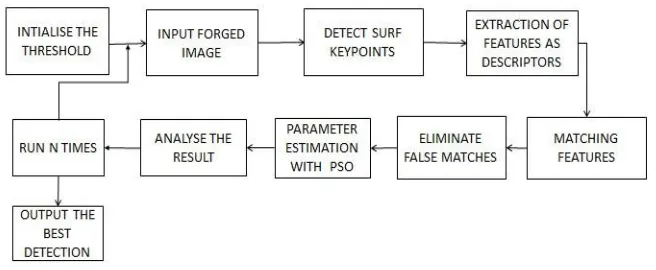
This method propose an automatically generate suitable parameter value for each test image to detection of digital image forgeries. Firstly, we identify output and input parameters of the SURF based forgery detection scheme.The input parameters are the test image and Hessian threshold.The output is number of matched keypoints,which is used as evaluation criterion to make detect decision. The higher criterion value means high performance. The Hessian threshold parameter is determined with PSO.
3.1 Speed-Up Robust Features (SURF)
images, similar to the Gaussian second order approximated box filters. After assigned the orientation, around the interest points the SURF descriptors are constructed by obtaining square regions. The windows are divided into 4 by 4 sub regions for keep in some spatial information. In each sub region, Haar wavelets are computed at regularly spaced sample points.
3.2 Particle Swarm Optimization (PSO)
The Particle Swarm Optimization (PSO) algorithm is proposed to model social behavior of bird flocking or fish schooling . The algorithm is suitable for solving minimization or maximization problems. Each element of the population is referred to as a particle, and is represented by three vectors and two real values: One of them points out the position of the particle, and the other one represents the last position change, and it is also called velocity vector. The third one is a copy of the best position of the particle found as yet. Each particle moves in the solution space according to its current speed, the best solution found yet, and the position of the best of the population. The PSO algorithm maintains several candidate solutions in the search space iteratively. In each iteration of the algorithm, each candidate solution is obtained by optimizing the objective function, determining the fitness of that solution.Has good performance even under post processing and preprocessing attacks (such as blurring, noise addition, rotation, JPEG compression).
3.3 Working Principle
The input parameters are the test image and Hessian threshold. The output is number of matched key points, which is used as evaluation criterion to make detect decision. The higher criterion value means high performance. The Hessian threshold parameter is determined with PSO. The Particle Swarm Optimization (PSO) algorithm is proposed to model social behavior of bird flocking or fish schooling. The algorithm is suitable for solving minimization or maximization problems. Each element of the population is referred to as a particle and is represented by three vectors and two real values: One of them points out the position of the particle, and the other one represents the last position change, and it is also called velocity vector. The third one is a copy of the best position of the particle found as yet. Each particle moves in the solution space according to its current speed, the best solution found yet, and the position of the best of the population. The PSO algorithm maintains several candidate solutions in the search space iteratively. In each iteration of the algorithm corresponding to match for the current key point. We set t value to 0.6. RANSAC surveys the quality of the hypothetical model on input data set that is contaminated by outliers. For the analysis of copy-move forgery detection, the right matching should robust to the rotation and scaling, which is defined as location of point. So, for every outlier that are not appropriate for the translation matrix are removed with iteratively.
3.4 Proposed Architecture Diagram
Figure 3.1. Proposed Architecture Diagram
3.5 Performance Analysis 3.5.1 Efficiency Of The System
OUTPUT SCREENSHOTS
Figure 3.2. PSO points diagram
PSO AND SURF ALGORITHM:-
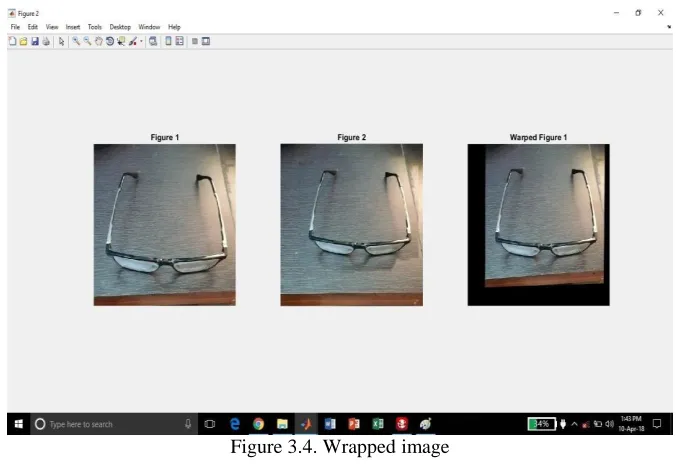
Figure 3.4. Wrapped image
4. CONCLUSION
In this study, a novel detection of copy moves forgery algorithm based on SURF and PSO is proposed. The method generates suitable parameter values for each test image to detect copy move forgeries. The higher performance of the proposed method than reported with precision and recall metrics. The proposed method not only detects duplicated regions but also determines under rotation, scale changes and post processing operations like JPEG compression, blurring, noise adding applied to the forged images.In this project various techniques were used to increase the complexity. But time taken for processing all the functions is approximately10 minutes. In the future research processing time yet to be reduced
5. REFERENCES
[1] A. C. Popescu and H. Farid, “Exposing digital forgeries by detecting duplicated image regions,” Dept. Comput. Sci., Dartmouth College, Hanover, NH, USA. 2004.
[2] B. Mahdian and S. Saic, “Detection of copy–move forgery using a method based on blur moment invariants,” Forensic Sci. Int. Sep. 2006.
[3] B. Xu, J. Wang, G. Liu, H. Li, Y. Dai, Image copy-move forgery detection based on surf, in: Intl. Conference on Multimedia Information Networking and Security (MINES), 2010, pp. 889–892.
[4] D. G. Lowe, “Object recognition from local scale-invariant features,” in Proc. 7th IEEE Int. Conf. Comput. Vis., vol. 2. Sep. 1999. [5] H. Bay, T. Tuytelaars, and L. Van Gool, “SURF: Speeded up robust features,” in Proc. Eur. Conf. Comput. Vis. (ECCV). 2006.
[6] H. Huang, W. Guo, and Y. Zhang, “Detection of copy-move forgery in digital images using sift algorithm,” in Proceedings of the Pacific-Asia Workshop on Computational Intelligence and Industrial Application (PACIIA ’08), Computer Society, 2008, pp. 272–276.
[7] I. Amerini, L. Ballan, R. Caldelli, A. Del Bimbo, L. Del Tongo, G.Serra (2013) Copy-move forgery detection and localization by means of robust clustering with J-Linkage. Signal Process Image Commun 28(6):659– 669.
[8] J. Fridrich, D. Soukal, and J. Lukáš, “Detection of copy-move forgery in digital images,” in Proc. Digit. Forensic Res. Workshop (DFRWS), Cleveland, OH. 2003.
[9] J. Li, X. Li, Y. Bin, X. Sun, 2015. Segmentation-based image copymove forgery detection scheme. IEEE Trans. Inf. Forensics Secur.10 (3), 507–518. [10] L. Xu, A. Krzyzak, and C. Y. Suen, Methods of combining multiple classifiers and their applications to handwriting recognition,” IEEE Trans. Syst.,
Man, Cybern., vol. 22. May/Jun. 1992.
[11] M. Emam, Q. Han, and X. Niu, “PCET based copy-move forgery detection in images under geometric transforms,” Multimedia Tools and Applications, vol. 75, no. 18, pp. 11513–11527, 2016.
[12] V. Christlein, C. Riess, J. Jordan, C. Riess, and E. Angelopoulou, “An evaluation of popular copy-move forgery detection approaches,” IEEE Trans. Inf. Forensics Security, vol. 7. Dec. 2012.
[13] Y. Zhu, X. Shen, H. Chen, Copy-move forgery detection based on scaled ORB, Multimed Tools Appl, pp. 1-15, DOI:10.1007/s11042-014-2431-2. [14] Y. S. Huang and C. Y. Suen, “A method of combining multiple experts for the recognition of unconstrained handwritten numerals,” IEEE Trans.