e-ISSN: 2278-067X, p-ISSN: 2278-800X, www.ijerd.com
Volume 10, Issue 3 (March 2014), PP.53-59
Computer users perceptions of Indonesian online
bussines webpage based on human computer
interface and ror framework web programming
Sri Ariyani
Department of Electrical Engineering, Faculty of Engineering Udayana University, Bali, Indonesia
Abstract:- Nowadays, in this era of information technology personal computer is common usage in office and home purposes. Most of personal computer software applications use US-English for its user interface and not all countries use the computer instruction using the language of the country concerned. In general, the problems caused by conditions like this one is creates a semantic gap. Indonesian is also experiencing these problems which there are still many Indonesian people that cannot understand in computer English instructions. This gap may increase intensifies globalization. However, the semantic gap also creates end users market opportunity for Indonesian computer application with appropriate terminology. With proper terminology, making computer software applications will target of non-advanced users.
This paper researches on the potentials of an Indonesian online bussines web browser. A mocked-up clone of Mozilla Firefox 18.1 was made for the purpose of collecting questionnaire result from respondents. The respondents were computer course students which meet the criterions of non-advanced users. The test that was done states that simple straightforward translations should be adequate for most cases, although a standardization of terminologies is still required.
Keywords:- HCI, Online Bussines, E-Commerce, Webpage
I.
INTRODUCTION
Background
The rapid world-wide web developments encouraging of the services proliferation which is offer the use web-based display server applications. This has led to the growing importance of the position of the web browser on a personal computer. The user interface aspect is important role for end-user applications [4]. It also said these types of applications are more concerned with the various aspects of the user as easy to learn, speed and ease of doing work, aesthetics, and other support facilities are provided rather than the quality of the algorithms, performance, or superiority theoretical [4].
Software instructions, the majority use English as the instructions so that many computer terminology written in English. Thus much of the terminology is difficult to find a counterpart in the Indonesian language [3]. Therefore there should be an experiment that could help establish Indonesian standard terminology translation. In Indonesia, the low level of education and the lack of ability to speak English with appropriate terminology users have resulted in a hidden problem that can grow along with the intense globalization. This causes the semantic gap between the users and application programs [1]. On the other hand, this problem is also given an opportunity for the development of software application programs in Indonesian appropriate terminology, especially for the end-user.
Research Objectives
The objectives and benefits of this study aims to:
1. Getting users perception of the online bussines web browser Indonesian instruction. 2. Getting common terminologies in online bussines web browser Indonesian instruction.
3. The results of this study can be used as a reference for the computer application programs development base on terminology and user computer interface.
4. The perception of users is expected useful help the computer programmer to develop of application programs based on user centered design.
Research Hypothesis
computer client that is used to retrieve and then display the web documents. Generally, a web browser that supports in HTML document into the main document format on the web, as well as several common image formats such as GIF and JPEG [14]. In taking documents, web browsers interact with web server with HTTP protocol (Hypertext Transfer Protocol) [11]. An individual websites supported image formats and HTML documents as in Figure 1. which is consists of many web pages. In order to read the web page required a web browser, such as Netscape Navigator software, Internet Explorer, or Mozilla Firefox from Microsoft [8].
Figure 1. Personal education webpage[14]
Online businesses commonly called electronic commerce (e-commerce) is a rapidly growing form of service in the internet world. The use of e-commerce can benefit many people, both consumers and producers and sellers (retailers) [15]. In Indonesia, online bussines systems are less popular because many internet users who still doubt its safety and lack of their commercial webpage terminology. The e-commerce transactions are not just a transaction of goods and money, but it’s also needs transaction information, knowledge and services [9]. Online shopping gives many conveniences and advantages compared to the conventional transactions. In addition, online shopping can be spending time shorter, on the internet there are various kinds of goods are sold in full. Information regarding these items are also available, so although not buy it online, one can obtain the information needed to select the product to be purchased. Figure 2 below is a view of Indonesian online shopping webpage design.
Figure 2. Indonesian online shopping webpage
The web programming written by Ruby on Rails (RoR), which the RoR is a framework for building web-based system. Rails is its framework and the Ruby is a programming language [13]. The advantages of using RoR framework is the speed of the application development and also practicing self-discipline to write code for programmers because this framework has an elbow strict rules [5]. With the existence of this rule will facilitate the process of maintenance depends on the application without a programmer only. In other words, system maintenance can be done by other computer programmers, as long as they understand the rules of RoR, then they will be able to continue the work of previous programmers. Furthermore, the questionnaire program is modeled to follow the appearance Mozilla Firefox ™ 18.1, which is a web browser that is simple but has enough functionality for the beginers user. This control component has size (code size) is relatively small, simple, and has been included in PHP [2],[7] and MySQL [12]. Thus the essence of the program is a window frame that provides support for this component interface. The program is intended for Win32 ® platform for PC users beginer using the operating system such as Windows ™ 7, which has good stability thus strongly supports the development of software that is trial-and-error when debugging [[8]. Nonetheless, online shopping program created using the Indonesian computer instructions can be executed on the system platform.
III.
RESEARCH
METHOD
In this study, a questionnaire was given to users (respondents) interactively using the Mozilla Firefox 18:01 web browser. When a menu item is selected, the respondent filed a dialog that displays the question of the function of the choice question. In the form of multiple choice questions, consist four possible answers for each question. At each appearance questions, randomized sequences response to reduce the things that are not meaningful in the study.
The analysis and flow of analysis in this study can be described as the following bellow:
1. Data were analyzed using hypothesis testing goodness-of-fit. Each option is given a value expected response frequency chosen by the authors: in which the answer with the highest frequency is considered the most correct answers by the authors, while the lowest frequency response is considered correct at least.
2. Tests performed by Chi-Square distribution with a level of significance of 1% ("= .01). Hypothesis Null (H0) is the answer of respondents would vote in accordance with the truth value chosen by the author. Truth value of a response is indicated by the expected frequency of the response. Alternative Hypothesis (H1) is generally considered correct answers by the respondents differ with the author.
Chi-Square equation:
- X2 = Chi-Square value
Sampling
In this experiment we determined earlier that the respondent (subject) is a person with no knowledge of computers. In general, the assumption of “laymen” is those who do not understand the use of computers in depth. For clarity, common assumptions can be defined as respondent (subject) who do not meet one or more of the following criteria:
a. Experience or working in the field of Information Technology or Electronic Data Processing.
b. Experience or studying or teaching at higher education institutions in computing, or engineering fields. c. Experience or a carrier on a Bulletin Board System (BBS).
d. Experience to be administrator of the server installation that is connected to the LAN, WAN, or the Internet.
e. Experience or currently using UNIX ® based system shell (and its derivatives) in a daily basis.
f. Experience or understand the programming and can make a program using one programming language and application programming packages that have facilities (such as PHP, ASP, etc.).
Sampling procedure
Procedure in this study all respondents had to fulfill the following criteria:
1. Samples were taken at random from the respondents are directly or indirectly that meet the definition of ordinary. While reducing the level of randomness, how this should be done for a variety of resource limitations. The sample consisted of students D0, D1, D2, D3, and S1 at educational institutions in the municipality of Denpasar. The majority of the outside of the computer department or have knowledge or experience in the field of computer.
2. Sampling was conducted with the respondents to the computer and then asked to select all the menu options in the form of a question. Once respondents complete, the program will be closed questionnaire which will then generate a data file that contains answers to the questionnaire. The data file is then collected to be processed.
IV.
RESULT
AND
DISCUSSION
In this study, sampling was conducted directly or indirectly due to filling out the questionnaire had to use a computer, so it is much easier if the respondent had known before. Of the 40 respondents who captured the majority of respondents expected from middle-and upper-class economy. While about three-quarters of respondents expected from Bali ethnic tribes, the rest is a combination of various tribes.
Figure 4. The analysis results as expected
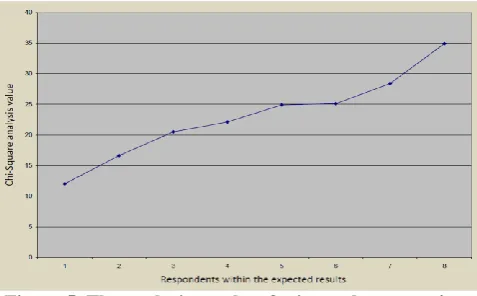
In Figure 5 describes the results of the analysis are answers to questions that are not in line with expectations. Of 40 respondents who captured the 30 questions posed to the respondents i.e. 26.67% gave no answer as expected with the lowest analysis value of 12% and the highest 34.9%.
Figure 5. The analysis results of mismatch expectations
In a discussion based on estimates of the error that occurred and any options written back the number of answers that occur (O) and the expectation of the answer (E) is as follows:
1. The reliability result of webpage software, involving 40 respondents found out that 68.2% of respondents said that webpage had a complete feature and 31.8% said that it had very complete feature; 72.3% said that was reliable and 27.7% said that it was very reliable; 42.3% said it was easy to use and 57.7% said it was very easy to use; 63.1% said it was safe and 36.9% said it was very safe; and 25.8% said it could document well and 74.2% said the documenting was very well.
2. Perceptions of respondents to list the contents of a variety of assistance offered. As much as 25.1% of respondents did not consider that the online help is part of the documentation program.
3. From the analysis of 33.59% of respondents were not aware that the context of windows is on a browser. Its means users generally thought that the window with the program did not consider that the program is actually an executable Windows Operating System.
4. As much as 25.17% of respondents gave very similar answers to other questions so the question becomes ambiguous.
5. Value analysis, 23.21% of respondents thought that the source is a web page. This means that respondents did not understand the concept of "source code" so no matter who chose the answer to that question.
V.
CONCLUSIONS
AND
RECOMMENDATIONS
Conclusion1. Translating the computer with the user interface elements of the English into Indonesian is sufficient for most cases, but to facilitate the development of computer software applications in the long term Indonesian standardization is still needed.
2. Computer users from middle and upper economic levels, more able to use the English language as a computer interface. Based on informal discussions with some respondents, they have their own hatred against Indonesian user interface.
3. This study is a preliminary study, in which the results are still not able to represent the general public, because there are many users who were in the heterogeneity of the samples.
Recommendations
1. There needs to be further research with a sample of more and more representative and reproduced features of the application software. With models of different applications that further research should be categorized according to various user roles for the application in question.
2. It needs to make the user interface guidelines for software applications in Indonesian language so there will be a proper standardization of computer terms and Indonesian terminology that is easily understood.
ACKNOWLEDGMENT
A great appreciation goes to promoter, colleague and everybody who has made valuable contributions in this study and their critical comments on this manuscript.
REFERENCES
[1]. Barnard, P. J., May, J., Duke, D. & Duce, D. (2000). Systems, Interactions, and Macro Theory. ACM Transactions on Computer Human Interaction, 7, pp. 222-262.
[2]. Castagnetto, J., Rawat, H., Schumann, S., Scollo, C., Veliath,D. (1999). Professional PHP
Programming. Jakarta:Penerbit Wrox Press Ltd.
[3]. Dyson, P. (1994). Kamus Komputer. Alih bahasa, Surya Satyanegara. Jakarta: Arcan.
[4]. Frank E.R. and Richard, M.Y. (2001). Embodied Models as Simulated Users: Introduction to this Special Issue on Using Cognitive Models to Improve Interface Design. International Journal Of Human Computer Studies. pp.1-14
[5]. Hartl, M., (2011). Ruby on Rails Tutorial: Learn Web Development with Rails, Accessed 21 Nopember 2012 http://ruby.railstutorial.org/chapters/beginning
[6]. Kimball, P.E. (1995). The X Toolkit Cook Book. New Jersey: Prentice Hall International Editions. [7]. Lukmanul, H., dan Musalini. (2004). 150 Rahasia dan Trik menguasai PHP. Jakarta: PT Elex Media
Komputindo.
[8]. Microsoft Corporation, (2000). Microsoft Developer’s Network CD, February 2000 edition. [9]. Purbo, O.(2005). Knowledge Commerce. Perpustakaan Onno. Accessed 21 Nopember 2012
http://stream.plasa.com/onno/gfe/index.php?dir=artikel_indonesia_1/application/e-commerce [10]. Purwanto, E. (2002). Pengantar World Wide Web. Jakarta: Jaringan Informasi IPTEK, JIIPP.
[11]. Prihatna, H. (2005). Kiat Praktis Menjadi Web Master Profesional. Jakarta: Penerbit PT. Elex Media Komputindo.
[12]. Raymond, A.L., and Daudenarde, J.J. (1991). SQL and Its Applications. New Jersey: Prentice Hall. [13]. Ruby, S. et. al. (2011) Ruby Programming Language, Accessed 1 August 2012
[14]. Sudarma,M. (2011), Manajemen Situs, Denpasar : Udayana University Press [15]. Suyanto, M. (2005). Strategi Periklanan pada E-Commerce. Yogyakarta: Andi Offset
[16]. Tanenbaum, A.S. 1996. Computer Networks, 3rd edition. New Jersey: Prentice-Hall International Editions.
[17]. Tuck, Mike. (2001). The Real History of the GUI. WebmasterBase.Com. accessed 15 November 2012
![Figure 1. Personal education webpage[14]](https://thumb-us.123doks.com/thumbv2/123dok_us/1385471.1649380/2.595.168.425.297.499/figure-personal-education-webpage.webp)