IJIRT 143777
INTERNATIONAL JOURNAL OF INNOVATIVE RESEARCH IN TECHNOLOGY360
Enhancing Network Lifetime of WSN using GPSR and
Spanning Tree Covering Algorithm for Mobile Sink
Collector
Ms. Aasawari S. Mandape
1, Dr. Mrs. Sangeeta. R. Chougule
21
M.E. Scholar Department of Electronics & Telecommunication Engineering
Bharati Vidyapeeth’s College of Engineering, Kolhapur
2
Professor, Department of Electronics & Telecommunication Engineering
Bharati Vidyapeeth’s College of Engineering, Kolhapur
Abstract— In wireless sensor network (WSN) the use of mobile sink collector has been attracting more attention in recent times. The sensor nodes in WSN have limited power supply, computational capability, and storage hence, the mobile sink collectors are more effective way of balancing energy expenditure among sensors. In this paper, we consider applications, where sensing data are generally collected at a low rate and are not so delay sensitive that it can be collected into fixed-length data packets and uploaded once in a while. We propose a mobile data collector, which moves to the vicinity of the sensor nodes to collect data. A mobile collector starts the data-gathering tour periodically from the static data sink, polls each sensor while traversing its transmission range, then directly collects data from the sensor in single-hop communications, and finally transports the data to the static sink. Since data packets are directly gathered without relays and collisions, the lifetime of sensors is expected to be enhanced.
In this paper, we discuss The Mobile sink which finds a route to the sensor node by using spanning tree covering algorithm. Sensor location information is collected using greedy perimeter stateless routing. We also evaluated network performance parameters throughput, energy consumption, end to end delay and packet delivery ratio.
Index Terms— GPSR (Greedy perimeter stateless routing), Mobile collector, spanning tree covering algorithm, WSN
I. INTRODUCTION
From past few years, WSNs have become a very popular type of networks which consist of distributed autonomous set of different types of sensor nodes which are spread over an area under interest. Sensor
nodes are nothing but a device with a sensor which particularly deployed to sense some or other physical parameter of monitoring field. These WSNs are having a large variety of applications. It includes battlefield surveillance, medical treatment, habitat monitoring, border patrol, remote health monitoring, even to get early warnings of natural disasters such as forest fire, also used for wildlife tracking, smart transportation and many more [1-6] .
IJIRT 143777
INTERNATIONAL JOURNAL OF INNOVATIVE RESEARCH IN TECHNOLOGY361
are located far from data sink at the margin of thenetwork, because they need to relay many packets from other sensor nodes far away from the data sink. Because of this once these sensor nodes fail, other nodes cannot reach the data sink and ultimately the network becomes disconnected, even though most of the nodes still having enough battery power. Therefore, it is inefficient to use a single static data sink to collect data from all sensor nodes for a large-scale data-centric sensor network.
In some applications, some sensors cannot forward data to the data sink via wireless links, as the network may be partially connected. Because of these reasons, the idea of introducing mobility to data sink i.e. data collector comes into picture. Mobile data collector traverses through entire network and may links all separated sub networks together. Mobile data collector could be a mobile robot or a vehicle which must be equipped with a powerful transceiver, battery, and most importantly large memory. The mobile data collector starts travelling from the data sink, travels through the network and aggregate sensed data from nearby sensor nodes while moving, and then returns and uploads data to the base station. Due to mobility, it can move close to sensor nodes. This will save the energy of sensor nodes wasted in just relaying the data packets from other nodes. Here we consider network lifetime depending on analyzing energy consumption of network. Less the energy consumed, more will be the network lifetime and vice versa.
II. RELATED WORK REVIEW
R. C. Shah, S. Roy, S. Jain, and W. Brunette, [7], present and analyze architecture to collect sensor data in sparse sensor networks. Their approach exploits the presence of mobile entities (called MULES) present in the environment. MULEs pick up data from the sensors when in close range, buffer it, and drop off the data to wired access points. This can lead to substantial power saving at the sensors BS they only have totransmit over a short range.
K. Singh and T. P. Sharma, [8] proposed a Reliable Energy-efficient Data Dissemination (REDD) scheme for WSNs with multiple mobile sinks. In this strategy, sink first determines the location of source and then directly communicates with the source using geographical forwarding. Every forwarding node
(FN) creates a local zone comprising some sensor nodes that can act as representative of FN when it fails.
W. R. Heinzelman, A. Chandrakasan, and H. Balakrishnan [9] explains that, in a homogeneous network, where all nodes have identical capability and energy at the beginning, some of the nodes are selected to serve as cluster heads. However, cluster heads will inevitably consume more energy than other sensor nodes. To avoid the problem of cluster heads failing faster than other nodes, sensor nodes can become cluster heads rotationally. In this type of network, since every sensor node may possibly become a cluster head, each of them has to be “powerful” enough to handle incoming and outgoing traffic and cache sensing data, which will increase the overall cost of the entire sensor network. Furthermore, selecting cluster heads dynamically results in high overhead due to the frequent information exchange among sensor nodes.
Zhenghao Zhang, M. Ma, and Y. Yang [10] focused on the energy-efficient design within a cluster to prolong network lifetime. They used polling to collect data from sensors instead of letting sensors send data randomly so that less energy is consumed and showed that the problem of finding a contention-free polling schedule that uses the minimum time is NP-hard.
J. Luo and J.-P. Hubaux [11] explain a unified framework to analyze the maximizing network lifetime (MNL) problem in WSNs. It is based on a graph model, jointly considers sink mobility and routing for lifetime maximization. They have developed an efficient algorithm to solve the MNL problem involving only a single mobile sink; they have further generalized the algorithm to approximate the general MNL problem. In addition, using the duality theory, they have proved that, moving the sinks is always better than keeping them static.
M. Zhao and Y. Yang, and Z. Zhang [12][13] explored a balance between the relay hop count of local data aggregation and the moving tour length of the mobile collector. They polling to collect data from sensors to the cluster .Also they focus on finding energy-efficient and collision-free polling schedules in a multi-hop cluster.
IJIRT 143777
INTERNATIONAL JOURNAL OF INNOVATIVE RESEARCH IN TECHNOLOGY362
improves of up to four times over the static networkin the ideal case.
III. PROPOSED WORK
We propose WSN consisting of two protocols namely GPSR (greedy perimeter stateless routing) [15] via which sensor node sends its location information to Mobile collector. Spanning tree covering algorithm [16] will be used by Mobile collector to plan the shortest tour towards sensor node. The algorithm works as follows
To choose a subset of points from the candidate polling point set, each of which corresponds to a neighbor set of sensors.
At each stage of the algorithm, a neighbor set of sensors can be covered when its corresponding candidate polling point is chosen as a polling point in the data-gathering tour.
The algorithm will terminate after all sensors are covered.
The algorithm tries to cover each uncovered neighbor set of sensors with the minimum
average cost at each stage. When multiple sensor nodes are expecting the
M collector to send the data then multiple mobile nodes will perform the same task as mentioned above.
IV. EXPERIMENTAL SCENARIO
The experimental scenario consists of the cases mentioned below:
1) When there is only one event occurred and it is being served by nearest mobile M collector.
2) When there are multiple events have occurred and those are served by nearest mobile M collectors. We conduct
(a)
(b)
(c)
(d)
Fig.1 (a) Network scenario with multiple mobile collectors colored blue and polling points colored red (b), (c), (d) Multiple mobile collectors serving to nodes to their nearest polling points
V. STEPS OF IMPLEMENTATION IN NETWORK SIMULATOR
1. Add GPSR.cc and related files in ns-2.34 installation directory
2. Compile with tcl object hook inside ns-2.34
3. Write TCL based front end script for simulation and experimentation
3.1 Configure network for n number of nodes (where n=10, 20, 40 60, 80,100)
IJIRT 143777
INTERNATIONAL JOURNAL OF INNOVATIVE RESEARCH IN TECHNOLOGY363
3.3 Set gpsr protocol configuration for all wirelessnodes along with 802.11 protocol
3.4 Establish spanning tree covering algorithm link in ns-2.34 installation directory.
3.5 create trace file and animator instances for further analysis
4. Write awk based analysis scripts, to analyze trace file generated in experimentation
5. Generate results from awk scripts for different nodes scenarios and collect in one file
6. Create graphical presentation from gathered data.
VI. RESULTS ANALYSIS.
For analyzing different parameters of WSN for single static Vs mobile collector scenarios, we implement our algorithm on WSNs with 10, 20, 40, 60 80 and 100 number of nodes respectively. We run the simulation for 250 seconds in Network Simulator2 and then noted the observations as follows.
Table I–IV shows observations about the network performance parameters energy consumption, throughput, end to end delay and packet delivery ratio respectively.
TableI. Energy Consumption Observations Number of
Nodes
Static Sink Scenario
Mobile sink Scenario
10 0.585256 0.603678
20 3.530063 2.135655
40 10.57225 6.377231
60 17.557959 10.615894
80 22.280018 14.83901
100 34.682024 25.201957
Fig.2 Energy consumption analysis
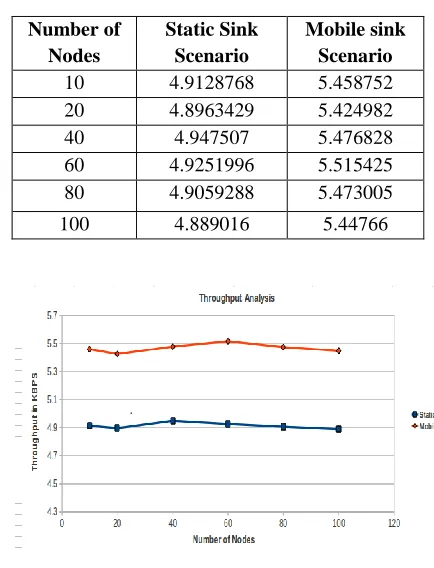
Table II. Throughput Observations
Number of Nodes
Static Sink Scenario
Mobile sink Scenario
10 4.9128768 5.458752
20 4.8963429 5.424982
40 4.947507 5.476828
60 4.9251996 5.515425
80 4.9059288 5.473005
100 4.889016 5.44766
Fig. 3 Throughput Analysis
Table III. End to End delay Observations
Number of Nodes
Static Sink Scenario
Mobile sink Scenario
10 0.531349 0.384687
20 0.350177 0.181361
40 0.167326 0.100361
60 0.196289 0.081837
80 0.117579 0.062868
100 0.071959 0.033211
IJIRT 143777
INTERNATIONAL JOURNAL OF INNOVATIVE RESEARCH IN TECHNOLOGY364
Table IV. Packet Delivery Ratio ObservationsNumber of Nodes
Static Sink Scenario
Mobile sink Scenario
10 0.81 0.9072
20 0.875 0.9153
40 0.885 0.9234
60 0.895 0.9234
80 0.898 0.9153
100 0.88 0.9153
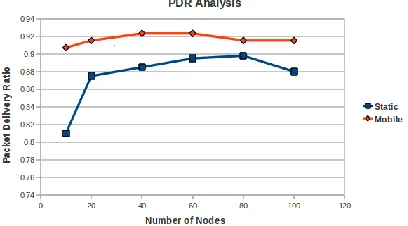
Fig. 5 PDR Anaysis
A. Annotations:
1. From figure 2 to 5, energy consumption, throughput, end to end delay and PDR graphs are indicated.
2. From energy consumption graph we can observe that, proposed algorithm with mobility model shows less energy consumption in all scenarios as number of nodes varies. As energy consumption is less network lifetime is will be more and is enhanced by
this work.
3. From throughput graph it can be observed that, though trend remains the same there is much difference in the actual throughput obtained. As can be seen performance in terms of throughput is increased in case of mobile M-collector scenario. 4. From end to end delay graph it can be seen that, as event occurs, faster packets delivered to sink node in case of mobile M-collector based network compared to static sink nodes network.
5. From analysis as in figure 4.4, we can say that due to one to one single hop communication in Mobile collector scenario, more numbers of packets are successfully received which results in increased PDR
as compared to WSN with static collector. As node density increases PDR also increases in static collector network, but in case of mobile collector network it increases up to certain limit and then slightly decreases. But overall observation states that mobile collector network has better performance than static sink network.
VII. C O N C L U S I O N
Based on our simulated experimentation we analyzed the effectiveness of using mobile sinks to collect data in wireless sensor networks. By comparing energy consumption of static sink and mobile sink networks we conclude that when sink collector moves to the vicinity of a sensor node to collect the data, significant energy savings can be obtained as single hop based route is selected and in a route, number of participating nodes are less. And thus we can say that the network lifetime of WSN surely enhances by using mobile collector. Also the network performance with respect to the parameters throughput, packet delivery ratio, and end to end packet delivery delay is better than the network having static sink collector. In this way experimentation shows the proposed work can be successfully implemented for network lifetime enhancement.
.
REFERENCES
[1] P. Juang, H. Oki, Y. Wang, M. Martonosi, and D. Rubenstein, “Energy-efficient computing for wildlife tracking: Design tradeoffs and early experiences with ZebraNet,” in Proc. ASPLOS, 2002,pp. 96–107.
[2] A. Mainwaring, J. Polastre, R. Szewczyk, D. Culler, and J. Anderson, “Wireless sensor networks for habitat monitoring,” in Proc. ACM Int.Workshop Wireless Sens. Netw. Appl., Atlanta, GA, Sep. 2002, pp. 88–97.
[3] B. Sauser. (2007). Networking the Hudson
River. [Online]. Available:
IJIRT 143777
INTERNATIONAL JOURNAL OF INNOVATIVE RESEARCH IN TECHNOLOGY365
[4] S. Chessa and P. Santi, “Crash faultsidentification in wireless sensor networks,” Comput. Commun., vol. 25, no. 14, pp. 1273–1282, Sep. 2002.
[5] L. Schwiebert, S. K. S. Gupta, and J. Weinmann, “Research challenges in wireless networks of biomedical sensors,” in Proc. ACM MobiCom, 2001, pp. 151–165.
[6] S. Churchill, “Wireless Bridge monitoring,” MIT Technol. Rev., 2007. [Online]. Available:
http://www.dailywireless.org/2007/08/13/ wireless-bridge-monitoring/
[7] R. C. Shah, S. Roy, S. Jain, and W. Brunette, “Data MULEs: Modeling a three-tier architecture for sparse sensor networks,” in Proc. IEEE Workshop Sens. Netw. Protocols Appl., 2003, pp. 30–41.
[8] K.Singh and T.P. Sharma, “REDD: Reliable energy-efficient data dissemination in wireless sensor networks with multiple mobile sinks,” in World Academy of Science, Engineering and Technology 78 2013
[9] W. R. Heinzelman, A. Chandrakasan, and H. Balakrishnan, “Energyefficient communication protocols for wireless microsensor networks,” in Proc. HICSS, Maui, HI, Jan. 2000, pp. 1–10.
[10] Z. Zhang, M. Ma, and Y. Yang, “Energy efficient multi-hop polling in clusters of two-layered heterogeneous sensor networks,” IEEE Trans. Comput., vol. 57, no. 2, pp. 231–245, Feb. 2008
.
[11] J. Luo and J.-P. Hubaux, “Joint mobility and routing for lifetime elongation in wireless sensor networks,” in Proc. IEEE INFOCOM, 2005, pp. 1735–1746.
[12] M. Zhao and Y. Yang, “Bounded relay hop mobile data gathering in wireless sensor networks,” IEEE Trans. Comput., vol. 61, no. 2, pp. 265–277, Feb. 2012.
[13] Z. Zhang, M. Ma, and Y. Yang, “Energy efficient multi-hop polling in clusters of two-layered heterogeneous sensor networks,” IEEE
Trans.Comput., vol. 57, no. 2, pp. 231–245, Feb. 2008.
[14] W. Wang, V. Srinivasan, and K. C. Chua, “Using mobile relays to prolong the lifetime of wireless sensor networks,” in Proc. ACM Mobicom, Aug. 2005, pp. 270–283.
[15] Brad Karp, H. T. Kung,” GPSR: Greedy Perimeter Stateless Routing for Wireless
Networks,” in MobiCom 2000.