Hybrid Approach for Software Component
Classification using Computational Intelligence
Pravind Kumar
Department of Computer Science and Engineering, School of Information and Communication Technology,
Gautam Buddha University, Greater Noida,UP, India
Pradeep Tomar
Department of Computer Science and Engineering, School of Information and Communication Technology,
Gautam Buddha University, Greater Noida,UP, India
Jagdeep Kaur
CSE & IT Department, The NorthCap University, Gurgaon, Haryana, India
Abstract-Software engineering provides solutions of the existing problems coming from different-different areas. Fuzzy C-Means and Subtractive Clustering Algorithm play a vital role in the Software Engineering for Software Components Classification in their respective Clusters. Fuzzy C-Means Clustering Algorithm has a major disadvantage that the number of Clusters formed, intimate before classification of Software Components. How can intimate the number of Software Components beforehand, it depends on the nature of data points used. This is the main cause to produce local optimal solutions instead of optimal solution. Fuzzy Subtractive Clustering Algorithm evaluates the number of required Clusters on the base of nature of Software Components. This paper uses a Hybrid Approach for Software Components Classifications by using Computational intelligence. The problems associated with Fuzzy C-Means can rectify to use to Fuzzy Subtractive Clustering Algorithm, but Computation time required is high that’s why in this paper use rejection ratio, Recall and Precision to classify Software Components. Selecting a Cluster Center is main task in Clustering process because if selection of Cluster center is good then Computation time to classify Software Components in their respective Clusters is small.
Keywords-Fuzzy C-Means Clustering Algorithm, Fuzzy Subtractive Clustering Algorithm, Software Component Classification.
I. INTRODUCTION
FCM is a method applied to put up in clustering and used in many area domain like image segmentation [1], pattern matching, pattern recognition, Artificial intelligence, Computational intelligence, etc. FCM is very sensitive to its intialization. If the initial value is not proper we can not find optimal solution, people have to set number of cluster initial time again and again for optimal solution.The size of Sofware Component is very large so the possibility of finding optimal solution is very low.
To find optimal solution will use FSC to initialize the initial value of FCM before use FCM to put up for clustering [2].
Software Component reuse is a popular design methodology common to engineering discipline.Reuse has two primary aspect one is cost reduction and other is time reduction. on the base of three properties Functional,Structural and Behavioral Software Component Classified [3]. Different values of three Properties (Functional,Structural and Behavioral) of Software Component depends on user chosen values. The minimum evaluated values of selected Software Components indicates, most suitable software components for reuse.
1.1 Software Component Representation Define software component M be
M=(Str,Fun,Bhr)
Where Str be the structure properties, Fun be the Functional properties and Bhr be the Behavioral propertis.Each of the three properties denotes of the form
Str={ Str1,Str2,………..Strm } Equation….………..(1)
Fun={ Fun1,Fun2…………Funn } and Equation….………..(2)
Bhr={ Bhr1,Bhr2………BhrP }. Equation….………..(3)
II. ALGORITHM FOR SOFTWARE COMPONENT CLASSIFICATION(SCC)
This paper use Hybrid Approach for Software Component Classification. FCM Clustering Algorithm will fall into local optimal solutions due to initialization sensitive of number of Clusters, so here FSC Algorithm overtake the problems associated with FCM.This paper use Subtractive Clustering Algorithm to initialize the initial value of FCM before use Fuzzy C-Means Clustering Algorithm to put up Fuzzy Clustering.
2.1 Fuzzy C-Means Clustering Algorithm(FCM)
FCM[4] assigned data point when these belongs more than one cluster.it is very sensitive to its initial value. It produce local optimal solution, if intial value is not good. So use Subtractive clustering algorithm before initialized the initial values of FCM as a result will gain optimal solution in stead of local maxima solution.
This procedure gives a local maxima instead of optimal solution due to outliner data points. FCM Clustering Algorithm may produce optimal solution when try with different – different Clusters values initialization.FCM Clustering Algorithm evaluate membership values of each data points by formula (7) and then stored in the matrix. Number of columns in the matrix is equal to the number of initialized cluster and number of rows is as the number of data points(Software Components).The maximum membership value in column is selected as first cluster center and as same as for second cluster center.
2.2 Fuzzy Subtractive Clustering Algorithm
FCM[4] assigned data point when these belongs more than one cluster.it is very sensitive to its initial value. It produce local optimal solution, if intial value is not good. So use Subtractive clustering algorithm before initialized the initial values of FCM as a result will gain optimal solution in stead of local maxima solution.
This procedure gives a local maxima instead of optimal solution due to outliner data points. FCM Clustering Algorithm may produce optimal solution when try with different – different Clusters values initialization.FCM Clustering Algorithm evaluate membership values of each data points by formula (7) and then stored in the matrix. Number of columns in the matrix is equal to the number of initialized cluster and number of rows is as the number of data points(Software Components).The maximum membership value in column is selected as first cluster center and as same as for second cluster center.
III. HYBRID APPROACH FOR SOFTWARE COMPONENT CLASSIFICATION
This paper encompasses the Software Components which does not encompassed by Fuzzy C-Means Clustering Algorithm on the base of assigned ra and rb and allowable error before calculations.
Step1: First of all calculate density of all software components by formula
P
i=
Equation….………..(4)Where
|| . || is the Euclidean distance and the selected software component with highest potential value as first cluster center Xc1.
Step2: After calculating first cluster center, calculate the density of remaining (n-1) software components by formula
Equation….………..(5)
Where xkis point of the kth cluster center, pk is its potential value and beta(β)=4/1.25 and then select
second highest potential as second cluster center Xc2.
Step3: Give initial matrix U(0).
Step4: Calculate the cluster center using formula
C
j=
Equation….………..(6)Step5: Update U(r) by using formula
u
ij=
Equation….………..(7)Step6:If the condition
U(r+1)≤ (Ԑ)*(P max)
Where Ԑ is allowable error and Pmax be the Component having maximum potential value.
IV. EVALUATION & RESULTS
Recall = Retrieved target software component /Total no. of target software components.
Equation….………..(8)
Precision= Retrieved target software component /Total number of software components retrieved
Equation….………..(9) Where #Ci denotes the number of elements on cluster Ci and 0≤recall, precision≤1.
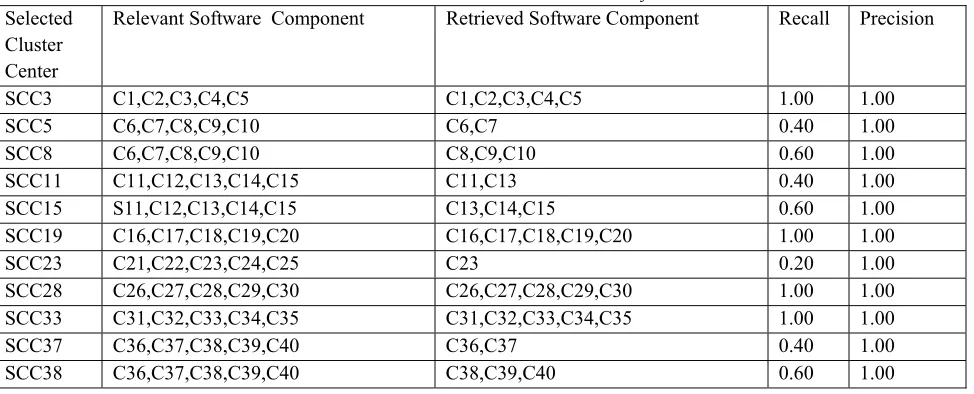
In this paper conduct trial with different rejection ratio groups (like 0.10-021,0.34,0.40-0.50) and used the derived cluster centers from each trail to calculate its recall and precision performance.
Let U denotes a software component requirement matrix which matches cluster center C3, this cluster center encompasses C1,C2,C3,C4 and C5.
Table 1. Recall and Precision Performance on the base of Rejection Ratio 0.10-0.21 Selected
cluster center
Software component relevant Software component retrieved Recall Precision
SCC5 C1,C2,C3,C4,C5 C1 0.20 1.00
SCC3 C1,C2,C3,C4,C5 C2,C3,C4,C5 0.80 1.00
SCC5 C6,C7,C8,C9,C10 C6,C7 0.40 1.00
SCC8 C6,C7,C8,C9,C10 C8,C9,C10 0.60 1.00
SCC11 C11,C12,C13,C14,C15 C11 0.20 1.00
SCC15 C11,C12,C13,C14,C15 C13,C14,C15 0.60 1.00
SCC19 C16,C17,C18,C19,C20 C16,C17,C18,C19,C20 1.00 1.00
SCC23 C21,C22,C23,C24,C25 C21,C22,C23,C24,C25 1.00 1.00
SCC26 C26,C27,C28,C29,C30 C26 0.20 1.00
SCC28 C26,C27,C28,C29,C30 C27,C28,C29,C30 0.80 1.00
SCC31 C31,C32,C33,C34,C35 C31 0.20 1.00
SCC33 C31,C32,C33,C34,C35 C32,C33,C34,C35 0.80 1.00
SCC37 C36,C37,C38,C39,C40 C36,C37 0.40 1.00
SCC38 C36,C37,C38,C39,C40 C38,C39,C40 0.60 1.00
SCC43 C41,C42,C43,C44,C45 C41,C42,C43,C44,C45 1.00 1.00
SCC48 C46,C47,C48,C49,C50 C48 0.20 1.00
SCC50 C46,C47,C48,C49,C50 C46,C47,C48,C49,C50 1.00 1.00
Average 0.56 1.00
Cluster Center Selection:
Relevant Software Component is C1,C2,C3,C4,C5, then calculate the potential of all the software component by formula (4) and then stored in the matrix as below:
1 2 3 4 5
1st pass 2nd pass
Fig.(a) Fig. (b)
Pmax(1.00,1.02,4.08,16.32) =16.32 means SCC5 as the first Cluster center as Xc1. Except SCC5
potential values of remaining Software Components (C1,C2,C3,C4) SCC3 is the second cluster center as
Xc2 .C2 and C4 does not becomes next cluster center.
In Similar way the remaining relevant software components produce cluster center as (C5 C8),(C11 C13 C15), C19, C23, (C26,C28),(C31 C33), ( C37 C38), C43),(C48 C50). Precision and Recall evaluated by formula (8) & formula (9).
Table 2. Recall and Precision Performance on the base of Rejection Ratio 0.34 Selected
Cluster Center
Relevant Software Component Retrieved Software Component Recall Precision
SCC3 C1,C2,C3,C4,C5 C1,C2,C3,C4,C5 1.00 1.00
SCC5 C6,C7,C8,C9,C10 C6,C7 0.40 1.00
SCC8 C6,C7,C8,C9,C10 C8,C9,C10 0.60 1.00
SCC11 C11,C12,C13,C14,C15 C11,C13 0.40 1.00
SCC15 S11,C12,C13,C14,C15 C13,C14,C15 0.60 1.00
SCC19 C16,C17,C18,C19,C20 C16,C17,C18,C19,C20 1.00 1.00
SCC23 C21,C22,C23,C24,C25 C23 0.20 1.00
SCC28 C26,C27,C28,C29,C30 C26,C27,C28,C29,C30 1.00 1.00
SCC33 C31,C32,C33,C34,C35 C31,C32,C33,C34,C35 1.00 1.00
SCC37 C36,C37,C38,C39,C40 C36,C37 0.40 1.00
SCC43 C41,C42,C43,C44,C45 C41,C42,C43,C44,C45 1.00 1.00
SCC50 S46,C47,C48,C49,C50 C46,C47,C48,C49,C50 1.00 1.00
Average 0.63 1.00
Table 3. 3 Recall and Precision Performance on the base of Rejection Ratio 0.40-0.50
Selected cluster center
Relevant Software component Retrieved Software component Recall Precision
SCC3 C1,C2,C3,C4,C5 C1,C2,C3,C4,C5 1.00 1.00
SCC8 C6,C7,C8,C9,C10 C6,C7,C8,C9,C10 1.00 1.00
SCC15 C11,C12,C13,C14,C15 C11,C12,C13,C14,C15 1.00 1.00
SCC19 C16,C17,C18,C19,C20 C16,C17,C18,C19,C20 1.00 1.00
SCC23 C21,C22,C23,C24,C25 C23 0.20 1.00
SCC28 C26,C27,C28,C29, C30 C6,C26,C27,C28,C29,C30 1.00 0.83
SCC33 C31,C32,C33,C34,C35 C31,C32,C33,C34,C35 1.00 1.00
SCC38 C36,C37,C38,C39,C40 C36,C37,C38,C39,C40 1.00 1.00
SCC43 C41,C42,C43,SC44,C45 C41,C42,C43,C44,C45 1.00 1.00
SCC50 C46,C47,C48,C49,C50 C46,C47,C48,C49,C50 1.00 1.00
Average 0.92 0.98
Table 4. Recall and Precision Performance Comparison
Rejection Ratio Number of cluster selected Recall Precision
0.10-0.21 18 0.56 1.00
0.34 13 0.63 1.00
0.40-0.50 10 0.92 0.98
Table 5 shows the result of suitable software component (SC) selection on the bases of equation with different degree of significance on structural, functional and behavioral properties.
SC=Xreuse Equation….………..(10)
values of reuse can be calculated from
Reuse=arg Equation….………..(11)
where pr and pi is retrieved potential and potential of i-th software component.
be degree of structural, functional and behavioral properties.
Table 5. Software Component Selection with different Degree of Significance
Degree of Significance Value of Each Software Component Suitable Software
Component for Reuse
Structural Functional Behavioral C17 C18 C19 C20
0.8 0.1 0.1 3.250 3.163 3.163 3.250 C18
0.1 0.8 0.1 3.250 3.163 3.163 3.250 C18
0.1 0.1 0.8 3.250 3.163 3.163 3.250 C19
0.3 0.3 0.3 2.925 2.846 2.846 2.925 C19
Hybrid Approach (FSC & FCM) use to classify software components for reuse. This paper will use computational intelligence approach to classify software components repository into their respective cluster groups with the help of FCM & FSC algorithm. FCM is a common method used in many aspects. For example, image segmentation, preprocessing for data and pattern recognition. Before using FCM number of Cluster Centers required, calculated by FSC for optimal solution.
Fuzzy clustering algorithm could not assigned some of the software components into their respective cluster, but Fuzzy subtractive clustering algorithm assigned the outliers Software Component into their respective Cluster. In this paper, Hybrid approach classify the Software Component on the base of Precision and Recall performance by formula (8 & 9) and then evaluate the value of each Software Components by formula (10 & 11). The minimum value of Software Component select as suitable Software Component for reuse.
REFERENCES
[1] Samina Naz, Hammad Majeed, and Humayun Irshad, “ Image Segmentation using Fuzzy Clustering : A Survey”, ieeexplore.ieee.org/iel5/5621662/5638364/05638492.pdf?arnumber...
[2] Wen-Yuan Liu, Chun-Jing Xiao, Bao-Wen Wang, Yan Shi, and Shu-Fen Fang, “Study on Combining Subtractive Clustering with Fuzzy C-Means Clustering”, in Proceedings of the Second International Conference on Machin Learning and Cybernetics, Xian, 2003.
[3] Sathit Nakkrasae, Peraphon Sophatsathit, and William R. Edwards, “Fuzzy Subtractive Clustering Based Indexing Approach For Software Components Classification”, International Journal of Computer & Information Science, Vol. 5, No. 1, 2004. [4] R.Suganya, and R. Santhi, “ Fuzzy C-Means Algorithm-A Review”, International Journal of Scintific and Research Publications, Volume
2, 2012.
[5] Agus Priyono, Md. Ridwan, Ahmad Jais Alias, Riza Atiq O. K. Rahmat, Azmi Hassan and Mohd Alauddin Mohd. Ali, “ Generation of Fuzzy Rules With Subtractive Clustering”, in Journal Teknologi, 43 2005: .
[6] M. S. Yang, “A Survey of Fuzzy Clustering", in Mthl. Compt. Modeling Vol.18,No.11,pp. 1- 16,1993 printed in great Britain.
[7] Jianxiong Yang, and Junzo Watada, “ Fuzzy Clustering ananlysis of data minig: Application to an Accident Mining Syatem”, International Journal of Innovative Computing, Information and control Volume 8, Number 8, 2012.
[8] Witold Pedrycz, Senior Member, IEEE, and James Waletzky, “ Fuzzy Clustering With Partial Supervision”, In IEEE Transactions on Systems, Man, and Cybernatics, Vol.27.
[9] Soumi Ghosh, and Sanjay Kumar Dubey, “ Comprative Analysis of K_Means and Fuzzy C-Means Algorithm”, International Journal of Advaced Computer Science and Applications, Vol. 4, No. 4, 2013.
[10] Boldeanu Silviu, “Fuzzy Clustering”, in Babes-Bolayi University, Faculty of Compute Science.