
E-ISSN 2308-9830 (Online) / ISSN 2410-0595 (Print)
Scientific and Technical Challenges Facing the Effective
Implementation of Radio Frequency Identification (RFID)-based
Systems
E. G. Zahran1, A. A. Arafa2, H.I.Saleh3, M. I. Dessouky4
1, 2, 3 Dept. of Radiation Engineering, NCRRT, Atomic Energy Authority
4 Dept. of Electrical Communications, Faculty of Electronic Engineering, Menoufia University
E-mail: [email protected], [email protected]
ABSTRACT
Radio frequency identification (RFID) is a wireless technology used to identify objects at distance using radio waves. RFID has wide area of applications such as inventory management, production process monitoring, assembly process control, access control and security, toll collection at highways, shipping operations at ports, wild animal tracking, livestock tracking, and improving safety at hazardous areas. This paper presents an overview of the state of art of the RFID system, its applications, architecture, and challenges in deployment in order to highlight its implementation and for further investigations.
Keywords:RFID, Security, Safety, Privacy, Anti-collision.
1 INTRODUCTION
RFID is a technology allowing objects to be automatically identified, monitored and tracked using radio frequency signals [1-2]. Its history reverses back to the Second World War when a friend-or-foe military identification system used it to discriminate the genuine aircrafts from foreign ones. In the last decades the RFID technology is integrated in many applications such as inventory management, production process monitoring, assembly process control, access control, shipping operations at ports, livestock tracking, and improving safety at hazardous areas.
The RFID technology has a lot of advantages over other identification technologies (e.g. barcodes). These advantages can be summarized as follows:
No line of sight
The important feature of the RFID system is that the identification is done using contactless tags. The communication between tags and reader does not require a line of sight which allows objects to be identified at distance from the reader. Therefore, objects need not be aligned toward the reader as in the barcode system.
Work in harsh environment
The RFID capabilities can be integrated in the process of drilling for gas and oil [3, 4] for tracking and monitoring of drilling equipment. The RFID system can also be very useful in environments of high temperature and pressure, and for monitoring of and inspection for radioactive and nuclear materials.
Data retrieval
The tag circuit may incorporate some memory chips to store specific data about the object attached to the tag. The stored data can be retrieved back by interrogating these tags; it may be updated, and stored in again. Also there might be some sensors built in the tag circuit for recording readings about the events that happened to the object at certain intervals to obtain a complete history about the tracked object. This will be beneficial in assets tracking and monitoring applications.
Cost effectiveness
Robustness
The RFID system is robust against environmental conditions such as dirt, friction, moisture which have bad impact on the barcode system. The RFID tagged objects can also be read when they are packed.
Fast identification
The RFID system provides a fast identification speed due to the capability of reading many tags simultaneously which is very useful in ubiquitous identification applications.
High efficiency
The RFID system achieves high identification efficiency because the identification process runs automatically which makes it robust against human errors.
This paper is organized as follows: section2 presents the applications of RFID system. The RFID system components are explained in section3. Section4 explains the operating frequency bands. The communication principles of RFID system are explained in section5. The challenges of RFID system implementation are explained in section6. Conclusions are drawn in section7.
2 APPLICATIONS OF RFID SYSTEM
The RFID technology is an evolving technology that has wide range of applications due to its data capturing, storing, processing, and retrieving capabilities. These capabilities allow the RFID to invade almost all industries. The applications of the RFID system can be explained as follows:
3.2 Access Control
The implementation of the RFID technology on access control systems will facilitate and fasten the control process because multiple tagged objects can be scanned at the same time. The RFID can also be used in car keys in which the RFID tags are embedded into the keys and the RFID readers are incorporated into cars to make the door of the car opens automatically.
2.2 Automatic Toll Collection
Another application of the RFID system is in the collection of toll at gates in which tags are placed into cars and read by a reader without stopping the driver. This makes the crossing process easier and the payment process faster which increase the overall accuracy of the payment system.
2.3 Retailing Industry
One of the applications of the RFID system is in retailing industry for monitoring of all products in
the stores which will be very useful in avoiding products shrinkage, and increases the accuracy of inventory management system.
2.4 Library Management
The RFID is a promise technology in library management systems [5,6] because many tagged books can be checked out at the same time, and the status of all books within the library can be tracked all the time which facilitates the management operation, and reduces the time needed for finding books location.
2.5 Health Care
The capabilities of the RFID technology can also be integrated into hospitals on the monitoring of patients with handicaps and special disabilities to be able to protect them all the time. Another application is in the monitoring of medical equipment to prevent any unauthorized usage which may cause damage, and protect them from being stolen. The FRID technology can also improve the process of monitoring the health status of patients by keeping monitor their implanted RFID tags and their medications to be able to update the medical reports. This will cost effective and reduce the human errors [7, 8].
2.6 Airports and Postal Package Tracking
One of the important applications of the RFID is in passports in which RFID chips are implemented into passports to store the data which will increase the efficiency of the travelling services by facilitating the authentication process at airports. The RFID can also be implemented at airports for tagging travellers and baggage to facilitate the tracking of baggage [9] and in tracking of postal packages to increase the efficiency, and protect privacy of the postal services.
2.7 Smart Shelf Applications
One of the applications of the RFID in industry is the smart shelf operations [10, 11] in which all the items on the shelf are tagged and scanned by RFID readers. These readers are connected to a computer system to store the information, for further processing. This will be helpful in determining the items in the stock, and to make reports of the required ones.
2.8 Monitoring of Nuclear Materials
an RFID system for monitoring and tracking of nuclear materials will enhance safety and security; protect humans and materials; and provides overall efficiency [13].The application of the RFID technology into nuclear facilities attracted many researchers in recent years [14-24].
3 COMPONENTS OF THE RFID SYSTEM
An RFID system generally consists of tags (transponders/ data-carrying devices), a reader (interrogators), and a middleware. The block diagram of the RFID system is shown in Fig.1.
Fig. 1.the block diagram of the RFID system [1].
3.1 RFID Tags
Tags are small labels attached to or embedded in the objects to be identified and they collect all the information about the object. Each tag has a unique identification number (ID) used in the identification. The ID of the tag is about 64 or 96 bits described by the EPC global consortium that defined the standards for RFID tags and readers [25]. Tags are interrogated when they are in the interrogation zone of the reader.
3.1.1. Types of Tags
Tags are categorized according to their activation power into three types [1, 2] as follows:
Passive Tags
Passive tags have no power source and get the energy to be activated from a radio frequency signal received from the reader. The energy of the radio frequency signal initiates the connection between the reader and the tag is established. They send their response to the reader by backscattering the received signal from reader. Their reading distance is limited from few centimeters, to a few meters. According to the passive nature of these tags, they have a small size allows them to be easily attached to objects, and low cost which make them suitable for item-level tagging. Their life span is long because there is no need for battery exchange.
Semi-passive Tags
Semi-Passive Tags have a battery used to activate the internal circuitry and to provide it with the power which makes it keep monitoring of the tagged object state when the reader is off
.semi-passive tags may incorporate some sensors used to record the status of the tagged object. They cannot set a connection unless they received signal from the reader to establish the communication. Their reading range is of few meters. The inclusion of a battery results in a short life-span.
Active Tags
Active tags have their own power source. They can sense the communication channel and detect collisions if exist. They have higher cost and larger size than passive tags. Active tags have a reading range of about several hundred meters. They contain large memory to store information about the tagged objects. These tags are the most expensive tags so they are used for tagging high value items.
Tags can also be classified according to the incorporated types of memory chips as [2]:
Read Only Tags
These tags contain a memory cell with storage capacity of about 64
bits to store permanent
data which cannot be modified. These data include the identification information of tag (a unique serial number made up of several bytes). These tags have low cost, low power consumption, and a small size. Read-only tags can work at all RFID frequencies. Read-Write Tags
These tags have memories with greater storage capacity to store information that may be updated during the life cycle of the tagged object. These tags are more expensive than read-only tags.
Write Once-Read Many Tags
These types of tags allow the data to be stored once but cannot be further altered.
3.1.2 Tag Architecture
RFID tag circuit consists of a control unit and an antenna. It may incorporate some sensors and memory cells. Memory cells used to store the ID of the tag and any other information specific to the object attached to the tag. The control unit is used to enable the tag to recognize the reader commands, modulate the response signal by its ID to send it to the reader, and to demodulate the reader queries [2]. The control unit enables the reader to read from or write on tags.
Fig. 2.The block diagram of the tag circuit
3.2.RFID Reader
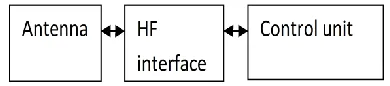
A reader can interrogate tags when they are in its interrogation zone. It sends a request command to all tags and they respond with their IDs. The reader interrogation zone can be defined as the effective area around the reader at which it sends and receives signals to and from tags so it can identify them correctly. RFID readers may be fixed or of mobile types. The block diagram of the RFID reader is shown in Fig. 3 as [26]. The HF interface block is responsible for providing the RFID tags with power, modulating the query signal to be transmitted to the tag, and receiving and demodulating the response signal from the tags. The control unit block is responsible for the communication and the execution of the middleware commands.
The reader specifications are dependent on the types of the used tags as follows [27]:
Readers for passive tags emit high power of to energize the tag circuit, provide short read ranges of few meters with capability of identifying many tags simultaneously.
Readers for active tags emit low power because active tags have their own battery with long reading range.
Fig. 3.The block diagram of the reader [26].
3.3.RFID Middleware
The RFID middleware is software used as an interface between the reader and the database system where the gathered data is stored. The main functions of the middleware [28] are:
Filter, process, and send the collected data to the database system, handling all the hardware of the RFID system and its related parameters. Providing an interface for to enable external
applications to access the RFID data.
The requirements that need to be taken into consideration when architecting middleware are explained [29-30].
4 OPERATING FREQUENCIES
The RFID system operates in four frequency bands described as [31]:
Low frequency band
Low Frequency (LF) band operates at (125-134) KHZ. This band is suitable in applications such as asset tracking, access control, and animal tracking. This range provides short read range, and lower system cost
High frequency band
High Frequency (HF) band operates at (10-15) MHZ with 13.56 MHZ is the common frequency. This range provides larger read range than the LF band.
Ultra high frequency band
Ultra High Frequency (UHF) band operates at (850-950) MHZ. The UHF band provides a larger read range with great reading speed.
Microwave frequency band
Microwave Frequency band operates at (2.4-2.5) GHZ specifically at 2.45 GHZ.
The operating frequency impacts the system reading range, and on the propagation of signals, and it is dependent on the system infrastructure.
The relation among the reading range, the reflected power, and the operating frequency can be expressed as [1, 31]:
The relation between the reading range, the reflected power, and the operating frequency can be expressed as [1, 31]:
√
(1)
Where R is the reading range, is the wave length, is the reader
transmitted power,
is
the antenna gain of the reader,
is the
antenna gain of the tag, and
is the
reflected power from the tag.
The reflected power density
is expressed
as [1, 31]:
( )
(2)
5 READER TO TAG COMMUNICATION
The communication between the reader and the tag is accomplished using magnetic (inductive) coupling or electromagnetic (back-scattering) coupling. The magnetic coupling is a near field communication system operates at LF and HF frequencies where magnetic field of the reader antenna induces voltage on the tag antenna used to power the tag circuit as shown in Fig. 4.
The electromagnetic coupling is a far field communication operates at the UHF, and Microwave frequencies where the reader antenna radiates electromagnetic waves used to activate the tag circuit. Once the circuit gets the activation
Fig. 4. Magnetic Coupling.
Power it backscatters the wave in accordance with its data. The electromagnetic coupling is shown in Fig. 5.
Fig. 5. electromagnetic Coupling.
6 RFID CHALLENGES
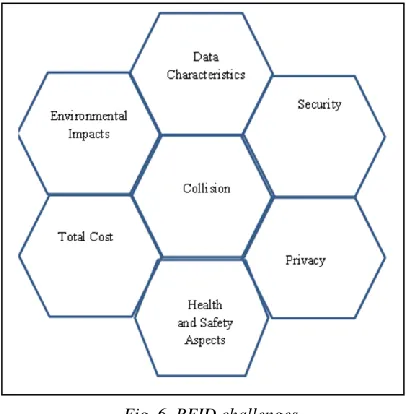
Even though the RFID technology is now being used very successfully, there are many limitations that restrict the application of the RFID technology as shown in Fig. 6.
Fig. 6. RFID challenges.
These limitations are explained as follows:
(1) 6.1. Security
The RFID Security is a technological challenge due to foreign attacks on the RFID data. These attacks include:
Listening is the process by which additional readers are settled to get the data of tags. Man-in-the-Middle (MIM) is a threat where a
device claims to be a tag or a reader among the actual tags and readers.
Tag disabling is a threat done by foreign readers to deactivate a tag so as not to be interrogated again.
Tag cloning is the threat of copying the data of a tag to another tag to get the authorities of the original tag.
Many scientific solutions were proposed to overcome this intrusion problem such as Encryption [32-35]. But there is another challenge in providing cryptographic operations for RFID tags as such kinds of low-cost device unable to perform basic encryption operations because these tags have a little rewritable memory with no computing capabilities. Other solutions for mitigating the security challenge can be found in [36-39].
6.2. Privacy
life such as tagged clothes when purchased without removing tags. These tags can be considered as a threat to individuals’ privacy.
A large number of studies [40-42] have been conducted to ensure maximum privacy of an individual, including:
Re-writing and blocking algorithms that writes a new random number on the tag memory to prevent the tagged object from being tracked so as to preserve person’s privacy. In blocking algorithms tags in the interrogation zone of the reader are blocked from being read.
Killing and sleeping algorithms
The killing operation aims at deactivating tags so as not be read again. The sleeping operations make tags inactive until they are activated again by the reader.
Privacy protection methodology in which a n RFID device used to spoil the RFID signals to prevent the tag from being identified which preserves the privacy.
6.3. Health and safety aspects
When implementing RFID systems into facilities (i.e. Health care systems at hospitals), the maximum exposure rate which is frequency dependent should be taken into account before setting the RFID antennas.
6.4. Total Cost
The total cost of RFID system include the cost of tags, readers, software, network technology, and the manual effort to install, apply, and the training for using the technology. There is also another cost for the integration of the RFID technology with the existing systems because there is a need to redesign these systems to get the benefits of the RFID technology. This may require entire processes change. But with growing and more adoption, the costs of RFID devices will quickly diminish, and that will lead to more benefits and further adoption.
6.5. Data characteristics
There are many characteristics associated with the nature of RFID data). These challenges include: Low Level Data refers to the raw observational
readings being recorded by the RFID Reader. Missed Reads in which a tagged item is present
in the interrogation zone of the reader but not read.
Wrong Reads in which data is captured where it should not resulting in the data set not
reflecting events which are actually taking place.
Duplicate reads in which a tagged item is stored twice in the database while it should be stored once.
High Data Volumes of RFID data: There are large volumes of raw data that need to be processed at the reader due to
scanning tags
many times
, and that data need to be retrieved from a central data base which is very difficult task that limits the large scale implementation of the RFID systems [27].6.6. Collision
One of the most common challenges in the deployment of RFID systems is the collision problem. The collision in the RFID system can be classified into two types they are: tags to reader and reader to reader collision.
6.6.1. Tags to Reader Collision
A tag to reader collision occurs when a reader sends a request and multiple tags in its interrogation zone respond simultaneously. Hence signals from all tags collide, cancel out each other and none of these tags can be identified. This type of collision reduces the reading rate, increases the identification delay, and wastes the energy and the bandwidth. The tag to reader collision is shown in Fig. 7.
Manny techniques have been developed to avoid collisions in the RFID systems called anti-collision protocols. These protocols can be classified into four categories [27] as follows:
Time Division Multiple Access (TDMA), Frequency Division Multiple Access (FDMA), Code Division Multiple Access (CDMA), and Space Division Multiple Access (SDMA). TDMA protocols are the common anti-collision techniques where the communicating tags share the transmission time to send their responses to the reader. TDMA protocols are separated into two types as:
b) 6.6.1.1. Tag driven protocols
Fig. 7. Tags to reader collision[43].
Pure Aloha with Muting in which the read tags are silenced by a muting command from the reader. As shown in Fig. 8. There are three tags T1, T2, and T3. Tag T1 is muted after being read [43].
Pure Aloha with Fast Mode: When the reader detects that transmission begins from one tag it sends a silence command to the other tags to be deactivated until the first tag finish its transmission [43] as shown in Fig. 9.
Pure Aloha with slowdown in which the reader reduces the transmission rate of some tags to avoid the collision problem, as shown in Fig. 10.
6.6.1.2. Reader driven anti-collision Protocols
The reader driven TDMA protocols are summarized in Fig.11 as:
Slotted Aloha protocols: Tags transmit their IDs into separate time slots, and collision
occurs at the boundaries of time
slots
as shown in Fig. 12. Framed Slotted Aloha Protocols: In these protocols the transmission time is divided into frames and each tag transmits once per frame. The frame size may be fixed as in Basic frame slotted aloha or variant as in dynamic frame slotted Aloha.
Tree Splitting protocols: In tree splitting protocols the tags are separated into Subsets until each subset contains one tag to be identified as shown in Fig. 13.
Fig. 8. Pure Aloha with Muting[43].
Fig. 10. Pure Aloha With Slow Down
Query tree protocol
Fig. 14 describes the query tree protocol in which the reader sends query; and tags that match that query respond, the process repeats until all tags are identified in separate rounds.
Fig. 11. Reader driven protocols[43].
Fig. 12. Framed Slotted Aloha [43].
Fig. 13. Tree Splitting Protocols [43].
6.6.1.3. Reader to Reader Collision
be well aligned to overcome the collision problem. Many algorithms have been developed to avoid this type of collision such as frequency hopping, and dynamic resource allocation. The reader to reader collision is shown in Fig. 15.
Fig. 14. Querry Tree Anti-collision Protocols [43].
Fig. 15. Reader to Reader Collision.
6.7. Environmental impacts on tag performance
The performance of the RFID system is affected by the dielectric and metals surrounding the tag. So the RFID components should be designed taking the environmental aspects into consideration [44].
7 CONCLUSION
RFID is an evolving technology that can be applied in a wide area. This paper presents a detailed survey on the RFID technology, its basics and applications. The paper also explains the various challenges in deployment of this
technology, and the existing solutions to combat with these challenges. The future work will be in the analysis of the RFID system performance and on the development of an RFID-based nuclear monitoring system that can withstand these challenges.
8 REFERENCES
[1] K. Finkenzeller," RFID HANDBOOK: Fundamentals Andapplications In Contactless Smart Cards, Radio Frequencyidentification And Near-Fieldcommunication, Third Edition, 2010.Rich and Knight, Artificial Intellegence, 2003, pp.68–73.
[2] S. AHSON, and M. ILYAS,"RFID
HANDBOOK Applications, Technology,
Security, and Privacy",2008.
[3] C. Turcu," Sustainable Radio Frequency Identification Solutions", 2010, PP. 365. [4] A. Binder, G. Bruckner, and J. Bardong,"
Passive SAW Based RFID Systems Finding their Way to Harsh Environment ", SENSORCOMM 2013:
[5] L.Tien. Privacy risks of radio frequency identification “tagging” of library books, October 2003.
[6] D. Molnar, and D. Wagner," Privacy and Security in Library RFID Issues, Practices, and Architectures",2004.
[7] I. Bose, E. Ngai, T. Teo, and S. Spiekermann,” Managing RFID projects in organizations”, European Journal of Information Systems, Vol. 18, 2009, 534–540.
[8] T. Cerlinca, C. TURCU, C. TURCU and M. CERLINCA “RFID-based Information System for Patients and Medical Staff Identification and Tracking”, Sustainable Radio Frequency Identification Solutions, Book ,ISBN 978-953-7619-74-9, 2010 ,pp. 356.
[9] R. Ferguson ,” Logan airport to demonstrate baggage, passenger rfid tracking”, http://www.eweek.com/c/a/Mobile-and-Wireless/ Logan-Airport-to-Demonstrate-Baggage-Passenger-RFID- tracking, 2005. [10] Helo, and et al. “Logistics information
systems: an analysis of software solutions for supply chain co-ordination,” Industrial Management & Data Systems, 2005, P.P 5-18. [11] E. George,” RFID technology in industrial
logistics: Basics and applications for shelves” Recent Advances in Robotics, Aeronautical and Mechanical Engineering, 2011.
[13] K. Chen et al,” development of the RFID system for nuclear materials management”, Proc. 49th INMM Meeting, Nashville, TN, 2008, July 13-17.
[14] K. Chen, H. Tsai, B. Fabian, and Y. Liu,” A radiofrequency identification (RFID) temperature-monitoring system for extended maintenance of nuclear materials packaging” ASME Pressure Vessels and Piping Division Conference, 2009, pp. 109-115.
[15] H. Tsai, et.al,” Comprehensive Nuclear Material Surveillance with a Radiation Detector-Equipped ARG-US RFID System”, INMM 54th Annual Meeting, 2013.
[16] K. Onda et al,” Development of Advanced RFID Application Systems for Nuclear Power Plants”, Hitachi Review, Vol. 57, 2008. [17] K. Chen et al,” development of the RFID
system for nuclear materials management”, Proc. 49th INMM Meeting, Nashville, TN, 2008, July 13-17.
[18] J. Anderson, and et al.,” Tracking and Monitoring with Dosimeter-Enabled ARG-US
RFID System”, WM2012 Conference,
February 26 - March1, 2012,.
[19] F. Nekoogar, and F. Dowla,”Ultra-wideband Radio Frequency Identification for Safeguards Applications” IAEA-CN-184/140P.
[20] ] H. C. Tsai, K. Chen, Y. Liu, J. P. Norair, S. Bellamy and J. Shuler,” Applying RFID
Technology in Nuclear Materials
management”, Packaging, Transport, Storage & Security of Radioactive Material,2008,VOL 19, NO 1.
[21] K. Chen et al," Real-Time Tracking of Nuclear and Radioactive Material Packages in Transport", PATRAM, London, United Kingdom, 2010.
[22] B. Craig, et. Al, " Tracking and Monitoring Nuclear Material and Waste Packages by
Using the ARG-US Radio Frequency
Identification System ", WM2011 Conference, March, 2011.
[23] M. Dillon, and T. Wilfong," Advances in Radio Frequency Identification Technology and Their Potential Applications in Commercial Nuclear Power Plants ", 2010, www.accu-traq.com.
[24] ] R. Walker et al, "tracking and monitoring of radioactive materials in the commercial hazardous materials supply chain", Proc. of the 15th International Symposium on the Packaging and Transportation of Radioactive Materials (PATRAM), 2007.
[25] EPCglobal Inc., EPC Radio-Frequency Identity Protocols, Class-1 Generation-2 UHF RFID,
Protocol for communication at 860MHz-960MHz, Version 1.0.9, January 2005.
[26] RFID at Ultra and Super High Frequencies: Theory and Applications, edited by Dominique Paret, 2009.
[27] M. Lieshout, et. Al,” RFID Technologies: Emerging Issues, Challenges and Policy Options”, Institute for Prospective Technological Studies, 2007.
[28] J.Hoag and C. Thompson,"Architecting RFID middleware",IEEE internet computing, 2006. [29] C. Floerkemeier and M. Lampe," RFID
Middleware Design - Addressing Application Requirements And RFID Constraints",EUSAI conference, 2005.
[30] M. El Khaddar, M. Boulmalf,H. Harroud and M. Elkoutbi," RFID Middleware Design and Architecture", Designing and Deploying RFID Applications book , Cristina Turcu, 2011. [31] M. Uddin, M. Ibrahimy, M. Reaz, and A.
Nordin,” Design and pplication of Radio Frequency Identification Systems”, European Journal of Scientific Research, Vol.33, 2009, pp.438-453.
[32] T. Karygiannis, B. Eydt, , G. Barber, , L. Bunn, and T. Phillips, "Guidelines for Securing Radio Frequency Identification (RFID) Systems, National Institute of Standards and Technology",2007.
[33] D. Konidala, Z. Kim, and K. Kim," A simple and Cost-effective RFID tag-reader Mutual Authentication Scheme", International Conference on RFID Security, 2007, pp. 141– 152.
[34] P. Darcy et al, "Detecting Intrusions within
RFID Systems through Non-Monotonic
Reasoning Cleaning", Intelligent Sensors, Sensor Networks and Information Processing, 2010, pp. 257–262.
[35] G. Thamilarasu, and R. Sridhar, "Intrusion
Detection in RFID Systems,
Military",Communications Conference, IEEE, 2008, pp. 1 –7.
[36] G. Chang, “A Feasible Security Mechanism for Low Cost RFID Tags”, Proc. Intl. Conf. on Mobile Business (ICMB'05), 2005, pp. 675- 677.
[37] C. Floerkemeier and M. Wille, Comparison of Transmission Schemes for Framed ALOHA based RFID Protocols, Proc. Intl. Symposium on Applications and the Internet Workshops (SAINT 2006) , January 2006, pp. 92-97. [38] S. Garfinkel, A. Juels, and R. Pappu, “RFID
[39] M. Rieback, B. Crispo, and A. Tanenbaum , “The Evolution of RFID Security”, IEEE Pervasive Computing, January 2006, pp. 62-69.
[40] A. Weis et.al," Security and privacy aspects of low-cost radio frequency identification systems " , Lecture Notes in Computer Science (Springer Berlin/Heidelberg) 2802, 2004, 201– 212.
[41] A. Juelset.al," The blocker tag: selective blocking of RFID tags for consumer privacy ", Proc. Of the ACM Conference on Computer and Communications Security, 2003, pp. 103– 111.
[42] S. Garfinkel et. al, " RFID privacy: an overview of problems and proposed solutions ", IEEE Security and Privacy Magazine 3 (3) , 2005, 34–43.
[43] D. Klair, K. Chin, R. Raad,”A Survey and Tutorial of Anti-Collision Protocols”, IEEE COMMUNICATION SURVEYS, Vol. 12 (3), 2010, 400-420.
![Fig. 1.the block diagram of the RFID system [1].](https://thumb-us.123doks.com/thumbv2/123dok_us/1328555.1641071/3.612.95.295.248.300/fig-block-diagram-rfid.webp)
![Fig. 7. Tags to reader collision [43].](https://thumb-us.123doks.com/thumbv2/123dok_us/1328555.1641071/7.612.311.500.398.616/fig-tags-to-reader-collision.webp)
![Fig. 11. Reader driven protocols[43].](https://thumb-us.123doks.com/thumbv2/123dok_us/1328555.1641071/8.612.91.298.476.719/fig-reader-driven-protocols.webp)
![Fig. 14. Querry Tree Anti-collision Protocols [43].](https://thumb-us.123doks.com/thumbv2/123dok_us/1328555.1641071/9.612.90.300.387.541/fig-querry-tree-anti-collision-protocols.webp)
