Secure Routing & Intrusion Detection in Ad
Hoc Networks
Sudan Jha
ScholarDepartment of Computer Engineering
OPJS University, Churu – Rajasthan.
Abstract- Numerous schemes have been proposed for secure routing protocols, and Intrusion Detection and Response Systems, for ad hoc networks. In this paper, we present a proof-of-concept implementation of a secure routing protocol based on AODV over IPv6, further reinforced by a routing protocol-independent Intrusion Detection and Response system for ad-hoc networks. Security features in the routing protocol include mechanisms for non-repudiation, authentication using Statistically Unique and Cryptographically Verifiable (SUCV) identifiers, without relying on the availability of a Certificate Authority (CA), or a Key Distribution Center (KDC). We present the design and implementation details of this system, the practical considerations involved, and how these mechanisms can be used to detect and thwart malicious attacks. We discuss several scenarios where the secure routing and intrusion detection mechanisms isolate and deny network resources to nodes deemed malicious. We also discuss shortcomings in this approach and conclude with lessons learned, and ideas for future work.
Keywords – Watermarking, Haar Wavelet, DWT, PSNR
I. INTRODUCTION
Recentyears have witnessed a proliferation of mobiledevices. Corporations and government agencies alike are increasingly using embedded and wireless technologies, and working towards mobilizing Mobile devices typicallysupport several forms of wireless connectivity like802.11, IrDA, Bluetooth, etc. Among them, “Converged Mobile devices” – devices with integrated functionality ofcell-phones and PDAs, make use of services like GSM and GPRS, for access to the Internet. Due to technology limitations, however, wireless access to the service providing infrastructure is limited to particular areas.Moreover, buildings and other physical obstructionsfurther restrict availability. Consequently, the productivity of a mobile workforce relying solely on infrastructure-based network services is restrictive and unsatisfactory. Reliable communication is a necessity for nodes in a dense network of independent mobile devices such as,participants in a meeting. Several co-operativemechanisms exist which enable such devices to interactthrough peer relationships, even in the absence ofinfrastructure support. Other factors of cost, responsetime, and efficiency strongly motivate the use of ad hocnetworks. Ad hoc networks, as the name suggests, have no supporting infrastructure. Ad hoc networks are comprised of a dynamic set of cooperating peers, whichshare their wireless capabilities with other similar devicesto enable communication with devices not in direct radio-range of each other, effectively relaying messages on behalf of others. Conventional methods of identificationand authentication are not available, since the availabilityof a Certificate Authority or a Key Distribution Centercannot be assumed. Consequently, mobile device identities or their intentions cannot be predetermined orverified.
singlenode may be unable to obtain a large enough sample sizeof data to accurately diagnose other nodes. Several architectures and detection mechanisms for IDS for
MANETs have been proposed so far. Simulations and illustrations have been used to validate the feasibility of proposed schemes for secure routing and intrusion detection. However, to the best of our knowledge, this combination of a secure routing protocol and IDS is the first actual implementation. We present a detailed analysis of issues involved in the implementation and deployment of a secure routing protocol and an IDS. In this paper we describe implementation of a Secure routing protocol, SecAODV. We also provide a description of the IDS module. Furthermore, we discuss several other routing protocols proposed in the literature, in the related work section. For the Secure AODV (henceforth referred to as SecAODV) we have adapted the AODV implementation by Tuominen , and added security features to it, which have been previously proposed. Further the security of the MANET is enhanced by deploying a stateful packet snooping Intrusion Detection System (IDS) based on an algorithm proposed in our previous work. SecAODV and the Snooping IDS complement each other in being able to detect most of the prevalent attacks. Our goal is to detect malicious or chronically faulty nodes and deny them network resources. We describe different kinds of security threats in pervasive environments. We then describe the design nd implementation of SecAODV and IDS, and discuss how this combination protects benign nodes in the MANET. We conclude with a discussion on lessons learned in our implementation, feasibility of proposed methods, and ideas for future research.
II. INTRODUCTION BACKGROUND AND RELATED WORK
2.1. Secure Routing Protocols: - As previously mentioned, a majority of the routing protocols proposed in the literature assume non-hostile environments. MANETs are extremely vulnerable to attacks due to their dynamically changing topology, absence of conventional security infrastructures and open medium of communication, which, unlike their wired counterparts, cannot be secured. To address these concerns, several secure routing protocols have been proposed: SAODV, Ariadne, SEAD, CSER, SRP, SAAR, BSAR, and SBRP. Implementation of the SecAODV is based upon the protocol proposed in BSAR and SBRP for DSR. This solution is a highly adaptive distributed algorithm designed for IPv6-based MANETs that do not require: prior trust relations between pairs of nodes (e.g. a trusted third party or a distributed trust establishment) time synchronization between nodes, or prior shared keys or any other form of secure association.
The protocol provides on-demand trust establishment among the nodes collaborating to detect malicious activities. A trust relationship is established based on a dynamic evaluation of the sender’s “secure IP” and signed evidence, contained in the SecAODV header. This routing protocol enables the source and destination nodes to establish a secure communication channel based on the concept of “Statistically Unique and Cryptographically Verifiable” (SUCV) identifiers which ensure a secure binding between IP addresses and keys, without requiring any trusted CA or KDC. The concept of SUCV is similar to that of Cryptographically Generated Address (CGAs). SUCVs associate a host’s IPv6 address with its public key that provides verifiable proof of ownership of that IPv6 address to other nodes.
Anomaly detection-based systems detect intrusions based on an established baseline of normal behavior. Misuse detection involves identifying attack signatures and usage patterns associated with known attacks. They point out that unlike wired networks there are no fixed “concentration points” where real-time traffic monitoring can be done; audit collection is limited by radio-range of the devices. Also, communication patterns are different from wireline devices and mobile devices are often expected to operate in disconnected mode.Anomalies are not easily distinguishable from localized, incomplete, and possibly outdated information. So, anomaly detection schemes are not directly applicable in wireless ad hoc networks. Hence, they propose a new architecture for IDS, based on IDS agents. Other proposals include use of mobile agents trained to detect intrusions and specification based algorithms. The performance costs and security risks associated with these approaches, however, limit their practical uses. Cheng describe several attacks possible in the base AODV protocol. They illustrate the use of a finite state machine to detect anomalous behavior in order to determine attacks. They also suggest the use of an additional previous hop field to ascertain the source/path of AODV control messages. This approach to intrusion detection is similar to that proposed by Zhang and Lee. We deploy IDS monitors on individual nodes for detecting intrusions within radio range. We consider these local monitors as building blocks for further work on collaborative IDS schemes for MANETs.
III. SECURITY THREATS
Attacks can be targeted at the routing protocol in which the malicious node actively disrupts the functioning of the cooperative routing mechanisms. A secure routing protocol is intended to minimize or prevent the impact of possible attacks against nodes in a MANET. In general, the attacks can be classified as:
a. Routing disruption attacks b. II. Resource consumption attacks c. Attacks on data traffic
3.1. Routing Disruption attacks
In a “routing disruption attack,” a malicious node intentionally drops control packets, misroutes data, or disseminates incorrect information about its neighbors and/or its pre-discovered routing capabilities to particular destinations. An attacker might try to:
a. forge messages by spoofing originator or destination addresses, b. signal false route errors or modify route error messages,
c. alter or replace originator, destination or sender addresses in routed messages.
3.2. Resource Consumption attacks
In a “resource consumption attack ” also known as “resource exhaustion attacks,” an attacker might try to consume network resources by:
a. initiating large number of route requests to bogus destinations in order to exhaust the resources of the network, or
b. playing the “gray hole attack” or “selective dropping” of packets, resulting in increased number of route requests from neighbor nodes that have limited routing capabilities, exhausting neighbors’ resources.
3.3. Colluding adversaries
A group of malicious nodes can collude in attacking the network causing far more damage than a single node. In general, if keying material is compromised or a malcicious node colludes with others to intentionally disrupt communications, the extent of damage increases with the number of colluding adversaries and the availability of keying material. Several typical attacks against MANETs have been identified in the literature as
a. The “Wormhole attack .” An adversary listens to a message in one part of the network, and replays it in another part of the network with the help of another colluding, malicious node. Wormhole attacks can be classified under colluding adversaries that have cryptographic key material.
b. The “Invisible-node attack .” This attack can be launched by any node in the routing path. It can be considered as a man-in-the-middle attack. The damage caused by this attack is limited to the path on which the node is present and it can be classified under non-colluding adversaries attack.
c. The “Rushing attack .” This attack can be launched against any protocol that implements suppression function for duplicate packets (i.e., duplicate packet detection and suppression) or some kind of waiting time. The damage caused by this attack depends on the protocol under question. In this attack, an adversary rushes a spurious packet to a destination (possibly to an intermediate node on the path or to a destination) making the legitimate packet look like a duplicate. Thus, the legitimate packet is discarded. The technique of duplicate suppression is usually used to make routing basedon network flooding efficient. More efficient, non-flooding methods will render this attack harmless.
IV. PROTOTYPE IMPLEMENTATION DETAILS
4.1. Assumptions and observations: -
It is the queuing packet handler. The ip6 nf aodv module decides whether a packet is queued or not. It also manipulates the route lifetime. If the queue handler module is not registered, the packets are dropped. The aodvd daemon allows for specific settings from debugging information to configuration file, logging information, etc. For more information and detailed description of the functions can be found . Interfaces have a promiscuous mode to monitor
4.2.2. Secure:
Address, Auto-Configuration and traffic - Key lengths are sufficiently long, making it infeasible to compute or guess a private key knowing only the public key, but on the other hand do not make signature computation and verification computationally expensive for the mobile device Normal packet drop rates can be dynamically determined and thresholds established to distinguish malicious behavior from trustworthy conduct.
We do not, however, require MAC addresses to be unforgivable, since the SUCV identifiers provide secure bindings between IPv6 addresses and public keys. Identity is not determined by MAC addresses alone. Spoofing of IPv6 addresses and MAC addresses can be detected, since signature verification will fail unless private keys have been compromised. A malicious node may change its own MAC address and IPv6 address periodically to evade detection. Thus, to go undetected, the attacker will need to change their IPv6 address very often, and incur the additional expense of computing a SUCV identifier every time. Consequently such an attack is largely ineffective, and quite expensive for the attacker.
4.2. SecAODV 4.2.1. Overview
The SecAODV implements two concepts which are common features in both BSAR and SBRP Secure binding between IP version 6 (IPv6) addresses and the RSA key generated by the nodes themselves, and independent of any trusted security service, and Signed evidence produced by the originator of the message and signature verification by the destination, without any form of delegation of trust IPv6 was adopted for its large address space, portability and suitability in generating SUCVs. Of special importance is the address auto- configuration feature available in IPv6 that allows IP auto-configuration for the nodes on a need basis. The implementation follows Tuominen’s design. It uses two kernel modules: ip6 queue and ip6 nf aodv, and a user space daemon aodvd. The ip6 queue module
Verification
configuration file and/or from the command line. The aodvd daemon then generates a 1024-bit RSA key pair. Using the public key of this pair, the securely bound global and site-local IPv6 addresses are generated. To derive the addresses, a node generates a 64-bit pseudo- random value by applying a one-way, collision-resistant hash function to the newly generate, uncertified, RSA public key. However, only 62 bits out of the generated 64 bits will then be used for the IPv6 address because 2 bits of the address space are reserved. The final IP is generated by concatenating the subnet identifier with the pseudo-random value derived from the public key and by setting the 2 reserved bits, according to RFC 3513 (2373). A source node uses the secure binding to authenticate its IP address to an arbitrary destination. Upon completion of the RSA keys generation and IP address configuration, SecAODV can optionally broadcast “Hello”-type, signed messages to its neighbors (using the multicast address ff02::1 ) to make its presence known. Upon IPv6 address and signature verification, the neighbors update their routing tables with the new information.
4.3. Overview of working of SecAODV over IPv6
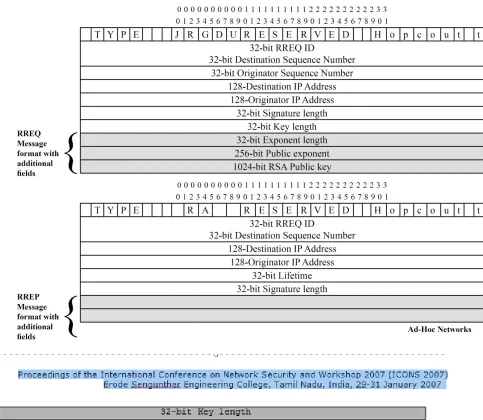
The AODV protocol, as proposed by RFC 3561, is comprised of two basic mechanisms, viz. route discovery and maintenance of local connectivity mechanisms. The Route Discovery mechanism is employed in an “Ad Hoc, On Demand” fashion. The source node S - the device that requests communication with another member of the MANET referred to as destination D - initiates the process by constructing and broadcasting a signed route request message RREQ. The format of the RREQ message differs from the one proposed. An AODV message contains the RSA public key of the source node S and that it is digitally signed to ensure the node’s authentication
and message integrity (refer to fig. 1). Upon receiving a RREQ message, each node member of the MANET authenticates the source node S and verifies message integrity by checking the IP address using the same secure bootstrapping algorithm described in section 4.3.2, and by verifying the signature against the provided public key.
Upon successful completion of the verification process, the node updated its routing table with the source and router IP addresses, if any, and then checks the destination IP address. If the message is not addressed to it, it rebroadcasts the RREQ. If the current node is the destination, it constructs a route reply message RREP) addressed to the source node S. The message is signed and it includes the destination’s public key as shown in Fig. 1. The destination node D unicasts the RREP back to the neighboring node that initially forwarded the RREQ. The neighbor address is retrieved from its own routing table, under source address. Upon receiving a RREP, anyrouting node verifies the destination D’s IP address and signature against the included public key, updates its own routing table with the destination D and router addresses, if any, and unicasts the message to the router listed in its routing table under the source S address entry. If the route entry to S does not exist or has expired, the message is dropped and an error message is sent to all affected neighbors. If the source node does not receive any reply in a predetermined amount of time, it rebroadcasts new route requests. A detailed explanation of the process can be found. The Maintenance of Local Connectivity mechanism is optionally achieved by periodically broadcasting Hello-type messages. In our implementation these messages are signed and contain the sender’s public key for authentication and message integrity verification. Additional information on local connectivity maintenance can be found. During our implementation and testing of AODV and SecAODV, we observed that the protocol’s performance is very sensitive especially to the HELLO
Figure 1. SecAODV message formats (shaded fields are the newly added fields to AODV message format)
V. DESING OF IDS
Although encryption and signed headers are intrusion prevention measures, security holes remain nonetheless. An IDS further strengthens the defense of a MANET. A reliable IDS, operating within a MANET, requires that trust be established amongst collaborating nodes in the absence of any pre-existing trust associations, or the availability of an online service to establish such associations. The use of SUCVs is thus well-suited for such situations.
5.1. Design Considerations
greater the availability of meaningful data for further analysis. The degree of mobility of each node in the network will also have a significant impact on its effectiveness. In a MANET with a high degree of mobility, if the number of routing error messages causes by legitimate reasons far exceeds the number of routing error messages caused due to the presence of malicious nodes, the effectiveness or benefit of such an IDS may be minimal. The damage that could be caused by a malicious node in highly mobile environment would, however, also be minimal since malicious routing messages would likely make up a small percentage of routing error messages. Sensor networks may be less ephemeral and less mobile, while other networks may be characterized by sporadic participation of individual members. MANETs with loose or no prior associations would be more difficult to diagnose than a MANETs comprised of nodes from the same organization with strong as associations. Clearly, the latter case would present a more challenging problem. In a network in which nodes have sporadic participation, the damage malicious nodes are likely to cause would also be less serious and more of a nuisance than a serious performance threat. The IDS would perform differently in an open MANET, one in which participation is not restricted, versus a closed MANET, one in which participation is restricted in both number and by the possession of certain credentials.
5.2. Design goals
5.2.1. Scalability
Snooping on all packet traffic is prohibitively expensive for most resource-constrained mobile devices, especially when traffic increases as the number of nodes within radio-range increase. In dense networks, there will be a large number of neighbor nodes. Also, as newer wireless standards increase the radio-range of wireless interfaces, resulting larger ranges will have the same effect. The IDS should allow selective processing of packets and ignore the rest. The effectiveness of the IDS will depend on its scalability.
5.2.2. Platform for a collaborative IDS
In order to implement a truly robust IDS there will be a need to aggregate data from multiple architectural layers. Alarms and thresholds placed at the network layer can report on the detection of routing misbehaviors such as observed incorrect packet forwarding. The MAC layer may alarm on nodes that send malicious CTS messages designed to deny other nodes network access. The Transport layer may contain signatures for known attacks such as the SYN flood. Delegating collaboration and Trust issues to the application level, the IDS agent should enable collection of local audit data. The notion of Trust is determined through an aggregation of information collected from multiple observing layers providing input for evaluation algorithms at the Application layer. Collaboration not only comes from within the node, but can be shared between nodes as Trust and reputation values are passed from throughout the network.
5.2.3. Enable protocol specific IDS.
The IDS should allow monitoring of packet traffic for specific protocols. Specific protocols behave in a predictable pattern. Intrusion detection makes use of these patterns to spot abnormal behavior and in some instances, Ad-Hoc Networks specific signatures indicating malicious activity. Some protocols are more likely than others to be used with malicious intent. For example in TCP a SYN flood can use up available ports on the target machine effectivelydenying service.
5.3. Scope of IDS
some fields like hopcount in the IPv6 header. A node can thus monitor most of the packet traffic of its neighbors in promiscuous mode, while they are in radio-range. A node receiving packets but not forwarding them can be detected. We monitor AODV control messages and data stream packets only. We do not monitor control messages for faithful retransmissions. Since control
5.4. Stateful packet monitoring
Figure 2. Packet filtering and monitoring
We use the packet capture library, libpcap, for capturing packets. As shown in Fig. 2 the raw packets captured by the pcap are filtered to get only IPv6 using the protocol header field in the MAC header (Ethernet in this case). Further filtering is used to separate AODV and TCP packets. We restrict ourselves to monitoring TCP data streams.
5.4.1. Building Neighbor tables.
The AODV control messages include special kind of RREP messages called “Hello” messages. These are used by nodes to advertise their presence provide connectivity information in the messages are signed by the senders, modifications will be caught in the signature verification at the receiver. .3.2. Intrusion Response. The purpose of intrusion detection is to isolate misbehaving nodes and deny them network resources. Nodes may be maliciously dropping packets or may have a genuine problem that prevents them from forwarding packets. Chronically faulty or malicious behavior, however, can be distinguished from transient failures by monitoring their activity over a period of time and setting thresholds. Such nodes are then deemed malicious and denied network resources. This can be done in two ways viz. unilaterally ignoring all traffic to or from a malicious node, and calling a vote on other members in the MANET to decide upon the eviction of a suspected node from the MANET. Though this is a design goal, the collective response part has not yet been implemented.
5.4. Stateful packet monitoring
We use the packet capture library, libpcap, for capturing packets. As shown in Fig. 2 the raw packets captured by the pcap are filtered to get only IPv6 using the protocol header field in the MAC header (Ethernet in this case). Further filtering is used to separate AODV and TCP packets. We restrict ourselves to monitoring TCP data streams.
The AODV control messages include special kind of RREP messages called “Hello” messages. These are used by nodes to advertise their presence provide connectivity information in the by the nodes at periodic intervals. Nodes can discover their neighbors using these messages. Also, if a neighbor moves away, the node will cease to receive its neighbor’s hello messages and thus update its routing tables. We use these messages to build neighbor tables, which consist of tuples of the form (MAC address, IPv6 address, drop count, route state), as shown in fig. 2. (MAC address, IPv6 address) constitute the unique key. This table is kept updated by monitoring Hello messages and RERR messages. More details on route maintenance and timeouts can be found. Data traffic of active neighbor nodes is monitored.
5.4.2. Monitoring data packets.
As shown in Figure 3 we monitor data packets that need to be forwarded. Referring to Figure 3, consider nodes A, B and C within radio-range of each other. Without loss of generality, let C be the monitoring node, and B be the target of monitoring. A is sending a datagram via B to some other destination. B is acting as an intermediary node forwarding packets on behalf of A. Consider the datagram dgram in sent by A to B. diagram in will have MAC source address of A, MAC destination address of B. But the destination IPv6 address will not be that of B, since B is not the ntended recipient of diagram in. Now consider the datagram that B forwards after receiving dgram in. dgram out will have the MAC source address of B, however the source IPv6 address in the datagram will be that of A, and not B. In fact, dgram in is a datagram that B is expected to forward and dgram out will be that expected datagram sent out by B, onward to its intended recipient. Packets of specific protocols can be selectively monitored using the protocol field in the IPv6 header for filtering. C being the monitoring node, will first record dgram in and watch for B to transmit dgram out. The processing and queuing delay at B, may vary depending on congestion and CPU load on B. Under normal circumstances, B will transmit dgram out within a reasonable amount of time. If B fails to do so, then C can infer that B must have dropped the packet. When matching dgram in and dgram out for a particular protocol it is important to match all fields that should not be changed by B. If B mangles the packet in some malicious way, the original dgram in will be unaccounted for in C’s monitoring process. C will also infer such packets to have been dropped by B.
VI. CONCLUSIONS AND FUTURE WORK
protecting the network from routing disruption attacks, packet mangling attacks and grey holes, denial of service attacks that use MACvulnerabilities to disrupt communication are still possible.However such attacks cannot be prevented at higher networking layers, rather security mechanisms need to provided in the MAC protocol itself. Nodes can operate on their own, however for propagating information on misbehaving nodes a platform to enable collaboration for dissemination of such IDS data is needed. The scope of a host based IDS deployed on a mobile device is limited to its radio range. Potentially an IDS may assume that a neighboring node is dropping packets, when in fact, the node simply moved out of range of the monitoring node. A low signal strength will help determine the distance of the neighboring node and thus help decide if a node is misbehaving or has simply moved out of range. Also it will be helpful in selection of nodes to monitor and increase the scalability and detection accuracy of the IDS.
REFERENCES
[1] Anand Patwardhan, Jim Parker, Anupam Joshi, Michaela Iorga and Tom Karygiannis, “Secure Routing and Intrusion Detection in Ad Hoc Networks”
[2] R. Bobba, L. Eschenauer, Ve. Gligor, and W. Arbaugh.“Bootstrapping security associations for routing in mobile ad-hoc networks”, May 2002.
[3] C. Perkins and E. Belding-Royer and S. Das. “Ad hoc On-Demand Distance Vector (AODV) Routing”, July 2003.
[4] Elizabeth M. and Belding-Royer. Report on the AODV interop. http://www.cs.ucsb.edu/ ebelding/txt/interop.ps, on Communications Architectures, Protocols and Applications, pages 234–244, 1994.June 2002.
[5] Y.-C. Hu, D. B. Johnson, and A. Perrig. Sead: “Secure efficient distance vector routing for mobile wireless ad hoc networks”, In Proceedings of the Fourth IEEE Workshop on Mobile Computing Systems and Applications, page 3. (IPv6) Addressing Architecture, April 2003.
[6] Y.-C. Hu, A. Perrig, and D. B. Johnson. “Ariadne: a secure on-demand routing protocol for ad hoc networks”, In Proceedings of the 8th annual international conference on Mobile computing and networking, pages 12–23. ACM Press, 2002.
[7] D. B. Johnson and D. A. Maltz. “Dynamic source routing in ad hoc wireless networks”, In Imielinski and Korth, editors, Mobile Computing, volume 353. Kluwer Academic Publishers, 1996.
[8] U. Lu, B.; Pooch. Cooperative security-enforcement routing in mobile ad hoc networks. In Mobile and Wireless Communications Network, 2002. 4th International Workshop on, Vol., Iss., pages 157–161, 2002.
[9] Martin Casado. Packet Capture With libpcap and other Low Level Network Tricks.
[10] G. Montenegro and C. Castelluccia. Statistically unique and cryptographically verifiable(sucv) identifiers and addresses, 2002.
[11] J. Morris. Perlipq: Perl extension to Linux 275–283. ACM Press, 2000. Iptables userspace queueing via libipq. http://www.intercode.com.au/jmorris/perlipq/
[12] P. Papadimitratos and Z. Haas. Secure routing for mobile ad hoc networks, January 2002.
[13] V. D. Park and M. S. Corson. A highly adaptive distributed routing algorithm for mobile wireless networks. In INFOCOM (3), pages 1405– 1413, 1997.
[14] J. Parker, J. L. Undercoffer, J. Pinkston, and A. Joshi. On Intrusion Detection in Mobile Ad Hoc Networks. In 23rd [15] R. Hinden and S. Deering. Internet Protocol Version 6
[16] T. Aura. Cryptographically Generated Addresses (CGA), February 2004.IEEE Computer Society, 2002. [17] Tim Carstens. Programming with pcap.
[18] C.-Y. Tseng, P. Balasubramanyam, C. Ko, R. Limprasittiporn, J. Rowe, and K. Levitt. A specification- based intrusion detection system for aodv. In Proceedings of the 1st ACM workshop on Security of ad hoc and sensor networks, pages 125–134. ACM Press, 2003. V. Jacobson, C. Leres, and S. McCanne. TCPDUMP group’s release 3.8.3.
[19] Y.-C. Tseng, J.-R. Jiang, and J.-H. Lee. Secure bootstrapping and routing in an ipv6-based ad hoc network. In ICPP Workshop on Wireless Security and Privacy, 2003.
[20] Tuominen A. HUT AODV for IPv6 User Guide and Function Reference Guide.
[21] S. Yi, P. Naldurg, and R. Kravets. Security-aware ad hoc routing for wireless networks. In Proceedings of the 2nd ACM international symposium on Mobile ad hoc networking & computing, pages 299–302. ACM Press,2001.
[22] M. G. Zapata. Secure Ad hoc On-Demand Distance Vector (SAODV) Routing. In Internet Draft, 2002.