Minimum impact and immediacy of citations to physics open
archives of arXiv.org:
Science Citation Index
based reports
E. R. Prakasan, Anil Sagar, V. L. Kalyane, Anil Kumarand Stevan Harnad
Abstract
The present work has calculated the minimum Open Archive Impact Factors and Open Archive Immediacy Index for the Physics Classes of arXiv.org as calculated for traditional journals in Journal Citation Reports of Institute of Scientific Information using
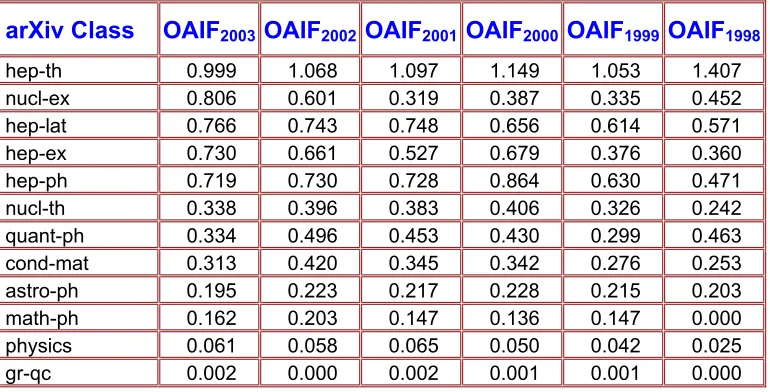
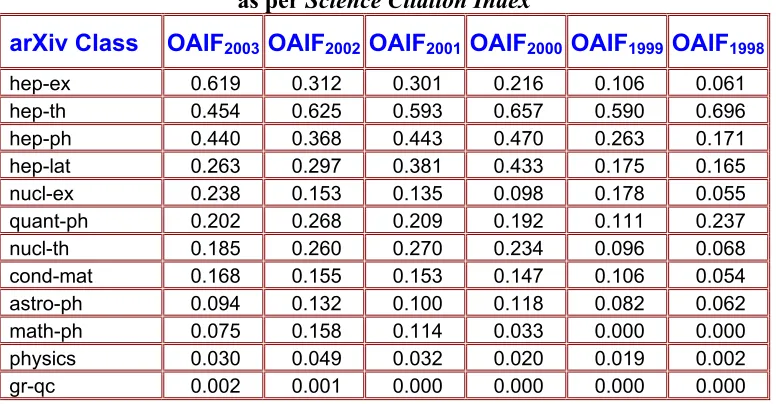
Science Citation Index without the citation by the classes itself. The calculated Impact Factors reveal that High-Energy Physics classes of arXiv.org (‘hep-th’, ‘hep-lat’, ‘hep-ex’, and ‘hep-ph’) have made more impact on scientific community than any other classes except for the class ‘nucl-ex’. The Impact Factors for the year 2003 are: ‘hep-th’ (0.999), ‘nucl-ex’ (0.806), ‘hep-lat’ (0.766), ‘hep-ex’ (0.73), ‘hep-ph’ (0.719), ‘nucl-th’ (0.338), ‘quant-ph’ (0.334), ‘cond-mat’ (0.313), ‘astro-ph’ (0.195), ‘math-ph’ (0.162), ‘physics’ (0.061), and ‘gr-qc’ (0.002). It has been found that if the period for getting the citations to the open archive classes is considered one year as against two years for journal articles the rank of the classes are same. The immediacy of citing the Open Archives is also high for the High-Energy Physics classes. The Immediacy Indexes for the year 2003 are: ‘hep-ex’ (0.619), ‘hep-th’ (0.454), ‘hep-ph’ (0.44), ‘hep-lat’ (0.263), ‘nucl-ex’ (0.238), ‘quant-ph’ (0.202), ‘nucl-th’ (0.185), ‘cond-mat’ (0.168), ‘astro-ph’ (0.094), ‘math-ph’ (0.075), ‘physics’ (0.03), and ‘gr-qc’ (0.002). Definitely, the impact is much more than what is concluded from the calculated factors as the self-citations are not taken into the study. Use of web-tools like ‘Citebase’, ‘Citeseer’ etc. may strengthen the above argument.
Keywords:
Open Archives; Citation Impact; Immediacy in Citing; Impact Factor; Immediacy Index; Physics Open Archives; arXiv.org; Open Archive Impact Factor; Open Archive Immediacy Index; Minimum ImpactIntroduction
home pages [Björk, 2004]. R&D policy makers around the world have recommended mandating that researchers provide Open Access (OA) to their research articles by self-archiving them free for all on the Web [Harnad, 2001]. OA is now firmly on the agenda for funding agencies, universities, libraries and publishers. What is needed now is objective, quantitative evidence of the benefits of OA to research authors, their institutions, their funders and to research itself. OA articles have significantly higher citation impact than non-OA articles [Harnad et al., 2004]. Brody [2004] is also supported in a web-based analysis of usage and citation patterns. One universally important factor for all authors is impact made by their research papers, typically measured by the number of times a paper is cited.
Now the Open Archives (OA) era has revolutionized with new ideas about starting a global database for finding the number of citations received to the OA submissions. Citebase [Brody, 2003] and Citeseer are two such webtools, which serve this partially. Studies have begun to show that open access increases impact, although more studies and more substantial investigations are needed to confirm the effect. Hitchcock [2004] has given the progress in these directions in the form of a chronological bibliography with some explanation.
Recently Laurence [2001] and Brody, et al. [2004] have demonstrated that articles which are available on-line at no charge are cited at substantially higher rates than those which are not. Kurtz [2004] has shown that restrictive access policies can cut article downloads to half the free access rate [Kurtz et al., 2004].
A new measure that becomes possible with online publication is the number of downloads or 'hits', opening a new line of investigation. Brody et al. [2004] have been prominent in showing there is a correlation between higher downloads and higher impact, particularly for high impact papers, holding out the promise not just for higher impact resulting from open access but for the ability to predict high impact papers much earlier, not waiting years for those citations to materialise [e.g. Brody and Harnad, 2004]. The effect can be verified with the Correlation Generator.
Citation analysis can be used to find emerging fields, to map the time-course and direction of research progress, and to identify synergies between different disciplines [Brody, 2004]. Citation analysis is being mainly used for measuring the impact made by journal articles. But Rousseau [1997] has attempted to compare the impact made by the ‘first and second international conferences on bibliometrics, scientometrics and informetrics’ with some top journals in the field. Information scientists are already computing web impact factors [Bjorneborn and Ingwersen, 2001].
in the wrong hands it might be abused [Garfield, 1999a]. As long as scientists publish articles containing lists of cited references, it will be possible to calculate impact factors [Garfield, 2001]. Garfield [2004] has also stated that “it has been demonstrated that on line access improves both readership and citation impact”. The same impact factor can indicate the ‘influence’ and ‘performance’ of e-print archives they make among scientists.
According to Institute of Scientific Information (ISI), the ‘Impact Factor’ and ‘Immediacy Index’ of a journal are calculated as follows:
Impact Factor =
years two previous the in published articles citable of No. year g calculatin the in articles years two previous the to citations of No.
Immediacy Index =
year g calculatin the in published articles citable of No. year g calculatin the in published articles the to citations of No.
Sen et al. [1989] had calculated Impact Factors of non-Science Citation Index
(SCI) journals. The calculation is based on three factors:
1. the number of citable items published in the journal during years (Y-1) and (Y-2), say y1 and y2 respectively;
2. the number of times those items are cited in year Y in SCI journals, say x1;
3. the number of times those items are cited in year Y in the journal X itself, say x2;
Impact Factor is calculated as:
2 1 2 1 Y y y x x IF + + =
Index data is used for computing the Impact Factors and Immediacy Index for Open Archives. Then the Open Archive Classes are compared with the journals included in the Science Citation Index.
Refining the computation of topic based impact factors can be done through the computation of impact factors for individual research papers [Garfield, 1999b]. Citation and publication patterns differ between disciplines, so the Impact Factor is only meaningful when it is used to compare journals within a discipline [Testa and McVeigh, 2004]. For this reason, the comparisons in this study are done for only the physics sub-class e-print archives of arXiv.org.
Materials & Methods
Open archive initiatives have for the first time started by Los Alamos National Laboratory arXiv.org in 1991 and it was the brainchild of Paul Ginsparg, a physicist. It receives about 10,000 downloads per hour on the main site alone (there are a dozen mirror sites), is an essential resource for research physicists. ArXiv's high level of usage by both authors and readers makes it an excellent database for analysing research trends as well as an important test-case for the OA literature [Brody and Harnad, 2004]. The categorised services of the present arXiv.org have helped scientists to look in to items of his/her interest. The categories are divided into five main categories, viz. Physics,Mathematics, Nonlinear Sciences, Computer Science, and Quantitative Biology. The physics category is again categorised in to 12 sub-classes as follows:
• Astrophysics (astro-ph)
• Condensed Matter (cond-mat)
• General Relativity and Quantum Cosmology (gr-qc) • High Energy Physics - Experiment (hep-ex)
• High Energy Physics - Lattice (hep-lat)
• High Energy Physics - Phenomenology (hep-ph) • High Energy Physics - Theory (hep-th)
• Mathematical Physics (math-ph) • Nuclear Experiment (nucl-ex) • Nuclear Theory (nucl-th) • Physics (physics)
The calculation with out the third factor for the sub-classes of physics by treating them as journal titles is experimented here. The formulae for calculating the minimum Open Archive Impact Factor (OAIF) and Open Archive Immediacy Index (OAII) will be as follows:
OAIF = The ratio of the number of citations received to the previous two years submissions in the calculating year (without self citations) with the number of submissions in the previous two years.
OAII = The ratio of the number of citations received to the submissions in the calculating year (without self citations) with the number of submissions in the same year.
The citations received in Science Citation Database (1996 - 2003) are used as the base data for calculating the above parameters. There is no direct search mechanism for citations received for these categories. Search mechanism and analysis are somewhat different from the direct search in Web of Sciences or
Web of Knowledge. For eg. The search query used for retrieving the citations
received to the ‘Condensed Matter (cond-mat)’ category of physics for the year 1997 in the ‘cited author/reference’ field is as follows.
A*-COND-MAT97-* OR B*-COND-MAT97-* OR C*-COND-MAT97-* OR D*-COND-MAT97-* OR E*-COND-D*-COND-MAT97-* OR F*-COND-D*-COND-MAT97-* OR G*-COND-D*-COND-MAT97-* OR H*-COND-MAT97-* OR I*-COND-MAT97-* OR J*-COND-MAT97-* OR K*-COND-MAT97-* OR L*-COND-K*-COND-MAT97-* OR M*-COND-K*-COND-MAT97-* OR N*-COND-K*-COND-MAT97-* OR O*-COND-MAT97-* OR P*-COND-MAT97-* OR Q*-COND-MAT97-* OR R*-COND-MAT97-* OR S*-COND-R*-COND-MAT97-* OR T*-COND-R*-COND-MAT97-* OR U*-COND-R*-COND-MAT97-* OR V*-COND-MAT97-* OR W*-V*-COND-MAT97-* OR X*-V*-COND-MAT97-* OR Y*-V*-COND-MAT97-* OR Z*-COND-MAT97-* OR <ANON>*-COND-MAT97-*
JCR-2003 was made use of to elicit the latest Impact Factors of some journals.
Results and Discussion
‘quant-ph’, ‘cond-mat’, ‘astro-ph’, ‘math-ph’, and ‘physics’ categories. The subfield of physics with hardly any impact was for the category ‘gr-qc’.
Table 1: Open Archive Impact Factors (by considering citations to previous two years submissions) for the Physics Classes of arXiv.org as per
Science Citation Index
arXiv Class OAIF2003 OAIF2002 OAIF2001OAIF2000 OAIF1999 OAIF1998
hep-th 0.999 1.068 1.097 1.149 1.053 1.407
nucl-ex 0.806 0.601 0.319 0.387 0.335 0.452
hep-lat 0.766 0.743 0.748 0.656 0.614 0.571
hep-ex 0.730 0.661 0.527 0.679 0.376 0.360
hep-ph 0.719 0.730 0.728 0.864 0.630 0.471
nucl-th 0.338 0.396 0.383 0.406 0.326 0.242
quant-ph 0.334 0.496 0.453 0.430 0.299 0.463
cond-mat 0.313 0.420 0.345 0.342 0.276 0.253
astro-ph 0.195 0.223 0.217 0.228 0.215 0.203
math-ph 0.162 0.203 0.147 0.136 0.147 0.000
physics 0.061 0.058 0.065 0.050 0.042 0.025
gr-qc 0.002 0.000 0.002 0.001 0.001 0.000
Open archives are increasingly and immediately accessed through the Web and instantly get cited than the traditional journal articles. For researchers, the time of accessibility to the open archives has drastically reduced. The phenomena have caused the time for citing the open archives. The study has also taken citations received in the previous one year as against two years for the calculation of Impact Factors for traditional journal articles. Table 2 presented the corresponding Impact Factors. In this case also, high-energy physics classes are leading and the rank of the classes are almost same. The Impact Factors have gone up for almost all classes. The quotient has increased only because the growth in numerator has increased. That means, the number of citations are increasing every year, but the number of submissions are not growing in that pace.
Table 2: Open Archive Impact Factors (by considering citations to previous year submissions) for the Physics Classes of arXiv.org as per
Science Citation Index
arXiv Class OAIF2003 OAIF2002 OAIF2001OAIF2000 OAIF1999 OAIF1998
hep-th 1.507 1.469 1.482 1.546 1.472 2.064
hep-lat 1.262 1.099 1.183 0.976 0.989 0.964
nucl-ex 1.214 0.845 0.448 0.534 0.264 0.739
hep-ph 1.024 1.072 0.994 1.195 0.946 0.723
hep-ex 0.881 0.951 0.670 0.855 0.501 0.468
nucl-th 0.437 0.517 0.528 0.569 0.494 0.356
cond-mat 0.415 0.609 0.481 0.471 0.361 0.363
quant-ph 0.401 0.585 0.571 0.545 0.362 0.424
astro-ph 0.278 0.294 0.303 0.287 0.280 0.258
math-ph 0.195 0.192 0.154 0.172 0.147 0.000
physics 0.082 0.064 0.073 0.059 0.049 0.027
gr-qc 0.001 0.000 0.003 0.002 0.002 0.000
Table 3 is the list of Immediacy Indexes calculated for the Physics classes of arXiv.org for the years 1998-2003. As the Impact Factors of High-Energy Physics classes of physics, they are cited more immediately after their submission than any other classes. ‘gr-qc’ class has very low immediacy index.
Table 3: Open Archive Immediacy Index for the Physics Classes of arXiv.org as per Science Citation Index
arXiv Class OAIF2003 OAIF2002 OAIF2001OAIF2000 OAIF1999 OAIF1998
hep-ex 0.619 0.312 0.301 0.216 0.106 0.061
hep-th 0.454 0.625 0.593 0.657 0.590 0.696
hep-ph 0.440 0.368 0.443 0.470 0.263 0.171
hep-lat 0.263 0.297 0.381 0.433 0.175 0.165
nucl-ex 0.238 0.153 0.135 0.098 0.178 0.055
quant-ph 0.202 0.268 0.209 0.192 0.111 0.237
nucl-th 0.185 0.260 0.270 0.234 0.096 0.068
cond-mat 0.168 0.155 0.153 0.147 0.106 0.054
astro-ph 0.094 0.132 0.100 0.118 0.082 0.062
math-ph 0.075 0.158 0.114 0.033 0.000 0.000
physics 0.030 0.049 0.032 0.020 0.019 0.002
gr-qc 0.002 0.001 0.000 0.000 0.000 0.000
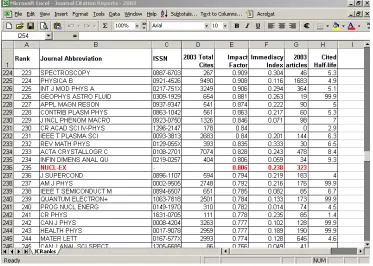
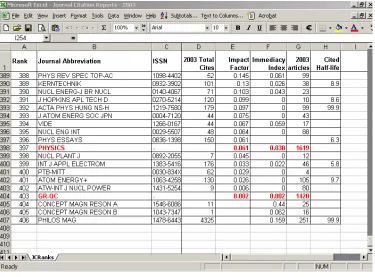
Figure 2a: Rank of ‘hep-th’ class among the physics related journals in JCR-2003
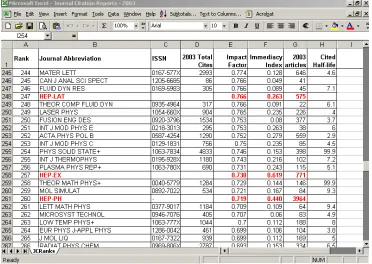
Figure 2c: Ranks of ‘hep-lat’, ‘hep-ex’, and ‘hep-ph’ classes among the physics
related journals in JCR-2003
Figure 2e: Ranks of ‘astro-ph’, and ‘math-ph’ classes among the physics related journals in JCR-2003
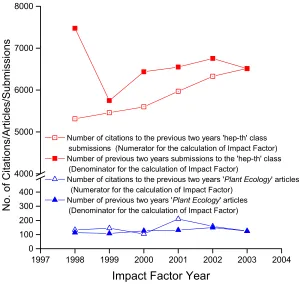
The study has given a typical example of the comparison of numerators (number of citations to the previous two years submissions in the calculating year) and denominators (number of submissions in the previous years of the calculating year) for the calculation of Impact Factors of 2000 to 2203 for the arXiv class ‘hep-th’ and the traditional journal ‘Plant Ecology’, both have almost same Impact Factors (0.999 and 1.000 respectively) through Figure 3. The close observation to the figure reveals that the numerators i.e. the number of citations have the fluctuations in a horizontal way but the denominators i.e. the number of articles are going almost parallel in all calculated years for the journal ‘Plant Ecology’. But for ‘hep-th’, the number of citations increased with time, and also with the number of submissions to the category.
1997 1998 1999 2000 2001 2002 2003 2004
0 100 200 300 400 4000 5000 6000 7000 8000
Number of citations to the previous two years 'hep-th' class submissions (Numerator for the calculation of Impact Factor)
Number of previous two years submissions to the 'hep-th' class (Denominator for the calculation of Impact Factor)
Number of citations to the previous two years 'Plant Ecology' articles (Numerator for the calculation of Impact Factor)
Number of previous two years 'Plant Ecology' articles (Denominator for the calculation of Impact Factor)
No.
of Cit
a
tions
/A
rt
ic
les
/Submiss
ions
Impact Factor Year
Figure 3: Comparison of numerators and denominators for the calculation of Impact Factors of arXiv ‘hep-th’ class and the
Conclusion
The High-Energy Physics open archives are making much impact among scientists. The immediacy factor is higher in High-Energy Physics open archives as compared to other classes. If the study incorporates the citations received for these e-print archives in the e-print archives itself, definitely the categories may compete with the science journals with impact factors of more than one. Again the impact made by the categories studied may go up if the study is also based on the new autonomous Open Archive web tools like ‘Citebase’, ‘Citeseer’, etc.
Since the e-print archives are instant information feeding mechanism with an ephemeral effect, the OAIF can be a divergent idea rather than OAII. This connotation can be complemented if half-life of e-print archives has been calculated.
Although many authors believe that their work has a greater research impact if it is freely available, studies to demonstrate that impact are few [Antelman, 2004].
Once the impact and immediacy in citations of subject open archives are compared, scientists will submit their research documents in the open archive categories with high impact factors and immediacy index. In that case, the continued emphasis on ‘Impact Factors’ will not be misguided the readers as stated by Brunstein [2000]. Wherever the readers can make a comparison of sources they want to publish considering impact factors as the criteria, they may slant towards the high impact side.
References
2. Björk, B.C. (2004) Open access to scientific publications - an analysis of the barriers to change, Information Research, 9(2) paper 170,
http://informationr.net/ir/9-2/paper170.html.
3. Bjorneborn, L. and Ingwersen, P. (2001) Perspectives of webometrics, Scientometrics, 50(1): 65-82.
4. Brody, T. (2003) Citebase Search: Autonomous Citation Database for e-Print Archives, SINN 03 conference on Worldwide Coherent Workforce, Satisfied Users - New Services For Scientific Information, Oldenburg, Germany, September 2003,
http://physnet.physik.uni-oldenburg.de/projects/SINN/sinn03/proceedings/brody.
5. Brody, T. (2004) Citation Analysis in the Open Access World,
http://eprints.ecs.soton.ac.uk/10000/01/tim_oa.pdf, To appear in: Interactive Media International http://www.epsltd.com/clients/imi.asp.
6. Brody, T. and Harnad, S. (2004, in prep.) Earlier Web Usage Statistics as Predictors of Later Citation Impact, http://www.ecs.soton.ac.uk/~harnad/Temp/timcorr.doc.
7. Brody, T. and Harnad, S. (2004) Using Web Statistics as a Predictor of Citation Impact Author eprint (in prep.) http://www.ecs.soton.ac.uk/~harnad/Temp/timcorr.doc.
8. Brody, T.; Stamerjohanns, H.; Harnad, S.; Gingras, Y.; Vallieres, F. and Oppenheim, C. (2004) The effect of Open Access on Citation Impact, National Policies on Open Access (OA) Provision for University Research Output: an International meeting. Southampton University, Southampton UK. 19 February 2004.
http://opcit.eprints.org/feb19oa/brody-impact.pdf.
9. Brunstein, J. (2000) End of Impact Factors, Nature, 403(6769): 478-478.
10. Correlation Generator http://citebase.eprints.org/analysis/correlation.php Generates a graph (or table) of the correlation between citation impact and usage impact from the Citebase database.
11. Garfield, E. (1999a) Journal Impact Factor - A Brief Review, Canadian Medical Association Journal, 161(8): 979-980.
12. Garfield, E. (1999b) Refining the Computation of Topic Based Impact Factors: Some Suggestions, Occupational Medicine (Oxford), 49(8), 571,
http://www.garfield.library.upenn.edu/papers/occupmed49(8)p571y1999.html.
13. Garfield, E. (2001) Impact Factors, and Why They Wont Go Away, Nature, 411(6837): 522-522.
14. Garfield, E. (2004) post to American Scientist Open Access Forum listserv, 18 January 2004. http://listserver.sigmaxi.org/sc/wa.exe?A2=ind04&L=american-scientistopen-access-forum&F=l&S=&P=9766.
15. Harnad, S. (2001) Research access, impact and assessment, Times Higher Education Supplement, 1487: 16.
16. Harnad, S.; Brody, T.; Vallieres, F.; Carr, L.; Hitchcock, S.; Gingras, Y; Oppenheim, C.; Stamerjohanns, H. and Hilf, E. (2004) The Access/Impact Problem and the Green and Gold Roads to Open Access, Serials Review, 30.
17. Hitchcock, S. (2004) The effect of open access and downloads ('hits') on citation impact: a bibliography of studies, http://opcit.eprints.org/oacitation-biblio.html.
18. Kurtz, M.J. (2004) Restrictive access policies cut readership of electronic research journal articles by a factor of two, National Policies on Open Access (OA) Provision for University Research Output: an International meeting. Southampton University, Southampton UK. 19 February 2004. http://opcit.eprints.org/feb19oa/kurtz.pdf.
19. Kurtz, M. J.; Eichhorn, G.; Accomazzi, A.; Grant, C. S.; Demleitner, M. and Murray, S. S. (2004) Worldwide Use and Impact of the Nasa Astrophysics Data System Digital Library, Author eprint, January 28, 2004, http://cfa-www.harvard.edu/~kurtz/jasist1-abstract.html, Journal of the American Society for Information Science and
Technology, accepted for publication.
20. Lawrence, S. (2001) Online or Invisible?, Nature, 411: 521.
21. Prakasan, E.R.; Anil Sagar; Anil Kumar; Lalit Mohan; Gaderao, C. R.; Surwase, Ganesh; Kadam, Sandeep; Kalyane, V. L. and Vijai Kumar (2004a) Nuclear Theory and Nuclear Experiment E-print Archives: Science Citation Index - based Analysis, Proc. of the 22nd Annual Convention & Conference on Digital Information Exchange: Pathways to Build Global Information Society (SIS 2004), IIT Madras, Chennai, 22-23 January 2004, pp. 172-183. http://eprints.rclis.org/archive/00001244/
22. Prakasan, E. R. and Kalyane, V. L. (2004) Citation analysis of LANL High-Energy Physics E-Prints through Science Citation Index (1991-2002) Author eprint, E-LIS, 26 August 2004.
23. Rousseau, Ronald (1997) The proceedings of the first and second international conferences on bibliometrics, scientometrics and informetrics: A data analysis, Proceedings of the Sixth Conference of the International Society for Scientometrics and Informetrics, Jerusalem, Israel, 1997.
24. Sen, B.K.; Karanjai, A.; and Munshi, U.M. (1989) A method for determining the impact factor of a non-SCI journal, Journal of Documentation, 45(2): 139-141.
25. Testa, J. and McVeigh, M. E. (2004) The Impact of Open Access Journals: A Citation Study from Thomson ISI, Author eprint, 14 April 2004, http://www.isinet.com/media/presentrep/acropdf/impact-oa-journals.pdf.
26. Tomer, C. (1986) A statistical assessment of two measures of citation: the impact factor and the immediacy index, Information Processing and Management, 22 (3): 251-258.
27. Youngen, G.K. (1998a). Citation Patterns to Electronic Preprints in the Astronomy and Astrophysics Literature. Library and Information Services in Astronomy, 153.