Abstract
Over the past decade functional Magnetic Reso-nance Imaging (fMRI) has emerged as a powerful technique to locate activity of human brain while engaged in a particular task or cognitive state. We consider the inverse problem of detecting the cog-nitive state of a human subject based on the fMRI data. We have explored classification techniques such as Gaussian Naive Bayes, k-Nearest Neighbour and Support Vector Machines. In order to reduce the very high dimensional fMRI data, we have used three feature selection strategies. Dis-criminating features and activity based features were used to select features for the problem of identifying the instantaneous cognitive state given a single fMRI scan and correlation based features were used when fMRI data from a single time in-terval was given. A case study of visuo-motor se-quence learning is presented. The set of cognitive states we are interested in detecting are whether the subject has learnt a sequence, and if the subject is paying attention only towards the position or to-wards both the color and position of the visual stimuli. We have successfully used correlation based features to detect position-color related cog-nitive states with 80% accuracy and the cogcog-nitive states related to learning with 62.5% accuracy.
1 Introduction
Functional Magnetic Resonance Imaging (fMRI) is a power-ful imaging tool, which can be used to perform brain activa-tion studies my measuring Blood Oxygen Level Dependent (BOLD) signal [Ogawa et al., 1990]. Human brain carries out various functions at a time. The operations within the brain like, “the process of thinking” and “the process of remembering”, that affect our mental contents are called as ‘cognitive processes’ and the person is said to be in the par-ticular ‘cognitive state’. Our aim is to identify the cognitive state of a human subject that is persistent within a certain interval of time, given the fMRI activity within that interval. Our motivation in the detection of cognitive states is that this could lead to our understanding of the hidden cognitive states a human passes through while performing a particular
task. This could have potential applications in Lie Detectors, Cognitive control of artifacts, Cognitive control of mental states (Neurofeedback), etc.
An fMRI scanner measures the value of the fMRI signal at all the points in a three dimensional grid, or image every few seconds (6 sec in our data). The voxels (volume pixels) in a typical fMRI study have a volume of a few tens of cubic millimeters and the 3D brain image contains 1,84,707 vox-els that constitute the whole brain, thereby resulting in very high dimensional data. Since the signals measure tiny fluc-tuations in the magnetic field, known as the Blood Oxygen Level Dependent (BOLD) response, the signal-to-noise ratio (SNR) for fMRI data is very low. Thus the other characteris-tic of fMRI data is that they are very noisy. This problem domain is quite interesting from the Machine Learning per-spective, as it provides a case study of classifier learning from extremely high dimensional and noisy data.
We borrow Mitchell’s [Mitchell, 1997] definition to state more formally the problem of detection of cognitive states from fMRI data.
Definition: A computer program is said to have learned from experience E with respect to some class of tasks T and performance measure P, if its performance at tasks in T, as measured by P, improves with experience E. In our case, T: classification of cognitive state of human subject E: labelled training data mapping fMRI scans to the instan-taneous cognitive state
P: performance accuracy of the algorithm over the unseen fMRI data.
The case study in this paper is a Visuomotor sequence learning experiment [Miyapuram, 2004]. Human Subjects perform a motor task (pressing a key on a keyboard) in re-sponse to visual stimuli (having position and colour attrib-utes). The problem that we have attempted in this study is to classify fMRI data into a discrete set of cognitive states that are “subject has learnt a sequence”, “subject did not learn the sequence”, “the subject is paying attention only towards the position of the visual stimuli” and “the subject is paying attention towards the color and the position of the visual stimuli”. The various machine learning algorithms we have applied on this fMRI data are Gaussian Naive Bayes Classi-fier (GNB), k-Nearest Neighbor (kNN) and Support Vector Machines (SVM). To deal with the high dimensionality of the data we have used three feature selection strategies
Detection of Cognitive States from fMRI data using Machine Learning Techniques
Vishwajeet Singh, K.P. Miyapuram, Raju S. Bapi*
University of Hyderabad
Computational Intelligence Lab, Department of Computer and Information Sciences
Gachibowli, Hyderabad, India 500046
namely, Discriminating features, Activity based features and Correlation based features.
2 Materials and Methods
2.1 Machine Learning Classifier Techniques
A classifier is a function which takes input a set of exam-ples and outputs a class label to each input example, where class label belongs to a discrete set of possible categories. In our case the classifier is a function of the form:
f : fMRI-sequence(t1, t2) CognitiveState
where fMRI-sequence(t1, t2) is the sequence of fMRI images
collected during the contiguous time interval [t1, t2], and
where CognitiveState is the set of cognitive states to be dis-criminated.
We explored three classifier training methods: a Gaussian Naive Bayes (GNB), k-Nearest Neighbor (kNN), and linear Support Vector Machines (SVM). These classifiers were selected because they have been used successfully earlier by [Mitchell et al., 2003, 2004; Wang et al., 2004] for solving similar problem as well as in other applications involving high dimensional data. For example, Naive Bayes Classifi-ers, kNN and SVM have all been used for text classification problems [Nigam et al., 2000], where the dimensionality of the data is approximately 105, corresponding to the natural language vocabulary.
2.2 fMRI Task Procedure
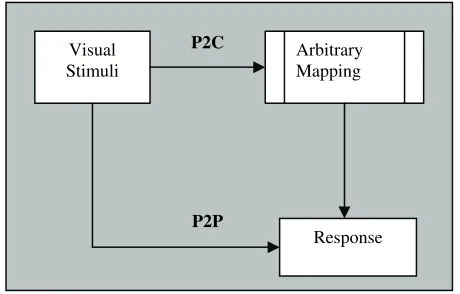
The fMRI experiment consisted of a visuomotor sequence learning task. A set of two circles filled with different col-ours (Yellow, Red, Green or Blue) appeared simultaneously at two distinct positions (Top, Bottom, Left, or Right) on a screen. The correct order of the sequence is to be learnt by trial and error based on the spatial positions of the visual stimuli. In one task (P2P), the response was required to be generated according to the position of the stimuli. In another task (P2C) the subjects had to respond using an arbitrary rule with the following mapping: Green – Top, Red – Right, Blue – Bottom, and Yellow – Left. The entire sequence to be learnt consisted of six such sets. Hence this sequence learning task is called a 2 x 6 task. Subjects continue to practice the same sequence repeatedly for 4 sessions (6 se-quence blocks, of 36 sec each, per session). Human brain is involved in many activities at a time. There are many back-ground processes such as respiration, heart beat, mood, etc. that are not related to the task being performed. Hence fMRI studies must be designed to quantify relative changes in brain activity. For this purpose, the sequence blocks alter-nated with baseline blocks (18 sec each) in which subjects performed keypresses (using the same rule as in sequence task) viewing visual stimuli presented randomly one at a time.
2.3 Feature Selection and Data Abstraction
Data preprocessing: The case studies involve fMRI data of five normal subjects. As shape and size of brain varies for each individual, images need to be transformed into the
co-ordinate system of a standard brain. This transformation would help in standardization of reporting of co-ordinates of the brain space across different studies. To achieve this, two types of brain images were collected for each subject. The first type of image referred to as a functional image, cap-tures brain activation via the BOLD response. The second type of image, called the structural image, captures the static physical brain structure at higher resolution. First the struc-tural images of all the subjects were standardized [Friston et al., 1995] to a template image and the resulting parameters were used for standardizing all the functional images of each subject to the template. The end result of this preproc-essing step is that all the image data are in same size and approximately same shape.
Data Abstraction: As we are interested in training classifi-ers that work across subjects and as the strength of the BOLD response varies from subject to subject, abstracting the data is very important. Hence we adopted a normaliza-tion method in which the algorithm rescales the data in each scan of every subject such that the mean value of the result-ing data is zero, i.e.
Yt = (Xt – meanXt) / stdXt, t = 1 … n
Where Xt's and Yt's are the data before and after normaliza-tion, respectively and, meanXt and stdXt are the mean and the standard deviation of Xt, respectively.
The other approach for data abstraction is a method that takes the correlation of the selected features to transform the real image data.
Feature Selection: Feature selection, as a preprocessing step to machine learning, is effective in reducing dimen-sionality, removing irrelevant data, increasing learning ac-curacy, and improving result comprehensibility. However, the increase in the dimensionality of the data poses a severe challenge to many existing feature selection methods with respect to efficiency and effectiveness. The enormity of data may cause serious problems to many machine learning algo-rithms with respect to scalability and learning performance. For example, high dimensional data (i.e., data sets with hundreds or thousands of features) can contain high degree of irrelevant and redundant information which may greatly degrade the performance of the learning algorithms. There-fore, feature selection becomes very necessary for machine learning tasks when facing high dimensional data. The first two methods, i.e. Discrim and Active, are the same as used by [Mitchell et al., 2003, 2004; Wang et al., 2004].
Select the n most discriminating voxels (Discrim): In this method, voxels (features) are selected based on their ability to distinguish one target class from the other.
Select the n most active voxels (Active): In this method, voxels are selected based on their ability to distinguish ei-ther target class from the baseline condition.
techniques such as Recursive Feature Elimination [Am-broise and McLachlan, 2002] and Fast Correlation Based Filter (FCBF) [Yu and Liu, 2003] lose this information as they use the feature data only. In this method, voxel pairs are selected based on their ability discriminate the target classes. The correlation value between these voxel pairs is then used as feature vector to train the classifiers.
3 Case Study
Our case study involves fMRI data collected when subjects are enagaged in visuo-motor sequence learning experiments. In these experiments, subjects learn the correct sequence of response by trial and error and continue to perform it until the end of the experiment. Therefore there are task–related changes at the neuronal level occurring continuously in dif-ferent areas of the brain. These changes are reflected as changes in the activity at different voxels in fMRI images.
3.1 P2P Vs P2C Classification Study
Firstly, we have considered the problem of training classifi-ers to detect the cognitive states, “the subject is paying at-tention only towards the position of the visual stimuli” and “the subject is paying attention towards the color and the position of the visual stimuli”. When the subject is perform-ing the P2P task he pays attention towards the position of the visual stimuli and responds only according to the posi-tion of the stimuli, the color of the stimuli is irrelevant. Whereas when the subject is performing the P2C task he pays attention towards the position of the visual stimuli and responds according to the color of the stimuli. Hence the essential difference between these two tasks is the way in which the response is generated after seeing the position of the visual stimuli.
Figure 1: The Difference in the response generated during P2P and P2C Tasks
The assumption here is that since the set of brain areas un-derlying spatial and color perception are distinct, the cogni-tive states reflecting the two tasks can be distinguished based on the fMRI signals.
In this particular case study we have tried to capture this difference in our classifier function. We have used the Dis-criminating features and Active feature selection strategies
to train a classifier function of the form f : It
CognitiveS-tate, where It is an fMRI scan at a single time instance and
CognitiveState takes values of P2P or P2C. Results of single subject classification are shown in Table 1.
For multiple subjects, the detection of instantaneous cog-nitive state using Discrim and Active features was below random classification. We have successfully used the corre-lation based feature selection to train the classifier function of the form f: <I1 … It> CognitiveState where <I1 … It>
is a set of fMRI scans taken in a time interval of length t and CognitiveState takes on values P2P and P2C.
Table 1: Results of Single-Subject Classifiers detecting instantane-ous cognitive states in P2P Vs P2C classification study
Feature Selection
No. of Features
GNB KNN (k = 5)
KNN (k = 9)
SVM
Discrim 50 97.91 98.332 97.78 98.61
Discrim 100 98.19 100 99.86 98.61
Discrim 200 98.61 99.722 99.72 98.61
Active 50 92.34 98.332 97.34 98.47
Active 100 92.49 98.472 98.05 98.47
Active 200 92.91 99.026 98.61 98.47
Table 2 shows the results of using correlation based fea-ture selection technique where the average accuracy of the multiple subject classifier is above that of a random classi-fier, for t taking values 12, 36 and 72. The “leave-one-subject-out” strategy was used for training multiple-subject classifiers.
Table 2: Results of Multiple subjects classifiers using CorrPair feature selection in P2P Vs P2C classification study
Feature Selection
No. of Features
GNB KNN (k = 5)
KNN (k = 9)
SVM
t=12 200 56.66 51.66 58 51.65
t=36 200 65 67.5 65 57.5
t=72 200 75 65 75 60
t=12 474 58.33 51.66 50.8 44.1
t=36 474 75 67.5 75 60
t=72 474 80 75 80 70
All three classifiers, GNB, kNN and SVM have per-formed successfully and have given much better results than random-chance classification. Using the CorrPair (t=72) feature selection method gave the optimal results where the number of features is 474 and the number training samples were 16. The results show the superior performance of GNB and kNN (k=9) classifiers over the SVM.
3.2 Early Vs Late Learning Study
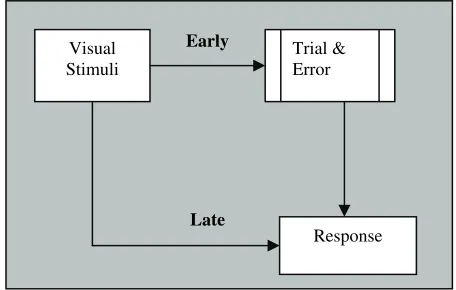
In the second phase, we have considered the problem of training classifiers to detect the cognitive states, “subject has learnt the sequence (Late stage where the performance is smooth and automatic)” and “subject did not learn the se-quence (Early stage where the performance is deliberate and error-prone).” In both the tasks, P2P and P2C, the subjects
Visual Stimuli
Arbitrary Mapping
Response
P2C
have to learn the position sequences (or the order in which to press on the keypad, given the visual stimuli). This se-quence is learnt by a process of trail and error.
Figure 2: The Difference in the response generated during Early and Late Learning Periods
In this case study we try to detect whether the subject has learnt the sequence or not, irrespective of the task he is per-forming. It is to be noted that this classification task is po-tentially more difficult than the earlier one. The assumption here is that the brain processes related to early learning are distinguishable from those engaged in the later part. Further, it is also assumed that the cognitive states corresponding to the two learning stages are similar across the P2P and P2C tasks. We have used the Discriminating features and the Activity based feature selection methods to find a classifica-tion funcclassifica-tion of the form f : It CognitiveState where It is a
fMRI scan at a single time instance and CognitiveState takes values as either “Early Learning” or “Late Learning”. As in previous case study, we were successful in training single subject classifiers.
Table 3: Results of Single-Subject Classifiers detecting instantane-ous cognitive states in Early Vs Late Learning study
Feature Selection
No. of Features
GNB KNN (k = 5)
KNN (k = 9)
SVM
Discrim 50 50 100 100 98.6
Discrim 100 60 100 100 98.6
Discrim 200 65 100 100 98.6
Active 50 80 100 100 98.6
Active 100 80 100 100 98.6
Active 200 80 100 100 98.6
We obtained less than random classification for multiple subject classifications using Discrim and Active features. We have successfully used the correlation based feature selection to train the classifier function of the form
f: < I1 … It > CognitiveState, where < I1 … It > is a set of
fMRI scans taken in a time interval of length t and Cogni-tiveState takes on values — “Early Learning” or “Late Learning”.
Table 4 shows the results of using correlation based fea-ture selection technique where the average accuracy of the multiple subject classifier is above that of a random classi-fier, for t taking values 12, 36 and 72. The “leave-one-subject-out” strategy was used for training multiple-subject classifiers.
Table 4: Results of Multiple Subject classification using CorrPair feature selection in Early Vs Late: Learning Study
Feature Selection
No. of Features
GNB KNN (k = 5)
KNN (k = 9)
SVM
t=12 200 62.5 51 62.5 52.5
t=36 200 52.5 55 65 35
t=72 200 55 50 55 30
t=12 445 56.7 50 58.3 42.5
t=36 445 62.5 43 60 50
t=72 445 55 55 50 35
All three classifiers, GNB, kNN (k=9) have performed satisfactorily and have given better results than random classification, whereas the performance of the SVM was very poor. Using the CorrPair (t=36) feature selection method gave the optimal results where the number of fea-tures is 445 and the number of training samples were 32. The results show the superior performance of GNB and kNN (k=9) classifiers over the SVM.
One important point that we have noticed is that the over-all performance of the multi-subject classifier in this case study has decreased as compared to the “P2P Vs P2C” case study. One possible reason for this could be that that differ-ent subjects learn the sequence at differdiffer-ent rates. For this purpose, we have designated the first two sessions of the experiment as the “Early Learning” period and the last two sessions as the “Late Learning” period. This criterion might not efficiently account for the subjective variations.
4 Discussion
The field of machine learning techniques for classifica-tion of data is very huge. We have tried a number of differ-ent techniques [Singh, 2005] that are suited for the high dimensional data of fMRI. The paper has taken up as a case study data from a real fMRI experiment employing visuo-motor sequence learning task. Here the present state of brain is a function of its previous states and the present input (vis-ual stimuli), a function which is unknown. Hence classifica-tion in such a dynamically varying situaclassifica-tion is a very chal-lenging. The learning task in this paper is inherently differ-ent from previous case studies of [Wang et al., 2004], such as the Picture Vs Sentence Study, in which the present state of the brain is just a function of its present input (picture & sentence). As with any cognitive experiments, there will be overlapping and distinct brain areas associated with the re-spective cognitive processes – position and colour process-ing in our case studies. As the focus of the present paper is detection of cognitive states, comparision of our results to the literature in cognitive neuroscience is beyond the scope.
Visual Stimuli
Trial & Error
Response
Early
Problems related to artifacts in data have been dealt with appropriate preprocessing techniques commonly used for FMRI data. The additional challenge posed by this data was feature selection. Hence, we have focused on comparison of different classifiers and also the feature selection strategies. The three difficulties namely, ‘high dimensionality', `differ-ent shapes & sizes of the brain' and `variations in the activ-ity level across subjects', are the major reasons for the supe-rior performance of the single-subject classifiers over multi-subject classifiers and are primary hurdles in the `feature selection problem'.
The existing feature selection algorithms, like FCBF and Corona, could not be implemented in such a high dimen-sional feature space. Hence we had to opt the strategies which were described earlier in the section 2. The drawback of these strategies is that we do not know the optimal num-ber of features to select, and hence we have to do a lot of trial and error until we get good result or we conclude that we cannot get any better result further. In spite of these drawbacks, the correlation based strategies outperformed the activity based or discriminating feature selection methods when tested across subjects. Also, this can be successfully used in the absence of a domain expert, who identifies the regions of interest (ROI’s) in the human brain given the nature of the task and reduces the need of feature selection.
The reason for the better performance of the correlation based features as compared to the Discriminating features and the Activity based features in the multi-subject classifier training scenario is that they are not using the voxel (fea-ture) activity values directly as feature vector to train the classifiers, instead they are abstracting the voxel values and using the correlation between the voxels as the feature vec-tor for training, hence the problem of variations in the activ-ity level across subjects is addressed. Whereas the Discrimi-nating features and the Activity based features use the voxel activity values directly as features to train the classifiers and face the problem of difference in the activity levels across the subjects.
The results showed superior performance of GNB and kNN over the SVM. This was similar to Semantic Category Study of [Mitchell et al., 2003] where the number of train-ing samples per class was very less (10). This is quiet oppo-site to the results obtained in the Picture versus Sentence study, where the number of training samples per class was 40 and the SVM out-performed the GNB and kNN. So we speculate that when the training samples are small in num-ber GNB out-performs SVM.
5 Conclusions
The results obtained in the two case studies, i.e., “P2P Vs P2C Study” and “Early Vs Late Learning Study”, prove that the problem of detection of cognitive states in such a high dimensional feature space is feasible when right choice of features is made along with methods to abstract data As future work to this project we suggest the following: 1. The problem of multiple subject classifiers learning to
detect the instantaneous cognitive states.
2. Finding new future selection methods for such a high dimensional and periodically changing data.
Acknowledgments
The fMRI data was collected by grants from Kawato Dy-namic Brain Project, Exploratory Research for Advanced Technology, Japan. We thank Drs. Kenji Doya and Kazu-yuki Samejima for their help with fMRI experiments.
References
[Ambroise and McLachlan, 2002] C. Ambroise and G. J. McLachlan. Selection bias in gene extraction on the ba-sis of microarray gene-expression data. Proceedings of the National Academy of Sciences, USA, 99(10):6562– 6566, May 2002.
[Friston et al., 1995] K. Friston, J. Ashburner, C. Frith, J. Poline, J. Heather and R. Frackowiak. Spatial registra-tion and normalisaregistra-tion of images. Human Brain Map-ping, 2:165–189, 1995.
[Mitchell, 1997] T. Mitchell. Machine Learning. McGraw Hill, 1997.
[Mitchell et al., 2003] T. Mitchell, R. Hutchinson, M. Just, R. Niculescu, F. Pereira and X. Wang. Classifying in-stantaneous cognitive states from fMRI data. In Ameri-can Medical Informatics Association Symposium, 465– 469, 2003.
[Mitchell et al., 2004] T. Mitchell, R. Hutchinson, R. Ni-culescu, F.Pereira, X. Wang, M. Just and S. Newman. Learning to decode cognitive states from brain images. Machine Learning, 57(1-2):145–175, October 2004. [Miyapuram, 2004] K. P. Miyapuram, Visuomotor
Map-pings and Sequence Learning: A Whole-Brain fMRI In-vestigation, Master's thesis, Department of Computer and Information Sciences, University of Hyderabad, In-dia, 2004.
[Nigam et al., 2000] K. Nigam, A. McCallum, S. Thrun and T. Mitchell. Text classification from labeled and unla-beled documents using EM. Machine Learning, 39:103– 104, 2000.
[Ogawa et al., 1990] S. Ogawa, T. Lee, A. Kay and D. Tank, Brain magnetic resonance imaging with contrast dependent on blood oxygenation. In Proceedings of the National Academy of Sciences, USA, 87:9868–9872, 1990.
[Singh, 2005] Vishwajeet Singh, Detection of Cognitive States from fMRI data using Machine Learning Tech-niques, Master’s thesis, Department of Computer and In-formation Sciences, University of Hyderabad, India, 2005.
[Yang et al., 2005] K. Yang, H. Yoon and C. Shahabi. A supervised feature subset selection technique for multi-variate time series. In Proceedings of the Workshop on Feature Selection for Data Mining: Interfacing Machine Learning with Statistics, 92–101, 2005.