Outcomes From a Hearing-Targeted
Cytomegalovirus Screening Program
Marissa L. Diener, PhD, a Cathleen D. Zick, PhD, a Stephanie Browning McVicar,AuD, CCC-A, b Jill Boettger, MS, CCC-A/SLP, b Albert H. Park, MDc
abstract
BACKGROUND AND OBJECTIVES: Cytomegalovirus (CMV) is the most common congenital infection and nongenetic cause of congenital sensorineural hearing loss in the United States. Utah was the first state to pass legislation mandating CMV screening for newborns who fail newborn hearing screening (NBHS). The study objective was to present outcomes of hearing-targeted CMV screening and determine factors predicting CMV screening.
METHODS: We used Utah Department of Health HiTrack and Vital Records databases to examine CMV screening from 509 infants who failed NBHS in the 24 months after implementation of the Utah legislation. Multivariate logistic regression analyses were conducted to identify predictors of compliance with CMV screening and diagnostic hearing evaluation.
RESULTS: Sixty-two percent of infants who never passed hearing screening underwent CMV screening. Fourteen of 234 infants tested within 21 days were CMV positive; 6 (42.9%) had hearing loss. Seventy-seven percent of eligible infants completed a diagnostic hearing evaluation within 90 days of birth. Compliance with CMV screening was associated with sociodemographic factors, time since the law was enacted, and NBHS protocol. Infants born after the legislation showed greater odds of achieving timely diagnostic hearing evaluation than infants born before the law.
CONCLUSIONS: Incorporating CMV screening into an established NBHS program is a viable option for the identification of CMV in infants failing NBHS. The addition of CMV testing can help a NBHS program attain timely audiological diagnostics within 90 days, an important early hearing detection and intervention milestone.
Departments of aFamily and Consumer Studies and cSurgery, Division of Otolaryngology–Head and Neck
Surgery, University of Utah, Salt Lake City, Utah; and bUtah Department of Health, Salt Lake City, Utah
Dr Diener conceptualized the study, drafted parts of the initial manuscript, helped analyze the data, and reviewed and revised the manuscript; Dr Zick conceptualized the study, drafted parts of the initial manuscript, carried out the initial analyses, and reviewed and revised the manuscript; Dr McVicar designed the data collection instruments, coordinated and supervised data collection at the Department of Health, extracted the Early Hearing Detection and Intervention (EHDI) and birth certifi cate data, and critically reviewed the manuscript; Ms Boettger coordinated and supervised data collection at the Department of Health, extracted the EHDI and birth certifi cate data, and critically reviewed the manuscript; Dr Park provided substantial contributions to the conception and design of the study, facilitated the acquisition of data between HiTrack and Vital Records, and critically reviewed the manuscript; and all authors approved the fi nal manuscript as submitted.
DOI: 10.1542/peds.2016-0789
Accepted for publication Nov 17, 2016
Address correspondence to Marissa Diener, PhD, 225 South 1400 East, Room 228 AEB, Department of Family and Consumer Studies, University of Utah, Salt Lake City, UT 84112. E-mail: marissa. [email protected]
To cite: Diener ML, Zick CD, McVicar SB, et al. Outcomes From a Hearing-Targeted Cytomegalovirus Screening Program. Pediatrics. 2017;139(2):e20160789
WHAT’S KNOWN ON THIS SUBJECT: Cytomegalovirus (CMV) is the most common congenital infection and nongenetic cause of congenital sensorineural hearing loss in the United States. Utah was the fi rst state to introduce statewide hearing-targeted CMV screening. Other states have considered implementing this approach.
Cytomegalovirus (CMV) is the most common congenital infection, with a prevalence of 0.3% to 1.2% in industrialized nations, and is the most common nongenetic cause of congenital sensorineural hearing loss (SNHL) in the United States. 1–3
Although the exact magnitude is unclear, 6% to 30% of pediatric hearing loss may be attributed to congenital CMV (cCMV). 2, 4 –7
Congenital CMV often goes undetected at birth because most newborns are “asymptomatic” with no obvious clinical signs or symptoms other than a possible failed newborn hearing screen (NBHS), although 10% to 15% of these asymptomatic infants have or will develop SNHL. 8, 9 For the
purposes of this study, infants with no clinical symptoms other than isolated hearing loss were considered asymptomatic because the only way to identify them was through CMV screening or hearing screening followed by CMV screening. Targeted screening of infants for cCMV based on a failed NBHS (hearing targeted early CMV screening; HT-CMV) is 1 approach for early detection of asymptomatic cCMV. Although the cost for CMV screening is higher than cost estimates for other newborn screening tests, few infants are tested in an HT-CMV approach, making the CMV screening process more similar to diagnostic testing than to screening. As such, CMV screening appears to be relatively low cost compared with diagnostic testing, although the impact on health outcomes have not yet been examined. 10, 11
In 2013, Utah became the first state to enact a CMV public health initiative on CMV education and testing (UCA 26-10-10). 12 The first
provision of the law charged the Utah Department of Health with creating an education program about birth defects associated with and ways to prevent cCMV. This program has an approximate annual budget
of $30 000 and targets women of childbearing ages, as well as child care and health care providers. The second provision mandates that all infants who fail their NBHS be tested for CMV within the first 3 weeks of life unless a parent declines the test. The 21-day period is required to differentiate cCMV from postnatally acquired CMV, which is not associated with childhood hearing loss. 1, 13, 14 The associated Rule
(R398-4) further clarifies eligibility criteria for CMV screening as those infants who fail both their inpatient and return outpatient screening or those infants who fail their first hearing screening if it occurs after age 14 days. The legislation was designed to identify asymptomatic infants most at risk for hearing loss: those who fail NBHS.15, 16 In special
populations where NBHS(s) cannot be accomplished before 21 days of age (such as those in the NICU), testing for cCMV is left to the discretion of the medical practitioner(s) caring for the newborn.
The Utah law is serving as a model for actions in other states. In 2015, Connecticut enacted legislation that mirrors Utah’s mandatory testing provision for newborns. 17 Texas,
Tennessee, Hawaii, and Illinois enacted legislation to increase cCMV educational efforts; Illinois now provides information on testing options for cCMV and early intervention. 18 –21 The results of
Utah’s work are timely and have implications for national public policy. The goal of this study is to present the results from the first 2 years after Utah’s legislation and determine which sociodemographic and health care characteristics are related to compliance for timely CMV screening and diagnostic hearing evaluation.
METHODS Data
The data for the current study were drawn from 2 sources: the Utah
Department of Health’s Early Hearing Detection and Intervention (EHDI) Tracking and Data Management System (HiTrack) and the Utah Vital Records database for births that occurred in the 24 months before and after the implementation of the law on July 1, 2013. The number of infants who failed their NBHS and the number of infants eligible who actually underwent CMV screening were determined from Utah’s EHDI HiTrack database. Out of 103 868 births, 705 newborns (0.7%) failed their inpatient and subsequent NBHS or failed their first hearing screen after age 14 days and were eligible for CMV screening according to the legislation. Nationally, ∼1.6% of infants failed their final NBHS in 2013. 22 Potential factors that
may influence successful early CMV screening were obtained from Vital Records. Sixteen records were dropped because of missing data on mother’s education and thus, 689 infants had vital records data. Not included in the current study were infants in special populations such as those in the NICU who had NBHS after 21 days. Thirteen infants with symptomatic cCMV (ie, those who showed clinical symptoms at birth that led to CMV screening such as thrombocytopenia, petechiae, hepatomegaly, splenomegaly, intrauterine growth restriction, hepatitis, or central nervous system involvement) were all in the NICU and not included in the current study because the focus of the legislation was on infants who failed NBHS. The study was approved by the Institutional Review Boards at Primary Children’s Hospital, the University of Utah, and the Utah Department of Health.
Statistical Methods
Descriptive statistics on the sociodemographic characteristics of mothers and the hearing
3-month diagnostic audiologic follow-up milestone attainment were examined. Multivariate logistic regression analyses, appropriate for dichotomous outcomes, assessed what characteristics were linked to the likelihood of the infant undergoing (1) CMV screening by 3 weeks of age and (2) an audiological diagnostic evaluation by 3 months of age. The events-to-variable ratio was >10 for all analyses involving logistic regression. The odds ratios (ORs) generated from such regressions can be interpreted as the effect of being in a specific category relative to the reference group on the odds of the outcome in question, holding all other covariates constant. 23
Collinearity diagnostics undertaken as part of the multivariate analyses
revealed no causes for concerns regarding multicollinearity among the independent variables.
RESULTS
Descriptive Statistics
Figure 1 shows the various CMV screening patterns for those who were eligible for CMV screening according to the HT-CMV legislation because of an inpatient and
outpatient failed screen or an initial failed screen after 14 days. One hundred eighty infants passed a subsequent hearing screen and were not referred for CMV screening (and excluded from subsequent analyses). Fourteen (6.0%) of the 234 infants tested within 21 days of birth were positive, and 6 (42.9%) of those had
confirmed hearing loss. The type of CMV test varied and is indicated in Fig 1. Saliva samples for CMV screening were taken at least 60 minutes after breastfeeding. 24 Seven
(8.8%) of the 80 infants tested after 21 days were CMV positive, and 3 (42.9%) of those had confirmed hearing loss.
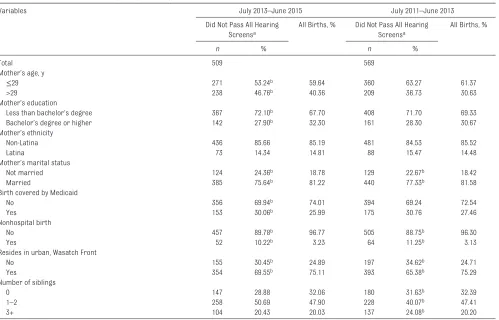
Table 1 provides descriptive
information on the mothers and their infants born both before and after the legislation who never passed a NBHS. Mothers whose infants failed NBHS (and were referred for CMV screening after the legislation) were more likely than the population of all births to be younger than 29 years of age, not married, have less than a college education, have the birth covered by Medicaid, have a FIGURE 1
CMV testing fi gures for Utah births between July 1, 2013, and June 30, 2015. a One infant who passed NBHS had a twin who never passed a NBHS.
nonhospital birth, and live away from the urban Wasatch Front.
Figure 2 illustrates the 90-day diagnostic hearing evaluation patterns for the infants who failed their NBHS(s) after the law. After the legislation, 77% of all infants received timely diagnostic hearing evaluation (compared with 56% in the 24 months before the legislation). After the law, among the infants who received a CMV test, 272 of 314 (86.6%) had the diagnostic hearing evaluation within 90 days, compared with 120 of 195 (61.5%) infants who did not receive a CMV test (see Fig 3). After the legislation, 54% of the infants who had diagnostic hearing evaluations after 90 days had comorbidities (eg, chronic otitis media with or without cleft lip and palate) that delayed final audiological determination.
Among all infants who completed a diagnostic hearing evaluation after the legislation, 218 (50.2% of 434 infants) were found to have had normal hearing, whereas 215 (49.5% of 434 infants) were confirmed to have a hearing loss. Eighty-five infants had SNHL, 19 mixed, 87 conductive hearing loss, 5 auditory neuropathy spectrum disorder, and 19 undetermined. Eighty-five percent of infants diagnosed with SNHL had CMV screening completed.
Multivariate Analyses
Multivariate analyses examined the sociodemographic and health care variables associated with achieving CMV screening compliance ( Table 2) and the 3-month hearing diagnostic target ( Table 3). We examined the sociodemographic and NBHS protocol predictors of infants
completing CMV screening within 21 days of birth.
The multivariate analyses showed an OR of 0.23 (confidence interval [CI] 0.11–0.51), indicating the odds of CMV screening was 77% lower for infants who received 2 screens, at least 1 of which occurred after 14 days of birth (n = 9 infants; 10% of those who had 2 screens with at least 1 after 14 days) compared with those infants who underwent the recommended 2 screenings within 14 days of birth (n = 162; 66% of those who had 2 screens within 14 days of birth). The odds of an infant getting CMV screening for those born in the first 6 months after the law was enacted were 64% lower than those born after the first 6 months (OR = 0.36, CI = 0.23–0.57). The odds of an infant getting CMV tested were 1.84 times higher (CI = 1.17–2.89) for infants born to a mother with a
TABLE 1 Descriptive Information Regarding the Study Populations in Utah, 2011–2015
Variables July 2013–June 2015 July 2011–June 2013
Did Not Pass All Hearing Screensa
All Births, % Did Not Pass All Hearing Screensa
All Births, %
n % n %
Total 509 569
Mother’s age, y
≤29 271 53.24b 59.64 360 63.27 61.37
>29 238 46.76b 40.36 209 36.73 30.63
Mother’s education
Less than bachelor’s degree 367 72.10b 67.70 408 71.70 69.33
Bachelor’s degree or higher 142 27.90b 32.30 161 28.30 30.67
Mother’s ethnicity
Non-Latina 436 85.66 85.19 481 84.53 85.52
Latina 73 14.34 14.81 88 15.47 14.48
Mother’s marital status
Not married 124 24.36b 18.78 129 22.67b 18.42
Married 385 75.64b 81.22 440 77.33b 81.58
Birth covered by Medicaid
No 356 69.94b 74.01 394 69.24 72.54
Yes 153 30.06b 25.99 175 30.76 27.46
Nonhospital birth
No 457 89.78b 96.77 505 88.75b 96.30
Yes 52 10.22b 3.23 64 11.25b 3.13
Resides in urban, Wasatch Front
No 155 30.45b 24.89 197 34.62b 24.71
Yes 354 69.55b 75.11 393 65.38b 75.29
Number of siblings
0 147 28.88 32.06 180 31.63b 32.39
1–2 258 50.69 47.90 228 40.07b 47.41
3+ 104 20.43 20.03 137 24.08b 20.20
a Excludes infants who eventually passed a NBHS.
bachelor’s degree or higher relative to those with less than a bachelor’s degree. The location of the infant’s birth was also associated with the odds of undergoing CMV screening within 21 days of birth; the odds of an infant receiving CMV screening were 69% lower (OR = 0.31, CI =
0.15–0.63) for infants born outside a hospital compared with those born in a hospital.
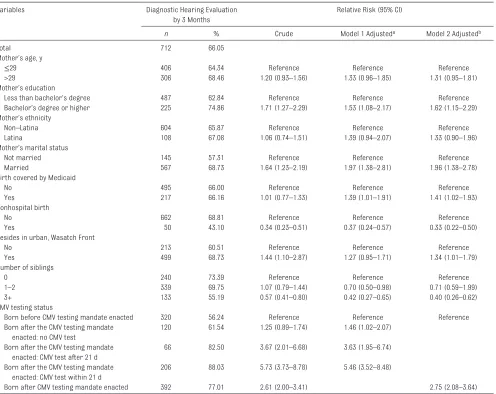
In Table 3, we present the logistic regression OR estimates of factors associated with eligible infants undergoing a diagnostic hearing evaluation by 3 months of age for all
infants born 24 months before and 24 months after the legislation was enacted. Two multivariate models are estimated. The first model adjusts for the different CMV screening patterns with the reference group being infants born before the CMV law went into effect. The second model provides a strict test of the law’s impact on the likelihood of complying with the 3-month diagnostic hearing evaluation regardless of the pattern of CMV screening.
Column 3 in Table 3 reveals that timely diagnostic hearing evaluation rates improved after the legislation from 56% to 77%. Model 2 shows that the odds of an infant receiving a timely diagnostic hearing evaluation were 2.75 times higher (CI = 2.08–3.64) for those infants born after the law compared with those born before the legislation. Model 1 demonstrates that the pattern of CMV screening was related to the odds of undergoing a timely diagnostic evaluation. Although all FIGURE 2
Three-month diagnostic hearing evaluation fi gures for Utah infants who failed their NBHS and were asymptomatic for CMV for the 24-month period after enactment of the law (July 2013–June 2015). a Infants whose diagnostic evaluations were still in process had received at least 1 diagnostic evaluation but
had not yet received a confi rmed diagnosis.
FIGURE 3
infants were more likely to undergo timely diagnostic evaluation after the legislation compared with those born before the law, the magnitude of the OR varied by CMV screening pattern. Infants who underwent CMV screening within 21 days were >5 times as likely to have timely diagnostic testing done relative to those born before the CMV screening legislation was enacted (OR = 5.46, CI = 3.52–8.48). In contrast, the effect size, although still positive, is smaller for infants who were tested after 21 days and infants who did not undergo CMV testing. These differences in magnitude across the groups may reflect a “compliance effect” in which parents who comply with the CMV testing also comply with the 3-month
diagnostic hearing evaluation recommendation.
Models 1 and 2 reveal that several sociodemographic factors were also linked to the odds of meeting the diagnostic recommendations. Mothers with college degrees and married mothers had greater odds of completing diagnostic testing by 3 months of age relative to mothers with less education and unmarried mothers. Births covered by Medicaid were more likely to comply with the 3-month diagnostic testing recommendation than those births not covered by Medicaid. Conversely, the odds of an infant completing timely diagnostic testing were lower for those who had a nonhospital
birth compared with infants born in the hospital. The odds of an infant completing timely diagnostic testing were also lower for children with siblings compared with only children.
DISCUSSION
This study is the first to assess the implementation of a statewide HT-CMV screening of infants after the enactment of CMV legislation. Fourteen infants were identified as CMV-positive within 21 days after birth; 6 had hearing loss. It is highly likely that these asymptomatic cCMV infected children would not have been diagnosed at a later time because of the difficulty distinguishing postnatally acquired
TABLE 2 Associations of Maternal and Infant Factors With Follow-up CMV Testing Among Infants Who Never Passed a NBHS, July 2013–June 2015 (N = 509)
Variables Undergoing CMV Testing Within
21 Days
Relative Risk (95% CI)
n % Crude Adjusteda
Total 234 45.97
Mother’s age, y
≤29 125 46.13 Reference Reference
>29 109 45.80 0.99 (0.70–1.40) 0.96 (0.63–1.48)
Mother’s education
Less than bachelor’s degree 152 41.42 Reference Reference
Bachelor’s degree or higher 82 57.75 1.93 (1.31–2.86) 1.84 (1.17–2.89)
Mother’s ethnicity
Non-Latina 206 47.25 Reference Reference
Latina 28 38.36 0.70 (0.42–1.15) 0.69 (0.39–1.21)
Mother’s marital status
Not married 53 42.74 Reference Reference
Married 181 47.01 1.19 (0.80–1.79) 0.91 (0.55–1.52)
Birth covered by Medicaid
No 168 47.19 Reference Reference
Yes 66 43.14 0.85 (0.58–1.24) 0.99 (0.63–1.57)
Nonhospital birth
No 222 48.58 Reference Reference
Yes 12 23.08 0.32 (0.16–0.62) 0.31 (0.15–0.63)
Resides in urban, Wasatch Front
No 64 41.29 Reference Reference
Yes 170 48.02 1.31 (0.90–1.92) 1.37 (0.89–2.11)
Number of siblings
0 72 48.98 Reference Reference
1–2 122 47.29 0.82 (0.57–1.18) 0.94 (0.60–1.48)
3+ 40 38.46 0.54 (0.34–0.85) 0.90 (0.49–1.68)
Birth date
January 1, 2014–June 30, 2015 197 51.30 Reference Reference
July 1, 2013–December 30, 2013 37 29.60 0.46 (0.31–0.68) 0.36 (0.23–0.57)
NBHSs
2 screens ≤14 d old 162 48.07 Reference Reference
1 screen and referred for testing 10 58.82 1.54 (0.57–4.15) 1.59 (0.57–4.49)
2 hearing screens >14 d old 9 17.65 0.23 (0.11–0.49) 0.23 (0.11–0.51)
3 hearing screens 53 50.96 1.12 (0.72–1.74) 1.12 (0.69–1.82)
CMV from cCMV after 3 weeks of age from urine or saliva. Alternative approaches to cCMV diagnosis at a later date by using archived neonatal dried blood spot (DBS) polymerase chain reaction testing may be an appropriate testing strategy for infants with hearing loss, depending on the sensitivity of the DBS assay used and length of storage of DBS neonatal Guthrie cards. 25, 26
Identification of asymptomatic CMV-positive children provides opportunities for focused
surveillance. Fowler and others have shown that cCMV positive infants are at risk for delayed onset, fluctuating,
and progressive SNHL. 7–9, 16 This
risk has been reported to be 8% to 15% or higher for asymptomatic cCMV.16, 27 Repeated hearing testing
of cCMV children also provides an opportunity to detect changes in hearing thresholds and provide earlier intervention. Furthermore, HT-CMV screening may improve the diagnosis of symptomatic cCMV infected infants. Future research should examine the hypothesis that HT-CMV screening improves the diagnosis of not only asymptomatic but also symptomatic cCMV infants.
Infants born after the CMV legislation were significantly more likely
to undergo diagnostic hearing evaluation by 3 months of age than infants born before the HT-CMV legislation. Educational campaigns and urgency surrounding CMV also may have increased awareness of the importance of timely diagnostic hearing evaluation. Delays in the diagnosis and treatment of hearing loss are a major challenge for universal NBHS programs. Thus, HT-CMV screening has implications not just for CMV infected but for all infants who are hard of hearing. Several studies have demonstrated improved language outcomes when children who are hard of hearing
TABLE 3 Associations of Maternal and Infant Factors With Follow-up Diagnostic Hearing Evaluation by 3 Months of Age Among Infants Who Failed Their NBHSs, July 2011–June 2015 (N = 1078)
Variables Diagnostic Hearing Evaluation
by 3 Months
Relative Risk (95% CI)
n % Crude Model 1 Adjusteda Model 2 Adjustedb
Total 712 66.05
Mother’s age, y
≤29 406 64.34 Reference Reference Reference
>29 306 68.46 1.20 (0.93–1.56) 1.33 (0.96–1.85) 1.31 (0.95–1.81)
Mother’s education
Less than bachelor’s degree 487 62.84 Reference Reference Reference
Bachelor’s degree or higher 225 74.86 1.71 (1.27–2.29) 1.53 (1.08–2.17) 1.62 (1.15–2.29)
Mother’s ethnicity
Non–Latina 604 65.87 Reference Reference Reference
Latina 108 67.08 1.06 (0.74–1.51) 1.39 (0.94–2.07) 1.33 (0.90–1.96)
Mother’s marital status
Not married 145 57.31 Reference Reference Reference
Married 567 68.73 1.64 (1.23–2.19) 1.97 (1.38–2.81) 1.96 (1.38–2.78)
Birth covered by Medicaid
No 495 66.00 Reference Reference Reference
Yes 217 66.16 1.01 (0.77–1.33) 1.39 (1.01–1.91) 1.41 (1.02–1.93)
Nonhospital birth
No 662 68.81 Reference Reference Reference
Yes 50 43.10 0.34 (0.23–0.51) 0.37 (0.24–0.57) 0.33 (0.22–0.50)
Resides in urban, Wasatch Front
No 213 60.51 Reference Reference Reference
Yes 499 68.73 1.44 (1.10–2.87) 1.27 (0.95–1.71) 1.34 (1.01–1.79)
Number of siblings
0 240 73.39 Reference Reference Reference
1–2 339 69.75 1.07 (0.79–1.44) 0.70 (0.50–0.98) 0.71 (0.59–1.99)
3+ 133 55.19 0.57 (0.41–0.80) 0.42 (0.27–0.65) 0.40 (0.26–0.62)
CMV testing status
Born before CMV testing mandate enacted 320 56.24 Reference Reference Reference
Born after the CMV testing mandate enacted: no CMV test
120 61.54 1.25 (0.89–1.74) 1.46 (1.02–2.07)
Born after the CMV testing mandate enacted: CMV test after 21 d
66 82.50 3.67 (2.01–6.68) 3.63 (1.95–6.74)
Born after the CMV testing mandate enacted: CMV test within 21 d
206 88.03 5.73 (3.73–8.78) 5.46 (3.52–8.48)
Born after CMV testing mandate enacted 392 77.01 2.61 (2.00–3.41) 2.75 (2.08–3.64)
are diagnosed and treated before 6 months of age. 28–30
We found parents of infants who complied with the CMV testing recommendations were more likely to comply with the recommendation of having the infant undergo a diagnostic evaluation in a timely manner. This finding suggests that educational efforts and systems should target CMV noncompliers; identifying infants who failed
to be tested for CMV in a timely manner may be important for improving timely diagnostic hearing rates by targeting this hard-to-reach group.
For those interested in improving CMV screening compliance, our multivariate analysis demonstrated several factors that were associated with CMV screening success. Lower maternal education and nonhospital births were associated with lower odds of CMV screening. Those infants who did not have 2 hearing screens before 14 days of age had lower odds of receiving timely CMV screening. Continuing education of health care providers and parents on the importance of early CMV screening is critical given that testing after 21 days cannot differentiate cCMV and CMV acquired postnatally. Focused efforts to improve awareness of the importance of CMV screening among midwives who often are involved with nonhospital births should improve screening success.
Both universal CMV screening and HT-CMV screening approaches have advantages and disadvantages. Universal screening is optimal for identifying all cCMV-infected newborns, including the 10% to 15% of asymptomatic cCMV-infected infants who will develop hearing loss after birth and those with nonspecific symptoms who may not be otherwise diagnosed. 16, 27, 31
Yet universal screening is a massive undertaking, and costs are unknown. An HT-CMV approach piggybacks onto an ongoing NBHS program that can facilitate implementation and lower costs. Assuming the 1.5% referral rate nationally, a more modest 60 000 newborns would need to be tested each year via this HT-CMV approach. 22 On the other
hand, targeted CMV screening misses asymptomatic infants who have normal hearing at birth but will later develop CMV-related hearing loss and those infants with nonspecific clinical symptoms who may not receive CMV screening.
Rates of timely diagnostic evaluation may also be
improved by focusing on several sociodemographic groups who are at-risk for lower compliance rates. Specifically, larger families, single mothers, mothers without a college degree, those who had nonhospital births and those not covered by Medicaid were all at relatively greater risk of not meeting the 3-month diagnostic testing recommendation. Compliance with the diagnostic testing
recommendations may be improved by targeting educational and outreach efforts to these groups.
One limitation of the study is the inability to examine data that were not reported to the Utah Department of Health. Thus, we may have overestimated noncompliance for both CMV and audiological evaluation if the health care provider did not provide the information to the Department of Health, although multiple efforts were made to obtain CMV testing information through other means. The CMV Rule states that medical providers must report results of the CMV screening within 10 days of receiving results. The Department of Health provides EHDI and CMV Mandate reports for each hospital and midwife so that organizations can identify
their compliance rate and improve performance.
CONCLUSIONS
A statewide HT-CMV approach can identify cCMV-infected children. The Utah program, being the first in the nation, serves as a model on which other states can build their programs. Fourteen infants were recognized who likely would not have otherwise been identified with cCMV over 2 years of testing. Because lower maternal education, nonhospital births, and NBHS that occurred after 14 days of age were associated with lower rates of successful CMV screening, a directed approach toward maternal and midwife outreach, and educating screeners may improve the success of this and other programs. Timely CMV screening rates increased substantially from the first 6 months to the subsequent 18 months after the legislation, indicating successful uptake of the screening program. Statewide HT-CMV screening also significantly improved the 3-month diagnostic hearing evaluation rate. Furthermore, the study identified several sociodemographic and CMV screening patterns related to 3-month diagnostic hearing evaluation that can be used to target educational and outreach efforts going forward.
ABBREVIATIONS
CI: confidence interval cCMV: congenital
cytomegalovirus CMV: cytomegalovirus DBS: dried blood spot
EHDI: Early Hearing Detection and Intervention
HT-CMV: hearing targeted early cytomegalovirus screening
NBHS: newborn hearing screen OR: odds ratio
REFERENCES
1. Kenneson A, Cannon MJ. Review and meta-analysis of the epidemiology of congenital cytomegalovirus (CMV) infection. Rev Med Virol. 2007;17(4):253–276
2. Stehel EK, Shoup AG, Owen KE, et al. Newborn hearing screening and detection of congenital
cytomegalovirus infection. Pediatrics. 2008;121(5):970–975
3. Engman ML, Malm G, Engstrom L, et al. Congenital CMV infection: prevalence in newborns and the impact on hearing defi cit. Scand J Infect Dis. 2008;40(11–12):935–942
4. Grosse SD, Ross DS, Dollard SC. Congenital cytomegalovirus (CMV) infection as a cause of permanent bilateral hearing loss: a quantitative assessment. J Clin Virol. 2008;41(2):57–62
5. Barbi M, Binda S, Caroppo S, Ambrosetti U, Corbetta C, Sergi P. A wider role for congenital cytomegalovirus infection in sensorineural hearing loss. Pediatr Infect Dis J. 2003;22(1):39–42
6. Park AH, Duval M, McVicar S, Bale JF Jr, Hohler N, Carey JC. A diagnostic paradigm including cytomegalovirus testing for idiopathic pediatric sensorineural hearing loss.
Laryngoscope. 2014;124(11):2624–2629
7. Dahle AJ, Fowler KB, Wright JD, Boppana SB, Britt WJ, Pass RF. Longitudinal investigation of hearing disorders in children with congenital cytomegalovirus. J Am Acad Audiol. 2000;11(5):283–290
8. Fowler KB, McCollister FP, Dahle AJ, Boppana S, Britt WJ, Pass RF. Progressive and fl uctuating sensorineural hearing loss in children with asymptomatic congenital cytomegalovirus infection. J Pediatr. 1997;130(4):624–630
9. Fowler KB, Dahle AJ, Boppana SB, Pass RF. Newborn hearing screening: will children with hearing loss caused by congenital cytomegalovirus infection be missed? J Pediatr. 1999;135(1):60–64
10. Williams EJ, Gray J, Luck S, et al. First estimates of the potential cost and cost saving of protecting childhood hearing from damage caused by congenital CMV infection.
Arch Dis Child Fetal Neonatal Ed. 2015;100(6):F501–F506
11. Bergevin A, Zick CD, McVicar SB, Park AH. Cost-benefi t analysis of targeted hearing directed early testing for congenital cytomegalovirus infection.
Int J Pediatr Otorhinolaryngol. 2015;79(12):2090–2093
12. Cytomegalovirus (CMV) Public Education and Testing. H.B. 81 (2013 General Session) UCA 26-10-10 (2013)
13. Stagno S, Reynolds DW, Pass RF, Alford CA. Breast milk and the risk of cytomegalovirus infection. N Engl J Med. 1980;302(19):1073–1076
14. Reynolds DW, Stagno S, Hosty TS, Tiller M, Alford CA Jr. Maternal cytomegalovirus excretion and perinatal infection. N Engl J Med. 1973;289(1):1–5
15. Hicks T, Fowler K, Richardson M, Dahle A, Adams L, Pass R. Congenital cytomegalovirus infection and neonatal auditory screening. J Pediatr. 1993;123(5):779–782
16. Goderis J, Keymeulen A, Smets K, et al. Hearing in children with congenital cytomegalovirus infection: results of a longitudinal study. J Pediatr. 2016;172:110–115.e2
17. Connecticut Committee on Public Health. An Act Concerning Newborn Screening for Cytomegalovirus and Establishing a Public Education
Program for Cytomegalovirus. H.B. 5147 (2014)
18. Cytomegalovirus Public Education program (Illinois). IL H.B. 4199 (2014)
19. House of Representatives, State of Hawaii. An Act Relating to the Cytomegalovirus. H.B. 782 HD1 SD2 CD1 (2015)
20. Relating to Education About Congenital Cytomegalovirus in Infants. Texas Senate Bill 791. (June 19, 2015)
21. Tennessee State Legislature. An Act to Amend Tennessee Code Annotated, Title 63 and Title 68, relative to cytomegalovirus. TN SB2097 (2015–2016)
22. Centers for Disease Control and Prevention. Summary of 2013 National CDC EHDI Data. February 2016. Available at: www. cdc. gov/ ncbddd/ hearingloss/ 2013- data/ 2013_ ehdi_ hsfs_ summary_ c. pdf. Accessed October 20, 2016
23. Rothman KJ, Greenland S, Lash TL.
Modern Epidemiology. 3rd ed. New
York, NY: Wolters Kluwer; 2008
24. Koyano S, Inoue N, Nagamori T, Moriuchi H, Azuma H. Newborn screening of congenital
cytomegalovirus infection using saliva can be infl uenced by breast feeding.
Arch Dis Child Fetal Neonatal Ed. 2013;98(2):F182
25. Boppana SB, Ross SA, Novak Z, et al; National Institute on Deafness and Other Communication Disorders CMV and Hearing Multicenter Screening (CHIMES) Study. Dried blood spot real-time polymerase chain reaction assays to screen newborns for congenital cytomegalovirus infection. JAMA. 2010;303(14):1375–1382
26. Wang L, Xu X, Zhang H, Qian J, Zhu J. Dried blood spots PCR assays to screen congenital cytomegalovirus
PEDIATRICS (ISSN Numbers: Print, 0031-4005; Online, 1098-4275). Copyright © 2017 by the American Academy of Pediatrics
FINANCIAL DISCLOSURE: The authors have indicated they have no fi nancial relationships relevant to this article to disclose.
FUNDING: No external funding.
POTENTIAL CONFLICT OF INTEREST: The authors have indicated they have no potential confl icts of interest to disclose.
infection: a meta-analysis. Virol J. 2015;12:60
27. Dollard SC, Grosse SD, Ross DS. New estimates of the prevalence of neurological and sensory sequelae and mortality associated with congenital cytomegalovirus infection. Rev Med Virol. 2007;17(5):355–363
28. Moeller MP. Early intervention and language development in children
who are deaf and hard of hearing.
Pediatrics. 2000;106(3). Available at: www. pediatrics. org/ cgi/ content/ full/ 106/ 3/ e43
29. Yoshinaga-Itano C, Sedey AL, Coulter DK, Mehl AL. Language of early- and later-identifi ed children with hearing loss. Pediatrics. 1998;102(5):1161–1171
30. Centers for Disease Control and Prevention. 2012 Annual Data Early
Hearing Detection and Intervention (EHDI) Program. 2014. Available at: http:// www. cdc. gov/ ncbddd/ hearingloss/ ehdi- data2012. html. Accessed December 3, 2016
DOI: 10.1542/peds.2016-0789 originally published online January 24, 2017;
2017;139;
Pediatrics
Albert H. Park
Marissa L. Diener, Cathleen D. Zick, Stephanie Browning McVicar, Jill Boettger and
Outcomes From a Hearing-Targeted Cytomegalovirus Screening Program
Services
Updated Information &
http://pediatrics.aappublications.org/content/139/2/e20160789
including high resolution figures, can be found at:
References
http://pediatrics.aappublications.org/content/139/2/e20160789#BIBL
This article cites 22 articles, 4 of which you can access for free at:
Subspecialty Collections
b
http://www.aappublications.org/cgi/collection/infectious_diseases_su
Infectious Disease
sub
http://www.aappublications.org/cgi/collection/fetus:newborn_infant_
Fetus/Newborn Infant
following collection(s):
This article, along with others on similar topics, appears in the
Permissions & Licensing
http://www.aappublications.org/site/misc/Permissions.xhtml
in its entirety can be found online at:
Information about reproducing this article in parts (figures, tables) or
Reprints
http://www.aappublications.org/site/misc/reprints.xhtml
DOI: 10.1542/peds.2016-0789 originally published online January 24, 2017;
2017;139;
Pediatrics
Albert H. Park
Marissa L. Diener, Cathleen D. Zick, Stephanie Browning McVicar, Jill Boettger and
Outcomes From a Hearing-Targeted Cytomegalovirus Screening Program
http://pediatrics.aappublications.org/content/139/2/e20160789
located on the World Wide Web at:
The online version of this article, along with updated information and services, is
by the American Academy of Pediatrics. All rights reserved. Print ISSN: 1073-0397.