www.atmos-meas-tech.net/3/457/2010/
© Author(s) 2010. This work is distributed under the Creative Commons Attribution 3.0 License.
Measurement
Techniques
Minimizing light absorption measurement artifacts of the
Aethalometer: evaluation of five correction algorithms
M. Collaud Coen1, E. Weingartner2, A. Apituley3, D. Ceburnis4, R. Fierz-Schmidhauser2, H. Flentje5, J. S. Henzing6, S. G. Jennings4, M. Moerman3, A. Petzold7, O. Schmid8,9,*, and U. Baltensperger2
1MeteoSwiss, Aerological Station, Les Invuardes, 1530 Payerne, Switzerland
2Laboratory of Atmospheric Chemistry, Paul Scherrer Institut, 5232 Villigen PSI, Switzerland 3National Institute for Public Health and the Environment, Bilthoven, The Netherlands
4School of Physics / Environmental Change Institute, National University of Ireland, Galway; Ireland
5Deutscher Wetterdienst (DWD), Meteorologisches Observatorium (MOHP), Albin-Schwaiger-Weg 10, 82383 Hohenpeissenberg, Germany
6Netherlands Organisation for Applied Scientific Research, TNO, 80015 Utrecht, The Netherlands
7Institut f¨ur Physik der Atmosph¨are, Deutsches Zentrum f¨ur Luft- und Raumfahrt, 82234 Wessling, Germany
8Helmholtz Zentrum M¨unchen, German Research Center for Environmental Health, Institute of Lung Biology and Disease, 85758 Neuherberg/Munich, Germany
9Missouri University of Science and Technology, Center of Excellence for Aerospace Particulate Emissions Reduction Research, Rolla, MO 65409, USA
*formerly at: Max Planck Institute for Chemistry, Biogeochemistry Department, 55020 Mainz, Germany Received: 1 July 2009 – Published in Atmos. Meas. Tech. Discuss.: 28 July 2009
Revised: 12 March 2010 – Accepted: 22 March 2010 – Published: 13 April 2010
Abstract. The aerosol light absorption coefficient is an
es-sential parameter involved in atmospheric radiation budget calculations. The Aethalometer (AE) has the great advantage of measuring the aerosol light absorption coefficient at sev-eral wavelengths, but the derived absorption coefficients are systematically too high when compared to reference meth-ods. Up to now, four different correction algorithms of the AE absorption coefficients have been proposed by several authors. A new correction scheme based on these previously published methods has been developed, which accounts for the optical properties of the aerosol particles embedded in the filter. All the corrections have been tested on six datasets representing different aerosol types and loadings and include multi-wavelength AE and white-light AE. All the corrections have also been evaluated through comparison with a Multi-Angle Absorption Photometer (MAAP) for four datasets last-ing between 6 months and five years. The modification of the wavelength dependence by the different corrections is ana-lyzed in detail. The performances and the limits of all AE corrections are determined and recommendations are given.
Correspondence to: M. Collaud Coen
1 Introduction
458 M. Collaud Coen et al.: Correction algorithms for Aethalometer light absorption coefficient increased by the light absorbing particles accumulating in the
filter thus reducing the optical path for a loaded filter (filter-loading correction).
The most frequently used filter-based commercial instru-ments to measure real-time black carbon (BC) mass con-centrations are the Aethalometer (AE) and the Particle Soot Absorption Photometer (PSAP). The multi-wavelength AE measures at seven wavelengths covering the ultra-violet to the near-infrared wavelength range (the AE-31 measures in the range fromλ=370 to 950 nm), the multi-wavelength PSAP has only recently become commercially available and measures at three wavelengths (λ=467 to 660 nm). The ab-sorption data from both instruments need to be corrected for the above mentioned artifacts in the filter matrix and these corrections require concomitant scattering measurements. In contrast to the AE and PSAP, the more recently developed Multi-Angle Absorption Photometer (MAAP) detects not only the transmitted, but also the backscattered light at two angles to resolve the influence of light-scattering aerosol components on the angular distribution of the backscattered radiation. The absorption coefficient atλ=630 nm is there-after obtained from a radiative transfer scheme (Petzold and Sch¨onlinner, 2004; Petzold et al., 2005). This technique treats the multiple scattering in the filter and the scattering effect of the particles embedded on the filter. Hence, the MAAP instrument does not use any empirically determined, aerosol-related correction factors. The instrumental artifacts are reduced for the MAAP in comparison with AE or PSAP, so that the absorption coefficients measured with a MAAP should be closer to the true ones. Even if the MAAP is not an absolute reference method, it is however used as a refer-ence for AE in this paper.
Various correction schemes have been published for the PSAP (Bond et al., 1999; Virkkula et al., 2005a) taking into account the above mentioned artifacts, and particularly the scattering correction. Similarly, AE correction methods pre-sented in the literature also take these effects into account (Weingartner et al., 2003; Arnott et al, 2005; Schmid et al., 2006; Virkkula et al., 2007).
Using the above mentioned correction methods, high instrument correlation but with highly variable regression slopes were found for intercomparison measurements with various absorption instruments both in the laboratory and un-der atmospheric conditions (Arnott et al., 2005; Saathoff et al., 2003; Schmid et al., 2006; Wallace, 2005; Rice, 2004; Petzold et al., 2005; Virkkula et al., 2005a, b; Schnaiter et al., 2005; Park et al., 2006; Slowik et al., 2007). For example, the intercomparison of continuously operated Aethalome-ters, MAAPs and Photoacoustic spectrometers (PAS) at the Fresno Supersite (Park et al., 2006) resulted in regression slopes between 0.2 and 2. The intercomparison also pointed out differences between winter and summer measurements indicating that the aerosol composition also plays an impor-tant role for instrument correlation.
It is widely accepted (Arnott et al., 2005; Schmid et al, 2006; Rice, 2004) that the uncorrected AE measures too high absorption coefficients. Weingartner et al. (2003), Arnott et al. (2005) and Schmid et al. (2006) published AE correc-tions, taking into account either results of chamber exper-iments involving extinction and scattering coefficient mea-surements or comparison with a PAS. The ability to correct the AE and/or PSAP for all of the above mentioned instru-mental artifacts is important: firstly, to derive climatically important aerosol parameters more accurately from a sim-ple instrument; secondly, to take advantage of already exist-ing long-term data sets (such as the 13-year AE dataset from the Jungfraujoch (JFJ), or the 15-year AE dataset from Mace Head (MHD, see Junker et al., 2006)); and thirdly, to perform multi-wavelength measurements providing spectral informa-tion on absorpinforma-tion and single scattering albedo, which is not yet available from more reliable instruments.
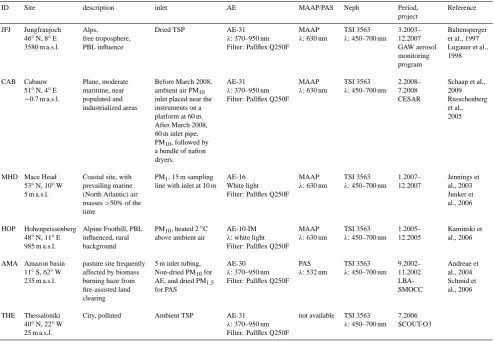
Two new AE corrections are developed in this paper, us-ing already published AE corrections schemes. These new corrections as well as all the previously published ones were tested on six datasets from different sites, of which four also included a MAAP (Table 1). The analyzed absorption coeffi-cients include aerosol measured in the Alps (Jungfraujoch, Hohenpeissenberg, HOP), in a flat region near populated and industrialized areas (Cabauw, CAB), at a coastal site (Mace Head), on a pasture site affected by biomass burning (Amazon Basin, AMA) and in a city (Thessaloniki, THE). Therefore these sites represent free tropospheric, continen-tal, maritime, biomass burning and heavily polluted environ-ments and are characterized by a annual mean single scatter-ing albedo (ω0) between 0.65 and 0.90 (atλ=660–840 nm). Comparisons with a MAAP have been performed on datasets lasting between six months and five years, so that the cor-relation between both absorption measurements can be es-tablished on real atmospheric aerosols during a time period long enough to study the performance of MAAP and AE in-struments and associated corrections in long-term monitor-ing programs.
2 Experimental
2.1 Measurement sites and instrumentation
Table 1. Description of the used datasets, including the measuring sites, the instruments, time periods and brief site characteristics.
ID Site description inlet AE MAAP/PAS Neph Period,
project
Reference
JFJ Jungfraujoch 46◦N, 8◦E 3580 m a.s.l.
Alps, free troposphere, PBL influence
Dried TSP AE-31
λ: 370–950 nm Filter: Pallflex Q250F
MAAP
λ: 630 nm
TSI 3563
λ: 450–700 nm
3.2003– 12.2007 GAW aerosol monitoring program Baltensperger et al., 1997 Lugauer et al., 1998
CAB Cabauw
51◦N, 4◦E −0.7 m a.s.l.
Plane, moderate maritime, near populated and industrialized areas
Before March 2008, ambient air PM10
inlet placed near the instruments on a platform at 60 m. After March 2008, 60 m inlet pipe, PM10, followed by
a bundle of nafion dryers.
AE-31
λ: 370–950 nm Filter: Pallflex Q250F
MAAP
λ: 630 nm
TSI 3563
λ: 450–700 nm
2.2008– 7.2008 CESAR
Schaap et al., 2009 Russchenberg et al., 2005
MHD Mace Head 53◦N, 10◦W 5 m a.s.l.
Coastal site, with prevailing marine (North Atlantic) air masses>50% of the time
PM1, 15 m sampling
line with inlet at 10 m AE-16 White light Filter: Pallflex Q250F
MAAP
λ: 630 nm
TSI 3563
λ: 450–700 nm
1.2007– 12.2007 Jennings et al., 2003 Junker et al., 2006 HOP Hohenpeissenberg 48◦N, 11◦E 985 m a.s.l.
Alpine Foothill, PBL influenced, rural background
PM10, heated 2◦C
above ambient air
AE-10-IM
λ: white light Filter: Pallflex Q250F
MAAP
λ: 630 nm
TSI 3563
λ: 450–700 nm
1.2005– 12.2005
Kaminski et al., 2006
AMA Amazon basin 11◦S, 62◦W 235 m a.s.l.
pasture site frequently affected by biomass burning haze from fire-assisted land clearing
5 m inlet tubing, Non-dried PM10for
AE, and dried PM1.5
for PAS
AE-30
λ: 370–950 nm Filter: Pallflex Q250F
PAS
λ: 532 nm
TSI 3563
λ: 450–700 nm
9.2002– 11.2002 LBA-SMOCC Andreae et al., 2004 Schmid et al., 2006 THE Thessaloniki 40◦N, 22◦W 25 m a.s.l.
City, polluted Ambient TSP AE-31
λ: 370–950 nm Filter: Pallflex Q250F
not available TSI 3563
λ: 450–700 nm 7.2006 SCOUT-O3
Nephelometer) sampled aerosol from the same inlet, so that comparisons are always performed for the same size fraction and relative humidity.
The scattering and backscattering coefficients of all sta-tions were measured by Integrating Nephelometers and cor-rected for the truncation error and for the non-idealities in the angular intensity distribution of the light inside the instru-ment according to Anderson and Ogren (1998) and Nessler et al. (2005). All the data were aggregated to hourly means.
The multi-wavelength AE’s cover the 370–950 nm wave-length range, and the white-light AE’s have a broad spec-tral range from 500 nm to 1100 nm with a peak sensitivity in the near IR at about 840 nm (Weingartner et al., 2003). All the AE’s undergo a filter-preconditioning cycle after each tape change that exposes the filter to sampled air before the measurement starts. In rack mounted Aethalometers (AE16, AE21, AE22, AE31) the sample flows through the filter tape for a part of the preconditioning cycle only (about 3 min), and the flow is diverted through a by-pass cartridge filter dur-ing most of the preconditiondur-ing cycle (G. Mocnik, Aerosol d.o.o., Magee Scientific, personal communication, 2009). This preconditioning cycle can modify the zero point of the
light intensityI0(see Eq. 1 below) and consequently the at-tenuation ATN. The ATN modification will change the filter loading correction and induce a lower calibration constant Creffor the multiple scattering correction that was estimated to less than 5% for the studied datasets. As also stated in Arnott et al. (2005), this is normally not an issue for ambi-ent measuremambi-ents as reported in this study, but it could be an issue when sampling from highly polluted sources. A better quantification of this effect is however not possible since the shift of the zero point of the filter transmittance is presently not known.
2.2 Aethalometer corrections
460 M. Collaud Coen et al.: Correction algorithms for Aethalometer light absorption coefficient
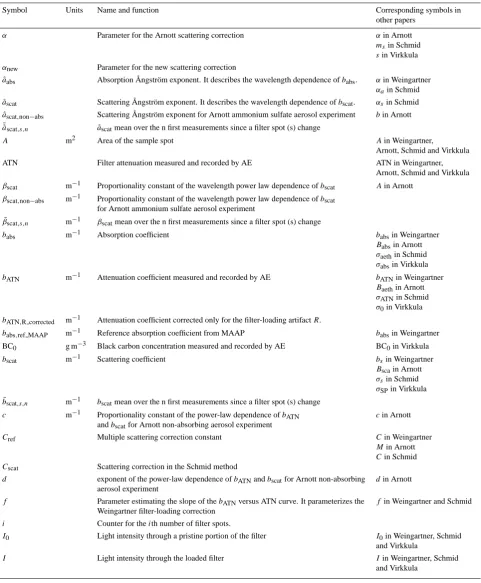
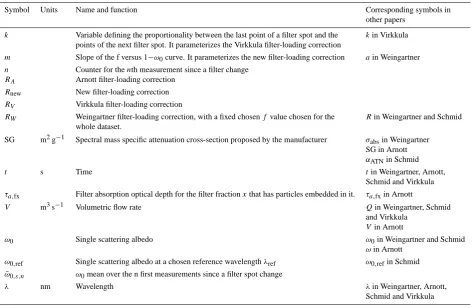
Table 2. Symbols, units, description of the parameters used in this paper as well as the corresponding symbols used in the papers describing
the previously published correction schemes. The used nomenclature follows symbols commonly used by Seinfeld and Pandis (1998).
Symbol Units Name and function Corresponding symbols in
other papers
α Parameter for the Arnott scattering correction αin Arnott
msin Schmid
sin Virkkula
αnew Parameter for the new scattering correction
˚
aabs Absorption ˚Angstr¨om exponent. It describes the wavelength dependence ofbabs. αin Weingartner
αain Schmid
˚
ascat Scattering ˚Angstr¨om exponent. It describes the wavelength dependence ofbscat. αsin Schmid
˚
ascat,non−abs Scattering ˚Angstr¨om exponent for Arnott ammonium sulfate aerosol experiment bin Arnott
¯
˚
ascat,s,n a˚scatmean over the n first measurements since a filter spot (s) change
A m2 Area of the sample spot Ain Weingartner,
Arnott, Schmid and Virkkula
ATN Filter attenuation measured and recorded by AE ATN in Weingartner,
Arnott, Schmid and Virkkula
βscat m−1 Proportionality constant of the wavelength power law dependence ofbscat Ain Arnott
βscat,non−abs m−1 Proportionality constant of the wavelength power law dependence ofbscat for Arnott ammonium sulfate aerosol experiment
¯
βscat,s,n m−1 βscatmean over the n first measurements since a filter spot (s) change
babs m−1 Absorption coefficient babsin Weingartner
Babsin Arnott
σaethin Schmid
σabsin Virkkula
bATN m−1 Attenuation coefficient measured and recorded by AE bATNin Weingartner
Baethin Arnott
σATNin Schmid
σ0in Virkkula
bATN,R corrected m−1 Attenuation coefficient corrected only for the filter-loading artifactR.
babs,ref MAAP m−1 Reference absorption coefficient from MAAP babsin Weingartner
BC0 g m−3 Black carbon concentration measured and recorded by AE BC0in Virkkula
bscat m−1 Scattering coefficient bsin Weingartner
Bscain Arnott
σsin Schmid
σSPin Virkkula
¯
bscat,s,n m−1 bscatmean over the n first measurements since a filter spot (s) change
c m−1 Proportionality constant of the power-law dependence ofbATN cin Arnott
andbscatfor Arnott non-absorbing aerosol experiment
Cref Multiple scattering correction constant Cin Weingartner
Min Arnott
Cin Schmid
Cscat Scattering correction in the Schmid method
d exponent of the power-law dependence ofbATNandbscatfor Arnott non-absorbing din Arnott aerosol experiment
f Parameter estimating the slope of thebATNversus ATN curve. It parameterizes the f in Weingartner and Schmid Weingartner filter-loading correction
i Counter for theith number of filter spots.
I0 Light intensity through a pristine portion of the filter I0in Weingartner, Schmid
and Virkkula
I Light intensity through the loaded filter Iin Weingartner, Schmid
Table 2. Continued.
Symbol Units Name and function Corresponding symbols in
other papers
k Variable defining the proportionality between the last point of a filter spot and the kin Virkkula points of the next filter spot. It parameterizes the Virkkula filter-loading correction
m Slope of the f versus 1−ω0curve. It parameterizes the new filter-loading correction ain Weingartner
n Counter for thenth measurement since a filter change
RA Arnott filter-loading correction
Rnew New filter-loading correction
RV Virkkula filter-loading correction
RW Weingartner filter-loading correction, with a fixed chosenf value chosen for the Rin Weingartner and Schmid
whole dataset.
SG m2g−1 Spectral mass specific attenuation cross-section proposed by the manufacturer σabsin Weingartner SG in Arnott
αATNin Schmid
t s Time tin Weingartner, Arnott,
Schmid and Virkkula
τa,fx Filter absorption optical depth for the filter fractionxthat has particles embedded in it. τa,fxin Arnott
V m3s−1 Volumetric flow rate Qin Weingartner, Schmid
and Virkkula
Vin Arnott
ω0 Single scattering albedo ω0in Weingartner and Schmid
ωin Arnott
ω0,ref Single scattering albedo at a chosen reference wavelengthλref ω0,refin Schmid
¯
ω0,s,n ω0mean over the n first measurements since a filter spot change
λ nm Wavelength λin Weingartner, Arnott,
Schmid and Virkkula
The light attenuation (ATN) through the aerosol-laden sec-tion of a filter spot is defined as
ATN=ln I
0 I
(1) whereI0 is the intensity of light passing through a pristine portion of the filter andI the intensity passing through the loaded filter. The particles embedded in the filter during a time interval1t will increase ATN, so that thenth measure of the aerosol attenuation coefficient (bATN,n)of the filtered
aerosol particles is obtained from bATN,n(λ)=
(ATNn(λ)−ATNn−1(λ))
1t ·
A
V (2)
whereAis the area of the sample spot andV the volumetric flow rate. The corrections discussed below are then applied to infer the true aerosol absorption coefficientbabs,nof
air-borne particles frombATN,n.
Both the absorption ˚Angstr¨om exponent ˚aabsand the scat-tering ˚Angstr¨om exponent ˚ascat, which refer to the wave-length dependence of the respective coefficients, were deter-mined by fitting the measured absorption or scattering coef-ficients with a wavelength power-law dependence (b∼λ−a˚). These ˚Angstr¨om exponents were used to calculate
coeffi-cients at other wavelengths, such as the absorption coefficient atλ=630 nm to allow comparison with the MAAP.
2.2.1 The Weingartner correction
Weingartner et al. (2003) proposed an empirical correction RW for the attenuation effect due to the filter-loading and
determined the calibration constantCreffor different aerosol types produced in the AIDA aerosol chamber (at FZ Karl-sruhe, Germany) to correct for the multiple scattering in the filter matrix. The resultingnth absorption coefficientbabs,n
is given by:
babs,n=
bATN,n
Cref·Rw,n
= bATN,n
Cref·
h
1
f−1
·lnATNn−ln(10%)
ln(50%)−ln(10%)+1
i (3)
where Cref is determined by first correcting bATN for the filter-loading correction and then comparing it with the ab-sorption coefficient measured simultaneously with a ref-erence instrument (babs,ref). Since the Weingartner filter-loading correctionRW takes ATN=10% as a reference point, Crefrelates in this case to ATN=10%:
Cref=
bATN RW·babs,ref
462 M. Collaud Coen et al.: Correction algorithms for Aethalometer light absorption coefficient
Concomitant measurement of reference babs ?
yes no
Application of the filter-loading correction: Calculation of bATN,R_corrected = bATN / Rnew
(Eq. 13)
Needed parameters:,m, ATN, bATN, ω0,s,n
Determination of
Cref = bATN,R_corrected / babs,ref_MAAP (Eq. 4)
Estimation of Cref from Fig. 3
Application of the total correction:
1. Calculation of the variables needed for the complete correction (βscat, åscat, åabs, ω0,ref, ω0(λ))
2. Determination of filter spot changes
3. Calculation of the variables averaged since the last filter spot
change (ω0,s,n,åscat,s,n,βscat,s,n,bscat,s,n) 4. Calculation of babs (Eq. 14a-b)
Needed constants: c, d, m, Cref
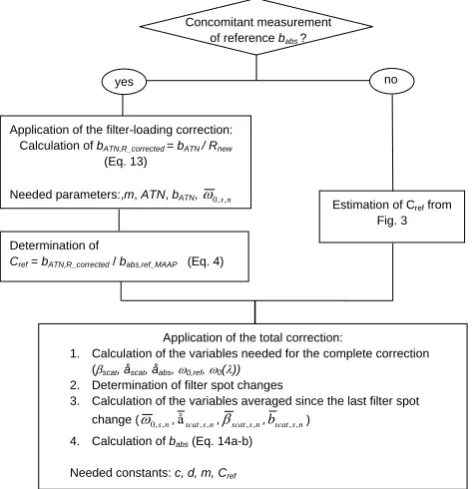
Fig. 1. Description of the sequence of steps to apply the new
cor-rection scheme.
A parameterf (λ)is introduced which characterizes the slope betweenbATN,n and ln(ATNn)and parameterizes the
filter-loading correctionRW. A clear dependence off on 1−ω0 was also observed for pure, internally and externally mixed diesel soot particles, which leads to the following quasi-linear relation
f=m·(1−ωo)+1, (5)
where m is nearly constant (0.87 to 0.85) for λ=470 to 660 nm.
The Weingartner correction parameterRW can depend on
the light wavelength, butCrefdoes not. Therefore, a constant Cref value over the wide spectral range (370–950 nm) was chosen. Weingartner et al. (2003) also determinedf values for different aerosol types. In this paper, RW will always
correspond to the Weingartner correction with fixedf values chosen for each dataset depending on the aerosol type, as it is presently applied by most users, so that theRW correction
does not need concomitantbscat measurements oncef has been determined. It is evident from Eqs. 3 through 5 that if ω0=1, bothf andRW are equal to unity. Since the aerosol
measured at the high alpine site JFJ was aged aerosol with ω0values mostly close to unity,RW can be taken as unity. 2.2.2 The Arnott correction
Arnott et al. (2005) proposed a theoretically well docu-mented correction, which includes an explicit scattering cor-rection similarly to the corcor-rection commonly applied to the
PSAP (Bond et al., 1999). The form of this scattering correc-tion (−α·bscat) was deduced from the non-zerobATN mea-sured by an AE with a purely scattering aerosol. The scat-tering coefficientbscatweighted by theα values was there-fore subtracted frombATN to correct for the scattering arti-fact (Eq. 6). The Arnott filter-loading correctionRAwas
de-rived from multiple scattering theory, which shows that the exponential behavior of light absorption in the strong multi-ple scattering limit scales as the square root of the total ab-sorption optical depth. The correctedbabs,nis given by : babs,n=
bATN,n−α·bscat,n Cref·RA,n
=bATN,n−α·bscat,n
Cref
s
1+(
V·1t A )·
Pn−1 i=1babs,i τa,f x
(6)
α (λ)=βscatd−1,non−abs·c·λ−a˚scat,non−abs·(d−1) (7) wheren,V,1t, andAwere introduced in Eq. 2,βscat,non−abs and ˚ascat,non−absare obtained from measurements of ammo-nium sulfate aerosol and correspond to the power-law fit of the wavelength dependence ofbscat,non−abs:
bscat,non−abs=βscat,non−abs·λ−a˚scat,non−abs (8) candd are also obtained from the measured non-zerobATN in the presence of a non-absorbing aerosol and correspond to the relation betweenbscat,non−absandbATN:
bATN=c·bdscat,non−abs (9)
andτa,f x(λ) is the filter absorption optical depth for the
fil-ter fraction x that has particles embedded in it, and Crefis obtained by comparison between AE and PAS absorption coefficients. τa,f x(λ) and Cref (λ) were determined from kerosene soot measurements during the Reno Aerosol Op-tics Experiment, under the condition thatbabs(λ), when ex-trapolated toλ=532 nm with ˚aabs=1, were all equal to PAS measurements at λ=532 nm. In this Arnott correction, all the reported calibration constants depend on the wavelength of the light. Six weeks of ambient measurements at an ur-ban site allowed testing of the proposed correction, which showed that different values of the above described parame-ters are needed for ambient and laboratory generated aerosol. Arnott et al. (2005) also hypothesized that the variation in these parameters is related to the AE pre-conditioning cycles that blackened the filters before the measurement began.
2.2.3 The Schmid correction
Schmid et al. (2006) proposed a correction that includes firstly the filter-loading correctionRW with constant values
by Arnott. Instead of subtracting a part ofbscatin the nom-inator like Arnott, the Schmid scattering correction adds a termCscattoCref, leading to a correction that includes both the multiple scattering and the scattering corrections in the denominator:
babs,n(λ)=
bATN,n Cref+Cscat,n
·RW,n
(10)
= bATN,n
Cref+α·1−ω0ω,n0,n
·
h 1
f−1
·lnATNn−ln(10%) ln(50%)−ln(10%)+1
i
The correctedbabsmeasured either by an AE or a PSAP were compared to thebabs measured by a PAS at λ=532 nm for some days of measurements in AMA, leading to high corre-lations and ratios between AE and PASbabsof between 0.94 and 1.03.
2.2.4 Virkkula filter-loading correction
Virkkula et al. (2007) proposed a filter-loading correctionRV
very close to that of the PSAP, assuming that the three last values measured on the filter spotiand the three first values measured on the next filter spoti+1 should be equal, and that the values measured on lightly loaded filters are the closest to the real concentration:
bATN,R corrected,n= bATN,n
RV
=(1+ki·ATN)·bATN,n (11)
ki=
BC0(ti+1,first)−BC0(ti,last)
ATN(ti,last)·BC0(ti,last)−ATN(ti+1,first)·BC0(ti+1,first)
(12) whereti,lastis the time of the last measurement on the filter spoti andti+1,first is the time of the first measurement on the next filter spoti+1. Aki value is therefore determined
for each filter spot and applied to allnmeasurements on the ith filter spot. The correction was validated by a compar-ison with simultaneous aerosol volume concentration mea-surements at three sites with different aerosol types.
Virkkula et al. (2007) chose to set the scattering correction to zero, since a lot of AE users do not have concomitant scat-tering measurements. In addition, they did not introduce a multiple scattering correction. Henceforth, the Virkkula cor-rection will be considered as a filter-loading corcor-rection only and not as a total correction of the attenuation coefficient, since the multiple scattering correction is not negligible as will be shown below.
2.2.5 The new correction
The necessity of a further development of the above de-scribed corrections became obvious when the corrections were applied to the JFJ dataset (see Sects. 3 and 4). Firstly, the Weingartner filter-loading correctionRW results
in 1/RW<1 for ATN<10%. Considering that a pristine
fil-ter should produce no artifact, 1/RW should be equal to 1
for ATN=0. The subtraction of ln(10%) was therefore re-moved for the new filter-loading correction. Weingartner et al. (2003) found a linear relationship betweenbATN and ln(ATN), which leads to amvalue (Eq. 5) independent of the wavelength. Recent experiments with aged diesel soot showed a linear relationship betweenbATNand ATN (Steiger, 2008). Investigations of the JFJ and THE datasets show that the regressions betweenbATNand ATN are statistically better than betweenbATNand ln(ATN). The direct proportionality is therefore chosen for the modified Weingartner filter-loading correction (Eq. 13). A newmvalue was consequently calcu-lated similarly to that of Weingartner et al. (2003) and with the same datasets from the AIDA chamber experiment but by fitting a linear relationship betweenbATNand ATN. This mvalue has a mean valuem=0.74 when averaged over the experiments and the wavelengths, but is wavelength depen-dent. It was verified for all datasets that a change of them value induces a change in the calculatedCrefbut insignifi-cant changes in the finalbabsvalues. The new filter-loading correction is:
Rnew,s,n=
1
m·(1− ¯ω0,s,n)+1
−1
·ATNn
50% +1 (13)
where ATN is given in %, ω¯0,s,n is the mean of the n
sin-gle scattering albedo measured since the filter spot change, where the subscriptsindicates that the mean optical proper-ties of the aerosol particles embedded in the filter spot and not only of thenth measurement are taken into account.
Secondly, the new corrections take explicitly into account the fact that the AE measures a non-zerobabs when loaded with non-absorbing aerosol. Either the Arnott or the Schmid scattering correction schemes can be applied. Both correc-tions use the Arnottα(λ) parameters to weight the scatter-ing correction. Followscatter-ing the Arnott assumption ofα be-ing constant for a defined λ, the ratio babs/bscat for non-absorbing aerosols should be constant, independently of the value of bscat. The 2007 EUSAAR intercomparison cam-paign in Leipzig showed however that the ratio between the absorption and scattering optical depth increased with decreasing scattering optical depth for all filter-based in-struments (PSAP, MAAP and AE) (M¨uller et al., 2008). The scattering coefficient and its wavelength dependence (Eq. 8) should therefore match the measured aerosol and not the ammonium sulfate experiment involving high ω0 and high ˚ascat( ˚ascat,non−abs=3). The Arnottβscat,non−abs and
˚
ascat,non−abs constants have therefore to correspond toβscat and ˚ascatof the aerosol particles embedded in the filter spot. Therefore, the main modification introduced by the new cor-rection is that the constantβscat,non−abs and ˚ascat,non−abs of Eq. 8 are replaced by a mean scattering coefficientβ¯scat,s,n
and a mean scattering ˚Angstr¨om exponenta¯˚scat,s,nof the total
464 M. Collaud Coen et al.: Correction algorithms for Aethalometer light absorption coefficient newαnew,n(λ) (see Eq. 15 below) allows one to take the real
scattering properties of the measured aerosol into account and is therefore applied to both the Arnott and Schmid scat-tering correction schemes, leading to two new corrections. Similarly, instead of usingbscat,norω0,n measured
simulta-neously with thenth absorption measurementbabs,nsince a
filter spot change, the mean scattering coefficientb¯scat,s,nor
the mean single scattering albedoω¯0,s,nof the total aerosol
loading in the filter spot are used for the Arnott scattering and for the Schmid scattering corrections, respectively.
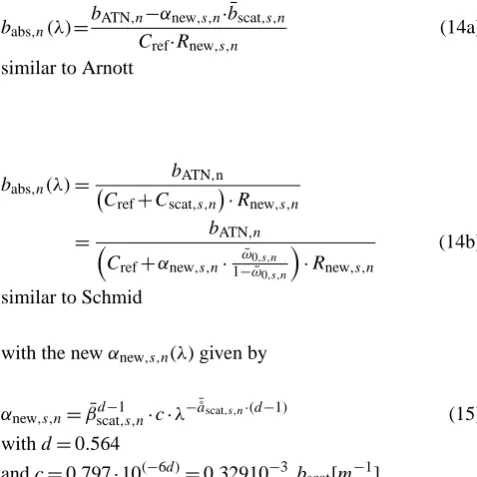
Finally the new AE correction is described in Fig. 1 and by Eqs. 14a or 14b depending if the Arnott or the Schmid scattering correction is applied:
babs,n(λ)=
bATN,n−αnew,s,n· ¯bscat,s,n Cref·Rnew,s,n
(14a) similar to Arnott
babs,n(λ)=
bATN,n
Cref+Cscat,s,n·Rnew,s,n
= bATN,n
Cref+αnew,s,n· ¯ ω0,s,n 1− ¯ω0,s,n
·Rnew,s,n
(14b)
similar to Schmid
with the newαnew,s,n(λ) given by
αnew,s,n= ¯βscatd−1,s,n·c·λ
− ¯a˚scat,s,n·(d−1) (15)
withd=0.564
andc=0.797·10(−6d)=0.32910−3,bscat[m−1]
TheCrefis determined by comparing thebATN already cor-rected for the filter-loading with the newRnewcorrection to babs,refmeasured by a reference instrument, as described in Eq. 4.
The wavelength dependentω0(λ) (Eq. 16) is obtained from ω0,ref that can be calculated with the scattering coefficient taken at one of the AE wavelengthsλrefand the first estima-tion ofbabs=bATN/SG (Schmid et al., 2006), where SG is the mass specific attenuation cross-section proposed by the manufacturer (14625/λ[m2g−1],λin [nm]). It was verified with the JFJ and THE datasets that the choice of the initial wavelengthλrefis not important for the final result:
ω0(λ)=
ω0,ref·
λ λref
−a˚scat
ω0,ref·
λ λref
−a˚scat
+(1−ω0,ref)·
λ λref
−a˚abs (16)
Fig. 2. 1/Rfor the four filter-loading corrections as a function of time for about one month measured at the JFJ atλ=370 nm.
3 Results
3.1 Effects of each partial correction corresponding to a systematic artifact
3.1.1 The filter-loading correction
Figure 2 shows 1/R calculated by the methods by Wein-gartner et al. (2003), Arnott et al. (2005), and Virkkula et al. (2007) as well as the new one described under 2.2.5 for one month of measurements at the JFJ, and Table 3 sum-marizes the results of the four R corrections applied to all the datasets. The constantf of the Weingartner 1/RW
cor-rection was estimated from Weingartner et al. (2003), with f=1.025 corresponding to aged mixed aerosols (JFJ, HOP) andf=1.2 for aerosols near pollution sources (THE), while intermediate values off=1.05 and f=1.10 were taken for MHD and CAB, respectively. The form of the Weingartner filter-loading correction results in 1/RW<1 for ATN<10%,
which leads to minimal 1/RW values of 0.77<1/RW<0.93
depending on the station and consequently to an increase of babs measured on lightly loaded filters. For all the analyzed datasets, the maximum of 1/RW amounts to 1.06, whereas
the mean of 1/RWvaries between 1.01 and 1.03. The Arnott
filter-loading correction leads to 1/RAvalues between 1 and
1.81 with mean values between 1.00 and 1.08. The new correction has a minimum 1/Rnewvalue of 1 similar to the Arnott correction and a maximum value of 2.56. The mean 1/Rnew values vary between 1.05 and 1.37. The Weingart-ner, Arnott and the new filter-loading corrections have a clear wavelength dependence with a greater 1/R at lower wave-lengths, following the wavelength dependence of ATN and babs. The Virkkula filter-loading correction is highly non-stable, leading to large negative and positive 1/RV outliers.
Table 3. Use of the scattering coefficient, minimum, maximum and mean of 1/Rvalues, for all four filter-loading corrections and for the four measuring stations. For the Weingartner correctionf=1.025,f=1.1,f=1.05,f=1.025,f=1.025 andf=1.2 were taken for JFJ, CAB, MHD, HOP, AMA and THE datasets, respectively.Rvalues were taken atλ=660 nm for multi-wavelength AE (JFJ, CAB, AMA and THE).
JFJ CAB MHD HOP AMA THE
Filter-loading Use of Min Max Mean Min Max Mean Min Max Mean Min Max Mean Min Max Mean Min Max Mean correction bscat (1/R) (1/R) (1/R) (1/R) (1/R) (1/R) (1/R) (1/R) (1/R) (1/R) (1/R) (1/R) (1/R) (1/R) (1/R) (1/R) (1/R) (1/R)
WeingartnerRW no 0.87 1.02 1.01 0.77 1.06 1.01 0.84 1.06 1.03 0.91 1.02 1.01 0.93 1.03 1.01 0.94 1.02 1.01 ArnottRA no 1.00 1.07 1.00 1.00 1.15 1.01 1.00 1.40 1.03 1.00 1.22 1.03 1.00 1.81 1.08 1.00 1.30 1.03 VirkkulaRV no −250 1803 2.23 −3.60 6.99 1.05 −1.18 10.08 1.14 −87 223 1.31 −1.61 8.73 1.07 −134 182 0.92 New correctionRnew yes 1.00 1.36 1.05 1.00 1.23 1.05 1.00 2.56 1.12 1.00 1.37 1.09 1.00 2.05 1.29 1.00 1.27 1.09
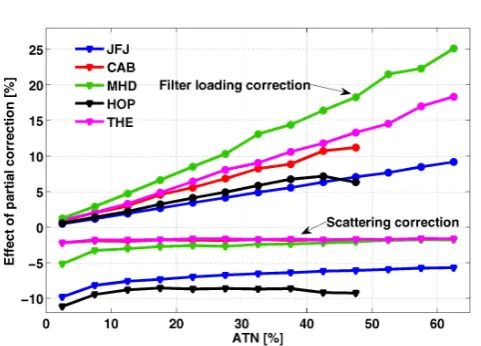
Fig. 3. Effect of the filter-loading (•) and of the scattering (N) tial corrections [(total correction – total correction without one par-tial correction)/total correction] as a function of the attenuation of light through the filter for 5 stations. At MHD and HOP the max-imum of the wavelength is found at 840 nm, whereλ=370 nm is reported for multi-wavelength AE (JFJ, CAB, THE). For the THE dataset, aCref=4.26 similar to the one of CAB was applied.
variability ofbATN as a function of time, which is for most of the time greater than thebATNdecrease induced by filter changes.
The filter-loading artifact can be clearly visualized after a filter change in a distinct step inbATNduring chamber stud-ies, when the aerosol type and concentration remains fairly constant. In an ambient environment however, steps inbATN are not only due to the filter-loading artifact but also due to the natural variability of the aerosol properties. The efficacy of the four filter-loading corrections to smooth steps inbATN due to the filter-loading artifact was tested on the THE and JFJ datasets, leading to no significant differences between the filter-loading corrections.
The averaged effect of the filter-loading correction is plot-ted in Fig. 3 as a function of ATN for the various datasets. At ATN=60% the filter loading correction increasesbabs by 7 to 25% depending on the station. The greatest filter-loading corrections are found for MHD and for the most polluted en-vironments (THE, CAB).
Fig. 4. Crefcalculated frombabscorresponding to a defined ATN
as a function of ATN for the four filter-loading corrections and for the JFJ, CAB, MHD and HOP datasets as well as for thebabsAE
output calculated as recommended by the manufacturer. For JFJ and CAB,babsatλ=660 nm are represented. For JFJ, the Virkkula
filter-loading correction leads to too highCrefvalues varying between 3.7
and 17, and for HOP, the AEbabs calculated as recommended by
the manufacturer leads to around 0.6; these extreme values are not shown for clarity purpose.
466 M. Collaud Coen et al.: Correction algorithms for Aethalometer light absorption coefficient
Table 4. MeanCrefconstants with standard deviations for all four filter-loading corrections for JFJ, CAB, MHD and HOP stations. The
correlation with the MAAP was done withλ=660 nm at JFJ and CAB.
JFJ CAB MHD HOP
WeingartnerRW 2.81±0.11 4.09±0.12 3.05±0.10 2.81±0.10
ArnottRA 2.80±0.13 4.12±0.06 3.08±0.11 2.78±0.09
VirkkulaRV 7.77±4.15 4.57±0.49 3.83±0.41 3.16±0.43
New correctionRnew 2.88±0.08 4.26±0.11 3.51±0.23 2.89±0.03
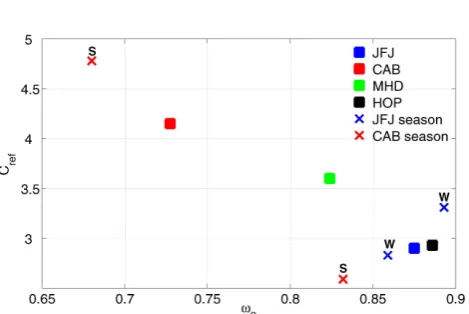
Fig. 5.Crefas a function of the single scattering albedoω0for the
JFJ, CAB, MHD and HOP datasets. For the JFJ and CAB datasets, Crefandω0are also separated between summer (S) and winter (W).
having however the smallest variability with ATN for the smallest ATN. At MHD, the Weingartner and Arnott correc-tions are the flattest ones, the new correction becoming too large at high ATN.
3.1.2 The multiple scattering correction
For the evaluation ofCref of the multi-wavelength AE, the wavelength of λ=660 nm, which is nearest to the MAAP wavelength (λ=630 m), was chosen. The comparison of the AE and MAAP for the four datasets leads to averageCref val-ues between 2.9 and 4.3 (Table 4) with the new filter-loading correction algorithm, while the results found with the Arnott and Weingartner filter-loading corrections are lower. Due to the particularly strong seasonal cycle of aerosol optical properties at the JFJ, an estimation ofCreffor each month was also performed. Crefis lower from April to September with a mean value of 2.83, and higher during the October-March period with a mean of 3.24. The CAB dataset is too short to analyze a complete seasonal cycle. However,Cref is clearly higher during the May–July period than for the rest of the dataset, either because of seasonal variation of the aerosol composition or due to a modification of the inlet during March 2008 (see Table 1). HOP and MHD have less distinct seasonal cycles. Figure 5 showsCrefas a function of
ω0for the four complete datasets (squares) as well as for the JFJ and CAB datasets divided into 2 seasons. A clear cor-relation betweenCref andω0exists, Cref becoming greater for lowerω0. Figure 5 showsCreffor datasets withω0>0.7. Further analysis with other ambient aerosol types, particu-larly in very polluted environments with lower ω0 (<0.7) such as big cities, should enable an extension of the results to a more universalCref(ω0) curve. It is very important to establish such correlation, since the multiple scattering cor-rection is the most important one to ensure good agreement with a referencebabsas will be discussed later.
According to the correction schemes, the multiple scat-tering artifact should depend only on the filter properties and not on the embedded aerosol. However, the calculated Cref is not always constant, even at the same station. This variation of Cref could be caused by semi-volatile organic compounds (VOCs) and water vapor condensing on the filter fibers (Weingartner et al., 2003) or to other similar phenom-ena such as organic particles emitted from low-temperature biomass burning that have a liquid, bead-like appearance when collected on fibrous filters (Subramenian et al., 2007). Firstly, the scattering of the filter fibers can be enhanced by these compounds, leading to a longer optical path length; secondly, the scattering phase function can also be modi-fied leading to a modification of the mean filter reflectance; thirdly, the sticking coefficient (probability to stick on a sur-face) of the aerosol on the fiber and the possible change of the inter-fiber spacing can change the depth of aerosol depo-sition in the filter, leading to a change in its optical properties. The experimental setup used in this study does not allow us to further investigate these potential influences.
3.1.3 The scattering correction
reflectance. The reflectance depends on the aerosol asym-metry parameter, which is lower for longer wavelengths, so that the proportionality factorαshould increase with increas-ing wavelength. The second scatterincreas-ing artifact, as described above, leads to a higher probability of encountering an em-bedded particle, which is presently not compensated by any correction. The MAAP measurement technique does not cor-rect for this second artifact either, but shows close agreement with a reference absorption measurement through the differ-ence between light extinction and scattering (Petzold et al., 2005). This second scattering effect is therefore probably not very pronounced.
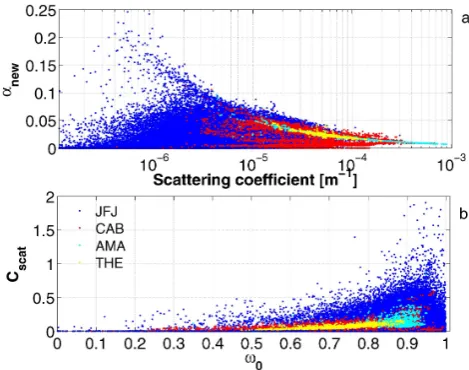
Contrary to the Arnott scattering correction, but according to recent results (M¨uller et al., 2008) (see Sect. 2.2.5), the new correction introduces anαnew(λ) that depends onβ¯scat anda¯˚scat(Eq. 15). Figure 6a shows αnewatλ=660 nm as a function ofbscatfor the JFJ, CAB, AMA and THE datasets. αnew(λ) is lower than about 0.08 for the CAB, AMA and THE datasets. When applied to the JFJ dataset, αnew(λ) ranges between 0 and 0.20, but the great majority ofαnew(λ) values are smaller than 0.1. As expected from the wavelength dependence of the asymmetry parameter,αnew is greater at longer wavelengths. Since ˚ascatat AMA and THE are always near 2 (standard deviation<0.15 for the two stations),αnew clearly increases with decreasingbscat. ˚ascathas a lower mean for the JFJ and CAB datasets (1.64±1.25 and 1.56±0.72, re-spectively), and is much more variable, particularly at the JFJ, due firstly to the longer dataset and secondly to the pres-ence of aged accumulation mode aerosol (Weingartner et al., 1999), which are coarser and lead to low ˚ascatand sometimes even to negative ˚ascatin presence of mineral particles.αnewis therefore not always increasing withbscat, but tends towards zero for very low ˚ascat.
Figure 6b shows theCscatdependence onω0for the JFJ, CAB, AMA and THE datasets. As can be deduced from Eq. 14b,Cscatincreases with increasingω0. While theCscat dependence onω0is well defined for the high aerosol load-ing at Thessaloniki, it becomes less sharp at lower aerosol concentrations, particularly at the JFJ, due firstly to a greater uncertainty in the measurement of very low babs andbscat and secondly to a broader range ofαnewvalues (see Fig. 5a). Cscatmaximum values can be equal to 2 forω0near one at the JFJ, but remains normally below 0.5 for most values of ω0<0.95. TheCscatcorrection is usually greater at longer wavelengths, but inversion of this wavelength dependence is also observed.
Figure 3 shows that the new scattering correction de-creasesbabson average by 2 to 12% depending on the station. The greatest scattering correction is obtained for the high al-titude stations (JFJ, HOP) where aged aerosols are measured. Since the new scattering correction takes into account the mean scattering of all the aerosol embedded into the filter, this correction tends to be more constant with higher filter loading.
Fig. 6. Dependence (a)αnewatλ=660 nm as a function of
scat-tering coefficient atλ=550 nm and (b) Cscat as a function ofω0
atλ=660 nm for the four datasets.αnewandCscat, were calculated
with the new correction scheme and represent the multiplying factor of the scattering correction (Eq. 14a), and the scattering correction in Schmid method (Eq. 14b), respectively.
3.2 Applicability of the AE corrections
The very low aerosol concentrations, particularly at the JFJ and MHD, induce some instrumental difficulties. Due to the fact that the measurements result from the difference be-tween the last and the last before the last measured light attenuation through a loaded filter, very low concentrations sometimes induce negativebabsdue to electronic noise in the raw signals (Petzold and Sch¨onlinner, 2004). Even if nega-tivebabs are not real, these values have to be kept, because they are necessary to avoid a bias in the calculated averages. The amount of negativebabscan be lowered by use of larger flow rates or by longer integrating times. Long-term mon-itoring sites may however have constraints in not allowing variable integrating times. In addition, long integrating times may induce a loss of information such as, for example, di-urnal cycles. Correction algorithms that can be applied to negative values are therefore necessary.
Since the Weingartner correction consists of a simple mul-tiplication with constant factors, it can be applied to the neg-ative values ofbabs, it does not create new negative values as other algorithms do (see below), and has no impact on ˚aabs (the difference between the measured and the Weingartner corrected ˚aabsis less than 0.01%), as long asf is taken as a constant for a given dataset.
468 M. Collaud Coen et al.: Correction algorithms for Aethalometer light absorption coefficient
Fig. 7. Histogram of the relative change (in percent) of AE
de-rived ˚aabs values using Arnott, Schmid and the new corrections,
the method similar to Schmid being represented here. The JFJ and CAB datasets are presented in light and dark colors, respectively. The numbers of cases represented for±100% correspond to ˚aabs changes equal or greater than±100%, with values reaching some-times up to±200% or greater.
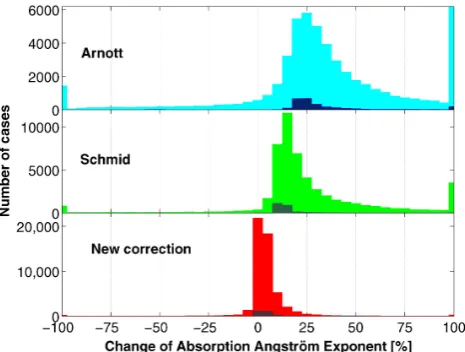
values ofbabs. Finally, the Arnott correction has a broad im-pact on ˚aabs. As can be seen in Fig. 7, the Arnott correction produces values of ˚aabsthat are on average 25% higher than the initially measured ones for both datasets.
The Schmid correction depends onω0; negative values of babslead toω0values greater than 1 and therefore to negative Cscatvalues for the scattering correction. The use of ˚aabs to calculateω0 prevents its application to negativebabs. This produces new missing values ofbabs(2.3% and 0.9% at JFJ and CAB, respectively) and a few new negative values ofbabs (<0.1% for both datasets). The absorption wavelength de-pendence is also clearly modified, leading to ˚aabson average 10–15% higher than the initially measured ones (Fig. 6) for both datasets.
The new AE corrections cannot be used for negativebabs, similarly to the Schmid correction. They therefore generate missing values unless ˚aabs values are averaged in the case of negativebabs. If the new correction similar to the Arnott method (Eq. 14a) is used, new negativebabsvalues are gen-erated (2.1% and<0.1% atλ=370 nm and 2.8% and<0.1% atλ=950 nm at JFJ and CAB, respectively) due to the scat-tering correction subtraction, which is rather less than use of the Arnott correction at high wavelength values. It also in-troduces more outliers than the new method, similar to the Schmid method. Finally this new correction mainly pre-serves ˚aabs(Fig. 6) with 58% and 46% of the exponents re-maining constant, with 18% and 42% of the exponents hav-ing a difference of only 5%, and 7% and finally 1% of the exponents having a 10% difference from the initially mea-sured exponent at JFJ and CAB, respectively.
Fig. 8. Monthly regression slopes between the absorption
coef-ficients at λ=630 nm from the MAAP and the AE (interpolated to λ=630 nm) at the four stations for all the different correction schemes as well as between the absorption coefficients given by the MAAP and those measured by the MAAP in transmission only (black dashed line). For all the corrections schemes, theCrefvalues
from Table 4 are applied. The lack of measurements from Septem-ber 2005 to March 2006 at the JFJ is due to a leak in the MAAP inlet.
3.2.1 Correlation ofbabsvalues derived from AE and
MAAP
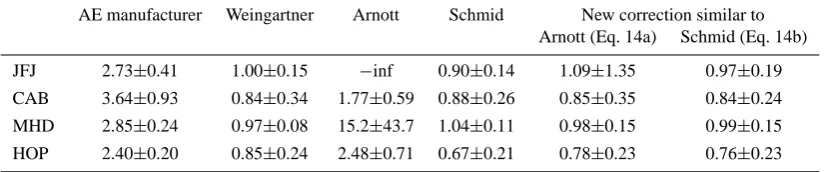
As already stated in the introduction, the MAAP is not an absolute reference method for the absorption coefficient, but it has reduced the AE artifacts by using a sophisticated ra-diative transfer scheme. Due to its better measuring proce-dure and to its availability at various measurement sites for several years, the MAAP will be taken in the following as a reference to evaluate the AE corrections. The slopes of the linear regression between the corrected and the MAAPbabs values are reported in Fig. 8 for each month of simultaneous AE and MAAP measurements at the four stations. The av-erages of the monthly slopes with their standard deviations are given in Table 5. As already mentioned the Arnott cor-rection produces a lot of outliers and has consequently very large mean slopes and is therefore not reported in Fig. 8. As can be seen in Table 5, the new correction like the Arnott and like the Schmid methods both lead to very similar results for all the stations but for JFJ, so that only the new correction like the Schmid method is reported in Fig. 7. Finally, the er-rors on the slope determination are always far smaller than the slope fluctuation between months, so that they have not been reported for clarity purposes.
Table 5. Averages and standard deviations of the monthly slopes between MAAP (λ=630 nm) and AE (reported atλ=630 nm) absorption coefficients measured at the four stations for manufacturer estimation and each AE correction.
AE manufacturer Weingartner Arnott Schmid New correction similar to
Arnott (Eq. 14a) Schmid (Eq. 14b)
JFJ 2.73±0.41 1.00±0.15 −inf 0.90±0.14 1.09±1.35 0.97±0.19
CAB 3.64±0.93 0.84±0.34 1.77±0.59 0.88±0.26 0.85±0.35 0.84±0.24
MHD 2.85±0.24 0.97±0.08 15.2±43.7 1.04±0.11 0.98±0.15 0.99±0.15
HOP 2.40±0.20 0.85±0.24 2.48±0.71 0.67±0.21 0.78±0.23 0.76±0.23
one, followed by the new corrections and finally the Schmid correction. At HOP and JFJ, the Weingartner, the Schmid and the new correction similar to Schmid provide similar standard deviations. At MHD, the Weingartner correction leads to the lowest standard deviation of the slopes, and the new correction to greatest ones. At CAB, the Schmid cor-rection and the new corcor-rection similar to Schmid have the lowest standard deviations. The new correction similar to Arnott leads sometimes to higher standard deviations due to the presence of outliers.
None of the tested AE corrections are able to get rid of some time dependence of the monthly slopes such as the in-crease from October 2006 to February 2007 at the JFJ or the decrease in April 2008 at CAB and in October 2005 at HOP. Monthly slopes between the MAAPbabsoutput and thebabs measured by the MAAP in transmission only (thus using the MAAP in a similar way as the AE, i.e. without the backscat-tering measurements and the radiative transfer scheme, and then treated similarly to AE measurements), are also plotted in Fig. 8 (black dashed line) for the JFJ dataset. Some fea-tures such as the slope increase at the end of 2006 followed by a sharp decrease at the beginning of 2007 are also present. The variability of the monthly slopes as a function of time is therefore not only due to AE instrumental non-idealities, but also due to variations in aerosol properties. Parts of this vari-ability might also be attributed to the condensation of VOCs, water vapor or liquid organic particles as described above. Since Arnott et al. (2005) give a prediction for a scattering correction based on aerosol scattering and asymmetry param-eters, some unsuccessful attempts were performed to weight the scattering correction with the asymmetry parameters. It was also checked that monthly slopes are not correlated with the asymmetry parameter or withω0.
To evaluate the influence of the filter-loading, the scatter-ing and the multiple scatterscatter-ing corrections individually, the new correction was applied to the four datasets while remov-ing successively the different components of the correction. It was found that less than three percents of the total cor-rection is due to the filter-loading corcor-rectionR, which was expected due to the very low mean values of 1/R(Table 3). The greatest part of the correction is due to the multiple scat-tering correction, so that theCrefdetermination is the most
important one to ensure a slope near unity when compared with a reference method. The difference between the Wein-gartner, the Schmid and the new corrections can be mainly at-tributed to the scattering correction. For all the four stations, the scattering correction does not have a great impact on the slope between AE and MAAPbabs. Even if the multiple scat-tering correction is the largest one (150% to 330% depending onCref)to correct for the too highbabs value measured by AE, the filter-loading and the scattering corrections remain necessary since they minimize real measurable artifacts and can modifybabsby up to 25% on average (see Fig. 3).
4 Discussion
4.1 Criteria for a good correction
Before recommendations are formulated on the best way to correct the AE data, criteria for a good correction proce-dure should be stated. Firstly, the correction has to take into account all known artifacts occurring during measurements. Secondly, the correction should be applicable to all kind of datasets. Thirdly, the correction should introduce few out-liers, or new missing or negative values. Fourthly, the cor-rection should lead to the bestbabscorrelation with a “true” reference method. Fifthly, the correction should also lead to a real wavelength dependence of the babs that is real ˚aabs. Finally, the ease of use of the correction may also be a con-sideration for choosing a correction method.
4.2 Modification of the absorption ˚Angstr¨om exponent by AE corrections
470 M. Collaud Coen et al.: Correction algorithms for Aethalometer light absorption coefficient in a greater scattering coefficient but a lower reflectance at
shorter wavelengths. It is therefore difficult to determine if the scattering correction for increased reflectance should modify the absorption wavelength dependence or not, and, in case of modification, if the ˚aabswill be increased or de-creased. Thirdly, due to increasing scattering from the par-ticles with decreasing wavelength, the increase of the ab-sorption due to increased probability of encountering an em-bedded aerosol particle should lead to an increased absorp-tion wavelength dependence. Fourthly, since the filter fibers are non-absorbing and large (typically 1 micrometer for the quartz fiber and 10 micrometer for the cellulose fiber, Arnott et al., 2005), geometric scattering occurs from the cylindri-cal fibers, so that the multiple scattering correction can be expected in a first approximation to be wavelength indepen-dent and to induce no change in the absorption wavelength dependence. Weingartner et al. (2003) concluded similarly. Considering the effects of all parts of the correction on the absorption wavelength dependence, it is not possible to make precise conclusions on the expected changes of ˚aabsinduced by the AE correction.
Weingartner et al. (2003) show a high correlation between AE ˚aabs and a reference method (measurement of the dif-ference between extinction and scattering) for “pure” Diesel and Palas soot particles as well as soot particles externally mixed with secondary organic aerosol or ammonium sul-fate; a lower correlation was found for coated soot particles. Virkkula et al. (2005a) showed a high agreement between ˚
aabs from a 3λ-PSAP calculated with the Virkkula method and a reference value for ˚aabsbetween 1.0 and 1.3. However Virkkula et al. (2005b) also concluded that the correction al-gorithm could still be improved regarding the wavelength dependence. A. Petzold (personal communication, 2009) showed that the 3λ-PSAP Virkkula correction (Virkkula et al., 2005b) leads to minor modification of ˚aabs for values around 1 but to up to 2.5 times larger ˚aabsfor values around 4 corresponding to desert dust. The wavelength dependence of the PSAP filter transmission is far greater than that of the AE filter, which has a low wavelength dependence (see Fig. 6 in Arnott et al., 2005). Since the reflectance of an AE filter is greater than of a PSAP filter (Arnott et al., 2005), its dependence on the scattering artifact is lower (Lindberg et al., 1999). The discrepancy between real and measured ˚
aabs is therefore probably smaller for an AE than for PSAP measurements. Reviewing literature and taking into account all considerations about the modification of the absorption wavelength dependence induced by measurement artifacts, an AE correction that minimizes modifications of ˚aabsis pre-ferred.
Both the Arnott and the Schmid corrections induce impor-tant ˚aabsmodifications. A finer analysis of these wavelength dependent modifications shows that they are present mostly for low ˚ascatand are greater for low positive ˚aabs. They are in fact due to the wavelength dependence of the scattering cor-rection constantsα(λ): since theαwavelength dependence
is fixed for both Arnott and Schmid corrections (α∼λ+1.3), the subtracted amount of the scattering correction increases with increasing wavelength for low ˚ascat. The large ˚aabs in-crease (Fig. 6) is therefore determined by the scattering prop-erties of both non-absorbing and Diesel-soot aerosols mea-sured by Arnott in a chamber study and cannot be explained by considerations about the wavelength dependence modifi-cation due to the scattering correction. The Weingartner cor-rection keeps the measured ˚aabsabsolutely unmodified for all aerosol types. The new correction similar to the Arnott or to the Schmid method mainly preserves ˚aabs, inducing a small increase of ˚aabs in some cases, particularly in presence of mineral dust as determined for the JFJ dataset. Since no ˚aabs reference measurements are available to determine the true absorption coefficient wavelength dependence, the new cor-rection probably offers a median solution between no mod-ification and large modmod-ifications that are not based on theo-retically or experimentally founded reasons.
4.3 Evaluation of each AE correction
Taking into account the criteria for a good correction proce-dure defined in Sect. 4.1, Table 6 summarizes the applicabil-ity and the performances of each AE correction scheme.
The AE correction proposed by Virkkula et al. (2007) does not take into account all the known artifacts and produces a lot of outliers. It is therefore not recommended to use it on atmospheric aerosol long-term datasets.
The Arnott correction (Arnott et al., 2005) proves to have technical limits mainly due to the generation of new nega-tivebabs values, that are greatly enhanced at lower aerosol concentration and particularly at higher wavelengths. It in-troduces large ad-hoc modifications of the absorption wave-length dependence, which are not grounded in theory. The Arnott method remains therefore difficult to apply to all at-mospheric aerosol datasets.
The empirical Weingartner correction (Weingartner et al., 2003) is easy to use, since it does not directly needbscat mea-surements, even if an evaluation ofω0can influence the filter-loading correction. However the determination of thef con-stant used in the Weingartner filter-loading correction is not clearly defined. It does not modify the ˚aabsand shows a very good agreement with the MAAP.
The Schmid correction (Schmid et al., 2006) needs con-comitant scattering coefficient measurements and cannot cope with negative values ofbabs. It also introduces artifacts in the absorption wavelength dependence like the Arnott method, but to a lesser extent. It shows good agreement with the MAAPbabs, leading however to smaller slopes than the Weingartner scheme as well as the new corrections for two stations out of the four.
Table 6. Evaluation of the applicability and the performance of AE corrections based on the criteria defined under Sect. 4.1.
Correction All Applicable to Needbscat Outliers and Agreement a˚abs
Scheme artifacts babs<0 measurement newbabs<0 with MAAP modification
Virkkula no yes no Yes – –
Weingartner yes yes no no Very good none
Arnott yes yes yes Yes, a lot Not good large
Schmid yes no yes no good large
New like Arnott yes no yes Yes, few Very good small
New like Schmid yes no yes no Very good small
negative values ofbabs. Both new corrections introduce a small modification of ˚aabsand show a very good agreement with the MAAPbabs.
All the corrections apart from the Arnott one lead to pretty good agreements with the MAAPbabs. The small differences in the agreement with the MAAP between the Schmid, the Weingartner and both new corrections leads to the conclu-sion thatCrefis indeed the most important parameter in or-der to obtain a good agreement with another instrument. The scattering correction, which is achieved differently for the Weingartner, Schmid and the new corrections, has therefore a far lower impact than the multiple scattering correction. The filter-loading and the scattering corrections are however not negligible and remain necessary to correct for the well-documented corresponding artifacts. The filter-loading cor-rection is more important in the presence of highly polluted environments (lowω0) whereas the scattering correction is the largest in remote stations measuring aged aerosol (high ω0). For stations where nobabsreference measurements are available, Fig. 5 yields an estimate ofCrefifω0is known.
The monthly slopes between AE and MAAPbabsvary as a function of time for all datasets with the standard deviations of the monthly slope reaching 8% to 25%. Similar variations are also found as a function of other extensive and intensive aerosol parameters such asbscat, ˚ascat, ˚aabsandω0. The slope between the MAAPbabs calculated by the MAAP software including the backscatter measurement and from the MAAP transmission measurement only (similarly to AE) are also not constant as a function of time (Fig. 7). The inter-comparison of six carbon measurement methods at the Fresno Supersite during a year (Park et al., 2006) also resulted in standard de-viations of monthly values ranging between 6% and 19% of the average of all monthly values. Better results are only met for similar instruments such as two AE’s. The com-parison ofbabs measured by different types of instruments seems to depend always on the aerosol properties despite the presently applied corrections algorithms. Lack et al. (2008) showed that there is a correlation between the aerosol or-ganic content (OC), ranged between 0 and 17 µg m−3, and the ratio between thebabsmeasured by a PSAP and a PAS. The aerosol OC was measured during two campaigns of 2.5
months duration at the JFJ (Cozic et al., 2007). Since the daily mean OC showed small variations and did not exceed 1.5 µg m−3at the JFJ, no correlation between the measured OC and the ratio between the AE and MAAPbabswas found in this dataset. However, several results presented in this pa-per, particularly the monthly slopes presented in Fig. 8, in-dicate that the variability in aerosol composition is a main clue to the variable slopes between the absorption coeffi-cients measured by the MAAP and AE instruments at the four sites.
5 Conclusions and recommendations
472 M. Collaud Coen et al.: Correction algorithms for Aethalometer light absorption coefficient induces no modification of ˚aabs. Thef constant determining
the filter-loading correction is however not well defined. The new correction scheme has also good agreement with MAAP and it mainly preserves ˚aabsallowing however a modification of ˚aabs, for example in the case of mineral dust events. The new correction similar to the Schmid method leads to a better performance than the one similar to the Arnott method.
The results and recommendations for the AE measure-ments and correction algorithms are summarized as follows:
– Measured attenuation values need to be stored in
databases, since they are used for all AE corrections.
– Concomitant scattering coefficient measurements are
highly recommended, since they are used in all the corrections, and an estimation of the single scattering albedoω0 is important in the determination of several correcting constants.
– The determination of the multiple scattering constant
Crefis crucial to allow good agreement with MAAP data or other reference instruments’ data. The analysis of data from four stations permits a first estimation ofCref as a function of the single scattering albedoω0. Fur-ther analyses, particularly at stations with very high BC load, are however recommended prior to determining a universal correlation betweenCrefandω0.
– The new filter-loading correctionRnewis the most ap-propriate algorithm at two stations because it leads to the most constant ratio between AE and MAAP absorp-tion coefficients as a funcabsorp-tion of ATN.
– Modification of the absorption coefficient wavelength
dependence is a very important factor issue for global radiation transfer assessments. Considerations on the wavelength dependence of each AE artifact does not al-low to determine if an increase or a decrease of ˚aabs occurs. The use of multi-wavelength reference methods (when available) should resolve this issue.
– If no scattering coefficient measurements are available,
the new correction withαnew=0, which corresponds to the Weingartner correction apart from theRcalculation, or the Weingartner correction are recommended.
– If scattering coefficient measurements are available, the
new correction procedure similar to the Schmid method is recommended.
Acknowledgements. We thank the International Foundation High
Altitude Research Stations Jungfraujoch and Gornergrat (HFSJG), which made it possible for PSI to carry out the experiments at the High Altitude Research Station at the Jungfraujoch. This work was supported by MeteoSwiss within the Swiss program to the Global Atmosphere Watch (GAW) of the World Meteorological Organiza-tion. Measurements at Jungfraujoch, Mace Head and Cabauw were also supported by the EC project EUSAAR (European Supersites
for Atmospheric Aerosol Research). For the measurements at Mace Head we acknowledge the Irish Environmental Protection Agency for a Senior Researcher Fellowship under the STRIVE 2007–2013 program, and for the measurements at Cabauw, we acknowledge the support of the Dutch BSIK-program. Financial support from the EC-Project SCOUT-O3 is also acknowledged. The measurements at the Amazon Basin were performed within the framework of the Smoke, Aerosols, Clouds, Rainfall, and Climate (SMOCC) project, a European contribution to the Large-Scale Biosphere-Atmosphere Experiment in Amazonia (LBA), under the leadership of M. O. Andreae and P. Artaxo. It was financially supported by the Max Planck Society (MPG) and the Environmen-tal and Climate Program of the European Commission (contract NEVK2-CT-2001-00110 SMOCC).
Edited by: M. Wendisch
References
Anderson, T. L. and Ogren, J. A.: Determining aerosol radiative properties using the TSI 3563 integrating nephelometer, Aerosol Sci. Tech., 29(1), 57–69, 1998.
Andreae, M. O., Rosenfeld, D., Artaxo, P., Costa, A. A., Frank, G. P., Longo, K. M., and Silva-Dias, M. A. F.: Smoking rain clouds over the Amazon, Science, 303(5662), 1337–1342, 2004. Arnott, W., Hamasha, K., Moosm¨uller, H., Sheridan, P. J. , and
Ogren, J. A.: Towards aerosol light-absorption measurements with a 7-wavelength aethalometer: Evaluation with a photoa-coustic instrument and 3-wavelength nephelometer, Aerosol Sci Tech., 39(1), 17–29, 2005.
Baltensperger, U., G¨aggeler, H. W., Jost, D. T., Lugauer, M., Schwikowski, M., Weingartner, E., and Seibert, P.: Aerosol cli-matology at the high-alpine site Jungfraujoch, Switzerland, J. Geophys. Res., 102(D16), 19707–19715, 1997.
Bohren, C. F. and Huffman, D. R.: Absorption and Scattering by small Particles, Wiley, New York, 196, 1983.
Bond, T. and Bergstrom, R.: Light absorption by carbonaceous par-ticles: An investigative review, Aerosol Sci. Tech., 40, 1–41, 2006.
Bond, T. C., Anderson, T. L., and Campbell, D.: Calibration and intercomparison of filter-based measurements of visible light ab-sorption by aerosols, Aerosol Sci. Tech., 30(6), 582–600, 1999. Cozic, J., Verheggen, B., Weingartner, E., Crosier, J., Bower, K.
N., Flynn, M., Coe, H., Henning, S., Steinbacher, M., Henne, S., Collaud Coen, M., Petzold, A., and Baltensperger, U.: Chemi-cal composition of free tropospheric aerosol for PM1 and coarse mode at the high alpine site Jungfraujoch, Atmos. Chem. Phys., 8, 407–423, 2008,
http://www.atmos-chem-phys.net/8/407/2008/.
Heintzenberg, J., Charlson, R. J., Clarke, A. D., Liousse, C., Ramaswamy, V., Shine, K. P., Wendisch, M., and Helas, G.: Measurements and modeling of aerosol single-scattering albedo: progress, problems and prospects, Contrib. Atmos. Phys., 70(4), 249–263, 1997.
Horvath, H.: Atmospheric light absorption: a review, Atmos. Envi-ron., 27(3), 293–317, 1993.