
1535-9778/10/$12.00 doi:10.1128/EC.00286-09
Copyright © 2010, American Society for Microbiology. All Rights Reserved.
Mapping of Vps21 and HOPS Binding Sites in Vps8 and Effect of
Binding Site Mutants on Endocytic Trafficking
䌤
Agnes Pawelec,† Janja Arsic
´, and Ralf Ko
¨lling*
Institut fu¨r Lebensmittelwissenschaft und Biotechnologie, Fg. Ga¨rungstechnologie (150f), Universita¨t Hohenheim, D-70599 Stuttgart, Germany
Received 6 October 2009/Accepted 6 February 2010
Vps8 is a subunit of the CORVET tethering complex, which is involved in early-to-late endosome fusion.
Here, we examine the role of Vps8 in membrane fusion at late endosomes in Saccharomyces cerevisiae. We
demonstrate that Vps8 associates with membranes and that this association is independent of the class C/HOPS core complex and, contrary to a previous report, also independent of the Rab GTPase Vps21. Our data indicate that Vps8 makes multiple contacts with membranes. One of these membrane binding regions could be mapped to the N-terminal part of the protein. By two-hybrid analysis, we obtained evidence for a physical interaction between Vps8 and the Rab5 homologue Vps21. In addition, the interaction with the HOPS core complex was confirmed by immunoprecipitation experiments. By deletion analysis, the Vps21 and HOPS binding sites were mapped in Vps8. Deletions that abrogated HOPS core complex binding had a strong effect on the turnover of the endocytic cargo protein Ste6 and on vacuolar sorting of carboxypeptidase Y. In contrast, deletions that abolished Vps21 binding showed only a modest effect. This suggests that the Vps21 interaction is not essential for endosomal trafficking but may be important for some other aspect of Vps8 function.
The compartments of the exocytic/endocytic membrane sys-tem are dynamic structures that continuously exchange mate-rials by budding and fusion of transport vesicles. Despite this continuous exchange, the compartments maintain their specific identities. A basic machinery consisting of tethering factors, Rab GTPases, SNARE proteins, and Sec1/Munc18 (SM) pro-teins accomplishes membrane targeting and fusion. For each individual membrane fusion event, a characteristic set of pro-teins is used.
We are interested in a particular membrane fusion step, the fusion of early endosome-derived vesicles with late endosomes. Screening for vps(vacuolar protein sorting) mutants in Sac-charomyces cerevisiaeidentified factors involved in this fusion step (3). Mutants defective in the early-to-late endosome traf-ficking step belong to the class D group ofvpsmutants, whose hallmark is an enlarged vacuole (21). Among the class D func-tions, representatives of the main groups of targeting and fu-sion factors can be found. The Q-SNARE protein Pep12, for instance, a member of the syntaxin family, serves as a marker for late endosomal membranes (2). Together with the Q-SNAREs Vti1 and Syn8 or Tlg1, it forms two alternative t-SNARE complexes on late endosomal membranes (17). These t-SNAREs combine with the v-SNARES Snc1/Snc2 or Ykt6 to form functionaltrans-SNARE complexes. Pep12 func-tionally interacts with another class D protein, the SM protein Vps45 (4). Another component of the basic fusion machinery
at late endosomes is the class D protein Vps21, a member of the Rab GTPase family and the yeast homologue of mamma-lian Rab5 (8, 12, 30). Rab proteins are key regulators of mem-brane fusion (9). They are involved in the recruitment of teth-ering and docking factors, and by their interplay with Rab effectors they contribute to the establishment of specific mem-brane domains. Another class D protein connected to Rab function is Vps9, a guanidine nucleotide exchange factor (GEF) for Vps21 (11).
Additional class D proteins are involved in vesicle teth-ering at late endosomes. Basically, there are two kinds of tethers, proteins containing extensive coiled-coil domains and large multisubunit complexes (33). The prototype of the coiled-coil tethers is p115, with its yeast homologue Uso1, involved in tethering of vesicles to Golgi apparatus mem-branes (25). Another member of this class is EEA1, which is involved in tethering of vesicles to endosomes. The yeast class D protein Vps19/Pep7/Vac1 could be functionally sim-ilar to EEA1 (16). Two further class D proteins, Vps3 and Vps8, are part of the multisubunit (class C core vacuole/ endosome tethering) CORVET tethering complex (20, 32). This complex shares core components with the HOPS (ho-motypic fusion and vacuole protein sorting) tethering com-plex involved in homotypic vacuolar fusion (28). This core complex, the class C Vps complex, consists of Vps11/Pep5, Vps16, Vps18/Pep3, and the SM protein Vps33 (26). Instead of Vps3 and Vps8, HOPS contains two additional subunits, Vps39/Vam6 and Vps41 (35), which appear to be function-ally equivalent to Vps3 and Vps8 (20). In addition to bridg-ing donor and acceptor membranes, tethers appear to be involved in coordinating Rab and SNARE functions. This was suggested by the finding that the equivalent CORVET/ HOPS subunits Vps3 and Vps39/Vam6 both display GEF activity toward their respective Rab proteins, Vps21 and Ypt7 (20, 35). In addition, whole tethering complexes act as * Corresponding author. Mailing address: Institut fu¨r
Lebensmittel-wissenschaft und Biotechnologie, Fg. Ga¨rungstechnologie (150f), Uni-versita¨t Hohenheim, Garbenstr. 23, D-70599 Stuttgart, Germany. Phone: 0711-459 22310. Fax: 0711-459 24121. E-mail: koelling@uni -hohenheim.de.
† Present address: Institut fu¨r Funktionelle Genomik, Universita¨t Regensburg, Franz-Josef-Strauss Allee 11 (Uniklinik), D-93053 Re-gensburg, Germany.
䌤Published ahead of print on 19 February 2010.
602
on September 8, 2020 by guest
http://ec.asm.org/
Rab effectors by binding to activated Rab-GTP and interact with the corresponding SNARE complexes (6, 20, 31).
How exactly the tethers coordinate Rab and SNARE func-tions during membrane fusion is at present unclear. Here, we examine the function of the CORVET subunit Vps8 (5, 13) in membrane fusion at late endosomes in yeast. We demonstrate that Vps8 directly associates with membranes. Contrary to a previous report (13), we show that this membrane association is not dependent on Vps21. We further investigate the func-tional relationship between Vps8 and Vps21. We found that Vps21 physically interacts with Vps8 but that this interaction does not appear to be absolutely required for endosomal traf-ficking. Finally, we speculate that Vps8 could be part of a higher-order structure.
MATERIALS AND METHODS
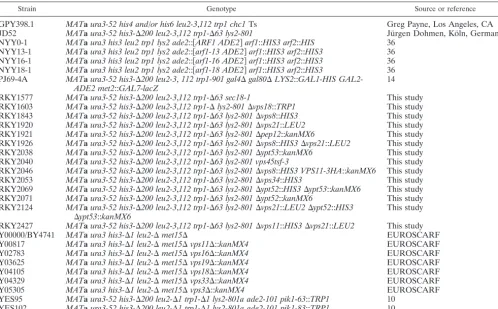
Yeast strains and plasmids. The yeast strains used are listed in Table 1. Deletion strains were derived from the wild-type strain JD52. They were con-structed by one-step gene replacement with PCR-generated cassettes (18). The deletions were verified by PCR. Site-directed mutagenesis ofVPS21was per-formed by QuikChange PCR mutagenesis (Stratagene, La Jolla, CA). Yeast cells were grown in yeast extract-peptone-dextrose medium (1% yeast extract, 2% Bacto peptone, 2% glucose) or in synthetic dextrose-Casamino Acids medium (0.67% yeast nitrogen base without amino acids, 1% casein hydrolysate, 2% glucose).
Flotation gradients.Flotation gradients were essentially performed as de-scribed in reference 1. Briefly, cells were grown overnight to logarithmic phase. Ten optical density at 600 nm (OD600) units were harvested by centrifugation,
washed with water, and lysed by agitation with glass beads in TNE buffer (50 mM Tris, pH 7.4, 150 mM NaCl, 5 mM EDTA plus protease inhibitors). After
removal of cell debris and intact cells by centrifugation at 500⫻gfor 5 min, 125
l of the extract was mixed with 250l of 60% Optiprep solution (Axis-Shield, Oslo, Norway). The resulting 40% Optiprep fraction was transferred to the bottom of a centrifugation tube and overlaid with 600l of 30% Optiprep in TNE buffer and 100l of TNE. Then the gradients were centrifuged at 77,000 rpm and 4°C for 2 h in a TLA 100.2 rotor in a Beckman tabletop ultracentrifuge. Six equal fractions were collected and assayed for the presence of proteins by Western blotting.
Other methods.Pulse-chase, carboxypeptidase Y (CPY) sorting, and immu-noprecipitation experiments were performed as described previously (34).
RESULTS
Membrane association of Vps8. The hydrophilic protein
Vps8 can be sedimented by centrifugation. From this, it has been concluded that Vps8 is membrane associated (5, 13). But, sedimentation is not necessarily proof of membrane associa-tion, since the protein could also be sedimented as part of a larger protein structure. To distinguish between these possibil-ities, Vps8 membrane association was examined in flotation experiments (Fig. 1). For detection, Vps8 was 13myc tagged at its C terminus, resulting in a fully functional protein (data not shown). Cell extracts were mixed with a high-density Optiprep solution and were overlaid with Optiprep solutions of lower densities in a centrifuge tube. Due to their low densities, mem-branes float to the top of the gradient during centrifugation, while proteins not associated with membranes remain in the lower part of the gradient. About half of Vps8 was recovered in the top three fractions of the gradient, along with the mem-brane markers ALP and Pep12 (Fig. 1A). The soluble protein TABLE 1. Yeast strains
Strain Genotype Source or reference
GPY398.1 MATaura3-52 his4 and/or his6 leu2-3,112 trp1 chc1Ts Greg Payne, Los Angeles, CA JD52 MATaura3-52 his3-⌬200 leu2-3,112 trp1-⌬63 lys2-801 Ju¨rgen Dohmen, Ko¨ln, Germany NYY0-1 MATaura3 his3 leu2 trp1 lys2 ade2::关ARF1 ADE2兴arf1::HIS3 arf2::HIS 36
NYY13-1 MATaura3 his3 leu2 trp1 lys2 ade2::关arf1-13 ADE2兴arf1::HIS3 arf2::HIS3 36 NYY16-1 MATaura3 his3 leu2 trp1 lys2 ade2::关arf1-16 ADE2兴arf1::HIS3 arf2::HIS3 36 NYY18-1 MATaura3 his3 leu2 trp1 lys2 ade2::关arf1-18 ADE2兴arf1::HIS3 arf2::HIS3 36 PJ69-4A MATaura3-52 his3-⌬200 leu2-3,112 trp1-901 gal4⌬gal80⌬LYS2::GAL1-HIS
GAL2-ADE2 met2::GAL7-lacZ
14
RKY1577 MATaura3-52 his3-⌬200 leu2-3,112 trp1-⌬63 sec18-1 This study RKY1603 MATaura3-52 his3-⌬200 leu2-3,112 trp1-⌬lys2-801⌬vps18::TRP1 This study RKY1843 MATaura3-52 his3-⌬200 leu2-3,112 trp1-⌬63 lys2-801⌬vps8::HIS3 This study RKY1920 MATaura3-52 his3-⌬200 leu2-3,112 trp1-⌬63 lys2-801⌬vps21::LEU2 This study RKY1921 MATaura3-52 his3-⌬200 leu2-3,112 trp1-⌬63 lys2-801⌬pep12::kanMX6 This study RKY1926 MATaura3-52 his3-⌬200 leu2-3,112 trp1-⌬63 lys2-801⌬vps8::HIS3⌬vps21::LEU2 This study RKY2038 MATaura3-52 his3-⌬200 leu2-3,112 trp1-⌬63 lys2-801⌬ypt53::kanMX6 This study RKY2040 MATaura3-52 his3-⌬200 leu2-3,112 trp1-⌬63 lys2-801 vps45tsf-3 This study RKY2046 MATaura3-52 his3-⌬200 leu2-3,112 trp1-⌬63 lys2-801⌬vps8::HIS3 VPS11-3HA::kanMX6 This study RKY2053 MATaura3-52 his3-⌬200 leu2-3,112 trp1-⌬63 lys2-801⌬vps34::HIS3 This study RKY2069 MATaura3-52 his3-⌬200 leu2-3,112 trp1-⌬63 lys2-801⌬ypt52::HIS3⌬ypt53::kanMX6 This study RKY2071 MATaura3-52 his3-⌬200 leu2-3,112 trp1-⌬63 lys2-801⌬ypt52::kanMX6 This study RKY2124 MATaura3-52 his3-⌬200 leu2-3,112 trp1-⌬63 lys2-801⌬vps21::LEU2⌬ypt52::HIS3
⌬ypt53::kanMX6
This study
RKY2427 MATaura3-52 his3-⌬200 leu2-3,112 trp1-⌬63 lys2-801⌬vps11::HIS3⌬vps21::LEU2 This study
Y00000/BY4741 MATaura3 his3-⌬1 leu2-⌬met15⌬ EUROSCARF
Y00817 MATaura3 his3-⌬1 leu2-⌬met15⌬vps11⌬::kanMX4 EUROSCARF Y02783 MATaura3 his3-⌬1 leu2-⌬met15⌬vps16⌬::kanMX4 EUROSCARF Y03625 MATaura3 his3-⌬1 leu2-⌬met15⌬vps19⌬::kanMX4 EUROSCARF Y04105 MATaura3 his3-⌬1 leu2-⌬met15⌬vps18⌬::kanMX4 EUROSCARF Y04329 MATaura3 his3-⌬1 leu2-⌬met15⌬vps33⌬::kanMX4 EUROSCARF Y05305 MATaura3 his3-⌬1 leu2-⌬met15⌬vps3⌬::kanMX4 EUROSCARF YES95 MATaura3-52 his3-⌬200 leu2-⌬1 trp1-⌬1 lys2-801a ade2-101 pik1-63::TRP1 10
YES102 MATaura3-52 his3-⌬200 leu2-⌬1 trp1-⌬1 lys2-801a ade2-101 pik1-83::TRP1 10
on September 8, 2020 by guest
http://ec.asm.org/
phosphoglycerate kinase (PGK) was mostly found in the lower three fractions of the gradient. This indicated that indeed a substantial fraction of Vps8 is membrane associated.
Effect of⌬vps21on Vps8 membrane association.Since Vps8
does not contain any hydrophobic membrane-spanning seg-ments, it appears to be a peripheral membrane protein. We were interested to know how Vps8 associates with membranes and to identify potential factors involved in its membrane as-sociation. Previously, it was suggested that membrane associ-ation is dependent on the small GTPase Vps21, the yeast Rab5 homologue (13). We therefore tested by flotation whether Vps8 membrane association was abrogated in a⌬vps21strain (Fig. 1B). Controls were performed as described for Fig. 1A (data not shown). In conflict with these earlier results, Vps8 was still found at the membrane in the ⌬vps21 strain. We further tested whether the nucleotide state of the Vps21 GTPase had an influence on Vps8 membrane association. To this end, the dominant negative Vps21 S21N mutant, locked in the GDP-bound form, and the permanently active Vps21 Q66L mutant, locked in the GTP-bound form (11), were ex-pressed in a⌬vps21strain. But, similar to the⌬vps21 strain, Vps8 was still found at the membrane. We also considered the possibility that the Vps21 homologues Ypt52 and Ypt53 could substitute for Vps21 in membrane binding. But we also found that the triple mutant⌬vps21⌬ypt52⌬ypt53still showed mem-brane binding (data not shown).
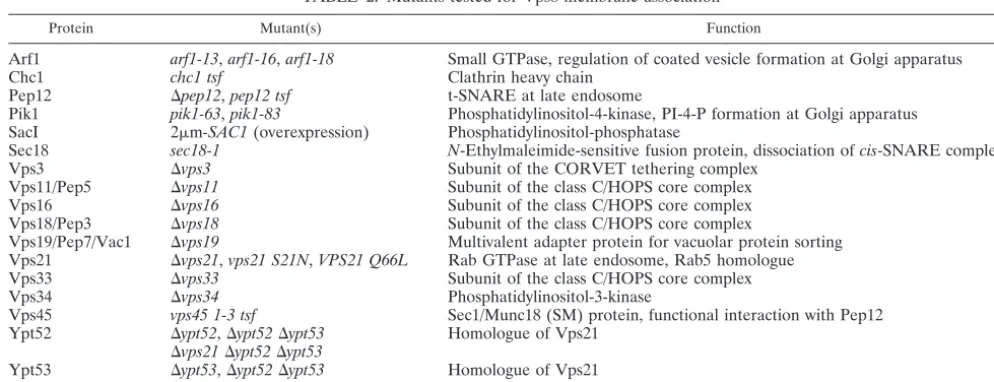
In addition to ⌬vps21, a whole collection of pertinent mu-tants (as detailed in Table 2) was examined for their effects on Vps8 membrane association in flotation experiments. Espe-cially, we focused on the mutants of the class C/HOPS core complex (26) and the CORVET subunit mutant ⌬vps3(Fig. 1C). Vps8 was still found at the membrane in these mutants; however, the Vps8 proportion in the membrane fraction was slightly reduced compared to the wild type. Thus, although Vps8 membrane association is not absolutely dependent on the HOPS core components, the presence of a functional CORVET com-plex seems to further stabilize Vps8 at the membrane. Alterna-tively, the Vps8 membrane association is destabilized due to the FIG. 1. Fractionation of Vps8 by flotation. (A) Cell extracts of
RKY1843 (⌬vps8) transformed with pRK827 (VPS8-13myc) were frac-tionated on Optiprep flotation gradients. Six fractions (lanes 1 to 6) were collected from the gradients (lanes 1 to 3, membrane fraction; lanes 4 to 6, soluble proteins) and analyzed for the presence of marker proteins by Western blotting with specific antibodies as indicated. (B) Additional flotation experiments were performed with (from top to bottom) strain RKY1926 (⌬vps8⌬vps21) transformed with pRK827 (VPS8-13myc) and YCplac22 (vector), pRK933 (VPS21 S21N), and pRK935 (VPS21 Q66L) and with strain RKY2427 (⌬vps11⌬vps21) transformed with pRK827. (C) Flotations with HOPS/CORVET mu-tants (in the BY4741 background [see Table 1]). The average percent-ages of Vps8 in the membrane fraction from three independent ex-periments are indicated (with standard deviations). WT, wild-type strain BY4741.
TABLE 2. Mutants tested for Vps8 membrane associationa
Protein Mutant(s) Function
Arf1 arf1-13,arf1-16,arf1-18 Small GTPase, regulation of coated vesicle formation at Golgi apparatus
Chc1 chc1 tsf Clathrin heavy chain
Pep12 ⌬pep12,pep12 tsf t-SNARE at late endosome
Pik1 pik1-63,pik1-83 Phosphatidylinositol-4-kinase, PI-4-P formation at Golgi apparatus SacI 2m-SAC1(overexpression) Phosphatidylinositol-phosphatase
Sec18 sec18-1 N-Ethylmaleimide-sensitive fusion protein, dissociation ofcis-SNARE complexes
Vps3 ⌬vps3 Subunit of the CORVET tethering complex
Vps11/Pep5 ⌬vps11 Subunit of the class C/HOPS core complex
Vps16 ⌬vps16 Subunit of the class C/HOPS core complex
Vps18/Pep3 ⌬vps18 Subunit of the class C/HOPS core complex
Vps19/Pep7/Vac1 ⌬vps19 Multivalent adapter protein for vacuolar protein sorting Vps21 ⌬vps21,vps21 S21N,VPS21 Q66L Rab GTPase at late endosome, Rab5 homologue
Vps33 ⌬vps33 Subunit of the class C/HOPS core complex
Vps34 ⌬vps34 Phosphatidylinositol-3-kinase
Vps45 vps45 1-3 tsf Sec1/Munc18 (SM) protein, functional interaction with Pep12 Ypt52 ⌬ypt52,⌬ypt52⌬ypt53 Homologue of Vps21
⌬vps21⌬ypt52⌬ypt53
Ypt53 ⌬ypt53,⌬ypt52⌬ypt53 Homologue of Vps21
⌬vps21⌬ypt52⌬ypt53
a
Transformed with pRK827; membrane associations were tested by flotation.
on September 8, 2020 by guest
http://ec.asm.org/
trafficking block induced in the mutants. We also considered the possibility that Vps8 may be held at the membrane by two differ-ent interactions mediated by Vps21 and HOPS. Therefore, a flotation experiment was performed with a⌬vps11⌬vps21double mutant. However, Vps8 was still found in the membrane fraction in this mutant (Fig. 1B).
So far, we have not been able to identify any mutant that completely abolishes the Vps8 membrane association. The most likely interpretation of these data therefore is that Vps8 has an intrinsic ability to bind to membranes. We wanted to address this point by testing the lipid binding properties of purified Vps8. However, due to aggregation problems with Vps8 expressed inEscherichia coli, we were unable to resolve this issue.
Mapping of an N-terminal membrane binding domain in
Vps8.Using C-terminal truncations, we tried to map the
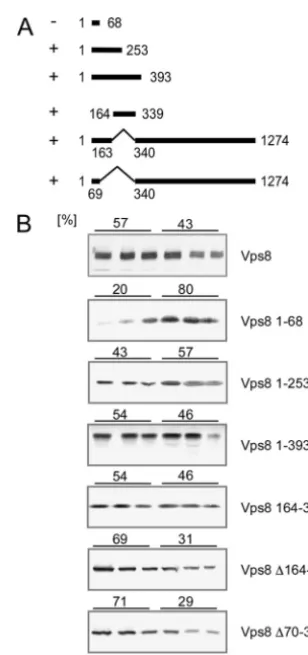
mem-brane binding domain in Vps8. Again, the deletions were ex-amined for membrane binding by flotation (Fig. 2). A small N-terminal fragment comprising 253 amino acids was still able to bind to membranes. But, the membrane association was lost upon further shortening to 68 N-terminal amino acids. Fur-thermore, a fragment spanning amino acids 164 to 339 did bind to membranes. From this analysis, we conclude that a mem-brane binding domain is contained in Vps8 between amino acids 164 and 253.
When we deleted the mapped membrane binding region from Vps8 (⌬164–339 or⌬70–339), the resulting proteins were still membrane bound. This indicates that there are additional regions in Vps8 that mediate membrane binding.
In fact, all Vps8 deletion mutants examined in this study (except for the short N-terminal peptide) were still membrane bound (data not shown). This indicates that there are multiple membrane binding regions in Vps8.
Mapping of Vps21 and HOPS core complex binding
do-mains in Vps8.It has been claimed that Vps21 functionally
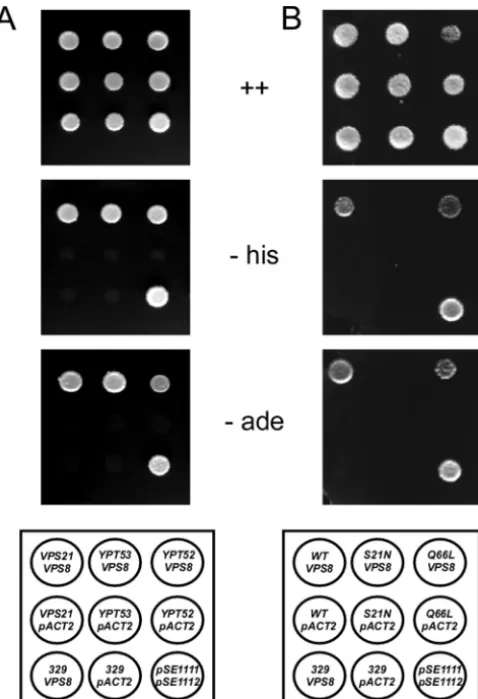
interacts with Vps8 (13). Although we could not detect an effect of⌬vps21on Vps8 membrane binding, Vps21 could still affect other aspects of Vps8 function. Therefore, we examined Vps8 for Vps21 binding by using the yeast two-hybrid system. Fusions between Vps8 and the Gal4 activation domain (Gal4AD-Vps8) and between Vps21 and the Gal4 DNA bind-ing domain (Gal4DB-Vps21) were expressed in a two-hybrid tester strain. Interaction of the two fusion partners is reflected by activation of the GAL UAS-dependent HIS3 and ADE2 reporter cassettes. When the Gal4AD-Vps8 fusion was ex-pressed together with the Gal4DB-Vps21 fusion, activation of theHIS3andADE2reporter cassettes was observed (Fig. 3A). No activation was observed with the single constructs. This indicates that Vps21 indeed interacts with Vps8. A similar interaction was also observed with the Vps21 homologues Ypt52 and Ypt53. We also tried to verify this interaction by coimmunoprecipitation (co-IP). However, we failed to detect a specific co-IP signal between Vps8-13myc and Vps21 (data not shown). We further tested whether the nucleotide state of the Vps21 GTPase had an influence on Vps8 binding. To this end, the dominant negative Vps21 S21N mutant, locked in the GDP-bound form, and the permanently active Vps21 Q66L mutant, locked in the GTP-bound form, were examined for Vps8 two-hybrid interactions (Fig. 3B). We found that Vps21 was only able to interact with Vps8 in its GTP-bound (Q66L)
form. A similar result has been reported recently elsewhere (19).
In addition to Vps21, Vps8 also associates with the core components of the HOPS complex (20, 32). We were inter-ested in mapping the binding domains for Vps21 and the HOPS core complex in Vps8. To this end, various deletions were introduced into Vps8 (Fig. 4), and the deletion constructs were examined for Vps21 and HOPS core complex interac-tions by two-hybrid analysis and by coimmunoprecipitation experiments.
By database inspection, we looked for conserved motifs in the Vps8 protein sequence, as a starting point for our deletion analysis. At present, only three conserved motifs in Vps8 are listed with high confidence in the SMART database (http: //smart.embl-heidelberg.de/): two N-terminal WD40 repeats and a C-terminal RING-H2 domain. When we started this analysis, two putative clathrin heavy chain repeats (CLH) were FIG. 2. Mapping of the N-terminal membrane binding region in Vps8. (A) The range of Vps8 amino acids encoded by the different constructs is indicated by solid lines and marked with the correspond-ing sequence positions.⫹, membrane association;⫺, no membrane association. All Vps8 constructs were 13myc tagged at the C terminus. (B) Flotation analysis was performed as described for Fig. 1. Cell extracts were prepared from RKY1843 (⌬vps8) transformed with the following various plasmids (from top to bottom): pRK827 ( VPS8-13myc), pRK1000 (VPS8 1–68), pRK990 (VPS8 1–253), pRK992 (VPS8 1–393), pRK1015 (VPS8 164–339), pRK1038 (VPS8⌬164–339), and pRK1052 (VPS8⌬70–339). The amounts of Vps8 (percentages) in the top three fractions (membrane fraction) and the lower three frac-tions (soluble proteins) are given on top of the panels.
on September 8, 2020 by guest
http://ec.asm.org/
also displayed, but these are no longer listed in the current version of the database, presumably because their scores are less significant than the required threshold. Yet, these motifs could still be meaningful, since for Vps41, which appears to be functionally equivalent to Vps8, such a motif is predicted with high confidence.
In addition to the confidently predicted domains, a whole list of putative domains in Vps8 was presented in the SMART database with scores below the selected threshold. It is well possible that some of them are meaningful. For our deletion study, we selected putative motifs related to membrane bind-ing (PX and PXA) and motifs related to GTPase function
(FH2, RasGEFN, RhoGEF, RhoGAP, ARF-GAP, and Sec7). The deletion comprising the motifs related to GTPase function was called an effector domain (EFF) deletion. Although we are well aware that these motifs may not be significant, for sim-plicity we still chose to use these motif designations to name our deletion constructs. The deletions introduced into Vps8 are depicted in Fig. 4.
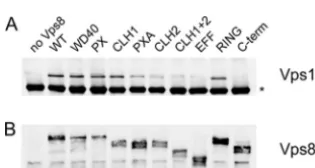
The interaction between Vps8 deletion mutants and Vps21 was again examined by two-hybrid analysis (Fig. 5). Gal4DB-Vps21 was expressed together with Gal4AD-Vps8 fusions in the two-hybrid tester strain, and induction levels of theHIS3 and ADE2cassettes were monitored by growth on⫺His and⫺Ade plates. Three deletion mutants, Vps8⌬CLH2, Vps8⌬RING, and Vps8⌬C-term, were still able to interact with Vps21, while all other deletion mutants did not show an interaction. The three deletions which still allowed binding are located in the C-terminal part of Vps8. Thus, the N-terminal three-quarters of the protein appear to be important for Vps21 binding.
The interaction between Vps8 deletions mutants and the HOPS core complex was examined by coimmunoprecipitation (Fig. 6). The 13myc-tagged Vps8 variants were immunopre-cipitated from cell extracts with anti-myc antibodies, and the immunoprecipitates were examined for the presence of the 3HA-tagged HOPS subunit Vps11 by Western blotting. For most of the deletion variants, a Vps11 signal was obtained. Interestingly, most of the deletions that abrogated Vps21 ing (WD40, PX, CLH1, and PXA) did not affect Vps11 bind-ing. Only one deletion, the⌬C-term deletion, completely pre-vented Vps11 binding. The Vps11 signal was reduced with the
⌬CLH2 and ⌬EFF deletions and was very faint with the
⌬CLH1⫹2 double deletion. Thus, deletions in the C-terminal part of Vps8 seem to affect HOPS binding.
So, an inverse pattern of interactions was observed for FIG. 3. Vps8-Vps21 interaction. Interactions were tested by
two-hybrid analysis. Strain PJ69-4A was transformed with two plasmids coding for Gal4-DNA binding domain (DB) and Gal4 activation do-main (AD) fusions. Equal amounts of cells were spotted onto minimal plates (from top to bottom) containing adenine and histidine (⫹⫹), adenine (⫺his), or histidine (⫺ade). Plates were scored after 3 days at 30°C. Plasmid combinations spotted are indicated in the lower panels (from left to right). (A) pRK1002 (GAL-DB-VPS21) ⫹ pRK979 (GAL-AD-VPS8); pRK1003 (GAL-DB-YPT53)⫹pRK979; pRK1024 (GAL-DB-YPT52) ⫹ pRK979; pRK1002 ⫹ pACT2; pRK1003 ⫹ pACT2; pRK1024⫹pACT2; pRK329⫹pRK979; pRK329⫹pACT2; pSE1111 ⫹ pSE1112 (positive controls) (14). (B) pRK1002 ⫹ pRK979; pRK1004 (GAL-DB-VPS21 S21N); pRK1005 ( GAL-DB-VPS21 Q66L); pRK1002⫹pACT2; pRK1004⫹pACT2; pRK1005⫹ pACT2; pRK329 ⫹ pRK979; pRK329 ⫹ pACT2; pSE1111 ⫹ pSE1112.
FIG. 4. Vps8 deletions. Putative motifs (top) and the positions of the deletions (bottom) within the Vps8 protein sequence are indicated. The names of putative sequence motifs (as originally defined in the SMART database [http://smart.embl-heidelberg.de/]) are listed on the left; the range of deleted amino acids is listed on the right. The single-copy plas-mids encoding the C-terminally 13myc-tagged Vps8 deletion variants are (from top to bottom): pRK999 (⌬WD40), pRK1006 (⌬PX), pRK868 (⌬CLH1), pRK1007 (⌬PXA), pRK863 (⌬CLH2), pRK1008 (⌬EFF), pRK864 (⌬CLH1⫹2), pRK858 (⌬RING), and pRK1054 (⌬C-term).
on September 8, 2020 by guest
http://ec.asm.org/
Vps21 and the HOPS core complex: while the N-terminal three-quarters of Vps8 appear to be important for Vps21 ing, the C-terminal quarter appears to be important for bind-ing to the HOPS core complex.
All deletion mutants were also tested for membrane associ-ation in flotassoci-ation experiments. But again, none of the deletions had an effect on membrane association (data not shown).
Phenotypes ofVPS8deletions.VPS8mutants are defective in
sorting of biosynthetic and endocytic cargoes to the yeast vac-uole. To study the effects of our Vps8 deletions on vacuolar protein sorting, we examined the transport of the endocytic cargo protein Ste6, the yeasta-factor transporter. The
short-lived Ste6 protein (half-life, 13 min) is strongly stabilized in a
⌬vps8strain. The Ste6 half-life was determined by pulse-chase experiments in a ⌬vps8 strain transformed with single-copy plasmids expressing the different Vps8 deletion mutants (as detailed in Fig. 4) and with a multicopy plasmid expressing Ste6-3HA (Fig. 7). Some deletions had a strong effect on Ste6 half-life, and some had only a moderate effect or no effect at all. A strong effect was observed with those deletions that affect HOPS binding (⌬EFF,⌬CHL1⫹2, and⌬C-term), while only a moderate effect was seen with the deletions that affect Vps21 binding (⌬WD40,⌬PX, ⌬CHL1, and ⌬PXA). The deletions that affect neither Vps21 nor HOPS binding had no effect on the Ste6 half-life (⌬CLH2 and⌬RING). So, there appears to be a correlation between the binding properties of the Vps8 mutants and the observed Ste6 phenotype. While loss of HOPS core complex binding leads to a severe defect in Ste6 turnover, loss of Vps21 binding has only modest effects on Ste6.
To exclude that the effects of the VPS8 deletions are re-stricted to Ste6 turnover, we also examined the trafficking of another protein, CPY, which passes through endosomes on its way to the vacuole. By passing from one compartment to the other, CPY receives different modifications that can be distin-guished by gel mobility. In the endoplasmic reticulum, it is core glycosylated to the p1 form, in the Golgi complex it is con-verted into the slower-migrating, outer chain glycosylated p2 form, and in the vacuole the mature m form is finally generated by proteolytic cleavage of the precursor. In vacuolar protein FIG. 5. Vps21 interaction with Vps8 deletion variants. Interactions
were tested by two-hybrid analysis. Strain PJ69-4A was transformed with pRK1002 (GAL-DB-VPS21) and a second plasmid coding for one of several different Gal-AD-Vps8⌬fusions. Equal amounts of cells were spotted onto minimal plates containing adenine and histidine (⫹⫹), only adenine (⫺his), or only histidine (⫺ade). Plates were scored after 3 days at 30°C. The transformants contained the followingVPS8plasmids (from left to right): pRK979 (VPS8), pRK1047 (⌬WD40), pRK1033 (⌬PX), pRK1051 (⌬CLH1), pRK1034 (⌬PXA), pRK1045 (⌬CLH2), pRK1035 (⌬EFF), pRK1032 (⌬CLH1⫹2), pRK1030 (⌬RING), pRK1101 (⌬ C-term). Positive controls were pRK329 (GAL-DBvector)/pRK979 (VPS8), pRK1002 (VPS21)/pACT2 (GAL-ADvector), pRK329⫹pACT2, and pSE1111⫹pSE1112.
FIG. 6. HOPS core complex interaction with Vps8 deletion vari-ants. The interaction between the 13myc-tagged Vps8 deletion variants and 3HA-tagged Vps11 was examined by coimmunoprecipitation. Strain RKY2046 (⌬vps8 VPS11-3HA) was transformed with the fol-lowing plasmids (lanes indicated in parentheses): YCplac33 (vector) (1), pRK827 (VPS8-13myc) (2); pRK999 (⌬WD40) (3), pRK1006 (⌬PX) (4), pRK868 (⌬CLH1) (5), pRK1007 (⌬PXA) (6), pRK863 (⌬CLH2) (7), pRK864 (⌬CLH1⫹2) (8), pRK1008 (⌬EFF) (9), pRK858 (⌬RING) (10), and pRK1054 (⌬C-term) (11). Vps8-13myc was precipitated from cell extracts with anti-myc antibody (9E10; Co-vance), and the immunoprecipitates were examined for the presence of Vps11-3HA by Western blotting (WB) with anti-HA antibodies (HA.11; Covance) (A) and Vps8-13myc with anti-myc antibodies (B). *, background band.
FIG. 7. Effects of VPS8deletions on Ste6 trafficking. RKY1843 (⌬vps8) was transformed with the 2m plasmid pRK906 expressing Ste6-3HA and with a second plasmid expressing one of the 13myc-tagged Vps8 deletion variants. The Ste6 half-life was determined in a pulse-chase experiment. Cells were labeled for 15 min with [35 S]me-thionine and then chased with cold meS]me-thionine. Cell extracts were prepared at the indicated time intervals, and Ste6 was tated from the extracts with anti-Ste6 antibodies. The immunoprecipi-tates were analyzed by SDS-PAGE and autoradiography. Signals were quantified with ImageJ. Calculated half-lives () are indicated. The
VPS8 plasmids are as follows (from top to bottom): left panels, pRK827 (VPS8-13myc), pRK999 (⌬WD40), pRK1006 (⌬PX), pRK868 (⌬CLH1), and pRK1007 (⌬PXA); right panels, pRK863 (⌬CLH2), pRK1008 (⌬EFF), pRK858 (⌬RING), pRK864 (⌬CLH1⫹2), and pRK1054 (⌬C-term).
on September 8, 2020 by guest
http://ec.asm.org/
sorting (vps) mutants, which are defective in endosomal trans-port, p2-CPY is missorted to the culture medium. To detect missorting, CPY was immunoprecipitated from cell extracts and from culture supernatants. CPY sorting was examined in a pulse-chase experiment (Fig. 8). After a 40-min chase period, CPY was completely converted to the m-CPY form in the wild-type strain, which is exclusively found in the internal frac-tion. In theVPS8deletion strain, m-CPY could not be detected in the internal fraction, while p2-CPY could now be precipi-tated from the culture medium. A similar phenotype was ob-served for the mutants that abrogate HOPS binding (⌬EFF and⌬CLH1⫹2). Most of the mutants, however, that abolished the Vps21 interaction showed a wild-type pattern (m-CPY internal and no p2-CPY in the external fraction). Only with the
⌬WD40 mutant could some p2-CPY be detected in the exter-nal fraction, while most of CPY was still found interexter-nal in its mature form. Thus, theVPS8deletions affect CPY sorting in a way that is similar to Ste6 trafficking.
DISCUSSION
In this report, membrane association of the class D Vps function Vps8 and the interaction with its binding partners Vps21 and the HOPS core complex were examined.
Based on the fact that Vps8 can be sedimented by centrif-ugation, it has been concluded that Vps8 is membrane associ-ated (5, 13). Based on flotation experiments, we now present conclusive evidence that this notion is indeed correct. Mem-brane binding was not absolutely dependent on Vps21 or on the class C/HOPS core complex. In ⌬vps21 and in class C/HOPS core complex single mutants, as well as in the⌬vps21
⌬vps11 double mutant, Vps8 was still associated with mem-branes.
In a previous report, it was claimed that the Rab GTPase Vps21, the yeast homologue of mammalian Rab5, recruits Vps8 to membranes (13). This notion, however, is not sup-ported by our experiments. Differences in the methods used may be responsible for the divergent results. In the study by Horazdovsky et al. the yeast cells were subjected to a number of stress conditions (high osmolarity, high pH, starvation, and
cell wall stress) before extract preparation. Yeast spheroplasts were generated and subjected to a pulse-chase regimen fol-lowed by immunoprecipitation of Vps8 after an extended chase period. Our experiments, however, were performed in a dif-ferent way. Cell extracts prepared from exponentially growing cells by rapid glass bead lysis were immediately fractionated by flotation without further treatment. Thus, our experiment more closely reflects the steady-state distribution of Vps8. In-deed, Vps8 membrane association was lost when we used the Horazdovsky et al. conditions for extract preparation (unpub-lished data).
Since neither Vps21 nor HOPS appears to be essential for Vps8 membrane recruitment under steady-state conditions, we looked for other potential Vps8 receptors. Vps8 is part of the so-called CORVET tethering complex, which shares core com-ponents with the HOPS complex. HOPS binds to the Rab GTPase Ypt7 and to the vacuolar SNARE complex, which appears to contribute to anchoring HOPS to the vacuolar membrane. Therefore, components of the endosomal SNARE complex (Pep12) and associated factors like Vps45 involved in the same trafficking step as Vps8 were obvious candidates for potential Vps8 receptors. However, membrane association was also unaffected by deletion of PEP12 and inactivation of Vps45.
So far, we have failed to identify a mutant that completely abolishes Vps8 membrane binding. We therefore believe that Vps8 has an intrinsic ability to bind to membranes. Our data further suggest that this Vps8 membrane association is more stable in the context of a functional CORVET complex. Sev-eral components of the endocytic machinery have been shown to bind directly to membranes, mostly through interactions with phosphatidyl inositol phosphates (29). Notably, HOPS also has an affinity for phosphoinositides (31). PI-3-P appears to play a prominent role as a receptor in the endocytic path-way, but PI-3-P does not appear to be essential for Vps8 membrane binding, since Vps8 was still at the membrane in the PI-3 kinase mutant ⌬vps34, which is devoid of PI-3-P (27). Also, lowering the PI-4-P level by inactivation of the PI-4 kinase Pik1 or by overexpression of the PI-4-P-specific phos-phatase SacI (10) did not affect Vps8 membrane association.
No obvious membrane binding motifs could be found in the Vps8 sequence. Thus, Vps8 may contain novel binding motifs. Vps8 could bind to membranes in a way analogous to Bet3, the membrane binding component of the TRAPP tethering com-plex (24). The crystal structure of mouse bet3 reveals a flat, wide membrane-interacting surface decorated with positively charged residues (15). Charge inversion mutations on this sur-face affect TRAPP localization and cause trafficking defects. In support of an extended membrane binding surface, our data indicate that Vps8 makes multiple contacts with the mem-brane. This is suggested by the finding that deletion of the mapped N-terminal membrane binding region (amino acids 164 to 253) did not abolish membrane binding. Furthermore, we found that portions (quarters) of Vps8 were all membrane associated (unpublished data). So, there must be at least four independent membrane binding areas in Vps8.
It has been claimed that Vps8 functionally interacts with Vps21 (13), but physical association had not been examined until recently. By two-hybrid analysis, we have shown that Vps8 interacts with Vps21 in its GTP-bound form. By deletion anal-FIG. 8. Effects ofVPS8deletions on CPY sorting. Cells were
la-beled for 5 min with [35S]methionine and then chased with cold me-thionine for 40 min. CPY was immunoprecipitated from cell extracts (I) and from the culture medium (E) with anti-CPY antibodies. The immunoprecipitates were analyzed by SDS-PAGE and autoradiogra-phy. Lanes: 1 and 2, JD52 (3–22) RKY1843 (⌬vps8) transformed with plasmids expressing 13myc-tagged Vps8 deletion variants; 3 and 4, YCplac33; 5 and 6, pRK827; 7 and 8, pRK999; 9 and 10, pRK1006; 11 and 12, pRK868; 13 and 14, pRK1007; 15 and 16, pRK863; 17 and 18, pRK1008; 19 and 20, pRK858; 21 and 22, pRK864. Arrows show positions of the p2 and m forms; asterisks indicate background bands.
on September 8, 2020 by guest
http://ec.asm.org/
ysis, we found that the N-terminal three-quarters of Vps8 are important for Vps21 binding, while the C-terminal quarter appears to be important for binding to the HOPS core com-plex. While the manuscript was under review, a study was published reporting a Vps21-Vps8 two-hybrid interaction (19). Although the initial mapping experiments from that study are compatible with our data, Markgraf et al. came to a completely opposite conclusion as to the localization of the Vps21 and class C/HOPS binding regions. However, we think that their data were obviously not properly interpreted.
What is the significance of this Vps8-Vps21 interaction? Rab/ tethering complex interactions are of central importance for ves-icle docking and fusion. Yet, other subunits of CORVET and HOPS appear to be more important in this context. For instance, the two equivalent subunits, Vps3 in CORVET and Vps39/Vam6 in HOPS, have been shown to display GEF activity toward the respective Rabs, Vps21 and Ypt7 (20, 35). In addition, whole tethering complexes bind to active Rab-GTP, i.e., act as Rab effectors (6, 20, 31). In contrast, the Vps8-Vps21 interaction does not appear to be absolutely required for endocytic traf-ficking. Vps8 deletions that abolish Vps21 binding only had a modest effect on Ste6 trafficking and CPY sorting, while dele-tions that abolish interaction with the class C/HOPS core com-plex caused severe trafficking defects. Thus, the Vps8-Vps21 interaction probably serves an auxiliary function. For instance, it could play a role in removing the tethers from the membrane after fusion in preparation for a new cycle of membrane fusion. In contrast to our findings, a central role for the Vps21-Vps8 interaction in endocytic trafficking has been postulated in a recent report (19). This was concluded from the finding that overexpression of Vps21 as well as Vps8 leads to a clustering of late endosomes and multivesicular bodies. Both Vps21 and Vps8, among other Vps proteins, could be detected in these clusters. However, the functional significance of these struc-tures for endocytic trafficking is unclear, since trafficking of endosomal cargo proteins like Ste3 and CPS was apparently not impaired by this clustering. This rather supports our con-tention that the Vps21-Vps8 interaction under normal condi-tions is not essential for targeting endosomal cargo proteins to the vacuole.
At present, Vps8 is viewed as a subunit of the distinct 700-kDa CORVET complex (20). However, some of our data are more compatible with Vps8 being part of some higher-order structure. For instance, Vps8 displayed an unusual fraction-ation behavior. After detergent or high-salt extraction, Vps8 was still largely insoluble (unpublished data). In this respect Vps8 resembles the TRAPP complex, which also proved to be resistant to detergent extraction (23). It is tempting to specu-late that the CORVET subunit Vps8 performs a similar func-tion as its cognate HOPS subunit, Vps41. It has been demon-strated that Vps41 forms homotypic, hexameric complexes (7). Vps41 has two functions: in addition to its role in homotypic vacuole fusion as part of the HOPS complex, it is also involved in formation of vesicles at thetrans-Golgi network (TGN) as part of the so-called ALP pathway, a direct transport route from the TGN to the vacuole (22). It has been suggested that Vps41 may form coats at TGN membranes. Vps8 could per-form a similar function at early endosomes.
ACKNOWLEDGMENTS
We thank Aki Nakano, Greg Payne, and Jeremy Thorner for send-ing us yeast strains. We are also grateful to Karin Krapka for her assistance with some of the experiments.
This work was supported by DFG grant Ko 963/4-2 to R.K.
REFERENCES
1.Bagnat, M., S. Keranen, A. Shevchenko, and K. Simons.2000. Lipid rafts function in biosynthetic delivery of proteins to the cell surface in yeast. Proc. Natl. Acad. Sci. U. S. A.97:3254–3259.
2.Becherer, K. A., S. E. Rieder, S. D. Emr, and E. W. Jones.1996. Novel syntaxin homologue, Pep12p, required for the sorting of lumenal hydrolases to the lysosome-like vacuole in yeast. Mol. Biol. Cell7:579–594.
3.Bryant, N. J., and T. H. Stevens.1998. Vacuole biogenesis inSaccharomyces cerevisiae: protein transport pathways to the yeast vacuole. Microbiol. Mol. Biol. Rev.62:230–247.
4.Burd, C. G., M. Peterson, C. R. Cowles, and S. D. Emr.1997. A novel Sec18p/NSF-dependent complex required for Golgi-to-endosome transport in yeast. Mol. Biol. Cell8:1089–1104.
5.Chen, Y. J., and T. H. Stevens.1996. TheVPS8gene is required for local-ization and trafficking of the CPY sorting receptor in Saccharomyces cerevi-siae. Eur. J. Cell Biol.70:289–297.
6.Collins, K. M., N. L. Thorngren, R. A. Fratti, and W. T. Wickner.2005. Sec17p and HOPS, in distinct SNARE complexes, mediate SNARE complex disruption or assembly for fusion. EMBO J.24:1775–1786.
7.Darsow, T., D. J. Katzmann, C. R. Cowles, and S. D. Emr.2001. Vps41p function in the alkaline phosphatase pathway requires homo-oligomerization and interaction with AP-3 through two distinct domains. Mol. Biol. Cell
12:37–51.
8.Gerrard, S. R., N. J. Bryant, and T. H. Stevens.2000.VPS21controls entry of endocytosed and biosynthetic proteins into the yeast prevacuolar com-partment. Mol. Biol. Cell11:613–626.
9.Grosshans, B. L., D. Ortiz, and P. Novick.2006. Rabs and their effectors: achieving specificity in membrane traffic. Proc. Natl. Acad. Sci. U. S. A.
103:11821–11827.
10.Hama, H., E. A. Schnieders, J. Thorner, J. Y. Takemoto, and D. B. DeWald.
1999. Direct involvement of phosphatidylinositol 4-phosphate in secretion in the yeast Saccharomyces cerevisiae. J. Biol. Chem.274:34294–34300. 11.Hama, H., G. G. Tall, and B. F. Horazdovsky.1999. Vps9p is a guanine
nucleotide exchange factor involved in vesicle-mediated vacuolar protein transport. J. Biol. Chem.274:15284–15291.
12.Horazdovsky, B. F., G. R. Busch, and S. D. Emr.1994.VPS21encodes a rab5-like GTP binding protein that is required for the sorting of yeast vacuolar proteins. EMBO J.13:1297–1309.
13.Horazdovsky, B. F., C. R. Cowles, P. Mustol, M. Holmes, and S. D. Emr.
1996. A novel RING finger protein, Vps8p, functionally interacts with the small GTPase, Vps21p, to facilitate soluble vacuolar protein localization. J. Biol. Chem.271:33607–33615.
14.James, P., J. Halladay, and E. A. Craig.1996. Genomic libraries and a host strain designed for highly efficient two-hybrid selection in yeast. Genetics
144:1425–1436.
15.Kim, Y. G., E. J. Sohn, J. Seo, K. J. Lee, H. S. Lee, I. Hwang, M. Whiteway, M. Sacher, and B. H. Oh.2005. Crystal structure of bet3 reveals a novel mechanism for Golgi localization of tethering factor TRAPP. Nat. Struct. Mol. Biol.12:38–45.
16.Lemmon, S. K., and L. M. Traub.2000. Sorting in the endosomal system in yeast and animal cells. Curr. Opin. Cell Biol.12:457–466.
17.Lewis, M. J., and H. R. Pelham.2002. A new yeast endosomal SNARE related to mammalian syntaxin 8. Traffic3:922–929.
18.Longtine, M. S., A. McKenzie III, D. J. Demarini, N. G. Shah, A. Wach, A. Brachat, P. Philippsen, and J. R. Pringle.1998. Additional modules for versatile and economical PCR-based gene deletion and modification in Sac-charomyces cerevisiae. Yeast14:953–961.
19.Markgraf, D. F., F. Ahnert, H. Arlt, M. Mari, K. Peplowska, N. Epp, J. Griffith, F. Reggiori, and C. Ungermann.2009. The CORVET subunit Vps8 cooperates with the Rab5 homolog Vps21 to induce clustering of late endo-somal compartments. Mol. Biol. Cell20:5276–5289.
20.Peplowska, K., D. F. Markgraf, C. W. Ostrowicz, G. Bange, and C. Unger-mann.2007. The CORVET tethering complex interacts with the yeast Rab5 homolog Vps21 and is involved in endo-lysosomal biogenesis. Dev. Cell
12:739–750.
21.Raymond, C. K., S. I. Howald, C. A. Vater, and T. H. Stevens.1992. Mor-phological classification of the yeast vacuolar protein sorting mutants: evi-dence for a prevacuolar compartment in class Evpsmutants. Mol. Biol. Cell
3:1389–1402.
22.Rehling, P., T. Darsow, D. J. Katzmann, and S. D. Emr.1999. Formation of AP-3 transport intermediates requires Vps41 function. Nat. Cell Biol.1:346– 353.
23.Sacher, M., J. Barrowman, D. Schieltz, J. R. Yates III, and S. Ferro-Novick.
2000. Identification and characterization of five new subunits of TRAPP. Eur. J. Cell Biol.79:71–80.
on September 8, 2020 by guest
http://ec.asm.org/
24.Sacher, M., Y. Jiang, J. Barrowman, A. Scarpa, J. Burston, L. Zhang, D. Schieltz, J. R. Yates III, H. Abeliovich, and S. Ferro-Novick.1998. TRAPP, a highly conserved novel complex on the cis-Golgi that mediates vesicle docking and fusion. EMBO J.17:2494–2503.
25.Sapperstein, S. K., D. M. Walter, A. R. Grosvenor, J. E. Heuser, and M. G. Waters.1995. p115 is a general vesicular transport factor related to the yeast endoplasmic reticulum to Golgi transport factor Uso1p. Proc. Natl. Acad. Sci. U. S. A.92:522–526.
26.Sato, T. K., P. Rehling, M. R. Peterson, and S. D. Emr.2000. Class C Vps protein complex regulates vacuolar SNARE pairing and is required for vesicle docking/fusion. Mol. Cell6:661–671.
27.Schu, P. V., K. Takegawa, M. J. Fry, J. H. Stack, M. D. Waterfield, and S. D. Emr.1993. Phosphatidylinositol 3-kinase encoded by yeastVPS34gene es-sential for protein sorting. Science260:88–91.
28.Seals, D. F., G. Eitzen, N. Margolis, W. T. Wickner, and A. Price.2000. A Ypt/Rab effector complex containing the Sec1 homolog Vps33p is required for homotypic vacuole fusion. Proc. Natl. Acad. Sci. U. S. A.97:9402–9407. 29.Simonsen, A., A. E. Wurmser, S. D. Emr, and H. Stenmark.2001. The role of phosphoinositides in membrane transport. Curr. Opin. Cell Biol.13:485– 492.
30.Singer-Kru¨ger, B., H. Stenmark, A. Dusterhoft, P. Philippsen, J. S. Yoo, D.
Gallwitz, and M. Zerial.1994. Role of three rab5-like GTPases, Ypt51p, Ypt52p, and Ypt53p, in the endocytic and vacuolar protein sorting pathways of yeast. J. Cell Biol.125:283–298.
31.Stroupe, C., K. M. Collins, R. A. Fratti, and W. Wickner.2006. Purification of active HOPS complex reveals its affinities for phosphoinositides and the SNARE Vam7p. EMBO J.25:1579–1589.
32.Subramanian, S., C. A. Woolford, and E. W. Jones.2004. The Sec1/Munc18 protein, Vps33p, functions at the endosome and the vacuole of Saccharo-myces cerevisiae. Mol. Biol. Cell15:2593–6052.
33.Sztul, E., and V. Lupashin.2006. Role of tethering factors in secretory membrane traffic. Am. J. Physiol. Cell Physiol.290:C11–C26.
34.Weiß, P., S. Huppert, and R. Ko¨lling.2009. Analysis of the dual function of the ESCRT-III protein Snf7 in endocytic trafficking and in gene expression. Biochem. J.424:89–97.
35.Wurmser, A. E., T. K. Sato, and S. D. Emr.2000. New component of the vacuolar class C-Vps complex couples nucleotide exchange on the Ypt7 GTPase to SNARE-dependent docking and fusion. J. Cell Biol.151:551–562. 36.Yahara, N., T. Ueda, K. Sato, and A. Nakano.2001. Multiple roles of Arf1 GTPase in the yeast exocytic and endocytic pathways. Mol. Biol. Cell12:
221–238.
![FIG. 8. Effects ofS]methionine and then chased with cold me-thionine for 40 min. CPY was immunoprecipitated from cell extracts(I) and from the culture medium (E) with anti-CPY antibodies](https://thumb-us.123doks.com/thumbv2/123dok_us/8679962.1733201/7.594.43.287.74.158/effects-methionine-chased-thionine-immunoprecipitated-extracts-culture-antibodies.webp)
