Full Proof Cryptography: Verifiable Compilation of
Efficient Zero-Knowledge Protocols
José Bacelar Almeida
Universidade do Minho[email protected]
Manuel Barbosa
Universidade do Minho[email protected]
Endre Bangerter
Bern Univ. of Appl. Sciences[email protected]
Gilles Barthe
IMDEA Software Institute
[email protected]
Stephan Krenn
∗IST Austria
[email protected]
Santiago Zanella Béguelin
Microsoft Research[email protected]
Abstract
Developers building cryptography into security-sensitive ap-plications face a daunting task. Not only must they under-stand the security guarantees delivered by the constructions they choose, they must also implement and combine them correctly and efficiently.
Cryptographic compilers free developers from having to im-plement cryptography on their own by turning high-level specifications of security goals into efficient implementations. Yet, trusting such tools is risky as they rely on complex mathematical machinery and claim security properties that are subtle and difficult to verify.
In this paper, we present ZKCrypt, an optimizing crypto-graphic compiler that achieves an unprecedented level of as-surance without sacrificing practicality for a comprehensive class of cryptographic protocols, known as Zero-Knowledge Proofs of Knowledge. The pipeline of ZKCrypt tightly in-tegrates purpose-built verified compilers and verifying com-pilers producing formal proofs in theCertiCryptframework. By combining the guarantees delivered by each stage in the pipeline,ZKCryptprovides assurance that the implementa-tion it outputs securely realizes the high-level proof goal given as input. We report on the main characteristics of ZKCrypt, highlight new definitions and concepts at its foun-dations, and illustrate its applicability through a represen-tative example of an anonymous credential system.
1.
INTRODUCTION
Zero-Knowledge Proofs of Knowledge (ZK-PoKs) [37, 36] are two-party protocols in which a prover convinces a veri-fier that it knows some secret piece of information satisfying some property without revealing anything except the cor-rectness of this claim. ZK-PoKs allow obtaining assurance on a prover’s honest behavior without compromising pri-vacy, and are used in a number of practical systems, includ-ing Direct Anonymous Attestation (DAA) [17], a privacy-enhancing mechanism for remote authentication of comput-ing platforms, the identity mixer [19], an anonymous cre-dential system for user-centric identity management, Off-the-Record messaging [34, 15], a protocol enabling denia-bility in instant messaging protocols, and privacy-friendly smart metering [50], an emerging technology for smart me-ters. However, more than 25 years after their inception [35], the potential of ZK-PoKs has not yet been realized to its full
extent, and many interesting applications of ZK-PoKs still only exist at the specification level. In our experience, one main hurdle towards a larger use of ZK-PoKs is the difficulty of designing and correctly implementing these protocols for custom proof goals.
Zero-knowledge compilers [7, 45] are domain-specific com-pilers that automatically generate ZK-PoKs for a large class of proof goals. They are a promising enabling technology for ZK-PoKs, because they allow developers to build cryp-tographic protocols that use them, without being experts in cryptography, and without the risk of introducing security flaws in their implementations.
Zero-knowledge compilers embed sophisticated mathemat-ical machinery and as a consequence implementing them correctly can be difficult—arguably more difficult than im-plementing optimizing compilers. Moreover, this type of compilers cannot be tested and debugged because their pur-ported correctness properties are formulated in the style of provable security, and testing such properties is out of reach of current methods. This state of affairs leaves practitioners with no other option than blindly trusting that the compiler is correct.
Contributions. We presentZKCrypt, a high-assurance zero-knowledge compiler that outputsformally verified and opti-mized implementations of ZK-PoKs for a comprehensive set of proof goals. We consider the class of Σ-protocols for prov-ing knowledge of pre-images under group homomorphisms, which underly essentially all practically relevant applications of ZK-PoKs, including all applications mentioned above and the well-known identification schemes by Schnorr [53] and Guillou-Quisquater [39].
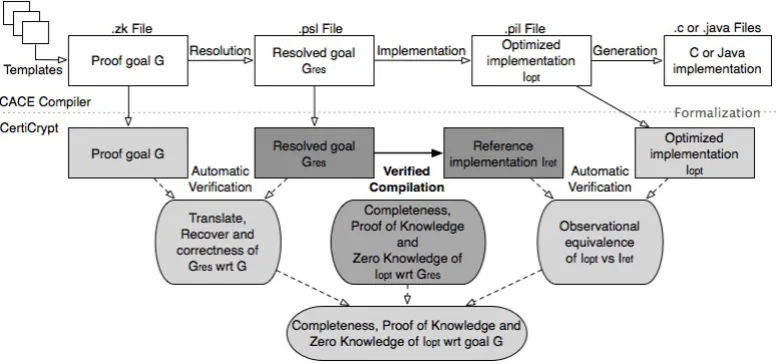
Figure 1: ZKCryptarchitecture, depicting a verifying compiler that takes high-level proof goalsGto optimized
implementations (top), relying on a verified compiler implemented inCoq/CertiCrypt(center). Full lines denote
compilation steps and translation over formalization boundary (i.e. the generation of code that can be fed into formal verification tools), dashed lines denote formal verification guarantees. Rectangular boxes denote code in various (intermediate) languages either stored in files or as data structures in memory. Rounded
rectangles represent the main theorems that are generated and formally verified byZKCryptand which jointly
yield the desired formal correctness and security guarantees.
establish that the reference and optimized implementations satisfy the following properties1 (refer to Section 3.2 for the full definitions):
• Completeness: an honest prover can always convince an honest verifier;
• Proof of knowledge: a malicious prover cannot convince a verifier without actually knowing the secret, except with small probability;
• Zero-knowledge: a verifier following the protocol does not learn additional information about the secret of the prover.
The architecture of the compiler is shown in Figure 1. At the top level,ZKCrypt is composed of a chain of compila-tion components that generates C and Java implementacompila-tions of ZK-PoKs; these implementations can be turned into ex-ecutable binaries using general-purpose compilers. These top level compilation components are an extension of the CACEcompiler [2] with support for user-defined templates and high-level proof goals. At the bottom level, ZKCrypt generates formal evidence in CertiCrypt of the correctness of each compilation step except code generation. The top level compiler is independent of the bottom level verification backend.
The main three verification phases inZKCryptare: resolu-tion, verified compilaresolu-tion, and implementation. We briefly describe key aspects of each phase:
1
In the remainder of the paper, when we refer to the (rele-vant) security properties of a ZK-PoK, we mean these three properties.
1. Resolutiontakes a (user-friendly) high-level goalGand outputs an equivalent goalGresonly consisting of proofs
of knowledge of pre-images under homomorphisms; such pre-image proofs constitute atomic building blocks that correspond to well known, concrete instances of ZK-PoK protocols. The correctness of resolution is cap-tured by a transformation that provably converts ZK-PoK protocols for Gres into ZK-PoK protocols for G.
The compiler implements both the decomposition and the transformation, and we prove a set of sufficient conditions for correctness and security;
2. Verified compilationtakes a resolved goalGresand
out-puts a reference implementationIref in the embedded
language of CertiCrypt.A once-and-for-all proof of cor-rectness guarantees that this component only produces reference implementations that satisfy the relevant se-curity properties, for all supported input goals. This result hinges on two contributions of independent in-terest: a unified treatment of the proof of knowledge property and a formalization of statistical zero-know-ledge;
3. Implementationtakes a resolved goalGresand outputs
an optimized implementationIopt. The correctness of
this step is established, in the style of verifying compi-lation, using an equivalence checker proving semantic equivalence between the reference and optimized im-plementationsIref andIopt.
Combining the correctness results for each phase yields a proof that the optimized implementation Iopt satisfies the
security properties of the original high-level goalG.
compiler is comprehensive, it currently has two limitations that we describe next.
First,ZKCryptdelivers formal guarantees about the correct-ness of the optimized implementationIopt, but not for the last
step in the compilation chain, namely the generation of Java or C code. Although we consider the verification of this last compilation step as an important direction for future devel-opment, we see this as an independent line of work, notably since the verification goals involved at this level are of a dif-ferent nature to those presented in this paper. Specifically, the natural path to achieve correctness guarantees about bi-naries is to extendZKCryptwith formal verification at the code generation level, and then to use a high-assurance com-piler from C or Java to binaries. Given the characteristics of the programming language in which the optimized imple-mentationsIoptare described (cf. Appendix C), the key step
to adding a formal verification back-end for code generation is to build a certified number theory library that matches the one provided with theCACEcompiler. Then, the com-pilation from C to binaries can be certified directly using state-of-the-art verified compilers, such asCompCert[42].
Second, we do not prove completeness of verification, i.e., that allCACEcompiler program can be verified by our com-ponent. There are two reasons for this. One is that there are some known sources of incompleteness, as some of the proof goals that can be handled by theCACEcompiler are not yet supported. A more fundamental reason is that certi-fying compilation techniques, as used by part of the formal verification back-end, are seldom proved complete; instead, one validates the effectiveness of a technique by its ability to cover a wide range of examples. As we will demonstrate later in the paper,ZKCryptsatisfactorily complies with this more practical view, as the class of goals for which verifi-cation is available is already broad enough to cover most practical applications.
Paper organization. The applicability of ZKCrypt is il-lustrated in Section 2 through a use case from theidentity mixeranonymous credential system [19]. Section 3 provides some necessary background material onCertiCryptand ZK-PoKs. Sections 4–6 describe the resolution, verified compi-lation and implementation phases, respectively. Section 7 briefly reports on experimental results obtained by applying ZKCryptto a wider range of examples. We give an overview of related work in Section 8 and briefly conclude in Sec-tion 9.
2.
USE CASE
Anonymous credential systems [24, 25] are among the most practically relevant applications of ZK-PoKs; examples of prominent realizations include the IBM identity mixer li-brary (Idemix) [23], the Microsoft U-Prove toolkit [46], as well as Trusted Platform Modules (TPMs), which implement the Direct Anonymous Attestation (DAA) protocol [17] and are widely built into consumer devices. In a further and co-ordinated effort to bring anonymous credential systems to practice, the ABC4Trust project [1] is working to deliver open reference implementations of attribute-based creden-tial systems and to integrate them into real-world identity-management systems.
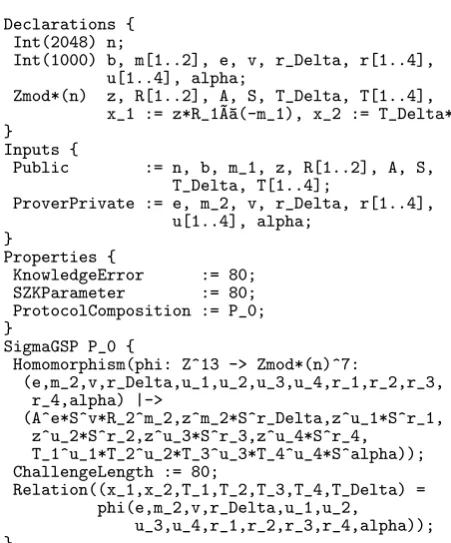
An anonymous credential system typically consists of a col-lection of protocols to issue, revoke, prove possession of cre-dentials, etc. One key feature for ensuring anonymity is that users can selectively reveal certain identity attributes without disclosing anything else. Our running example is extracted fromIdemix, and involves a user with a valid cre-dential of his namem1 and his birthdatem2; following Ca-menisch et al. [23] we assume that the credential is a valid Camenisch-Lysanskaya (CL) signature [20] onm1andm2 is-sued by some certification authority. Assume the user wants to authenticate to a server and is willing to reveal his name but not his birthdate. On the other hand, he is required to show that he was born after a certain date b. To achieve authentication agreeably to both parties, the user will re-vealm1 and give a ZK-PoK thatz is a valid CL signature onm1, m2, wherem2≥b, without revealingm2. Using the standard notation for ZK-PoK [22], this goal Gis formally stated as:
ZPKhm2:z=CL(m1, m2)∧ m2≥b i
The convention in the formulation above is that knowledge of all values before the colon has to be proved, while all other values are assumed to be publicly known. Note that the first conjunct shows possession of a valid CL-signature
z onm1, m2, and the second conjunct shows that m2 ≥b, as required by the server policy.
ZKCrypt generates an optimized implementation of a ZK-PoK and machine-checkable proofs that it satisfies the rele-vant security properties. We give below an overview of the compilation process.
Resolution. ZKCryptresolves the above proof goalGto the following goalGres:
ZPK h
(e, m2, v, r∆, u1, u2, u3, u4, r1, r2, r3, r4, α) :
Z Rm1
1
=AeSvRm2
2 ∧ T∆Zb=Zm2Sr∆ ∧ 4
^
i=1
Ti=ZuiSri ∧ T∆=T1u1T
u2 2 T
u3 3 T
u4 4 S
αi
The first conjunct is obtained by unfolding the definition of theCLpredicate, making explicit the groups elements Z
and S used in the signature. The remaining conjuncts are obtained by applying Lipmaa’s technique [43] to resolve the goal m2 ≥ b into equalities between exponentiations of Z andS. This compilation step and the formal verification of its correctness are described in detail in Section 4. In short, we formalize the sufficient conditions for correctness based on a procedure Translatefor turning a witness forGinto a witness for Gres and a procedure Recover for computing a
witness forGres from a witness forG.
Verified compilation This phase outputs a reference im-plementation Iref in the embedded language of CertiCrypt.
use case we present, Φ is defined as:
Φ (e, m2, v, r∆, u1, u2, u3, u4, r1, r2, r3, r4, α)=.
AeSvRm2 2 , Z
m2Sr∆, Zu1Sr1, . . . , Zu4Sr4, Sα Q4
i=1T
ui
i
This instantiation yields a reference implementation Iref of
a ZK-PoK protocol, comprising four procedures that rep-resent the computations performed by each party during a run of a Σ-protocol. Each procedure consists of either a random assignment followed by a deterministic assignment, or just a deterministic assignment. The completeness, proof of knowledge, and honest verifier zero-knowledge (HVZK) properties ofIref are a direct consequence of generic proofs
inCertiCrypt. Interestingly, statistical HVZK is established using an approximate version of the Probabilistic Relational Hoare Logic of CertiCrypt, which has been recently devel-oped for different purposes [11].
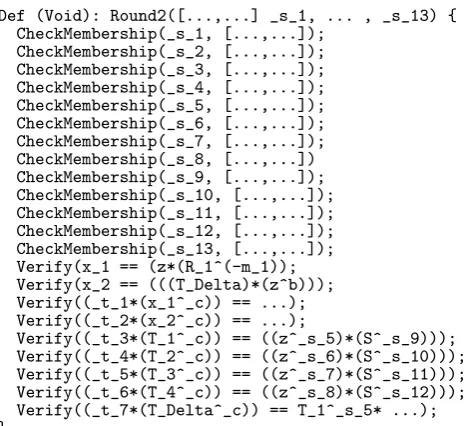
Implementation This phase outputs a representation Iopt
that can be used for code generation. Contrary to the refer-ence implementation,Iopt does not adhere to a constrained
shape; in particular, it uses long sequences of instructions and branching statements. Also, algebraic expressions are re-arranged in order to enable optimizations during code generation. The equivalence ofIopt andIref is proved in two
steps. First,ZKCrypt builds a representation ofIopt in the
embedded language ofCertiCrypt. It then generates a proof thatIopt satisfies the relevant security properties, by
estab-lishing that each algorithm in the protocol is observationally equivalent to the matching algorithm in the reference imple-mentation.
By glueing together the correctness proofs of the different phases, one obtains the end-to-end guarantee thatIopt is a
correct implementation of a ZK-PoK forG.
3.
PRELIMINARIES
3.1
An Overview of
CertiCrypt
CertiCrypt[10, 12] is an automated toolset for proving the security of cryptographic constructions in the computational model. It builds upon state-of-the-art verification technolo-gies to support code-based proofs, in which security is cast in terms of equivalence of probabilistic programs. The core of CertiCrypt is a rich set of verification techniques based on a Relational Hoare Logic for probabilistic programs [10]. A recent extension [11] supports reasoning about a broad range of quantitative properties, including statistical dis-tance, which is crucial in our definition of zero-knowledge.
The CertiCrypt toolset consists of two main components. Both allow proving that the distributions generated by prob-abilistic experiments are identical or statistically close, but differ in their degree of automation, flexibility and formal guarantees. The first component, calledCertiCrypt, excels in flexibility and is fully formalized in theCoq proof assis-tant; its verification methods are implemented inCoq and proved correct w.r.t. program semantics. The second com-ponent, EasyCrypt, delivers a higher degree of automation by relying on SMT solvers and automated theorem provers to discharge verification conditions arising in proofs. Easy-Cryptgenerates proof certificates that can be mechanically checked inCoq, thus practically reducing the trusted com-puting base to that of the first component; however, it lacks
on generality as it only exposes a limited set of proof meth-ods. ZKCrypttakes advantage of both components: it uses the latter to check the correctness of goal resolution and the former for verifying the compiler for reference implementa-tions and the equivalence of reference and optimized imple-mentations. We outline below some of the essential features of both components.
Language. Programs are written in the procedural, prob-abilistic imperative language pWhile. The statements of the language include deterministic and probabilistic assign-ments, conditional statements and loops, as given by the following grammar:
C ::= skip nop
| V ← E deterministic assignment
| V← DE$ probabilistic assignment
| ifE thenCelseC conditional
| whileE doC while loop
| V ← P(E, . . . ,E) procedure call
| C; C sequence
where V is a set of variable identifiers, P a set of proce-dure names, E is a set of expressions, and DE is a set of distribution experssions.
This base language suffices to conveniently express a wide class of cryptographic experiments and security properties. However, to achieve greater flexibility, the language of deter-ministic and random expressions is user-extensible. A pro-gramc∈ C in the language ofCertiCryptdenotes a function
JcK from an initial memory m (a mapping from program
variables to values) to a distribution over final memories. We denote by Pr [c, S:m] the probability of event S w.r.t to the distributionJcKm. We refer the reader to Barthe et al. [14] for a more detailed description of the language and its semantics.
Reasoning principles. Proving the (approximate) equiv-alence of the distributions generated by two probabilistic programs inCertiCryptamounts to deriving valid judgments in an approximate Relational Hoare Logic (apRHL). We re-strict our attention in this paper to a fragment of apRHL that captures both perfect and statistical indistinguishabil-ity of distributions generated by programs. We consider judgments of the form
c1∼c2: Ψ⇒Φ , (1) wherec1 andc2 are probabilistic programs, Ψ,Φ binary re-lations over program memories and ∈ [0,1]. Taking Φ as the equality relation on a subset of observable program variablesX, one recovers the usual definition of statistical indistinguishability. In particular, given an eventA, repre-sented as a predicate over memories, if Aonly depends on variables inX, one has
m1 Ψm2 =⇒ |Pr [c1, m1:A]−Pr [c2, m2:A]| ≤ . We let c1≈Ψ,X c2 denote the validity of (1) when Φ is the equality relation on variables inX; we omit Ψ when it is the total relation or can be inferred from the context.
3.2
Zero-Knowledge Proofs
Definition 1 (Σ-protocol). Let R denote a binary relation,(x, w)∈R, and let P1,P2, and Vdenote arbitrary algorithms. A protocol between a prover P=.P(x, w) and a probabilistic polynomial-time (PPT) verifier V=. V(x) is called a Σ-protocolwith challenge setC={0, . . . , c+–1}, if it satisfies the following conditions.
3-move form. The protocol is of the following form:
• P sets(r,st)←P1(x, w)and sendsr toV;
• V sends a random challenge c← C$ toP. We refer to the algorithm that samples the challenge asVc;
• P sendss←P2(x, w,st, c)to the verifier;
• V accepts if V(x, r, c, s) = true, otherwiseV rejects.
Completeness. For an honest proverP, the verifierV ac-cepts on common inputx, whenever (x, w)∈R.
A triple (r, c, s) for which V(x, r, c, s) = true is called an accepting conversation.
Informally, a two-party protocol is a proof of knowledge if from every successful (potentially malicious) prover P∗
, a witness can be extracted within a certain time bound by a knowledge extractor algorithm. For all practically relevant Σ-protocols, the knowledge extractor works in two phases. First, using rewinding black-box access toP∗
, two accepting conversations (r, c, s) and (r, c0, s0) are extracted. Then, in a second step, a witness is computed from these conversations. The first part of the knowledge extractor is well-known to work for arbitrary Σ-protocols [28]. The second phase only works only under certain conditions, which are formalized next:
Definition 2 (Generalized Special Soundness). A Σ-protocol satisfies generalized special soundness for a relation R0, if there is a PPT algorithm that, on input a relationR← R$ (1λ), a valuexin the language defined byR, and any two accepting conversations, (r, c, s) and (r, c0, s0) satisfyingR0, computes a valid witness wsatisfyingR(x, w) with overwhelming probability.
Observe that a Σ-protocol satisfying this definition is a proof of knowledge forRif the conversations extracted by the first phase of the knowledge extractor satisfyR0.
Definition 2 is a generalization of the classical notion of spe-cial soundness found in the literature, e.g., Cramer [26], and enables a uniform formalization of the proof of knowledge property for all Σ-protocols supported byZKCrypt. Roughly, thespecial extractor algorithm will only be able to recover a valid witness if the accepting conversations display specific properties captured by relation R0. Furthermore, in some cases, the existence of an algorithm that is able to extract these conversations relies on a computational assumption. To account for this, following Damg˚ard and Fujisaki [29],
we allow relation R to be sampled using an efficient algo-rithmR. We will detailRandR0for each concrete instance of a Σ-protocol later2.
The proof of knowledge property ensures a verifier that a convincing prover indeed knows the secret. On the other hand, the verifier should not be able to deduce any infor-mation about this witness. This is captured by the zero-knowledgeproperty. In the following, we denote by viewPV(x)
the random variable describing the content of the random tape ofVand the messagesVreceives fromPduring a suc-cessful protocol run on common inputx.
Definition 3 (Honest Verifier Zero Knowledge).
A protocol (P,V) is perfectly (resp. statistically) honest-verifier zero-knowledge(HVZK), if there exists a PPT sim-ulator S such that the distribution ensembles {S(x)}x and
{viewPV(x)}x are perfectly (resp. statistically)
indistinguish-able, for all inputsxin the language ofR.
Note that this definition only gives guarantees against ver-ifiers that do not deviate from the protocol specification. Security against arbitrary verifiers can be realized by ap-plying the Fiat-Shamir heuristic [32] to make the protocol non-interactive, which is also supported by our compiler (al-though, as we will explain later, this is currently outside of the scope of the verification back-end). Further, other stan-dard techniques to solve this problem exist [31].
3.3
The
ΣGSP-Protocol
Almost all practical applications of ZK-PoKs are proofs for pre-images under a group homomorphism φ:G → H. De-pending on whether G is finite orG 'Z, (typically) either the Σφ-, the Σexp-, or the ΣGSP-protocol is used [2]. In the following we recapitulate the ΣGSP-protocol, which is central
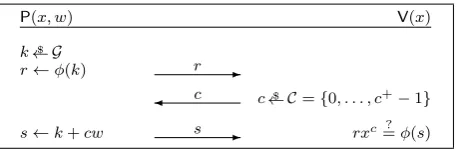
for understanding the remainder, as it is used for the run-ning example. For self-containment, the Σφ- and the Σexp -protocols (a far less prevalent version of the ΣGSP-protocol)
are included in Appendix A.1 and Appendix A.2.All the mentioned techniques are also incorporated inZKCrypt.
The so calledGeneralized Schnorr Protocol (ΣGSP-protocol)
can be used to prove knowledge of pre-images under arbi-trary exponentiation homomorphisms, in particular includ-ing such with a hidden-order co-domain. That is, it can be used for mappings of the form:
φ:Zm→ H: (w1, . . . , wm)7→ m
Y
i=1
gwi 1i, . . . ,
m
Y
i=1
gwi
ui
!
.
In the protocol, an upper bound Ti on the absolute value
of eachwi needs to be known. These values can be chosen
arbitrarily large, and required to assert that the protocol is (statistically) zero-knowledge forwi∈[−Ti, Ti]. The
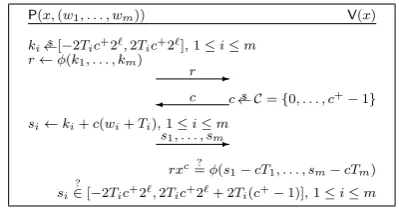
proto-col flow and the parties’ algorithms are given in Figure 2, where `is a security parameter regulating the tightness of the statistical zero-knowledge property.
P(x,(w1, . . . , wm)) V(x)
ki←$[−2Tic+2`,2Tic+2`], 1≤i≤m r←φ(k1, . . . , km)
r
-c
c← C$ ={0, . . . , c
+−1}
si←ki+c(wi+Ti), 1≤i≤m s1, . . . , sm
-rxc ?
=φ(s1−cT1, . . . , sm−cTm)
si
?
∈[−2Tic+2`,2Tic+2`+ 2Ti(c+−1)], 1≤i≤m
Figure 2: Protocol flow of theΣGSP-protocol.
The ΣGSP-protocol is statistically HVZK for arbitrary values
ofc+ (the simulation error is upper-bounded bym/2`)and is sound forc+= 2, i.e., for binary challenges. However, for larger challenge sets, which are are required for efficiency reasons, generalized special soundness can only be estab-lished under certain computational assumptions.
Concerning generalized special soundness, the relation gen-erator Rpicks a group Hin which the generalized strong RSA assumption [33] holds (i.e., givenx← H$ , it is hard to find (w, e) ∈ H ×Z\ {−1,0,1} such that x = we), and defines:
R(x,(µ, w)) =. x=µφ(w) ∧ µd= 1,
Here,φ is as before, the gij are generators of a large
sub-group ofHwith hidden order such that all relative discrete logarithms (i.e., all logg
ijguv) are unknown toP, anddis the product of all primes smaller thanc+dividing ordH.
The relationR0is defined as follows:
R0((r, c, s),(r, c0, s0)) = (. c−c0)|(s−s0).
It can be shown [29] that the conversations extracted in the first step of the knowledge extractor satisfy R0 with over-whelming probability, given thatHsatisfies the generalized RSA assumption andφis defined as above. Thus, the ΣGSP -protocol satisfies Definition 2 and is a ZK-PoK forR0.
For instance, if n = pq is a safe RSA modulus (i.e., p, q, (p−1)/2 and (q−1)/2 are all prime),H=Z∗n and thegij
all generate the quadratic residues modulon, we getd= 4 and knowledge of a pre-image is proved up to a fourth root of unity.
3.4
Combination of Proof Goals
In practice one often has to prove knowledge of multiple, or one out of a set of secret values in one step. This can be achieved byAnd- andOr-compositions [27]. To support our description of theIdemixexample in the rest of the paper we only requireAnd-compositions of ΣGSP-protocols for homo-morphismsφ1, . . . , φn. This can be realized by running a
sin-gle ΣGSP-protocol for the homomorphismφ=φ1× · · · ×φn.
Generic constructions for BooleanAnd- andOr-compositions are given in Appendix A.3.
4.
GOAL RESOLUTION
ZKCrypt generates implementations for arbitrary Boolean And- andOr-compositions of pre-image proofs under group homomorphisms and claims on the size of secrets. Formally,
the class of proof goals supported by theZKCryptfront-end can be defined as follows. Let x1, . . . , xn be public group
elements, or expressions only containing public values, and let, for 1≤i≤n,φi:Gi1×· · ·×Gimi→ Hibe arbitrary and potentially different group homomorphisms, where the Gij
are either arbitrary finite groupsZ. Then every goal which can logically be rewritten to the following form is supported:
ZPKh(w11, . . . , w1m1, . . . , wn1, . . . , wnmn) : _
G∈Γ ^
i∈G
xi=φi(wi1, . . . , wimi) ∧ ^
(i,j)∈S
wij∈[Lij, Rij]
i
,
where Γ⊆2{1,...,n} andGij=Zfor all (i, j)∈S. Further, theLij, Rijare public integers or±∞. Note thatLij=−∞
is equivalent towij≤Rij and similar forRij=∞.
The first compilation step consists of rewriting all semantic expressions to pre-image proofs, i.e., every term w∈[L, R] is rewritten to a proof specification of the following form [43, 41]:
ZPKh(w, r, w1, . . . , w8, r1, . . . , r8, rw, rL, rR) :
xw=gwhrw ∧
8 ^
i=1
xi=hwihri ∧
xwg −L
= 4 Y
i=1
xwi
i h
rL ∧ gRx−1
w =
8 Y
i=5
xwi
i h
rwi. (2)
Here, g and h are both random generators of a group of hidden order (e.g. the (signed) quadratic residues modulo a safe RSA modulus n). Further, loggh and loghg must
be hard to compute. If such a group is already used in the original proof goal, it can safely be reused.
4.1
A Cryptographic Perspective
We next describe howZKCryptdeals with the formal verifi-cation of the goal translation stage.
The starting point in the goal resolution procedure is a (high-level) goalGassociated to a relation generation algo-rithmR, i.e., we aim to construct a Σ-protocol for proving (in zero-knowledge) knowledge of a witness w for a pub-lic input x such that R(x, w) holds, for R sampled from
R. The resolution procedure first defines a generator for a (lower-level) family of relations Rres associated with a re-solved goal Gres and then defines a translation algorithm
Translate(R, x, w) which, on input a relation R and a pair (x, w), produces the description of a relationRresand a pair
(x0, w0). The following properties must be satisfied by the Translatealgorithm:
1. Completeness.On a valid input (R, x, w), i.e., where Ris in the range ofRandR(x, w) holds,Translate out-puts triples (Rres, x0, w0) such that Rres is in the range
ofRres, andRres(x0, w0) holds.
2. Soundness. There is an efficient algorithm Recover
such that, for all PPT adversaries A, the following holds forR← R$ , (x, w)∈Rand (Rres, x0, w0)← A(R, x, w): if (Rres, x0) are in the range of Translate(R, x, w) and
Rres(x0, w0) holds, Recover(Rres, x0, w0) outputs ˜wsuch
3. Public verifiability. The public outputs ofTranslate, i.e.,Rres andx0, can efficiently be checked to be in the
correct range for all valid public inputs (R, x).
4. Simulatability. There exists an efficient simulatorS
which, on input Rsampled from Randxin the lan-guage that it defines, outputs (Rres, x0) with a
distribu-tion identical (or statistically close) to that produced byTranslate(R, x, w) for a valid witnessw.
Now, to construct a protocol for goalG, one first generates descriptions of algorithmsP01,P02andV0of a Σ-protocol for goalGres, and then defines the procedures for the high-level
protocol as follows:
• P1(x, w) runsTranslate(R, x, w) to get (Rres, x0, w0), and P01(x
0
, w0) to get (r0, st0), and returns (r, st) = ((Rres, x
0
, r0),(Rres, x 0
, w0, st0)).
• P2(x, w, c, st) recovers (Rres, x0, w0, st0) fromst. It then
runsP0
2(x0, w0, st0, c) to gets0and returnss=s0.
• V(x, r, c, s) recovers (Rres, x0, r0) fromrand checks that
Rres andxare in the correct range w.r.t. Randx. It
then runsV0
(x0, r0, c, s) and returns the result.
The correctness and security of the resulting protocol is es-tablished in the following theorem. We present a proof in Appendix B.
Theorem 1. Assume that algorithmsP01,P
0
2andV
0
yield aΣ-protocol for Rres, which is complete, HVZK and satis-fies generalized special soundness for relationR0res. Then, if
Translatesatisfies the four properties listed above, algorithms
P1, P2 and V yield aΣ-protocol for R, which is complete, HVZK and satisfies generalized special soundness for rela-tion
R0((Rres, x 0
, r0), c, s),(Rres, x 0
, r0),c,ˆsˆ)) =R0res((r 0
, c, s),(r,ˆc,sˆ))
This result permits identifying precisely the proof obliga-tions that suffice to formally verify that the resulting pro-tocol is correct and secure. First of all, one needs to show that the low-level protocol is itself correct and secure for the relation generatorRres(inZKCryptthis maps to the formal verification of subsequent compilation steps, which we dis-cuss later). Secondly, one needs to show that theTranslate procedure has all properties described in the theorem.
Idemixgoal resolution.To make things more concrete, let us go back to the goal resolution performed byZKCryptand recast the rewriting performed for a term of the formw≥b
in the theoretical framework above (an upper bound onw
can be treated analogously). This matches the resolution of the proof goal in our Idemix running example. From Sec-tion 2, and usingx=Z/Rm1
1 , we can rewrite the relation corresponding to goalGas
R(x, w) =. x=AeSvRm2
2 ∧ m2≥b (3)
Translate(R, x, w): Parse (A, S, R2, Z)←R Parse (e, m2, v)←w
Find (u1, u2, u3, u4) s.t. m2−b=u21+u22+u23+u24
ri←$[0..2|n|2`], fori= ∆,1,2,3,4 α←r∆−P4i=1uiri
Ti←ZuiSri, fori= 1,2,3,4 T∆←T1u1T
u2
2 T
u3
3 T
u4
4 S
α Y1←T∆Zb
(g1, g2, g3, g4)←(T1, T2, T3, T4)
x0←(x, Y1, T1, T2, T3, T4, T∆)
w0←(e, m
2, v, r∆, u1, u2, u3, u4, r1, r2, r3, r4, α)
return(Rres, x0, w0)
Figure 3: Translatealgorithm forIdemixexample.
Re-lationsR andRres are as in (3) and (4).
Here, we have w= (e, m2, v). Similarly, usingY1 =T∆Zb, the relation associated with resolved goalGres is:
Rres(x0, w0) =. x=AeSvRm22 ∧ Y1=Zm2Sr∆ ∧ 4
^
i=1
Ti=ZuiSri ∧T∆=gu11g
u2 2 g
u3 3 g
u4 4 S
α
(4)
Here,
w0= (e, m2, v, r∆, u1, u2, u3, u4, r1, r2, r3, r4, α)
x0= (x, Y1, T1, T2, T3, T4, T∆)
We observe that implicit in the definition of these goals are the relation generatorsRandRresthat produce descriptions of the (hidden order) groups and generators that are used in the protocol. Furthermore, note that the resolved goalGres
can be handled by the ΣGSPprotocol, for whichZKCryptcan generate an implementation of a ZK-PoK protocol which is proven to display the relevant security properties.
Figures 3 and 4 provide the pseudo-code of the Translate andRecoveralgorithms for theIdemixexample. Observe the dual role of theTi values inGres: these values appear both
as generators in Rres, and as images in x0. As we will see,
this is essential to guarantee that witnesses for the original goalGcan be recovered. We will now discuss how we prove that these algorithms satisfy the hypotheses of Theorem 1, from which we can conclude that resolution is correct.
4.2
A Formal Verification Perspective
We illustrate our approach to verifying the goal translation step on the same running example from Idemix. We first show how one would useEasyCrypt[12] to prove, with minor user intervention, that theTranslatealgorithm from Figure 3 satisfies the completeness and soundness properties. Then we explain how this formal verification approach has been integrated into the compiler to obtain an automated solu-tion. Finally, we discuss how the simulatability and public verifiability properties are handled with a once-and-for-all proof for supported goals.
Completeness ofTranslate.The idea underlying the com-pleteness property is the following. Assume a prover knows
w≥b. Then, by Lagrange’s Four Square Theorem [41], she can find integers u1, . . . , u4 such that m−b = P4i=1u
2
i.
Recover(Rres, x0, w0):
(e, m2, v, r∆, u1, u2, u3, u4, r1, r2, r3, r4, α)←w0
w←(e, m2, v)
returnw
Figure 4: Recover algorithm forIdemixexample
r∆−P4i=1uirishe can now clearly perform the above proof.
Formally verifying this property usingEasyCryptis achieved by proving that the following experiment always returns true for all R in the range of R and all pairs (x, w) such that R(x, w) holds:
(Rres, x 0
, w0)←$ Translate(R, x, w); return R
res(x 0
, w0) TheTranslatealgorithm is represented inEasyCryptin a form very close to its description in Figure 3, with the sole dif-ference that the decomposition ofm2−bas a sum of four squares is computed by applying a function assumed to cor-rectly implement Lagrange’s decomposition. The proof itself is written as a series of game transitions, where the initial experiment is gradually transformed until it is reduced to the trivial program that simply returns true. All transitions are proved automatically by the tool.
Soundness ofTranslate. A detailed specification of the Re-coveralgorithm for theIdemixexample is given in Figure 4. Letm02
.
=P4
i=1u 2
i+b. Clearlym 0
2≥band, by the definition ofRresassociated withGres, we have thatZ=AeSvRm11R
m2 2 . The correctness ofRecover thus hinges on the fact that R
computationallyguaranteesm2=m02, down to the following assumption:
Definition 4 (Unique representation assumption). LetHbe as before, and letZ andS be generators ofH. If a PPT algorithm outputs (a, b), (a0, b0) ∈ Z×Z such that
ZaSb=Za0Sb0 then, with overwhelming probability, we have
thata=a0 ∧ b=b0.
Any witnessw0 given toRecover, satisfyingRres(x0, w0), for
publicly validatedRres andx0, can be expressed in the
fol-lowing form:
Zm2−bSr∆=Zm02−bSα+ P4
i=1riui
Ifm26=m02, the input witness would provide two alternative representations for the same value under generatorsZandS, contradicting the unique representation assumption. Thus, necessarilly with overwhelming probabilitym2=m02.
Formally, if the group parameters are generated in a par-ticular way, the unique representation assumption holds for
H=Z∗n if the factoring assumption holds forn [21]. The
Idemixspecification incorporates this method into its param-eter generation procedure. We note that this computational assumption is used implicitly throughout relevant literature when dealing with such transformations. We believe that forcing such assumptions to be stated explicitly is one of the advantages of using mechanized support to validate security proofs for cryptographic protocols.
The correctness of this algorithm is again formally verified inEasyCrypt. The proof is more intricate than in the case of
Translate, since we now must take into account the unique representation assumption. The proof is quantified for all relations R in the range of R, and all xand w such that R(x, w) holds. Consistently with the definition of the sound-ness property, we begin by defining the following experiment inEasyCrypt:
(Rres, x0, w0)← A(R, x, w);
w∗←Recover(Rres, x0, w0);
if¬Rres(x0, w0) ∨ ¬pubVerify(R, x,Rres, x0)then return⊥
else return R(x, w∗)
Here, an adversary (i.e., a malicious prover)Ais given such an input (R, x, w), and outputs a tuple (Rres, x0, w0). The
Recoveralgorithm is then called to produce a high-level wit-ness. The experiment output expresses that the event in which the adversary produces a valid tuple (Rres, x0, w0) must
imply thatRecover succeeds in obtaining a valid high-level witness w∗. This is expressed as a disjunction where ei-ther the adversary fails to produce publicly verifiable Rres,
x0 and a witnessw0 such thatRres(x0, w0) holds, or Recover
must succeed. Public verifiability is captured by a predi-cate pubVerifyimposing that Y1 = T∆Zb, and gi = Ti for
i= 1,2,3,4.
The proof establishes that this experiment is identical to the trivial program that always returns true, except perhaps when both Rres(x0, w0) and pubVerif(Rres, x0) hold, but the
witnessw0 satisfies the following Boolean test:
m26=u21+u 2 2+u
2 3+u
2 4+b ∨
r∆6=r1u1+r2u2+r3u3+r4u4+α
Intuitively, thisfailurecondition can be triggered only if the adversary was able to recover a low level witness which con-tradicts the unique representation assumption: in the proof we show that the probability of failure is bounded by the probability that an adversaryBfinds two different represen-tations for the same group element under generatorsZ and
S. On the other hand, conditioning on the event that fail-ure does not occur, and through a series of transformations involving algebraic manipulations, we show thatRecover al-ways succeeds. Again, the validity of all transformations is handled automatically byEasyCrypt.
Integration and automation The above approach to for-mally verifying the goal resolution procedure was not inte-grated in earlier versions of ZKCrypt. This meant that user intervention was required to deal with this compilation step, and hence the natural back-end to use wasEasyCrypt. This was not a major limitation, as many practical applications are based on specifications that already include the result of the goal resolution stage (this is the case of Idemix). Nev-ertheless, the latest release of ZKCrypthas been extended with an extra component that deals with this compilation step without user intervention. The formal verification of proof goal resolution is now handled in two steps:
the translation and recovery procedures. A once-and-for-all proof in Coq then guarantees that translation is complete and sound with respect to the reference low-level goal. This is done using essentially the same formalization approach as described above, extended to handle the general case of ΣGSP-type goals where each pre-image can be bounded with an arbitrary in-terval.
2. The resolved goal produced by theCACEcompilerGres
is then proven equivalent to Gref
res. This establishes
that the goal resolution step carried out by theCACE compiler is indeed correct. We recall that the opti-mized implementation produced by theCACEcompiler is generated from Gres and that this compilation
pro-cess is formally verified inZKCrypt, as described in the following Sections. This means thatZKCryptprovides guarantees of correctness and security of the generated optimized protocol with respect to the original high-level goal.
Public verifiability and simulatability. We now briefly discuss why the resolution procedure used inIdemixcan be easily shown to satisfy public verifiability and simulatability. This argument extends to all instances of the resolution step implemented inZKCrypt.
Looking at (4), one can immediately see that the public outputs of Translate can be validated to be in the correct range assuming that group membership can be efficiently checked, and given the fixed structure of the low-level re-lation. For simulatability we observe that the description (Rres, x0) output byTranslatecomprises the values of the
im-ages andx0= (x, Y1, T1, T2, T3, T4, T∆) and of the generators (g1, g2, g3, g4) = (T1, T2, T3, T4) SincexandY1 are fully de-termined by public inputs and (T1, T2, T3, T4, T∆), all that remains to show is that the latter values can be efficiently simulated. Observing that the domain of ri is sufficiently
large for the distribution of Sri (i ∈ {1,2,3,4,∆}) to be statistically close to uniform inhSi, we conclude that the variablesTi(i∈ {1,2,3,4,∆}) are also statistically close to
uniform (note thatZandSare both generators of the same group of hidden order). It follows that these values can be trivially simulated by sampling uniformly random elements in the target group.
5.
VERIFIED COMPILATION
At the core of the formal verification tool of ZKCryptsits a verified compiler that generates correct and secure refer-ence implementations of ZK-PoK for the following class of resolved proof goals produced by the front end of the com-piler:
(i) Atomic goals consisting of pre-image proofs under a homomorphism with a finite domain using the Σφ -protocol, including product homomorphisms where the co-domain is a tuple of images in the range of the group operation.
(ii) Atomic goals consisting of pre-image proofs under an exponentiation homomorphism in a hidden-order group
using the ΣGSP-protocol, including product
homomor-phisms where the co-domain is a tuple of images in the range of the group operation. In particular, these include goals resulting from the resolution of interval proofs as described in Section 4.
(iii) Arbitrary, possibly nested,AND- andOR-compositions of proof goals as in point (i).
We stress that, although the code generation component of ZKCryptaddresses an even broader set of proof goals, this class was selected to cover essentially all practical applica-tions.
Given a resolved proof goalGres, the verified compiler is able
to generate a description of a reference implementation for a suitable Σ-protocol, consisting ofCertiCryptprograms cor-responding to algorithmsP1,P2,VandVc. The generated
descriptions of these algorithms follow a carefully designed structure, tailored to facilitate the formal proof that, for any goal, the (therefore) verified compiler produces correct and secure reference implementations.
The challenge here was to find the best balance between the level of abstraction at which the formalization is per-formed in CertiCrypt, and our goal to give formal verifica-tion guarantees over the optimized implementaverifica-tions gener-ated by ZKCrypt. On the one hand, proving that the gen-erated reference implementations meet the prescribed cor-rectness and security requirements is much easier if one can reason abstractly about homomorphisms, group operations, etc. On the other hand, we wish to prove observational equivalence to programs produced byZKCryptin what is es-sentially pseudo-code of an imperative language very close to common programming languages. We achieve a compro-mise between these two aspects, which enables us to reach both objectives simultaneously.
Concretely, we construct each algorithm as shown in Fig-ure 5. Note that all algorithms have at most two statements: a random assignment that samples all necessary random val-ues up-front, and a deterministic assignment that computes the output in terms of the input of the algorithm and the sampled random values. For example, in algorithmP1hGresi, the first operation corresponds to sampling a tuple uniformly at random from the set stTypehGresi, which corresponds to a cartesian product of sets derived from the proof goalGres.
The second statement consists of a single assignment that evaluates a function of the inputs of the algorithm and the randomly sampled tuple; this is typically a huge expression performing all the necessary parsing and algebraic computa-tions. More precisely, functions Prover1hGresi,Prover2hGresi
andVerifierhGresimay map to arbitrarily complexCertiCrypt expressions.
P1hGresi(x, w): stP←$ stTypehGresi
r←Prover1hGresi(x, w,stP)
return(r,stP)
VchGresi():
c←$ cTypehG
resi returnc
P2hGresi(x, w, c,stP):
s←Prover2hGresi(x, w, c,stP)
returns
VhGresi(x, r, c, s):
a←VerifierhGresi(x, r, c, s) returna
Figure 5: Descriptions of reference
implementa-tions.
for the Σφ- and ΣGSP- protocols. For Boolean combinations
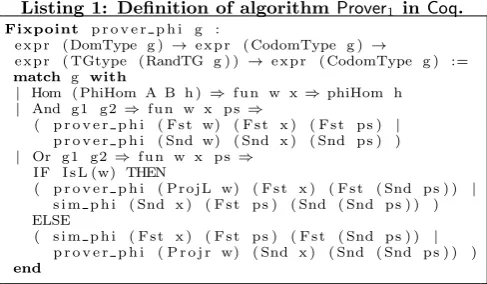
of Σφ-protocols, the reference implementation is generated recursively by unfolding the inductively defined proof goal according to the standard procedures for Boolean compo-sition described in Section 3.2. This is made possible by our approach to isolating random sampling operations from other computations. For illustrative purposes we present a short excerpt of the definition of the prover functionProver1 in Listing 1. The excerpt corresponds to the case of Boolean compositions of proof goals that can be handled using the Σφ-protocol, and takes as input a pair (x, w) and the value
stP comprising all values randomly sampled by theP1hGresi algorithm. The base case maps to a concrete homomor-phism, whereas recursive calls construct homomorphisms for AndandOrcombinations.
In addition to the descriptions of reference implementations for the algorithms of Σ-protocols, the compiler also gener-ates the auxiliary algorithms that are required to establish security. In particular, for each goal, the compiler gener-ates definitions of a suitable simulator and special extractor that can be used in the theorem statements that capture the zero-knowledge and proof of knowledge properties. The ability to generate suitable simulators is also an essential part of generating ZK-PoK protocols for Or compositions of Σφ-protocols. Indeed, the definitions of algorithms P1 andP2 explicitly rely on the simulator descriptions as part of their code, as can be seen in the snippet in Listing 1: inOr-compositions, the prover uses as a sub-procedure the simulator of the protocol for which it does not know a wit-ness.
Listing 1: Definition of algorithmProver1 in Coq.
Fixpoint p r o v e r p h i g :
e x p r ( DomType g ) → e x p r ( CodomType g ) →
e x p r ( TGtype (RandTG g ) ) → e x p r ( CodomType g ) :=
match g with
| Hom ( PhiHom A B h ) ⇒ f u n w x ⇒phiHom h | And g1 g2⇒ f u n w x p s ⇒
( p r o v e r p h i ( F s t w) ( F s t x ) ( F s t p s ) | p r o v e r p h i ( Snd w) ( Snd x ) ( Snd p s ) ) | Or g1 g2 ⇒ f u n w x p s ⇒
IF I s L (w) THEN
( p r o v e r p h i ( P r o j L w) ( F s t x ) ( F s t ( Snd p s ) ) | s i m p h i ( Snd x ) ( F s t p s ) ( Snd ( Snd p s ) ) ) ELSE
( s i m p h i ( F s t x ) ( F s t p s ) ( F s t ( Snd p s ) ) | p r o v e r p h i ( P r o j r w) ( Snd x ) ( Snd ( Snd p s ) ) ) end
We discuss next how we prove the correctness and security properties of reference implementations for all supported proof goals.
Completeness.Completeness of reference implementations is given by theCertiCrypttheorem below.
Theorem 2 (Completeness). For all supported goals Gres, and all pairs (x, w) satisfying the associated relation,
we prove
c←$ VchGresi();
(r,stP)←$ P1hGresi(x, w);
s←P2hGresi(x, w, c,stP);
a←VhGresi(x, r, c, s)
≈{0a} a←true
Intuitively, this formalization states that in an honest exe-cution, the verifier always will accept. Observe that, also in the protocol definition, the challenge generation is hoisted to the beginning of the protocol, as this facilitates proving equivalence claims. This is a valid transformation because we only have to prove that properties hold for an honest verifier that does not deviate from the protocol.
The proof of this theorem requires combined reasoning about the algebraic manipulations performed by the protocol par-ties. This is particularly challenging in the case of goals based on Σφ, for which the proof is by induction on the structure of the goal, dealing with the recursive definitions of the algorithms themselves. For example, in the case of Or-compositions, one needs to deal with the rearrangement of recursive invocations, by establishing intermediate results of the form:
(r, c, s, a)←$ ProtocolhG1∨G2i(x, ι1(w 1))
≈{0r,c,s,a}
(r1, c1, s1, a1)←$ ProtocolhG1i(π1(x), w1);
c←$ cTypehGresi; c
2←c−c1; (r2, c2, s2, a2)←$ ShG2i(π2(x), c2);
r←(r1, r2); a←a1∧a2
This result essentially states that the behavior of the pro-tocol, when run on the prover side with the witnesses cor-responding to goalG1 is identical to that of another proce-dure which explicitly relies on a protocol for goalG1 and a simulator for goal G2. The proof of this equivalence must then make use of the recursive definition of the protocol (it-self based on the prover and verifier algorithms presented in Figure 5) and of the simulator, and requires proving that the needed code rearrangements do not modify the semantics of the experiments.
5.1
Honest Verifier Zero Knowledge Property
Honest verifier ZK of reference implementations is given by theCertiCrypttheorem below.Theorem 3 (HVZK). For all supported goalsGres, and
for all pairs(x, w)satisfying the relation associated withGres,
we prove the following statistical equivalence:
c←$ VchGresi();
(r,stP)←$ P1hGresi(x, w);
s←P2hGresi(x, w, c,stP);
a←VhGresi(x, r, c, s)
≈{hr,c,sG }
resi (r, c, s) $
←ShGresi(x)
Here,ShGresiis the simulator algorithm generated byZKCrypt for goal Gres. The concrete value of the statistical distance
thereof, this is actually 0, and so proving this property cor-responds to showing that the distributions are identical, im-plying perfect HVZK. In this case, the type of reasoning required to construct the proof is very similar to that de-scribed for completeness.
On the contrary, proving the zero knowledge property of ΣGSP-protocols constitutes a significant challenge because
it requires reasoning about statistical distance. Given any ΣGSPgoalGres defined over a homomorphism where the
co-domain is a tuple of arbitrary sizem, we bound the statisti-cal distance in the statement above byhGresi=m/2`, where
`is a concrete security parameter given as input to the com-piler along with the goal specification (see Section 3.2). Es-tablishing this result for arbitrary homomorphisms required reasoning about the number of points contained in hyper-cubes inZm, and proving the upper bound using Bernoulli’s inequality.
5.2
Proof of Knowledge
The followingCertiCrypttheorem ensures that all generated reference implementations satisfy the Generalized Special Soundness introduced in Section 3.2.
Theorem 4 (Proof of Knowledge). For every sup-ported valid goalsGres, for all (x, w) satisfying the relation
associated withGres, and for any two accepting conversations
(r, c, s)and(r, c0, s0)satisfying relationR0hGresi, RhGresi(x,EhGresi(r, c, c0, s, s0)) = true.
The theorem statement nicely matches Definition 2, where relationR0hGresiexpresses the restriction on traces described in Section 3.2 for either Σφ- or ΣGSP- protocols. However, the theorem includes an additionalvalidityrestriction on proof goals that we now explain. Referring to Section 3.2, recall that forc+>2 both the Σφ-protocol and the ΣGSP-protocol can only be proven to satisfy Definition 2 if the underlying homomorphisms satisfy an additional property. Our notion of proof goal validity captures these extra restrictions. Con-cretely, the validity requirement for Σφgoals implies that all prime factors of special exponents for homomorphisms are greater thanc+. For the ΣGSP-protocol, the validity require-ment is as follows. Recall, from Section 3.2 thatRtypically samples an RSA modulusnand defines a relationRas
R(x,(µ, w)) =. x=µφ(w) ∧ µd= 1 (modn) Here,dis the product of the primes dividing the order of the multiplicative group modulon, which are less than or equal toc+. We require for validity thatdsatisfies this property.
Proving this theorem in CertiCrypt posed a different sort of challenge when compared to the previous ones, as it is not formulated in the form of a program equivalence state-ment. Essentially, it translates into a proof goal formulated over the semantics of the underlying algebraic constructions. Here we make critical use of the extensiveCoqlibrary that is included in ZKCryptand that was developed to support the semantics of the data types included in the necessary CertiCryptextensions. In turn, this library makes intensive use ofSSReflect [38] and its comprehensiveCoq library on algebraic and number theoretic results.
6.
IMPLEMENTATION
To establish our ultimate verification goal, we translate the optimized implementations of protocols generated byZKCrypt to the language of CertiCrypt. By taking advantage of the convenient notation that ZKCryptautomatically sets up in CertiCrypt, this translation step is straightforward and essen-tially corresponds to pretty-printing the output implemen-tation files. Our strategy to formally verify these optimized implementations is to first establish an intermediate result stating that these are correct with respect to a reference implementation. More precisely, we establish that each of the algorithms in the implementation file, namelyP1,P2,V, andVc, are observationally equivalent to the corresponding
algorithms in the reference implementation. These results are formalized in CertiCrypt by lemmas that typically look as the one below.
Lemma 1 (Correctness of P1). For all(x, w)in the domain of relationR, associated with resolved goalGres, the
following equivalence holds:
(r,stP)←$ P1(x, w)≈ {r,stP}
0 (r,stP)←$ Pref1 hGresi(x, w)
Here Pref
1 refers to the reference implementation for algo-rithm P1. Equivalence is formalized by imposing that, for any possible fixed input, the outputs of both algorithms are identically distributed. Several aspects make proving these lemmas non trivial:
1. The reference implementation is expressed at a slightly higher level of abstraction than the optimized imple-mentation. In particular, the reference implementa-tion expresses homomorphism computaimplementa-tions as native operations in the CertiCrypt language, whereas these are expanded as lower-level operations over the under-lying algebraic groups in the optimized protocol im-plementation.
2. The reference implementation typically uses different language constructions than the optimized protocol. In particular, the reference implementation uses a min-imum number of statements and local variables, in ex-change for more elaborate expressions. For example, expressions in the reference implementation pack pro-gram variables into product data types, and contain conditional expressions in order to eliminate the need forif-then-elsestatements.
3. The ZK-compiler implementation may rearrange al-gebraic expressions in order to enable the generation of optimized implementations by the lower-level code generators or back-ends.
Listing 2: Equivalence proof goal inCertiCrypt. EqObs {x , w} {r , s t , x , w}
[i f I s L (w) then [ r 1 ←$ Gs ;
t 1 ← [ g ] [ ˆH ] ( [ G t o n a t ] r 1 ) ; t 2 ← [ h ] [ ˆH ] ( [ G t o n a t ] r 1 ) ] e l s e [
c 1 ←$ c s ; s 1 ←$ Gs ;
t 1 ← [ g ] [ ˆH ] ( [ G t o n a t ] s 1 ) [ /H ] F s t ( F s t x ) [ ˆH ] ( [ c t o n a t ] c 1 ) ; t 2 ← [ h ] [ ˆH ] ( [ G t o n a t ] s 1 ) [ /H ]
Snd ( F s t x ) [ ˆH ] ( [ c t o n a t ] c 1 ) ] ; I f ! I s L (w) then [
r 2 ←$ Gs ; t 3 ← [ g ] [ ˆH ] ( [ G t o n a t ] r 2 ) ] e l s e [
c 2 ←$ c s ; s 2 ←$ Gs ;
t 3 ← [ g ] [ ˆH ] ( [ G t o n a t ] s 2 ) [ /H ] Snd x [ ˆH ] ( [ c t o n a t ] c 2 ) ] ; r ← ( ( t 1 | t 2 ) | t 3 ) ;
s t ← IF I s L (w) THEN ( c 2|( r 1|s 2 ) ) ELSE ( c 1|( s 1|r 2 ) ) ; ] [ s t ←$ E . Dprod c s (E . Dprod Gs Gs ) ;
r ← IF I s L (w) THEN
( [ p h i ] F s t ( Snd s t ) | [ p s i ] Snd ( Snd s t ) [ /H ]
Snd x [ ˆH ] ( [ c t o n a t ] ( F s t s t ) ) ) ELSE
( ( F s t ( [ p h i ] F s t ( Snd s t ) ) [ /H ]
F s t ( F s t x ) [ ˆH ] ( [ c t o n a t ] ( F s t s t ) ) | Snd ( [ p h i ] F s t ( Snd s t ) ) [ /H ]
Snd ( F s t x ) [ ˆH ] ( [ c t o n a t ] ( F s t s t ) ) ) | [ p s i ] Snd ( Snd s t ) ) ]
Pleasingly, our automation approach performed well in han-dling such equivalence proofs, both for this example and for the ones described in Section 7. Specifically, we have found that tactics already implemented in CertiCrypt are ideally suited to reduce proof goals as the one in Listing 2 to lower-level verification conditions over the semantics of operators used to implement the algorithms. Thanks to this, the prob-lem of automation becomes one of constructingCoqtactics that can solve these lower level goals. To do this, we combine the powerful decision proceduresringand omegabuilt into Coqwith customized tactics that handle patterns observed in a comprehensive set of practical examples.
Listing 3: Protocol correctness lemma inCertiCrypt.
Lemma p r o t o c o l c o r r e c t : ∀ g E P1 V1 P2 V2 ,
EqObs {vW g , vX g} {vT g , vPS g ,vW g , vX g} ( P1 ++
[ vPS g ←F s t ( vP1Res g ) ; vT g ← Snd ( vP1Res g ) ] ) ( P r o v e r 1 g ) →
EqObs {vT g , vPS g ,vW g , vX g}
{vVS g , vC , vT g , vPS g ,vW g , vX g} ( V1 ++
[ vVS g ← F s t ( vV1Res g ) ; vC ← Snd ( vV1Res g ) ] ) ( v e r i f i e r 1 ++ [ vVS g ← ( vC | vT g ) ] ) →
EqObs {vVS g , vC , vT g , vPS g ,vW g , vX g} {vS g , vVS g , vC , vT g ,vW g , vX g}) P2 ( P r o v e r 2 g ) →
EqObs {vS g , vVS g , vC , vT g ,vW g , vX g} {vA , vS g , vC , vT g ,vW g , vX g} V2 ( V e r i f i e r 2 g ) →
EqObs {vW g , vX g} {vA , vS g , vC , vT g ,vW g , vX g} ( P1 ++
[ vPS g ←F s t ( vP1Res g ) ; vT g ← Snd ( vP1Res g ) ] ++ V1 ++
[ vVS g ← F s t ( vV1Res g ) ; vC ← Snd ( vV1Res g ) ] ++ P2 ++ V2 )
( V e r i f i e r 1 ++ P r o v e r 1 g ++ P r o v e r 2 g ++ V e r i f i e r 2 g )
Combining the results. Once the equivalence lemmas above are established, generic proof scripts can be used to
discharge the proof obligations associated with complete-ness, honest verifier, and generalized special soundness of optimized implementations. The theorem statements them-selves are identical to those described in Section 5 for the reference implementations produced by ZKCrypt; however, their proofs are esentially different.
We rely on a general lemma stating that any given algo-rithms P1,P2, V, andVc observationally equivalent to the
respective algorithms in a reference implementation, lead to a protocol whose transcripts are distributed exactly as in the reference implementation. The statement of this lemma inCertiCryptappears in Listing 3.
Proving the completeness and honest verifier zero knowledge properties of the optimized protocol then amounts to argu-ing that these results are directly implied by the identical distributions displayed by reference and optimized protocol implementations. For the soundness property, one appeals directly to the correctness of the optimized V2 algorithm, which implies that an accepting trace for the optimized pro-tocol is a valid input to the knowledge extractor that is proven to exist for the reference implementation.
7.
MORE EXPERIMENTS AND RESULTS
Besides the running example presented in the previous sec-tions, we also tested and verified the functionality ofZKCrypt based on a representative set of proof goals of academic and practical interest. We briefly report on some of these appli-cations to illustrate the capabilities of ZKCrypt. We provide benchmarking results in Table 1 in terms of lines of code of the implementations output by the compiler and verification time of formal proofs. We note that the formal verification component of ZKCryptdescribed in this paper was devel-oped in a way that is totally non-intrusive to the original CACE compiler that generates the executable implementa-tions, and hence the efficiency of the generated C- and Java-implementations remains unaffected.
Electronic Cash. Electronic payment systems realize fully digital analogues of classical cash systems involving bills and coins. Besides high security and privacy guarantees, real-world usability requires that they work off-line, i.e., the bank must not be required to participate in transactions. One of the first schemes satisfying this condition was suggested by Brands [16]. All phases of his scheme use ZK-PoKs as sub-protocols. For instance, when withdrawing money from a bank account, a user has to prove its identity by proving possession of a secret key. The respective proof goal is given as follows:
ZPKh(u1, u2) :I=gu11g
u2 2
i
.
Here, I, g1, g2 ∈ Z∗p such that ordg1 = ordg2 = q, where
q|(p−1) andp, q∈P. The secretsu1, u2are elements ofZq.
This proof goal can be realized by a single instance of the Σφ-protocol(see Appendix A.1).
Type Compositions HLL (loc) PIL (loc) CertiCrypt(loc) Verification
Electronic Cash Σφ None 23 59 1288 <2m
Deniable Authentication Σφ And, Or 31 89 1383 <3m
Ring Signatures Σφ Or 37 110 1384 <4m
Identity Mixer ΣGSP And 23 134 1515 <25m
Table 1: Benchmarking results for representative applications ofZKCrypt. TypeandCompositiondescribe the
type and complexity of the protocol required to realize the proof goal. HLL, PIL and CertiCrypt denote the
lines of code of the high-level input file, the generated protocol and the generated formal proof. Verification
denotes the duration of generating the proofs and verifying them inCertiCrypt.
the prover computes c itself as c ← H(r), where r is the commitment computed in its first step. It then computes its response s as in the original protocol. Upon receiving (r, c, s), the verifier checks whether the triple is an accept-ing conversation, and whetherc=H(r).3
Clearly, proofs obtained in this way are not deniable. Namely, the verifier can convince a third party that it knows the prover’s secret by just forwarding (r, c, s). This problem can be solved by migrating todesignated verifier ZK proofs. There, one assumes a public key infrastructure (PKI), where each party deposits a public key. The prover then shows that it either knows the secret key for its own public key, or the secret key of the verifier. In this way the authentication scheme becomes deniable, asV could simulate proofs using its own secret key.
To make things concrete, we briefly recap the scheme of Wang and Song [55] here. A party A holds a secret key
xA ∈Zq, and publishes the corresponding public key yA =
(y1A, y2A) = (gxA, hxA), whereq ∈ Pand g, h are elements ofZ∗pwith orderq. Now, authenticatingPtowardsVboils
down to the following proof goal:
ZPKh(xP, xV) : (y1P =gxP∧y2P=hxP)∨y1V =gxV i
.
As the orderqofg, his known, this proof goal can be realized using the Σφ-protocol and the composition rules stated in Section 3.4 and Appendix A.3.
Ring Signatures. A ring signature scheme allows a set of parties to sign documents on behalf of the whole group [52], without revealing the identities of the signers. Such schemes are often realized by modifying the Fiat-Shamir transforma-tion as follows: instead of settingc←H(r), the prover sets
c←H(r, m), hashing the pair (m, r) wheremis the message to be signed.
In a very basic scenario one wants to allow each member of the group to issue signatures on behalf of the group. Let therefore be given a PKI containing public keys (yA, eA) ∈
Z∗nA×Zfor safe RSA modulinA, and let each partyAhold its secret keyxA satisfyingyA=xeAA. For simplicity, assume
further that the group consists of only three parties. Then the proof goal is given by:
ZPKh(x1, x2, x3) :y1=xe11 ∨ y2=xe22 ∨ y3 =xe33 i
.
3Currently, the Fiat-Shamir heuristic is supported by the code-generation component of ZKCrypt only, so the for-mal verification tool currently only verifies the original Σ-protocol.
Again, as the domain of each mapping x 7→ xei is finite, realization is done using the Σφ-protocol and the techniques stated in Section 3.4 and Appendix A.3.
Summary. Our experimental results illustrate thatZKCrypt is flexible enough to generate and verify implementations for a large set of proof goals occurring in practically relevant ap-plications. We observe that, although proof verification is performed automatically, the performance of the developed Coq/Certicrypt tactics degrades significantly for proof goals based on the ΣGSP-protocol. This is due to the complexity of the formalization of the underlying algebraic structures, which involve the definition of product homomorphisms with a large number of inputs and outputs.
8.
RELATED WORK
Cryptographic compilers for ZK-PoK were studied before in two different lines of work; in the setting of the CACE project [18, 6, 7, 2] and for e-cash applications [45].
TheCACE compiler is a certifying compiler that generates efficient implementations of zero-knowledge protocols. The compiler takes moderately abstract specifications of proof goals as input and generates C or Java implementations. The core compilation steps (i.e., all but the backends) are certifying in the sense that they generate an Isabelle [48] proof of the existence of a knowledge extractor guarantee-ing special soundness. However, neither the fundamental zero-knowledge property nor completeness are addressed by the compiler, and the verification component only supports a very limited set of proof goals, not including the ΣGSP -protocol. ZKCrypt builds on the compilation functionality of theCACEcompiler, adding a new front-end and a com-pletely reengineered verification component. Moreover, it solves several minor bugs, some of which were uncovered as a direct consequence of the new formal verification back-end development.
TheZKPDL compiler generates efficient distributed imple-mentations of ZK-PoKs from high-level goals [45]. It has been used to build a realistic e-cash library. ZKPDLoffers a level of abstraction similar to ours, but foregoes any attempt to verify the generated code and supports a more restricted set of proof goals.