I. INTRODUCTION
Street foods are convenient and affordable. However, they are also perceived to be unsanitary or unhygienic, which may pose significant public health problems. This phenomenon is supported by the fact that many of the street food vendors are often unlicensed and untrained in food safety, food hygiene and sanitation, and work under crude unsanitary conditions (FAO, 1990). These vendors can be carriers of such pathogens like E. coli, Salmonella, or S. aureus.
The flavors of street food can be enhanced with sauces. Usually, the choices provided by the vendors are sweet, spicy, and sour. When consumers buy their choice of street food, one way of transferring the sauce to their food is through dipping and this exposes consumers to cross-contamination. Moreover, there are some consumers that dip their food into these sauces, which can be a possible reason of diseases to multiple purchasers who repeatedly dip onto the same chosen sauce.
The main objective of this study are to verify the safety of the street food dipping sauces by determining whether the load of microorganisms in sauces has reached the potential hazard limit or not and to identify microorganisms that will grow into the sauces through presumptive identification tests.
This study will raise consumer awareness in the safety of consuming not only street foods, but their sauces as well. The analysis of the sauces would be
important to determine whether it is a risk for consumption. Moreover, the researchers would be able to identify which microorganisms will grow in the dipping sauces.The study is limited to ambulant vendors that only sell street foods with dipping sauces with a limited geographical area. Sauces are the samples tested through determining its microbial load. Normally, street foods are cooked at high temperatures, killing microorganisms, leaving dipping sauces as factor for contaminations. Moreover, presumptive identification tests were done and not confirmatory tests, due to lack of resources.
II. Materials and Method
Data Collection and Gathering
Four (4) ambulant vendors with street vended dipping sauces (SVDS) were gathered at Dapitan as Sample A, España as Sample B, Lacson as Sample C, and P.Noval as Sample D, while one (1) commercial dipping sauce (CDS) were subjected to microbiological tests as the control sample. The ambulant vendors were selected based on their number of customers, income, hours of vending and ingredients of their sauce. In addition, the licensed business establishment was selected because of its certificate of food safety or sanitary permit issued by the City Hall of Manila.
Global Journal of Advance Engineering Technologies and Sciences
MICROBIOLOGICAL ASSESSMENT OF STREET FOOD DIPPING SAUCE
Eufemio G. Barcelon*, Dan Mark R. Collado, Shekinah A. Eustaquio, Maria Nikkita H. Luna, Kim Joshua C. Santos, Mary Chenneth S. Sombrano, Danielle P. Villaceran
University of Santo Tomas, College of Education, Department of Food Technology, España Blvd., Sampaloc, 1008, Manila, Philippines
ABSTRACT
Sauces used for street food are sweet, spicy and sour-flavored sauces. The microbial assessments of these sauces are determined in this study. The assessments conducted in this study are presumptive identification test and microbial load analyses. With the use of Salmonela- Shigella agar (SSA) and Listeria selective agar (LSA), some pathogenic microorganisms such as Salmonella spp., Shigella spp., E. coli and Listeria spp. were identified. In the microbial load analyses APC, yeasts and mold count, and coliform count were done to determine if the sauces were hygienically produced and safe to consume. After the analysis, presumptive identification tests showed that the Commercial Dipping Sauce (CDS) had no growth in SSA agar, with a positive growth in LSA. In the street food dipping sauces, there were positive growth in almost all sauces in both SSA and LSA. In microbial load analyses, results showed that most of the sauces in both Commercial Dipping Sauces (CDS) and Street Vended Dipping Sauces (SVDS) exceeded the acceptable limits but the street food dipping sauces have higher load. The study aims to raise the awareness of consumers and vendors about the hazard and risk to human consumption.
Sauce Sampling
Sauces were collected six (6) hours after they started vending, specifically at meriendatime approximately 3:00 pm in the afternoon. Sauces were taken directly from the sauce containers and were aseptically transferred in sterile plastic cups to be tested in the food and biology laboratory.
During collection, samples were placed in sterile plastic cups and labeled accordingly. These were then brought to the laboratory for microbial plate count for aerobic bacteria, yeasts, molds and coliforms. Samples were also subjected to presumptive identification tests for Salmonella, Shigella, E. coli and L. monocytogenes using selective media. Under aseptic conditions, 11 ml of each sample were weighed and homogenized with 99 ml of peptone water. This resulted in a 10−1 dilution. Further dilutions were prepared using sterile peptone water (0.1%) until 10−4 dilution was achieved then plated.
Microbial load Analyses
In microbiological analyses, 1 ml of serially diluted samples were plated in duplicates using the plate count agar (PCA) and potato dextrose agar (PDA). In addition, 1 ml of the serially diluted samples were also plated using 3MTM petri films for
coliforms/E.coli. Moreover, 1 ml of the pure samples were streaked into Salmonella- Shigella agar (SSA) and Listeria selective base agar (LSA).
Aerobic Plate Count (APC)
An aliquot of 1.0 ml from each dilution was placed in sterile disposable petri dish. Plate Count Agar (PCA) was then poured onto the inoculum and allowed to solidify. Plates were then placed inside an incubator held at 37⁰C for 24 to 48 hours. Plates containing 25 to 250 colonies were considered for Colony Forming Units (CFU) per ml computation.
Yeasts and Molds count
An aliquot of 1.0 ml from each dilution was placed in sterile disposable petri dish. Potato Dextrose Agar (PDA) was then poured onto the inoculum and allowed to solidify. Plates were then placed inside an incubator held at 37⁰C for 24 to 48 hours. Plates containing 25 to 250 colonies were considered for Colony Forming Units (CFU) per ml computation.
Coliforms count
An aliquot of 1.0 ml from each dilution was inoculated onto 3MTMPetrifilm CC/EC Count Plate.
Films were then incubated at 37o C for 24 to 48 hours.
Coliform colonies indicated red color, while E.coli indicated blue color. Colony-forming units (CFU) per
Identification tests
Presence of Salmonella spp., Shigella spp., E. coli, and L. monocytogeneswere determined based on the positive growth in their respective selective media and through colonial morphology.
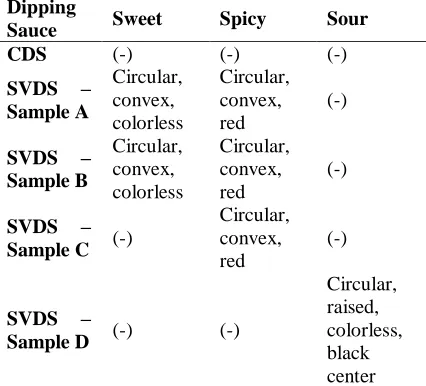
Salmonella Shigella Agar (SSA) was poured into sterile petri dish and solidified. Fresh undiluted sample sauce was aseptically streaked onto the agar. Plates were then placed inside an incubator held at 37⁰C for 24 to 48 hours. After 48 hours, positive growth of Salmonella spp. would be identified, if the colony is colorless and usually with a black center. Shigella spp. is positive if the colony is colorless only and if the colony have a slight growth and with a color of pink or red, it indicates the presence of E. coli.
For the determination of the presence of L. monocytogenes, Listeria Selective Base Agar (LSA) was poured into sterile petri dish and solidified. Fresh undiluted sample sauce was aseptically streaked onto the agar. Plates were then placed inside an incubator held at 37⁰C for 24 - 48 hours. Growth after 48 hours indicates that it is positive for Listeria spp.
III.RESULTS AND DISCUSSION
Table 1. Presumptive identification test of Salmonella Shigella Agar (SSA) and Listeria Selective Agar (LSA) media
Dipp ing Sauc e
Loca tion
SSA LSA
Sw eet
Spi cy
So ur
Sw eet
Spi cy
So ur
CDS Pot Dog
(-) (-) (-) (+) (+) (+ ) SVD
S – Sam ple A
Dapit an
(+) (+) (-) (+) (+) (+ )
SVD S – Sam ple B
Espa ña
(+) (+) (-) (+) (+) (+ )
SVD S – Sam ple C
Lacso n
(-) (+) (-) (-) (+) (+ )
SVD S – Sam ple D
P.No val
(-) (-) (+ )
(+) (+) (+ )
Table 1 shows the summary of results conducted in detecting the presence of pathogenic microorganisms in street food dipping sauces. Sauces from the control showed no growth. On the other hand, Dapitan and España’s sweet and spicy sauces were positive in SSA and LSA. In Lacson’s, only the spicy sauce has a growth of microorganisms. Lastly, P.Noval’s sour sauce was the only sauce showed positive in presence of such microorganisms.
On the same table, LSA supports the growth of Listeria species. Almost all the sauces showed positive result; while Lacson’s sweet sauce was negative. This phenomenon may be due to the characteristics of Listeria spp. which is very widespread in the natural environment. The presence of these bacteria in almost all the identified sauces may be contributed from high moisture environments where they are best incubated particularly the high moisture content of these sauces.
Its resistance to environmental stress (acid, salt, temperature, etc) are observed in foods (Ryser & Mart, 2007). Since sauces were served in containers exposed to open areas and poor sanitation, contamination occurred. Product contamination can also result from the environment and equipment in sites difficult to access (Motarjemi, Moy, & Todd, 2014).
Table 2.Morphology of present microorganisms in Salmonella Shigella Agar (SSA) medium
Dipping
Sauce Sweet Spicy Sour
CDS (-) (-) (-)
SVDS – Sample A
Circular, convex, colorless
Circular, convex, red
(-)
SVDS – Sample B
Circular, convex, colorless
Circular, convex, red
(-)
SVDS – Sample C (-)
Circular, convex, red
(-)
SVDS –
Sample D (-) (-)
Circular, raised, colorless, black center (-) indicates absence of growth in selective media.
Table 3.Identified microorganisms through morphology
Dipping Sauce
Sweet Spicy Sour
CDS (-) (-) (-)
SVDS – Sample A
Shigella E. coli (-)
SVDS – Sample B
Shigella E. coli (-)
SVDS – Sample C
(-) E. coli (-)
SVDS – Sample D
(-) (-) Salmonella
(-) indicates absence of growth in selective media.
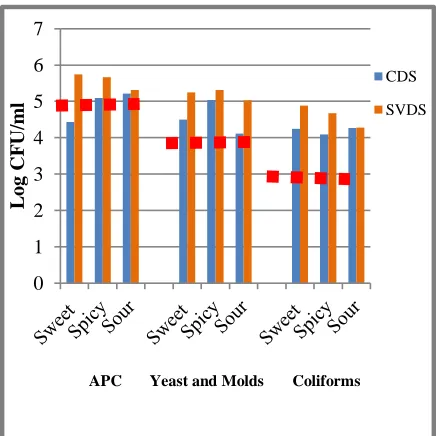
*broken lines indicates the limit of standard plate count
Figure 1. Microbial load of Control dipping sauce vs. Ambulant dipping sauce
Figure 1 shows the Aerobic Bacteria, Yeast and Molds, and Coliforms Count of the sauces used for the investigation. Bacteria are most likely to grow in pH range from 4 to 9 (Rahman, 2007). Thus, aerobic plate count was utilized to determine the growth of bacteria in these sauces. The aerobic plate count cannot predict the safety of the product and will be influenced by the storage conditions of the product, but can be used to indicate whether the product have been prepared unhygienically or stored inappropriately. (NSW Food Authority, 2009). In this investigation, presence of aerobic bacteria was shown in a plate count agar. The exposure of sauces to open air promotes growth of these microorganisms. The results showed that all SVDS as well as the spicy and sour CDS reached the limit. The acceptable aerobic plate count should be <5 log cfu/ml and the unsatisfactory limit is ≥5 log cfu/ml (NSW Food Authority, 2009). This indicates that the results of the determined number of colonies per sauces in this investigation present no food safety concern, but might indicate poor food handling practices. However, only the sweet CDS obtained lower than the limit count of colonies.
Yeast and molds counts are considered to be spoilage organisms. These are usually not destroyed during processing or cooking because of the production of mycotoxins. They generally require oxygen for growth and can grow at reduced water activities ≤ 0.85 (McLandsborough, 2004). Molds
was used to determine Yeasts and Molds growth. The sauces from ambulant vendor obtained higher number of colonies than the colony growth from the sauces of control. However, the results revealed that all of the sauces exceeded the limit of acceptable log cfu/ml. The acceptable Yeast and Molds count should be 2 log cfu/ml and the count, which indicates risk to human consumption, is 4 log cfu/ml (FDA, 2013). The high number of counts can be the effect of surviving fungi from unprocessed materials in handling and/or processing of sauces (Corry, Curtis, & Baird, 2003). According to Sun (2012), their presence in foods may result in a decrease in shelf life during frozen storage at high temperature (-8°C) or after thawing in refrigerated storage.
For the determination of Coliforms and E. coli,petrifilms were used. Coliforms are capable of growing on a large number of media and in many foods. They can grow over a pH range of 4.4 to 9.0 (Jay, Loessner, & Golden, 2005). Coliforms growth was shown, but there was no growth of E. coli. All the sauces investigated revealed high number of count of coliforms than the control. Still, all the sauces exceeded the accepted number of colonies, which indicates a risk to human consumption or imminent spoilage. High number of coliforms may indicate potential presence of bacterial pathogens. This high number of results can be due to improper hygienic practices of the vendors. It may also be caused by massive contamination, process failure, or from growth resulting from extended processing delays and/or improper storage. Coliforms acceptable count must be 3 cfu/ml, and the limit of 3 log cfu/ml indicates potential hazard to human consumption (FDA, 2013). Contamination of these sauces may come from the vendors preparing the sauces and utensils used for cooking or serving.
According to the observation of the researchers to the selected vendors, water could also be the source of contamination (Official Gazette, 2013). Since street food vendors are mobile and do not have permanent places of selling their goods, there is lack of potable water for the preparation of sauces, including the water based of the sauces.
IV.CONCLUSION
The study indicates the microbiological assessment of street food dipping sauces to raise the awareness to the sauces not only in the street foods. The sauces analyzed and compared were the control and street food dipping sauces. The sauces available in the assessments are sweet, spicy and sour. In the control and street dipping sauces there are pathogenic 0
1 2 3 4 5 6 7
L
og
CF
U/m
l
APC Yeast and Molds Coliforms CDS
load of the control and street dipping sauces, most of the sauces exceeded the acceptable limits and this may indicate a hazard and risk to human consumption.
Despite limited microbiological analyses conducted in the street food dipping sauces, this study provided baseline data for the microbiological assessment of street food dipping sauces. The study proposes public awareness on human risk consumption of the street food dipping sauces.
V. REFERENCES
I. Albrecht, J. A. (2014). UNL Food: Shigella. Retrieved March 3, 2015, from food.unl.edu: http://food.unl.edu/safety/shigella
II. Corry, J. E., Curtis, G. D., & Baird, R. M., Handbook of Culture Media for Food Microbiology, Volume 37. Amsterdam: Elesevier Science B.V., 2003
III. FAO, F. a. (1990). Street Foods; Report of an FAO expert consultation. Jogjakarta, Indonesia: FAO Nutrition.
IV. FDA. (2013, February 27). Retrieved November 5, 2014, from www.fda.gov.ph: http://www.fda.gov.ph/attachments/article/7 1149/Annex%20I%20-%20FC%202013-010%20Microbiological%20Standard%20fo r%20Processed%20Food.pdf
V. Jay, J., Loessner, M., & Golden, D., Modern Food Microbiology. USA: Springer Science+Business Media, Inc., 2005
VI. Lawley, R., Curtis, L., & Davis, J., The Food Safety Hazard Guidebook. United Kingdom: RSC Publishing, 2008
VII. McLandsborough, L., Food Microbiology Laboratory. Boca Raton: CRC Press, 2004 VIII. Minnesota Department of Agriculture, Dairy
and Food Inspection Division, A Guide to Understanding How to Develop a HACCP Plan. St. Paul: Minnesota Department of Agriculture, Dairy and Food Inspection Division, 1998
IX. Motarjemi, Y., Moy, G., & Todd, E., Encyclopedia of Food Safety. San Diego: Academic Press, 2014
X. NSW Food Authority, Microbiological quality guide for ready-to-eat foods, 7, July 2009
XI. Official Gazette. (2013, August 23). Retrieved November 5 4, 2014, from www.gov.ph:
http://www.gov.ph/2013/08/23/republic-act-no-10611/
XII. Rahman, M. S., Handbook of Food Preservation, Second Edition. USA : Taylor & Francis Group, 2007
XIII. Ryser, E. T., & Mart, E. H., Listeria, Listeriosis, and Food Safety, Third Edition. Boca Raton: CRC Press, 2007
XIV. Sun, D.-W. (2012). Handbook of Frozen Food Processing and Packaging, Second Edition. Boca Raton: CRC Press.