R E S E A R C H
Open Access
Addressing poverty through disease control
programmes: examples from Tuberculosis control
in India
Vishnu Vardhan Kamineni
1,3*, Nevin Wilson
1, Anand Das
1, Srinath Satyanarayana
1, Sarabjit Chadha
1,
Kuldeep Singh Sachdeva
2and Lakbir Singh Chauhan
2Abstract
Introduction:Tuberculosis remains a major public health problem in India with the country accounting for one-fifth or 21% of all tuberculosis cases reported globally. The purpose of the study was to obtain an understanding on pro-poor initiatives within the framework of tuberculosis control programme in India and to identify
mechanisms to improve the uptake and access to TB services among the poor.
Methodology:A national level workshop was held with participation from all relevant stakeholder groups. This study conducted during the stakeholder workshop adopted participatory research methods. The data was elicited through consultative and collegiate processes. The research study also factored information from primary and secondary sources that included literature review examining poverty headcount ratios and below poverty line population in the country; and quasi-profiling assessments to identify poor, backward and tribal districts as defined by the TB programme in India.
Results:Results revealed that current pro-poor initiatives in TB control included collaboration with private providers and engaging community to improve access among the poor to TB diagnostic and treatment services. The participants identified gaps in existing pro-poor strategies that related to implementation of advocacy, communication and social mobilisation; decentralisation of DOT; and incentives for the poor through the available schemes for public-private partnerships and provided key recommendations for action. Synergies between TB control programme and centrally sponsored social welfare schemes and state specific social welfare programmes aimed at benefitting the poor were unclear.
Conclusion:Further in-depth analysis and systems/policy/operations research exploring pro-poor initiatives, in particular examining service delivery synergies between existing poverty alleviation schemes and TB control programme is essential. The understanding, reflection and knowledge of the key stakeholders during this
participatory workshop provides recommendations for action, further planning and research on pro-poor TB centric interventions in the country.
Keywords:Tuberculosis control, Poverty, India
Introduction
India is the highest tuberculosis (TB) burden country in the world, accounting for nearly one-fifth or 21% of all tuberculosis cases [1]. In 2009, out of the estimated glo-bal annual incidence of 9.4 million TB cases, nearly 2
million cases were estimated to have occurred in India [1,2]. India’s Revised National TB Control Programme (RNTCP), based on the internationally recommended Directly Observed Treatment Short-course (DOTS) strategy launched in 1997 implemented a phased expan-sion achieving nation-wide programme coverage in March 2006. RNTCP covers over a billion population (1,164 million) across 632 districts in 35 states and Union territories, and has initiated more than 12.8 * Correspondence: [email protected]
1
International Union Against Tuberculosis and Lung Diseases (The Union), South-East Asia Regional Office, New Delhi, India
Full list of author information is available at the end of the article
million TB patients on treatment, saving an additional 2.3 million lives [2]. RNTCP has sustained new sputum positive (NSP) case detection rates of over 70% and treatment success rates over 85% nationally since 2007, in line with global targets for TB control [2]. TB mortal-ity and prevalence in the country has witnessed a reduc-tion compared with 1990 figures, indicating progress towards achieving TB related targets of the United Nations Millennium Development Goals (MDG) [2].
The World Bank defines international poverty as peo-ple living below US$ 1.25 per day [3]. Of the 22 TB high-burden countries accounting for 81% of the global TB burden, 10 countries are categorised under the‘low income category’ (GNI < US $ 995), and 9 countries under lower middle income category (GNI US $ 996-3,945), as per World Bank benchmarks for income group classification [1,4]. Within these already poor countries, there are significant disparities compounded by large populations that are densely distributed and with restricted access to basic health services. India is currently ranked 119 out of 169 countries on human development, with 41.8% of population living below the international poverty line [5]. Planning Commission of India (PCI) reports estimate the poverty headcount ratio, assessed based on the national sample surveys to be at 37% in India (rural and urban) [6]. Multidimen-sional poverty index (MPI) analysis using the develop-mental parameters of health, education and standard of living reveal that 8 Indian states (West Bengal, Rajasthan, Chhattisgarh, Jharkhand, Odisha, Uttar Pra-desh, Madhya Pradesh and Bihar) with a combined population of 421 million live in poverty comparable to the 26 poorest African countries that have a cumulative population of 410 million [7]. That deprivation of health is the second most significant contributor to overall poverty in India after living standard provides ample indication of the prevailing poverty-health co-relation [7]. It is often the poor and socially excluded groups that are disproportionately exposed to ill-health and are unlikely to receive care.
The linkages between poverty and TB are established historically with tuberculosis more commonly occurring in poor people [8]. Socio-economic determinants such as poverty, overcrowding, food insecurity and malnutri-tion while identified as proximate risk factors facilitating transmission of infection and disease, are also responsi-ble for inequities in accessing TB care [9]. Poor were two times more likely to have TB, three times less likely to access TB care, four times less likely to complete treatment and many times more likely to incur impover-ishing payments for TB care [10]. The impact of TB on poor included loss of income, stigmatisation and home-lessness, more acute in women and children [10]. Furthermore, TB patients reduced ability to work is
projected to incur a 20-30% loss in their annual wages [11]. These socio-economic determinants amplify health inequities within populations particularly among the poor and vulnerable groups.
In India, free diagnostic and treatment services pro-vided under RNTCP are designed to benefit the poor and vulnerable groups of the society. However, recent evidence from community based Knowledge, Attitudes and Practices (KAP) survey suggests that people ‘most in need’of free services were not accessing or utilising these services, and that a significant proportion of TB patients, illiterate and from low income rural households were being diagnosed and treated outside the DOTS/ RNTCP system, and incurring expenditure [12]. RNTCP is moving in to the next phase of programming that includes promoting the concept of‘Universal Access to TB Care’. The implementation of this concept is expected to allow all TB patients in the community to have early access to good quality TB diagnosis and treat-ment services. One of the key challenge in achieving this objective is addressing reasons behind inter/intra-district disparities in programme performances, with problems persisting more so in the poorer and backward districts of the country. Recognising the pivotal role of TB con-trol in alleviating poverty, the World Health Organisa-tion-Stop TB Partnership established a sub working group on TB and Poverty, the secretariat for this sub group more recently located in a TB high-burden coun-try - India. The role of the secretariat is to coordinate the work of the subgroup and to promote poverty cen-tric TB activities, engaging policy makers, practitioners, non-governmental organisations and other stakeholders in setting the foundations for development of specific tools, guidelines and activities that are aimed at increas-ing the access of the poor to TB services.
There is very limited information in published litera-ture on what specific measures/efforts are undertaken by the TB Control Programmes to make the services accessible to TB patients among the poor. Secondly there is also limited information on whether the services that are made available are utilised by the poor. Through this paper, we attempt to present these two issues with respect to TB control Programme in India. In addition we also highlight key issues relating to TB control and poverty that emerged during the consulta-tive workshop on‘Poverty and TB’.
Methods
stakeholder involvement comprising of consultative and collegiate processes.
The consultative method aimed at eliciting‘knowledge for action’information with appropriate recommenda-tions emanating from participant’s practical field experi-ences; while the collegiate methodical approach allowed both the facilitators and participants with varying skills to be involved in a mutual learning experience. The focus of the methods used was to elicit the information on understanding equity issues within the framework of tuberculosis control programme in India and to outline the mechanisms to improve the uptake and access to TB services among the poor. This workshop funded by The Centers for Disease Control aimed at examining poor initiatives adopted in tuberculosis control pro-gramme in India and also discuss equity-mapping by adopting participatory techniques involving stakeholders during the 2 day iterative workshop. Workshop on TB and poverty was organised in Gurgaon, India on 29-30 October, 2010, by the Secretariat of the WHO Stop TB Poverty sub working group hosted by The Union’s South-East Asia regional office located in New Delhi, India.
The participants (n = 31) were from a wide range of stakeholders that included RNTCP National Programme Manager and TB programme managers representing 5 Indian states with a higher proportion of people living below poverty line: Bihar, Jharkhand, Madhya Pradesh, Chhattisgarh, and Uttarakhand. Two relatively not-so-poor states consisting of poverty afflicted urban slums, Tamil Nadu, Haryana and Union territory-Chandigarh also participated in the workshop. The selection of states was based on existing poverty levels and TB bur-den as ibur-dentified by the RNTCP programme in India. In addition, representatives from multilateral and non-gov-ernmental agencies, civil society and media: World Bank-India, World Vision-India, International Union Against TB and Lung Disease (The Union), WHO-RNTCP consultants network, Partnership for TB Care and Control in India (national civil society partnership), and Citizen News Service participated in the study.
The first day of the participatory workshop allowed for overview discussions on poverty and TB at country level, followed by structured presentations and discus-sions on pro-poor TB initiatives in the represented states/union territories (n = 6) Jharkhand, Bihar, Chhat-tisgarh, Tamil Nadu, Chandigarh and Uttarakhand. A pro-poor initiative was defined as any measure that is introduced/implemented and expected to specifically benefit the TB patients who are poor. The end-session on Day 1 allowed for specific inputs from participants in to the PR design with inputs identifying working groups and segregating the participants in to 3 thematic groups. The second day of the participatory group work allowed
participants to deliberate on the thematic areas relating to pro-poor approaches; existing strategies and pro-poor recommendations; and lastly equity mapping to measure equity in TB control. Facilitated discussions in the group work were aimed at identifying recommendations that were likely to be later examined in a systematic manner at the level of RNTCP programme and other TB projects having scope for implementing pro-poor interventions in their target populations. Results from each group were discussed among all the participants in obtaining inputs and final consensus contributing to an improved knowledge and understanding on pro-poor initiatives within the framework of TB control.
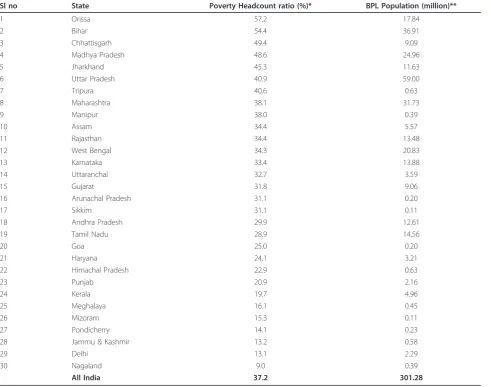
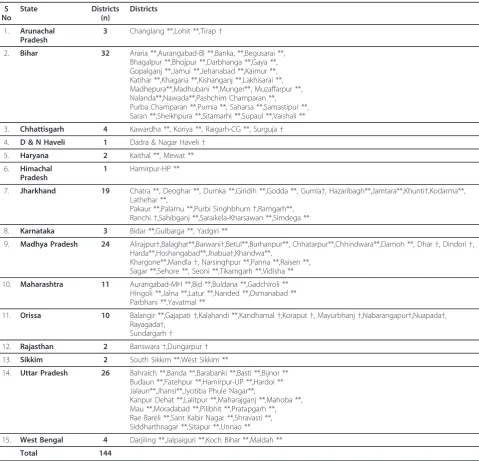
In addition, the research study also factored informa-tion from the following primary and secondary sources: literature review examining poverty headcount ratios and BPL population in Indian states (Table 1) and quali-tative and quantiquali-tative profiling assessments to identify poor, backward and tribal districts as identified by the TB programme in India. No ethical approval was required for this study.
Results and discussion
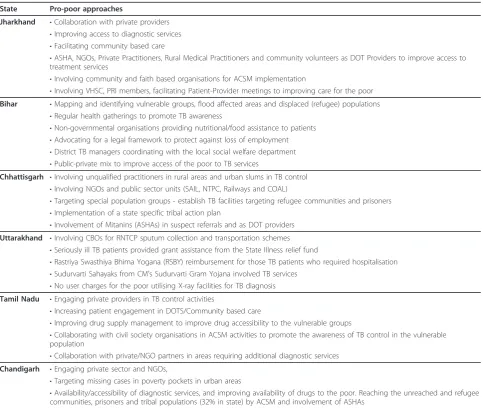
The approaches identified as pro-poor in Jharkhand state included collaboration with private providers to improve access to diagnostic services through estab-lishment of sputum collection centres, facilitating com-munity based care, and involving Accredited Social Health Activists (ASHA),aNGOs, Private Practitioners, informal health providersband community volunteers as DOT Providers to improve access to treatment ser-vices. Interventions also include engaging community and faith based organisations for ACSM implementa-tion, sensitising community groups such as Village Health & Sanitation Committee (VHSC),c organising PRI meetings and Patient- Provider meeting so as to contribute towards improving care for the poor in Jharkhand state. Table 3 summarises the key pro-poor approaches currently implemented across states repre-sented in the workshop.
TB Programme in Bihar had initiated geographical mapping and identifying vulnerable groups (margina-lised/discriminated groups) based on their residential location. Mapping exercise was inclusive in identifying flood affected areas, urban slums and displaced popula-tions. Under the aegis of National Rural Health mission (NRHM),dregular health gatherings were organised in close collaboration with the District TB centres. Non-governmental organisations such as Damien Foundation and LEPRA India were providing nutritional/food assis-tance to patients who were sole household earning members. Pro-poor initiatives targeting social barriers included advocating for a legal framework to protect against loss of employment, and investigating attitude and behaviour of health staff towards patients. The state was exploring mechanisms to address geographical bar-riers that included advocating with the national Table 1 States with Poverty Headcount ratio and BPL Population in India
Sl no State Poverty Headcount ratio (%)* BPL Population (million)**
1 Orissa 57.2 17.84
2 Bihar 54.4 36.91
3 Chhattisgarh 49.4 9.09
4 Madhya Pradesh 48.6 24.96
5 Jharkhand 45.3 11.63
6 Uttar Pradesh 40.9 59.00
7 Tripura 40.6 0.63
8 Maharashtra 38.1 31.73
9 Manipur 38.0 0.39
10 Assam 34.4 5.57
11 Rajasthan 34.4 13.48
12 West Bengal 34.3 20.83
13 Karnataka 33.4 13.88
14 Uttaranchal 32.7 3.59
15 Gujarat 31.8 9.06
16 Arunachal Pradesh 31.1 0.20
17 Sikkim 31.1 0.11
18 Andhra Pradesh 29.9 12.61
19 Tamil Nadu 28.9 14.56
20 Goa 25.0 0.20
21 Haryana 24.1 3.21
22 Himachal Pradesh 22.9 0.63
23 Punjab 20.9 2.16
24 Kerala 19.7 4.96
25 Meghalaya 16.1 0.45
26 Mizoram 15.3 0.11
27 Pondicherry 14.1 0.23
28 Jammu & Kashmir 13.2 0.58
29 Delhi 13.1 2.29
30 Nagaland 9.0 0.39
All India 37.2 301.28
Source: *Planning commission of India, Tendulkar committee report, 2009
programme to relax eligibility norms for the creation of diagnostic services and increase their number within a population. District TB programme managers were par-ticipating in meetings of the local social welfare depart-ment. Tracking out-migration, mapping of vulnerable groups and increasing numbers of diagnostic services within the population were some of the pro-poor initiatives.
The approaches identified as pro-poor in the state of Chhattisgarh included involving informal health provi-ders in rural areas and urban slums to promote TB
suspect referral and in DOT provision for diagnosed TB patients, involve NGOs and public sector units (SAIL, NTPC, Railways and COAL) in TB control to enhance access of TB services to the poor. Vulnerable population groups have received special attention with TB facilities established in Mainpat Tibetan camps and Mana Ban-gladeshi camps targeting refugee communities from Tibet and Bangladesh, and TB facilities have also been set up in Bilaspur and Raipur central jails to provide services closer to prisoners. Implementation of a state specific tribal action plan providing transportation Table 2 Profile of Poor, Backward and Tribal districts, RNTCP programme
S No
State Districts
(n)
Districts
1. Arunachal Pradesh
3 Changlang **,Lohit **,Tirap†
2. Bihar 32 Araria **,Aurangabad-BI **,Banka, **,Begusarai **, Bhagalpur **,Bhojpur **,Darbhanga **,Gaya **, Gopalganj **,Jamui **,Jehanabad **,Kaimur **, Katihar **,Khagaria **,Kishanganj **,Lakhisarai **, Madhepura**,Madhubani **,Munger**, Muzaffarpur **, Nalanda**,Nawada**,Pashchim Champaran **, Purba Champaran **,Purnia **, Saharsa **,Samastipur **, Saran **,Sheikhpura **,Sitamarhi **,Supaul **,Vaishali **
3. Chhattisgarh 4 Kawardha **, Koriya **, Raigarh-CG **, Surguja†
4. D & N Haveli 1 Dadra & Nagar Haveli†
5. Haryana 2 Kaithal **, Mewat **
6. Himachal Pradesh
1 Hamirpur-HP **
7. Jharkhand 19 Chatra **, Deoghar **, Dumka **,Giridih **,Godda **, Gumla†, Hazaribagh**,Jamtara**,Khunti†,Kodarma**, Lathehar **,
Pakaur **,Palamu **,Purbi Singhbhum†,Ramgarh**, Ranchi†,Sahibganj **,Saraikela-Kharsawan **,Simdega **
8. Karnataka 3 Bidar **,Gulbarga **, Yadgiri **
9. Madhya Pradesh 24 Alirajpur†,Balaghat**,Barwani†,Betul**,Burhanpur**, Chhatarpur**,Chhindwara**,Damoh **, Dhar†, Dindori†, Harda**,Hoshangabad**,Jhabua†,Khandwa**,
Khargone**,Mandla†, Narsinghpur **,Panna **,Raisen **, Sagar **,Sehore **, Seoni **,Tikamgarh **,Vidisha **
10. Maharashtra 11 Aurangabad-MH **,Bid **,Buldana **,Gadchiroli ** Hingoli **,Jalna **,Latur **,Nanded **,Osmanabad ** Parbhani **,Yavatmal **
11. Orissa 10 Balangir **,Gajapati†,Kalahandi **,Kandhamal†,Koraput†, Mayurbhanj†,Nabarangapur†,Nuapada†, Rayagada†,
Sundargarh†
12. Rajasthan 2 Banswara†,Dungarpur†
13. Sikkim 2 South Sikkim **,West Sikkim **
14. Uttar Pradesh 26 Bahraich **,Banda **,Barabanki **,Basti **,Bijnor ** Budaun **,Fatehpur **,Hamirpur-UP **,Hardoi ** Jalaun**,Jhansi**,Jyotiba Phule Nagar**,
Kanpur Dehat **,Lalitpur **,Maharajganj **,Mahoba **, Mau **,Moradabad **,Pilibhit **,Pratapgarh **, Rae Bareli **,Sant Kabir Nagar **,Shravasti **, Siddharthnagar **,Sitapur **,Unnao **
15. West Bengal 4 Darjiling **,Jalpaiguri **,Koch Bihar **,Maldah **
Total 144
incentives for patients from tribal communities to access diagnosis and treatment services, and involving ASHAs in suspect referrals and as DOT providers were among other poverty centric initiatives aimed at reaching the unreached.
Uttarakhand state has identified new community-based organisations (CBOs) for sputum collection and transportation schemes under RNTCP. TB patients who were seriously ill were at times provided grant assistance from the State Illness relief fund. Rastriya Swasthiya Bhima Yogana (RSBY)ereimbursement was made avail-able for poor TB patients who required hospitalization. Sudurvarti Sahayaks from CM’s Sudurvarti Gram Yojana were also involved in providing TB services. User charges were not levied from the poor when they uti-lised X-ray facilities for TB diagnosis. X-ray diagnosis is an important step in the TB diagnostic algorithm and
costs usually associated with this test is also a barrier to its use.
Pro-poor approaches in Tamil Nadu state included engaging private providers in TB control activities, increasing patient engagement in DOTS/Community based care and improving drug supply management to improve drug accessibility to the vulnerable groups. State TB programme was presently collaborating with civil society organisations in implementing ACSM activ-ities to promote the TB awareness in vulnerable popula-tions. In areas where need based analysis identified requirement of additional diagnostic services, collabora-tion with private/NGO partners was explored to provide services in alignment with RNTCP public-private mix schemes. In order to improve community engagement in DOTS and encouraging community based care, DOT providers were paid an honorarium at the end of the Table 3 Summary of pro-poor approaches for TB care, RNTCP
State Pro-poor approaches
Jharkhand •Collaboration with private providers •Improving access to diagnostic services •Facilitating community based care
•ASHA, NGOs, Private Practitioners, Rural Medical Practitioners and community volunteers as DOT Providers to improve access to treatment services
•Involving community and faith based organisations for ACSM implementation
•Involving VHSC, PRI members, facilitating Patient-Provider meetings to improving care for the poor Bihar •Mapping and identifying vulnerable groups, flood affected areas and displaced (refugee) populations
•Regular health gatherings to promote TB awareness
•Non-governmental organisations providing nutritional/food assistance to patients •Advocating for a legal framework to protect against loss of employment •District TB managers coordinating with the local social welfare department •Public-private mix to improve access of the poor to TB services
Chhattisgarh •Involving unqualified practitioners in rural areas and urban slums in TB control •Involving NGOs and public sector units (SAIL, NTPC, Railways and COAL)
•Targeting special population groups - establish TB facilities targeting refugee communities and prisoners •Implementation of a state specific tribal action plan
•Involvement of Mitanins (ASHAs) in suspect referrals and as DOT providers Uttarakhand •Involving CBOs for RNTCP sputum collection and transportation schemes
•Seriously ill TB patients provided grant assistance from the State Illness relief fund
•Rastriya Swasthiya Bhima Yogana (RSBY) reimbursement for those TB patients who required hospitalisation •Sudurvarti Sahayaks from CM’s Sudurvarti Gram Yojana involved TB services
•No user charges for the poor utilising X-ray facilities for TB diagnosis Tamil Nadu •Engaging private providers in TB control activities
•Increasing patient engagement in DOTS/Community based care
•Improving drug supply management to improve drug accessibility to the vulnerable groups
•Collaborating with civil society organisations in ACSM activities to promote the awareness of TB control in the vulnerable population
•Collaboration with private/NGO partners in areas requiring additional diagnostic services Chandigarh •Engaging private sector and NGOs,
•Targeting missing cases in poverty pockets in urban areas
treatment that served as an incentive as well as a moti-vating factor to continue as DOT providers.
Poverty-centric activities in Chandigarh included enga-ging private sector and NGOs, targeting missing cases in poverty pockets, examining availability/accessibility of diagnostic services and improving availability of drugs to the poor. The programme was striving to reach the unreached and refugee communities, prisoners and tri-bal populations (32% in Union territory) through TB Advocacy, Communication and Social Mobilisation and involvement of ASHAs. Participants from represented Indian states also acknowledged the availability of social welfare schemes like public distribution system for dis-tributing essential food commodities to the economically weaker sections, nutrition within the ambit of rural development departments, and various poverty alleviat-ing social welfare schemes relatalleviat-ing to self-employment,
NREGAf in the country. The RNTCP national
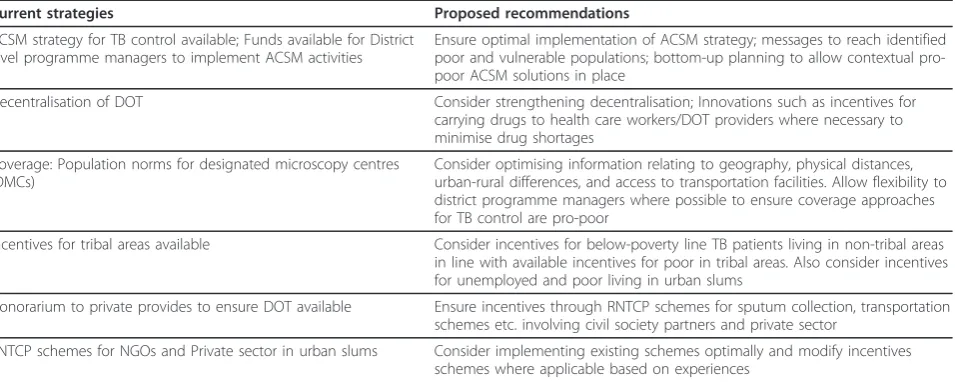
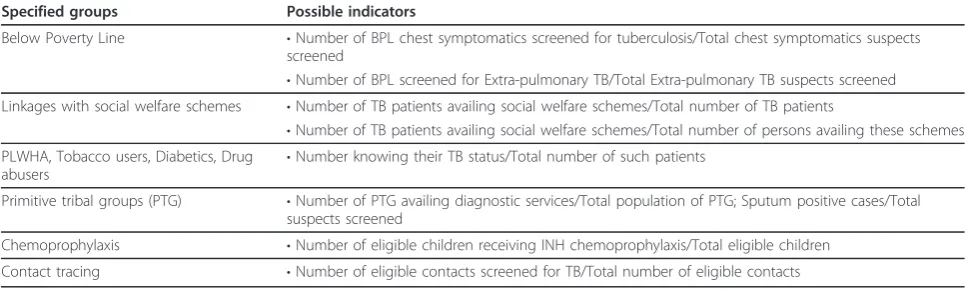
pro-gramme manager added that the Global Fund to fight AIDS, TB and Malaria (GFATM) Round 9TB project provides a unique opportunity for state/districts to work closely with the civil society organisations (CSO) to link the poor to social welfare schemes. Ensuring optimal implementation of ACSM strategy, strengthening DOT decentralisation, addressing geographic and economic barriers, and developing innovative incentives to address the access bottlenecks were few of the key recommenda-tions for action emanating from the deliberarecommenda-tions. Table 4 highlights participants’ deliberations on knowledge gaps and the various options available to address pov-erty through tuberculosis control. The stakeholders identified pro-poor indicators such as proportion of patients linked to the social welfare schemes, proportion of patients living below poverty line, proportion of patients belonging to primitive tribal groups as few of
the key indicators that were needed to be examined in sub-district level equity mapping exercises. Table 5 illus-trates workshop deliberations on equity related indica-tors that may be examined and used to measure progress towards addressing poverty through TB con-trol. Though the poverty reduction activities currently in practice were listed, there was limited information on whether the listed activities are reaching the poor, how much money is spent towards implementing the activ-ities and sustainability of such activactiv-ities. The immediate and later impact of these pro-poor strategies was also not known to the participants.
Benatur et al. (2010) elucidate that extreme poverty along with malnutrition, overcrowding, and lack of access to health care are major drivers for tuberculosis and its spread, including its dangerous varieties namely multi-drug resistant and extremely drug resistant strains [15]. The role of disease control programmes such as RNTCP is central to addressing poverty today. An improvement in economy more recently witnessed in India has a potential to influence the incidence of tuber-culosis in the country. Regression analysis suggests that with each doubling of GDP, there is an associated decrease of 38.5% in the incidence of TB [16]. While the poverty rates appear to have reduced, their absolute numbers increased due to the rising population in the country. Persisting inequity despite GDP growth and vulnerability with its newer variants emerge in the coun-try [17]. While existing studies highlight the economic impact of the TB control efforts in India, it is crucial to note such assessments have not taken in to account the wider socio-economic disparities that prevail in the country.
The participants in the study discussed the barriers in accessing diagnostic and treatment services, especially
Table 4 Existing strategies and recommendations made during the Working group deliberations
Current strategies Proposed recommendations
ACSM strategy for TB control available; Funds available for District level programme managers to implement ACSM activities
Ensure optimal implementation of ACSM strategy; messages to reach identified poor and vulnerable populations; bottom-up planning to allow contextual pro-poor ACSM solutions in place
Decentralisation of DOT Consider strengthening decentralisation; Innovations such as incentives for
carrying drugs to health care workers/DOT providers where necessary to minimise drug shortages
Coverage: Population norms for designated microscopy centres (DMCs)
Consider optimising information relating to geography, physical distances, urban-rural differences, and access to transportation facilities. Allow flexibility to district programme managers where possible to ensure coverage approaches for TB control are pro-poor
Incentives for tribal areas available Consider incentives for below-poverty line TB patients living in non-tribal areas in line with available incentives for poor in tribal areas. Also consider incentives for unemployed and poor living in urban slums
Honorarium to private provides to ensure DOT available Ensure incentives through RNTCP schemes for sputum collection, transportation schemes etc. involving civil society partners and private sector
among the poor and vulnerable populations within their jurisdictions. Several factors identified as impeding access to TB diagnostic services among the poor include lack of awareness of existing TB services, lower educa-tion levels among the marginalised groups, sub-optimal or ineffective ACSM implementation by the RNTCP, discrimination in relation to gender/age/religion, and apathy of health care providers towards the poor. Bar-riers to treatment services identified include suboptimal ACSM implementation by the RNTCP, lack of flexibility (timings/observer) in implementing DOTS including workplace DOTS, economic constraints faced by the poor, and lower incentive paid to DOT providers. Fac-tors magnifying both diagnostic and treatment barriers included illiteracy, unemployment, lack of social secur-ity, migrants who legal status was unclear, gender and age related, location of health care services, lack of motivation among health care providers, added stigma of HIV and poor involvement of private providers.
Participants emphasised the need to strengthen the RNTCP’s effort to engage and involve private providers, including informal providers, non-allopathic providers (AYUSH)gto ensure providing access to TB related ser-vices targeting the poor. Line-listing of NGOs within identified poverty pockets followed by their sensitisation on available RNTCP schemes to promote their involve-ment will expand access to TB services within commu-nities. Synergy with educational department by organising sensitization of school teachers and examin-ing community-owned schemes such as Sarva Shiksha Abhiyan (SSA)h were discussed. Collaboration with the national chambers of commerce such as the Confedera-tion of Indian Industries (CII) to build synergy between corporate sector and RNTCP was considered essential to ensure work place DOTS. Public sector units (PSU) such as Indian Railways, Employees state insurance, Steel Authority of India (SAIL), Coal India (COAL), National Thermal Power Corporation (NTPC) have
their own health facilities and establishing and strength-ening linkages between PSU units and the RNTCP offered a possibility to widen reach and ensure optimis-ing TB service provision to the poor.
RNTCP’s revised scheme for NGOs and private provi-ders introduced in 2008 has adopted innovative mechanisms to involve diverse stakeholders in TB con-trol [18]. ACSM scheme, sputum collection scheme, transport scheme, treatment adherence scheme and urban slum schemes among others have been designed to improve access of TB services to the populations, especially the poor and needy. Special emphasis is pro-vided within these schemes to engage institutions work-ing in hard to reach areas or‘underserved’areas where there are challenges relating to accessing TB services. However, efficient uptake of these schemes will need concerted efforts on the part of the programme, as well as civil societies and private sector stakeholders con-cerned. There is limited awareness on the existence of these schemes among the stakeholders therefore calling for wider dissemination of schemes to promote stake-holder engagement.
Integrated Rural Development Programme or Swaran-jayanti Gram Swarozgar Yojana (SGSY), Jawahar Rozgar Yojana, Rural Employment Generation Programme, Employment Assurance schemes, Sampoorna Grameen Rozgar Yojana (SGRY), Rural Housing- Indira Awaas Yojana, National Food for work programme, National Social Assistance Programme, Swarna Jayanti Shahri Rozgar Yojana and Old age pension scheme were some of the anti-poverty programmes being implemented by the government of India. Some of the above mentioned schemes may have merged with intent to promote con-certed action at service delivery level. An inherent sys-temic challenge that may potentially hinder any synergistic efforts is the limited awareness regarding social welfare schemes among TB programme managers at state and district level, accompanied by perceived lack Table 5 Equity mapping in TB control–possible indicators to measure equity: Recommendations from the deliberations of the Working groups
Specified groups Possible indicators
Below Poverty Line •Number of BPL chest symptomatics screened for tuberculosis/Total chest symptomatics suspects screened
•Number of BPL screened for Extra-pulmonary TB/Total Extra-pulmonary TB suspects screened Linkages with social welfare schemes •Number of TB patients availing social welfare schemes/Total number of TB patients
•Number of TB patients availing social welfare schemes/Total number of persons availing these schemes PLWHA, Tobacco users, Diabetics, Drug
abusers •
Number knowing their TB status/Total number of such patients
Primitive tribal groups (PTG) •Number of PTG availing diagnostic services/Total population of PTG; Sputum positive cases/Total suspects screened
Chemoprophylaxis •Number of eligible children receiving INH chemoprophylaxis/Total eligible children
of coordination and linkages between the multi-depart-ment schemes and RNTCP. However what remains clear is that TB patients below the poverty line would benefit immensely if linkages between RNTCP and pov-erty alleviation schemes are established where they do not exist, and strengthen harmonization efforts where they already exist aimed at ultimately benefiting the poor. There was consensus that a detailed analysis of poverty alleviation programmes and examining their current and potential linkages with TB control is neces-sary if any attempt to promote synergistic efforts is envisioned.
Conclusion
There are wide ranging interventions that were identi-fied as pro-poor in the context of tuberculosis control. There is however very limited information on the effec-tiveness of these measures in reaching out to the poor. There is a need for evaluating and addressing wider issues related to poverty within the scope of the TB Control Programme.
Addressing health inequities necessitates multi-sec-toral coordination, and that sustained TB control efforts involving pro-poor approaches with resulting decline in TB prevalence among the poor and advancing the wel-fare of the poor seems likely. This is possible only when intensified efforts sustained by the RNTCP, are augmen-ted with coordinaaugmen-ted and synergistic efforts of con-cerned departments across diverse sectors dealing with populations that are considered to be poor. However our current understanding of how tuberculosis control is advancing poverty alleviation efforts at the population level remains incomplete. The understanding, reflection and knowledge of the key stakeholders during this parti-cipatory workshop forms the basis for recommendations for action, further planning and research on pro-poor TB centric interventions in the country. An in-depth analysis and systems/policy/operations research explor-ing pro-poor initiatives as highlighted by stakeholders in this article, in particular examining service delivery synergies between existing poverty alleviation schemes and TB control programme aimed at benefiting poor and vulnerable populations is necessary.
Limitations
The study findings are based on an agreed position and final consensus from participants participating in the study, but may not necessarily reflect the views of their respective organisations.
Endnotes a
Accredited social health activist–female community health activist trained to work as an interface between the community and the public health system.
b
Informal health provider–unqualified health service provider.
c
VHSC- created under national rural health mission, these committees have the responsibility for health at community level and receive untied grants for village level activities.
d
National rural health mission, launched by Ministry of Health and Family Welfare, Government of India envisages improving the availability of and access to quality health care by people, especially for those resid-ing in rural areas, the poor, women and children.
e
RSBY launched by Ministry of Labour and Employ-ment under GovernEmploy-ment of India provides health insur-ance coverage for Below Poverty Line (BPL) families, where beneficiaries are entitled to hospitalization cover-age up to INR 30,000 for most of the diseases requiring hospitalization.
f
NREGA-Mahatma Gandhi National Rural Employ-ment Guarantee Act, launched under the Ministry of Rural Development, Government of India aims at enhancing the livelihood security of people in rural areas by guaranteeing 100 days of wage-employment in a financial year to a rural household whose adult mem-bers volunteer to do unskilled manual work.
g
Ayurveda, Yoga & Naturopathy, Unani, Siddha and Homoeopathy (AYUSH).
h
Sarva Shiksha Abhiyan (SSA), Government of India’s flagship programme for universal elementary education.
Acknowledgements
The authors would like to acknowledge inputs from all the participants of the Poverty workshop, as well as acknowledge the funding support to organise the workshop made available through The Union’s Co-operative agreement with The Centers for Disease Control.
Author details
1International Union Against Tuberculosis and Lung Diseases (The Union),
South-East Asia Regional Office, New Delhi, India.2Central TB Division, Directorate General of Health Services, Ministry of Health and Family Welfare, Government of India, New Delhi, India.3Technical Advisor, International Union Against Tuberculosis and Lung Disease (The Union), The Union South-East Asia Office, C-6, Qutub Institutional Area, New Delhi 110016, India.
Authors’contributions
Authors VK, NW were part of the writing team with contributions from AD, SS, SC, and LSC. VK drafted the manuscript, with manuscript review and edits by NW, SS, AD and SC. All authors read and approved the final manuscript.
Competing interests
The authors declare that they have no competing interests.
Received: 25 November 2011 Accepted: 26 March 2012 Published: 26 March 2012
References
1. World Health Organisation:WHO Report on Global Tuberculosis Control: Epidemiology, Strategy, FinancingGeneva: World Health Organisation; 2010. 2. Central Tuberculosis Division Tuberculosis India:Annual Report of the
Publications through Central TB Division - accessible from location: Government of India; 2011 [http://tbcindia.nic.in/].
3. Ravallion M,et al:Dollar a day revisited.World Bank Econ Rev2009,
23(2):163-184.
4. World Bank:World Development ReportWashington: Conflict, Security and Development; 2011.
5. United Nations Development Programme:Human Development ReportNew York: United Nations Development Programme; 2010.
6. Tendulkar ,et al:Planning Commission: Report of the Expert Group to Review the methodology for Estimation of Poverty.Government of India; 2009.
7. Alkire S, Santos ME:Acute Multidimensional Poverty: A New Index for Developing Countries.OPHI Working paper No 38, accessible at [www. ophi.org.uk/wp-content/uploads/ophi-wp38.pdf].
8. Spence DPS, Hotchkiss J, Williams CSD, Davies PD:Tuberculosis and poverty.BMJ1993,307:759-761.
9. Hargreaves JR,et al:The social determinants of tuberculosis: from evidence to action.Am J Public Health2011,101(No4):654-662. 10. International Union Against Tuberculosis and Lung Disease:Report of the
Consultative workshop on Tuberculosis and PovertyDelhi: The Union (SEARO); 2010.
11. World Health Organisation:Addressing poverty in TB control: options for national tuberculosis programmesGeneva: World Health Organisation; 2005. 12. International Union Against Tuberculosis and Lung Disease:Knowledge,
Attitude and Practices Survey ReportDelhi: The Union (SEARO); 2011. 13. Cornwall A, Jewkes R:What is participatory research?Soc Sci Med2008,
41(No 12):1667-1676.
14. Goodchild M, Sahu S, Wares F:A cost-benefit analysis of scaling up tuberculosis control in India.Int J Tuberc Lung Dis2011,15(3):358-362. 15. Benatar SR, Upshur R:Tuberculosis and poverty: what could (and should)
be done?Int J Tuberc Lung Dis2010,14:1215-1221.
16. Janssens JP, Rieder HL:An ecological analysis of incidence of tuberculosis and per capita gross domestic product.Eur Respir J2008,32(No 5):1415-1416.
17. The World Bank: InSocial Protection for a Changing India. Volume 1. Washington: The World Bank; 2011.
18. Central Tuberculosis Division Tuberculosis India:Revised schemes for NGOs and Private providersDirectorate General of Health Services, Ministry of Health and Family Welfare. Government of India Publications through Central TB Division - accessible from location: Government of India; 2008 [http://tbcindia.nic.in/].
doi:10.1186/1475-9276-11-17
Cite this article as:Kamineniet al.:Addressing poverty through disease control programmes: examples from Tuberculosis control in India.
International Journal for Equity in Health201211:17.
Submit your next manuscript to BioMed Central and take full advantage of:
• Convenient online submission
• Thorough peer review
• No space constraints or color figure charges
• Immediate publication on acceptance
• Inclusion in PubMed, CAS, Scopus and Google Scholar
• Research which is freely available for redistribution