S T U D Y P R O T O C O L
Open Access
A pragmatic cluster randomized controlled trial of
early intervention for chronic obstructive
pulmonary disease by practice nurse-general
practitioner teams: Study Protocol
Jeremy M Bunker
1ˆ
, Helen K Reddel
2, Sarah M Dennis
3, Sandy Middleton
4*, CP Van Schayck
5, Alan J Crockett
6,
Iqbal Hasan
3, Oshana Hermiz
3, Sanjyot Vagholkar
7, Guy B Marks
8and Nicholas A Zwar
1Abstract
Background:Chronic Obstructive Pulmonary Disease (COPD) is a leading cause of disability, hospitalization, and premature mortality. General practice is well placed to diagnose and manage COPD, but there is a significant gap between evidence and current practice, with a low level of awareness and implementation of clinical practice guidelines. Under-diagnosis of COPD is a world-wide problem, limiting the benefit that could potentially be achieved through early intervention strategies such as smoking cessation, dietary advice, and exercise. General practice is moving towards more structured chronic disease management, and the increasing involvement of practice nurses in delivering chronic care.
Design:A pragmatic cluster randomised trial will test the hypothesis that intervention by a practice nurse-general practitioner (GP) team leads to improved health-related quality of life and greater adherence with clinical practice guidelines for patients with newly-diagnosed COPD, compared with usual care. Forty general practices in greater metropolitan Sydney Australia will be recruited to identify patients at risk of COPD and invite them to attend a case finding appointment. Practices will be randomised to deliver either practice nurse-GP partnership care, or usual care, to patients newly-diagnosed with COPD.
The active intervention will involve the practice nurse and GP working in partnership with the patient in
developing and implementing a care plan involving (as appropriate), smoking cessation, immunisation, pulmonary rehabilitation, medication review, assessment and correction of inhaler technique, nutritional advice, management of psycho-social issues, patient education, and management of co-morbidities.
The primary outcome measure is health-related quality of life, assessed with the St George’s Respiratory Questionnaire 12 months after diagnosis. Secondary outcome measures include validated disease-specific and general health related quality of life measures, smoking and immunisation status, medications, inhaler technique, and lung function. Outcomes will be assessed by project officers blinded to patients’randomization groups. Discussion:This study will use proven case-finding methods to identify patients with undiagnosed COPD in general practice, where improved care has the potential for substantial benefit in health and healthcare utilization. The study provides the capacity to trial a new model of team-based assessment and management of newly diagnosed COPD in Australian primary care.
Trial registration:ACTRN12610000592044\
* Correspondence:[email protected] ˆDeceased
4
National Centre for Clinical Outcomes Research, Australia, Australian Catholic University, Sydney, NSW, Australia
Full list of author information is available at the end of the article
Background
Chronic obstructive pulmonary disease (COPD) is a leading cause of morbidity and mortality [1], ranked glo-bally in 2002 as the fifth leading cause of death [2] and the seventh leading cause of disease burden after ischae-mic heart disease and stroke. In Australia, COPD is the fourth leading cause of death for males (4.2% of all deaths) and the sixth leading cause of death for women (3.3% of all deaths); it is also a contributory cause of death in many patients with coronary heart disease or cancer [3]. In the Burden Of Obstructive Lung Disease survey (BOLD), the prevalence of airflow limitation (GOLD Stage II or higher) in Australians aged≥40 years was 10.8% [4], whereas the prevalence of doctor-diagnosed COPD in the same population was 5.9% [5].
Clinically, COPD is characterised by airflow limitation that is not fully reversible, and is associated with an enhanced chronic inflammatory response to noxious particles or gases [6]. Patients typically present with breathlessness, cough, and sputum production. The most important cause in developed countries is cigarette smoking, and up to 50% of smokers may eventually de-velop clinically significant COPD [7].
Even mild to moderate COPD is associated with impaired health status [8]. Patients with COPD have increased healthcare utilisation before diagnosis, raising the possibility that earlier diagnosis may allow more ra-tional and directed use of healthcare resources [9]. The feasibility of a COPD case-finding approach has been established. For example, in an Australian study in 2007, 20% of patients identified as being at risk of COPD responded to invitations to be screened and of these 20% had a new diagnosis of COPD on spirometric cri-teria [10]. This is similar to findings from primary care studies in other countries [11-13]. For diagnosis of COPD, spirometry is required [6], and standards have been developed for the performance of spirometry in primary care [14]. Practice nurses can feasibly and suc-cessfully undertake spirometry [13,15]; as for other health professionals, approximately six hours of training are required [16].
Clinical practice guidelines have been developed and disseminated for the diagnosis and management of COPD [6], including in Australia (COPD-X guidelines) [17]. Despite the high level evidence for the efficacy of guidelines-based interventions, the care provided for patients with COPD in community settings indicates low levels of awareness and implementation of these guide-lines [18]. Medication use is often not in accordance with guidelines [19,20], and a high proportion of patients prescribed inhalers use them incorrectly [21,22].
Effective treatment for COPD improves symptoms, prognosis, and quality of life. Smoking cessation is the most effective measure to reduce progression of the
disease [23]. Because smoking cessation may become less effective at altering the course of disease in patients with severe COPD, interventions that target patients with mild and moderate disease may be more effective [24]. In the Lung Health Study [25] smokers with early COPD who were assigned to a smoking cessation inter-vention had fewer respiratory symptoms after five years follow-up than those who were not. Smokers diagnosed with COPD [26] or who are told their ‘lung age’ [27] may be more likely to cease smoking.
General practice is well placed to diagnose COPD and provide early intervention and longer-term management [28,29]. Care planning and a team approach are effective in the management of chronic disease. Care planning by general practitioners (GPs) has been shown to improve the clinical outcomes for other chronic diseases such as diabetes [30] and asthma [31], but GPs need more sup-port to develop and implement multidisciplinary care plans [32,33] Current guidelines recommend the use of multidisciplinary care plans in the management of patients with COPD [17].
Practice nurses are increasingly contributing to chronic disease management. Specialised nurses have contributed to the care of patients with diabetes and COPD, and there is evidence of improvements in patient self-care, quality of life, and satisfaction [34]. A Cochrane review [35] of nurs-ing outreach programs for COPD found significant gains in health-related quality of life for patients with moderate COPD, but the review highlighted the lack of high quality studies and concluded that further study was required.
While the role of specialist nurses in contributing to the care of patients with COPD has been examined [35-37] and some evidence of benefit in disease-specific quality of life has been found, there are few studies examining the potential role of practice nurses working in partner-ship with GPs in providing more coordinated, integrated, and evidence-based care for patients with newly-diagnosed COPD.
Study aims
The primary aim is to assess the effectiveness of early intervention by a GP-nurse team applying evidence-based guidelines, compared with usual care, in the assessment and management of patients newly diag-nosed with COPD. Secondary aims are to assess the ac-ceptability of the two management approaches to GPs, nurses and patients, and to assess the utility of the COPD Diagnostic Questionnaire (CDQ) and COPD Assessment Test (CAT) in an Australian population.
Study hypothesis
practice guidelines for patients with newly-diagnosed COPD, compared with usual care.
Methods
Study approvals
The PELICAN study (Primary care EarLy Intervention for Copd mANagement) is a pragmatic cluster rando-mized controlled study with two treatment arms, which is being conducted in greater metropolitan Sydney, Aus-tralia. The study is funded by the National Health and Medical Research Council of Australia (Project Grant No. 630421). Ethical approval has been obtained from the Human Research Ethics Committee, University of New South Wales (HREC 10015). The project has been registered with the Australian Clinical Trials Registry (ACTRN12610000592044).
Study design
This pragmatic cluster randomized controlled trial will test the hypothesis that early intervention by a practice nurse-GP partnership will improve outcomes for patients newly diagnosed with COPD, compared with usual care. Because the intervention involves a team ap-proach by treating practitioners, randomization will occur at the practice level rather than at the level of in-dividual patients (CONSORT guidelines for cluster trials [38,39]). All participating practices will use case-finding methods to identify a cohort of patients with newly diag-nosed COPD.
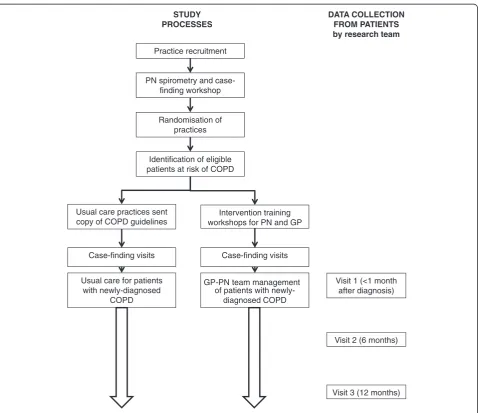
The research plan, identifying recruitment strategies, randomization, data collection points, and the relation-ships between intervention and control groups in the two arms are summarised in Figure 1. Because it is a complex intervention with potential for variable
Practice recruitment
Identification of eligible patients at risk of COPD
Randomisation of practices PN spirometry and
case-finding workshop
Intervention training workshops for PN and GP
Case-finding visits Case-finding visits
GP-PN team management of patients with
newly-diagnosed COPD Usual care for patients
with newly-diagnosed COPD
STUDY PROCESSES
DATA COLLECTION FROM PATIENTS by research team
Visit 1 (<1 month after diagnosis)
Visit 2 (6 months)
Visit 3 (12 months) Usual care practices sent
copy of COPD guidelines
implementation, there will be a focus on process evalu-ation as well as quantitative outcome measures.
Inclusion criteria GPs and practice nurses
Practices will be eligible to participate if they have computer-based patient records, employ at least one practice nurse, and have a spirometer. More than one GP per practice may be involved in the study. Written informed consent will be obtained from GP(s) and prac-tice nurse(s).
Patients
Patients will be eligible for inclusion if they have attended the practice at least twice, with at least one visit in the preceding 12 months, and have risk factors for COPD (aged 40 to 85, and with a documented his-tory of smoking). Patients will be excluded if they have a recorded diagnosis of COPD, are unable to understand English sufficiently to complete study questionnaires or procedures, or have cognitive impairment.
Randomization and allocation concealment
Practices will be randomized to deliver either a practice nurse-GP team management approach, or usual care, to patients with newly-diagnosed COPD. Randomization will be undertaken after the nurses have completed spirometry and case-finding training, and before case-management training for the intervention group. Randomization will be carried out independently of study and practice staff by a statistician separate to the study team using a computer-generated randomization program, with a minimisation al-gorithm to ensure a balance of practice characteristics that could potentially affect study outcomes. These characteris-tics are: practice size, as indicated by the number of prac-tice nurses (1 or >1); socio-economic status, classified according to Socio-Economic Indexes for Areas (SEIFA, [40]) (low: SEIFA 1-5, high: SEIFA 6-10); and participation by the GP in significant (>6 hours) COPD education activ-ities within the last six months (yes or no). Allocation con-cealment will be ensured as group allocation will be conducted at the same time as randomization. Practices will be informed about their group allocation by fax.
Blinding
Participating GPs, practice nurses and patients will not be blinded to the true aims of the study, nor to their randomization group. Project officers, who will collect study outcome measures, will be blinded to group allo-cation as will the statistician undertaking the analyses.
Recruitment
GP and practice nurse recruitment
Recruitment will be conducted with assistance from Divisions of General Practice (local organisations of GPs) in the greater Sydney area. GPs and practice nurses will be provided with an information sheet and asked to provide written consent. All practices expressing an interest in taking part in the project will be visited by an investigator (SD) to discuss the study, answer questions, and obtain consent from the GP and practice nurse. Fur-ther recruitment strategies will include provision of study information packs at GP and practice nurse work-shops and conferences, and by email to members of the Australian Practice Nurses Association.
Intervention and Control Groups: Patient recruitment For both randomization groups, patient recruitment will involve three stages:
1. Potentially eligible patients, i.e., those at risk of COPD (aged 40 to 85, with documented smoking history) will be identified through a search of the practice electronic records by research assistants and practice staff who have no involvement in patient care.
2. Eligible patients will be recruited by a letter from the practice inviting them to a case-finding visit and management of COPD, if diagnosed. The letter will include a brief description of the research and an invitation to participate, and a response form and reply-paid envelope. Non-responders will be followed up by GP practice staff by telephone.
3. Patients who contact the practice in response to the letter will be given an appointment for the
case-finding visit with the practice nurse. The consent form will be signed at the start of the case-finding visit.
For eligible patients who decline to participate in a case-finding visit, basic de-identified information (age, gender, language spoken) will be collected from the practice to allow examination of response bias.
Training of GPs and practice nurses
Intervention and Control Groups—case-finding training of practice nurses for diagnosis of COPD
be provided (total, eight hours), based on the American Thoracic Society and the European Respiratory Society (ATS/ERS) lung function guidelines of 2005 [41,42]. Nurses will receive practical training on their practice’s own spirometer, and calibration of each spirometer will be checked during the workshop. The follow-up work-shop will include revision of spirometry and the pro-cesses for the case-finding appointment.
Intervention Group only—training in GP-nurse team management of newly-diagnosed COPD
In practices randomized to the GP-practice nurse part-nership management arm, the nurses and GPs will at-tend further workshops to receive practical training in team-based management of COPD. These additional workshops for GPs and practice nurses in the GP-practice nurse partnership intervention will be provided by the study team including a nurse academic, a GP aca-demic, and a respiratory physician. The intervention workshops will comprise a full day for practice nurses, a distance learning activity for GPs, and an evening work-shop for both practice nurses and GPs.
The one-day training workshop for nurses will cover: pathophysiology and assessment of COPD; smoking ces-sation including use of lung age as a motivational tool [27]; COPD management according to Australian guide-lines [17]; prescribing guideguide-lines; assessment of patients’ inhaler technique and education to improve technique [43]; the role of pulmonary rehabilitation; the manage-ment of exacerbations; the use and value of nurse/GP joint care planning; information about reimbursement codes for relevant activities; and education about self-efficacy theory, motivation, change management, team-work, and fostering partnerships. The program will be based on that used in an earlier study [44], with adapta-tion to address specific issues for patients with newly-diagnosed COPD. It will foster a culture of positive organisational change through team building and pro-motion of collaborative practice [45]. Practice nurses will be provided with a folder containing workshop notes and presentations.
GPs will complete a computer-based distance learning activity and quiz on the management of COPD accord-ing to the COPDX guidelines. The evenaccord-ing three-hour workshop for GPs and practice nurses will focus on the importance for each GP-practice nurse team to clarify individual elements of their roles, because lack of under-standing has been shown to be a barrier to collaborative practice [46,47]. Each practice will be provided with a copy of current Australian COPD guidelines [17].
Control group training
After case-finding training, practices that are rando-mized to usual care will be provided with a print copy of
the Australian COPD guidelines [17]. At the end of the study, after conclusion of all data collection for all prac-tices, GPs and practice nurses in the control group will be offered a workshop on assisting patients to optimise their inhaler technique.
Study procedures
Intervention and Control Groups—case-finding appointments
At the case-finding visit, the practice nurse will first ob-tain written informed consent for the case-finding process and for participation in the study if COPD is diagnosed; patients will also be asked to consent to re-lease of their contact details to the project officer for ar-ranging data collection visits. The practice nurse will administer a questionnaire including demographic data and the COPD Diagnosis Questionnaire (CDQ, [48]), without calculation of the CDQ score, and will perform spirometry before and after two inhalations of salbuta-mol. Practice nurses will be provided with a computer-based toolkit [49] to assist in diagnosis of COPD, which will be based on post-bronchodilator FEV1/FVC <0.7 [6,17]. The patient consent and demographic/contact details, spirometry printout, diagnosis, and CDQ re-sponses will be faxed to the project officer. Quality of all spirometry traces will be reviewed by one investigator (AC), and if necessary, feedback or additional training in spirometry will be provided to the practice nurse, ini-tially by telephone, with face-to-face support, if needed. Patients will be included in the study on the basis of the COPD diagnosis assigned by the nurse and/or GP from the case-finding spirometry.
All current smokers—irrespective of the results of spir-ometry or practice randomisation—will be offered smoking cessation advice and resources at the case-finding visit. Patients with newly diagnosed COPD will be offered man-agement and follow-up, as below, according to whether the practice is in the intervention or control group. If spirom-etry appears abnormal for other reasons (bronchodilator reversibility suggesting asthma, or restrictive spirometry), the patient will be referred to the GP.
Intervention group—delivery of GP-Practice nurse team management for newly-diagnosed COPD
In the intervention practices, the practice nurse will work in partnership with the GP and patient to develop a care plan for patients newly-diagnosed as having COPD. The workbooks provided during the intervention group train-ing workshops will prompt the nurse and GP to include relevant components of the following in the care plan:
2. Immunization: influenza and pneumococcal vaccination status will be assessed relative to local guidelines [51], and immunization recommended and provided where appropriate.
3. Exercise: recommendation about regular exercise for all patients regardless of COPD severity; patients with moderate or severe COPD provided with details of their local pulmonary rehabilitation provider. 4. Medication review: review of current medications
and education about potential future indications for pharmacotherapy. For patients already using any inhaler, inhaler technique will be checked using published checklists [43]. Patients for whom inhaled medication is indicated will be educated on the appropriate use of these using established protocols [43].
5. Nutrition: Advice about diet and exercise and referral to a dietician if appropriate for overweight or
underweight patients.
6. Psychosocial issues: identification and management of anxiety and/or depression.
7. Co-morbidities and complications of COPD will be assessed and managed.
8. Patient education: patients will be provided with written information about COPD (from Australian Lung Foundationhttp://www.lungfoundation.com. au/) and its management and with information about local patient support groups which provide
emotional support and self-management information.
The nurse and GP will work in partnership with the patient to implement care plans using appropriate pre-scribing, investigations, referral, and follow-up consulta-tions with the GP, and visits or telephone consultaconsulta-tions with the practice nurse. Patients will be added to a COPD Register within the practice to facilitate appropri-ate recall and reminder notifications and monitor patient progress. This will allow recording of implementation milestones in patient care plans, outstanding actions, and review arrangements. The guideline-based care plan for each patient will seek to optimise management, im-prove function, prevent deterioration, and enhance pa-tient knowledge and skills. It may be informal, or may be documented in line with government-funded reim-bursement programs for chronic disease care [32].
Control group: usual care for newly-diagnosed COPD In the control practices, at the completion of the case-finding visit, the nurse will recommend that patients with newly-diagnosed COPD should see their GP for management of the condition. Usual care for the pur-pose of this study will thus be the normal pattern of care of COPD by the GP; to ensure that all GPs have access to current Australian COPD guidelines, they will be
provided with a print copy [17]. All current smokers will be offered brief smoking cessation advice at the case-finding visit, regardless of the results of spirometry.
Intervention and control groups: mentoring of practice nurses
Brief periodic mentoring will be provided to all practice nurses by experienced registered nurses in order to fa-cilitate compliance with study processes, to enhance re-cruitment and retention of patients, and to provide a standardised framework for responding to questions. Intervention and control practices will receive similar levels of spirometry mentoring. Intervention practices alone will receive mentoring relating to GP-nurse case management of COPD. Mentoring of intervention and control practices will be carried out by two different registered nurses to avoid any cross-contamination be-tween randomisation groups.
Outcome measures Data collection—patients
Once the project officer has received the consent form, contact details, and spirometry worksheet for a patient, they will arrange a visit as soon as possible for baseline assessment, either at the patient’s home or at the GP’s practice according to patient preference. The project officer will collect demographic data including age, gen-der, body mass index, employment status, education, and country of birth, and data for outcome and process measures. Further data collection will occur at 6 months (by telephone and mail) and 12 months (face to face).
Outcome measures—patients
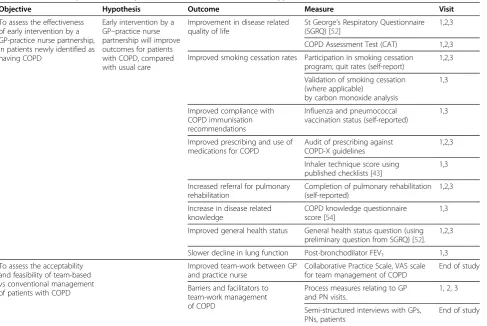
The primary outcome measure will be disease-specific qual-ity of life assessed by the St George’s Respiratory Question-naire (SGRQ [52]). Secondary outcome measures include: patient awareness of COPD diagnosis, COPD Assessment Test (CAT, a disease specific QOL measure [53]); smoking status by self-report and from carbon monoxide analysis (Smokerlyzer, Bedfont Scientific Ltd, Maidstone, UK) and readiness to quit if applicable; immunisation rates; medi-cation including appropriate inhaler prescription and ef-fective inhaler use; referral for pulmonary rehabilitation or referral for or provision of exercise prescriptions; disease related knowledge [54]; patient satisfaction; healthcare utilisation; and lung function. The relationship between objectives, outcomes, measures, and hypothesis is outlined in Table 1.
Process measures
and practice nurses in both groups will be asked to rate the extent to which they practice team-based manage-ment of COPD, on a visual analogue scale. Practice nurses and GPs will complete the Collaborative Practice Scale [55] to assess the‘interactions between nurses and GPS that enable the knowledge and skills of both profes-sionals to synergistically influence patient care’[55].
Semi-structured interviews at the conclusion of the pro-ject with the practice nurses, GPs, and patients will exam-ine satisfaction with the program and will explore the effects and value of the nurse input into COPD diagnosis and care, and barriers and facilitators to the team-management approach. The software package NVivoWwill be used to facilitate coding and exploration of the data.
Reimbursement
The project will provide the following support to partici-pating practices:
1. Intervention and control practices: Reimbursement for the practice nurse attendance at the COPD diagnosis and spirometry workshop (AUD270); payment for the practice nurse to undertake the medical record search (AUD500); reimbursement for practice nurse time for case-finding consultations
(AUD38.50 for each appointment, for up to 60 patients per practice); continuing professional development points for workshop attendance. 2. Intervention group: reimbursement for practice
nurse attendance at the COPD team management workshop (AUD270); reimbursement for GP attendance at the team management workshop (AUD450); category two continuing professional development points for GPs.
Once a diagnosis of COPD is made, any medical or prac-tice nurse consultations that are required for clinical man-agement may be funded through normal practice processes. Small gifts (food baskets) will be provided to practice reception staff as thanks for their assistance in making follow-up telephone calls.
Data analysis
Data collation will be managed using Access, and data analysis undertaken using the Statistical Package for the Social Sciences (SPSS) by a statistician blind to group al-location. Analysis will be by intention to treat, i.e., by the diagnosis assigned by the practice nurse/GP on the basis of case-finding spirometry, including patients whose diagnosis of COPD is not confirmed by the
Table 1 Relationships between objectives, outcomes, measures and hypotheses
Objective Hypothesis Outcome Measure Visit
To assess the effectiveness of early intervention by a GP-practice nurse partnership, in patients newly identified as having COPD
Early intervention by a GP–practice nurse partnership will improve outcomes for patients with COPD, compared with usual care
Improvement in disease related quality of life
St George’s Respiratory Questionnaire (SGRQ) [52]
1,2,3
COPD Assessment Test (CAT) 1,2,3
Improved smoking cessation rates Participation in smoking cessation program; quit rates (self-report)
1,2,3
Validation of smoking cessation (where applicable)
by carbon monoxide analysis
1,3
Improved compliance with COPD immunisation recommendations
Influenza and pneumococcal vaccination status (self-reported)
1,3
Improved prescribing and use of medications for COPD
Audit of prescribing against COPD-X guidelines
1,2,3
Inhaler technique score using published checklists [43]
1,3
Increased referral for pulmonary rehabilitation
Completion of pulmonary rehabilitation (self-reported)
1,2,3
Increase in disease related knowledge
COPD knowledge questionnaire score [54]
1,3
Improved general health status General health status question (using preliminary question from SGRQ) [52].
1,2,3
Slower decline in lung function Post-bronchodilator FEV1 1,3
To assess the acceptability and feasibility of team-based vs conventional management of patients with COPD
Improved team-work between GP and practice nurse
Collaborative Practice Scale, VAS scale for team management of COPD
End of study
Barriers and facilitators to team-work management of COPD
Process measures relating to GP and PN visits.
1, 2, 3
Semi-structured interviews with GPs, PNs, patients
project officer. Intra-cluster (practice) correlation coeffi-cients will be determined and published for all primary outcome variables to assist future research.
The effect of the intervention on outcomes measured on a continuous scale (such as SGRQ score) will be esti-mated and tested using mixed model analysis of variance in which time and treatment group will be fixed effects and GP practice and subject nested within practice will be random effects. The effect of the intervention on the dichotomous variables (such as smoking and vaccination status) will be analysed using generalised estimating equations with a logistic link and a model structure that is analogous to that described above.
Sample size calculations
The sample size calculation is based on a minimum clin-ically important difference for the primary outcome measure (SGRQ) of 4.0 [52], between subject standard deviation in SGRQ of 13 in a similar population [54], intra-cluster correlation coefficient of 0.01, and a result-ant design effect of 1.09 for a cluster size of 10. With this design effect, a sample size of 200 patients complet-ing each arm will provide >80% power to detect a differ-ence of 4 or greater in SGRQ (calculations in PASS software). Forty practices will each invite 300 patients to attend a case-finding appointment, and within each practice this is expected to produce 12 patients with a new diagnosis of COPD; loss to follow-up of 20% by 12 months has been assumed. The projected recruitment rate is derived from the response rate to invitation (25%), and the yield of new diagnoses (21%) in our re-cently completed case-finding project [10].
This sample size will also confer 90% power to identify a doubling of the expected rate of correct inhaler use (from 20% to 40%) at a significance level of 5% (based on an ICCC of 0.1, and design effect of 2.1).
Discussion
There is substantial evidence that COPD is under-diagnosed in the community, and that even once a diag-nosis of COPD is made, many patients are not managed according to evidence-based guidelines. By the time the diagnosis is made, COPD is often far-advanced, limiting the benefit that could potentially be achieved through early intervention with strategies such as smoking cessa-tion, dietary advice, and increased exercise. This study will use proven case-finding methods in an at-risk popu-lation to identify new patients with COPD, followed by a pragmatic cluster randomised study design to test a novel intervention designed to improve the implementa-tion of evidence-based guidelines for newly-diagnosed COPD. Practice nurses and GPs will be trained in prac-tical strategies for assessing and managing COPD, and in working as a team in managing patients with chronic
diseases. Elements of the intervention have been piloted and found to be feasible. The impact of this team-based approach to COPD management on quality of life will be compared with usual care using a widely used and validated tool (SGRQ). Other outcome measures will evaluate the concordance of patient management with evidence-based guidelines for management of COPD, using instruments with demonstrated validity and reli-ability, which are congruent with the recommendations of the ERS/ATS Task Force on COPD trials [56]. In addition, the acceptability of the team management ap-proach to GPs and practice nurses, and barriers and facilitators to its implementation, will be evaluated with structured interviews at study end.
This study targets COPD patients in general practice where the contact with potential patients with mild and moderate COPD is greatest, and where improved care has the potential for substantial health benefit. Because COPD is a major contributor to the burden of disease in countries such as Australia, improved care is of great public health significance. If successful, the trial will pro-vide a model for care of COPD patients in the commu-nity that is feasible and sustainable. Publication of the results of the trial will influence policy and practice on how care for COPD is provided at a national and inter-national level.
Sustainability of the intervention
In this pragmatic study, the intervention deliberately makes use of and augments existing practice structures, staffing, and approaches to chronic disease management. While there is potential for nurses to undertake advanced practice in primary care, this study will not re-quire practice nurses to work at an advanced practice level. For this study, the role of the practice nurse is fo-cussed on patient assessment; counselling; education; and liaison with medical and allied health colleagues, using expertise that forms part of the skills base of regis-tered nurses. The intervention is thus potentially generalizable and easily transferable.
Abbreviations
BOLD: Burden of Obstructive Lung Disease; CAT: COPD Assessment Test; CDQ: COPD diagnostic questionnaire; COPD: Chronic obstructive pulmonary disease; FEV1: Forced expiratory volume in one second; GOLD: Global
Initiative for Chronic Obstructive Pulmonary Disease; GP: General practitioner; PELICAN: Primary care EarLy Intervention for Copd mANagement;
PN: Practice nurse; SGRQ: St George’s Respiratory Questionnaire.
Competing interests
advice on smoking cessation education programs to Pfizer Pty Ltd and GlaxoSmithKline Australia Pty Ltd and has received support to attend smoking cessation conferences. Other authors have no competing interests.
Authors’contributions
The study was conceived by JB, NZ and GM, and all authors contributed to the study design. CPvS advised on the design of the CDQ utility study. AC designed the spirometry toolkit for diagnosis of COPD. HR wrote the initial draft of the manuscript. All authors contributed to and approved the final version of the manuscript.
Acknowledgements
This paper honours the memory of Jeremy Bunker, without whose initiative and enthusiasm this study would not have taken place. The study was funded by the National Health and Medical Research Council, Project Grant No. 630421. The input of Professor S Teng Liaw into the study design, and Charmaine Rodricks for administrative assistance, are appreciated.
Author details 1
School of Public Health and Community Medicine, University of New South Wales, Sydney, NSW 2052, Australia.2Woolcock Institute of Medical Institute,
University of Sydney, Sydney, NSW, Australia.3Centre for Primary Health Care and Equity, University of New South Wales, Sydney, NSW 2052, Australia.
4
National Centre for Clinical Outcomes Research, Australia, Australian Catholic University, Sydney, NSW, Australia.5Research School Caphri, Maastricht
University, Maastricht, The Netherlands.6Discipline of General Practice, School of Population Health And Clinical Practice, The University of Adelaide, Adelaide 5005, South Australia.7General Practice Unit, Fairfield Hospital, South Western Sydney Local Health District/School of Public Health & Community Medicine, University of New South Wales, Sydney, NSW 2052, Australia.8Woolcock Institute of Medical Research, University of Sydney and
Department of Respiratory Medicine, Liverpool Hospital, Liverpool, NSW 2170, Australia.
Received: 29 June 2012 Accepted: 29 August 2012 Published: 7 September 2012
References
1. World Health Organization:Global surveillance, prevention and control of chronic respiratory diseases: a comprehensive approach. InBook Global surveillance, prevention and control of chronic respiratory diseases: a comprehensive approach. City: World Health Organization; 2007. 2. Mathers CD, Loncar D:Projections of Global Mortality and Burden of
Disease from 2002 to 2030.PLoS Med2006,3:e442.
3. Australian Institute of Health and Welfare:Australia's Health 2010. Canberra: AIHW; 2010.
4. Buist AS, McBurnie MA, Vollmer WM, Gillespie S, Burney P, Mannino DM, Menezes AMB, Sullivan SD, Lee TA, Weiss KB,et al:International variation in the prevalence of COPD (the BOLD Study): a population-based prevalence study.Lancet2007,370:741–750.
5. Toelle B, Xuan W, Bird T, Abramson M, Burton DH M, Johns D, Maguire G, Wood-Baker R, Marks G:COPD in the Australian Burden Of Lung Disease (BOLD) study.Respirology2011,16:12.
6. Global Initiative for Chronic Obstructive Pulmonary Disease (GOLD): Global Strategy for Diagnosis, Management and Prevention of COPD. 2011. www.goldcopd.com. Date accessed: November 201.
7. Lundback B, Lindberg A, Lindstrom M, Ronmark E, Jonsson AC, Jonsson E, Larsson LG, Andersson S, Sandstrom T, Larsson K:Obstructive Lung Disease in Northern Sweden S: Not 15 but 50% of smokers develop
COPD?–Report from the Obstructive Lung Disease in Northern Sweden Studies.Respir Med2003,97:115–122.
8. Roche N, Dalmay F, Perez T, Kuntz C, Vergnenegre A, Neukirch F, Giordanella JP, Huchon G:Impact of chronic airflow obstruction in a working population.Eur Respir J2008,31:1227–1233.
9. Akazawa M, Halpern R, Riedel AA, Stanford RH, Dalal A, Blanchette CM:
Economic burden prior to COPD diagnosis: a matched case-control study in the United States.Respir Med2008,102:1744–1752.
10. Bunker J, Hermiz O, Zwar N, Dennis SM, Vagholkar S, Crockett A, Marks G:
Feasibility and efficacy of COPD case finding by practice nurses.Aust Fam Physician2009,38:826–830.
11. Buffels J, Degryse J, Heyrman J, Decramer M, Study D:Office spirometry significantly improves early detection of COPD in general practice: the DIDASCO Study.Chest2004,125:1394–1399.
12. Stratelis G, Jakobsson P, Molstad S, Zetterstrom O:Early detection of COPD in primary care: screening by invitation of smokers aged 40 to 55 years.
Br J Gen Pract2004,54:201–206.
13. Van Schayck CP, Loozen JMC, Wagena E, Akkermans RP, Wesseling GJ:
Detecting patients at a high risk of developing chronic obstructive pulmonary disease in general practice: cross sectional case finding study.BMJ2002,324:1370.
14. Levy ML, Quanjer PH, Booker R, Cooper BG, Holmes S, Small I, General Practice Airways Group:Diagnostic spirometry in primary care: Proposed standards for general practice compliant with American Thoracic Society and European Respiratory Society recommendations: a General Practice Airways Group (GPIAG) document, in association with the Association for Respiratory Technology & Physiology (ARTP) and Education for Health.Prim Care Respir J2009,18:130–147.
15. DeJong SR, Veltman RH:The effectiveness of a CNS-led community-based COPD screening and intervention program.Clin Nurse Spec2004,
18:72–79.
16. Bolton CE, Ionescu AA, Edwards PH, Faulkner TA, Edwards SM, Shale DJ:
Attaining a correct diagnosis of COPD in general practice.Respir Med 2005,99:493–500.
17. McKenzie DK, Abramson M, Crockett AJ, Glasgow N, Jenkins S, McDonald C, Wood-Baker R, Frith PA, on behalf of The Australian Lung Foundation:The COPD-X Plan: Australian and New Zealand Guidelines for the management of Chronic Obstructive Pulmonary Disease 2011. Lutwyche, Queensland: Australian Lung Foundation. 2011. www.copdx.org.au. Date accessed: February 2012. 18. Ta M, George J:Management of chronic obstructive pulmonary disease
in Australia after the publication of national guidelines.Intern Med J2011,
41:263–270.
19. Matheson MC, Abeysena C, Raven JM, Skoric B, Johns DP, Abramson MJ, Walters EH:How have we been managing chronic obstructive pulmonary disease in Australia?Intern Med J2006,36:92–99.
20. Mularski RA, Asch SM, Shrank WH, Kerr EA, Setodji CM, Adams JL, Keesey J, McGlynn EA:The quality of obstructive lung disease care for adults in the United States as measured by adherence to recommended processes.Chest2006,130:1844–1850.
21. Lavorini F, Magnan A, Dubus JC, Voshaar T, Corbetta L, Broeders M, Dekhuijzen R, Sanchis J, Viejo JL, Barnes P,et al:Effect of incorrect use of dry powder inhalers on management of patients with asthma and COPD.Respir Med2008,102:593–604.
22. Melani AS, Bonavia M, Cilenti V, Cinti C, Lodi M, Martucci P, Serra M, Scichilone N, Sestini P, Aliani M,et al:Inhaler mishandling remains common in real life and is associated with reduced disease control.
Respir Med2011,105:930–938.
23. Doherty DE:Early detection and management of COPD. What you can do to reduce the impact of this disabling disease.Postgrad Med2002,
111:41–44. 49-50, 53 passim.
24. Anthonisen NR, Connett JE, Kiley JP, Altose MD, Bailey WC, Buist AS, Conway WA Jr, Enright PL, Kanner RE, O'Hara P,et al:Effects of smoking intervention and the use of an inhaled anticholinergic bronchodilator on the rate of decline of FEV1.The Lung Health Study. JAMA1994,
272:1497–1505.
25. Kanner RE, Connett JE, Williams DE, Buist AS:Effects of randomized assignment to a smoking cessation intervention and changes in smoking habits on respiratory symptoms in smokers with early chronic obstructive pulmonary disease: the Lung Health Study.Am J Med1999,
106:410–416.
26. Smith-Sivertsen T, Rortveit G:Should general practitioners screen smokers for COPD?Scand J Prim Health Care2004,22:196–201.
27. Parkes G, Greenhalgh T, Griffin M, Dent R:Effect on smoking quit rate of telling patients their lung age: the Step2quit randomised controlled trial.
BMJ2008,336:598–600.
28. Levy ML, Fletcher M, Price DB, Hausen T, Halbert RJ, Yawn BP:International Primary Care Respiratory Group (IPCRG) Guidelines: diagnosis of respiratory diseases in primary care.Prim Care Respir J2006,
15:20–34.
30. Harris M, Blakeman T:Enhanced primary care items.Their use in diabetes management. Aust Fam Physician2001,30:1134–1140.
31. Clark N, Lachance L, Milanovich AF, Stoll S, Awad DF:Characteristics of successful asthma programs.Public Health Rep2009,124:797–805. 32. Blakeman TM, Harris MF, Comino EJ, Zwar NA:Evaluating general
practitioners' views about the implementation of the Enhanced Primary Care Medicare items.Med J Aust2001,175:95–98.
33. Zwar NA, Comino EJ, Hasan I, Harris MF, Primary Health Care Research N:
General practitioner views on barriers and facilitators to implementation of the Asthma 3+ Visit Plan.Med J Aust2005,183:64–67.
34. Vrijhoef HJ, Diederiks JP, Spreeuwenberg C:Effects on quality of care for patients with NIDDM or COPD when the specialised nurse has a central role: a literature review.Patient Educ Couns2000,41:243–250.
35. Wong CX, Carson KV, Smith BJ:Home care by outreach nursing for chronic obstructive pulmonary disease.Cochrane Database Syst Rev 2011, CD000994.
36. Zakrisson A-B, Engfeldt P, Hagglund D, Odencrants S, Hasselgren M, Arne M, Theander K:Nurse-led multidisciplinary programme for patients with COPD in primary health care: a controlled trial.Prim Care Respir J2011,
20:427–433.
37. Canesi M, Montrasio A, Di Mauro S:The contribution of nurses in integrated primary cares for chronic obstructive pulmonary disease outpatient: first results from an ongoing trial in a health district in northern Italy.Journal of Medicine and the Person2012,10:30–33. 38. Campbell MK, Elbourne DR, Altman DG:CONSORT statement: extension to
cluster randomised trials.BMJ2004,328:702–708.
39. Zwarenstein M, Treweek S, Gagnier JJ, Altman DG, Tunis S, Haynes B, Oxman AD, Moher D, group C, Pragmatic Trials in Healthcare g:Improving the reporting of pragmatic trials: an extension of the CONSORT statement.BMJ2008,337:a2390.
40. Australian Bureau of Statistics: Socio-Economic Indices for Areas (technical paper). Canberra: Australian Bureau of Statistics; 2006.
http://www.abs.gov.au/ausstats/[email protected]/mf/2039.0.55.001/. Date accessed: January 2009.
41. Miller MR, Crapo R, Hankinson J, Brusasco V, Burgos F, Casaburi R, Coates A, Enright P, van der Grinten CPM, Gustafsson P,et al:General considerations for lung function testing.Eur Respir J2005,26:153–161.
42. Pellegrino R, Viegi G, Brusasco V, Crapo RO, Burgos F, Casaburi R, Coates A, van der Grinten CPM, Gustafsson P, Hankinson J,et al:Interpretative strategies for lung function tests.Eur Respir J2005,26:948–968. 43. Inhaler technique in adults with asthma or COPD.
http://www.nationalasthma.org.au/html/management/info_inhaler/ Inhaler_technique_in_adults_with_asthma_or_COPD.pdf.
44. Zwar N, Hermiz O, Hasan I, Comino E, Middleton S, Vagholkar S, Marks G:A cluster randomised controlled trial of nurse and GP partnership for care of chronic obstructive pulmonary disease.BMC Pulm Med2008,8:8. 45. Patterson E, McMurray A:Collaborative practice between registered
nurses and medical practitioners in Australian General Practice: Moving from rhetoric to reality.Aust J Adv Nurs2003,20:43–48.
46. Stichler JF:Professional interdependence: the art of collaboration.
Advanced Nursing Practice Quarterly1995,1:53–61.
47. Chan BC, Perkins D, Wan Q, Zwar N, Daniel C, Crookes P, Harris MF, Team-link project t:Finding common ground? Evaluating an intervention to improve teamwork among primary health-care professionals.Int J Qual Health Care2010,22:519–524.
48. Price DB, Tinkelman DG, Halbert RJ, Nordyke RJ, Isonaka S, Nonikov D, Juniper EF, Freeman D, Hausen T, Levy ML,et al:Symptom-based questionnaire for identifying COPD in smokers.Respiration2006,
73:285–295.
49. Primary Care Respiratory Toolkit. http://www.lungfoundation.com.au/ professional-resources/general-practice/primary-care-respiratory-toolkit. 50. Zwar N, Richmond R, Borland R, Stillman S, Cunningham M, Litt J:Smoking
cessation guidelines for Australian general practice. InBook Smoking cessation guidelines for Australian general practice. City: Commonwealth of Australia; 2004.
51. National Immunisation Handbook. http://immunise.health.gov.au/internet/ immunise/publishing.nsf/Content/Handbook-home.
52. Jones PW, Quirk FH, Baveystock CM, Littlejohns P:A self-complete measure of health status for chronic airflow limitation. The St. George's Respiratory Questionnaire.Am Rev Respir Dis1992,
145:1321–1327.
53. Jones PW, Harding G, Berry P, Wiklund I, Chen WH, Kline Leidy N:
Development and first validation of the COPD Assessment Test.
Eur Respir J2009,34:648–654.
54. Hermiz O, Comino E, Marks G, Daffurn K, Wilson S, Harris M:Randomised controlled trial of home based care of patients with chronic obstructive pulmonary disease.BMJ2002,325:938.
55. Weiss SJ, Davis HP:Validity and reliability of the Collaborative Practice Scales.Nurs Res1985,34:299–305.
56. Cazzola M, MacNee W, Martinez FJ, Rabe KF, Franciosi LG, Barnes PJ, Brusasco V, Burge PS, Calverley PMA, Celli BR,et al:Outcomes for COPD pharmacological trials: from lung function to biomarkers.Eur Respir J 2008,31:416–469.
doi:10.1186/1748-5908-7-83
Cite this article as:Bunkeret al.:A pragmatic cluster randomized controlled trial of early intervention for chronic obstructive pulmonary disease by practice nurse-general practitioner teams: Study Protocol.
Implementation Science20127:83.
Submit your next manuscript to BioMed Central and take full advantage of:
• Convenient online submission
• Thorough peer review
• No space constraints or color figure charges
• Immediate publication on acceptance
• Inclusion in PubMed, CAS, Scopus and Google Scholar
• Research which is freely available for redistribution