A Study on Seismic Behavior of Base
Isolated Structures
Rasna P, Shinu Shajee
Abstract—This paper tries to contribute to a better understanding of the behaviour of base isolated asymmetric structures. In this research, asymmetric structures with plan irregulaties are considered. Here Rectangular, C shaped, L shaped and T shaped buildings with varying height isolated by a simple lead rubber bearing base isolation system with various distributions of isolators were considered as test examples. Out of the different positions of isolators, the best position is selected by studying the various responses like storey rotation, storey acceleration, storey displacement and storey drift. The asymmetry is created by providing a mass eccentricity of 30%.
Index Terms—Asymmetric structures, Base isolation,
Distribution of isolators, Lead Rubber Bearings.
1) INTRODUCTION
The so far applications and researches in the field of seismic base isolation have proved clearly that this system of alternative seismic protection is very much effective in reducing the damage of certain type of buildings during earthquake. The technical development of rubber bearings and dampers in recent years has reduced their price and such systems have become an important alternative for construction of building structures in seismic areas, even for ordinary multi-storey buildings such as offices, residential housing, industrial buildings and others. Structures are very often asymmetric in plan or/and in elevation and thus completely irregular from a structural point of view.
Base isolation is a passive vibration control system that does not require any external power source for its operation and utilizes the motion of the structure to develop the control forces. It reduces the effect of ground motion and thus leads to nullify the effect of earthquake on the structure. Base isolation has become popular in last couple of decades in its implementations in buildings and bridges. Base isolation has become a traditional concept for structural design of buildings and bridges in high risk areas. [1]
Basic principle of base isolation is to differentiate the building from its foundation, so during the seismic action, building stays unaffected from the ground motion. In other words, even though ground moves aggressively, the building will tend to move ideally as a rigid body rather than collapsing. This reduces the floor hastening and storey gliding and so the building components are left less harmed. In the model, separation is total but practically, there is some co relation between the ground and the building which
Manuscript received April, 2018.
Rasna P,PG Student, Department of Civil Engineering, AWH Engineering College, Kuttikatoor, Calicut, Kerala, India.
Shinu Shajee, Assistant Professor, Department of Civil Engineering, AWH Engineering College, Kuttikatoor, Calicut, Kerala, India.
provides flexibility to the structure. Any stiff structure will have short period. During the ground movement, amount of acceleration entrusted in the structure is the same of ground acceleration that results in zero displacement between the structure and the ground. In other words, ground and structure will move with equal amount. Flexible structure will have longer life span.
2) RELATED WORKS
Few researches have been carried for studying the best positions of base isolators in structures. Vojko Kilar et al., [2] studied the seismic behavior of asymmetric base isolated structures with different distributions of isolators. Numerous variants of originally symmetric four storey RC frame building isolated by a simple lead rubber bearing base isolation system were considered. Asymmetry was created by shifting the centre of mass towards one side of the building. Torsionally restrained and unrestrained variants of each building were also obtained by changing the mass distribution, keeping total mass constant. The results obtained by 3D nonlinear dynamic analyses are presented as an average of maximum for ten selected ground motions and three different scalings. The paper analyses the positive and negative effects of different bearing distributions to the displacements and rotations of the superstructure as well as to the base isolation system and tries to determine the most favourable distribution of isolators that is able to balance the effects of introduced eccentricities. M Hashemi Yekani et al., [3] studied the effect of torsion in seismic behavior of base isolated structures. A symmetric four story concrete structure was chosen as the reference model with varying eccentricity are considered. In nonlinear time history analysis, seven records on soil type C according to IBC2003 code normalize to peak ground acceleration equal to 0.4g are used. The isolations are made of rubber and they have modeled with bilinear behavior, in three types. This paper studied maximum isolation deformation from among the other base isolations, calculating the range of base isolation eccentricity to super structure dimensions and decreasing the effect of torsion in base isolated structure, with stiffening the flexible edge. To increase the rigidity of flexible edge, an approach suggested was to vary the dimension and properties of base isolator.
3) DESCRIPTION OF MODELS Details of Structures
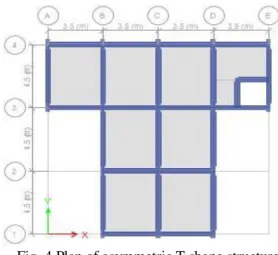
Storey height =3.0 meters, Bay width along X-direction = 3.5 meters, Bay width along Y-direction = 4.5 meters, Beam-1 250X350, Column- 250X450mm, Slab-150mm.
Volume 7, Issue 4, April 2018, ISSN: 2278 -7798 Table 1 Seismic details of the structure in general
Types of structures Multistorey structures
Materials Concrete M20, M25
Reinforcing bar Fe 415
Zonal considerations Zone IV
Zone factor 0.24
Soil type II
Importance factor 1
Reduction factor 5
Live load 3kN/m2
Details of LRB isolators (designed as per UBC-97) Effective stiffness: 1064.43kN/m
Horizontal stiffness: 350kN/m Vertical stiffness: 180 MN/m Yield force: 20kN, Stiffness ratio: 0.1 Damping: 0.05.
The plans of different models are shown in Fig 1 to Fig 4.
Fig. 4 Plan of asymmetric T shape structure The five different positions of LRB isolators are as below.
Uniform distribution with symmetrically positioned LRB isolators under all columns
A Peripheral distribution with isolators aligned only under the columns at outer frames.
An internal distribution of isolators under all interior columns.
Isolators positioned at the bay next to the geometric centre of the structure in X direction.
Isolators positioned at the bay previous to geometric centre of the structure in the negative X direction.
4) RESULTS AND DISCUSSION
Fig 1: Plan of rectangular base isolated structure The linear static and nonlinear time history analysis for the
models have been carried out using ETABS 2016 software [6]. The seismic details were incorporated in accordance to the IS code 1893:2002[4] and UBC-97[5]. The results of study by giving the eccentricity of centre of mass of 30% for
different plan shapes are included. The storey rotation, storey
acceleration, storey displacement and storey drift values are noted and comparison graphs are plotted for four models in base isolated structures.
4.1 Rectangular plan shaped structures a) G+3 Rectangular Plan Structure
For five different positions of LRB isolators for 30%
eccentricity the graph of various responses has been depicted
in Fig 5 and Fig 6. Fig 2 Plan of asymmetric L shape structure
Fig.5 (a) Storey rotation (b) Storey acceleration
Fig.6 (a) Storey displacement (b) Storey drift
b) G+9 Rectangular Plan Structure
In case of G+9 structures, storey response graphs have been depicted in Fig 7 and Fig 8.
Fig.10 (a) storey displacement (b) Storey drift
b) G+9 C shaped Plan Structure
Storey response graph has been depicted in Fig 11 and Fig 12 below.
Fig.7 (a) Storey rotation (b) Storey acceleration
Fig.8 (a) Storey displacement (b) Storey drift
In this case, for 30% mass eccentricity, centre of mass obtained as a result of analysis is at a distance of 10.8332m and centre of isolator in case of rectangular structures position P-4 are calculated as 10.5m. So P-4, i.e., isolators positioned at the bay next to geometric centre along x-direction is obtained as the best position of isolator.
4.2) C shape plan structures
By considering the mass eccentricity as 30%, study is done on C shaped plan structures.
a) G+3 C shaped Plan Structure
The graphs of various storey responses have been depicted in Fig 9 and Fig 10. Here centre of mass as a result of analysis of C shaped structure is 7.7465m and P-4, i.e. Isolators positioned at the bay next to geometric centre along x-direction are obtained as the best position of isolator. Centre of isolator calculated in this case is 7.3125m.
Fig.11 (a) Storey rotation (b) storey acceleration
Fig.12 (a) storey displacement (b) Storey drift
4.3) L shaped plan structure
By considering the mass eccentricity as 30%, study is done on L shaped plan structures.
a) G+3 L shaped Plan Structure
The graphs of various storey responses have been depicted in Fig 13 and Fig 14.From the graphs depicted, we can see that P-3, i.e. an internal distribution with isolators aligned only under the interior columns is the best position. Here centre of mass is at 5.6383m and calculated centre of isolator for position P-3 is 5.5m.
Fig.13 (a) Storey rotation (b) storey acceleration
Volume 7, Issue 4, April 2018, ISSN: 2278 -7798
Fig.14(a) storey displacement (b) Storey drift Fig.18(a) storey displacement (b) Storey drift
b) G+9 L shaped Plan Structure b) G+9 C shaped Plan Structure
Storey response graph has been depicted in Fig 15
and Fig 16 below. and Fig 12 below.Storey response graph has been depicted in Fig 11
Fig.15 (a) Storey rotation
(b) storey acceleration
Fig.19 (a) Storey rotation
(b) storey acceleration
Fig.16 (a) storey displacement (b) Storey drift Fig. 20 (a) storey displacement (b) Storey drift 4.4) T shape plan structure
CONCLUSION
By considering the mass eccentricity as 30%, study is done
From the analysed models of different plan on T shaped plan structures.
structures, the behavior of base isolated structures a) G+3 T shaped Plan Structure
for the mass eccentricity is studied and the best The graphs of various storey responses have been depicted
position of LRB isolators in each of the four in Fig 9 and Fig 10.From the graphs depicted, we can see that
structures is obtained. P-3, i.e. an internal distribution with isolators aligned only
under the interior columns is the best position. Centre of mass When the centre of isolators coincides of this structure is at 7.05m and centre of isolator of this approximately with the centre of isolator, the position is at 7m from analysis. flexible edge of the structure will be
strengthened. In such case minimum responses are obtained.
In case of rectangular structures and C shaped structures, the best position obtained is the position P-4 as the centre of isolators coincide with centre of mass for the position P-4. P-3 is the best suitable position of L shaped and T
shaped structures as in this case centre of isolator coincide with centre of mass of these structures.
REFERENCES
1. “Structural protection system MAURER seismic isolation systems with LRB”. SPS/ 02. 05.2003
2. Hashemi Yekani et al., (2008) “The new method for control and reduction of torsion with base isolation.” The 14 the World Conference on Earthquake Engineering, Beijing, China.
3 Vojko Kilar et al., (2009) “Seismic behavior of asymmetric base isolated structures with various distributions of isolators” Engineering structures 91, Page 910-921.
4.IS 1893(Part-1)-2000, “Criteria for Earthquake Resistant Design of structures” (fifth revision)
5.UBC- 97 “U niform building code:, Chap. 16, Div. 1, volume 2. 6.ETABS 2016. Integrated software for Structural analysis, Design and Drafting of building system. Computers and Structures,Inc, Berkley.
Rasna P,PG Student, Department of Civil Engineering, AWH
Engineering College, Kuttikatoor, Calicut, Kerala, India.
Shinu Shajee, Assistant Professor, Department of Civil Engineering,