Patron: Her Majesty The Queen Rothamsted Research Harpenden, Herts, AL5 2JQ
Telephone: +44 (0)1582 763133 Web: http://www.rothamsted.ac.uk/
Rothamsted Research is a Company Limited by Guarantee
Rothamsted Repository Download
A - Papers appearing in refereed journals
Dawson, G. W., Janes, N. F., Mudd, A., Pickett, J. A., Slawin, A. M. Z.,
Wadhams, L. J. and Williams, D. J. 1989. The aphid sex pheromone.
Pure And Applied Chemistry. 61 (3), pp. 555-558.
The publisher's version can be accessed at:
•
https://dx.doi.org/10.1351/pac198961030555
The output can be accessed at:
https://repository.rothamsted.ac.uk/item/86345/the-aphid-sex-pheromone
.
© Please contact [email protected] for copyright queries.
Printed in Great Britain.
0
1989 IUPACThe aphid sex pheromone
Glenn W. Dawson, Norman F. Janes, Alan Mudd, John A. Pickett, Alexandra M.Z. Slawin*, Lester J. Wadhams and David J. Williams"
AFRC Institute of Arable Crops Research, Rothamsted Experimental Station, Harpenden, Herts., AL5 254, U.K.
*. Chemistry Department, Imperial College of Science and Technology, Prince Consort Road, London SW7 2AY, U.K.
Abstract
-
Many species of pest aphids reproduce sexually on the winter host. The sex pheromone of the vetch aphid, Megoura v i c i a e , has recently been identified as comprising the,(4aS,7S,7aR)- isomers of nepetalactone and nepetalactol. The stereochemistry at carbon-1 of the lactol was not defined, but is now shown, by X-ray crystallography on the 3,5- dinitrobenzoate ester, to have the R configuration, This lactol is the major product from reduction of the lactone with diisobutylaluminium hydride. Results from the similar reduction of other nepetalactone isomers are presented.I N T R O D U C T I O N
Aphids reproduce asexually on their host plants during the summer, but many species migrate to winter or primary hosts, where sexual reproduction occurs. Pettersson (ref. 1) demonstrated that females of Schizaphis spp. attract males by means of a sex pheromone released from the hind tibiae. Marsh (ref. 2) also demonstrated a sex pheromone for the vetch aphid, Megoura v i c i a e , and this has now been identified as a synergistic mixture of (4aS,7S,7aR)-nepetalactone
(1)
and (4aS,7S,7aR)-nepetalactol (2a or b) (ref. 3). However, the stereochemistry at carbon-1 of the lactol ( a or b) was not defined and therefore required further investigation.- 2a; R = OH, R' = H b; R = H, R' = OH.
PREPARATION OF THE L A C T O L Z
(+)-(4aS,7S,7aR)-Nepetalactone
(L),
isolated from Nepeta ca s r i a (refs. 3 and 4), was treated with diisobutylaluminium hydride (DIBAL) at -78'C for 5 min and, after work-up with methanol, gave the lactol 2 as mostly one isomer: = -40' (c = 0.5, EtOH); IH-NMR (nuclear magnetic resonancr) (400 MHz, JEOL JNM-GX 400, DCl,), major isomer (93%), 1.09 ppm (d, 3H, J=6), 1.15 (m, lH), 1.35 (m, lH), 1.55 ( s , 3 H ) , 1.65 (m, 1H), 1.82-
2.00 (m, 3H), 2.45 (m, 1H), 2.96 (d,lH, J,,0~=6Hz,ex D,O), 4.84 (t, 1H, J I = 6Hz), 6.01 ( S , 1H); diagnostic protons minor isomer (7%), 2.90 (d,lH,J, 0~=6Hz,eXD,d), 5.20 (dd,lH,J, 0 =6Hz, J, ,=3Hz); 13C-NMR1(100 MHz), major isomer, 16.3 (4Me), 20.6 (7Me), 30.8 (C-5), 33.4 ?C-6). 35:4 (C-7), 38.7 (C-4a). 50.5 (C-7a), 94.3 (C-l), 113.6 (C-4), 134.1 (C-3); minor isomer, 15.9 (4Me), 22.7 (7Me), 29.3 (C-5), 31.8 (C-7), 33.2 (C-6). 41.2 (C-4a), 50.4 (C-7a). 94.3 (C-1). 113.3 (C-4), 134.9 ( C - 3 ) , assigned using DEPT, C-H and H-H correlation spectroscopy. GC-MS (gas chromatography coupled mass spectrometry) (fused SiO, capillary column, HP1 bonded phase; VG 70-250, 70 eV, 240°C), only one peak obtained, m / / z 168 (M', 8 ) , 150 (181, 135 (37). 122 (31), 81 (93), 67 (68), 58 (70), 55 (59), 41 (100). This material was identical to that found in556 G . W. DAWSON e t a / .
acetic anhydride and 4-(dimethylamino)pyridine (DMAP) in pyridine, to aid chromatographic resolution. Two peaks were obtained from the acetylated product, in the ratio indicated by
NMR on the original sample: the major component chromatographed first on both columns. The first peak was enhanced on coinjection with acetylated leg extract from M. v i c i a e . Only a trace of the second isomer could be found in the aphid leg extract, Designation of the stereochemistry at carbon-1 could not be made by NMR spectroscopy because it was not possible to define the conformation of the molecule, so the 6 or 3 Hz coupling constants between protons on carbons-1 and 7a for the major and minor isomers might have arisen from either absolute stereochemistry.
X-RAY CRYSTALLOGRAPHY ON DERIVATIVE OF LACTOL
2
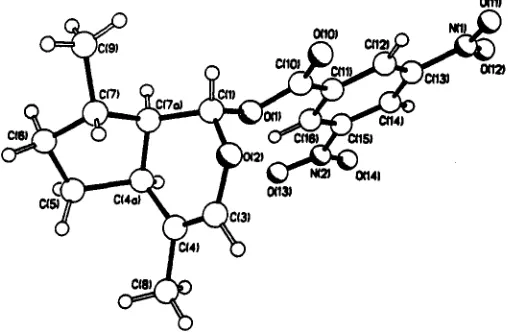
The lactol (i.e. mainly 2 a or b) (50 m g ) was treated with 3,5-dinitrobenzoyl chloride (200 m g ) and DMAP (200 m g ) in pyridine (5 ml) overnight at room temperature. The solvent was removed and the residue purified by chromatography on a silica plate, eluting with hexane/ether. The product, which contained the two isomers in the original ratio, was then crystallised from acetonitrile at -15'C to give the 3,5-dinitrobenzoate of the major isomer only (i e. 3a or b) m.p. 145'C (35 mg, 32%): 'H-NMR (400 MHz) 1.14 (d, 3H, .J=6), 1.27 (m, lH), 1.i9
Cc,
3H), 1'.63 (m, lH), 1.98 (m, 3H), 2.72 (m, lH), 6.00 ( s , lH), 6.32 (d, lH, J=3), 9.14 ( d , 2H, 5=2), 9.25 (t, lH, J=2); "C-NMR (100 M H Z ) 15.9, 19.8, 28.9, 32.8, 35.1, 36.7, 48.8, 93.9, 114.2, 122.6, 129.6, 133.4, 133.9, 148.7, 161.7.An X-ray diffraction study (Fig. 1) on
3
revealed the structure with the S stereochemistry at carbon-1. i.e. structure Aa. Based on these findings, the aphid-derived nepetalactol is assigned structure 2a, (-)-(lR,4aS,7S,7aR)-nepetalactol.mn
Fig. 1. The molecular structure of the lactol 3,5-dinitrobenzoate ester
( 3 )
(Note a).Note a: C r y s t a l d a t a f o r 3: C17Hl,N,07, M = 362.3, monoclinic, a = 9.553(4), b = 5.884(2), c = 16.008(7)A, B = 95.6073)", (I = 896A3, space group P2,, Z = 2, D, = 1 . 3 4 gcrn-', v(Cu-A&) = 9 cm-1. Data were measured on a Nicolet R3m diffractometer with Cu-&, radiation (graphite monochromator) using w-scans. The structure was solved by direct methods and refined anisotropically to give R = 0.055, R, = 0.060 for 1238 independent observed reflections
R E D U C T I O N OF OTHER NEPETALACTONE I S O M E R S
In addition to the nepetalactone
1,
there are three other diastereoisomers, and of these,4
and6
were obtained from Nepeta mussinii (refs. 3 and 4 ) . On reduction with DIBAL, the lactone 4 gave the two iridodial isomers2 :
IH-NMR (400 MHz), aldehydic protons, major isomer ( 8 0 % ) , 9x63 (d, lH, 5 = 3 ) , 9.78 (d, l H , J = 3 ) ; minor isomer ( 2 0 % ) , 9.57 (d, l H , J = 2 ) , 9.78 (obs); 13C-NMR (100 MHz), major isomer, 12.1, 16.2, 29.5, 34.7, 37.7, 38.8, 50.5, 57.6, 204.3, 204.6; minor isomer, aldehydic carbons, 204.4, 204.5. The formation of the ring-opened products from contrasts with the unopened product from2,
and presumably reflects the greater steric strain in the trans-fused cyclopentane/&lactol ring systems. Corresponding ring-opened products would also be expected from the fourth nepetalactone diastereoisomer, which also has trans-fused rings. The cis,cis lactonea
gave both diastereoisomers of the corresponding nepetalactol1:
lH-NMR (400 MHz),
diagnostic protons, major isomer ( 7 0 % ) , 5.02 (t, l H , J , , a = 5 ) , 6.02 (s, 1 H ) ; minor isomer ( 3 0 % ) , 5 . 3 3 (dd, l H ,J , , a = 3 ) 5.99 ( s 1H); 13C-NMR
clod
MHz), major isomer 16.3 (4Me), 16.6 (7Me), 29.5 ( C - 5 ) , 32:4( C - i ) ,
35.8 i C - 7 ) , 38.3 (C-4a), 45.3 (C-7a), 92.7 ( C - l ) , 113.7 (C-4), 134.4 ( C - 3 ) ; minor isomer, 15.1 (7Me), 17.1 (4Me), 30.8 (C-5), 32.4 (C-6), 36.6 ( C - 7 ) , 38.8 (C-4a), 44.3 (C-7a), 92.6 ( C - 1 1 , 114.5 ( C - 4 ) , 132.3 ( C - 3 ) , assignments made as above. The major isomer therefore appears to be la.4 -
6
- - 7a - 7b
The cis ring-fused nepetalactols, 2 and
1,
were stable in neutral solution, but on treatment with formic acid, the nepetalactol-2 gave the corresponding iridodial isomers8:
IH-NMR (400MHz), aldehydic protons, major isomer ( 6 0 % ) , 9.66 (d, l H , J=1), 9.74 (d, l H , J = 2 ) ; minor isomer ( 4 0 % ) , 9.63 (d, l H , J = 3 ) , 9.73 (d, lH, J = 4 ) . A s further proof of the structure of the iridodial isomers
8 ,
they were shown to have the same NMR and GC properties as the iridodialisomers (i.e. enantiomeric with
8 ) .
These were prepared by Swern oxidation of the diol11
from reduction of the dihydronepetalactonelo
(available by the method of Wolinsky and Eustace, ref. 5, from R-pulegone2 ) .
558 G. W. DAWSON e t a / .
REFERENCES
1. J. Pettersson, Ent. scand. I, 63-73 (1970); J. Pettersson, Ent. scand. 2, 81-93 (1971). 2. D. Marsh, Nature New B i o l . 238, 31-32 (1972); D. Marsh, J . E n t . (A) 50, 43-64 (1975). 3. G.W. Dawson, D.C. Griffiths, N.F. Janes, A. Mudd, J.A. Pickett, L.J. Wadhams and C.M.
4. E.J. Eisenbraun, C.E. Browne, R.L. Irvin-Willis, D.J. McGurk, E.L. Eliel and D.L. Harris,
5. J. Wolinsky and E.J. Eustace, J. Org. Chem. 37, 3376-3378 (1972).
6. G.W. Dawson, D.C. Griffiths, L.A. Merritt, A. Mudd, J.A. Pickett, L.J. Wadhams and C.M. Woodcock, Nature, Lond., 325, 614-616 (1987).
J . Org. Chem. 45, 3811-3814 (1980).