Local Binary Pattern Base Face
Recognition System
PALLAVI B. PATINGE Prof. C. N.DESHMUKH
M.E. (Digital Electronics Part Time) III year Department of Electronics & Telecommunication Engg. Prof. Ram Meghe Institute of Technology & Prof.Ram Meghe Institute of Technology & Research,
Research, Badnera-Amravati. Badnera-Amravati.
Abstract—Facial image analysis is an important and popular research topic in the
computer vision and image processing area, which includes face detection, face recognition, facial expression analysis, and several other related applications. A critical step for successful facial image analysis is to derive an effective facial representation from the original face images. In recent years, Local Binary Patterns (LBP) has received increasing attention for facial description. Local binary pattern (LBP) is a nonparametric descriptor, which efficiently summarizes the local structures of images. This paper presents a comprehensive survey of LBP methodology, including several more recent variations. As a typical application of the LBP approach, LBP-based facial image analysis is extensively reviewed, while its successful extensions, which deal with various tasks of facial image analysis, are also highlighted.
Keywords—Local Binary Patterns (LBP), face detection, face recognition, facial expression analysis, local features.
I. INTRODUCTION
During the past few years, local binary
patterns (LBPs)[1] have aroused
increasing interest in image processing and computer vision. As a nonparametric method, LBP summarizes local structures of images efficiently by comparing each pixel with its neighbouring pixels. The most important properties of LBP are its computational simplicity and have proved to be highly effective features foe face recognition [2][3]. LBP was originally proposed for texture analysis [4], and has proved a simple yet powerful approach to describe local structures. It has been
extensively exploited in many
applications, for instance, face image analysis [5], [6], image retrieval [7], [8], environment modeling [9], [10], visual inspection [11], [12], biomedical and aerial image analysis [13], [14].LBP-based facial image analysis has been one of the most popular and successful applications in recent years. Facial image analysis is an active research topic in computer vision,
with a wide range of important
applications, e.g., human–computer
interaction, biometric identification,
surveillance and security, and computer animation. LBP has been exploited for facial representation in different tasks, which include face detection [15] face recognition [20], facial expression alysis demographic classification and other related applications The development of LBP methodology can be well illustrated in facial image analysis, and most of its recent variations are proposed in this area. Some brief surveys on image analysis or face analysis which use LBP, were given, but all these studies discussed limited papers of the literature, and many new related methods have appeared in more recent years.
In this paper, we present a comprehensive survey of the LBP methodology, including its recent variations and LBP-based feature selection, as well as the application to facial image analysis.
To the best of our knowledge, this paper is the first survey that extensively reviews LBP methodology. LBP-based
feature-selection methods are discussed in this paper.
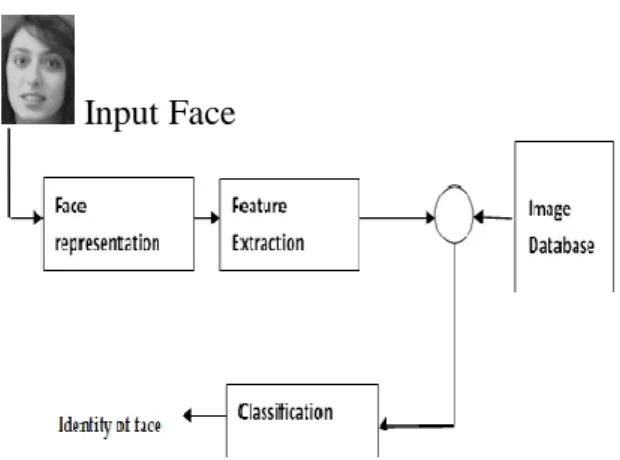
II. THE PARADIGM OF THE FACE RECOGNITION Despite of the fact that at this moment already numerous of commercial face recognition systems are in use, this way of identification continues to be an interesting topic for researchers. This is due to the fact that the current systems perform well under relatively simple and controlled environments, but perform much worse when variations in different factors are present, such as pose, viewpoint, facial expressions, time (when the pictures are made) and illumination (lightening changes)[16]. The goal in this research area is to minimize the influence of these factors and create robust face recognition system. A model for face recognition is shown in Figure-1.
Input Face
Figure 1: Principle of an identification
process with face recognition The process of person identification by using face recognition can be split into three main phases (figure 1). These are face representation, feature extraction and classification [17]. Face representation is the first task, that is, how to model a face. The way to represent a face determines the successive algorithms of detection and
identification. For the entry-level
recognition (that is, to determine whether or not the given image represents a face), the image is transformed (scaled and rotated) till it has the same ‗position‘ as
the images from the database. In the feature extraction phase, the most useful and unique features (properties) of the face image are extracted. With these obtained features, the face image is compared with the images from the database. This is done in the classification phase [16, 18]. The output of the classification part is the identity of a face image from the database with the highest matching score, thus with the smallest differences compared to the input face image. Also a threshold value can be used to determine if the differences are small enough.
III LOCAL BINARY PATTERNS The LBP operator [19] is one of the best performing texture descriptors and it has been widely used in various applications. It has proven to be highly discriminative and its key advantages, namely its invariance to monotonic gray level changes and computational efficiency, make it suitable for demanding image analysis tasks .The idea of using LBP for face description is motivated by the fact that faces can be seen as a composition of micro-patterns which are well described by such operator .The LBP operator was originally designed for texture description. The operator assigns a label to every pixel of an image by thresholding the 3x3-neighborhood of each pixel with the centre pixel value and considering the result as a binary number. Then the histogram of the labels can be used as a texture descriptor. See Figuare 2 for an illustration of the basic LBP operator. Formally, the LBP operator takes the form
LBP (𝑋𝑐, 𝑌𝑐) = 7𝑛=02𝑛𝑆(𝑖𝑛 − 𝑖𝑐) where in this case n runs over the 8
neighbours of the central pixel c , 𝑖𝑐 and in are gray level values at c and n s(u)=1 if u ≥ 0 and 0 otherwise
Two extensions of the original operator were made in [19]. The first defined LBPs for neighbourhoods of different sizes, thus making it feasible to deal with textures at different scales. The second defined the so-called uniform patterns: A local binary pattern is called uniform if the binary pattern contains at most two bitwise transitions from 0 to 1 or vice versa when the bit pattern is considered circular. For example, the patterns 00000000 (0 transitions), 01110000 (2transitions) and 11001111 (2 transitions) are uniform
whereas the patterns 11001001 (4
transitions) and 01010011 (6transitions) are not. In the computation of the LBP histogram, uniform patterns are used so that the histogram has a separate bin for every uniform pattern and all non-uniform patterns are assigned to a single bin. Uniformity is important because it characterizes the patches that contain primitive structural information such as edges and corners. Ojala et al.observed that although only 58 of the 256 8-bit patterns are uniform, nearly 90% of all
observed image neighbourhoods are
uniform and many of the remaining ones contain essentially noise. Thus, when histogramming LBPs the number of bins can be reduced significantly by assigning all non uniform patterns to a single bin,
typically without losing too much
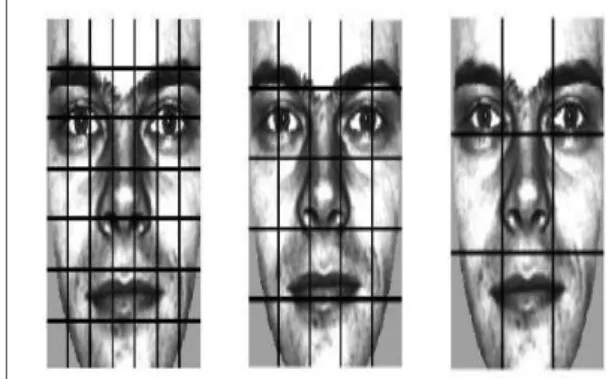
information. The facial image is divided into local regions and texture descriptors
are extracted from each region
independently. The descriptors are then concatenated to form a global description of the face. See Figure 3 for an example of a facial image divided into rectangular regions.
Figure 3: A facial image divided into 7x7, 5x5 and 3x3 Rectangular Region The basic histogram can be extended into a
spatially enhanced histogram which
encodes both the appearance and the spatial relations of facial regions. As the m facial regions R0, R1….Rm-1 has been determined, a histogram is computed independently within each of the m regions. The resulting m histograms are combined yielding the spatially enhanced
histogram. The spatially enhanced
histogram has size m x n where n is the length of a single LBP histogram. In the
spatially enhanced histogram, we
effectively have a description of the face on three different levels of locality: the LBP labels for the histogram contain information about the patterns on a pixel-level, the labels are summed over a small region to produce information on a regional level and the regional histograms are concatenated to build a global description of the face. It should be noted that when using the histogram-based methods, despite the examples in Fig 3b, the regions R0, R1…..Rm-1, do not need to be rectangular. Both do they need to be of the same size or shape, and they do not necessarily have to cover the whole image. For example, they could be circular regions located at the fiducially points like in the EBGM method. It is also possible to have partially overlapping regions.
V. Face Recognition Algorithm To implement the face recognition in this research work, we proposed the Local
Binary patterns methodology. Local
Binary Pattern works on local features that uses LBP operator which summarizes the local special structure of a face image [20].LBP is defined as an orders set of
binary comparisons of pixels intensities between the centre pixels and its eight surrounding pixels. Local Binary Pattern do this comparison by applying the following formula:
LBP (𝑋𝑐, 𝑌𝑐) = 2𝑛𝑆(𝑖
𝑛 − 𝑖𝑐) 7
𝑛=0
Where 𝑖𝑐 corresponds to the value of the centre pixel (𝑋𝑐, 𝑌𝑐) 𝑖𝑛 in to the value of eight surrounding pixels. It is used to determine the local features in the face and also works by using basic LBP operator. Feature extracted matrix originally of size 3 x 3, the values are compared by the value of the centre pixel, then binary pattern code is produced and also LBP code is obtained by converting the binary code into decimal one. The Face Recognition Algorithm Input: Training Image set. Output: Feature extracted from face image and compared with centre pixel and recognition with unknown face image. 1. Initialize temp = 0
2. FOR each image I in the training image set
3. Initialize the pattern histogram, H = 0
4. FOR each centre pixel 𝑔𝑐
5. Compute the pattern label of𝑔𝑐 , LBP (1)
6. Increase the corresponding bin by 1. 7. END FOR
8. Find the highest LBP feature for each face image and combined into single vector.
9. Compare with test face image. 10. If it match it most similar face in database then Successfully recognized.
VI Results and Discussion
This implementation is used to test the performance of the LBP-method on different kind of face images. Several parameters, like the LBP operator, non-weighted or non-weighted regions and the dividing of the regions, are varied to see the influence of these parameters on the performance. For this experiment we have collected lots of face images. And also collected face images from the face database [25]. In the proposed algorithm, different types of face images have been
recognized. Based on algorithm, the face image of an unknown identity is compared with face images of known individuals from a database. In the figure 7 we can see the input facial images used for input for face recognition are given below:
Figure 7: Different input images And also in the figure 8 we can see the facial images that are stored in the database which compared with the input facial images. If the input face images are found or the more similarities face images are matched in the database then we say the face image is successfully recognized.
Figure 8: Facial image from the Database In the experiment we can train the face images in the database. That the facial images are successfully trained shown in the bellow:
Based on the algorithm the input face images are compared with database facial images for identification. The face recognition results are shown in below.
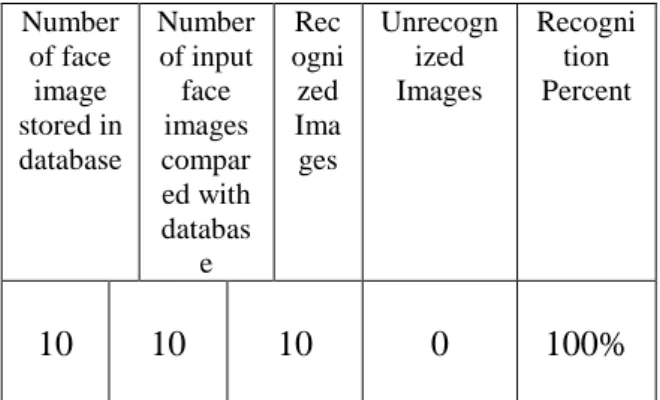
The following table shows overall face recognition rate: Number of face image stored in database Number of input face images compar ed with databas e Rec ogni zed Ima ges Unrecogn ized Images Recogni tion Percent 10 10 10 0 100%
Table 1: Recognition Rate of the Research. In the table 1 the recognition rate is 100%. We recognize the face images from the database face images by comparing between input face image and database image. From the experimental result, it is seen that the research satisfies all the requirements to recognize the face images.
VII CONCLUSION
In this research has been done to the performance of a face recognition system by making use of feature extraction with Local Binary Patterns [21]. It mainly consists of three parts, namely face representation, feature extraction and
classification. Face representation
represents how to model a face and determines the successive algorithms of detection and recognition. The most useful and unique features of the face image are extracted in the feature extraction phase. In the classification the face image is compared with the images from the database. This method represents the local feature of the face and matches it with the most similar face image in database. The accuracy of the system is 100% by the Local Binary Patterns algorithm.
Reference
[1]IEEE transactions on systems, man, and cybernetics—part c: applications and reviews, vol. 41, no. 6, november 2011 765 Local Binary Patterns and Its
Application to Facial Image Analysis: A Survey
[2] L. Wolf, T. Hassner, and Y. Taigman, ―Descriptor based methods in the wild,‖ in Proc. ECCV, 2008.
[3] J. Ruiz-del-Solar, R. Verschae, and M. Correa, ―Recognition of faces in
unconstrained environments: A
comparative study,‖ EURASIP Journal on Advances in Signal Processing, vol. 2009, pp. 1–20, 2009.
[4] T. Ojala, M. Pietik¨ainen, and D. Harwood, ―A comparative study of texture measures with classification based on featured distribution,‖ Pattern Recog., vol. 29, no. 1, pp. 51–59, 1996.
[5] T. Ahonen, A. Hadid, and M.
Pietik¨ainen, ―Face recognition with local binary patterns,‖ in Proc. Euro. Conf.
Comput. Vis., 2004, pp. 469–481.
[6] A. Hadid, M. Pietik¨ainen, and T. Ahonen, ―A discriminative feature
space for detecting and recognizing faces,‖ in Proc. Int. Conf. Comput.
Vis. Pattern Recog., 2004, pp. 797–804.
[7] D. P. Huijsmans and N. Sebe,
―Content-based indexing performance: A class size normalized precision, recall, generality evaluation,‖ in Proc. Int. Conf.
Image Process., 2003, pp. 733–736.
[8] D. Grangier and S. Bengio, ―A discriminative kernel-based approach to rank images from text queries,‖ IEEE
Trans. Pattern Anal.Mach. Intell.,
vol. 30, no. 8, pp. 1371–1384, Aug. 2008. [9] W. Ali, F. Georgsson, and T.
Hellstr¨om, ―Visual tree detection for autonomous navigation in forest
environment,‖ in Proc. IEEE Intell. Veh.
Symp., Jun. 2008, pp. 560–565.
[10] L. Nanni and A. Lumini, ―Ensemble of multiple pedestrian representations,‖
IEEE Trans. Intell. Transp. Syst., vol. 9,
no. 2, pp. 365–369, Jun.2008.
[11] T. M¨aenp¨a¨a, J. Viertola, and M. Pietik¨ainen, ―Optimising colour and texture features for real-time visual inspection,‖ Pattern Anal. Appl., vol. 6, no. 3, pp. 169–175, 2003.
[12] M. Turtinen, M. Pietik¨ainen, and O. Silven, ―Visual characterization of
paper using Isomap and local binary patterns,‖ IEICE Trans. Inform. Syst., vol. E89D, no. 7, pp. 2076–2083, 2006.
[13] A. Oliver, X. Llad´o, J. Freixenet, and J. Mart´ı, ―False positive reduction
in mammographic mass detection using local binary patterns,‖ in
Proc. Med. Image Comput. Comput.-Assisted Intervention Conf., 2007,
pp. 286–293.
[14] S. Kluckner, G. Pacher, H. Grabner, H. Bischof, and J. Bauer, ―A 3D
teacher for car detection in aerial images,‖ in Proc. IEEE Int. Conf.
[15] H. Jin, Q. Liu, H. Lu, and X. Tong, ―Face detection using improved LBP under Bayesian framework,‖ in Proc Int.
Conf. Image Graph., 2004,
pp. 306–309.
[16]W.Zhao.R.Chellappa.P.J.Phillips and A.Rosenfeld.‖Face recognition: A
literature Suevey‖ACM Computing Survey (CSUR),35(4): 399{458, 2003} [17]M.Turk and A Pentland,‖Eigenfaces for recognition ‖,Cognitive
Neuroscience,3:72{86,199}
[18]S.Z.Li and A.K.Jain (eds),‖Handbook of face
recognition‖Springer-Verlag,Secaucus,NJ 2005
[19] T. Ojala, M. Pietikainen, and T. Maenpaa, ―Multiresolution gray-scale and rotation invarianat texture
classification with local binary patterns,‖
IEEE Trans. Pattern Anal. Mach. Intell.,
vol. 24, no. 7, pp. 971–987,Jul. 2002. [20]T.Chen,Y.Wotao,S.Z.Xiang,D.Comnic iu and T.S.Huang ―Total variation modeles for variable lightning face
recognition‖IEEE Transcation on Pattern Analysis and Machine
Intelligence,28(9):1519{1524,2006} [21]M.Grudin,‖On internal representation in face recognition systeam‖.Pattern Recognition,33(7):1161 1177 ,2000. [22]P.A.Viola and M.J.Jones,‖Robust real time face detection‖.International Journal of Computer Vision,57(2):137{154,2004}. [23]Di Huang, Student Member, IEEE, Caifeng Shan, Member, IEEE, Mohsen Ardabilian, Yunhong Wang, Member,
IEEE, and Liming Chen, Member, IEEE
[24] T. Ahonen, A. Hadid, and M.
Pietik¨ainen, ―Face recognition with local binary patterns,‖ in Proc. Euro. Conf.
Comput. Vis., 2004, pp. 469–481.