B
AY OF
P
LENTY
C
OUNCILS
B
ROADBAND
B
USINESS
C
ASE
S
TUDY
F
UNDING
M
ODELS
-
W
I
MAX
W
IRELESS
S
PECTRUM
-
C
ORE
N
ETWORK
March 2007
GDI
Ground Floor, 201 Wickham Terrace PO Box 782 Spring Hill, Qld 4004. Telephone: +61(7) 3832 1222 Facsimile: +61(7) 3832 1212 Email: [email protected]
Page ii Commercial In Confidence
Contents
1 INTRODUCTION ... 3
2 PURPOSE ... 5
3 WIMAX FUNDING OPTIONS ... 6
4 CORE NETWORK FUNDING OPTIONS ... 9
5 CONCLUSIONS ... 10
DISCLAIMER
This document has been prepared by Gibsons Digital Innovation (GDI) from information provided by the client and from other sources. Our procedures do not necessarily include confirmation of validation procedures of that information and this document is provided to the client for its exclusive use and benefit only. No other party should rely on it for inferences or forecasts made therein. GDI accepts no responsibility to such parties.
In addition, certain inferences and forecasts have been drawn and made on the above basis although every effort has been made to ensure that such inferences and forecasts are reasonable, no responsibility can be accepted by GDI for eventual outcomes.
1 Introduction
This document is a supplementary part of a project and series of deliverables required by Bay of Plenty Councils to develop a broadband business case study for the Bay of Plenty region. The project recognises that a wider geographic availability of broadband services is an economic enabler, and that a lack of these services is increasingly an economic disabler.
The report is shown as additional to the 15 deliverables, Supplementary 1 (S1) and as such has been a special request within the scope of the project. This report and its relationship to other reports in the project is illustrated in figure 1 below:
Page 4 Commercial In Confidence
Bay of Plenty Councils Broadband Business Case Study Deliverables Summary
Broadband Definition A1
Speeds and scalability policy and related project requirements
Broadband Architecture Description A2
Current and emerging technologies for broadband delivery and identify applicable
hybrids
Options Open to Councils to Stimulate Investment A3
Relationship options with suppliers and users, risks, mitigation and benefits
Funding Investigation A4
Sources of funding and applicability criteria
Customer Connection A5
Customer Premises Equipment ( CPE) funding options for equipment to be installed in customer premises to terminate broadband
services
Service Providers A6
Engagement models for infrastructure investors and services providers
Operational A7
Model operational costs for one or more likely agreed infrastructure models
Sample Costing A8
Brown fields examples in urban and rural areas.
MUSH Network Design B1
Base level demand for new infrastructure investment – location, value
Network Partners B2
Short list if interested parties, from service providers, infrastructure providers, major
demand customers ( MUSH)
Benefits / synergies of Core ( MUSH) Networks and Broadband Access Networks
B3
Values for stakeholders – MUSH customers, and infrastructure investors
Legislation Review B4
Relevant legislation and impact on project options
RMA Review B5
Relevant legislation and impact on project options , especially Council interpretations of the RMA in relation to infrastructure to support
the rollout
Code of Practice Review B6
Workshop in Tauranga with council staff – extension of B
Final Report
Assemble all previous deliverables – prepare business case for investment in broadband
infrastructure in the Bay of Plenty Spectrum and Core Network Funding S1 Spectrum Auction Review S2 Spectrum Auction Summary S3 Service Providers A6
Figure 1 – Deliverables Structure
2 Purpose
This document describes the approach to the potential for the Bay of Plenty to take ownership in two key elements of the broadband infrastructure in the region:
i) Licensed radio frequency for WiMAX broadband radio services, and
ii) A core network of fibre optic capacity between Tauranga, Whakatane and Rotorua The use of WiMAX and related spectrum is vital to the effective early delivery of broadband services in the Bay of Plenty region, due to the large sparsely populated areas that cannot be economically served by other distribution technologies.
A second supplementary report has been prepared entitled ‘Spectrum Auction Review’, S2 as a result of the tender for WiMAX spectrum planned for June 2007. This report suggests an approach to the tender process that would assure the Bay of Plenty region of the use of the whole 96MHz to be auctioned.
If the recommendations set out in that report were to be adopted by the Ministry of Economic Development who are conducting the auction, or similar outcomes realised in that the region had full access to the spectrum offered in the auction, then it is recommended this is a better outcome for the region than proceeding to purchase some part of the offered spectrum as a defensive strategy against the potential for WiMAX spectrum to be effectively denied the region. This report, in section 3, discusses options and risks for the region to invest in spectrum if the recommended changes to the spectrum auction are not implemented.
The funding strategy for the core network is described in detail in deliverable A4, Funding Investigation. This report summarises the funding options.
Page 6 Commercial In Confidence
3 WiMAX
Funding
Options
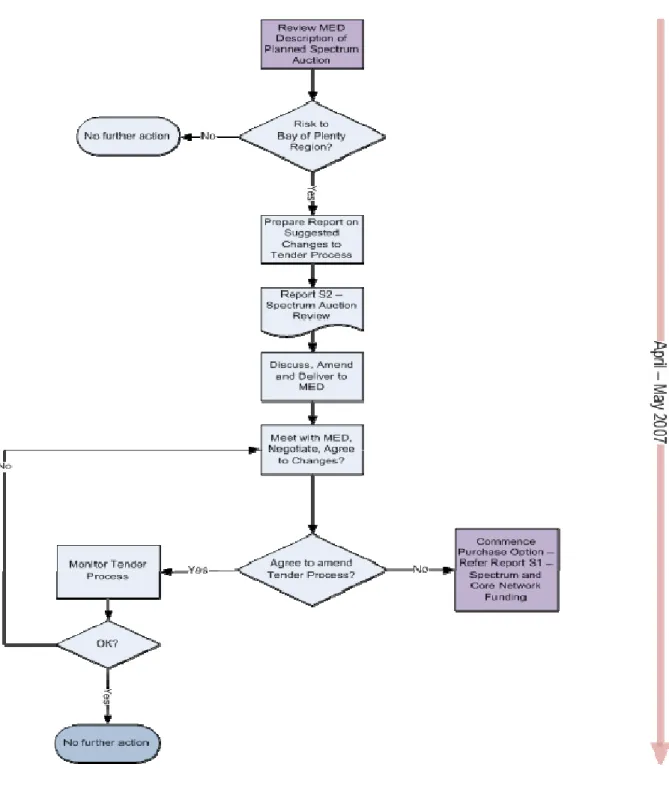
Figure 2 shows the process recommended to resolve concerns regarding the terms of the planned WiMAX spectrum auction, described in detail in deliverable S2. If this strategy is not effective, the process to purchase or influence the purchase rights to the spectrum is then commenced. We note the urgency of the tender of WiMAX spectrum, and that all these activities described below must be complete before the release of the tender documents, presumable late in June 2007.
The managed spectrum park allocation of 16MHz is shown in the supplementary deliverable S2 to be inadequate for wireless broadband delivery in the region. This section considers a number of ways the region might become involved in the tender process for the remaining 80MHz to be sold on a national basis. The practical restrictions we have considered in preparing the options below are:
a) The auctions are no more than 10 – 12 weeks away, leaving little time to prepare the region to intervene in the auction process.
b) The likely cost to win one or more of the 10MHz national bands will be high – potentially millions of dollars would be required. It is unlikely that councils could properly consider this option, arrange funding and effectively bid within the available time frame.
c) To make any spectrum produce a return on investment if the region were to respond to the tender, resale of the spectrum would be required all over New Zealand. This is not core business for Councils and would present an unfamiliar risk to the business operations of councils.
We recommend the following options be considered in terms of acceptability to Councils as soon as possible, if the changes sought to the tender process are not successful:
i) Approach known tender respondents and offer support in one or more of the following ways:
a. Regional support for a joint approach to the Ministry of Economic Development (MED) for support funding in the Bay of Plenty region if WiMAX services will be installed in the first 12 months following award of the spectrum.
b. Limited demand aggregation of Council demand if WiMAX services are deployed in the specific council region within 12 months of award of the spectrum.
c. Access to Council infrastructure for wireless infrastructure location.
d. Limited financial support for infrastructure installation in any specific Council area on the basis of an agreed open book assessment of the service provider business plan for the region.
These options might be developed relatively quickly into a Memorandum of Agreement (MOA) with tender respondents which would be included with their tender response, as confirmation of their intention to support regional service delivery.
This may be interpreted by the MED as a positive aspect of the tender response and add weight to the value of the response. It may be necessary to advertise the interest of the region in this aspect to ensure all interested parties can have to opportunity to work with the Bay of Plenty to include a standard MOA with their response.
It may be useful to alert Local Government New Zealand (LGNZ) to the problem and seek their support for the generic MOA that would appear in as many of the tender responses as possible.
This option does not involve any immediate cash commitment from the region, and a carefully worded MOA would continue to provide reasonable protection for councils.
Page 8 Commercial In Confidence
However, the process places pressure on the government, alerts tender respondents to a service provider friendly region, and may change the investment criteria of the successful respoindents in favour of the region.
ii) Offer a Non Compliant Bid for the Bay of Plenty
This option would offer a modest fee for the use of the spectrum in the Bay of Plenty region, and as such would be non compliant in that the auction requires a national coverage bid which may be impractical for the region to undertake this responsibility. The rationale for a low fee would be that the managed spectrum park allocation is inadequate for the Bay of Plenty, and for this region, another spectrum allocation is necessary and sought via the auction.
While the government would be able to reject the bid as non compliant, it may serve the purpose of highlighting the problems of the tender process and assist in securing support for the effective use of spectrum in the region.
In summary, we suggest there is little that the region can or should do in terms of mounting a compliant response to the spectrum auction because of the lack of time and the financial risks inherent in such an investment. If the planned negotiations with the MED on the terms of the auction are not successful (refer deliverable S2), then the two options set out in this section are practical, have manageable risks and would raise the profile of the problems of the tender.
4 Core Network Funding Options
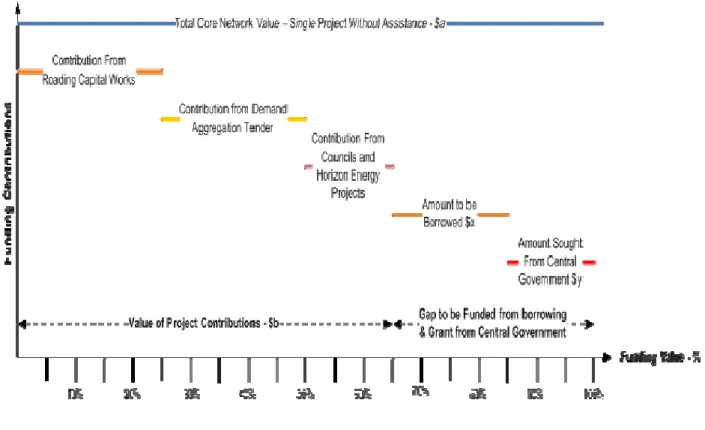
Deliverable A4, Funding Investigation suggests an investment strategy for the core network that is illustrated in figure 3 below:
Figure 3 – Core Network Funding Strategy
While it is unlikely the core network would be a viable investment at the whole project cost of $a, the strategy shows that the region can considerably reduce the cost of the network through a range of contributions, shown above and described in detail in deliverable A4. The remaining ‘gap’ funding is expected to come from a combination of central government grant, and local borrowing, the ratio being such that the local borrowing can be calculated to produce a positive return on this investment.
Under these circumstances, funding for cost element $x, ‘Amount to be Borrowed’ shown in figure 3, appears to be relatively easy to raise based on interviews held with a number of regional organisations in the Bay of Plenty. The key to a successful offer for equity in the business is the development of a viable business case for the core network, and this is set out in deliverable A8, Sample Costing.
Page 10 Commercial In Confidence
5 Conclusions
This supplementary report makes the following conclusions about two investment options for the region:
i) WiMAX spectrum. It is unlikely the region can or should bid directly for the WiMAX spectrum to be auctioned in June 2007 because of the anticipated cost, risks and national responsibilities that will arise. There are several ways to influence the auction process that could improve the opportunity for early use of the national spectrum in the Bay of Plenty. The preferred option in this matter is to positively influence the tender process for the spectrum to ensure all the tendered spectrum is available to the Bay of Plenty, and this strategy is the preferred first option.
ii) Subject to a viable business case for the core network, there will be little problem in raising funds for this asset, to be owned by the region.