Development, Distribution and Classification of Online
Tourism Services in China
Zi Lu
Faculty of Resources and Environment Science
Hebei Teacher's University, Shi Jia Zhuang, Hebei, 050016, China Email: [email protected]
Jie Lu
Faculty of Information Technology University of Technology, Sydney
Email: [email protected] ABSTRACT
The Internet has introduced new, virtual market spaces in addition to the traditional physical tourism market spaces (O'Brien 2001). Tourism organizations are moving more and more products and services online. More and more customers are getting destination information and booking accommodation by accessing the Internet. China, as a developing country, is developing its tourism E-commerce. This paper presents the current development and distribution of online tourism services in China. This paper also proposes two classifications and function distribution for tourism website development in China. Finally, this paper analyses main barriers and challenges to develop online tourism service in China.
Keywords: Online services, E-commerce, Tourism websites, China
INTRODUCTION
The development of electronic commerce (E-commerce) has led to great changes in the way tourists to tourism industry over last few years. The Internet has enabled tourism businesses to connect with each other in a way that requires new thinking in every area of commerce (Standing & Vasudavan 2000 b). Customers are increasingly using the web to get tourism information and services. Traditionally, tourism agencies, including travel (airplane, coach/bus, and train) agencies, recommendation (hotel, motel and restaurant) agencies, destination (park, museum, historic spot, scenic spot, and other attractions) agencies have acted as intermediaries between tourism suppliers and tourists (customers). The Internet brings a whole new set of challenges and opportunities for this business sector (Standing & Vasudavan 2000a). Tourism suppliers and tourism agencies have started to offer their products and services directly online to customers. Therefore customers can download tourism brochures or maps from the web, email questions, search tourism product catalogue, and make online bookings for airlines, hotels, restaurants, as well as tickets of parks, celebration activities, museums and concerts. Customers also can get external service providers' information through website links, and make payment online. Internet based tourism service technology has helped tourism suppliers and agencies in reducing costs and attracting customers.
Recent research concerning online tourism services has shown an increasing interest in this area. For example, Cano and Prentice (1998) proposed a communication concept which is used in the design of websites in tourism businesses and presented the development of tourism websites in Scotland. Standing and Vasudavan (2000a) explored the levels of web based service planning and strategies used by travel agencies. They also analysed the functionality and the types of information provided in the websites of travel agencies. Rayman-bacchus and Molina (2001) examined how the public tourist information bodies are harnessing the Internet. Burgess, Cooper and Alcock (2001) presented a result of the level of uptake of the web as a marketing tool by businesses in the regional tourism industry sector in Australia. Based on an extended model of E-commerce adoption, three stages in developing commercial websites: promotion, provision and processing, moving the websites from simple static promotion to full fledged E-commerce applications.
China has developed its online service industry and obtained initial experience in online tourism services. As a developing country, China has different E-commerce development environment, distribution, evolution, barriers and challenges in tourism E-commerce from developed countries. Following the section, this paper introduces the development of online tourism services in China in Section 2. It then presents the distribution of tourism websites in Section 3. Section 4 shows the classification, function performances and an evolution model for tourism website development in China. Main barriers and challenges to develop online tourism services in China are discussed in Section 5.
DEVELOPMENT OF ONLINE TOURISM SERVICES IN CHINA
Current development state of online tourism services
Website development in China has increased to point where hundreds of companies are creating new web pages and thousands of people are being new web users daily. In 2001, more than 12,450,000 computers were connected with Internet in China, about 2,340,000 of them were using LAN and 10,2000,000 using dialup ISP. There have been 33,700,000 Internet users at the end of 2001, about 6,720,000 of them mainly using broad band, 21,330,000 using dial up, 5,650,000 using both technologies, and about 1,180,000 using other information connection (CNNIC 2001). From 1997 to 2000, the number of Internet users is doubling every six months, and China still keeps an increasing 20%-30% since 2000 every six month.
Tourism is becoming an important industry sector in China. Online tourism service has been provided by more and more tourism business since 1997. A strong feeling of tourism organizations is they cannot be perceived as market leaders if they do not have a web presence. Online tourism services are attracting customers to access tourism websites and guiding them to arrange tourism activities. As the results reported in CNNIC (2001), about 12.5% of Internet users set one of main purposes to access to Internet is to get tourism (including travelling) related information. Tourism organizations are making effort to engage customers’ requirements in tourism website development activities.
In order to enhance China's participation in global tourism marketplace, the China government has developed some strategies to encourage tourism businesses to move services online. Particularly, China government proposed ‘Golden Travel Program’ in 2001. The main aim of the program is to develop Internet based tourism services and markets. It is as a part of China E-commerce development. The China government plans to have B2C’s revenue 80 billion RMB (10 billion US$) in 2005, increase rate is 200%, and B2B’s revenue 800 billion RMB (100 billion US$), increase rate is 50%.
Features of tourism website development
The government tourism administrative departments in China play an important role in tourism policy making, tourism spot development, tourism related transport construction, and large tourism companies' management. There are three tiers of government tourism departments in China, depending on their geographical scope: a national tourism department, province tourism developments and local (regional) tourism offices, or visitor bureaus. These government agencies are mostly designed as public non-profit tourism service and management organizations funded to market the destination via the development of tourism marketing strategies, with the cooperation of tourism companies. The three levels of tourism departments provide and maintain different levels of high quality destinations' facilities and information to associate tourists and travel agents to participate in tourism market.
Traditionally, a typical tourism value chain consists of four stages (components): tourism supplier, tour operator, travel agent and customer, and they are in a single link chain (Kaukal 2000). China tourism industry is new industry comparing with developed counties and thus these stages are in a multiple-link value chain. The first stage is the supplier (tourism company), such as the company of flights, accommodations, scenic spots, caterings, and entertainments in China. Customers often contact suppliers and make a payment directly to them. At an intermediate level, the tour operators perform integration tasks. They are responsible for aggregating a number of components and offer these as packaged services. Many tourism services are composed of various components that originate from different suppliers. For example, a school camp may integrate services of a motel, a swimming pool, shuttle buses and cinema tickets. The package is aggregated through a tour operator. This stage is very weak in China. Customers in China often have to directly contact suppliers and make a 'package' by themselves. The tourism agencies mainly act as retailers and are the intermediaries between the tour operators and the potential customers. The travel agencies collect different packages and are responsible for informing the potential customers and for the booking services. The stage is weak in China too.
In an Internet age, this value chain is a multiple link chain in both developed and developing countries. Since Internet is providing a communication platform between suppliers and consumers, tourism E-commerce facilities suppliers interacting directly with tourists, makes customers easier to create package through linking with several companies' websites, and particularly supports the information integration between tourism organizations through B-to-B E-commerce. In such situation, some functions provided by tour operators and travel agents in a traditional way can be completed by two end stages: suppliers and customers. As a developing country where the two intermediate stages of the value chain are very weak, it is an opportunity for China to catch up with developed counties in tourism services through taking full advantages of Internet.
Three stages of tourism website development
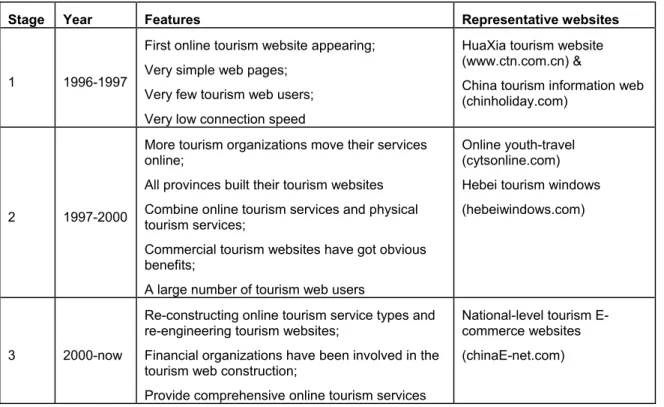
The development of tourism websites in China has experienced three stages (Table 1). With the appearance of E-commerce, the first tourism website (www.ctn.com.cn) was born in 1996. In the stage, websites were designed very simple, only providing very limited tourism information. Since 1997, more and more tourism organizations invested in website development and provided various online tourism services. Some tourism websites have been improved to be very professional and effective to use. More recently, through re-constructing tourism website types and re-engineering tourism companies, more comprehensive national/city-level tourism websites have been built to meet the requirement of global competition. Table 1 shows the three main development stages of tourism websites in China.
Table 1. Three main stages of tourism website development in China
Stage Year Features Representative websites
1 1996-1997
First online tourism website appearing; Very simple web pages;
Very few tourism web users; Very low connection speed
HuaXia tourism website (www.ctn.com.cn) &
China tourism information web (chinholiday.com)
2 1997-2000
More tourism organizations move their services online;
All provinces built their tourism websites Combine online tourism services and physical tourism services;
Commercial tourism websites have got obvious benefits;
A large number of tourism web users
Online youth-travel (cytsonline.com) Hebei tourism windows (hebeiwindows.com)
3 2000-now
Re-constructing online tourism service types and re-engineering tourism websites;
Financial organizations have been involved in the tourism web construction;
Provide comprehensive online tourism services
National-level tourism E-commerce websites (chinaE-net.com)
DISTRIBUTION OF TOURISM WEBSITES IN CHINA
Data collection
The results shown in this study are based on an online search for tourism websites that have a register name with the word 'tourism' (by Chinese character “Lv You”), such as ‘Tangshan Tourism’ and ‘Hebei Tourism Windows’. Totally 2,710 websites were collected with the word from those listed in the Yahoo. A systematic strategy then was used to remove all websites which are not relevant with decision and behaviors of tourists, such as 'Tourism shoes factory'. Finally, 912 tourism website were identified for the study. As the number of tourism websites was increasing rapidly, the online search process was occurred in one day, on 3 November 2001. However, some tourism websites don’t contain the word ‘tourism’ on their register name, such as ‘Chengde Imperial Place’, therefore some tourism websites may be missed. From the 912 websites identified, relevant data including website owner, web information content, online service type, service target and web functions were collected for the study during 4th to 24th November 2001.
Distribution of tourism website construction
According to the location of suppliers, Figure 1 shows the distribution of tourism websites in 31 provinces of China. Almost these websites are built by local scenic spots and relevant service companies. It can be found that tourism websites have been distributed in all 31 provinces of China (Taiwan and Hong Kong are not included for this study). The diffusion of tourism information has played an important role in transforming neutral resources advantages to marketing advantages. This study also explored the relationship between the development of regional economic and construction of tourism websites. The level of regional economic development has a significant impacting on the construction of local websites. From the 912 selected websites, 67% of them are distributed in south-eastern coastal provinces as these regions have a rapidly economic development advantage. There are five coast provinces (Beijing, Shanghai, Shandong, Guangdong, and Zhejiang) in the top six provinces that have more than 50 tourism websites.
0 20 40 60 80 100 120 BeijingShang hai jiangsuShan dong Guan gzho u Hena n Zhejia ng Sich uanHubei Hebe i Huna n Liao ningYunnan Guang xi Anh ui TianjinFu jian Chong qing Heilo ngjia ng Shan xi Jiangx i Guizho u Jilin Haina n Xinji ang Neime ngguGansu Ningx ia Qing hai Xiza ng Shan xi
Figure 1. Distribution of tourism websites in 31 provinces of China
The distribution of tourism website users also reflects the level of local economic development, as the number of website users is significant relevant to the level of development of local tourism industry. Figure 2 shows the relationships between the four factors: regional distribution of users, average consumption level, tourism income/GDP and regional distribution of tourism websites. The result shows that the four factors are very relevant. The related coefficient between the distribution of users and tourism income is 0.88695, between the distribution of users and average consumption level is 0.89156, and between the distribution of tourism websites and tourism income is 0.94705.
0. 00% 10. 00% 20. 00% 30. 00% 40. 00% 50. 00% 60. 00% 70. 00% BeijingShan ghai Tianji ng Cho ngqin g Hebe i Shan gxi Neime ng Liaon ingJilin Heilon gjian g Jiang su Zhe jiangAnh ui Fujia n Jiang xi Shan dongHena n Hub ei Hun an Guan gdon g Guan gxi Haina n Sich uan Guizh ou yunn an Xiza ng Shanx i Gansu Qingha i Ning xia Xinji ang
r egi onal di st r i but i on of user s aver age consumpt i on l evel
t our i sm i ncome/ GDP r egi onal di st r i but i on of t our i sm websi t e
Figure 2. The relationships between regional distribution of web users, average consumption level, tourism income/GDP and regional distribution of tourism websites
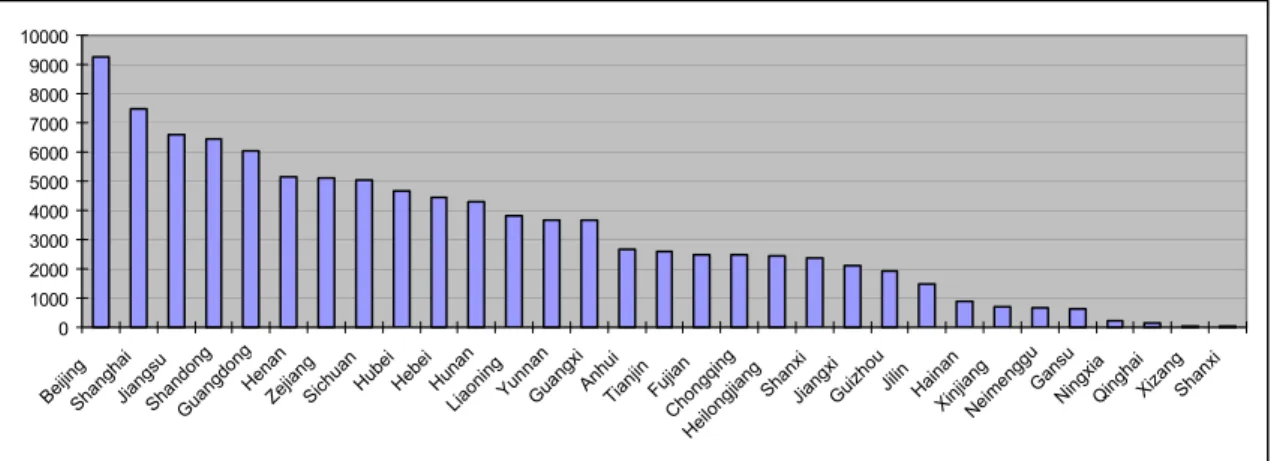
Figure 3 shows the number of visitors (tourists) in each province in 2001-2002 (CNNIC 2001). There is not a significant correlation between the number of websites and number of real visitors (tourists) in each province. It is obviously the number of tourists is dependent on several aspects such as the reputation of landscapes, transport and real services. The construction of websites, as a promoting way, only partially contributes the tourism industry.
0 1000 2000 3000 4000 5000 6000 7000 8000 9000 10000 Beijin g Sha nghai Jiang su Sha ndon g Gua ngdon g Hena n Zejian g Sichu an Hube i Hebe i Huna n Liao
ningYunnan Gua ngxi Anhu i Tianji n Fujia n Chon gqing Heilong jiang Shan xi Jiang xi Guizh ou Jilin Haina n Xinjia ng Neime ngguGansu Ning xia Qing hai Xiza ng Shan xi
Figure 3. Distribution of tourists in 31 provinces in China (unit:10,000)
CLASSIFICATION, FUNCTIONALITY AND EVOLUTION OF ONLINE TOURISM SERVICES IN CHINA
Classification of tourism websites
Two classifications were used in the study for clarifying the 912 tourism websites. Classification 1 is according to the types of website owner. Totally six types were identified under the classification: government administrative department, tourism agents, recommendations, tourism destinations, personal, and IT network company. It can be found from Table 2 that 64.58% of tourism websites are built by tourism destination organizations, 9.87% of are built by government departments, and 8.55% of are built by tourism agents. Obviously, the majority of tourism website owners are tourism destination organizations. These websites focus on specific tourism destinations: parks, palaces or museums, such as ‘ChengDe Imperial Palace Tourism’ and ‘ZhangJiaKo Tourism Resource Web’. The second classification divides the 912 websites into four groups by the type of online service offered. About 53.83% of the websites are regional comprehensive websites which offer a wide range of region-based online services, 26.42% of provide intermediary online service and 10.37% of provide single-types service such as transport service. These regional tourism comprehensive websites provide an outline of local (usually a city) tourism resources including various information and services about destinations, transport, culture, and recommendations in the area. An example of such websites is ‘Tianguishan Tourism’. Tianguishan is a tourism destination. Tianguishan Tourism is the website register name of Tianguishan Tourism Company. The website provides a wide range of information and services relevant Tianguishan to different types of tourists, including where is Tianguishan, how to go to Tianguishan, what special are in Tianguishan, and why the place is so popular.
Table 2. Classifications for tourism websites in China
Classification Category %
Government administrate department 9.87
Tourism agent 8.55
Recommendation 16.56
Tourism destination 64.58
Personal 0.33
By type of website owner
IT network company 0.11
Single-type online service 10.37 Intermediary online service 26.42 Regional comprehensive online service 53.83
By type of online service
Others 9.38
Functions of tourism websites
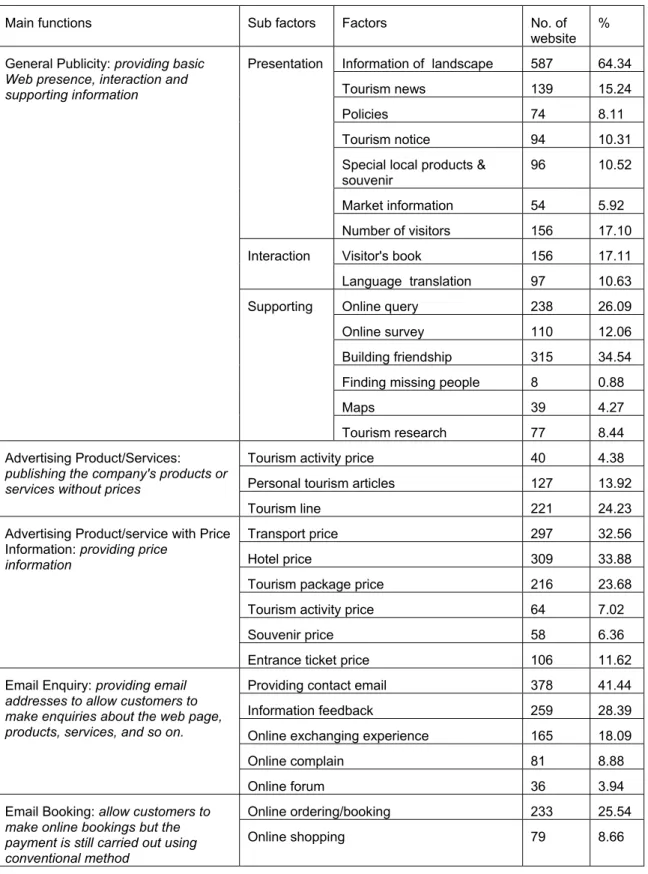
Previous studies have discussed various functions and identified different levels of online tourism services (Lu 2001; Rita 2000a, b). This study particularly identified online tourism services into seven functions (features): general tourism information publicity (function 1); advertising tourism products/services (function 2); advertising tourism products/service with prices (function 3); allowing email enquiry (function 4); allowing online products/services booking (function 5); on-line payment (function 6); and user registration with ID (function 7). Each website may offer one or more above functions. Table 3 shows the distribution of the seven functions in the 912 websites.
The first category is about providing basic web presence and supporting information, including information of landscape, tourism news, online sharing tourism experience, language translation, maps and relevant tourism research. There are 578 websites (64.34%) present landscape information, 15% of provide tourism news, and only 4% of provide brochure, map and other associate tourism information.
The second category is about advertising company's products or services without prices. About 10% of websites offer special local products and souvenir information.
The third category is similar to the second one, but it more convenient potential customers to buy products and services by providing price details. There are 32.56% of websites provide local transport time tables with prices, 34% of for hotel price, and 23.68% of for tourism package price. However, for some businesses, it is difficult to present product/service prices on the web, for example guide and language translator.
There are more than 41% of organizations provide email addresses to allow customers to make enquiries about products and services online.
There are 25% of the websites offering online booking function, but only 1.2% of them accepting online payment. This means that companies allow customers to make a booking by email but the payment is still carried out by conventional methods. We believe that this is due to credit cards are not popular in China.
On a high level of online service development, many tourism companies (34%) are using Internet to build customer relationships by having customer register directly, and then getting information from customers to create customer profiles that can be used in new tourism product development. They have started to build information partnerships to make cooperation between tourism companies and
tourism agents to provide better service to customers. Particularly, in order to improve online service quality, some companies are creating a specialized information provision according to the profile of the users.
Table 3. Function distribution in tourism websites in China Main functions Sub factors Factors No. of
website % Information of landscape 587 64.34 Tourism news 139 15.24 Policies 74 8.11 Tourism notice 94 10.31 Special local products &
souvenir 96 10.52 Market information 54 5.92 Presentation Number of visitors 156 17.10 Visitor's book 156 17.11 Interaction Language translation 97 10.63 Online query 238 26.09 Online survey 110 12.06 Building friendship 315 34.54 Finding missing people 8 0.88
Maps 39 4.27
General Publicity: providing basic Web presence, interaction and supporting information
Supporting
Tourism research 77 8.44 Tourism activity price 40 4.38 Personal tourism articles 127 13.92 Advertising Product/Services:
publishing the company's products or services without prices
Tourism line 221 24.23
Transport price 297 32.56
Hotel price 309 33.88
Tourism package price 216 23.68 Tourism activity price 64 7.02
Souvenir price 58 6.36
Advertising Product/service with Price Information: providing price
information
Entrance ticket price 106 11.62 Providing contact email 378 41.44 Information feedback 259 28.39 Online exchanging experience 165 18.09
Online complain 81 8.88
Email Enquiry: providing email addresses to allow customers to make enquiries about the web page, products, services, and so on.
Online forum 36 3.94
Online ordering/booking 233 25.54 Email Booking: allow customers to
make online bookings but the payment is still carried out using conventional method
Online ordering/booking & payment 11 1.21 On-line Payment: providing online
shopping (selling) with credit card
Online shopping 8 0.88
Member application 317 34.76 Registration with ID: provide their
customers with an account identity
number for direct purchase Website Registration 21 2.30
Call for advertisement 37 4.05 Tourism guide services 74 8.11 Investment services 18 1.97 Online vacancy advertisement 35 3.83 Others
Others 4 0.44
MAIN BARRIERS TO ONLINE TOURISM SERVICES IN CHINA
Based on Flynn & Purchase (2001)' classification, this research investigates the main barriers to the adoption of web technology in tourism industry in three aspects: technical, financial and organizational.
One of the main technical barriers in China is low Internet access speed. Internet users have listed ‘speed is too low’ as the most unsatisfied aspect for Internet applications. Currently, about 50% of Internet users use dial up access to the Internet with 33.6k modems in China. This is a main reason to result in a low access speed. Another technique barrier is the lack of E-commerce application development technology. Many tourism companies have a lack of in-house expertise and experience, particularly in security and reliability of transactions. Another survey (Lu 2002) shows that security is one of main barriers for users to accept online services.
Financial barriers involve the investment for the development and maintenance of an online tourism application. The investment includes web development costs, operating costs, staff training costs, and web maintenance cost. The cost of training/educating and switching a manual system to an online system blocked many small tourism companies. Researchers have indicated that training and education are important issues for electronic market (Flynn & Purchase 2001), however, travel agencies had not to prepare to invest in this area. In China many tourism agencies are very concerned about cost issues and feel that they lack expertise to make judgements.
The organisational and behavioral barriers involve three aspects: organization, staff and user. On the organization side, many website suppliers have a lack of planning for E-marketing development, cooperative with business partners and changing traditional organisational culture towards the requirements of online services. For the company staff, moving services online will result in the changes of staff in working habits and they are required to take additional training. For the customers, to receive online service will involve new knowledge, skills and may change their life style. Untrustworthy is one of main barrier for customers to accept online services.
Online tourism service has been developed in China for several years. However, the levels of online tourism services in many aspects need to be improved. Tourism websites should provide more valuable, effective and trustable online services to tourists. As reported in another paper, this study has compared the functions and customer satisfaction between tourism online services in China and Australia.
REFERENCES
Burgess L., Cooper J. & Alcock C. (2001), The adoption of the web as a marketing tool by regional tourism associations (RTAs) in Australia, The twelfth Australasian conference on information systems, Coffs Harbor, NSW Australia 4-7, December 2001, pp 493-502.
Cano, P. V. & Prentice R (1998), Opportunities for endearment to place through electronic visiting-www homepages and the tourism promotion of Scotland, Tourism Management, Vol. 19, No. 1, pp 67-73.
CNNIC (2001), China National Network Information Center, http://www.cnnic.net. Flynn A. & Purchase S. (2001), Perceptions of barriers to E-commerce, International
telecommunication society’s Asia-Indian Ocean Regional Conference, Telecommunications and E-commerce, Perth, 2-3 July 2001.
Kaukal, M., Hopken, W. & Werthner H. (2000), An approach to enable interoperability in electronic tourism markets, The 8th European Conference on Information Systems (ECIS) 2000, pp 1104-1111. Lu, Z., J. Lu and C. Zhang, Tourism Website Development and Investment Decision in China, The International Conference of Group Decision and Negotiation, 26, August 2002.
O'Brien P. (2001), Dynamic travel itinerary management: The Ubiquitous travel agent, The twelfth Australasian conference on information systems, Coffs Harbor, NSW Australia 4-7, December 2001, pp 493-502.
Rayman-bacchus L. & Molina A. (2001), Internet-based tourism service: business issues and trends, Futures, Vol. 33, no. 7, pp 587-605.
Rita, P. (2000a), Web design for destination tourism marketing, The travel and tourism research conference, California.
Rita, P. (2000b), Web marketing tourism destinations, The 8th European Conference on Information Systems (ECIS) 2000, pp 1096-1103.
Standing, C. & Vasudavan, T. (2000a), Diffusion of Internet technologies in Travel agencies in Australia, The 8th European Conference on Information Systems (ECIS) 2000, pp 1112-1119. Standing, C. Vasudavan, T. (2000b), The Travel Industry and Internet Commerce: Lessons from Australia, Journal of Tourism & Recreation Research.
T
ABLE OF
C
ONTENTS
Designing an Object-Oriented Programming Unit for Business StudentsError! Bookmark not defined.
S I Borbely
Electronic Commerce, Education And Enterprise: Bridging The GapsError! Bookmark not defined.
R Joseph1, G Robertson2, T Vuori3
Teaching Online – Going Beyond Rearranging the Deck Chairs into Virtual SpaceError! Bookmark not defined.
Shirlee-ann Knight
Knowledge Management: Scope and Themes...Error! Bookmark not defined.
Nick Lethbridge
Developments in Management Information Systems and Product Design: Structural Implications and Failure Reduction...Error! Bookmark not defined.
Dr. Terence Love
A Reflective Practitioner Writes on Some Issues in Information ManagementError! Bookmark not defined.
Stan Scott
Mark C. Williams
A Proposed Model for Evaluating the Benefits of Electronic MarketplacesError! Bookmark not defined.
Rosemary Stockdale Craig Standing
Promoting Industry Links in Higher Education to Enhance Teaching and Learning: A Case StudyError! Bookmark
Pina Tarricone Joe Luca Ken Ireland
Personality Type and e-Learning: The Use of MBTI in the Design of e-Learning EnvironmentsError! Bookmark no
W.R. Webster
Reflective Practitioner Research Applied to Information Systems, Reality or Illusion?Error! Bookmark not defined
Edward Sek Wong Mark Williams
Web-based e-Commerce in Australian Small and Medium EnterprisesError! Bookmark not defined.
Jianming Yong1,2 Yun Yang1
Australian SMEs in the online classroom – developing a framework for the alignment of e-business strategies and consultant engagement practices...Error! Bookmark not defined.
Shirley Bode
The Features of Selected Australian Web Sites...Error! Bookmark not defined.
Stephen Burgess Betty Zoppos
E-Security Guides for Australian SMEs...Error! Bookmark not defined.
Damien Hutchinson Matthew Warren
Strategic Tools for the New Economy...Error! Bookmark not defined.
Nick Lethbridge
Tacit to Explicit: Strategies to Convert Organizational Knowledge into Real AssetsError! Bookmark not defined.
The value of knowledge – Why the Balanced Scorecard can be used towards the application of knowledge for competitive advantage ...Error! Bookmark not defined.
Gerald Nugawela
Management of Information in the Logistics Support Branch of an Australian Defence Forces Barracks: How soft systems methodology rich pictures can be used to visualise organisational change...Error! Bookmark not defined.
Vannessa Van Beek Leigh Alver
Mark C.Williams
Business Strategy Modelling in the Information Age...Error! Bookmark not defined.
Robert Winter
What’s driving e-fulfilment: new aims, new frames ...Error! Bookmark not defined.
Paul Alexander
Managing Knowledge Transfer and Creation during Information Systems DevelopmentError! Bookmark not defin
Paul Jackson Prof. Jane Klobas
Informed Traders in Electronic Markets – Mining ‘Living’ Data to Provide Context Information to a Negotiation Process ...Error! Bookmark not defined.
Simeon J. Simoff
e-Procurement Drivers & Barriers...Error! Bookmark not defined.
Andrew Stein Paul Hawking,
The Problems in IT Supply Contracts – Some Suggested Strategies .Error! Bookmark not defined.
Mark Stoney Sue Stoney
A Conceptual Framework of eFraud From a Supply Chain Management PerspectiveError! Bookmark not defined.
Lucian Vasiu David Mackay Matthew Warren
BPR versus Outsourcing – Critical Perspectives...Error! Bookmark not defined.
Philip J. Dobson
Awareness of Business Continuity Planning in Australian Businesses: 1996 and 2001Error! Bookmark not defined
Rosemary Hill Stephen Burgess
Exploring Consumer Loyalty to Web Sites: Why Older Australians Return to the GreyPath PortalError! Bookmark
Jerzy Lepa Arthur Tatnall
The Cybercentrism Continuum and Virtually-Extended Enterprises in Local GovernmentError! Bookmark not defi
D.J. Stanton
The Usability of E-Commerce Systems: A Model for User Participation in Development ActivitiesError! Bookmar
Julian Terry Craig Standing
Advertising and Sales Promotion: New methods for Mobile Era...Error! Bookmark not defined.
T. A Vuori G. Weng
Think Globally, Act Globally: What are the enablers and inhibitors? A study of factors influencing globalisation in a large organisation. ...Error! Bookmark not defined.
Robyn Watters Andrew Wenn
A Model of e-Business Migration ...Error! Bookmark not defined.
C.G. Ash
Individualist and Collectivist Representations of Technology ...Error! Bookmark not defined.
Philip J. Dobson
Casino / Resorts in Australia: Applying Soft Systems Methodology to Common Problems and Perceptions...Error! Bookmark not defined.
Peter Gall
Virtual Organisation to Virtual Product: Cultural and Structural Challenges OnlineError! Bookmark not defined.
D. W. Maguire
Exploring Information Displayed On a Web Site as a Means to Establishing Trust Between Online Consumers and e-retailers...Error! Bookmark not defined.
Michael J Milloy
Sun Tzu and the Art of (Business) War; A Review of Control in the Information AgeError! Bookmark not defined
Gerry Nugawela
Ethical Aspects of Web Portals: Supporting the Shift from Socially Responsible to Morally
Responsible Investment Decisions ...Error! Bookmark not defined.
A. Scharl N. Knotzer H. Treiblmaier
Winery Internet transactions: Online wine sales as an effective means of maximising the Wine Equalisation Tax (WET) rebate? ...Error! Bookmark not defined.
Carmine Sellitto Bill Martin
The Protection of Raw Data within Information Databases – Real or Illusory?Error! Bookmark not defined.
Mark Stoney Sue Stoney
Development, Distribution and Classification of Online Tourism Services in China ... 1 Zi Lu