Information Technology
Curriculum Framework
Stage 6 Syllabus
Part A
for implementation from 2000
Information Technology (120 indicative hours)
Information Technology (180 indicative hours)
Information Technology (240 indicative hours)
Information Technology Specialisation Studies
(60 or 120 indicative hours)
Units of competency from the Information Technology Training Package in Part B of this syllabus are © Australian National Training Authority (ANTA). Reproduced with permission.
The following copyright warning applies to the material from the Training Package: All rights reserved. This work has been produced initially with the assistance of funding provided by the Commonwealth Government through ANTA. This work is copyright, but permission is given to trainers and teachers to make copies by photocopying or other duplicating processes for use with their own training organisations or in a workplace where the training is being conducted. This
permission does not extend to the making of copies for use outside the immediate training environment for which they are made, nor the making of copies for hire or resale to third parties. The views expressed in this version of the work do not necessarily represent the views of ANTA. ANTA does not give warranty nor accept any liability.
The Board of Studies owns the copyright on all syllabuses. Schools may reproduce this syllabus in part or in full for bona fide study or classroom purposes only.
Acknowledgement of the Board of Studies copyright must be included on any reproductions. Students may copy reasonable portions of the syllabus for the
purpose of research or study. Any other use of this syllabus must be referred to the Copyright Officer, Board of Studies NSW. Ph: (02) 9367 8111; fax: (02) 9279 1482. Material on p 7 from Securing Their Future © NSW Government 1997.
© Board of Studies NSW 1999
Published by
Board of Studies NSW GPO Box 5300
Sydney NSW 2001 Australia
Tel: (02) 9367 8111
Internet: http://www.boardofstudies.nsw.edu.au ISBN 0 7313 4302 6
1 Introduction to Industry Curriculum Frameworks ...5
2 Documentation Associated with Industry Curriculum Frameworks...6
3 The Higher School Certificate Program of Study...7
4 Vocational Education and Training (VET) in the NSW Higher School Certificate...8
4.1 The National Training Framework ...8
4.2 Industry Curriculum Frameworks ...9
5 Rationale ...10
6 Aim ...10
7 Information Technology Curriculum Framework...11
7.1 Training Package Qualifications ...11
7.2 Characteristics of AQF Qualifications ...11
7.3 Units of Competency Included in the Information Technology Curriculum Framework...13
8 Course Structures ...16
8.1 Courses Within the Information Technology Curriculum Framework ...16
8.2 Allocation of Hours for Unit Credit in the HSC...17
8.3 Information Technology (120 indicative hours)...18
8.4 Information Technology (180 indicative hours)...19
8.5 Information Technology (240 indicative hours)...21
8.6 Information Technology Specialisation Studies (60 or 120 indicative hours) ...23
9 Outcomes and Content ...27
9.1 Units of Competency...27
9.2 Course Delivery — Training Programs, Learning Materials, Resources and Teacher Qualifications...28
10 Work Placement...29
11 Assessment Requirements and Advice ...30
11.1 Competency Based Assessment ...30
11.2 Training Package Requirements ...31
11.3 Competency Record Book (Student Log) ...32
11.4 HSC Examination — Information Technology (240 Indicative Hours) ...32
12.1 Course Completion Requirements ...34
12.2 Preliminary and HSC Unit Credit ...34
12.3 HSC Record of Achievement ...34
13. Other Information ...35
13.1 Providing for all Students ...35
13.2 Key Competencies ...36
13.3 Links Between the Information Technology Curriculum Framework and Other HSC Courses...37
13.4 Articulation to Further Training ...37
14 Glossary ...38
Appendix A AQF Certificates II and III in the Information Technology Training Package ...42
1
Introduction to Industry Curriculum Frameworks
Industry curriculum frameworks have been developed to provide students with the opportunity to gain unit credit towards the NSW Higher School Certificate and credit towards national vocational qualifications under the Australian Qualifications
Framework (AQF).
Industry curriculum frameworks are based on national training packages. They contain industry developed units of competency from the relevant training packages suitable for the purposes of the Higher School Certificate. They also define how units of competency are arranged into Vocational Education and Training (VET) courses for the purpose of gaining unit credit for the Higher School Certificate. Wherever possible, VET courses in industry curriculum frameworks are aligned to national vocational qualifications.
This industry curriculum framework incorporates all HSC Information Technology VET courses, including:
• courses delivered by schools
• courses delivered by TAFE colleges
• courses delivered by other Registered Training Organisations (RTOs) on behalf of schools or TAFE colleges.
2
Documentation Associated with Industry Curriculum
Frameworks
The documentation associated with industry curriculum frameworks has been written to assist teachers and trainers develop teaching and assessment programs and to help in the management of competency achievement of Higher School Certificate candidates.
The purpose of Part A of the Information Technology Curriculum Framework Stage
6 Syllabus is to identify arrangements of units of competency that will enable
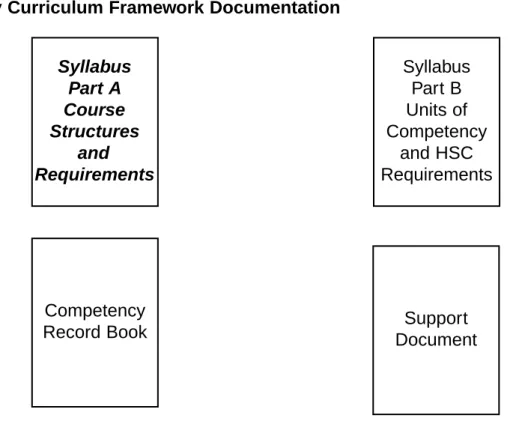
students to achieve unit credit towards the Higher School Certificate and credit towards a vocational qualification. It contains general advice about this industry curriculum framework and describes course structures and requirements, including work placement. This document should be referred to in the first instance when planning the implementation of VET courses for the Higher School Certificate. The documentation suite associated with this industry curriculum framework is illustrated in Figure 1 below.
Industry Curriculum Framework Documentation
Figure 1 Board of Studies documentation associated with this industry curriculum framework
Syllabus Part A Course Structures
and Requirements
Syllabus Part B Units of Competency
and HSC Requirements
Competency
3
The Higher School Certificate Program of Study
The purpose of the Higher School Certificate program of study is to:
• provide a curriculum structure which encourages students to complete secondary education;
• foster the intellectual, social and moral development of students, in particular developing their:
– knowledge, skills, understanding and attitudes in the fields of study they choose;
– capacity to manage their own learning;
– desire to continue learning in formal or informal settings after school; – capacity to work together with others;
– respect for the cultural diversity of Australian society;
• provide a flexible structure within which students can prepare for: – further education and training;
– employment;
– full and active participation as citizens;
• provide formal assessment and certification of students’ achievements; • provide a context within which schools also have the opportunity to foster
4
Vocational Education and Training (VET) in the NSW
Higher School Certificate
4.1
The National Training Framework
All accredited VET programs, including those for HSC students, must meet the requirements of the National Training Framework (NTF).
The key components of the National Training Framework are: • The Australian Qualifications Framework (AQF)
Under the AQF, VET qualifications in each industry area are standard across Australia. To facilitate this, the award of a particular AQF Diploma, Certificate or Statement of Attainment depends on the person who seeks a qualification meeting specified industry competency standards. Competency standards have been developed by the relevant industry to reflect the real requirements for employment and effective work performance and are expressed in national industry training packages.
• National Training Packages
All training packages contain three mandatory or ‘endorsed’ components:
– units of competency, which express the industry competency standards and include elements of competency, performance criteria, a range of variables and an evidence guide
– assessment guidelines, which set out conditions for establishing that competency has been met
– qualifications, explaining each qualification and relationships between them. Training packages may also contain a range of materials designed to assist with training and assessment. These are not mandatory and are known as ‘non-endorsed components’.
• The Australian Recognition Framework (ARF)
Because training packages and AQF qualifications are standardised across Australia, they are also recognised in all parts of Australia. This is assured by the ARF, which ensures that the quality of training and assessment is consistent and reliable.
Under the ARF, an organisation wishing to provide training, assess competencies and issue VET qualifications under the AQF, must be a Registered Training
Organisation (RTO). It is the responsibility of an RTO, whether it is a school or school system, a TAFE college or other training provider, to ensure that quality assurance requirements are met. These requirements include access to
adequate resources and appropriately qualified staff in order to deliver and/or assess training programs that lead to the achievement of qualifications (or individual units of competency) that have been identified in the RTO's scope of registration. As part of its registration, each RTO must agree to recognise AQF qualifications issued by any other RTO.
4.2
Industry Curriculum Frameworks
Industry curriculum frameworks have been developed to satisfy the requirements of the National Training Framework as well as the purposes of the NSW Higher School Certificate.
An industry curriculum framework describes the range of units of competency from the relevant training package that is endorsed by the Board of Studies for inclusion in the NSW Higher School Certificate. It also describes the groupings of units of competency that define specific HSC VET courses. These are determined largely by the qualifications available in the relevant training package and their suitability for school students attempting the Higher School Certificate. An industry curriculum framework must also meet a set of industry and school related criteria developed to promote the strengthening and extension of VET in the Higher School Certificate. Units of competency are the components against which assessment and reporting occur for the purpose of gaining credit towards an AQF qualification. They are also the focus of courses within an industry curriculum framework. In this sense, the elements of competency, which collectively define the outcomes of each unit of competency, also define the outcomes and determine the content of HSC VET courses within each framework.
5
Rationale
Information technology is a rapidly evolving industry area that is experiencing considerable and sustained growth. As an industry, information technology receives attention from governments, other industries and the community at large, and in many respects provides products and services that have a critical influence upon the way we go about our daily activities. Government and industry reports released in the last few years clearly indicate a need to address the information technology skill shortages to ensure the industry remains in a position to meet future demand. The Information Technology Curriculum Framework has been developed in response to the needs of the industry and to provide relevant training and education
opportunities for the full range of students. It is based on units of competency in the National Information Technology Training Package ICA99. The qualification available to students who achieve the appropriate units of competency in this industry
curriculum framework is the AQF Certificate II in Information Technology. Students may also be eligible for an AQF Statement of Attainment with credit towards an AQF Certificate III in Information Technology.
The study of courses in the Information Technology Curriculum Framework can lead to career opportunities in a range of occupation areas. Careers for which information technology competencies are required include:
• computing software and hardware development • information systems management
• telecommunications • printing and publishing • accounting
• teaching and education • research.
The focus of each of the courses in this industry curriculum framework is in the
support and management of the use of information technology. Learning in each
course provides opportunities for students to gain relevant technical, business and interpersonal competencies.
6
Aim
The Information Technology Curriculum Framework is designed to provide students with appropriate learning opportunities that will enable them to acquire a range of technical, personal and interpersonal skills valued both within and beyond the workplace as well as underpinning skills and knowledge related to the support and management of information technology.
7
Industry Curriculum Framework Structure
7.1
Training Package Qualifications Framework
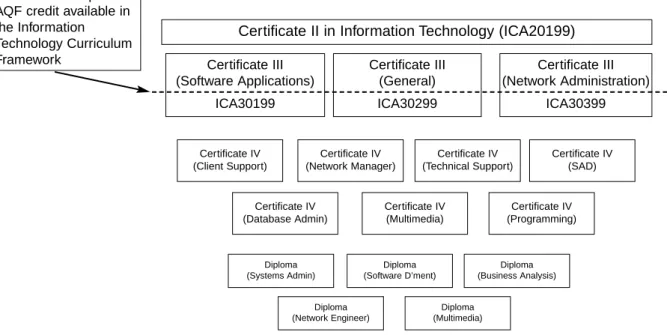
The Information Technology Curriculum Framework is developed with reference to the Information Technology Training Package (ICA99). This training package incorporates 16 AQF qualifications ranging from Level II certificate through to Diploma. The qualifications framework appears in Figure 2.
Qualifications within the Information Technology Training Package
Figure 2 Information technology qualifications framework, adapted from the Information Technology Training Package. It should be noted that people enter the information technology industry from a range of backgrounds. For this reason, progression paths from one qualification to the next are not identified in this diagram.
Consult the Information Technology Training Package ICA99 for recommended entry competencies into higher level qualifications.
7.2
Characteristics of AQF Qualifications
AQF qualifications reflect a level of performance and degree of responsibility for one’s own output and the output of others in a workplace context. The qualifications included in the AQF are defined in terms of units of competency and generally encompass attributes that might be broadly categorised as technical, interpersonal and
environmental. The AQF levels relevant to the industry curriculum frameworks are Levels I to III. A brief description of Levels I, II and III, adapted from the Australian
Qualifications Framework Implementation Handbook1, is provided over the page.
Certificate II in Information Technology (ICA20199) Certificate III (Software Applications) ICA30199 Certificate IV (Client Support) Certificate IV (Database Admin) Diploma (Systems Admin) Diploma (Network Engineer) Diploma (Multimedia) Diploma (Software D’ment) Diploma (Business Analysis) Certificate IV (Multimedia) Certificate IV (Programming) Certificate IV (Network Manager) Certificate IV (Technical Support) Certificate IV (SAD) Certificate III (General) ICA30299 Certificate III (Network Administration) ICA30399 Maximum anticipated
AQF credit available in the Information Technology Curriculum Framework
1Australian Qualifications Framework (AQF) Advisory Board, The Australian Qualifications Framework Implementation
AQF Level I
Work is likely to be carried out under direct supervision. Breadth, depth and complexity of knowledge and skills would prepare a person to perform a defined range of activities, most of which would be routine and predictable.
An individual demonstrating competencies at this level would be able to: • demonstrate knowledge by recall in a narrow range of areas
• demonstrate basic practical skills, such as the use of relevant tools • perform a sequence of routine tasks given clear direction
• receive and pass on messages/information.
AQF Level II
Work is likely to be carried out under direct supervision. Breadth, depth and
complexity of knowledge and skills would prepare a person to perform in a range of varied activities or knowledge application where there is a clearly defined range of contexts in which the choice of actions required is usually clear and there is limited complexity in the range of options to be applied.
An individual demonstrating competencies at this level would be able to: • demonstrate basic operational knowledge in a moderate range of areas • apply a defined range of skills
• apply known solutions to a limited range of predictable problems
• perform a range of tasks where choice between a limited range of options is required
• assess and record information from various sources
• take limited responsibility for one’s own outputs in work and learning.
AQF Level III
Breadth, depth and complexity of knowledge and competencies would cover
selecting, adapting and transferring skills and knowledge to new environments and providing technical advice and some leadership in resolution of specific problems. This would be applied across a range of roles in a variety of contexts, with some complexity in the extent and choice of options available.
An individual demonstrating these competencies would be able to:
• perform a defined range of skilled operations usually within a range of broader, related activities involving known routines, methods and procedures
• exercise some discretion and judgement in the selection of equipment, services or contingency measures
• operate within known time constraints • take some responsibility for others • participate actively in teams.
7.3
Summary of Units of Competency Included in the
Information Technology Curriculum Framework
There are fifty units of competency that have been included in the Information Technology Curriculum Framework. These units have been drawn from seven of the ten available industry fields described in the training package and represent all the units included in AQF Certificates II and III.
The four AQF qualifications from which units of competency have been selected for this industry curriculum framework are:
• Certificate II in Information Technology — ICA20199
• Certificate III in Information Technology (Software Applications) — ICA30199 • Certificate III in Information Technology (General) — ICA30299
• Certificate III in Information Technology (Network Administration) — ICA30399 The details of each of the qualifications are in Appendix A.
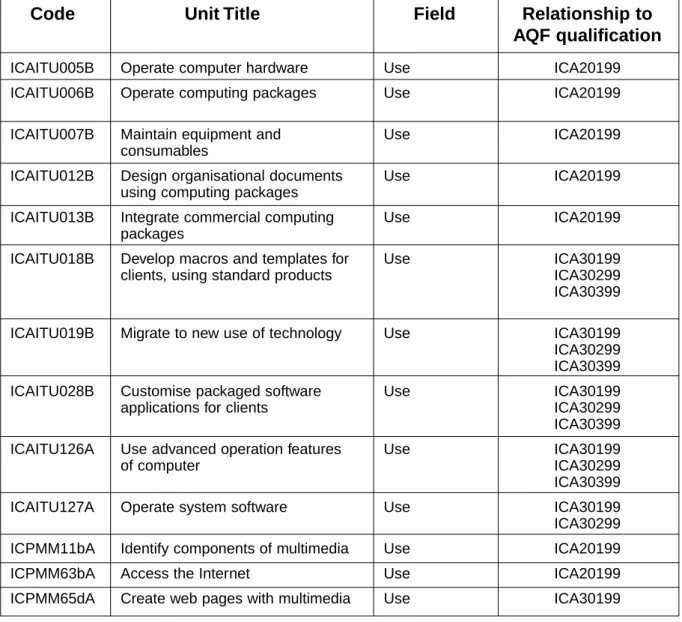
The units of competency and the qualification(s) in which they are found are identified in Table 1 below.
Code Unit Title Field Relationship to AQF qualification
PMX401A Apply skills in project integration IT Project Mgt ICA30199
ICAITB070A Create code for applications Build ICA30199
ICAITB002 Physical database requirements Build ICA30299
determined
ICAITD003B Receive and process oral Documentation ICA20199
and written communication ICA30399
ICAITD128A Create user and technical Documentation ICA30199
documentation ICA30299
ICA30399
ICAITI016A Build an Internet infrastructure Implement ICA30299
ICAITI097A Install and configure a network Implement ICA30299
ICAITI101A Install and manage network Implement ICA30199
protocols ICA30299
ICA30399
ICAITS106A Change requests are Support ICA30399
actioned and completed
ICAITS008B Maintain equipment/software Support ICA20199
inventory
ICAITS009B Interact with clients Support ICA20199
ICAITS010B Apply problem-solving techniques Support ICA20199
to achieve organisation goals ICA30399
ICAITS014B Connect hardware peripherals Support ICA20199
ICAITS015A Undertake capacity planning Support ICA30299
ICAITS015B Install software applications Support ICA20199
ICAITS016B Record client support Support ICA20199
Code Unit Title Field Relationship to AQF qualification
ICAITS017B Maintain system integrity Support ICA20199
ICAITS020B Install and optimise system Support ICA30199
software ICA30299
ICAITS021B Connect internal hardware Support ICA30199
components ICA30299
ICA30399
ICAITS022B Determine client computing Support ICA20199
problems and action
ICAITS023B Provide one-to-one instruction Support ICA30199
ICA30299 ICA30399
ICAITS024B Provide basic system administration Support ICA30199
ICA30299 ICA30399
ICAITS025B Run standard diagnostic tests Support ICA30199
ICA30299 ICA30399
ICAITS029B Install network hardware Support ICA30199
to a network ICA30299
ICAITS030B Install software to networked Support ICA30199
computers ICA30299
ICAITS031B Provide advice to clients Support ICA30199
ICA30299 ICA30399
ICAITS032B Provide network systems Support ICA30199
administration ICA30299
ICA30399
ICAITS034B Determine and action network Support ICA30299
problem ICA30399
ICAITS115A Maintain equipment and software Support ICA30199
in working order ICA30299
ICA30399
ICAITS117A Maintain custom software Support ICA30299
ICAITS120A Administer and configure a network Support ICA30399
operating system
ICAITS121A Administer network peripherals Support ICA20199
ICA30199 ICA30299 ICA30399
ICAITTW001B Work effectively in an information Team Work ICA20199
technology environment
ICAITTW002B Communicate in the workplace Team work ICA20199
ICAITTW011B Participate in a team and individually Team Work ICA20199
to achieve organisation goals ICA30399
ICAITTW027B Relate to clients on a business level Team Work ICA30199
ICA30399
ICAITU004B Apply Occupational Health and Use ICA20199
ICAITU005B Operate computer hardware Use ICA20199
ICAITU006B Operate computing packages Use ICA20199
ICAITU007B Maintain equipment and Use ICA20199
consumables
ICAITU012B Design organisational documents Use ICA20199
using computing packages
ICAITU013B Integrate commercial computing Use ICA20199
packages
ICAITU018B Develop macros and templates for Use ICA30199
clients, using standard products ICA30299
ICA30399
ICAITU019B Migrate to new use of technology Use ICA30199
ICA30299 ICA30399
ICAITU028B Customise packaged software Use ICA30199
applications for clients ICA30299
ICA30399
ICAITU126A Use advanced operation features Use ICA30199
of computer ICA30299
ICA30399
ICAITU127A Operate system software Use ICA30199
ICA30299
ICPMM11bA Identify components of multimedia Use ICA20199
ICPMM63bA Access the Internet Use ICA20199
ICPMM65dA Create web pages with multimedia Use ICA30199
Table 1: The range of units of competency available in the Information Technology Curriculum Framework
Code Unit Title Field Relationship to AQF qualification
8
Course Structures
8.1
Courses within the Information Technology Curriculum
Framework
An industry curriculum framework within the Higher School Certificate describes the range of units of competency that have been identified as being suitable for the purposes of the Higher School Certificate. A course within an industry curriculum framework describes how the available units of competency can be arranged to gain units of credit towards the Higher School Certificate.
There are five courses in the Information Technology Curriculum Framework. They are: • Information Technology (120 indicative hours)
• Information Technology (180 indicative hours) • Information Technology (240 indicative hours)
• Information Technology Specialisation Studies (60 indicative hours) • Information Technology Specialisation Studies (120 indicative hours) The following pages describe each of the courses in this industry curriculum framework. Figure 3 below summarises the course combinations available in the Information Technology Curriculum Framework.
Course Extension course Possibly leading to…
Information Technology Statement of Attainment with credit
(120 indicative hours) towards Certificate II
Information Technology Statement of Attainment with credit
(180 indicative hours) towards Certificate II
Information Technology Certificate II
(240 indicative hours) †
Information Technology Information Technology Certificate II plus
(240 indicative hours) † + Specialisation Studies Statement of Attainment with (60 indicative hours) credit towards Certificate III Information Technology Information Technology Certificate II plus
(240 indicative hours) † + Specialisation Studies Statement of Attainment with (120 indicative hours) credit towards Certificate III
Information Technology Statement of Attainment with
Specialisation Studies credit towards Certificate III
(120 indicative hours)*
† Optional external examination * Special entry considerations apply
Figure 3 Information Technology course combinations and possible AQF credit based on successful achievement of units of competency
8.2
Allocation of Hours for Unit Credit in the Higher School
Certificate
Units of competency drawn from industry training packages are not defined in terms of duration. The amount of time required by individual students to achieve competency will vary according to their aptitude and experience as well as the conditions under which learning takes place. Where a training program is designed for delivery by an RTO, the RTO will specify the length of the training program according to the curriculum resources/delivery strategies chosen.
However, for the purposes of the Higher School Certificate, courses must be described in terms of their duration. Courses are 240 indicative hour courses, 120 indicative hour courses or 60 indicative hour courses.
For this reason, the indicative hours for unit credit towards the Higher School Certificate have been assigned to each unit of competency within the industry curriculum framework. The allocation of indicative hours does not imply that all students will fulfil all requirements for a unit of competency within these hours. RTOs may determine that additional hours are required for the achievement of particular competencies. It is also expected that students will need to spend additional time in practising skills in a real or simulated work environment and in completing projects and assignments in order to fulfil industry assessment requirements.
The identified course structures list the indicative hours assigned to each unit of competency within the framework for the purpose of credit towards the Higher School Certificate. It should be noted that the total number of hours for Higher School
Certificate credit in any given course may be slightly fewer or slightly more than the indicative hours identified for the course.
8.3
Information Technology (120 indicative hours)
Purpose
The purpose of this course is to provide students with an opportunity to develop competencies associated with the use and support of desktop applications relevant to an information technology setting.
Qualifications
Students who satisfy the course requirements and who achieve the units of competency described in the course structure will be eligible to receive unit credit towards their Higher School Certificate and an AQF Statement of Attainment in Information Technology. In addition, students will receive advanced standing towards an AQF Certificate Level II in Information Technology.
AQF Statements of Attainment and AQF qualifications are ONLY issued on the basis of successful achievement of units of competency as a result of assessment by a qualified assessor.
Course structure
Students must attempt all units of competency from Table 2 below.
Course requirements
Students must attempt each of the units of competency described in the course structure and undertake a minimum of 35 hours work placement, 14 hours of which may be in a simulated work placement program.
Information Technology (120 indicative hours) Code
ICAITTW001B
ICAITU004B ICAITU006B ICAITU005B ICAITU012B
ICAITU013B
Indicative Hours for HSC Credit
20
10 20 40 20
20 Unit Title
Work effectively in an information technology environment
Apply Occupational Health and Safety procedures Operate computing packages
Operate computer hardware
Design organisational documents using commercial computing packages
Integrate commercial computing packages
8.4
Information Technology (180 indicative hours)
Purpose
The purpose of this course is to provide students with an opportunity to develop competencies associated with the use and support of desktop applications and to develop additional competencies in an area of interest.
Qualifications
Students who satisfy the course requirements and who achieve the units of competency described in the course structure will be eligible to receive unit credit towards their Higher School Certificate and an AQF Statement of Attainment in Information Technology. In addition, students will receive advanced standing towards an AQF Certificate Level II in Information Technology.
AQF Statements of Attainment and AQF qualifications are ONLY issued on the basis of successful achievement of units of competency as a result of assessment by a qualified assessor.
Course structure
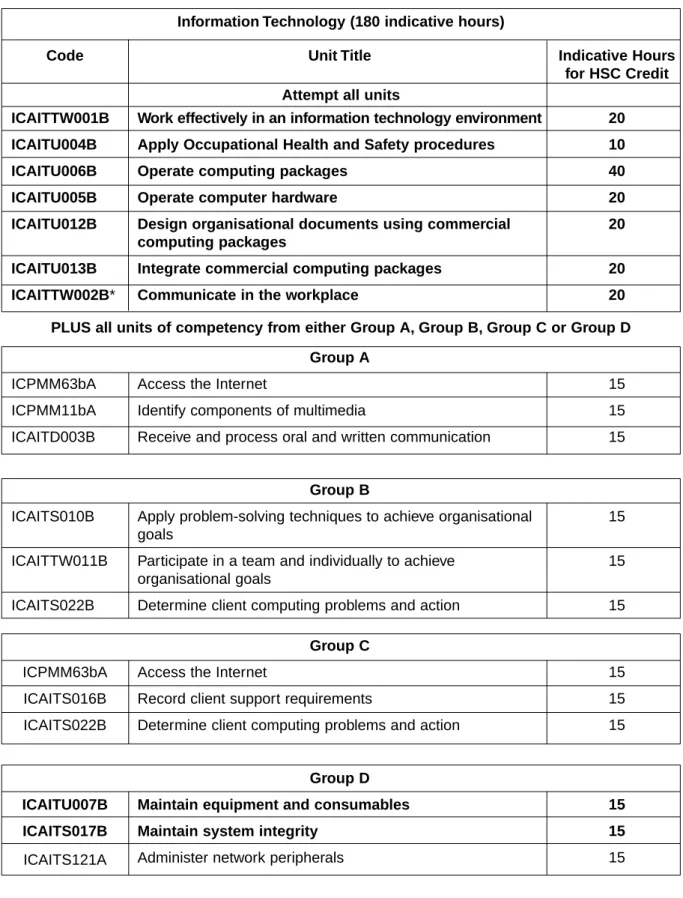
Students must attempt the unit of competency ICAITTW002B – Communicate in the workplace, plus one of four unit of competency groups from Table 3.
Course requirements
Students must attempt each of the units of competency described in the course structure and undertake a minimum of 49 hours work placement, 21 hours of which may be in a simulated work placement program.
Code ICAITTW001B ICAITU004B ICAITU006B ICAITU005B ICAITU012B ICAITU013B ICAITTW002B* ICPMM63bA ICPMM11bA ICAITD003B ICAITS010B ICAITTW011B ICAITS022B ICPMM63bA ICAITS016B ICAITS022B ICAITU007B ICAITS017B ICAITS121A Unit Title
Work effectively in an information technology environment Apply Occupational Health and Safety procedures Operate computing packages
Operate computer hardware
Design organisational documents using commercial computing packages
Integrate commercial computing packages Communicate in the workplace
Group A
Access the Internet
Identify components of multimedia
Receive and process oral and written communication
Group B
Apply problem-solving techniques to achieve organisational goals
Participate in a team and individually to achieve organisational goals
Determine client computing problems and action
Group C
Access the Internet
Record client support requirements
Determine client computing problems and action
Group D Maintain equipment and consumables Maintain system integrity
Administer network peripherals
Indicative Hours for HSC Credit
20 10 40 20 20 20 20 15 15 15 15 15 15 15 15 15 15 15 15
Information Technology (180 indicative hours)
Attempt all units
PLUS all units of competency from either Group A, Group B, Group C or Group D
Table 3: Course structure for Information Technology (180 indicative hours).
Units of competency shown in bold indicate core units within the AQF Certificate II in Information Technology.
* Note that ICAITTW002B – Communicate in the workplace is NOT included in the course Information Technology (120 indicative hours).
8.5
Information Technology (240 indicative hours)
Purpose
The purpose of this course is to provide students with opportunities to develop and enhance competencies relevant to employment in industries where information technology is used.
Qualifications
Students who satisfy the course requirements and who achieve the units of competency described in the course structure will be eligible to receive unit credit towards their Higher School Certificate and an AQF Certificate Level II in
Information Technology.
AQF Statements of Attainment and AQF qualifications are ONLY issued on the basis of successful achievement of units of competency as a result of assessment by a qualified assessor.
Course structure
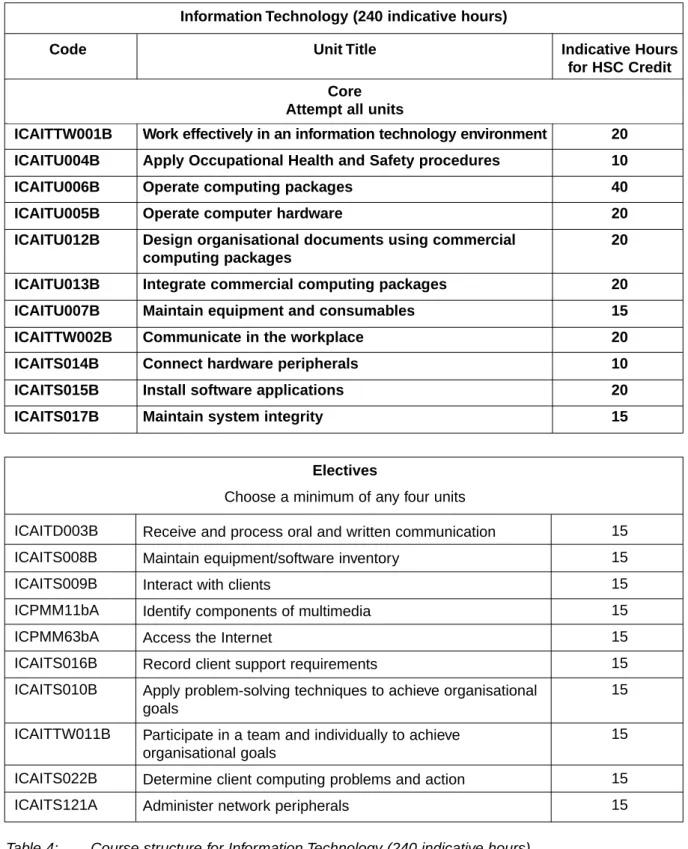
Students must attempt all core units from Table 4 as well as a minimum of four elective units of competency from Table 4.
Course requirements
Students must attempt each of the units of competency described in the course structure and undertake a minimum of 70 hours work placement, 35 hours of which can be in a simulated work placement program.
Optional external examination
Information Technology (240 indicative hours) Code ICAITTW001B ICAITU004B ICAITU006B ICAITU005B ICAITU012B ICAITU013B ICAITU007B ICAITTW002B ICAITS014B ICAITS015B ICAITS017B ICAITD003B ICAITS008B ICAITS009B ICPMM11bA ICPMM63bA ICAITS016B ICAITS010B ICAITTW011B ICAITS022B ICAITS121A Unit Title
Work effectively in an information technology environment Apply Occupational Health and Safety procedures Operate computing packages
Operate computer hardware
Design organisational documents using commercial computing packages
Integrate commercial computing packages Maintain equipment and consumables Communicate in the workplace
Connect hardware peripherals Install software applications Maintain system integrity
Electives
Choose a minimum of any four units Receive and process oral and written communication Maintain equipment/software inventory
Interact with clients
Identify components of multimedia Access the Internet
Record client support requirements
Apply problem-solving techniques to achieve organisational goals
Participate in a team and individually to achieve organisational goals
Determine client computing problems and action Administer network peripherals
Indicative Hours for HSC Credit
20 10 40 20 20 20 15 20 10 20 15 15 15 15 15 15 15 15 15 15 15 Table 4: Course structure for Information Technology (240 indicative hours).
Units of competency shown in bold indicate core units within the AQF Certificate II in Information Technology.
Core Attempt all units
8.6
Information Technology Specialisation Studies (60 or 120
indicative hours)
Purpose
The purpose of Information Technology Specialisation Studies is to provide students with a range of opportunities to develop and enhance competencies in an area of specialisation relevant to employment where information technology is used.
Students undertaking this course have the opportunity to receive credit towards one of the AQF Certificates Level III in Information Technology.
In addition, students undertaking either of these courses may be able to develop the necessary competencies to be eligible to undertake assessment for a vendor
qualification.
Qualifications
Students who satisfy the course requirements and who achieve the units of competency described in the course structure will be eligible to receive unit credit towards their HSC and credit towards an AQF Certificate Level III in Information Technology5.
AQF Statements of Attainment and AQF qualifications are ONLY issued on the basis of successful achievement of units of competency as a result of assessment by a qualified assessor.
Course structure
Students enrolled in Information Technology Specialisation Studies (60 indicative hours) must attempt units of competency from Table 5 to a minimum value of 60 indicative hours.
Students enrolled in Information Technology Specialisation Studies (120 indicative hours) must attempt units of competency from Table 5 to a minimum value of 120 indicative hours.
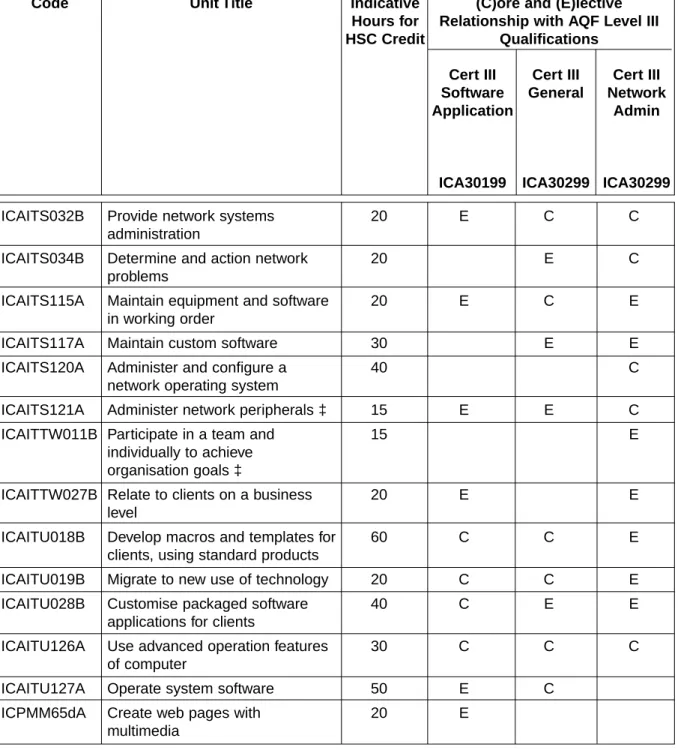
When choosing units of competency, students should be guided by the industry qualification framework for AQF Level III qualifications. This information is described in Table 5 and in Appendix A. Maximum credit for further training within this Qualifications Framework will be achieved by choosing units of competency that appear in each of the qualifications: • ICA30199 — Certificate III in Information Technology (Software
Applications)
• ICA30299 — Certificate III in Information Technology (General) • ICA30399 — Certificate III in Information Technology (Network
Administration).
It should be noted, however, that students may choose any combination of units of competency for the purpose of the Higher School Certificate.
5Students who wish to be issued with an AQF Certificate Level II in Information Technology must be assessed as
Course requirements
Students enrolled in Information Technology Specialisation Studies must attempt each of the units of competency described in the course structure. Students will not, however, be able to receive Higher School Certificate unit credit for a unit of
competency that they have already attempted as part of the Higher School Certificate in another course.
Students must undertake a minimum of 14 hours of work placement for the 60 indicative hour course, 7 hours of which may be in a simulated work placement program.
Students must undertake a minimum of 35 hours of work placement for the 120 indicative hour course, 14 hours of which may be in a simulated work placement program.
Course entry considerations
Information Technology Specialisation Studies courses have been developed with reference to units of competency included in the AQF Certificates Level III in Information Technology and as such build upon previously achieved underpinning competencies included in the AQF Certificate Level II.
Information Technology Specialisation Studies (120 indicative hours) is available to students who have completed, or are enrolled in, Information Technology (240 indicative hours).
Information Technology Specialisation Studies (60 indicative hours) is an extension course. Course entry is only available to students who:
• have completed, or are enrolled in, Information Technology (240 indicative hours)
OR
• have completed, or are enrolled in, Information Technology Specialisation Studies (120 hours indicative hours).
Under some circumstances, students may enrol directly in Information Technology Specialisation Studies (120 indicative hours) without having completed, or without being enrolled in, Information Technology (240 indicative hours). Under such circumstances, it is strongly recommended that students seek advice from a qualified information technology teacher/trainer/assessor as to their suitability for course entry. Typically, a student would attempt this course if they have been deemed competent at AQF Level II in Information Technology by a qualified assessor or are undertaking the course to enhance and/or complement other computing/information technology courses.
Choose units to a minimum value of 60 indicative hours for Information Technology Specialisation Studies (60 indicative hours) or 120 indicative hours for Information
Technology Specialisation Studies (120 indicative hours)
PMX401A Apply skills in project integration 40 C
ICAITB070A Create code for applications6 120 E
ICAITB060A Physical database requirements 50 C
determined
ICAITD003B Receive and process oral and 20 E
written communication ‡
ICAITD128A Create user and technical 30 C C C
documentation
ICAITI100A Build an Internet infrastructure 50 E
ICAITI097A Install and configure a network 50 C
ICAITI101A Install and manage network 30 E E C
protocols
ICAITS106A Change requests are actioned 60 E
and completed
ICAITS010B Apply problem-solving techniques 15 E
to achieve organisation goals ‡
ICAITS116A Undertake capacity planning 50 E
ICAITS020B Install and optimise system 20 C C
software
ICAITS021B Connect internal hardware 40 E C E
components
ICAITS023B Provide one-to-one instruction 20 E E E
ICAITS024B Provide basic system 20 E C C
administration
ICAITS025B Run standard diagnostic tests 10 C C C
ICAITS029B Install network hardware to a 40 E E
network
ICAITS030B Install software to networked 40 E E
computers
ICAITS031B Provide advice to clients 40 C C C
Code Unit Title Indicative
Hours for HSC Credit
(C)ore and (E)lective Relationship with AQF Level III
Qualifications Cert III
Software Application
ICA30199
Cert III General
ICA30299
Cert III Network
Admin
ICA30399
7Careful consideration needs to be given to the selection of this unit of competency as part of the Higher School Certificate.
ICAITB070A (Create code for applications) has been assigned 120 hours of Higher School Certificate credit, which is the maximum available Higher School Certificate credit. However, it is envisaged that achieving this unit of competency will exceed this allocated time by approximately 50%.
ICAITS032B Provide network systems 20 E C C administration
ICAITS034B Determine and action network 20 E C
problems
ICAITS115A Maintain equipment and software 20 E C E
in working order
ICAITS117A Maintain custom software 30 E E
ICAITS120A Administer and configure a 40 C
network operating system
ICAITS121A Administer network peripherals ‡ 15 E E C
ICAITTW011B Participate in a team and 15 E
individually to achieve organisation goals ‡
ICAITTW027B Relate to clients on a business 20 E E
level
ICAITU018B Develop macros and templates for 60 C C E
clients, using standard products
ICAITU019B Migrate to new use of technology 20 C C E
ICAITU028B Customise packaged software 40 C E E
applications for clients
ICAITU126A Use advanced operation features 30 C C C
of computer
ICAITU127A Operate system software 50 E C
ICPMM65dA Create web pages with 20 E
multimedia
Table 5: Course structure for Information Technology Specialisation Studies.
Units of competency identified with a ‡ indicate units for which credit is given in Information Technology (120, 180 or 240 indicative hours).
Code Unit Title Indicative
Hours for HSC Credit
(C)ore and (E)lective Relationship with AQF Level III
Qualifications Cert III
Software Application
ICA30199
Cert III General
ICA30299
Cert III Network
Admin
9
Outcomes and Content
9.1
Units of Competency
Details of individual units of competency included in the Information Technology Curriculum Framework for the Higher School Certificate are contained in Part B of this syllabus. The units determine both the outcomes of learning and its content for courses within the framework.
The text for each unit included is identical to that in the National Information Technology Training Package. For each unit of competency, the:
• elements of competency • performance criteria • range of variables and • evidence guide including:
– critical aspects of evidence
– underpinning knowledge and skills – relationship to key competencies – context and method of assessment – resource implications
are transcribed directly from the training package.
Accompanying each unit of competency in Part B is an additional section entitled ‘HSC Requirements’. This section prescribes the scope of learning expected of Stage 6 students. It also describes a range of resources that teachers might use in developing and delivering teaching and learning programs containing the unit, possible teaching and assessment strategies and the relationships between the unit and learning outcomes in other HSC courses.
The units of competency that can be delivered and assessed are determined by the scope of registration of the RTO. Teachers and trainers should check the scope of registration before determining which units of competency will be included in their teaching and assessment programs. Every RTO must be able to provide
documentary evidence defining their scope of registration and this should be sought wherever a school student is accessing learning and assessment through an
external provider other than a TAFE college.
For guidelines as to the delivery of training programs by RTOs other than schools or TAFE colleges, teachers and principals should consult the Board of Studies
Assessment, Certification and Examination (ACE) Manual or relevant Board of
9.2
Course Delivery — Training Programs, Learning Materials,
Resources and Teacher Qualifications
It is the responsibility of the RTO to determine the learning materials that will be used to deliver courses within the Information Technology Curriculum Framework. In many cases, it is expected that RTOs will choose to use the non-endorsed materials from the Information Technology Training Package. This curriculum has been developed in parallel with the endorsed components of the Information Technology Training Package and corresponds to units of competency on a one to one basis.
Alternatively, RTOs may develop their own training materials or use a combination of in-house and commercially produced curriculum resources.
Further advice on curriculum materials that may be used to support the delivery of courses within the Information Technology Curriculum Framework is listed with each unit of competency in Part B of this syllabus and in the Information Technology support document. This information is provided as a guide to RTOs and teachers delivering HSC courses within the curriculum framework. The use of the listed modules and other training materials is not mandatory.
It is also the responsibility of the RTO to determine the resources required for course delivery and the qualifications required by teachers and trainers delivering courses on behalf of the RTO.
Separate advice on: • learning materials • resource requirements • teacher qualifications
10
Work Placement
The courses in the VET industry curriculum frameworks have been designed to deliver specified units of competency. The units of competency have been drawn from the Industry Training Packages. They have associated indicative hours to guide schools and other deliverers.
Work placement is a mandatory HSC requirement of each course within this framework and indicative hours have been assigned to the work placement requirement for each course.
Learning in the workplace will enable students to:
• progress towards the achievement of industry competencies • develop appropriate attitudes towards work
• learn a range of behaviours appropriate to the industry
• practise skills acquired off the job in a classroom or workshop
• develop additional skills and knowledge, including the key competencies. The mandatory work placement requirements for courses in this framework are not intended to indicate the time required for the achievement of units of competency. The amount of workplace learning required for competency achievement will vary from student to student. Assessment of the units of competency is to be undertaken by a qualified assessor(s) either in a work placement or in classroom delivery.
Work Placement Requirement
Students are required to complete the following mandatory work placement: Information Technology (240 indicative hours)
– a minimum of 70 hours in a workplace Information Technology (180 indicative hours) – a minimum of 49 hours in a workplace Information Technology (120 indicative hours) – a minimum of 35 hours in a workplace
Information Technology Specialisation Study (120 indicative hours) – a minimum of 35 hours in a workplace
Information Technology (60 indicative hours) – a minimum of 14 hours in a workplace
It is the responsibility of the school or RTO to determine how course outcomes are best to be achieved and structure delivery accordingly. If additional work placement or
classroom time is required to enable individual or class groups of students to achieve the competencies this will be determined by the deliverer.
Further information and advice on the implementation of work placement is contained in policy statements or guidelines available from the relevant school system authority/RTO. Advice on the use of simulated work placements will be contained in the Information Technology Support Document.
Part-time work
Under some circumstances, students’ part-time work in an appropriate workplace may be used to fulfil work placement requirements. For further details, teachers and principals should consult the Board of Studies’ Assessment, Certification and
11
Assessment Requirements and Advice
Assessment is the process of gathering information and making judgements about student achievement for a variety of purposes. In the Higher School Certificate, those purposes include:
• assisting student learning
• evaluating and improving teaching and learning programs • certifying satisfactory achievement and completion of courses • reporting achievement in the Higher School Certificate.
For VET courses they also include assessment for the purpose of achieving AQF qualifications and Statements of Attainment.
The information in this section relates to the Board of Studies’ requirements for assessing and reporting achievement in the Higher School Certificate. In this context, assessing refers to competency based assessment and to external examinations. Reporting refers to the documents used by the Board and RTOs to report both measures of achievement.
11.1
Competency Based Assessment
The courses within the Information Technology Curriculum Framework are
competency based courses. The Board of Studies and the Vocational Education and Training Accreditation Board (VETAB) require that a competency based approach to assessment be used and that a record be held by the RTO of the competencies achieved.
In a competency based course, assessment of competencies is criterion referenced. This means that a participant’s performance is judged against a prescribed standard — not against the performance of other participants.
The purpose of assessment is to judge competence on the basis of performance against the performance criteria set out under each element of competency. A participant is judged either competent or not yet competent. Assessment should be fair, valid and consistent.
Competency based assessment is based on the requirements of the workplace. Competence incorporates all aspects of work performance, including problem solving and the capacity to apply skills and knowledge in both familiar and new situations. Assessment of competence involves the assessment of skills and knowledge combined.
It is not necessary, nor is it necessarily desirable, for individual performance criteria to be demonstrated separately for assessment purposes. Rather, assessors should adopt an integrated or holistic approach to assessment. This means that a number of elements of competency or even several units of competency are assessed
together. This method of assessment is encouraged in line with the concept of competence as the integration of a wide range of skills, knowledge and attitudes and is emphasised in the Information Technology Training Package.
11.2
Training Package Requirements
To achieve an AQF Certificate or Statement of Attainment a student or worker must be
assessed as competent according to the requirements set out in the national training
package. The assessment must be conducted by a qualified assessor through the auspices of the RTO that is to issue the qualification.
Assessment guidelines
The assessment guidelines of a training package are, along with qualifications and units of competency, one of the three endorsed components (mandatory
components) of the package.
The role of the assessment guidelines is to provide the principles and guidance to ensure that assessment is fair, valid, consistent and to industry standard.
The full text of the assessment guidelines is contained in the National Information Technology Training Package and is on the National Training Information Service (NTIS) website (www.ntis.gov.au).
Unit assessment
Assessment may be conducted for individual units of competency or for groups of units of competency. Candidates assessed as competent in one or more individual units will be eligible for a Statement of Attainment showing partial completion of the relevant Certificate. In the case of unit assessment, evidence is also most relevant when provided through a holistic assessment activity that integrates the elements of competency for each unit.
In addition to the assessment guidelines, the Information Technology Training Package sets out detailed assessment requirements — the evidence guide — for each unit of competency and provides advice indicating where units can be
assessed interdependently. These requirements are set out within the text of each unit of competency included in Part B of this syllabus package.
Using qualified assessors
The assessment guidelines in the Information Technology Training Package specify that assessment must be conducted by a qualified assessor.
Within the Information Technology Curriculum Framework, there are two assessor qualification components:
• a minimum qualification as a workplace assessor
It is important to note that the two components of assessor qualification need not be met by one individual. The ‘qualified assessor’ may consist of an assessment team in which one partner has assessor qualifications and knowledge and the other has technical competence in information technology.
The Information Technology Training Package is accompanied by a non-endorsed component. This resource contains suggested delivery strategies, including case studies and sample assessment instruments. In addition, the non-endorsed component of the training package includes a resource database. Non-endorsed components of the training package are available from Australian Training Products (ph: 03 9630 9836).
11.3
Competency Record Book
The competency record book (student log) forms a permanent record of all units and elements of competency demonstrated by students undertaking courses within the Information Technology Curriculum Framework.
Achievement of elements of competency and units of competency should be progressively recorded in the competency record book. It should be noted that: • all performance criteria need to be met to demonstrate the achievement of an
element of competency
• all elements of competency must be achieved in order to demonstrate the achievement of a unit of competency.
11.4
Higher School Certificate Examination — Information
Technology
The Higher School Certificate examination in Information Technology is optional. It will consist of a written examination. Students will nominate during the HSC year to undertake the optional examination.
The examination is independent of the competency based assessment undertaken during the course and has no impact on student eligibility for AQF qualifications.
11.5
Higher School Certificate Examination Specifications
The examination in Information Technology is a 2 hour written paper and is worth 100 marks. The paper is marked out of 80. The total marks gained are then converted to a final mark out of 100.
The paper will be based on three areas.
1 Core units of competency in Information Technology, including: – elements of competency
– performance criteria
– critical aspects of evidence
These core units are:
ICAITTW001B Work effectively in an information technology environment ICAITU004B Apply Occupational Health & Safety procedures
ICAITU006B Operate computing packages – applications desktop ICAITU005B Operate computer hardware
ICAITU012B Design organisational documents using commercial computing packages
ICAITU013B Integrate commercial computing packages ICAITU007B Maintain equipment and consumables ICAITTW002B Communicate in the workplace
ICAITS014B Connect hardware peripherals ICAITS015B Install software applications ICAITS017B Maintain system integrity.
2 Minimum prescribed learning contained in the Higher School Certificate requirements for each unit of competency (see Information Technology
Curriculum Framework, Part B), including:
– minimum learning for the Higher School Certificate – key terms and concepts.
3 Associated key competencies.
The paper will consist of THREE sections. Section I (15 marks)
• There are FIFTEEN multiple-choice questions. • All questions in this section are compulsory. • All questions are of equal value.
Section II (35 marks)
• The questions in this section are short response items, in parts. • All questions in this section are compulsory.
• Question parts will range in value. Section III (30 marks)
• The questions in this section are extended response items. • Students must attempt TWO questions.
12
HSC Requirements and Certification
12.1
Course Completion Requirements
For a student to be considered to have satisfactorily completed a course within the Information Technology Curriculum Framework there must be sufficient evidence that the student has:
• followed the course as specified
• demonstrated that they have applied themselves to the set tasks and experiences with diligence and sustained effort
• undertaken the mandatory work placement • achieved some or all of the course outcomes.
To gain an AQF qualification or Statement of Attainment, a student must demonstrate competence in ALL units of competency as required for that
qualification or Statement of Attainment and have had the assessment undertaken by a qualified industry assessor.
12.2
Preliminary and HSC Unit Credit
To facilitate flexibility of VET in the Higher School Certificate, courses within the Information Technology Curriculum Framework may be delivered as Preliminary units, HSC units or as a combination of Preliminary and HSC units.
12.3
Higher School Certificate Record of Achievement
Courses within the Information Technology Curriculum Framework will be listed on the Higher School Certificate Record of Achievement, together with the unit value of the course.
No mark will be listed for the achievement of competency but the Record of
Achievement will refer to the AQF qualifications, which will be issued separately. The issuing of AQF Certificates and Statements of Attainment is subject to the
requirements in section 11.2 above.
For students enrolled in the Board developed course in Information Technology and who have undertaken the Higher School Certificate examination in Information Technology (240 indicative hours), a scaled examination mark out of 100 will be recorded on the Higher School Certificate Record of Achievement. No school-based assessment mark will be recorded.
13
Other Information
13.1
Providing for all Students
Students with special education needs
Courses within the Information Technology Curriculum Framework are available to all students, including those with special education needs. Students following an HSC Special Program of Study may be allowed additional unit credit towards the HSC for courses within the framework.
Courses within industry curriculum frameworks will provide students with special education needs with access to pathways between school and work.
Successful participation in these courses for such students is dependent on: • transition planning to meet individual needs
• prevocational preparation
• appropriate methods for course delivery and assessment
• ongoing partnerships between schools, students, parents, teachers, employers and others in the community.
To develop competency to industry standard, students with special education needs may require extended time and additional support off the job and in the workplace. Careful planning is needed to ensure that students can maintain and apply the competencies being developed. Close links between school and work placement may also be necessary.
Further advice on the implementation of the Information Technology Curriculum Framework for students with special education needs is contained in the industry curriculum framework support document for students with special needs developed by the Board of Studies.
Gender and cultural considerations
Industry curriculum frameworks have been developed to address the needs of a broad range of students. For this reason, teaching and assessment programs in this industry curriculum framework should be, wherever possible, developed to minimise any gender or cultural bias. Case studies, illustrative examples and other materials used for teaching and assessment should be selected on the basis that they do not reinforce gender or cultural stereotypes.
Part-time trainees
This industry curriculum framework has been developed to facilitate the recognition of learning undertaken by indentured part-time trainees.
The Board of Studies is able to endorse courses identified as part of the training arrangements for indentured part-time trainees. Advice regarding the nature and extent of endorsement will vary according to the proposed information technology traineeship program and is therefore not published here.
Further information about traineeships is available from the Department of
Education and Training (DET), New Apprenticeship Centres (NACs) and the Board of Studies.
13.2
Key Competencies
The key competencies are competencies considered essential for effective
participation in the emerging patterns of work and work organisation as well as in life generally. They focus on the capacity to apply knowledge and skills in an
integrated way in work situations. Key competencies are generic in that they apply to work generally, rather than being specific to work in particular occupations or
industries. The key competencies referred to in the Information Technology Curriculum Framework are:
• collect, analyse and organise information • communicate ideas and information • plan and organise activities
• work with others and in teams
• use mathematical ideas and techniques • solve problems
• use technology.
Each unit of competency included in this industry curriculum framework identifies the relationship between the unit and the key competencies. This relationship is represented by a performance level (1 to 3). The following provides a brief description of the performance levels.
Performance Level 1
Describes the competence needed to undertake activities efficiently and with sufficient self-management to meet the explicit requirements of the activity and to make judgements about quality of outcome against established criteria.
Performance Level 2
Describes the competence needed to manage activities requiring the selection, application and integration of a number of elements and to select from established criteria to judge quality of process and outcome.
Performance Level 3
Describes the competence needed to evaluate and re-shape processes, to establish and use principles in order to determine appropriate ways of approaching activities, and to establish criteria for judging quality of process and outcome.
Key competencies are integral to each of the units of competency and therefore consideration must be given to the ways in which they can be addressed when designing learning activities and assessment instruments.
13.3
Links Between the Information Technology Curriculum
Framework and other HSC Courses
Links exist between courses in the Information Technology Curriculum Framework and other subjects in the HSC curriculum. These links can be used to enhance student opportunities.
Students entering Year 11 will have completed 50 hours compulsory computing. To this end, a link exists between the Information Technology Curriculum Framework and the Stage 4 and Stage 5 curriculum.
Links also exist between courses in the Information Technology Curriculum
Framework and Stage 6 Software Design and Development and Stage 6 Information Processes and Technology, particularly in the area of the use of application
software. These links enable learning to be enhanced. Links also exist with the Business Services Curriculum Framework and the Tourism and Hospitality Curriculum Framework where application software is addressed.
13.4
Articulation to Further Training
Students achieving units of competency within this industry curriculum framework will be eligible to receive advanced standing in further training in this industry area under the ARF.
Teachers and students should study the qualifications framework within the relevant training package to identify possible training pathways that are available.
Furthermore, students may in some cases receive academic credit at university in a related discipline. Such arrangements are often negotiated at a local level between the university and local schools. This information is likely to be available through careers teachers or school principals.
14
Glossary
ANTA Australian National Training Authority
AQF Australian Qualifications Framework — the AQF is a comprehensive policy framework defining all qualifications recognised nationally in post-compulsory education and
training within Australia. The qualification level depends on the depth, complexity and degree of autonomy involved in the work. The Australian Qualifications Framework comprises guidelines that define each qualification, together with principles and protocols covering articulation, issuing of a qualification and transition arrangements.
ARF Australian Recognition Framework — the ARF is a
comprehensive approach to national recognition of vocational education and training (VET). It is based on a quality assured approach to the registration of providers that assess
competency outcomes and issue qualifications. It includes mutual recognition, processes for registering training
organisations and quality assurance. It replaces the National Framework for the Recognition of Training and is part of the National Training Framework.
assessment The requirements of the assessment system in the industry’s guidelines training package. This component is mandatory and needs to
be read in conjunction with the assessment requirements of each competency standard.
AVETMISS Australian Vocational Education and Training Management Information Statistical Standard
competency The specification of knowledge and skill and the application of standards/units that knowledge and skill to the standards of performance of competency required in the workplace, expressed as a competency
standard. They provide a description of the skills, knowledge and attitudes required to perform particular kinds of work. Competency standards also define the outcomes for training delivery, assessment and the issue of qualifications and Statements of Attainment under the Australian Recognition Framework.
Units of competency are composed of elements of
competency. They include performance criteria (which specify the required level of performance), the range of variables (which indicates the context for performance) and the evidence guide (which indicates the context for assessment).