ISSN: 2252-8938, DOI: 10.11591/ijai.v8.i3.pp228-236 228
Performance comparison of various probability gate assisted
binary lightning search algorithm
Md Mainul Islam1, Hussain Shareef 2, Mahmood Nagrial3, Jamal Rizk4 and Ali Hellany5, Saiful Nizam Khalid6
1,3,4,5School of Computing, Engineering and Mathematics, Western Sydney University, Locked Bag 1797,
NSW 2751, Australia
2Department of Electrical Engineering, United Arab Emirates University, 15551, 1 Al-Ain, United Arab Emirates 6Department of Electrical Power Engineering, Universiti Teknologi Malaysia, 81310 Johor Bahru, Malaysia
Article Info ABSTRACT
Article history: Received May 5, 2019 Revised Jun 19, 2019 Accepted Jul 27, 2019
Recently, many new nature-inspired optimization algorithms have been introduced to further enhance the computational intelligence optimization algorithms. Among them, lightning search algorithm (LSA) is a recent heuristic optimization method for resolving continuous problems. It mimics the natural phenomenon of lightning to find out the global optimal solution around the search space. In this paper, a suitable technique to formulate binary version of lightning search algorithm (BLSA) is presented. Three common probability transfer functions, namely, logistic sigmoid, tangent hyperbolic sigmoid and quantum bit rotating gate are investigated to be utilized in the original LSA. The performances of three transfer functions based BLSA is evaluated using various standard functions with different features and the results are compared with other four famous heuristic optimization techniques. The comparative study clearly reveals that tangent hyperbolic transfer function is the most suitable function that can be utilized in the binary version of LSA.
Keywords:
Benchmark function
Binary lightning search algorithm
Decoding Probability Transfer functions
Copyright © 2019 Institute of Advanced Engineering and Science. All rights reserved.
Corresponding Author: Hussain Shareef
Department of Electrical Engineering, United Arab Emirates University, 15551, 1 Al-Ain, United Arab Emirates. Email: [email protected]
1. INTRODUCTION
In real-world condition, most of the problems are highly nonlinear. Over the last few decades, nature-based optimization algorithms have become powerful optimization tools for solving high dimensional nonlinear real-world problems in the area of science, commerce and engineering [1-3]. As no optimization algorithms can guarantee best result for all kinds of practical problems [4] the mimicking sense from nature always inspire to develop new optimization technique. One of the most recent nature-inspired optimization algorithms is the LSA first presented by Shareef et al. [5] based on natural occurrence of lightning. The basic LSA chiefly works in continuous search environment to resolve real area constrained optimization difficulties. Nevertheless, numerous optimization problems are vital to set in binary manner and solve them in binary search space by choosing “0” or “1” as well as seldom the outcomes need to be exhibited with some bits. Therefore, binary optimization algorithms are needed to solve those problems. In practical, the binary optimization algorithms are successfully utilized in many applications such as feature selection and modeling [6], unit commitment problems [7], power quality monitor placement [8], micro-grid operation scheduling [9], power quality and reliability enhancement [10], flow shop scheduling [11], optimum power flow problem [12], knapsack problem [13], optimal placement of sensors [14] and so on. The typical continuous domain optimization algorithm can be converted to binary one. The key factor between
the continuous and binary domain optimization algorithms is the transfer function. This function maps the binary search space from continuous one depending on the function’s probability condition. The most common transfer functions, namely, log sigmoid, tangent hyperbolic sigmoid and quantum bit rotating gate are generally applied for updating process of the continuous version of algorithms. The log sigmoid activation function has been successfully applied in many binary domain optimization algorithms such as binary particle swarm optimization (BPSO) [15], binary firefly (BFA) [11], binary cuckoo search [16] and binary bacterial foraging [17]. Similarly, tangent hyperbolic sigmoid activation function is utilized to form binary gravitational search algorithm (BGSA) [18], binary artificial bee colony [19] and binary magnetic optimization [20]. Nonetheless, quantum bit is promoted on existing binary algorithm for performance improvement such as quantum-inspired binary particle swarm optimization [7], quantum-inspired binary gravitational search algorithm [21], quantum-inspired binary firefly algorithm [10], quantum-inspired tabu search algorithm [22] and etc. The aim of this study is to formulate a binary version of LSA and identify which transfer function is most suitable to modify traditional LSA to handle binary optimization problems. Finally, the performances of those transfer functions are distinguished in terms of correctness of results and conjunction speed.
2. BINARY LIGHTNING ALGORITHM (BLSA)
The binary lightning search algorithm (BLSA) is first introduced by Islam et al. [23] to elevate the binary combinational difficulties relaying on the binary search space. In BLSA, three projectile forms are used: the transition projectiles that generate the first step leader population, the space projectiles (
p
iS) that try to become the leader, and the lead projectile (pL) that signifies the projectile excited from the best-positioned step leader. The updating process of space projectile is presented as) (
_ i
S i S
new
i p exprand
p (1)
where exprand is an exponential random integer, and µi signifies the distance among the lead projectile pL and the space projectile S
i
p under study.
The new position of pL at step+1 can be expressed as
) ( ,
_ L L
L i L
new
i p normrand
p (2)
where normrand is a random number caused by the normal distribution function, µL is occupied as current value of pL, and
L
is the scale parameter that exponentially declines as it discover the best solution. The full BLSA can be found in [23]. The following subsections, explains their adaptation in making the binary version of LSA.
2.1. Logistic sigmoid assisted updating
In this paper the probability transfers function Tf (pi), taken as a probability gate, is calculated based on (3) to plan a binary search space. Conversely, the projectile’s position at step+1 is upgraded succeeding the probability function with a terms as shown in (4). This formulation must exhibit less possibility to alter the projectile position if | pi|is small. It also should be capable to make great possibility of altering the projectile location with bigger value of| pi|. Logistic sigmoid transfer function has this feature as shown in (3).
i
p i
f
e p
T
1 1 )
( (3)
otherwise p
p T rand if p P
i
i f i
new i
,
| ) ( | ,
_
(4)
where rand is the uniformarbitrary variable in interval [0, 1]. 2.2. Tangent hyperbolic sigmoid assisted updating
Like the logistic sigmoid probability transfer function, Tangent hyperbolic activation function can be utilized in the updating process as shown in (5) to drawn to a binary search universe. Conversely, the
projectile’s position at step+1 is upgraded considering the probability function with a terms as shown in (6). In (5) suggests that when the | pi| are large from a specific position, the probability of directing pi in (6) to a new location at step+1 is high, whereas by decreasing the | |
i
p at later iterations, the probability of directing pi is reduced and lastly when the | pi| is zero, the position of pi remains unaffected.
| ) ( tanh | )
( i i
f p p
T (5)
otherwise p p T rand if p P i i f i new i , | ) ( | , _ (6)
where rand is the uniformrandom variable in interval [0, 1]. 2.3. Quantum bit assisted updating
A quantum bit (Q-bit) is the lowest unit in quantum computing in which it stores the data in dual-state. This Q-bit can be in the “0” state, in the “1” state or in a linear superposition of two [24]. The state of Q-bit can be represented as follows:
1
0
(7)
where
and
are complex numbers that fulfill the probability magnitudes of the resulting states. Hence, the states can be normalized to 1 as shown [24]:2
+ 2=1 (8)
The Q-bit state is upgraded by using a quantum gate, known as alterable gate, and can be characterized as a unitary operator U.
) cos( ) sin( ) sin( ) cos( ) ( i i i i i
U (9)
where
i, i= 1,2,3,…,n denotes the rotation angle of each Q-bit toward either the “0” or “1” state depending on the Q-bit sign. The rotation angle can be expressed asi
i p
(10)
where
is the rotation angle amplitude beside the iteration and decline monotonously from max to
minas shown in (11). The Q-bit individual sequence is then upgraded based on the rotation angle and rotation gate (12). Finally, the projectile’s position is upgraded based on the probability of
2 as shown in (13).max current min max max step step ( ) (11) ) ( ) ( ) ( ) 1 ( ) 1 ( step step U step step i i i i i (12) 2 _ , 0 | ) 1 ( | , 1 otherwise step rand if
Pi new i
(13)
where rand is the evenarbitrary variable in interval [0, 1]. The following are the steps of BLSA algorithm.
Step 2: Arbitrarily create step leaders (transition projectile). Step 3: Evaluate the performance (projectiles energies).
Step 4: Update leader tip energies as well as the best and worst step leaders.
Step 5: Check maximum channel time. If maximum channel time occurs, replace the worst step leader with the best one.
Step 6: Then, update each projectile position using (4) or 6 or 13 and evaluate the performance. Step 7: Check focking occurs or not after that update step leaders.
Step 8: Repeat Steps 4 to 7 until the optimization criteria is achieved. In this study, convergence criterion is based on maximum iteration number.
Step 9: Print solution.
3. PERFORMANCE EVALUATION USING BENCHMARK FUNCTIONS
3.1. Benchmark function
Benchmark function plays an important role for testing and validating new optimization algorithm. It governs the competence and effectiveness of the algorithm. To measure the effectiveness of BLSA, a range of benchmark functions are efficiently applied. It contains different search spaces, dimensions and global optimal are shown in Tables 1 to 3. The benchmark functions are classified as follows:
3.1.1. Unimodal functions
The main characteristics of benchmark functions F1 and F2 used in this study are high dimensional functions and contain only one global optimal for each function. Table 1 represents the properties of utilized unimodal functions in detail.
Table 1. Unimodal test functions
ID Test function Name of Function Search range Dimension(n) Best known
F1
n
i i
x f
1 2
)
(x Sphere [-100,100]n 30 0
F2
n
i i n
i
i x
x f
1 1
)
(x Schwefel 2.22 [-10,10]n 30 0
3.1.2. High dimensional multimodal functions
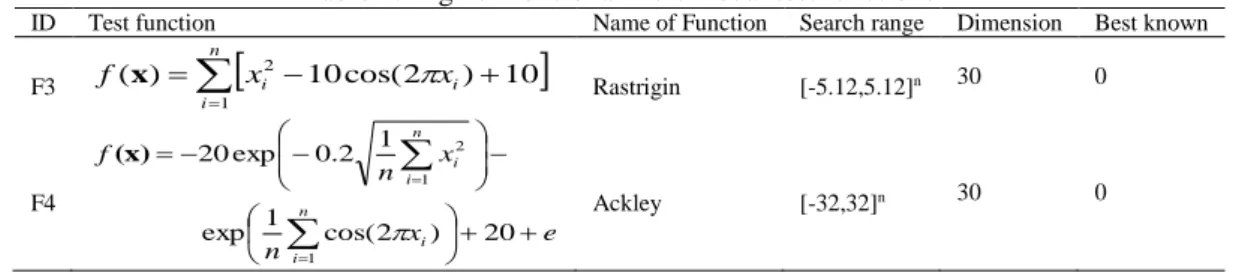
The high dimensional functions F3 and F4 are considered as the most challenging problems because it contains many local minima. Table 2 presents the properties of applied high dimensional multimodal functions.
Table 2. High dimensional multimodal test functions
ID Test function Name of Function Search range Dimension Best known
F3
n
i
i
i x
x f
1 2
10 ) 2 cos( 10 )
(x Rastrigin [-5.12,5.12]n 30 0
F4
e x
n
x n f
n
i
i n
i i
20 ) 2 cos( 1 exp
1 2 . 0 exp 20
1
1 2
(x)
Ackley [-32,32]n 30 0
3.1.3. Binary functions
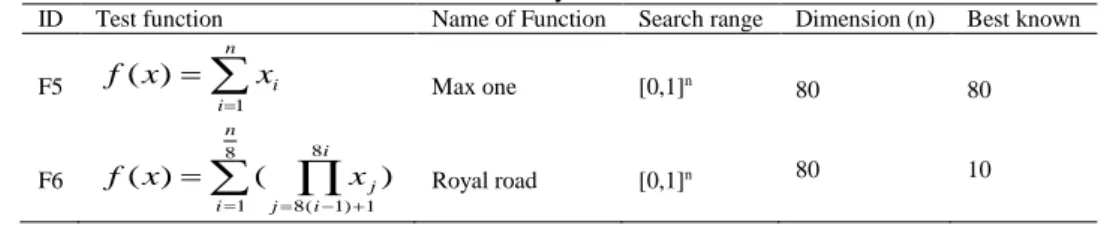
This function group is basically consisted of binary domain test function where global optimum depends on the function dimension. Table 3 reveals the properties of utilized binary test functions.
Table 3. Binary test functions
ID Test function Name of Function Search range Dimension (n) Best known
F5
n
i i
x x
f
1
)
( Max one [0,1]n
80 80
F6
8
1 8
1 ) 1 ( 8
) (
) (
n
i
i
i j
j
x x
f Royal road [0,1]n 80 10
4. PERFORMANCE TESTS
In this section, the performance of proposed BLSA with various bit updating procedures is shown using different benchmark functions and compared with other four heuristic optimization techniques to validate the results.
4.1. Parameter settings
Like other heuristic optimization techniques, BLSA has its own algorithm dependent parameter for its proper functioning. The performance of BLSA is generally influenced by the energy Ept. In this study, the value of Ept is set as 1.05. To validate the results, the effectiveness of BLSA is validated with BPSO [15], BFA [11], genetic algorithm (GA) [25] and BGSA [18]. To make fair comparison, the population size and maximum iteration are set as 50 and 500, respectively, for all algorithms.
4.2. Test results and discussion
The simulations are conducted to solve the above-mentioned benchmark functions under various test function groups in order to evaluate the performance of BLSA with each transfer function in which BLSAlog (BLSA_L), BLSAtan (BLSA_T) and BLSAQbit (BLSA_Q) represent the log sigmoid, tan hyperbolic sigmoid and Quantum bit, respectively, based BLSA. Among three test cases, Tests 1 and 2 are related to objective function minimization whereas Test 3 belongs to objective function maximization.
4.2.1. Test 1
This test group is consisted of unimodal benchmark functions F1 and F2 which are high dimensional in nature. The functions F1 and F2 are comparatively easy to solve because of single global optimal. Each benchmark function is executed 30 times independently for all algorithms while the dimension of these test functions is set as 30. A comparative study is shown in Table 4 in terms of best, worst, average, median, standard deviation and minimum number of iteration. The best performance for each algorithm is weighted in bold face. From Table 4, it is shown that the BLSA can find the best known value with all bit updating mechanisms. However, BPSO, BFA, GA and BGSA cannot find the global optimal solution. The results of these algorithms are further illustrated in box plots as shown in Figure 1 relied on 30 independent runs and the convergence characteristics are depicted in Figure 2. From Table 4 and Figure 2, it is clearly observed that the tangent hyperbolic sigmoid activation function based BLSA (BLSAtan) required less number of iterations to reach the global optimal solution. In some cases, BPSO as shown in Table 4 requires less number of iterations, however, it cannot find the best known value.
Table 4. Global optimization results of Test 1 for benchmark function in Table 1
Test Fn. Algorithm Best Worst Average Median Standard Deviation Minimum iteration
F1
BLSAlog 0 0 0 0 0 62
BLSAtan 0 0 0 0 0 28
BLSAQbit 0 0 0 0 0 34
BPSO 20239.97 49226.20 33774.02 34494.64 7030.68 23
BFA 34966.2 63715.34 52878.02 54068.65 7665.34 297
GA 46584.69 75625.58 66088.58 66521.42 6120.112 364
BGSA 1.53E-05 17.03518 1.196955 0.012367 3.292828 373
F2
BLSAlog 0 0 0 0 0 94
BLSAtan 0 0 0 0 0 20
BLSAQbit 0 0 0 0 0 36
BPSO 50.07819 102.6368 79.53768 78.85152 13.00522 21
BFA 84.82404 139.8556 117.5649 118.5391 11.91653 371
GA 129.2736 161.879 146.3888 147.5646 10.14098 56
(a) (b)
Figure 1.Global optimization results of Test 1 for benchmark functions F1 to F3. (a) F1 and (b) F2
(a) (b)
Figure 2. Convergence characteristic curves of Test 1. (a) F1 and (b) F2
4.2.2. Test 2
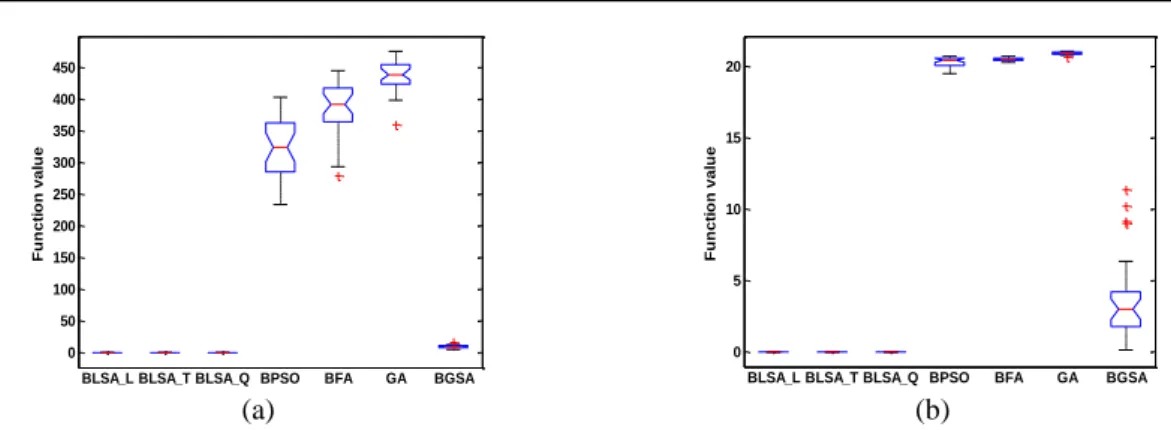
In this test, exploration and exploitation abilities of the BLSA are tested using multimodal high dimensional functions. It is important to note that the complexity level of the problems have increased because of containing many local minima. Due to several local minima, it is usually hard to find the best optimal solution. Therefore, final optimal outcomes of the tested algorithm are more significant. Similar to Test 1, again each benchmark function is performed 30 times while function dimension is maintained as 30. The numerical results are tabulated in Table 5. The best performance for each algorithm is weighted in boldface. The outcomes of 30 independent runs are depicted in Figure 3 through box plots. Furthermore, the convergence characteristic curves are shown in Figure 4. Similar to previous test, the tangent hyperbolic sigmoid activation function updating procedure (BLSAtan) is faster to find the global optimal solution than the others.
Table 5. Global optimization results of Test 2 for benchmark function in Table 2
Test Fn. Algorithm Best Worst Average Median Standard Deviation Minimum iteration
F3
BLSAlog 0 0 0 0 0 74
BLSAtan 0 0 0 0 0 21
BLSAQbit 0 0 0 0 0 30
BPSO 232.9097 403.0246 320.4552 323.8423 42.55152 28
BFA 278.638 444.8202 387.1754 392.0954 39.73813 477
GA 359.775 474.774 436.5995 438.7085 25.06685 44
BGSA 3.811253 15.94872 8.651355 8.373049 2.764086 384
F4
BLSAlog 8.88E-16 8.88E-16 8.88E-16 8.88E-16 1E-31 52
BLSAtan 8.88E-16 8.88E-16 8.88E-16 8.88E-16 1E-31 28
BLSAQbit 8.88E-16 8.88E-16 8.88E-16 8.88E-16 1E-31 34
BPSO 19.56376 20.72198 20.34145 20.44813 0.310445 17
BFA 20.34612 20.72151 20.54059 20.55727 0.105571 227
GA 20.6778 21.08882 20.96458 20.96271 0.08477 2
BGSA 0.144861 11.39533 3.744453 2.980169 2.872996 385
0 1 2 3 4 5 6 7
x 104
BLSA_L BLSA_T BLSA_Q BPSO BFA GA BGSA
F
u
n
c
ti
o
n
v
a
lu
e
F1
0 20 40 60 80 100 120 140 160
BLSA_L BLSA_T BLSA_Q BPSO BFA GA BGSA
F
u
n
c
ti
o
n
v
a
lu
e
F2
0 100 200 300 400 500
0 2 4 6 8 10 12x 10
4
Iteration
F
u
n
c
ti
o
n
v
a
lu
e
F1
BLSAlog BLSAtan BLSAQbit BPSO BFFA GA BGSA
0 100 200 300 400 500
0 0.5 1 1.5 2 2.5 3 3.5x 10
17
Iteration
F
u
n
c
ti
o
n
v
a
lu
e
F2
BLSAlog BLSAtan BLSAQbit BPSO BFFA GA BGSA
(a) (b)
Figure 3. Global optimization results of Test 2 for benchmark functions F3 and F4. (a) F3 and (b) F4
(a) (a)
Figure 4. Convergence characteristic curves of Test 2. (a) F3 and (b) F4
4.2.3. Test 3
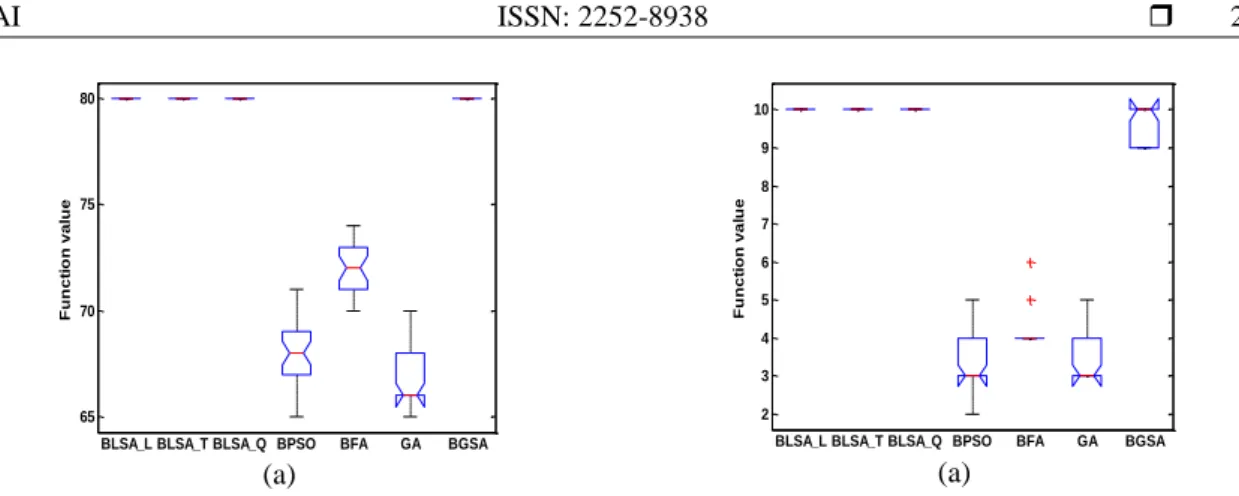
To determine the capability of the BLSA for maximization problem, this test group is handled with binary nature (Max one and Royal road) test function. The dimensions of these functions are set as 80. The simulation results are summarized in Table 6 based on 30 independent runs. The best performance for each algorithm is weighted in boldface. Similar to Tests 1 and 2, the performance of BLSA are identical for various bit updating procedures with different transfer functions as shown in Table 6 and Figures 5 and 6. For maximization problems, convergence characteristic curves portrayed in Figure 6 clearly represents that the quantum bit assisted BLSA (BLSAQbit) outperforms the others.
Table 6. Global optimization results of Test 3 for benchmark function in Table 3
Test Fn. Algorithm Best Worst Average Median Standard Deviation Minimum iteration
F5 n=80
BLSAlog 80 80 80 80 0 104
BLSAtan 80 80 80 80 0 36
BLSAQbit 80 80 80 80 0 13
BPSO 71 65 67.6 68 1.499425 30
BFA 74 70 71.93333 72 1.048261 227
GA 70 65 66.73333 66 1.201532 320
BGSA 80 80 80 80 0 302
F6 n=80
BLSAlog 10 10 10 10 0 110
BLSAtan 10 10 10 10 0 41
BLSAQbit 10 10 10 10 0 15
BPSO 5 2 3.466667 3 0.62881 23
BFA 6 4 4.233333 4 0.504007 69
GA 5 3 3.5 3 0.572351 197
BGSA 10 9 9.566667 10 0.504007 295
0 50 100 150 200 250 300 350 400 450
BLSA_L BLSA_T BLSA_Q BPSO BFA GA BGSA
F
u
n
c
ti
o
n
v
a
lu
e
F4
0 5 10 15 20
BLSA_L BLSA_T BLSA_Q BPSO BFA GA BGSA
F
u
n
c
ti
o
n
v
a
lu
e
F5
0 100 200 300 400 500 0
100 200 300 400 500 600
Iteration
F
u
n
c
ti
o
n
v
a
lu
e
F4
BLSA
log
BLSA
tan
BLSAQbit BPSO BFFA GA BGSA
0 100 200 300 400 500
0 5 10 15 20 25
Iteration
F
u
n
c
ti
o
n
v
a
lu
e
F5
BLSAlog BLSAtan BLSA
Qbit
BPSO BFFA GA BGSA
(a) (a)
Figure 5. Global optimization results of Test 3 for benchmark functions F5 and F6. (a) F5 and (b) F6
(a) (b)
Figure 6.Convergence characteristic curves of Test 3. (a) F5 and (b) F6
5. CONCLUSION
This paper investigated different methods to realize binary version of LSA using logistic, tangent hyperbolic and quantum bit probability gate, respectively. These activation functions modified the position update procedure of the original version of LSA. The solution finding ability and consistency of various transfer functions assisted BLSA were tested with various benchmark functions of different complexity. The performance of BLSA is compared with other heuristic optimization techniques. The comparative study reveals that the performance of BLSA with tangent hyperbolic sigmoid function projectile and step leader updating procedure is the best to be utilized for minimization problems whereas quantum bit method is better for maximization problems. Moreover, it can also be concluded that both tangent hyperbolic and quantum bit assisted BLSA can be equally used for both minimization and maximization problems since they can provide best global optimal solution for all standard benchmark functions corresponding to top known value without significant differences in convergence speed and computational burdens.
REFERENCES
[1] X. Huang, X. Zeng, R. Han, and X. Wang, "An enhanced hybridized artificial bee colony algorithm for optimization problems," IAES International Journal of Artificial Intelligence (IJ-AI), vol. 8, no. 1, p. 8, 2019. [2] A. Ullah, N. M. Nawi, J. Uddin, S. Baseer, and A. H. Rashed, "Artificial bee colony algorithm used for load
balancing in cloud computing: review," IAES International Journal of Artificial Intelligence (IJ-AI), vol. 8, no. 2, p. 12, 2019.
[3] R. M. Amar Hamzi, "Cat Swarm Optimization to Shunt Capacitor Allocation inAlgerian Radial Distribution Power System," IAES International Journal of Artificial Intelligence (IJ-AI), vol. 7, no. 3, p. 10, 2018.
[4] D. H. Wolpert and W. G. Macready, "No free lunch theorems for optimization," IEEE Transactions on
Evolutionary Computation, vol. 1, no. 1, pp. 67-82, 1997.
[5] H. Shareef, A. A. Ibrahim, and A. H. Mutlag, "Lightning search algorithm," Applied Soft Computing, vol. 36, pp. 315-333, 2015/11/01/ 2015.
[6] Q. Shen, J. H. Jiang, C. X. Jiao, G. L. Shen, and R. Q. Yu, "Modified particle swarm optimization algorithm for variable selection in MLR and PLS modeling: QSAR studies of antagonism of angiotensin II antagonists," (in eng),
65 70 75 80
BLSA_L BLSA_T BLSA_Q BPSO BFA GA BGSA
F
u
n
c
ti
o
n
v
a
lu
e
F11
2 3 4 5 6 7 8 9 10
BLSA_L BLSA_T BLSA_Q BPSO BFA GA BGSA
F
u
n
c
ti
o
n
v
a
lu
e
F12
0 100 200 300 400 500
45 50 55 60 65 70 75 80
Iteration
F
u
n
c
ti
o
n
v
a
lu
e
F11
BLSAlog BLSAtan BLSAQbit BPSO BFFA GA BGSA
0 100 200 300 400 500
1 2 3 4 5 6 7 8 9 10
Iteration
F
u
n
c
ti
o
n
v
a
lu
e
F12
BLSAlog BLSAtan BLSAQbit BPSO BFFA GA BGSA
European journal of pharmaceutical sciences : official journal of the European Federation for Pharmaceutical
Sciences, vol. 22, no. 2-3, pp. 145-52, Jun 2004.
[7] Y. Jeong, J. Park, S. Jang, and K. Y. Lee, "A New Quantum-Inspired Binary PSO: Application to Unit Commitment Problems for Power Systems," IEEE Transactions on Power Systems, vol. 25, no. 3, pp. 1486-1495, 2010.
[8] A. M. Ahmad Asrul Ibrahim, Hussain Shareef, "A Novel Quantum-inspired Binary Gravitational Search Algorithm in Obtaining Optimal Power Quality Monitor Placement.," Journal of Applied Sciences, vol. 12, pp. 822-830, 2012. [9] P. Li, Z. Zhou, X. Lin, X. Yang, and X. Niu, "Dynamic optimal operation scheduling of microgrid using binary gravitational search algorithm," in 2014 International Conference on Power System Technology, 2014, pp. 3175-3180.
[10] H. Shareef, A. A. Ibrahim, N. Salman, A. Mohamed, and W. Ling Ai, "Power quality and reliability enhancement in distribution systems via optimum network reconfiguration by using quantum firefly algorithm," International
Journal of Electrical Power & Energy Systems, vol. 58, pp. 160-169, 2014/06/01/ 2014.
[11] R. R. Mohammad Kazem Sayadi, Nader Ghaffari-Nasab, "A discrete firefly meta-heuristic with local search for makespan minimization in permutation flow shop scheduling problems," International Journal of Industrial
Engineering Computations, vol. 1, no. 1, pp. 1-10, 2010.
[12] V. Krishnasamy, "Genetic algorithm for solving optimal power flow problem with UPFC," International Journal
of Software Engineering and Its Applications, vol. 5, no. 1, pp. 39-50, 2011.
[13] A. Gherboudj, A. Layeb, and S. Chikhi, "Solving 0-1 knapsack problems by a discrete binary version of cuckoo search algorithm," Int. J. Bio-Inspired Comput., vol. 4, no. 4, pp. 229-236, 2012.
[14] G. Feng, M. Liu, and G. Wang, "Genetic algorithm based optimal placement of PIR sensors for human motion localization," Optimization and Engineering, journal article vol. 15, no. 3, pp. 643-656, September 01 2014. [15] J. Kennedy and R. C. Eberhart, "A discrete binary version of the particle swarm algorithm," in 1997 IEEE
International Conference on Systems, Man, and Cybernetics. Computational Cybernetics and Simulation, 1997,
vol. 5, pp. 4104-4108 vol.5.
[16] D. Rodrigues et al., "BCS: A Binary Cuckoo Search algorithm for feature selection," in 2013 IEEE International
Symposium on Circuits and Systems (ISCAS2013), 2013, pp. 465-468.
[17] B. Niu and Y. Bi, "Binary bacterial foraging optimization for 0/1 knapsack problem," in 2014 IEEE Congress on
Evolutionary Computation (CEC), 2014, pp. 647-652.
[18] E. Rashedi, H. Nezamabadi-pour, and S. Saryazdi, "BGSA: binary gravitational search algorithm," Natural
Computing, journal article vol. 9, no. 3, pp. 727-745, September 01 2010.
[19] C. P. G. Manasarani Mandala, "Binary Artificial Bee Colony Optimization for GENCOs'Profit Maximization under Pool Electricity Market " International Journal of Computer Applications, vol. 90, no. 19, pp. 34-42, 2014. [20] S. Mirjalili and S. Z. M. Hashim, "BMOA: binary magnetic optimization algorithm," International Journal of
Machine Learning and Computing, vol. 2, no. 3, p. 204, 2012.
[21] A. A. Ibrahim, A. Mohamed, and H. Shareef, "Optimal power quality monitor placement in power systems using an adaptive quantum-inspired binary gravitational search algorithm," International Journal of Electrical Power &
Energy Systems, vol. 57, pp. 404-413, 2014/05/01/ 2014.
[22] Y.-H. Chou, C.-H. Chiu, and Y.-J. Yang, "Quantum-inspired tabu search algorithm for solving 0/1 knapsack problems," presented at the Proceedings of the 13th annual conference companion on Genetic and evolutionary computation, Dublin, Ireland, 2011.
[23] M. M. Islam, H. Shareef, A. Mohamed, and A. Wahyudie, "A binary variant of lightning search algorithm: BLSA,"
Soft Computing, journal article vol. 21, no. 11, pp. 2971-2990, June 01 2017.
[24] K.-H. Han and J.-H. Kim, "Quantum-inspired evolutionary algorithm for a class of combinatorial optimization,"
Trans. Evol. Comp, vol. 6, no. 6, pp. 580-593, 2002.
[25] R. L. H. a. S. E. Haupt, "The Binary Genetic Algorithm. In Practical Genetic Algorithms," John Wiley and Sons