GLR Detector for Coded Signals
in Noise and Interference
A.A. Tadaion
, M. Derakhtian
1, M.M. Nayebi
2and M.R. Aref
2In this paper, the detection of a coded signal in additive white Gaussian noise and the interference is studied, where there is no knowledge about the correlation between the received symbols and about the noise and interference parameters. The Maximum Likelihood (ML) estimates of the unknown parameters are found, they are substituted in the probability density functions of the observation and the Generalized Likelihood Ratio (GLR) detector is derived. This detector can also be used for the activity detection of a signal in unknown Inter-Symbol Interference (ISI). In this case, the interference is modeled as the unknown correlation between the received symbols. Simulation examples are performed to evaluate the performance of the proposed detector.
INTRODUCTION
Detection methods for signals with correlation between the received symbols in noise and interference are of special importance in the implementation of a communication system. Signal activity detection is an important stage in real communication systems, since the performance of the succeeding stages, such as demodulation and decoding, depends on correct knowledge of the signal activity. The signal sym-bols are either independent or correlated with some known/unknwon properties. The correlation between the received symbols in a transmission system may be because of the coding on the transmitted information or due to the Inter-Symbol Interference (ISI) imposed on the signal, as the signal goes through the channel. Some attempts are made to propose ecient detectors, in terms of performance and computational complexity, for such a detection problem in a variety of appli-cations, including spectrum management and surveil-lance, signal conrmation and some other intelligence gathering activities, interference identication, mod-ulation classication and, also, in electronic warfare and threat analysis (e.g., see [1-9] and the references therein).
The traditional method of detecting the presence
*. Corresponding Author, Department of Electrical Engi-neering, Yazd University, Yazd, I.R. Iran.
1. Department of Electrical Engineering, Shiraz University, Shiraz, I.R. Iran.
2. Department of Electrical Engineering, Sharif University of Technology, Tehran, I.R. Iran.
of a signal is the energy detector, in which the energy level of the received signal is compared with a prede-termined threshold, to detect whether a signal is active or not [3]. However, such a method is susceptible to the a priori knowledge of the noise variance and the interference [1]. It must be noted that most of the exist-ing methods for signal presence detection assume that the signal, or some of its parameters, and/or the noise parameters are known, while, in practice, they may not be available to the receiver. In addition, mostly, the presence detection problem has not been studied in cases where the received symbols are correlated. The authors have proposed Generalized Likelihood Ratio (GLR) detectors for the activity detection of a Phase Shift Keying (PSK) signal with unknown amplitude and phase in unknown white Gaussian noise [10].
In this paper, the signal presence detection in Additive White Gaussian Noise (AWGN) is studied, where the received symbols are correlated. The GLR detector for this problem is derived. It is noted that the well-known problem of the activity detection of a signal in noise and ISI can also be formulated and solved by the proposed detector. Therefore, the recent problem is formulated and the proposed GLR detector is applied to solve it.
The remainder of the paper is organized as fol-lows. First, the signal presence detection problem is formulated as a binary hypothesis test. Then, the Maximum Likelihood (ML) estimates of the unknown parameters are founded and, by substituting them in the Likelihood Ratio (LR), the GLR detector is derived. After that, the presence detection of a signal in ISI is studied and, assuming that the channel is
unknown, the GLR solution is proposed. No assump-tion is made of the signal in this derivaassump-tion and some simulation examples and their results are reported to evaluate the performance of the presented detector. Finally, the paper is concluded.
PROBLEM FORMULATION
The desired problem is modeled as a binary hypothesis testing problem. In hypothesis H0, the samples of
the white Gaussian noise that are independent are received. In this hypothesis, no assumption of receiving the signal is made. The white Gaussian noise samples are of the zero mean and unknown variance, 2. In
hypothesis H1, the signal is received in AWGN. The
transmitted symbols are assumed to be chosen from a symmetric constellation, such as a PSK family or some QAM (Quadrature Amplitude Modulation), such as 16QAM. The assumption is that the received symbols are correlated. For instance, the transmitter uses a coding that is unknown for the receiver and, so one can assume that the received symbols are the samples of a Gaussian process with zero mean and unknown covariance matrix R. In this formulation, ISI is not assumed, the receiver noise is additive white Gaussian and independent of the signal. The hypothesis testing problem is, then, as follows:
(
H0: r[k] = u[k]; the signal is absent,
H1: r[k] = v[k]; the signal is present,
k = 0; ; K 1; (1)
where r[k] = [r0[k]; ; rN 1[k]]T is the baseband
representation of the received signal vector in the kth time interval (that can be anywhere in the received sequence), u[k] = [u0[k]; ; uN 1[k]]T N (0; 2IN),
in hypothesis H0, is the complex white Gaussian
noise with zero mean and unknown variance 2. In
hypothesis H1, v[k] = [v0[k]; ; vN 1[k]]T N (0; R)
represents the correlated signal symbols plus AWGN. Since the modulated signal samples are correlated, due to the coding applied to them, the signal plus noise in hypothesis H1 is modeled as a Gaussian process with
zero mean and covariance matrix R. In addition, the observation data is considered as some N-blocks, which is necessary for the estimation of the covariance matrix, R (see e.g. [11]).
GENERALIZED LIKELIHOOD RATIO DETECTOR FOR CODED SIGNALS
According to the Neyman-Pearson criteria, the optimal test is obtained by constructing the LR and comparing it with a threshold. This threshold is adjusted, such that the Probability of False Alarm, (Pfa), be less than
a predetermined value. In composite hypothesis testing problems, where one or both of the hypotheses contain unknown parameters, if the constructed test maximizes the Probability of Detection (Pd) for all values of
the unknown parameters, the detector is Uniformly Most Powerful (UMP) test. However, the UMP test does not exist for all composite hypothesis testing problems [12]. Therefore, the UMP tests are looked for within the class of invariant tests or unbiased tests, namely, UMP Invariant (UMPI) or UMP Unbiased (UMPU) tests, respectively. The other well-known test is the GLR test, which mostly performs close to optimum [10]. In this detector, the ML estimates of the unknown parameters are substituted in the likelihood ratio and the resulting likelihood ratio is compared with a threshold [13].
In the following, to derive the GLR detector for Equation 1, the ML estimates of the unknown parameters, 2 and R are substituted, under each
hypothesis in the probability density functions (pdfs) of the observation under each hypothesis and the LR is constructed. The pdf of the observation signals under the hypotheses, H0and H1, are as follows:
f(r[0]; ; r[K 1]; H0)
= 1
(2)2KN exp
( 1 2
K 1X k=0
rH[k]r[k]
) ;
(2a) f(r[0]; ; r[K 1]; H1)
=((2)2N1jRj)K exp
( K 1
X
k=0
rH[k]R 1r[k]
) ;
(2b) where (:)H is the conjugate transpose and j:j is the
determinant of the matrix. In the following, the ML estimates of the unknown parameters, 2 and R, will
be found. Taking the natural logarithm of both sides of Equation 2b, one has:
ln f(r[0]; ; r[K 1]; H0)
= KN ln(422) 1
2 K 1X
k=0
rH[k]r[k]; (3)
and by taking the derivation of the recent equation, with respect to 2, the ML estimate of the 2 will be
as follows: c 2= 1
KN
K 1X k=0
rH[k]r[k]: (4)
In order to nd the ML estimate of R, by taking the natural logarithm of both sides of Equation 2b and
since one has:
K 1X k=0
rH[k]R 1r[k] = trace R 1K 1X k=0
r[k]r[k]H
! ; the following is reached:
ln f(r[0]; ; r[K 1]; H1)
= 2NK ln(2) K ln(jRj) trace R 1K 1X
k=0
r[k]r[k]H
!
: (5)
If one takes the derivation of the recent equation with respect to R, from the identities (@=@R) ln(jRj) = R 1
and: @
@Rtrace R 1
K 1X k=0
r[k]r[k]H
!
= R 1K 1X k=0
r[k]r[k]HR 1;
one obtains: ^
R = K1
K 1X k=0
r[k]rH[k]: (6)
Substituting Equaion 4 in Equation 2a and Equation 6 in Equation 2b, respectively, the likelihood ratio is as follows:
f(r[0]; ; r[K 1]; H1)j(6)
f(r[0]; ; r[K 1]; H0)j(4) =
d
2NKe N
j ^RjKe NK
= 0 B B B B @ 1 NK
K 1P k=0r H[k]r[k] N 1 K
K 1P k=0r[k]r H[k] 1 C C C C A K
eN(K 1); (7)
where aj(:) means substituting the results of equations
numbered by (:) in the expression of a. After removing constants and, since xKN is an increasing function
of x, comparing the above likelihood ratio with the threshold, TKN, is equivalent to comparing:
1 NK
K 1P k=0r H[k]r[k] 1 K
K 1P k=0r[k]r
H[k]
!1
N ;
with threshold T . By dropping the constants (that can be absorbed in the threshold) and taking the Nth root, the GLR test rejects H0, if:
LGLR(r) = trace(S)
jSj1
N > GLR; (8)
where S =K 1P
k=0r[k]r
H[k] and trace(:) is the trace of the
matrix. Therefore, in order to determine if the received signal does contain a coded signal or is only noise, one can construct the matrix, S, and compare the ratio of Equation 8 with a threshold. The threshold, GLR,
in this detector is obtained, based on the maximum allowable value of the probability of false alarm, Pfa;
i.e. the threshold is selected, such that the Pfa does
not exceed a pre-determined value. It must be noted that the detection threshold is independent of the SNR and can be obtained by a Monte-Carlo simulation.
The model used in this problem can also be used for the detection of a signal that is passed through an ISI channel. In the following section, the corresponding detector is proposed.
GENERALIZED LIKELIHOOD RATIO DETECTOR IN THE PRESENCE OF ISI In this case, in the null hypothesis, H0, one only
receives noise and, in the other hypothesis, H1, he
receives the signal that is passed through an ISI channel. Assuming that one sample is available at each symbol interval, the received signal is:
rp = L 1X
l=0
hlsp l+ np; (9)
where spare the received symbols and hl; l = 0; ; L
1 are the unknown channel coecients of a Finite Impulse Response (FIR) channel. The elements of the covariance matrix of the received signal in hypothesis H1 are as follows:
E(rprHm) = L 1X
l=0 L 1X
t=0
hlhHt E(sp lsHm t) + 2[p m]
=L 1X
t=0
ht+(p m)hHt + 2[p m]: (10)
For instance, if L = 3, the covariance matrix of the received signal is as follows:
R= 2 4jh0j
2+jh1j2+jh2j2+2 h0hH
1 + h1hH2
h1hH0 + h2hH1 jh0j2+ jh1j2+jh2j2+2
h2hH0 h1hH0 + h2hH1
h0hH2
h0hH1 + h1hH2
jh0j2+ jh1j2+ jh2j2+ 2
3
It must be noted that the symbols of the received signal are considered as independent random variables. The hypothesis testing problem will then be:
(
H0: r[k] = n[k];
H1: r[k] = w[k]; k = 0; ; K 1; (12)
where n[k] = [n0[k]; ; nN 1[k]]T N (0; 2IN)
and w[k] = [w0[k]; ; wN 1[k]]T N (0; R). The
assumption is that w[k] and w[m] for 0 k 6= m K 1 are mutually independent. In order to satisfy this condition, one can choose the N-vectors, r[k], from the received signal, such that they are N + L apart. Note that r[k]; 1 k K 1 are used as the secondary data for the estimation of the covariance matrix and, since they can be chosen anywhere in the received signal sequence, they are chosen in such a way that the rst components of r[k] and r[k + 1], i.e. r0[k] and r0[k + 1]
are, at least, N+L apart from each other in the received signal sequence.
Since there is no assumption of the interference, this detector can also detect the coded signals in unknown interference. Obviously, compared to the previous situations, the lower performance in this case is expected, as the number of unknown parameters is increased.
SIMULATION RESULTS
The performance of the proposed detector is evaluated by simulations. In the authors' simulations, the threshold in each test is determined experimentally, as follows: The decision statistics for 105 independent
trials in the absence of signal were sorted in ascending order and the threshold was chosen as the %100 Pfa
-percentile of the resulting data. For example, for Pfa=
0:01, the threshold is chosen as the 0:01 105= 103th
ordered data; i.e., such that %100 Pfaof the decision
statistics are above the threshold. This threshold is independent of the unknown parameters. Since the threshold is obtained in the null hypothesis, H0, and in
this hypothesis, if one divides both the numerator and denominator by 2, it is as if the received vectors are
divided by and are of distribution N (0; IN), which
is independent of the unknown parameters. Such a detector is called a Constant False Alarm Rate (CFAR) detector. In Figure 1, it is observed that the proposed detector (Equation 8) is CFAR, compared with the energy detector. It is shown that, in contrast to the energy detector, the performance of the proposed GLR detector is constant as the noise variance varies.
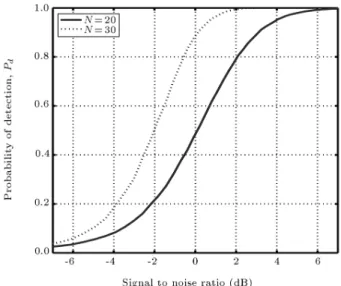
Other simulation examples are from the high application problem of the signal detection in ISI. The channel assumed is a channel with the high interference of length 3 and the coecients h = [1; 0:9; 0:8]. Figure 2 shows the probability of detection versus the
Figure 1. Performance comparison of the proposed GLR and the energy detector in terms of the probability of false alarm versus the noise variance.
Figure 2. Performance comparison of the proposed GLR for the BPSK signal detection in noise and unknown interference for dierent values of N = 20, 30 and Pfa= 0:01.
signal amplitude for some values of N = 20; 30. In these simulations, Pfa = 0:01 is assumed and the
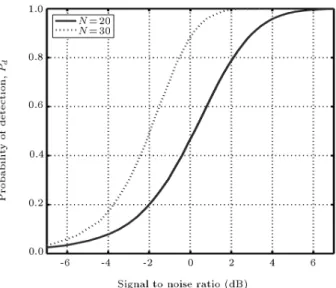
transmitter uses the Binary PSK (BPSK) modulation. It is observed that, as N increases, the performance of the detector improves. Similar simulations are performed for Quadrature PSK (QPSK) modulations in Figure 3.
CONCLUSION
In this paper, the presence detection of a coded signal is studied in cases where there is no knowledge about the correlation between the received symbols. A proper
Figure 3. Performance comparison of the proposed GLR for the QPSK signal detection in noise and unknown interference for dierent values of N = 20, 30 and Pfa= 0:01.
model is proposed for the problem and the GLR detector is derived by substituting the ML estimates of the unknown parameters in the likelihood ratio. In the authors' assumptions, the noise variance, the received signal amplitude and the coding are unknown. In addition, the signal detection in ISI is described, similar to the previous problem, and the GLR detector is derived. The performance of the proposed detector is evaluated by some simulation examples. It is shown that the authors detector is CFAR, compared with the well-known energy detector.
REFERENCES
1. Gardner, W.A. \Signal interception: A unifying theo-retical framework for feature detection", IEEE Trans-actions on Communications, 36(8), pp 897-906 (Aug. 1988).
2. Krasner, N.F. \Optimal detection of digitally
mod-ulated signals", IEEE Transactions on Communica-tions, COM-30(5), pp 885-895 (Jan. 1982).
3. Terrieri, D.J. Principles of Secure Communication Systems, Dedham, MA: Artech (1985).
4. Gardner, W.A. and Spooner, C.M. \Signal intercep-tion: Performance advantages of cyclic feature detec-tors", IEEE Trans. on Communications, 40(1), pp 149-159 (Jan. 1992).
5. Poor, H.V., An Introduction to Signal Detection and Estimation, Springer (1994).
6. Ramprashad, S.A. and Parks, T.W. \Locally most powerful invariant tests for signal detection", IEEE Transactions in Information Theory, 44(3), pp 1283-88 (May 1998).
7. Azzouz, E.E. and Nandi, A.K., Automatic Modulation Recognition of Communication Signals, Kluwer Aca-demic Publishers, Norwell, MA (1996).
8. Liedtke, F.F. \Computer simulation of an automatic classication procedure for digitally modulated com-munication signals with unknown parameters", Signal Processing, 6, pp 311-323 (1984).
9. Wei, W. and Mendel, J.M. \Maximum-likelihood clas-sication for digital amplitude-phase modulations", IEEE Trans. on Commun., 48(2), pp 189-193 (Feb. 2000).
10. Tadaion, A.A., Derakhtian, M., Gazor, S., Nayebi, M.M. and Aref, M.R.\Signal activity detection of phase-shift keying signals", IEEE Transactions on Communications, 54(8), pp 1439-1445 (Aug. 2006). 11. Raghavan, R.S., Qiu, H.E. and McLaughlin, D.J.
\CFAR detection in clutter with unknown correlation properties", IEEE Transaction on Aerospace and Elec-tronic Systems, 28(3), pp 661-665 (July 1992). 12. Derakhtian, M. and Nayebi, M.M. \UMP, ALR and
GLR tests and some applications to coherent radar detection", Proceeding of the IEEE International Sym-posium on Information Theory, ISIT-2000, p 388, (June 25-30 2000).
13. Kay, S.M., Fundamentals of Statistical Signal Process-ing: Detection Theory, Prentice Hall (1998).