Volume 2013, Article ID 587569,6pages http://dx.doi.org/10.1155/2013/587569
Research Article
Controllability of Second-Order Multiagent Systems with
Multiple Leaders and General Dynamics
Bo Liu,
1Hongke Feng,
1Li Wang,
2Rong Li,
3Junyan Yu,
4Housheng Su,
5and Guangming Xie
61College of Science, North China University of Technology, Beijing 100144, China
2Beijing Key Lab of Urban Intelligent Traffic Control Technology, North China University of Technology, Beijing 100144, China
3Department of Applied Mathematical Sciences, Shanghai Finance University, Shanghai 201209, China
4College of Mathematical Science, University of Electronic Science and Technology of China, Chengdu 611731, China
5Department of Control Science and Engineering, Key Laboratory of Image Processing and Intelligent Control of Education Ministry
of China, Huazhong University of Science and Technology, Wuhan 430074, China
6Intelligent Control Laboratory, Center for Systems and Control, Department of Industrial Engineering and Management,
College of Engineering, Peking University, Beijing 100871, China
Correspondence should be addressed to Bo Liu; [email protected] Received 3 April 2013; Accepted 3 June 2013
Academic Editor: Ming Cao
Copyright © 2013 Bo Liu et al. This is an open access article distributed under the Creative Commons Attribution License, which permits unrestricted use, distribution, and reproduction in any medium, provided the original work is properly cited.
This paper proposes a new second-order discrete-time multiagent model and addresses the controllability of second-order multiagent system with multiple leaders and general dynamics. The leaders play an important role in governing the other member agents to achieve any desired configuration. Some sufficient and necessary conditions are given for the controllability of the second-order multiagent system. Moreover, the speed controllability of the second-second-order multiagent system with general dynamics is discussed. Particularly, it is shown that the controllability of the whole system relies on the number of leaders and the connectivity between the leaders and the members. Numerical examples illustrate the theoretical results.
1. Introduction
Controllability is one of the fundamental issues for coordi-nated control of multiagent systems which is partly due to the wide applications in communication and computation, as well as cooperative control [1–19].
So far, the issue of controllability shows new features and difficulties, and is still lacking in studies. In [4], the issue of controllability was firstly investigated by the nearest neighbor rules. Tanner had obtained necessary and sufficient conditions of the controllability for first-order multiagent dynamic systems regarding an agent as a leader or the external input. In [5, 7], the controllability for multiagent systems was investigated by the graph theoretic charac-terization. Moreover, Ji et al. [17] analyzed the multiagent controllability using tree topology. Jafari et al. [18] studied the structural controllability of multiagent systems. In [9,15,
16], the authors discussed the controllability of discrete-time multiagent systems with a single leader or multiple leaders on fixed networks and switching networks, respectively, and obtained the necessary or sufficient controllable conditions for multiagent systems. References [10,14] studied the con-trollability of continuous-time multiagent systems with time-delay and switching topology, respectively.
However, most of the recent research work focuses on the controllability of single integrator or first-order multiagent dynamic systems, such as [4–19]. But the controllability of double integrator or second-order multiagent dynamic systems was seldom studied. Motivated by the works above, in this paper, we focus on discussing the controllability of second-order discrete-time multiagent systems with general dynamic topology. Some sufficient and necessary conditions for controllability are presented. The main contributions of our paper lie in the following. (1) A novel model of
discrete-time multiagent system is a second-order. (2) The influence of leaders on the followers is investigated. (3) The controllability of such second-order discrete-time system with multiple leaders and general dynamics is considered, which cannot be found in the recent literatures. (4) The controllability and the speed controllability of the second-order multiagent system are discussed, respectively. (5) A sufficient and necessary condition for controllability of the second-order system is presented.
This paper is organized as follows. InSection 2, we present some concepts in graph theory.Section 3 gives the model to be studied. In Section 4, main results are presented. In
Section 5, numerical examples and simulations are provided to illustrate the theoretical results. A conclusion is made in
Section 6.
2. Preliminaries
In this section, some basic definitions and concepts in graph theory [20] are first introduced.
Let G = (V,E, 𝐴)be an undirected graph of order 𝑛 with the set of nodesV= {1, 2, 3, . . . , 𝑛}and the set of edges E ⊆ V×V. An edge of Gis denoted by(𝑖, 𝑗), which is an unordered pair of distinct nodes ofV. If𝑖, 𝑗 ∈ V, and
(𝑖, 𝑗) ∈ E, then we say that𝑗 is a neighbor of𝑖or𝑖and 𝑗 are adjacent. The neighborhood set of node𝑖is denoted by N𝑖 = {𝑗 ∈ V : (𝑖, 𝑗) ∈ E}. 𝐴 = [𝑎𝑖𝑗] ∈ R𝑛×𝑛, where
𝑎𝑖𝑗 > 0 ⇔ (𝑗, 𝑖) ∈ E, and𝑎𝑖𝑗is called the coupling weight of edge(𝑖, 𝑗).
Any undirected graph can be represented by its adjacency matrix𝐴, which is a symmetric matrix. A diagonal matrix
𝐷 =diag{𝑑1, 𝑑2, . . . , 𝑑𝑛} ∈ 𝑅𝑛×𝑛is a degree matrix ofGwith its diagonal elements𝑑𝑖= ∑𝑗∈N𝑖𝑎𝑖𝑗,𝑖 = 1, 2, . . . , 𝑛.
Then, the Laplacian of the graphG(or matrix𝐴) is de-fined as
𝐿 = 𝐷 − 𝐴 ∈ 𝑅𝑛×𝑛. (1)
3. Model
Consider a second-order multiagent system with 𝑁 + 𝑛𝑙 agents, labeled the first𝑁agents from1to𝑁as followers and the remainder𝑛𝑙agents from𝑁 + 1to𝑁 + 𝑛𝑙as leaders, and each agent moves according to the following dynamics:
𝑥𝑖(𝑘 + 1) = 𝑥𝑖(𝑘) +V𝑖(𝑘) , V𝑖(𝑘 + 1) =V𝑖(𝑘) + 𝑢𝑖(𝑘) , (2) with 𝑢𝑖(𝑘) = − ∑ 𝑖∈N𝑖𝑗 𝑎𝑖𝑗(V𝑖(𝑘) −V𝑗(𝑘)) − ∑ 𝑝∈N𝑖𝑝 𝛾𝑖𝑝𝑏𝑖𝑝(V𝑖(𝑘) −V𝑝(𝑘)) , 𝑘 ∈ 𝐽𝑘, (3)
where𝑥𝑖∈R𝑚is the state of agent𝑖(𝑖 ∈ 𝑁 ≜ {𝑁 + 1, . . . , 𝑁 +
𝑛𝑙}) and 𝑥𝑝 ∈ R𝑚 is the state of agent 𝑝 (𝑝 ∈ 𝑁 + 𝑛𝑙 −
𝑁, 𝑁 + 𝑛𝑙 ≜ {1, 2, . . . , 𝑁}).N𝑖presents the neighbor set of
agent𝑖.N𝑖𝑗⋃N𝑖𝑝 =N𝑖, andN𝑖𝑗⋂N𝑖𝑝 = 0.𝐽𝑘is a discrete-time index set. The coupling matrix𝐴 = [𝑎𝑖𝑗] ∈R𝑁×𝑁with
𝑎𝑖𝑗≥ 0and𝑎𝑖𝑖= 0represents the coupling strength among the followers, and𝐵 = [𝑏𝑖𝑝] ∈ R𝑁×𝑛𝑙 with𝑏𝑖𝑝 > 0represents the coupling strength from the leaders to the followers.𝛾𝑖𝑝 = 1 if there is information from leader𝑝to follower𝑖; otherwise
𝛾𝑖𝑝= 0.
Throughout this paper, it is assumed that the leader can influence the member followers but cannot be influenced by its neighbors.
Suppose 𝑧 = (𝑥1, 𝑥2, . . . , 𝑥𝑁,V1,V2, . . . , 𝑥𝑁)𝑇 and 𝑦 =
(𝑥𝑁+1, 𝑥𝑁+2, . . . , 𝑥𝑁+𝑛𝑙,V𝑁+1,V𝑁+2, . . . ,V𝑁+𝑛𝑙)𝑇 be the state
vector of all the followers and all the leaders, respectively. Then, (2) can be rewritten as
𝑧 (𝑘 + 1) = 𝐺𝑧 (𝑘) + 𝐻𝑦 (𝑘) , 𝑘 ∈ 𝐽𝑘, (4)
where
𝐺 = (𝐼 𝐼0 𝐹) , 𝐻 = (0 00 𝑃) , (5)
𝐹 = 𝐼 − 𝐿 − 𝑅,𝐼is the𝑁 × 𝑁identity matrix,
𝑅 =diag{∑ 𝑝𝛾1𝑝𝑏1𝑝, ∑𝑝𝛾2𝑝𝑏2𝑝, . . . , ∑𝑝𝛾𝑁𝑝𝑏𝑁𝑝} ∈R 𝑁×𝑁, 𝑃= [ [ [ [ [ [ [ [ 𝛾1(𝑁+1)𝑏1(𝑁+1) 𝛾1(𝑁+2)𝑏1(𝑁+2) . . . 𝛾1(𝑁+𝑛𝑙)𝑏1(𝑁+𝑛𝑙) 𝛾2(𝑁+1)𝑏2(𝑁+1) 𝛾2(𝑁+2)𝑏2(𝑁+2) . . . 𝛾2(𝑁+𝑛𝑙)𝑏2(𝑁+𝑛𝑙) .. . ... d ... 𝛾𝑁(𝑁+1)𝑏𝑁(𝑁+1) 𝛾𝑁(𝑁+2)𝑏𝑁(𝑁+2) . . . 𝛾𝑁(𝑁+𝑛𝑙)𝑏𝑁(𝑁+𝑛𝑙) ] ] ] ] ] ] ] ] . (6) For simplicity, we denote (6) as
𝑃 = [𝑝𝑁+1, 𝑝𝑁+2, . . . , 𝑝𝑁+𝑛𝑙] ∈R𝑁×𝑛𝑙, (7)
where
𝑝𝑝 = (𝛾1𝑝𝑏1𝑝, 𝛾2𝑝𝑏2𝑝, . . . , 𝛾𝑁𝑝𝑏𝑁𝑝)𝑇∈R𝑁×1,
𝑞 ∈ 𝑁 + 𝑛𝑙− 𝑁, (8)
and the matrix𝐿 = [𝑙𝑖𝑗]with
𝑙𝑖𝑗= { { { { { { { { { −𝑎𝑖𝑗, 𝑖 ̸= 𝑗and 𝑗 ∈N𝑖𝑗 ∑ 𝑗∈N𝑖𝑗 𝑎𝑖𝑗, 𝑖 = 𝑗 0, otherwise. (9)
It can be easily seen that the matrix 𝐿 satisfies the following:
(i) the off-diagonal elements are all negative or zero; (ii) the row sums are equal to the column sums with the
4. Main Results
In the following, we first give the definition of controllability in second-order discrete-time system and the classical crite-rion of controllability.
Definition 1. A nonzero state𝑧0of system (4) is controllable
at the initial timeℎ ∈ 𝐽𝑘if there exists a finite time𝑙 ∈ 𝐽𝑘,𝑙 > ℎ and a control input𝑦(𝑘), such that𝑧(ℎ) = 𝑧0and𝑧(𝑙) = 0. If any nonzero state𝑧0of system (4) is controllable, then system (4) is said to be controllable. If𝑥(ℎ) = 𝑥0and𝑥(𝑙) = 0, then system (4) is position controllable, and ifV(ℎ) =V0andV(𝑙) =
0, then system (4) is speed controllable.
Definition 2(controllability matrix). The controllability
ma-trix of system (4) is given by
𝑄 = [𝐻 𝐺𝐻 𝐺2𝐻 ⋅ ⋅ ⋅ 𝐺2𝑁−1𝐻] , (10)
where matrix𝑄 ∈R2𝑁×𝑁𝑛𝑙.
Lemma 3 (Rank test for controllability). System(4)is
control-lable if Rank(𝑄) = 2𝑁.
Lemma 4 (PBH rank test for discrete-time systems). System
(4)is controllable if (4)satisfies one of the following conditions:
(i) rank(𝑠𝐼 − 𝐺, 𝐻) = 2𝑁, for all𝑠 ∈C;
(ii) rank(𝜆𝑖𝐼 − 𝐺, 𝐻) = 2𝑁, where𝜆𝑖, for all𝑖 = 1, 2, . . . ,
2𝑁, is the eigenvalue of matrix𝐺.
In general, for second-order multiagent systems, the con-trollable matrix is too hard to calculate. Therefore, we can use the PBH rank rest to justify the controllability of such system. In the following, we will give a more simple and convenient theorem using the PBH rank rest.
Theorem 5. System(4)is controllable if Rank(𝑃) = 𝑚.
Proof. ByLemma 4, system (4) is controllability if rank(𝜆𝑖𝐼 −
𝐺, 𝐻) = 2𝑁, where𝜆𝑖, for all𝑖 = 1, 2, . . . , 2𝑁, is the eigen-value of matrix𝐺. Then, it is obvious to see that
rank(𝜆𝑖I− 𝐺 𝐻) =rank(𝜆𝑖𝐼 − 𝐼0 𝜆 −𝐼 0
𝑖𝐼 − 𝐹 𝑃) = 2𝑁,
(11) if Rank(𝑃) = 𝑚.
Remark 6. From Theorem 5, we can find that the
second-order multiagent system (4) is controllable if𝑛𝑙≥ 𝑁(𝑛𝑙is the number of leaders and𝑁the number of followers); otherwise, the system is always uncontrollable.
Remark 7. Notice that the direct consequence ofTheorem 5
is that the controllability of the network (4) of a group of agents relies only on the connectivity between the leaders and members, regardless of the connectivity of the members in the network.
Corollary 8. If Rank(𝑃) = 𝑁, system(4)is speed
control-lable.
1 2 3
4 5 6 7
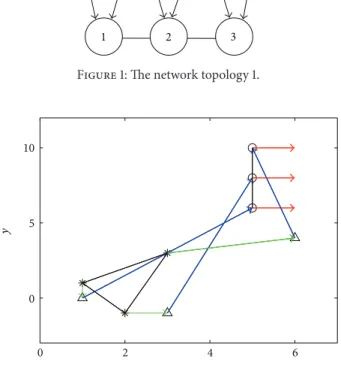
Figure 1: The network topology 1.
0 2 4 6 0 5 10 x y
Figure 2: A straight line configuration with speed.
Under the symmetry condition of the adjacent matrix𝐴, we can have the following result.
Theorem 9. System(4)is speed controllable if and only if the
following conditions hold.
(i)The eigenvalues of𝐹are all distinct.
(ii)All the eigenvectors of𝐹are not orthogonal to at least
one column in𝑃simultaneously.
The proof ofLemma 3is similar to that of [15, Theorem 1], here omitted.
Remark 10. FromCorollary 8andTheorem 9, it can be easily
seen that even though system (4) is speed controllable, system (4) cannot be completely controllable.
5. Numerical Examples and Simulations
This section presents some numerical examples and simula-tions to illustrate the theoretical results.
Example 1. Consider a seven-agent network with agents 4–7
as the leaders, where the topology of the network is described byFigure 1. FromFigure 1, we can see that the number of the leaders is more than that of the followers. For simplicity, let
0 0.5 1 1.5 2 0 2 4 6 8 k 2.5 x
(a) Position (𝑥-axis)
0 5 10 y 0 0.5 1 1.5 2 k 2.5 (b) Position (𝑦-axis) 0 0.5 1 1.5 2 k 2.5 0 2 4 6 −2 Vx (c) Velocity (𝑥-axis) 0 5 10 0 0.5 1 1.5 2 k 2.5 Vy (d) Velocity (𝑦-axis)
Figure 3: Second-order controllability.
𝑎𝑖𝑗 = 𝑏𝑖𝑝 = 1for𝑖, 𝑗 = 1, 2, 3and𝑝 = 4, 5, 6, 7. According to
Figure 1, the second-order multiagent system (4) is defined by
𝐺 = [ [ [ [ [ [ [ [ 1 0 0 1 0 0 0 1 0 0 1 0 0 0 1 0 0 1 0 0 0 −2 1 0 0 0 0 1 −3 1 0 0 0 0 1 −2 ] ] ] ] ] ] ] ] , 𝐻 = [ [ [ [ [ [ [ [ 0 0 0 0 0 0 0 0 0 0 0 0 1 1 0 0 0 1 1 0 0 0 1 1 ] ] ] ] ] ] ] ] , (12) with 𝐿 = [ [ 1 −1 0 −1 2 −1 0 −1 1 ] ] , 𝑅 = [ [ 2 0 0 0 2 0 0 0 2 ] ] , 𝑃 = [ [ 1 1 0 0 0 1 1 0 0 0 1 1 ] ] . (13)
By computing, Rank(𝑃) = 3 and Rank(𝑄) = Rank[𝐻 𝐺𝐻 𝐺2𝐻 ⋅ ⋅ ⋅ 𝐺2𝑁−1𝐻] = 6, then system (4) is indeed controllable.
Figures2and3show the simulation results of formation control of the second-order network. The follower agents (the black star dots) move from a random initial configuration to desired ones: aligning in a straight line (the black circles) with controllable speed as shown in Figures2and3, respectively.
Example 2. A five-agent network with agents 4 and 5 as the
leaders and with fixed topology described by the graph in
2
1 3
5 4
Figure 4: The network topology 2.
Figure 4. FromFigure 4, we can see that the number of the leaders is less than that of the followers.
FromFigure 1, the second-order multiagent system (4) is given by 𝐺 = [ [ [ [ [ [ [ [ 1 0 0 1 0 0 0 1 0 0 1 0 0 0 1 0 0 1 0 0 0 −1 1 0 0 0 0 1 −3 1 0 0 0 0 1 −1 ] ] ] ] ] ] ] ] , 𝐻 = [ [ [ [ [ [ [ [ 0 0 0 0 0 0 1 0 1 1 0 1 ] ] ] ] ] ] ] ] , (14) with 𝐿 = [ [ 1 −1 0 −1 2 −1 0 −1 1 ] ] , 𝑅 = [ [ 1 0 0 0 2 0 0 0 1 ] ] , 𝑃 = [ [ 1 0 1 1 0 1 ] ] . (15)
−3 −2 −1 0 1 2 3 4 5 6 Vx 0 0.5 1 1.5 2 k 2.5
(a) Velocity (𝑥-axis)
−25 −20 −15 −10 −5 0 5 0 0.5 1 1.5 2 k 2.5 Vy (b) Velocity (𝑦-axis)
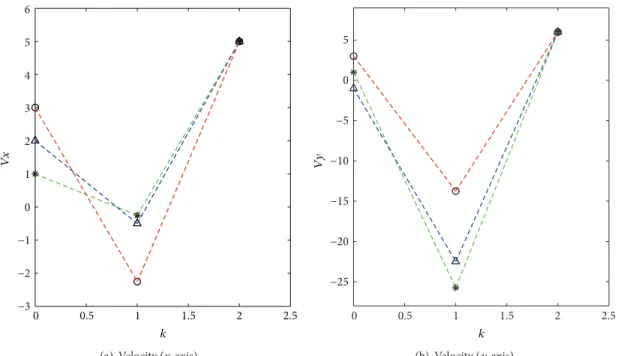
Figure 5: Speed controllability.
Using Matlab calculation, the eigenvalues of𝐹are eig(𝐹) = {−3.7321, −1, −0.2679} , 𝑈𝑇= [ [ −0.3251 0.8881 −0.3251 −0.7071 −0.0000 0.7071 0.6280 0.4597 0.6280 ] ] , 𝑈𝑇𝑃 = [ [ 0.5630 0.5630 −0.7071 0.7071 1.0877 1.0877 ] ] . (16)
It is obvious that the eigenvalues of𝐹are all different, and the elements of𝑈𝑇𝑃are all nonzero. Therefore, system (4) is speed controllable. However, Rank(𝑃) = 2and Rank(𝑄) = Rank[𝐻 𝐺𝐻 𝐺2𝐻 ⋅ ⋅ ⋅ 𝐺2𝑁−1𝐻] = 5, then system (4) is uncontrollable.
Figure 5 shows the simulation results of the second-order network. It is easily seen that the speeds of the system are controllable, but the positions of the system are uncontrollable. Therefore, the whole second-order system is uncontrollable.
6. Conclusion
This paper has studied the controllability of discrete-time second-order multiagent systems with multiple leaders and general dynamic topology. By applying the PBH rank test technique, some effective sufficient and necessary conditions for the controllability of the multiagent discrete-time systems are obtained. The results in this paper show that the con-trollability of discrete-time second-order multiagent systems can only depend on the information from the leaders to the
followers, regardless of the connectivity of the members in the network. These studies are helpful in understanding the dynamics of interconnected systems. However, for discrete-time second-order multiagent systems, as in cases often encountered in practice, it is usually difficult to deal with the controllability problem due to complexity of the topology and lack of theoretical tools. Our main result shows an advantage of the second-order topology scheme. We anticipate that our solutions to the above-described problems will offer a theoretical basis and valuable ideas for future applications of networked multiagent systems in the field of coordination control, including formation control and tracking problems.
Acknowledgments
This work was supported by National Natural Science Foun-dation (61170113, 61203150, 61104141, 60774089, 10972003, 61174116), Science and Technology Development Plan Project of Beijing Education Commission (no. KM201310009011), the Funding Project for Academic Human Resources Develop-ment in Institutions of Higher Learning Under the Juris-diction of Beijing Municipality (PHR201108055), the Pro-gram for New Century Excellent Talents in University from Chinese Ministry of Education under Grant NCET-12-0215, the National High Technology Research and Development Program of China 863 (no. 2012AA112401), and the Research Fund for the Doctoral Program of Higher Education (RFDP) under Grant no. 20100142120023. This work was also sup-ported by the Foundation Grant of Guangxi Key Laboratory of Automobile Components and Vehicle Technology (13-A-03-01) and the Opening Project of Guangxi Key Labora-tory of Automobile Components and Vehicle Technology (2012KFZD03).
References
[1] W. Ren and R. W. Beard, “Consensus seeking in multiagent systems under dynamically changing interaction topologies,”
Institute of Electrical and Electronics Engineers, vol. 50, no. 5, pp.
655–661, 2005.
[2] H. Su, X. Wang, and Z. Lin, “Flocking of multi-agents with a virtual leader,”Institute of Electrical and Electronics Engineers, vol. 54, no. 2, pp. 293–307, 2009.
[3] H. Su, G. Chen, X. Wang, and Z. Lin, “Adaptive second-order consensus of networked mobile agents with nonlinear dynamics,”Automatica, vol. 47, no. 2, pp. 368–375, 2011. [4] H. G. Tanner, “On the controllability of nearest neighbor
inter-connections,” inProceedings of the 43rd IEEE Conference on
Decision and Control (CDC ’04), pp. 2467–2472, December
2004.
[5] M. Ji and M. Egerstedt, “A graph theoretic characterization of controllability for multi-agent systems,”IEEE Transactions on
Robotics, vol. 23, no. 4, pp. 693–703, 2007.
[6] B. Liu, G. Xie, T. Chu, and L. Wang, “Controllability of inter-connected systems via switching networks with a leader,” in
Proceedings of the IEEE International Conference on Systems,
Man and Cybernetics, vol. 5, pp. 3912–3916, October 2006.
[7] Z. Ji, H. Lin, and T. H. Lee, “A graph theory based char-acterization of controllability for multi-agent systems with fixed topology,” in Proceedings of the 47th IEEE Conference
on Decision and Control (CDC ’08), pp. 5262–5267, Cancun,
Mexico, December 2008.
[8] M. Zamani and H. Lin, “Structural controllability of multi-agent systems,” inProceedings of the American Control Conference
(ACC ’09), pp. 5743–5748, St. Louis, Mo, USA, June 2009.
[9] B. Liu, T. Chu, L. Wang, and G. Xie, “Controllability of a leader-follower dynamic network with switching topology,”Institute of
Electrical and Electronics Engineers, vol. 53, no. 4, pp. 1009–1013,
2008.
[10] Z. Ji, Z. Wang, H. Lin, and Z. Wang, “Controllability of multi-agent systems with time-delay in state and switching topology,”
International Journal of Control, vol. 83, no. 2, pp. 371–386, 2010.
[11] R. Lozano, M. W. Spong, J. A. Guerrero, and N. Chopra, “Controllability and observability of leader-based multi-agent systems,” inProceedings of the 47th IEEE Conference on Decision
and Control (CDC ’08), pp. 3713–3718, Cancun, Mexico,
Decem-ber 2008.
[12] L. Wang, F. Jiang, G. Xie, and Z. Ji, “Controllability of multi-agent systems based on agreement protocols,”Science in China F, vol. 52, no. 11, pp. 2074–2088, 2009.
[13] F. Jiang, L. Wang, G. Xie, Z. Ji, and Y. Jia, “On the controllability of multiple dynamic agents with fixed topology,” inProceedings
of the American Control Conference (ACC ’09), pp. 5665–5670,
St. Louis, Mo, USA, June 2009.
[14] B. Liu, T. Chu, L. Wang, Z. Zuo, G. Chen, and H. Su, “Con-trollability of switching networks of multi-agent systems,”
Inter-national Journal of Robust and Nonlinear Control, vol. 22, no. 6,
pp. 630–644, 2012.
[15] B. Liu, N. Hu, J. Zhang, and H. Su, “Controllability of discrete-time multi-agent systems with multiple leaders on fixed net-works,”Communications in Theoretical Physics, vol. 58, pp. 856– 862, 2012.
[16] B. Liu, W. Hu, and Z. Jie, “Controllability of discrete-time multi-agent systems with leaders via switching topology,” Applied
Mechanics and Materials, vol. 128-129, pp. 92–95, 2012.
[17] Z. Ji, H. Lin, T. H. Lee, and Q. Ling, “Multi-agent controllability with tree topology,” in Proceedings of the American Control
Conference (ACC ’10), pp. 850–855, Baltimore, Md, USA, July
2010.
[18] S. Jafari, A. Ajorlou, A. G. Aghdam, and S. Tafazoli, “On the structural controllability of multi-agent systems subject to failure: a graph-theoretic approach,” inProceedings of the 49th
IEEE Conference on Decision and Control (CDC ’10), pp. 4565–
4570, Atlanta, Ga, USA, December 2010.
[19] Y. Liu, J. Slotine, and A. Barab´asi, “Controllability of complex networks,”Nature, vol. 473, no. 7346, pp. 167–173, 2011. [20] C. Godsil and G. Royle, Algebraic Graph Theory, vol. 207,
Submit your manuscripts at
http://www.hindawi.com
Hindawi Publishing Corporation
http://www.hindawi.com Volume 2014
Mathematics
Journal ofHindawi Publishing Corporation
http://www.hindawi.com Volume 2014 Mathematical Problems in Engineering
Hindawi Publishing Corporation http://www.hindawi.com
Differential Equations
International Journal of
Volume 2014
Hindawi Publishing Corporation
http://www.hindawi.com Volume 2014 Hindawi Publishing Corporationhttp://www.hindawi.com Volume 2014
Hindawi Publishing Corporation
http://www.hindawi.com Volume 2014 Mathematical PhysicsAdvances in
Complex Analysis
Journal ofHindawi Publishing Corporation
http://www.hindawi.com Volume 2014
Optimization
Journal ofHindawi Publishing Corporation
http://www.hindawi.com Volume 2014
Combinatorics
Hindawi Publishing Corporation
http://www.hindawi.com Volume 2014 International Journal of Hindawi Publishing Corporation
http://www.hindawi.com Volume 2014
Journal of
Hindawi Publishing Corporation
http://www.hindawi.com Volume 2014
Function Spaces
Abstract and Applied Analysis Hindawi Publishing Corporation
http://www.hindawi.com Volume 2014 International Journal of Mathematics and Mathematical Sciences
Hindawi Publishing Corporation http://www.hindawi.com Volume 2014
The Scientific
World Journal
Hindawi Publishing Corporation
http://www.hindawi.com Volume 2014
Hindawi Publishing Corporation
http://www.hindawi.com Volume 2014
Discrete Dynamics in Nature and Society Hindawi Publishing Corporation
http://www.hindawi.com Volume 2014
Hindawi Publishing Corporation
http://www.hindawi.com Volume 2014
Discrete Mathematics
Journal ofHindawi Publishing Corporation
http://www.hindawi.com Volume 2014 Hindawi Publishing Corporationhttp://www.hindawi.com Volume 2014