Transactional Behaviour Based Spam Detection
ByThomas Choi
A thesis submitted to
The Faculty of Graduate Studies and Research in partial fulfilment of
the degree requirements of
Master of Applied Science in Electrical Engineering
Ottawa-Carleton Institute for Computer and Electrical Engineering
Department of Systems and Computer Engineering Carleton University
Ottawa, Ontario, Canada April 2007
Copyright © 2007 – Thomas Choi
the Faculty of Graduate Studies and Research acceptance of the thesis
Transactional Behaviour Based Spam Detection
Submitted by Thomas Choiin partial fulfilment of the requirements for the degree of Master of Applied Science in Electrical Engineering
__________________________________________________
Adrian D.C. Chan, Thesis Supervisor, Department of Systems and Computer Engineering
__________________________________________________ Tony White, Thesis Co-Supervisor, School of Computer Science
__________________________________________________ Victor Aitkin, Chair, Department of Systems and Computer Engineering
Carleton University 2007
Abstract
In this thesis, we propose a novel spam zombie detection method by presenting a new real-time machine learning based spam filtering technique that uses the Spamhaus blacklist to learn SMTP transactional behaviour of spam zombies. Specifically our technique was implemented as a single layer perceptron plug-in that learns the behaviour of spam zombies and makes decisions as to whether an incoming source is likely to send spam or not. We also created and integrated a reverse DNS module into our design to prevent spammers from forging legitimate domains and making it difficult for them to overcome our technique. Our technique was deployed on a large corporate network, where we were able to demonstrate that our technique was able to generalize the Spamhaus list. In particular, our technique successfully detected spam zombies that were listed on the Spamhaus list, as well as zombies that were not already listed. In addition, this was accomplished without any increase in false positives.
Author’s Declaration
I hereby declare that I am the sole author of this thesis.
I authorize Carleton University to lend this thesis to other institutions or individuals for the purpose of scholarly research.
Signature_________________________________________________________
I further authorize Carleton University to reproduce this thesis by photocopying or by other means, in total or in part, at the request of other institutions or individuals for the purpose of scholarly research.
Acknowledgements
I wish to thank my thesis supervisors Dr. Adrian Chan and Dr. Tony White for their encouragement, guidance and support. I am truly grateful for having two extremely knowledgeable and understanding supervisors who have each taken time out of their busy schedules to review, edit and provide valuable feedback on my thesis. In 2005, I switched my research topic from bio-medical engineering to digital security engineering. As part of this switch, Dr. White had agreed to co-supervise my work with Dr. Chan. I thank Dr. White for giving me the opportunity to study digital security with some extremely exceptional individuals in the Carleton Digital Security and Carleton Intrusion Detection Research groups. I also thank Dr. Chan for his assistance in this transition and for his patience and advice.
I also wish to thank my manager Pat Cottrell for allowing me to use Nortel’s corporate resources and network to develop and test the new spam filtering technique described in this thesis. Finally, I wish to thank my mentor Chris Lewis whose guidance and encouragement led me to develop an extremely strong interest in the field of digital security.
Table of Contents
Abstract iii Author’s Declaration iv Acknowledgements v Table of Contents vi List of Tables x List of Figures xiList of Equations xii
Chapter 1:
Introduction 11.1 Motivation...1
1.2 Thesis Objectives...2
1.3 Contributions...3
1.4 Thesis Organization...4
Chapter 2: Background - SPAM
6 2.1 Introduction ...62.2 What is Spam?...6
2.2.1 Why does Spam Exist?...6
2.2.2 Why is Spam Disruptive?...7
2.2.3 Where does Spam come from?...8
2.4 Spam Zombies...13
2.4.1 What is a Spam Zombie? ...13
2.4.2 Spam Zombie as Spam Source ...15
2.5 Summary ...17
Chapter 3: Current State of the Art - Combating Spam
18 3.1 Introduction ...18 3.2 Legislation...18 3.3 Pre-emption ...19 3.3.1 User Education...20 3.3.2 Port 25 Filtering...20 3.3.3 Anomalies in DNS traffic...213.3.4 Command and Control Server Detection ...22
3.4 Filtering...23
3.4.1 Content Filtering...24
3.4.2 Network Based Filtering ...26
3.4.3 Forging ...29
3.4.4 Machine Learning ...30
3.5 Remediation ...33
3.6 Summary ...34
Chapter 4: SMTP Transaction Model and Mail Rejection
35 4.1 Introduction ...354.2 SMTP Procedure ...35
4.2.1 Step 1: Session Initiation...37
4.2.2 Step 2: Sending Server Identification ...38
4.2.3 Step 3: Sender Identification ...40
4.2.4 Step 4: Recipient Identification ...41
4.2.5 Step 5: E-mail Content ...42
4.4.1 In-line rejection...48
4.4.2 Bounces ...50
4.5 Summary ...52
Chapter 5: Spam Zombie Behaviour Analysis
53 5.1 Introduction ...535.2 Mail Environment...53
5.3 Packet Capturing ...54
5.3.1 Legitimate Packet Stream...55
5.3.2 Spam Packet Stream...55
5.3.3 Miscellaneous Packet Stream ...56
5.4 Packet Stream Analysis...56
5.4.1 Step 1: Session Initiation...56
5.4.2 Step 2: Sending Server Identification ...57
5.4.3 Step 3: Sender Identification ...60
5.4.4 Step 4: Receiver Identification ...60
5.4.5 Step 5: E-mail Content ...61
5.5 Summary ...63
Chapter 6: Design Decisions
64 6.1 Introduction ...646.2 Design Considerations ...64
6.2.1 E-mail Content...65
6.2.2 SMTP Transactional Flow...66
6.2.3 Server Identification module ...67
6.3 Machine learning ...68
6.3.1 Supervised Learning ...68
6.4 Architecture...75
6.4.1 Layer 1a: Perceptron Module ...78
6.5.1 Layer 1a: Perceptron Module ...86
6.5.2 Layer 1b: Reverse DNS Check Module...94
6.6 Summary ...95
Chapter 7: Training and Experimentation
96 7.1 Introduction ...967.2 Test Environment ...96
7.3 Determining Parameter Values ...100
7.4 Experimentation Setup...103
7.4.1 Mail filtering server logs ...103
7.4.2 False Positive Process ...105
7.4.3 False Negative Process...106
7.5 Training...107
7.6 Experimentation ...107
7.7 Analysis...108
7.7.1 Generalization of Spamhaus list ...110
7.8 Summary ...115
Chapter 8: Conclusion
117 8.1 Conclusions ...117 8.2 Contributions...119 8.3 Future Research...119 References 120 Appendix A 129 Appendix B 131List of Tables
Table 7-1: Experiment – Determining Perceptron Parameters...101
Table 7-2: Results - Day 2 Statistics ...108
Table 7-3: Results - Day 1 Statistics ...108
Table 7-4: Results - Generalization Validation ...111
List of Figures
Figure 2-1: E-mail Delivery Process...9
Figure 2-2: High Level Botnet Architecture...14
Figure 4-1: SMTP Transactional Flow...45
Figure 6-1: Single Perceptron Architecture...71
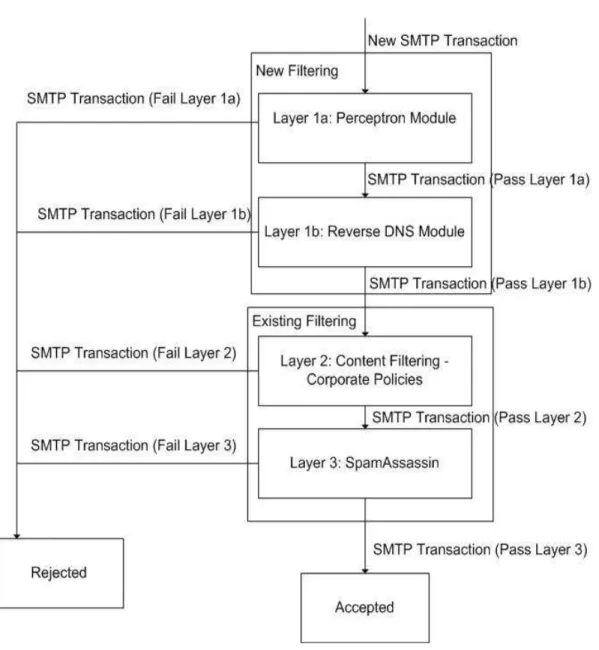
Figure 6-2: Integration of Filtering Techniques...76
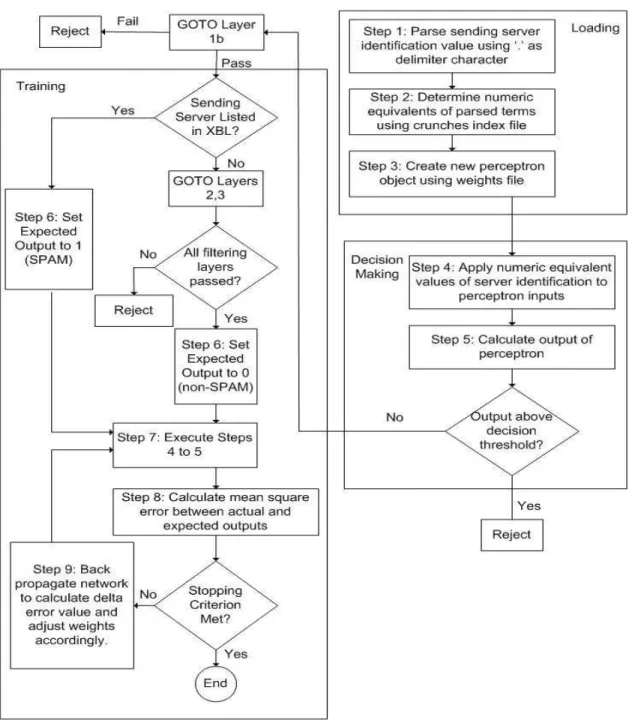
Figure 6-3: Information Flow of Perceptron Module...80
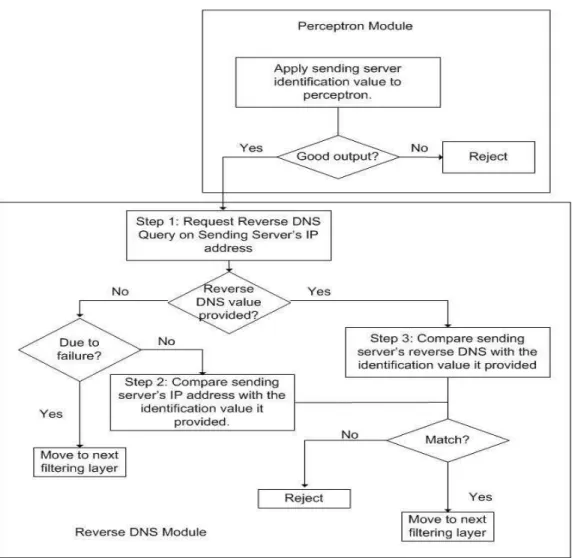
Figure 6-4: Information Flow of Reverse DNS Module ...84
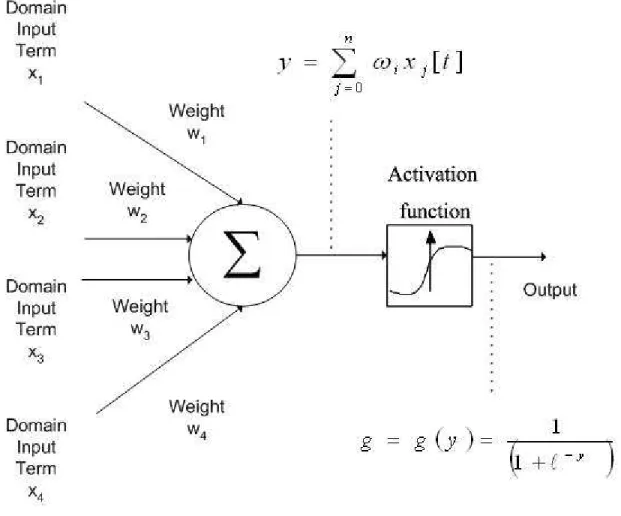
Figure 6-5: Implementation of Single Layer Perceptron...87
Figure 7-1: E-mail Test Environment ...97
List of Equations
Equation 3-1: Bayesian Formula...32
Equation 6-1: Mean Square Output Error...72
Equation 6-2: Gradient Descent Algorithm...73
Equation 6-3: Sigmoid Activation Function...73
Equation 6-4: Derivative of Sigmoid Activation Function ...73
Equation 7-1: Blocked by Layer 1a...109
Equation 7-2: Blocked by Layer 1 (Server 1)...109
Chapter 1:
Introduction
1.1
Motivation
E-mail is an efficient form of communication that has become widely adopted by both individuals and organizations. Today, more and more people are relying on e-mail to connect them with their friends, family, colleagues, customers and business partners. Unfortunately, as e-mail usage has evolved, so too has its threats. In particular, spam, which is also known as unsolicited bulk e-mail, has become an increasingly difficult threat to detect and is being delivered in incredibly high volumes. For example, according to MessageLabs, spam accounted for 67% of all e-mail traffic in October 2006, up from 57% the same time a year before [1].
Spam is a serious problem that potentially threatens the existence of e-mail services. In particular, it is a now a non-trivial task to find legitimate e-mails in an e-mail inbox cluttered with spam. Spam is also an expensive problem that costs service providers and organizations billion of dollars per year in lost bandwidth [2]. Further to the bandwidth cost, it is also estimated that each piece of spam costs an organization one dollar in lost employee productivity [2]. There are also published reports, which suggest that spam has resulted in lost opportunity costs of several billions of dollars [3] because of organizations that have lost faith in the security industry’s ability to fight this problem.
1.2
Thesis Objectives
Significant investment and advances have been made within the past decade on anti-spam research but even with all this work, the spam problem appears to be getting worse [1]. One reason is that existing spam filtering techniques have been directed towards detection based filtering techniques such as content and network based filtering. Content filtering is based upon a set of static rules generated by analyzing the content of previously detected spam whereas network based filtering, such as DNS blacklists, list sources that have been previously detected sending spam. Spammers have proven their ability to overcome such techniques by modifying the content of their spams such that the spams can bypass existing content filtering techniques [4] or by creating a fresh supply of spam zombies to send spam for the purpose of bypassing network filtering techniques. With industry metrics indicating that approximately 80% of all spam comes from spam zombies [5], there is a need to improve existing spam filtering techniques to detect a wide range of spam from spam zombies.
The objective of this thesis is to introduce a new approach to spam filtering by first investigating the SMTP transactional behaviour differences between legitimate mail sources and illegitimate mail sources such as spam zombies. Next, our objective is to introduce a new machine learning filtering technique that can continuously learn efficiently in real-time and also identify differences in mail sending behavior between a legitimate and illegitimate-mail source. Specifically, we wish to make use of existing detection based techniques as a learning mechanism to produce a solution designed to identify illegitimate mail servers, such as spam zombies, and filter mail from said
sources. Our final objective is to conduct experimentation to prove that our new filtering technique provides an advantage over existing detection based filtering.
1.3
Contributions
This thesis makes three main contributions to the state of the art in research in spam filtering:
1. Novel approach to spam filtering: E-mail is filtered based upon SMTP transactional behaviour, rather than traditional content or network based approaches. By studying the transactional-related behaviours exhibited by a legitimate mail server and a spam zombie, we were able to develop a five step SMTP transactional model and find key distinguishing behavioural characteristics between the two sources.
2. New spam filtering technique: We present a new spam filtering technique based upon SMTP transactional differences between legitimate mail servers and spam zombies. The technique uses a single perceptron to learn said differences in real-time and is able to generalize the Spamhaus blacklist [6]. A Reverse DNS module was also created and integrated with the perceptron to make it difficult for the spammer to overcome our filtering technique.
3. Detailed description of new spam filtering technique: We present design and implementation details of our filtering technique along with a set of experimental results that show that our algorithm was able to successfully generalize the Spamhaus list. In particular, we were able to show that our technique could detect spam zombies that were and were not already listed in the Spamhaus list. Specifically, in our experimentation, we selected five consecutive perceptron blocking events at a random point in our testing and
compared each of these blocks against the Spamhaus list. Of the five blocks that were selected, two were listed and three were not.
1.4
Thesis Organization
The remainder of this thesis is organized as follows. Chapter 2 presents an overview of spam as well as a four-step model to describe how spam sources have evolved. We then use the model to explain how spam zombies have become a preferred method of sending spam.
Chapter 3 describes current efforts at combating spam and the state of the art of spam filtering. For each effort or filtering technique, we examine their shortcomings with respect to spam prevention or filtering.
Chapter 4 gives a general overview of Simple Mail Transfer Protocol (SMTP) transactional behavior. Specifically, Section 4.2 describes a five-step SMTP transactional model between legitimate mail servers. Section 4.3 provides a comparative analysis between two mechanisms of notifying the sender when an SMTP transaction has failed.
Chapter 5 applies the five-step SMTP transactional model presented in Chapter 4 to determine the differences in SMTP transactional behaviour between legitimate mail servers and spam zombies.
Chapter 6 analyzes the behavioural differences found in Chapter 5 and describes how these findings were used as part of the design of our new filtering technique. In particular, Section 6.4 describes the design of our filtering technique and section 6.5 illustrates how our technique was implemented.
Chapter 7 presents the test results from our design running in a live corporate mail infrastructure.
Finally, Chapter 8 presents our conclusions and discusses several possibilities for extending our work in the future.
Chapter 2:
Background - SPAM
2.1
Introduction
In this Chapter, we begin by presenting an overview of spam. We then examine the e-mail delivery process and subsequently define a four-step model that describes the evolution of spam sources used to send spam. The model is then applied to explain the abundance of spam zombies currently used to send spam. In particular, we identify and discuss trends in the changing spam sources that have made spam zombies a preferred source for sending spam where approximately 80% of all spam comes from spam zombies [5].
2.2
What is Spam?
In this thesis, we define spam as all email the user does not want to receive and has not asked to receive [7]. Such unsolicited e-mails come in several forms such as advertisements [8], scams [9], and viruses [10].
2.2.1Why does Spam Exist?
Spam exists because the recipients allow spammers to make spamming a profitable business. First, compared to physical bulk mailings, sending e-mail advertisements is about 100 times cheaper [11] because it costs the sender far less to send their messages
via e-mail than through regular mail since it is the recipient or their carrier who is responsible for having to pay for most of the spam delivery cost. For example, assuming that a company receives 100 000 spams per day and it takes their servers 10 seconds to identify and discard a message, a total of 278 hours of connect time is being used by their servers to filter spam. With growing volumes of spam, the receiver and their carrier will require more network and disk resources to cope with the extra load, which will result in further costs to the receiver. In contrast, the spammer simply requires a broadband Internet connection to send their spam. Not only do recipients cover most of the costs for delivering spam but a small number of them are known to purchase goods advertised in the spams or fall for scam or virus spam attacks thus generating a stream of income for the spammer [12].
2.2.2Why is Spam Disruptive?
Spam is disruptive not only because it is unsolicited but also because spammers send it in bulk such that 67% of all e-mail is now defined as spam [1]. With so much e-mail being spam, end users will tend to agree that it is becoming more difficult and annoying for them to find legitimate e-mail in a sea of spam. In addition to being disruptive, spam is also considered offensive to users as well. For example, commercial spam may include advertisements of pornographic or sexual nature [13], which may be considered offensive to some users. As we will illustrate in the next section, in spite of the many efforts to block spam, spam continues to be a problem because for each major new filtering technique, spammers have found ways to evolve their spam to defeat it.
2.2.3Where does Spam come from?
Spam sources have evolved from simplistic sources such as a spammer’s e-mail account to more sophisticated means such as the use of third party relays, proxies and compromised machines. The motivation behind this evolution comes from anti-spam efforts such as anti-spam laws, broadband service provider policies and filtering techniques [14]. However, in spite of the changing spam sources, very little research has been conducted on spam sources. In the following sections, we present a model that highlights how spam and e-mail is delivered from a sending source and how spam sources have evolved.
2.2.4Spam and e-mail Delivery Process
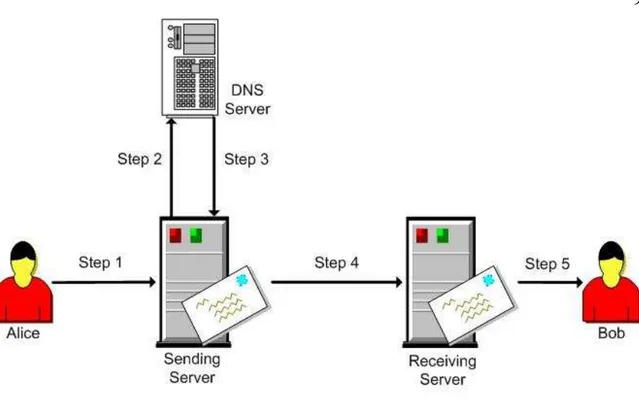
The e-mail delivery process can be best explained with the help of Figure 2-1, which illustrates a step-by-step process on how e-mail is delivered. The main elements of Figure 1-1 are the sending client, sending server, receiving server, receiving client, e-mail/spam and a DNS server used by sending server. In this section, we will describe the basics of e-mail delivery but for a more in-depth look at the delivery process along with the terminology used in this thesis, please refer to [16].
Figure 2-1: E-mail Delivery Process
For purposes of this example, we will assume that the sender’s domain is sender.com
and the receiver’s domain is receiver.com. In order the sender Alice
([email protected]) to send e-mail to Bob ([email protected]), the sender’s (Alice)
server must determine the receiver’s (Bob) inbound mail server. This is done via a Domain Name Server (DNS) query. Specifically, Step 1 of the e-mail delivery process requires the sender, Alice, to compose a message and request its e-mail server to deliver the message to the recipient Bob. In Step 2, the sending server asks the DNS server to lookup the DNS record of type MX of the receiving server. In Step 3, the DNS server responds to the sending server with the Internet Protocol (IP) address of the receiving server. In Step 4, the sending server connects to the receiving server and performs a Simple Mail Transfer Protocol (SMTP) transaction with the receiving server to deliver
the Alice’s message to Bob. In Step 5, the receiving server delivers Alice’s message to Bob’s e-mail client. The SMTP transaction performed between the sending and receiving servers is described in greater detail and modeled in Chapter 4.
2.3
Evolution of Spam Sources
In this section, we present a four-step model that identifies how spam sources have evolved in response to anti-spam measures. Our intent is to use this model to help identify the key features that spammers look for in a spam source.
1. Spammers are moving away from having to use their own sources to send spam
[14].
One of the first sources of spam was the spammer’s Internet Service Provider’s (ISP) mail servers where spammers would send mail from their ISP assigned account. Spammers quickly moved away from these sources once ISPs adopted acceptable usage policies and terminated accounts of those who abused their Internet privileges.
2. Spammers are moving away from sources that do not protect their identity [14].
Open relays are mis-configured mail servers that allow any non-authenticated user on the Internet to relay mail to any domain. Open relays were once a heavily utilized source for spam. In recent years however, spammers moved away from these sources because mail server software companies were issuing configuration patches to prevent mail servers from being abused in this fashion and also because spams sent from these sources could be traced back to the spammer’s machine [15].
3. Spammers are moving away from sources that require a non-trivial amount of manual labour [14].
Spammers are also known to abuse free-mail mailing sources such as those from yahoo, hotmail and gmail, by creating bogus free-mail accounts and using them to send spam. In recent years, free-mail providers have introduced a Completely Automated Public Turing test to tell Computers and Humans Apart (CAPTCHA) [17], which uses challenge-response type tests to determine whether the user is a human. CAPTCHAs help prevent automated creation of accounts thus making free-mail sources less attractive to spammers.
There are however, a few spammers today such as the Nigerian 419 scam spam gang that still use freemail sources to send spam. Specifically, they hire people from poorer parts of the world to manually create and send spam from freemail accounts, thus overcoming the graphical CAPTCHA technique [17]. The hired workers are also able to protect their identity by performing their work on public machines such as those in an Internet café.
In this type of scam, an e-mail is sent from an alleged ‘official’ who needs to transfer millions of dollars in funds from his/her foreign nation to a bank account in the recipient’s home country. For reasons outlined in the e-mail, the ‘official’ cannot conduct the transfer him/herself and as such, an offer is made whereby the recipient will receive a share of the funds. Although the offer will sound enticing and the need to transfer these funds overseas will sound legitimate, responding to such scams is costly, dangerous and in some cases life threatening [18]. An
example of what a Nigerian 419 scam e-mail looks like is provided in Appendix A. As a whole, free-mail is not a heavily utilized source for sending spam due to the high cost involved in hiring people to do the work and the fact that the amount of spam that can be generated is dependent upon how fast the hired workers can send e-mail. As such, spammers are moving away from sources that require a non-trivial amount of manual labour.
4. Spammers are moving away from using third party sources that are difficult to find [14].
Open proxies are typically non e-mail servers such as web servers, proxy servers, socks servers that have been abused to send spam to third parties. One way such servers can be abused is through accidental mis-configuration. For example, spammers could connect to the proxy and have it connect to an e-mail server to send spam. An advantage of using open proxies over open relays is that spam sent from open proxies cannot be traced back to the spammer’s machine [15].
However, in recent years, spammers have moved away from using these sources in favor of spam zombies [14].
Although we recognize that some of the above mentioned sources are still being used to send spam, industry anti-spam metrics show that the spam they send represent a relatively decreasing percentage of total spam [1]. What is missing is a source that is consistent with the above-mentioned trends. With such a source, spammers can safely send a significant amount of spam in an efficient manner. In the next sub-section, we will examine a commonly used source known as a spam zombie.
2.4
Spam Zombies
In recent years, a substantial amount of spam has been detected from one particular source known as spam zombies, where according to a leading anti-spam service provider, approximately 80% of all spam comes from spam zombies [16]. In this section, we provide some background information about spam zombies and apply our four-step model against spam zombies to help understand why they have become a preferred means to send spam.
2.4.1What is a Spam Zombie?
A spam zombie is an end-user system that has been compromised by malware [14] where malware is defined as any software program developed for the purpose of causing harm to a computer system, similar to a virus or trojan horse [19]. Once malware is installed on the system, the spammer is able to use the compromised system as a spam distribution channel without the knowledge of the system owner. Many of these end-user systems are insecure and have broadband Internet access. Specifically, these machines are typically missing critical operating system or application level patches and are hence vulnerable to the many corresponding exploits being spread across the Internet. The spread of such exploits are performed by compromised systems called bots, which scan the Internet for hosts possessing a vulnerability for the given exploit. Once such a host is found the exploit is applied, which discreetly opens a backdoor port on the host so that the attacker can access the machine. All this activity is done in the background such that the owner of the compromised machine has no idea what is going on their machine. One of the things that an attacker does with a compromised host is install spamware, an SMTP engine
designed specifically to send spam, and then sells the use of such hosts to spammers [14]. According to CipherTrust, a vendor of messaging security solutions, research findings confirm that 300 000 new zombies are created daily [20].
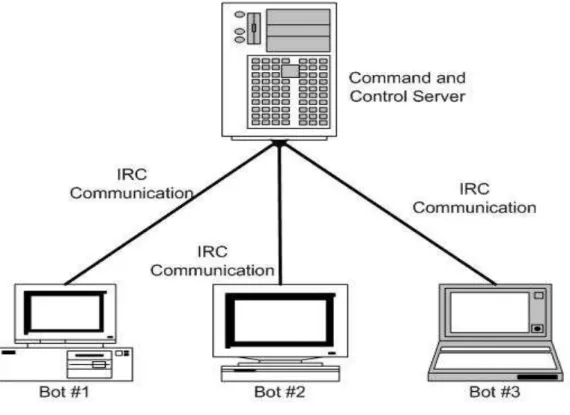
Spammers are able to control compromised hosts, through a central server known as the command and control server. With respect to terminology, each compromised host is referred to as a bot and the collection of bots controlled by the command and control server is called a botnet. Figure 2-2 illustrates a high-level architectural overview of a simple 1-to-many botnet architecture.
Figure 2-2: High Level Botnet Architecture
In the architecture of Figure 2-2 above, the command and control is able to communicate with each bots via a modified Internet Relay Chat (IRC) protocol.
Specifically, each bot executes a stripped down IRC client which allows them to authenticate on the proper IRC channel on the command and control server. The client also allows the bot to understand and perform commands given by the attacker through such a channel. Through the command and control server, the spammer can then control up to several thousand bots, allowing him or her to perform a mass spam campaign or scan the Internet to find more bots to add to the botnet [21]. For example, the IRCd server software allows an attacker to control up to 80 000 bots [21].
2.4.2Spam Zombie as Spam Source
To help understand why spam zombies have become a preferred means of sending spam, we apply our four-step model to spam zombies.
1. Spammers are moving away from having to use their own sources to send spam
[14].
Spam zombies allow spammers to use other people’s resources to send spam. Specifically, as mentioned above, a spam zombie is a compromised machine that usually provides spammers with enough processing power and Internet
connectivity to send spam.
2. Spammers are moving away from sources that do not protect their identity [14].
Spam zombies protect the spammer’s identity since the spams sent from spam zombies can only be traced back to the compromised machine and not the spammer [13].
3. Spammers are moving away from sources that require a non-trivial amount of manual labour [14].
Today, many users lack general computer security knowledge and either are not aware of the importance of patching and updating anti-virus signatures or simply do not do it. By exposing vulnerable computing systems to the Internet, these systems can be quickly transformed into spam zombies by various exploits and worms. Specifically, once an exploit encounters such a vulnerable machine, the machine then becomes compromised and the spammer may then have complete control over it. A benefit of this approach is that all the activity is automatically done in background such that the owner is unaware of what is happening to their machine and minimal effort is required on the part of spammers.
4. Spammers are moving away from using third party sources that are difficult to find [14].
The combination of the booming popularity of broadband Internet, affordable computer hardware and a lack of general computer security knowledge, provides spammers with a significant number of potential systems that they can use to conduct their activities. According to Panda Software, approximately 35% of all Personal Computers (PCs) were virally infected as of February 2005, down from 50% in November 2004 [14]. One benefit of having many potential spam
zombies is that it allows spammers to overcome today’s anti-spam technology such as Domain Name Service Black Lists (DNSBL), which list IP addresses that are known to send spam. Specifically, a fresh supply of spam zombies can
consistently overcome such a filtering mechanism. DNS-blacklists are described in greater detail in Section 3.4.2.
As we can see from the analysis above, the use of spam zombies is consistent with the above-mentioned trends. We believe that this is a major factor that resulted in spam zombies becoming a preferred source for sending spam.
2.5
Summary
As spam has evolved so too have the sources that are used to send them. Unlike other sources used in the past, spam zombies provide spammers with an efficient means for sending spam while protecting their identities. Furthermore, with the growing popularity of the Internet combined with a lack of general computer security knowledge amongst end users, spammers are provided with a wealth of potential computing sources that can be compromised for malicious purposes. Once a machine is compromised and turned into a zombie, non-standard mail server software called spamware [14] is installed on the system and used to deliver spam. In the next Chapter, we examine the current state of the art with respect to spam prevention and filtering.
Chapter 3:
Current State of the Art - Combating Spam
3.1
Introduction
The previous Chapter illustrated the evolution of spam sources where the majority of today’s spam originates from spam zombies. This Chapter presents a literature review on current efforts at combating spam and the state of the art of spam filtering. This Chapter is divided into four general sections: legislation, preemption, filtering and remediation. For each approach, we will outline their goals, uses and shortcomings. Once the current state of the art is presented, we will outline the goals of a new message filtering solution addressing the shortcomings of current filtering efforts and illustrate these ideas in subsequent Chapters.
3.2
Legislation
The goal of legislation is to create an enforceable law, which would make it illegal to send spam and impose heavy penalties for those caught doing so. We consider legislation as an anti-spam solution because imposing legal consequences to spamming should discourage people from spamming and there are those who believe that no technological solution will solve the spam problem [22].
In the United States, anti-spam legislation called the CAN-SPAM act [23] was introduced to help combat the spam problem. According to the CAN-SPAM act, in order to send unsolicited commercial e-mails, the e-mail must include, among other things, a means for the end user to opt-out of the distribution, a postal address where the user can contact the sender, true memo headers and a subject line header that does not mislead the end user as to what the content of the mail contains. In addition, all sexually explicit e-mail content needs to be sent with a label indicating such content in the subject line.
Unfortunately, the CAN-SPAM act has had little effect on spam volumes since its inception in 2003 [24] and may have promoted spam by legalizing certain types of spam [25]. At the time when the CAN-SPAM act went into effect, industry estimates put the total spam volume at around 35% of all e-mails [26]. This is in comparison to 2006/2007 where spam volumes have reached 67% of all e-mails [1]. One major problem with CAN-SPAM and other anti-spam legislation is the difficulty in tracing spam to the actual spammer [27] and hence enforcing the law. Specifically, with over 80% of all spam sent from compromised machines, tracing spams to the originating source will often lead to the innocent hi-jacked owner and not the spammer themselves. Furthermore, the distributed nature of the Internet makes it easy for people to send spam from anywhere around the world. Therefore, anti-spam laws have the effect of forcing spammers send spam from jurisdictions where laws are not in force.
3.3
Pre-emption
The goal of pre-emption is to prevent non-dedicated mail servers from becoming spam sources.
3.3.1User Education
One solution that has been proposed is a mass educational campaign to educate end users on how to secure their computers and prevent them from becoming spam zombies [14]. The goal of such campaign is to make end users aware of the risks involved in not applying security patches, updating anti-virus signatures, opening suspicious e-mail attachments, downloading spyware infested peer-to-peer programs, and clicking on malicious links obtained via e-mail or instant messaging.
Unfortunately, user education can only go so far and no matter how much effort and money is invested in such campaigns, the method is not fool proof [28]. So while there is value in user education, the battle against spam zombies is unlikely to be fully resolved by this method alone.
3.3.2Port 25 Filtering
In order for a machine to send spam, it must be able to connect to a relay or a destination mail server. More specifically, it must initiate an outbound port 25 request to one of these servers [29]. With the consequences of having compromised machines on one's network, many Internet service providers and corporations have blocked outbound port 25 access on all hosts on their network except those that are explicitly allowed to perform SMTP relay functions. That way, even if a machine is infected and behaves as a spam zombie, it will not be able to send spam [30]. In addition to blocking outbound port 25, the service provider or company may also want to block inbound port 25 access.
Although this is a simple yet effective means of stopping spam, it has its shortcomings. Specifically, not all service providers or corporations have adopted this policy since their users do not wish to have such blocks implemented. For example, some users may wish to use their own mail servers to send and receive mail rather than having to use a dedicated mail server provided by their provider or company. Such a situation could arise when a new business customer of a service provider requires their e-mails be stored on their own servers only and not on their service provider’s dedicated mail server. It should also be noted that the port 25 block does not prevent computers from becoming zombies. Rather it prevents zombie computers from being able to send spam. As such, an attacker will still be able to control the zombie computer and use it for other purposes such as storing illegal software or scanning the network for other machines to infect.
3.3.3Anomalies in DNS traffic
Another pre-emptive anti-spam solution is to detect abnormal DNS MX query requests [31]. Such requests are typically performed by an SMTP mailing agent that wishes to send mail to a specific domain. In order to find the mail server accepting mail on behalf of that domain, the agent must do a DNS lookup to find that domain's mail server's IP address. These types of lookups are called MX queries and should not be initiated on a machine that does not perform mail transport functions.
In an ISP network, most SMTP traffic is usually routed through the provider's mail server. In such cases, the end user's machine should never perform an MX DNS lookup; rather it is the provider's mail server that is responsible for this. As such, if an end user’s
machine is detected performing DNS MX query lookups, there is reason to be suspicious. Such a machine can be flagged as possibly being infected and isolated from the network.
One of the main drawbacks to this approach is false positives with respect to the alarms being generated by such an approach. Specifically, some e-mail clients are configured without an outbound SMTP server such that when a user tries to send mail to a user from an external domain, the sending user's machine will perform an MX query lookup in order to find the mail server it should be communicating with. Therefore, alarms generated by the anomalous DNS approach described above will not only detect spam zombies but will also falsely detect user machines where the e-mail client is configured to send mail directly to the recipient’s server. False positives are a problem because each alarm requires a security officer to inspect and analyze it and the more false alarms that get generated, the greater the amount of time and effort that is wasted by the officer.
3.3.4Command and Control Server Detection
As described in section 2.4.1, when a machine is infected with malware [19], it is common to have the host under the attacker's control via a command and control (C&C) botnet server. By using such a server, the attacker can control a plurality of zombies (also known as bots) by performing tasks such as uploading spamware software [14] to send spam. The bots connect to the C&C server by either IP address or domain name. It should be noted however that if the C&C server’s IP address is dynamically assigned, it will most likely be contacted by its domain name.
One way to help reduce the number of spam sources is to detect upstream botnet IRC communication between the C&C and the compromised machine where said IRC communication is illustrated in Figure 2-2 [14]. By finding the IP address or domain name of the hosting server, one can then filter the IP address or domain name so that any other machines on the network that become compromised cannot be controlled by that C&C. However, one problem with this approach is that the C&C server may reside on a dynamic IP address where blocking the IP address could potentially cause problems later on if the filter for that address is not eventually removed and is later reassigned to an innocent owner or company. Although terminating communication with the botnet server is helpful in preventing new spam zombies from appearing in one’s network, it does not necessarily prevent existing compromised machine from sending spam.
3.4
Filtering
The goal of anti-spam filtering is to filter messages by identifying which messages are likely to be spam and which are not. As we will see in Section 4.3, anti-spam filtering typically occurs towards the end of the SMTP transaction. In the following sections, we explain how spammers have found ways to modify the content of their e-mails such that some of these e-mails may overcome existing content filtering approaches. We also indicate how the content filtering techniques described below cannot detect the presence of new spam zombies nor prevent spam from said sources.
3.4.1Content Filtering
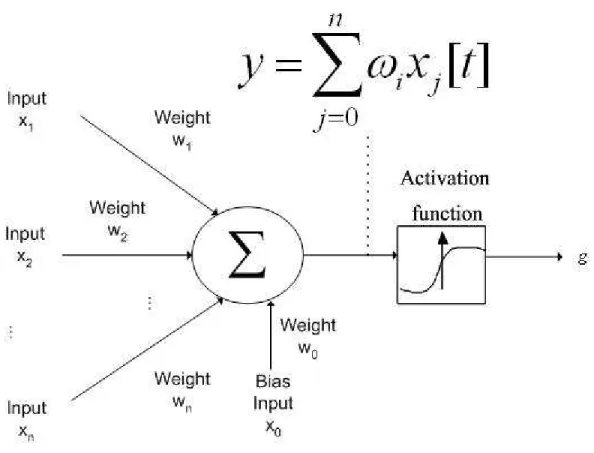
Content filtering was one of the first types of anti-spam filters to be used. Such filters use hard coded rules where each rule has an associated score and is periodically updated [32] [33]. An example of such filter is SpamAssassin [34], which works by scanning the textual content of the e-mail against each rule and adds the scores for all matching rules. If the total score of the e-mail exceeds some set threshold score then the message is considered spam. In order to generate these scores, a single perceptron is used [35] where the inputs to the perceptron indicate whether a particular rule was matched and the weight for the corresponding input indicates the score for each rule. More detailed information with respect to machine learning algorithms such as the single perceptron is presented in Chapter 6.
The simplest of content-based rules flag e-mails if a specific string or expression was matched. For example, one type of content filtering rule would be to match all e-mails that contained a variation of the word VIAGRA in the body or subject line. Content-based
filters can also match keywords or expressions in other parts of the e-mail such as the headers or the base64 encoding of e-mail attachments and embedded images. E-mail headers are typically used to determine where an e-mail came from and how it was delivered from the initial source to the current destination.
Although content filters are still being used, they are becoming less effective at blocking spam. First, spammers have found ways of getting around such filtering approaches by modifying their text. For example, if spammers are aware that a certain filter is filtering e-mails based on a variation of the term CIALIS excluding the variation
SPECIALIST then they may send the e-mail with a modified version of CIALIS such as SPE
CIALIS
T is unlikely to hit any exact match or regular expression based CIALIScontent filtering rule due to the SPECIALIST exemption. Even the combining of regular
expressions from a variety of sources is unlikely to overcome this modification [36]. The modified term is still read as CIALIS by the end user but looks like SPECIALIST to the content filtering system. Since content filtering is based on a static rule set, spammers can get a significant volume of spam to bypass said filter by crafting a message that will not trigger any content filtering rules.
Another approach to content filtering is called collaborative spam detection [37]. Specifically, when a receiving server receives an e-mail, it generates a signature for that particular e-mail and compares it against the signatures in a global server list to see how frequent the message has been reported as spam. If a match is found and was reported as spam above a specific threshold, the message is considered spam. Examples of this approach include Vipul’s Razor [38] or Distributed Checksum Clearinghouse (DCC) [39]. One problem with this approach is that it detects bulk e-mail and not necessarily spam. For example, some bulk e-mails such as legitimate corporate communications from outsourced vendors may be seen as spam by such techniques and as such these e-mails may end up getting blocked. Another problem is that a simple change in the content by the spammer such as re-adjusting an image size or changing a few words can generate a completely different signature that would not already be listed in the global server list and as a result, such spams would get through this filtering technique.
For more information regarding the drawbacks of using content filtering, we refer the reader to [4].
3.4.2Network Based Filtering
An alternate approach to content based filtering is network level filtering, which typically comprises of a blacklist. A blacklist comprises of known bad IP addresses that have been used to send spam. A mail server uses a blacklist when it receives a connection from a sending server. Specifically, the receiving server checks the sending server’s IP address against the blacklist to determine if the sending server’s IP address is listed.. If it is listed then the mail is rejected. However, if the sending server’s IP address is not listed in the blacklist then it is inconclusive as to what the filtering system should do with messages from the sending server.
There is a wide range of different publicly available blacklists where each list has a specific focus. For example, the Composite Blocking List (CBL) [40] and Not Just Another Bogus List (NJABL-PROXY) [41] are focused on compromised machines whereas the Spamhaus [44] blacklist [6] list is focused on known spam sources that are not necessarily compromised machines.
When a receiving mail server receives an incoming SMTP connection, the receiving server can query a blacklist to determine whether the incoming mail server is listed on that blacklist or not. The query is performed by doing a reverse DNS lookup on the blacklist server. The response from the blacklist server helps the receiving server know whether to block or allow such e-mails. For example, if a receiving mail server received a connection from a sending server with an IP address of 1.2.3.4 and wanted to know
whether the sending server was listed on the Spamhaus blacklist then the receiving server would perform the following DNS query:
4.3.2.1.xbl.spamhaus.org
If the IP address is listed in the Spamhaus blacklist then the response would be
127.0.0.2
If the IP address is not listed in the Spamhaus blacklist then the response would be
NXDOMAIN.
By examining the response received from the blacklist server, the receiving server will be able to determine whether the IP is listed and whether or not they should accept the e-mail.
One problem with blacklists is that they are detection based and suffer from lag times. For example, in [42] of the 4295 spam zombie hosts IP addresses queried against the Spamhaus blacklist, only 255 were blacklisted after 46 days of continual activity. This implies that there is a lag time from when a new spam source starts to send spam, to the time when the IP address of the source is listed in the blacklist [45]. The actual criteria used to determine whether an IP gets added to the list and how long that IP remains in that list is unclear and as a result, false positives can also result from using such lists. In fact, some blacklists are poorly maintained such that legitimate users are unable to effectively use IPs once used by spammers [46]. Furthermore, since the list is detection based and zombies are known to generate a large amount of spam immediately upon infection, it is possible that hundreds of spams can get through a filter that utilize such blacklisting approaches [42]. Another problem with blacklists is that the major blacklists [39][40][41] are IP-based. In particular, since many spam zombies are known to reside
on end user machines with broadband connection, typically on dynamic IP space [14], using IP addresses to list spam zombies may not be effective solution especially if said zombies are continuously assigned new IP addresses. With thousands of new malicious sources being generated everyday, such reactive based approaches are always a step behind the attacker.
Since spammers tend to make efficient usage of their spam-related websites, it is not surprising that many spams contain similar Universal Resource Identifiers (URIs), which is a standard means of addressing resources on the web. This leads us to another type of blacklist called the URI blacklist, which lists URIs, found in spams. An example of such list is the Spam URI Realtime Blocklists (SURBL) [48].
Unfortunately, URI blacklists suffer from similar problems as IP based blacklists where the list is generated on a detection-basis and a spam containing a newly created URI will not be detected by such list. Furthermore, there is also the risk of false positives. For example, in cases such as phishing e-mails where a ‘clean’ URI is obfuscated and actually directs the user to the spammer’s site, the ‘clean’ URI may end up getting listed in that list.
Since the above-mentioned blacklists are owned by third party volunteer organizations, it makes sense to have a local whitelist that can be used in the event of a false positive. In particular, such whitelists are typically designed to allow mail from a particular IP or e-mail address to bypass all spam filtering. One issue with this is that the machine using the whitelisted IP address may become compromised giving the spammer unfiltered access to recipient’s inbox. Similarly, if the spammer knew that a particular
e-mail address was whitelisted, he or she could forge that e-e-mail address in their spam to ensure that the spam gets through the filter. As a result, whitelists need to be carefully maintained so that they do not get abused, which leads to additional overhead for the e-mail administrator.
For more information regarding the drawbacks of using network filtering, we refer the reader to [4].
3.4.3Forging
With a significant amount of spam being forged, it makes sense to look at techniques that detect such forgeries. Email forging is where the ‘From’ line of an e-mail is forged such that the email appears to have been sent from someone else. For example, Alice could forge an e-mail to Bob to make it appears that the e-mail came from Jim by re-writing the ‘From’ line of the e-mail with Jim’s e-mail address.
In the absence of technological detection means, one may discover that they have been spoofed when someone complains to them about an email they never actually sent or they receive an e-mail bounce from email that was generated elsewhere.
One technique to detect e-mail forging is called the Sender Policy Framework (SPF) [47]. SPF determines whether the sending mail server is allowed to send mail on behalf of the sender’s domain. The success of SPF is dependent upon domains registering a DNS TXT record, which lists all the mail servers that are allowed to send mail on behalf of that domain. Although SPF is able to detect forged messages from domains that have SPF records such as Microsoft, SPF is not an effective means for filtering spam.
Specifically, spammers are known to register new domains with SPF records thus allowing their e-mails to bypass any SPF filter.
Domain keys [49] is another anti-forging technique where instead of listing allowed mail servers, a domain specific public key is listed in the TXT record. Domain keys works by having the sending mail server sign the message using its public key and include a hash of that signature in the header of the e-mail. The receiving server then finds the public key of the sender’s domain, listed in the domain’s DNS TXT record, to sign the message and produces a hash of the signature. If the hash value in the header and the hash value that the receiving server generated matches, then the receiving server can be confident that the message was not forged.
Another problem with current sender forgery techniques is that it does not handle relays or mailing lists very well. In particular, when a user sends an e-mail to a mailing list, the mailing list server receives the message and subsequently relays the message to the mail servers of all the recipients on the list. In such a case, the signature generated by the sender and the recipient servers would be different because of the additional headers added to the original message by the intermediate mailing list server.
3.4.4Machine Learning
In this sub-section, we review two anti-spam based machine learning filtering techniques. 3.4.4.1 Client Based E-mail behavioral analysis
This technique uses an e-mail data mining toolkit to analyze offline email corpus including e-mails sent and received from a user [50]. Specifically, machine learning
algorithms are used to model the user’s behavior to classify emails for spam detection. We note that this work does not conduct behavioral analysis of the sending mail server to classify mail and instead models the user’s sending and receiving behavioral patterns to detect spam.
3.4.4.2 Bayesian Filtering
The Bayesian algorithm makes use of Bayes’s rule, which uses prior probability knowledge to calculate the most likely classification of data. Given a set of features (f1,f2,f3..fn) to extract from the data, the Bayes theorem can determine the probability of the data being spam using the following formula [51][52] where according to the Equation 3-1, the probability that an e-mail is spam given that the e-mail contains a number of features, is equal to the probability that any e-mail is spam multiplied by the probability that an e-mail containing those features is found in spam divided by the probability of those features found in any e-mail. In the e-mail case, these features are words where each word has a certain probability of it occurring in a spam or legitimate e-mail. For example, the word VIAGRA is likely to be found in spam but not in legitimate
e-mail. The filter learns by training it with good and bad e-mails. By knowing which words are in good e-mails and bad, it then developed probabilities for each word and stores it in a database. For example, the word VIAGRA would have a large probability in
spam and low probability in non-spam. After training, the word probabilities are used to determine whether an incoming email is spam or not. Each word in the e-mail contributes to the overall email’s spam probability. The e-mail spam probability is
computed over all words and if it exceeds a threshold then the filter will mark the e-mail as spam.
(
)
(
) (
(
)
)
n n n P f f f f SPAM f f f f P SPAM P f f f f SPAM P ... , , | ,..., , , ,.. , , , 3 2 1 3 2 1 3 2 1 =Equation 3-1: Bayesian Formula
According to the Bayesian filtering approach, when new mail arrives, a message is scanned for all the features defined in the formula above such as words with a high probability of being in either spam or legitimate mail. The probability of each feature being in spam is calculated and used in the Bayesian formula to determine the overall probability of the e-mail being spam.
To better explain how Bayesian can be applied to the e-mail domain, we describe the existing use of Bayesian in content filtering. In such filtering, a corpus of mail is classified into two distinct groups and used for training purposes. The first group consists of legitimate mail while the second group consists of spam. For each group, the algorithm generates a number of features from the two groups and assigns a probability to each feature based on the number of times it appears in each group. In the e-mail domain, a feature could be considered a word. For example, a feature word such as 'conference' would appear in legitimate mail and not in spam and as a result, would have a conditional probability P(f1=business|SPAM)= 0. On the other hand, a feature word
such as 'Viagra', would appear in spam and not in legitimate mail and hence would have a conditional probability P(f2=Viagra|SPAM) = 1.
One major flaw with the Bayesian filtering approach is that a large amount of training data are required to accurately determine the conditional probability of a feature being in spam or legitimate mail. Specifically, in order to effectively use the Bayesian algorithm, we would need an extremely large corpus where each feature was used multiple times. Obtaining this type of corpus of training data is extremely difficult .
For more information regarding the drawbacks of using machine learning based filtering, we refer the reader to [4].
3.5
Remediation
The final anti-spam solution discussed in this Chapter is remediation where the malicious viral code known as malware [19] is removed from compromised machines. This approach however, requires the user to know that their machine is infected in the first place and know how to clean it up. In section 3.3 of this Chapter, we mentioned a few techniques to detect spam zombies. Specifically, one method is to look for anomalous DNS traffic and the other is to look for computers communicating with a known C&C server.
Since compromised machines are under the control of a botnet server, no one really knows what malicious software gets uploaded and installed on these hosts. As such, in order to remove such software from the machine, we recommend that the user re-install the operating system. Another challenge with cleaning infections is that viruses these days have become more difficult to kill. Some viruses disable key functionality such as anti-virus applications, pc firewalls, task manager, registry editor as well as access to important sites such as windows update and antivirus websites [14].
3.6
Summary
In this Chapter, we analyzed current efforts at combating spam and state of the art anti-spam solutions, which were categorized into one of four approaches: legislation, preemption, filtering, and remediation categories. By examining current filtering efforts and their shortcomings, we can begin illustrating our idea of a new message filtering solution that can address these issues.
Chapter 4:
SMTP Transaction Model and Mail Rejection
4.1
Introduction
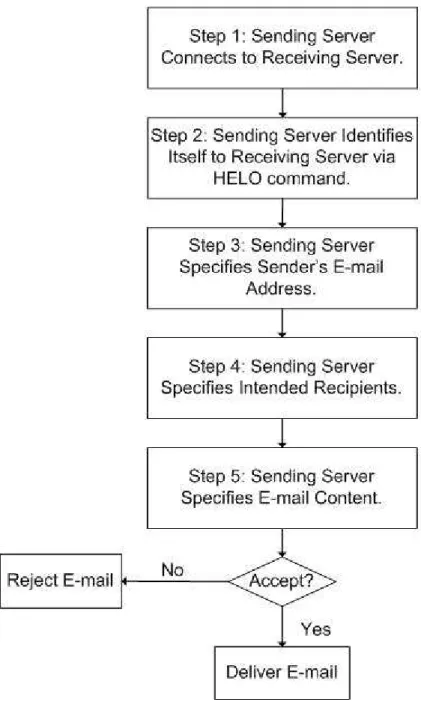
The previous Chapter presented related research on current efforts at combating spam and the state of the art of spam filtering. We note that existing anti-spam filtering techniques focus on distinguishing good and bad e-mail content while our filtering technique differs from existing solutions in that we look at discrepancies in mail transactional behavior between a legitimate mail server and a spam zombie. In this Chapter, we examine the SMTP transaction between a legitimate sending and receiving mail server and model the transaction in five sequential steps. We also examine the different ways that an SMTP transaction can be rejected and look at the different sender notification mechanisms used to notify senders that their mail has been rejected. Once the transactional model is presented, we will outline the machine learning algorithm goals of our new message filtering solution.
4.2
SMTP Procedure
The ability to exchange messages between a sending and receiving mail server is made possible by the SMTP protocol. In this section, we provide an overview of the SMTP protocol as defined in RFC 821 [53] and RFC 822 [54] developed in 1982 and extended
in RFC 2821 in 2001 [55]. An example of a successful SMTP transaction between a sending and receiving mail source is illustrated below.
220 mta554.mail.mud.receiver.com ESMTP YSmtp service ready HELO mail.receiver.com
250 Hello mail.receiver.com [198.2.25.87], pleased to meet you MAIL FROM: <[email protected]>
250 <[email protected]>... Sender ok RCPT TO: <[email protected]>
250 <[email protected]>... Recipient ok DATA
354 Enter mail, end with "." on a line by itself From: [email protected] To: [email protected] Date: January 18, 2007 Subject: Test This is a test .
250 2.0.0 l0J5FYf01210 Message accepted for delivery (relayed by MailShield
In the example above, the sending mail server mail.receiver.com engages in an
SMTP transaction with the receiving mail server a.mx.mail.receiver.com for the
purpose of delivering mail from the user account [email protected] to the user account [email protected]. All communication from the sending mail server is in bold while
the responses from the receiving mail source are underlined. Each step within the SMTP transaction will be described in the following sub-sections.
4.2.1Step 1: Session Initiation
An SMTP session begins when a sending mail server connects to the receiving mail server on the receiving server’s SMTP port; typically, TCP port 25. If the receiving mail server accepts the connection from the sending mail server, the receiving mail server presents the sending server with a banner message starting with a 220 SMTP code
followed by text identifying the receiving server’s fully qualified domain name, SMTP software and version. In our example, the banner message that the sending server received was:
220 mail.receiver.com ESMTP YSmtp service ready
In the banner above, the 220 represents an SMTP code that indicates that the SMTP
service is ready, mail.receiver.com is the fully qualified domain name of the receiving
server and ESMTP is the mail software used by the receiving server. In this case, the receiving server likely concealed the version information of the mail software for security reasons.
It should be noted that instead of presenting a banner with SMTP code 220, the
receiving server can respond to an incoming connection with SMTP code 554 which
indicates a transactional failure. This type of situation may occur if the receiving server is configured to consult a blacklist prior to accepting connections. Specifically, if the receiving server is configured to deny connections from all IP addresses listed in the
blacklist and the sending server’s IP address is listed, then the receiving server can immediately reject the connection. According to RFC 2821, if the incoming connection is rejected, the server must wait for the sending server to send a QUIT command before closing the connection and should respond to all other commands from the sending server with SMTP code 503, which indicates a bad sequence of commands. However, to
prevent Denial of Service (DoS) attacks that connect to mail servers without issuing a QUIT, the receiving server may be configured to drop a connection after a pre-specified amount of inactivity has elapsed. Such a pre-specified time period varies for each mail server environment.
4.2.2Step 2: Sending Server Identification
If the sending server is able to establish an SMTP connection with the receiving server and receives an SMTP code 220 banner message, the sending server must then identify
itself to the receiving server. This is performed with either the HELO or the EHLO command. The HELO command is used to simply identify the sending mail server. In our original example, the sending server identified itself by issuing the following command:
HELO mail.receiver.com
This command can be interpreted as saying ‘Hello, I am mail.receiver.com’. In
response to this command, the receiving server responded with SMTP code 250 which
indicates that the requested mail action was okay and completed:
The EHLO command is used when the sending server wishes to use a service extension of the SMTP protocol. An example of a sending server using EHLO communication is provided below:
EHLO mail.sender.com
The response to the above EHLO command is as follows:
250-mail.receiver.com Hello mail.sender.com [198.2.25.87], pleased to meet you 250-ENHANCEDSTATUSCODES 250-EXPN 250-VERB 250-8BITMIME 250-SIZE 20000000 250-DSN 250-ONEX 250-ETRN 250-XUSR 250-STARTTLS 250 HELP
In the example above, the parameter associated with the EHLO command identifies the sending server (mail.sender.com) and results in the receiving server
(mail.receiver.com) responding with a list of extensions it supports. At this point, the
sending server can use any of the available service extensions. For example, if the sending server wishes to encrypt the SMTP transaction, it would use the STARTTLS
In some cases the use of the EHLO command will result in the receiving server returning a SMTP code 500 response which indicates that the command is not recognized
and that the receiving server does not provide any service extensions. In such a situation, the sending server must use the HELO command instead.
According to RFC 2821, the HELO/EHLO parameter requires a fully qualified domain name of the sending server. If no meaningful domain name is found, the client should send an address literal which is an IP address enclosed in square brackets. It should be noted that majority of legitimate mail servers are assigned static IP addresses which typically map to a legitimate domain name. As such, very few servers should have address literals as its HELO/EHLO parameter and as we will see in Chapter 5, spam zombies will have unusual HELO/EHLO parameters. Therefore, the HELO/EHLO parameter values can help identity whether a server is legitimate or not. We will look at this in the subsequent Chapter.
4.2.3Step 3: Sender Identification
After the sending server identifies itself to the receiving server, the sending server issues the MAIL command to identify the sender. The command is generally used in the following form:
MAIL FROM:<address>.
Note: address represents the sender’s e-mail address (e.g. [email protected])
When the sending server issues the above command, the receiving server prepares for the start of a new mail transaction by resetting all state tables and buffers of previous MAIL transactions.
Now, referring to our original example, the sender server informs the receiving server that the sender is [email protected]:
MAIL FROM: <[email protected]> 250 <[email protected]>... Sender ok
In this case, the receiving server issued a response with SMTP code 250, which
means that the command was accepted and the associated e-mail address was stored in its buffer; however, if the command were not accepted then the receiving server must provide the sending server with a response to indicate whether the failure is permanent or temporary. If the failure is permanent, the sending mail server will not be able to send mail to the address under any circumstances. Such a situation would occur, for example, if the sender’s e-mail address was listed on a blacklist, which lists all e-mail addresses that the receiving server does not accept. In contrast, a temporary failure means that the sender address might be accepted if the sending mail server were to try specifying the same sender address again.
4.2.4Step 4: Recipient Identification
The RCPT command identifies the recipient of the sender’s message and is followed by the MAIL command; however, if the receiving server receives a RCPT command without a previous MAIL command then the receiving server should send a response with SMTP code 504 (bad sequence of commands) to the sender. Unlike the HELO or MAIL