Date of publication xxxx 00, 0000, date of current version xxxx 00, 0000. Digital Object Identifier 10.1109/ACCESS.201x.DOI
An Information Framework for Internet of
Things Services in Physical Internet
HOA TRAN-DANG1, (Member, IEEE), DONG-SEONG KIM1, (Senior Member, IEEE)
1Department of ICT Convergence Engineering, Kumoh National Institute of Technology, Gumi, South of Korea (e-mail: {hoa.tran-dang, dskim}@kumoh.ac.kr) Corresponding author: Dong-Seong Kim (e-mail: [email protected]).
This research was financially supported by the MSIT (Ministry of Science, ICT), Korea, under the ITRC (Information Technology Research Center) support program (IITP-2018-2014-1-00639) supervised by the IITP (Institute for Information & communications Technology Promotion), and Priority Research Centers Program through the National Research Foundation of Korea (NRF) funded by the Ministry of Education, Science and Technology (2018R1A6A1A03024003).
ABSTRACT
The Physical Internet (PI, orπ) concept was developed to address the current unsustainability problem of
logistics systems. The key physical elements in the PI includeπ-containers,π-nodes, andπ-movers. The
π-containers designed to be world-standard, smart, green, and modular are moved, handled, and stored
throughout an open global logistic infrastructure. Meanwhile, theπ-nodes andπ-movers including physical
systems and vehicles are designed to exploit as best as possible the characteristics of π-containers to
facilitate material handling processes. Thus, the logistics industry vision is a key player poised to benefit
from the Internet of Things (IoT) revolution since millions ofπ-containers with contained shipments being
moved, tracked, and stored by a variety of theπ-nodes andπ-movers each day. This paper proposes firstly an
information framework enabling IoT of the PI infrastructure and then a service-oriented architecture (SOA) for the IoT applied for providing the IoT logistics services for the PI. A case study utilizing the architecture is presented to illustrate an efficient management service of logistics operations in the PI.
INDEX TERMS Internet of Things (IoT), Physical Internet, Wireless Sensor Network, RFID, M2M, Service-Oriented Architecture (SOA), 3D layout .
I. INTRODUCTION
T
HE current logistics system is still recognized to beunsustainable in terms of economy, environment and society despite several innovative logistics paradigms ac-companying projects have been proposed and undertaken to reverse the situation. The intelligent logistics exploiting the intelligence concepts thanks to the integration of advanced information and communication technology (ICT) to im-prove the overall efficiency significantly in terms of security, physical flow management, automation of processes. One of key factors of such logistics vision is intelligent freight-transportation system that uses the latest technologies, in-frastructure, and services as well as the operations, plan-ning and control methods to efficiently transporting freight [1]. Such system is an effective solution to the significant transportation-related issues such as congestion, energy
con-sumption, and environment. Simple Links1 is an alternative
1Simple Links project introduction, https://www.
theconsumergoodsforum.com/wp-content/uploads/2018/02/CGF-Simple_ Links_White_Paper-1.pdf
framework of intelligent logistics. The project conducted by the consumer good forum aims to create, manage and analyze digital links between items and their containers as a dynamic hierarchy, then to infer item-level tracking and monitoring information for any item based on searching the hierarchy for the best available track, monitor and prediction data at a given time. The objective of project is enabled by an underlying principle that make items and their containers communicate together to share information all along the logistics links by using low cost identification technology (i.e., QR code). The primary demonstration results of the project imply the positive impact of project since it sup-ports both ecological and economical value end-to-end. To reduce the environment damage caused by inefficient ways of logistics activities, the Intelligent Cargo project (iCargo)
project2funded by European Union is expected to provide a
potential solution. Relying heavily on ICT, the iCargo is ca-pable of self-identification, context detection, service access,
2iCargo project, https://ec.europa.eu/digital-single-market/en/news/
status monitoring and registering, independent behavior and autonomous decision making. Thus, the end-to-end visibility of shipment flow is improved by a cargo tracking system [2]–[4] capturing the real time information relating to the location, time and status of the vehicles and carried iCargo. In this way, the logistics processes such as asset management, routing path of freight can be optimized to avoid empty trucks or congestion. Another logistics visions termed as green lo-gistics indicates methods that employ advanced technologies and innovated equipments to tackle the environment issues such as greenhouse gas (GHG) emissions, noise and acci-dents mainly caused by inefficient logistics operations [5]. To make the global logistics green, the environment aspect is concerned as the top priority in all logistics operations, in particular, transportation, warehousing and inventory op-erations [6]. These three activities are conducted in a series of researches and investigated in Operation Research (OR) models. For example, to minimize the GHG emissions by the transportation, the operation is performed by optimizing four significant choices, namely, mode choice (i.e., plane, ship, truck, rail, barge or pipelines), usage of inter-modal transport (i.e., types of containers), equipment choice (i.e., type and size of transportation unit) and fuel choice (e.g., gasoline, bio-fuels, electric, etc.). As the optimal selection of these handling equipments is set off, the minimum emission is obtained, thus the environment sustainability is resulted in.
Recently, the Physical Internet (PI, or π) is an emerging
paradigm that is strongly expected to achieve simultaneously the three dimensions of sustainability: economy, environment and society at global scale [7]. Conceptually, by taking the Digital Internet as a metaphor the PI is built towards an open global logistics system founded mainly on physical, digital, and operational inter-connectivity through a standard
set of modular containers (π-containers), collaborative
proto-cols (π-protocols), and smart interfaces (π-nodes, termed for
container distribution centers) for increased efficiency and sustainability [8], [9]. Accordingly, the PI does not
manip-ulate the physical goods directly but suchπ-containers that
encapsulate the physical merchandise within them. These
π-containers are world-standard, smart, green and modular
contains. Particularly, they are characterized by modularity and standardization worldwide in terms of dimensions, func-tions and fixtures. In the existing logistics and supply chain the diversity of brands and types of products with various sizes and weights leads to a nearly infinite range of different sizes of carton boxes. Therefore, generating efficient unit loads from such a high variance of cases is complicated and leads to inefficient space utilization at the pallet level and as a consequence also on a truck level. To release such issues, the container standardization concept of the PI aims to determine a limited set of modular container dimensions subject to all specific requirements [10]. Thus, having a small number of such containers would make it much easier for
goods to be rolled out ofπ-nodes and ontoπ-trucks andπ
-trains. In addition, as the open global logistics network, the PI allows all stakeholders share the infrastructure including the
π-containers,π-nodes, andπ-movers (denoted for material
handling equipments) to maximize its operation efficiency. In addition, the modularity of these containers enables sets of
smallerπ-containers to be composed easily to generate
com-positeπ-containers, which are efficient unit loads throughout
the PI network. In addition, the π-nodes andπ-movers are
designed and innovated to exploit as best as possible the standard and modular encapsulation. For example, the
phys-ical dimensions of π-movers such as π-pallets or π-trucks
should be modular and can be adapted to fit any size of
compositeπ-containers [11]. In this way, facilitation of
logis-tics processes such as moving, storing, handling, transporting the unit loads enables the system to gain huge efficiency and sustainability. The work in [12] proved that container standardization increases the space utilization of trucks and material handling equipments. In the similar research, an evaluation of PI performance introduced in [13] indicated that transporting shipments in the PI network contributes to reduce the inventory cost and the total logistics system cost as compared with the traditional logistics system thanks to the consolidation facilitation of such standardized containers. Furthermore, such advantage characteristic of the PI would enable the PI network to achieve more sustainable environ-ment since the shipenviron-ment consolidation approach was proved to mitigate the carbon and energy waste effectively in the traditional logistics system [14], [15].
A project has been conducted by CELDi (Center for Excel-lence in Logistics and Distribution) to examine more com-prehensive impact of the PI on the performance of existing logistics system in the U.S.A. The primary demonstration results declared in [9] imply various positive impacts of the PI on all three sustainable aspects. Concretely, if the PI was rolled out on 25% of flows in the U.S.A, its impact would represent a saving of 100 billion USD, a reduction of 200
million tonnes of CO2 emissions, and a decrease of 75%
in the turnover of long distance for vehicle drivers driving heavy goods. Another project led within CIRRELT (Interuni-versity Research Centre on Enterprise Networks, Logistics and Transportation) is to estimate the potential energy, envi-ronmental and financial gains for one industrial producer of manufactured goods exploiting an open distribution network. The simulation results from several scenarios introduced in [9] show the impact of PI with manifold gains including an increase in the fill rate of vehicles (e.g., trucks, trains, etc.), energy savings (saving millions of litres of Diesel per year), and a reduction of overall logistics cost.
The PI is a long-term vision for an end-to-end global
lo-gistics network, and several alliances like MHI3and ALICE4
have already adopted and then promoted the PI conceptu-alizations and practices. They also has decided to declare the PI as the ultimate logistics goal and set up a
com-3MHI, the largest material handling logistics, and supply chain association
in the U.S., has created a community of industry thought leaders called the U.S. Roadmap for Material Handling & Logistics. http://www.mhi.org/
4ALICE (Alliance for Logistics Innovation through Collaboration in
Europe), http://www.etp-logistics.eu/
prehensive roadmap to realize the PI concept by 2050. To reach the full-fledged PI many factors need to be taken into account simultaneously, including physical objects such as
π-containers, π-movers, and π-nodes as well as informal
abstracts including π-protocols and the Physical Internet
management systems (PIMS). The PI will thus lead to the development of an open logistics system for connecting the physical objects to the global Internet. This concept suggests significant organizational evolutions, in which the logistics objects are expected to be intelligent and autonomous since they are a communication channel and a stock of information at the same time. In this context, the PI is a key player poised to benefit from the Internet of Things (IoT) [16]
revolution since millions ofπ-containers are moved, tracked,
and stored by a variety of the π-nodes andπ-movers each
day. By embedding intelligent capabilities such as sensing, communication, and data processing into the PI components, IoT enables seamless interconnection of the heterogeneous devices and to get complete operational visibility and allow for the best real-time decisions in the logistics processes. For example, IoT enables managers to monitor the performance of machines, ambient conditions, energy consumption, status of inventory, or the flow of materials. Thus the benefits are contingent upon the design of IoT architecture for the PI and particularly the IoT services ubiquitously to manage and control efficiently the industrial automation processes in the logistics domain. However, much of the PI and IoT literature, to date, has been largely disjointed without much emphasis on theory or practical applicability [17]. This paper examines the trends of IoT applications in the PI and uncover various issues that must be addressed to transform logistics technologies through the IoT innovation. In this regard, the main contributions of paper are summarized as follows:
• The PI paradigm accompanying the state-of-the-art
de-velopments of related projects are highlighted. In addi-tion, the proposition design for the components of PI is introduced toward IoT application in the PI. Particularly, an active distributed system is proposed for the PIMS to
enable smooth flows of theπ-containers through theπ
-nodes.
• An information framework is proposed based on
ex-ploiting the IoT embedded in the physical devices of the PI and their active interaction.
• An service-oriented architecture (SOA) is proposed and
described for IoT applied for the PI. Such SOA then exploits the information framework to create and deliver IoT services for the PIMS.
• By adapting the proposed framework, a case study
aim-ing at developaim-ing an IoT service is presented to illustrate an efficient management service of logistics operations in the PI.
The rest of the paper is organized as follows: Section II describes the key infrastructure enabling the PI and our proposition design to create an IoT in the PI network. In Section III, we propose an SOA, which is designed to adapt
to the logistics environment to provide the IoT logistic ser-vices. After that, Section IV introduces a case study used the proposed IoT architecture as well as the proposed SOA architecture to create and deliver a value-added services for the PI management. Finally, Section V concludes the paper and proposes further developments.
II. IOT INFRASTRUCTURE FOR PHYSICAL INTERNET
In this section, we will present the key elements includingπ
-containers,π-nodes andπ-movers as well as the
state-of-the-art proposition design that enables the IoT for the Physical Internet.
A. Π-CONTAINERS
The π-containers are a key element enabling the success of
the PI operation. The π-containers are classified into three
functional categories: transport, handling and packaging con-tainers (termed as T/H/P-concon-tainers respectively) with their corresponding modular dimensions [18]. The proposition is
introduced in [19] to design the modular sizes of these π
-containers. Although the set of modular dimensions must be subject to an international standard committee, the partners of the CELDi PI project [20], [12] developed a mathematical model to determine the best container size to maximize space
utilization. In parallel, the project MODULUSHCA5funded
by the 7th Framework Program of the European commission
is the first project to design and developπ-containers (termed
as M-boxes in this project) dedicated for fast-moving con-sumer goods (FMCG). Generally, the FMCG includes daily used goods of consumers with wide range of small/medium sizes such as pharmaceutical, consumer electronic, personal care, household care, branded and packaged foods, spirits and tobacco. The M-boxes are sized and designed by the method-ological engineering process introduced in the research [10].
They demonstrated that a set of external dimensions of π
-containers including the following values in meters {0.12, 0.24, 0.36, 0.48, 0.6, 1.2, 2.4, 3.6, 4.8, 6, 12} increases the space utilization at the different unit load levels [11]. With the modularity and interlocking structure, the encapsulation concept [8] is applied to create efficient unit loads that facili-tate material handling processes such as moving, loading, or storage. Fig. 1 illustrates such concept realized by composing
nine smallerπ-containers to create a compositeπ-container
as an efficient unit load.
Note that, the physical encapsulation is applied in the three
types ofπ-containers. Accordingly, a P-container containing
directly several passive goods is placed in a H-container, itself contained in a T-container. In deed, number of smaller
π-containers are optimized such as their composition block
(compositeπ-container) fits perfectly with the internal space
of a largerπ-container.
Additionally, the PI emphasizes the importance of in-formational and communicational encapsulation. This is achieved by applying IoT and embedding the
accompany-5MODULUSHCA project, www.MODULUSHCA.com
FIGURE 1: An example of encapsulation concept that
com-poses nineπ-containers to create an efficient unit load [21].
ing technologies such as RFID, wireless sensor networks
(WSNs). With such ICT integration, theπ-containers become
smart IoT objects [22] having basic capabilities such as identification, ambient sensing, computation, and
communi-cation. Since theπ-containers are manipulated worldwide by
all stakeholders, the information relating to their physical status and context must be captured, coded, protected and transfered accurately. The EPCglobal standard provides a
solution that allows identifyingπ-containers uniquely.
Con-cretely, the container code is created in line of RFID tag with the EPC standard. Thus, when the code is put into service,
the information fed to an EPC Information Service (EPCIS6)
is shared among stakeholders. Meanwhile, the sensing ca-pability of the sensor node allows the ambient environment condition of the container to be monitored periodically. With
such ability, theπ-container is able to identify its state and
report it, compare its state with the desired one, and send information (e.g., warning) when certain conditions are met. Furthermore, integrated with a memory, the sensor node can store and maintain relevant data. Applying for the PI network,
sinceπ-containers are equivalent to the data packets flowed
in the Digital Internet networks, information relating to
fun-damental specification ofπ-container should be stored in the
memory such as container identifier, container dimension, container category. In addition, to support routing protocols effectively, routing information (i.e. previous/next/final
des-tination address) of the π-container provided by the PIMS
is also added to the memory of the sensor. More important, any problem in the logistics process along the supply chain will be recorded in the wireless sensor node memory, so such information can be checked using any device such as a computer, tablet or even a mobile phone. Processing capabil-ity enables the nodes to perform specific tasks and provide corresponding additional functionalities for the containers. Meanwhile, enabled by integrated wireless transceivers, the
π-container can communicate with the different support
sys-tems (e.g., manufacturing syssys-tems, supply chains,
mainte-nance systems, PIMS) and other activeπ-containers to enable
IoT as well as IoT services [23]. Practically, an example of integration of all these capabilities is the Intelligent Container
called InBin7recently developed by the Fraunhofer Institute
6EPCIS, GS1 standard, https://www.gs1.org/epcis/epcis/1-1
7inBin project, http://www.industrie40.iml.fraunhofer.de/en/ergebnisse/
inbin.html
for Material Flow and Logistics to support transporting the perishable food products efficiently. Another project named
TRAXENS8has been developed smart multi-modal
contain-ers (i.e., equivalent T-containcontain-ers in PI) that can achieve a huge gain in efficiency, service, and protection of the planet since the visibility of the cargo containers are obtained in real time.
With such ICT integration, each smartπ-container is
rep-resented by a corresponding intelligent agent (e.g., a smart tag, wireless sensor node, etc.) as illustrated in Fig. 2. Each agent is as a communication channel enabled by wireless communication technologies and holds a stock of significant information relating to the products and their status. In ad-dition, it helps ensure the identification, integrity, routing,
conditioning, monitoring, traceability and security of eachπ
-container. It also enables distributed handling, storage and routing automation [21].
R4 S4 C4 L4
Receiving Site
Sorting Site
Composing Site
Loading Site
πP3 πP4 πT3 πT4 πc6 πc7 πc8 πc9 πc16 πc15 πc13 πc11 πc6 πc9 πc15 πc2 PIMS Database πc1 πc2
Agents (sensors, smart tags) Communication, interaction
FIGURE 2: The wireless sensors or smart tags embedded in
the π-containers as their agents enable interaction between
them and with a PIMS actively.
Throughout the PI, stakeholders can access necessary data by interacting with the agents. However, based on the roles of the requesters more restricted data may be required and accessed to ensure the security and privacy of data. A Mod-ulusca common data model proposed in [24] is composed of four data types: business data, shipment data, network data, and public data, which can be accessed by corresponding ac-tors with the granted right to support exchanging information among the partners of the PI.
B. Π-MOVERS
In the Physical Internet,π-containers are generically moved
around by π-movers. Moving is used here as a generic
equivalent to verbs such as transporting, conveying, handling,
lifting and manipulating. The main types ofπ-movers include
π-transporters, π-conveyors and π-handlers. The latter are
humans that are qualified for moving π-containers. All π
-movers may temporarily storeπ-containers even though this
is not their primary mission.
Since the π-movers manipulates directly with the π
-containers, they are designed to exploit as best as possible the
8TRAXENS project, http://www.traxens.com/en/
characteristics of π-containers. From physical perspective,
dimensions ofπ-movers are innovated to subject to the
mod-ularity standard ofπ-container so as moving such containers
or compositeπ-containers with different sizes is facilitated.
Fig. 3 illustrates the conceptual model ofπ-movers designed
to exploit the modularity ofπ-containers.
(a)π-truck-lift (b)π-mover
FIGURE 3: Conceptual illustration ofπ-movers designed to
exploit the modularity ofπ-containers.
Regarding to information perspective, the widespread adoption of IoT technologies enables smart inventory and
asset management. In particular,π-movers can act as active
agents, which can interact withπ-containers and the PIMS
for information sharing and manage them temporarily in the distributed manner. Thus, through the interaction, the basic
information includes the specification ofπ-containers such as
ID, dimensions, final destination. In addition, the status ofπ
-container and alsoπ-movers are monitored in real time. For
example, the PIMS can be alerted when aπ-truck is being
over-utilized or when an idle π-pallet should be assigned
to do other task. Fig. 4 illustrates an example showing the
activeness of π-movers (π-pallet (πP) and π-truck (πT))
enabled by equipped wireless sensors or gateway.
Composing Site
Loading Site
Mounted-computer π-pallet (πP) or equivalent H-container π-truck (πT) or equivalent T-container PIMS Database Internet
Items Id Color Size Final Destination πc1 C100 red [2x1x1] πH2 πc2 C200 green [2x1x1] πH2 πc3 C300 violet [1x1x1] πH2 πc4 C400 blue [1x1x1] πH2 Sensor Coordinator Items Id Color Size Final
Destination πP1 P100 white [3x2x1] πH2 πP2 P200 white [3x2x1] πH2 πP3 P300 white [3x2x1] πH2 πP4 P400 white [3x2x1] πH2 Sensor Coordinator, GW
FIGURE 4: IoT logistics services provided by IoT
infrastruc-ture of Physical Internet like active πT andπP enabled by
equipped wireless sensors or gateway.
C. Π-NODES
In the PI vision, the π-nodes are locations playing a role as
smart interfaces to enable realizing universal
interconnectiv-ity at the operational level. For example,π-gateways enable
efficient and controlled entry of π-containers into the PI as
well as their exit from the PI. Generally, aπ-node includesπ
-movers and/or other embeddedπ-nodes permanently or
tem-porarily, which are collaborated for joint purposes of material
handling (e.g., composing π-containers, moving composite
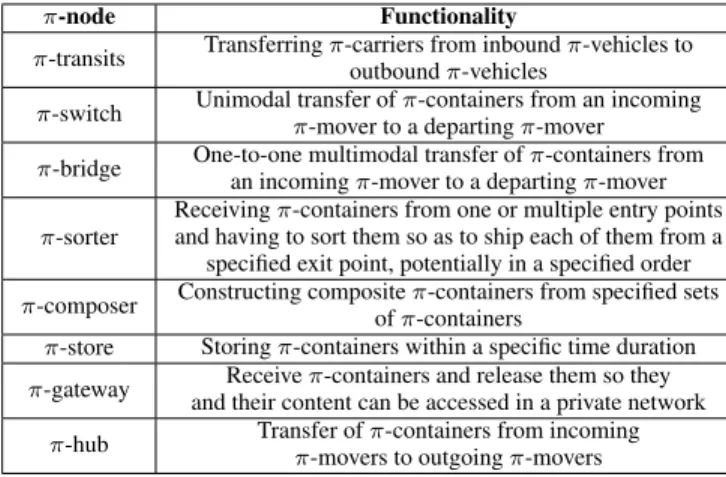
π-containers, storing compositeπ-containers, etc.). Table 1
summarizes the key π-nodes designed for the PI network
[21]. As container distribution centers almost logistics
activ-TABLE 1: Keyπ-nodes with their specific functionality in
the PI.
π-node Functionality
π-transits Transferringπ-carriers from inboundπ-vehicles to outboundπ-vehicles
π-switch Unimodal transfer ofπ-mover to a departingπ-containers from an incomingπ-mover
π-bridge One-to-one multimodal transfer ofπ-containers from an incomingπ-mover to a departingπ-mover
π-sorter
Receivingπ-containers from one or multiple entry points and having to sort them so as to ship each of them from a
specified exit point, potentially in a specified order
π-composer Constructing compositeofππ-containers-containers from specified sets
π-store Storingπ-containers within a specific time duration
π-gateway and their content can be accessed in a private networkReceiveπ-containers and release them so they
π-hub Transfer ofπ π-containers from incoming
-movers to outgoingπ-movers
ities are taken place and transformed here dynamically. Thus
theπ-nodes must be designed so that they exploit as best as
possible the characteristics ofπ-containers to support smooth
movement of the containers. In the next section, an active distributed PIMS for these smart interfaces are proposed to
enable the smooth physical flows of smartπ-containers.
D. ACTIVE DISTRIBUTED PIMS FORΠ-NODES
Due to the high dynamic and structural complexity of the PI networks, central planning and control of logistics processes become increasingly difficult. The difficulty is amplified by
the need of efficient management of a huge number of π
-containers and logistics assets in each π-node.Therefore,
distributed and autonomous control and management of lo-gistics processes are required in the context of the PI. In other words, the PIMS should be designed in distributed manner enabling management of the facilities and logistics assets efficiently. In addition, the PIMS should be active to exploit
as best as possible the capabilities of IoT π-facilities. The
term ”activeness” refers to the ability of PIMS in monitoring status of the logistics assets in real time and based on this information scheduling, processes are planned flexibly and effectively. In this way, the utilization of assets can be opti-mized. This section describes the proposed active distributed system designed to enable IoT for PI in both information and physical flow perspectives.
With the active distributed system, the logistics processes are monitored and controlled effectively. Thus, intention mistakes or errors can be traced and the exact processes causing such issues can be found thank to the activeness of PIMS to correct them. Generally, the main mission of
π-nodes is to ensure theπ-container transferring efficiently
and sustainably from their inbound π-movers carrying π
-containers to outbound π-movers. In addition, enabled by
IoT, the logistics assets can connect to the PIMS. Therefore,
all the π-nodes can manage not only their incoming and
outgoingπ-containers participating in the logistics processes
but also their logistics assets in real time.
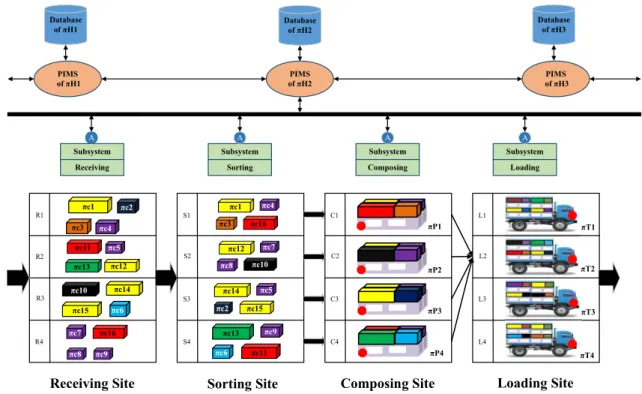
Fig. 5 illustrates such a PIMS at aπ-hub distributed into
active subsystems, which are responsible for single functions or corresponding services.
In the same way, a subsystem evolving specific π
-containers and facilities assigned by the PIMS manages and takes its function. An active subsystem is responsible for
managing a set of PI assets, inventories (i.e., π-containers,
πmovers) within a scheduled period to complete its specific
task.
As defined in Table 1 the exchange of π-containers from
carriers to another is the core activity of the π-hub (πH).
The following demonstrates such exchange process in both physical and information flow with IoT integration. As shown
in Fig. 5, the logistics process in theπH2 is divided in four
processes managed by four corresponding active sub-systems.
1) Receiving
At the receiving site, all inboundπ-movers, andπ-containers
are registered, verified and scanned for validation and
secu-rity purposes. At this stage, the activeness ofπ-facilities are
exploited to cross-check the current incoming inputs against
the information transmitted from πH1. After passing such
initial processes, π-containers are directed to appropriate
locations for their next involved processes. Usually, moving
the π-containers is supported by π-conveyors or π-carriers
depending on their next destination and next processes. To
avoid collisions and balance the loads, theπ-containers are
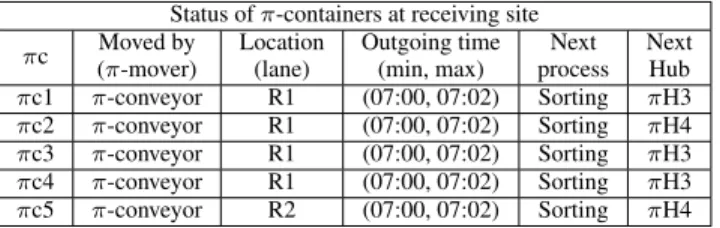
allocated to go in different input lanes. For example, as
illustrated in Fig. 5, every four π-containers are scheduled
and moved in one lane (i.e., R1, R2, R3, R4) to ensure the smooth flow in both time window and space window. Table
TABLE 2: Time and space schedule for π-containers at
receiving site
Status ofπ-containers at receiving site
πc (Moved byπ-mover) Location(lane) Outgoing time(min, max) processNext NextHub
πc1 π-conveyor R1 (07:00, 07:02) Sorting πH3
πc2 π-conveyor R1 (07:00, 07:02) Sorting πH4
πc3 π-conveyor R1 (07:00, 07:02) Sorting πH3
πc4 π-conveyor R1 (07:00, 07:02) Sorting πH3
πc5 π-conveyor R2 (07:00, 07:02) Sorting πH4
2 illustrates a detail status ofπ-containers scheduled by the
receiving subsystem at the receiving site. The schedule is sent to the sorting subsystem that is responsible for sorting the
listedπ-containers.
2) Sorting
Going out from the receiving site, the received and selected
π-containers go to the sorting site which aims to sort such
π-containers according to some rules as followings:
1) π-containers have the same final destination,
2) or they may have different the final destination but are
scheduled to transit in the same nextπ-node.
Table 3 illustrates an example of status and schedule of π
-containers at the sorting site.
TABLE 3: Time and space schedule for π-containers at
sorting site
Status ofπ-containers at sorting site
πc Moved by (π-mover) Location (lane) Outgoing time (min, max) Next process Next Hub πc1 π-conveyor S1 (07:03, 07:04) Composing πH3 πc2 π-conveyor S3 (07:03, 07:04) Composing πH4 πc3 π-conveyor S1 (07:03, 07:04) Composing πH3 πc4 π-conveyor S1 (07:03, 07:04) Composing πH3 πc5 π-conveyor S3 (07:03, 07:04) Composing πH4
In this example,π-containers,πc1,πc3, andπc4 having
the final destination (πH3) are sorted and moved in the lane
S1. Meanwhile,πc2 andπc5 are moved in the lane S3 since
their final destination isπH4. As mentioned before, sorting
mission is achieved by aπ-sorter that incorporate a network
ofπ-conveyors and/or other embeddedπ-sorters.
3) Composing
At the composing site, the sortedπ-containers are composed
to be compositeπ-containers, which are efficient loads with
different sizes fitting the sizes of H/T-containers. In addition, their composing orders must be taken into account since
someπ-containers can be decomposed in the nextπ-nodes,
thus they should be placed at the outermost locations of the
composite π-container. In other words, any mistake in
allo-catingπ-containers can lead to the inefficiency of following
logistics process. Generally, the composing task is completed
by π-composers in combination with the pre-assigned π
-movers such asπ-pallets or largerπ-containers to carry.
Table 5 illustrates an example of status and schedule of
π-containers at the composing site.
TABLE 4: Time and space schedule for π-containers at
sorting site
Status ofπ-containers at composing site
πc Moved by(π-mover) Location(lane) Outgoing time(min, max) processNext NextHub
πc1 πP1 C1 (07:04, 07:05) Loading πH3 πc2 πP3 C3 (07:04, 07:05) Loading πH4 πc3 πP1 C1 (07:04, 07:05) Loading πH3 πc4 πP1 C1 (07:04, 07:05) Loading πH3 πc5 πP3 C3 (07:04, 07:05) Loading πH4 6 VOLUME xx, 201x
PIMS of πH2 PIMS of πH1 PIMS of πH3 Database of πH2 Subsystem Receiving Subsystem Sorting Subsystem Composing Subsystem Loading A A A A Database of πH1 Database of πH3 R1 R2 R3 R4 S4 S3 S2 S1 C4 C3 C2 C1 L4 L3 L2 L1
Receiving Site Sorting Site Composing Site Loading Site
πP1 πP2 πP3 πP4 πT1 πT2 πT3 πT4 πc1 πc2 πc3 πc4 πc5 πc6 πc7 πc8 πc9 πc10 πc11 πc13 πc12 πc14 πc16 πc15 πc1 πc12 πc13 πc16 πc11 πc6 πc9 πc14 πc15 πc4 πc3 πc7 πc8 πc5 πc2 πc10
FIGURE 5: A typical distributed PIMS to manage incoming and outgoingπ-containers and the logistics assets in aπH2.
After π-containers are composed to be a composite π
-container, the information encapsulation is applied.
Accord-ingly, the coordinator or gateway embedding into the π
-pallet is responsible for managing their hold π-containers
directly instead of the composing subsystem. This distributed management allows the PIMS reduce the management and storage cost of the related data.
4) Loading
The loading process deals with composite π-container or
H/T-container to load them into π-transporters and then to
move them to nextπ-node. Similar to the composing process,
the loading process must follow significant rule as following:
1) Number of composite π-containers including
H-containers are optimized so as their spatial arrangement
in aπ-transporter maximizes the space utilization,
2) Since the composite π-containers may have different
final destination but same next destination, their load-ing orders must be taken into account to facilitate the unloading process in the next destination. In this case, the last-in-first-out (LIFO) rule is applied.
Table 5 illustrates an example of status and schedule of
π-containers at the composing site.
In the example, the four π-pallets are moved and
con-verged at the lane L2 of the loading site, at which they are
loaded into theπT2 pre-assigned. On the informational
per-spective, the coordinator or gateway or IoT device mounted
in the πT2 temporarily manages their loaded π-containers
until they are handled in the next process.
TABLE 5: Time and space schedule for π-containers at
loading site
Status ofπ-containers at loading site
πc (Moved byπ-mover) Location(lane) Outgoing time(min, max) processNext NextHub
πP1 πT2 L2 (07:05, 07:06) Transporting πH3
πP2 πT2 L2 (07:05, 07:06) Transporting πH3
πP3 πT3 L2 (07:05, 07:06) Transporting πH3
πP4 πT4 L2 (07:05, 07:06) Transporting πH3
III. SERVICE-ORIENTED ARCHITECTURE FOR THE IOT
Since no single consensus on architecture for IoT is agreed universally, different architectures have been proposed by researchers [25]. With a numerous number of things is moved dynamically in the PI scenarios, an adaptive architecture is needed to help devices dynamically interact with other things in real-time manner. In addition, the decentralized and heterogeneous nature of IoT requires that the architecture provides IoT efficient event-driven capability as well as on-demand services. In addition, the PIMS is difficult to im-plement and maintain at global scale due to the lack of an efficient, reliable, standardized, and low cost architecture. Furthermore, the ever-changing demands of businesses and the vastly different needs of different end users should be met by providing customization functionality to the end users and organizations under a flexible SOA. Thus an SOA is con-sidered an efficient method achieve interoperability between heterogeneous devices in a multitude of way [16], [26], [27]. In addition, SOA is considered suitable for such
driven logistics chains. In particular, SOA can integrate lo-gistics processes and information; and sharing such informa-tion can help create a better environment for real-time data exchange, real-time responsiveness, real-time collaboration, real-time synchronization, and real-time visibility across the entire logistics chain.
This section describes the proposed SOA for creating the IoT logistics services in PI. The architecture comprises four layers: physical layer, network layer, service layer and interface layer. In the following subsections, these layers are presented to adapt to the IoT of PI.
A. PHYSICAL LAYER
The physical layer involves perceiving the physical charac-teristics of things or surrounding environment. This process is enabled by several identification and sensing technologies such as RFID, WSN [28]–[30]. For example, by embedding
an intelligent sensor to aπ-container, the environment
condi-tion (e.g., temperature, humidity, etc) around it can be sensed and monitored in real-time. In addition, since communication
is enabled by these sensors, the π-containers can exchange
information and identify each other.
In addition, this layer is in charge of converting the infor-mation to digital signals, which are more convenient for net-work transmission. However, some objects might not be per-ceived directly. Thus, microchips will be appended to these objects to enhance them with sensing and even processing capabilities. Indeed, nanotechnologies [31], communicating material [32], [33] and embedded intelligence will play a key role in the physical layer. The first one will make chips small enough to be implanted into the objects used in our every day life. The second one will enhance them with processing capabilities that are required by any future application.
At the lowest layer of the architecture, the physical layer provides sets of information periodically or in passive mode. With the massive logistics activities, the information levels should be categorized and standardized. For example, the information used to realize the four classes of activeness of
π-containers can be classified into four corresponding levels
[23]:
1) Passive information: it is collected from static or dy-namic data stored in the RFID tag or sensors. Such
information relates toπ-container specification and
lo-cation for providing tracking and traceability function. 2) Triggering information: This information is perceived from sensing and detecting by adequate sensors. There-fore, detected problems are sent to the PIMS as alert message. Such information provides the monitoring function.
3) Decisional process information: This information is obtained through the interaction and communication
among proximity π-containers. The management of
incompatibility betweenπ-containers is an example of
services served by such information.
4) Self-organized information: The active π-containers
are self-sufficient and able to provide services based
on the information obtained from theπ-infrastructure
in the previous class.
B. NETWORK LAYER
The role of network layer is to connect all heterogeneous things together and allow them to share the information with other connected things [16]. In addition, the networking layer is capable of aggregating information from existing IT infrastructures supporting the logistics processes (i.e.,
π-movers, π-facilities). In SOA-IoT, services provided by
IoT devices or a collective group of devices are typically deployed in a heterogeneous network and all related things are brought into the service Internet [16] for further accessing and sharing. Since, the networking layer mainly provide information collected from the physical layer to the service layer, QoS management, service discovery and retrieval, data and signal processing, security, and privacy according to the requirements of users/applications are some significant issues [34]. On the other hand, the dynamic changing of network topology due to leaving or joining of IoT devices may lead to non-robust of the network. Practically, since the network is the backbone to realize the IoT, designing it must consider the following significant challenges listed in Table 6. TABLE 6: Design considerations for IIoT applications (adapted from [27] )
Design goals Description
Energy How long can an IoT device operatewith limited power supply?
Latency How much time is need for message
propagation and processing? Throughput that can be transported through the network?What is the maximum amount of data
Scalability How many devices are supported
Topology Who must communicate with whom?
Security & safety How secure and safe is the application?
C. SERVICE LAYER
This layer relies on middlewares to integrate multiple source of heterogeneous information provided by heterogeneous IoT devices to create valuable services. These services in turn are exploited to support the logistics process of the active subsys-tem as well as end users to monitor or track their orders. This layer is responsible for identifying and realizing services that could utilize the IoT infrastructure to service operations in the logistics service. Basic traceability or tracking functions, monitoring, scheduling, routing are typical services in the logistics operations. In addition, all service-oriented issues including information exchange and storage, database man-agement, search engines (database search, service search), and communication protocols among services are resolve by the layer [16], [26].
D. INTERFACE LAYER
In IoT, since a large number of IoT devices are made by different manufacturers/vendors and they do not always fol-low the same standards/protocols, there are many
tion problems with information exchange, communication between things, and cooperative event processing among different things. Furthermore, the constant increase of IOT objects participating in an IoT makes it harder to dynamically connect, communicate, disconnect, and operate. Therefore, the mission of the interface layer is to enable the services to be accessed and used by managers or end users. Web Services [34] are technologies that integrate a set of standards and protocols to exchange data between applications developed in different programming languages and they can run on any platform. Therefore, the Web Services can be used to exchange data in both private IoT devices or private networks and the Internet. Interoperability is achieved by open stan-dards proposed by organizations such as OASIS and W3C.
IV. MANAGEMENT OF COMPOSITEΠ-CONTAINERS: A
CASE STUDY
Composite π-containers composed of specified sets of
smaller π-containers are efficient unit loads, which are
ab-solutely key in improving transport, storage and handling ef-ficiency across the PI network. By exploiting the modularity
and interlocking structure of theπ-containers, the unit loads
have different sizes that are adapted to fit with the different
sizes of material handling systems such asπ-pallets (see Fig.
6). Next, such sets of π-pallets, which in turn, are loaded
Composite π-container Nine unitary π-containers
Composing
FIGURE 6: An efficient unit load (i.e. a composite π
-container) is formed by composing nine unitaryπ-containers
appropriately [35].
into a π-truck such that the utilized space of the truck is
maximized prior to transport as illustrated in Fig. 5.
Because the exchange ofπ-containers is the core activities
taken place continuously in the PI, a high frequency of trans-formation processes can introduce a desynchronization
be-tween the physical and information flows of theπ-containers
maintained and previously stored in the PIMS. For example,
an unexpectedπ-container can be placed on aπ-pallet during
the composing process or in aπ-truck during the loading
pro-cess. This type of issue leads to inefficiency in management of logistics processes because it requires additional costs and delay in recomposing or reloading activities. In addition, in reserve processes (i.e., decomposing or unloading) the part of
unitary π-containers can be decomposed (i.e., depalletized)
automatically at the final destination or for order picking at the next destination. Such a process is facilitated if the
position and orientation of the composed π-containers are
available.
As a case study of utilizing the IoT technology, an method-ology has been developed to obtain 3D layouts of composite containers, which is used for monitoring and validating such unit loads and addressing the above limitations [36]. This section presents the description of the approach as shown in Fig. 7, which is developed to provide these kinds of important information. Particularly, based on this layout, value-added services enabled by the IoT can be developed and used to enhance the efficiency of other logistics operations.
CRAN – UMR 7039
CNRS & Université de Lorraine
11
SIA (01/06/2017) HOA Tran-Dang
3D LAYOUT RETRIEVAL
FIGURE 7: 3D layout retrieval from a compositeπ-container.
A. ARCHITECTURE
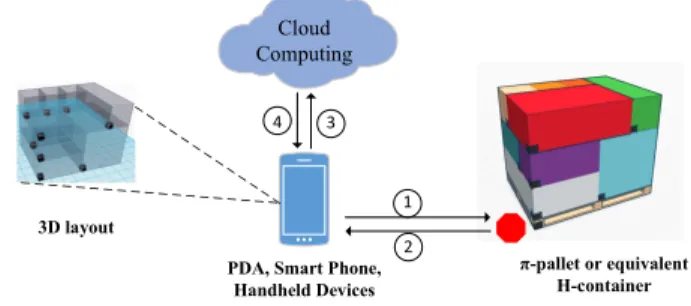
The proposed network architecture of IoT shown in Fig. 8
contains both fixed and mobile infrastructure.Agents (sensors, smart tags)
Communication, interaction Cloud Computing 1 2 3 4 π-pallet or equivalent H-container 3D layout
PDA, Smart Phone, Handheld Devices
FIGURE 8: IoT architecture for 3D layout retrieval at H-container level.
Applying the proposed architecture, the four-layer IoT architecture consists of the following elements. At the
sens-ing layer, each sensor node equipped with eachπ-container
contains information related to the specification of its con-tainer as well as the contained shipments. In addition, am-bient conditions such as temperature, humidity are sensed and stored in the sensors. A gateway (GW) placed at a
corner ofπ-pallet is responsible for coordinating the network
formed by those sensors and managing the composed π
-containers. At the networking layer, the sensors and the GW communicate on IEEE 802.15.4 links [37] to form an ad-hoc network coordinated by the GW (see Fig. 9). The mobile infrastructure usually includes PDA, smart phones or handled devices. These IoT devices request information from the GW/ coordinator (flow 1 in the Fig.8 ). After receiving the demanded data (flow 2), it then sends it to the cloud for requesting the services (flow 3). Finally, the devices receive the services and display the layout (flow 4).
Communication range
Wireless sensors GW
GW
Wireless Sensor Network
FIGURE 9: At the networking layer, an ad-hoc network is formed by nine wireless sensors and coordinated by the GW.
π-truck or equivalent T-container
Mounted-computer
3D layout
FIGURE 10: IoT architecture for 3D layout retrieval at T-container level.
At the service layer, the GW collects information from the
sensors to achieve the 3D layout of compositeπ-container,
which further is exploited to provide important services.
B. AN INFORMATION FLOW FRAMEWORK TO RETRIEVE 3D LAYOUTS
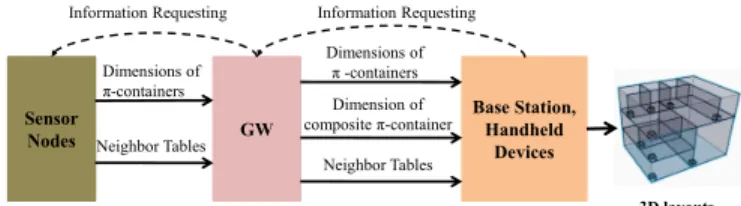
Fig. 11 shows the information framework flowing from the physical layer to the service layer for creating such layout.
Sensor Nodes GW Base Station, Handheld Devices Dimensions of π-containers Neighbor Tables Dimensions of π -containers Dimension of composite π-container Neighbor Tables Information Requesting Information Requesting 3D layouts
FIGURE 11: Information exchange among sensors, GW and processing points (i.e., base station, handheld devices) at the network layer.
In this framework, the required information includes the
dimensions of π-containers and the proximity information
obtained by neighborhood relationship among sensor nodes. In order to validate the framework, a simulation-based method has been created and described in our previous re-search work [36].
With such simple methodology for retrieving the 3D layout
of compositeπ-container, the value-added IoT services can
be developed to support the logistics processes in the Pi. In the next subsection, those services are introduced.
C. VALUE-ADDED SERVICES ENABLED BY RETRIEVED 3D LAYOUTS
The retried 3D layout provides the exact 3D view of spatial
distribution of composed π-containers in their blocks. In
addition, the locations of equipped sensor nodes are avail-able. Thus, the sensing functionality offers distribution of environment conditions inside these blocks. In this way, the
status ofπ-containers are monitored continuously to prevent
issues in real time. Such as, the π-container equipped with
adequate sensors can detect a problem (e.g., abnormal high
temperature), check for detection integrity with nearby π
-containers when pertinent, and send an alert message to their agents or directly to the PIMS. In another instance, proximity
π-containers carrying cargoes incompatible with each other
(e.g., chemical products that can contaminate each other or
cause an explosion) can be detected and avoided when aπ
-container arrives at aπ-hub, it sends to the PIMS the list of
elements incompatible with its cargo.
V. CONCLUSION AND FUTURE WORKS
With rapid development in the emerging IoT technology, this paper proposes a design framework of developing an SOA for Physical Internet using IoT, which is actually motivated and strongly demanded from the logistics managers as they need the service provision to efficiently manage and control the logistics processes. In this context, we describe key infras-tructure and proposition design mostly based on the advanced ICT innovation to enable IoT for such logistics domain. Furthermore, an IoT-enabled logistics service providing 3D
layout of compositeπ-containers is presented as a case study
to highlight the practical usage and merit of our proposed framework.
PI is an innovative concept in logistics. Several researches and studies since 2011 have contributed to demonstrate and give the proof of concept. Looking to the future roadmap, the goal in 2020 is to realize interoperability between networks and ICT applications for logistics. Obviously, application of IoT into PI brings huge benefits in terms of economy, environment and society. In other word, the IoT enables the PI achieve its global sustainability goal. However, deploying and realizing this revolution technology faces significant challenges mostly from the technical perspectives. For in-stance, since the physical facilities of the PI are equipped with smart devices (e.g., RFID, sensors) usually powered by batteries, saving their energy to prolong their operation lifetime is important. These IoT devices can be requested any time to provide information for higher layer in the SOA to develop the services. Thus they may be active always. To reduce the power consumption the WSN nodes will be asleep (low-power mode) most of the time, and it will only wake up to acquire the sensor data or to talk to another node. Several important issues such as standardization, network type, the quality of service, and logistics data protection are expected
to provide a basis for further research on IoT-based logistics services.
ACKNOWLEDGMENT
The authors would like to convey thanks to Research Center for Automatic Control of Nancy (CRAN), University of Lorraine, France and Networked Systems Lab., School of Electronic Engineering, Kumoh National Institute of Tech-nology, South Korea for providing laboratory facilities.
REFERENCES
[1] T. G. Crainic, M. Gendreau, and J.-Y. Potvin, “Intelligent freight-transportation systems: Assessment and the contribution of operations re-search,” Transportation Research Part C: Emerging Technologies, vol. 17, no. 6, pp. 541–557, 2009.
[2] L. Zhou and C. X. Lou, “Intelligent cargo tracking system based on the internet of things,” in 2012 15th International Conference on Network-Based Information Systems, Sept 2012, pp. 489–493.
[3] J. Schumacher, M. Rieder, M. Gschweidl, and P. Masser, Intelligent Cargo - Using Internet of Things Concepts to Provide High Interoperability for Logistics Systems. Berlin, Heidelberg: Springer Berlin Heidelberg, 2011, pp. 317–347.
[4] M. Forcolin, E. Fracasso, F. Tumanischvili, and P. Lupieri, “Euridice-iot applied to logistics using the intelligent cargo concept,” in 2011 17th International Conference on Concurrent Enterprising, June 2011, pp. 1–9. [5] S. Cosimato and O. Troisi, “Green supply chain management: Practices and tools for logistics competitiveness and sustainability. the dhl case study,” The TQM Journal, vol. 27, no. 2, pp. 256–276, 2015.
[6] R. Dekker, J. Bloemhof, and I. Mallidis, “Operations research for green logistics - an overview of aspects, issues, contributions and challenges,” European Journal of Operational Research, vol. 219, no. 3, pp. 671 – 679, 2012, feature Clusters.
[7] B. Montreuil, “Toward a physical internet: meeting the global logistics sustainability grand challenge,” Logistics Research, vol. 3, no. 2, pp. 71– 87, 2011.
[8] B. Montreuil, R. D. Meller, and E. Ballot, “Physical internet foundations,” IFAC Proceedings Volumes, vol. 45, no. 6, pp. 26 – 30, 2012, 14th IFAC Symposium on Information Control Problems in Manufacturing. [9] E. Ballot, B. Montreuil, and R. Meller, The Physical Internet: The Network
of Logistics Networks, L. D. française, Ed., 2014.
[10] C. Landschützer, F. Ehrentraut, and D. Jodin, “Containers for the physical internet: requirements and engineering design related to fmcg logistics,” Logistics Research, vol. 8, no. 1, p. 8, 2015.
[11] R. D. Meller, Y.-H. Lin, and K. P. Ellis, “The impact of standardized metric physical internet containers on the shipping volume of manufacturers,” IFAC Proceedings Volumes, vol. 45, no. 6, pp. 364 – 371, 2012. [12] M. RD, L. YH, E. KP, and T. LM, “Standardizing container sizes saves
space in the trailer,” Center for Excellence in Logistics and Distribution (CELDi), University of Arkansas., Tech. Rep., 2012.
[13] U. Venkatadri, K. S. Krishna, and M. A. Ülkü, “On physical internet logistics: Modeling the impact of consolidation on transportation and inventory costs,” IEEE Transactions on Automation Science and Engineer-ing, vol. 13, no. 4, pp. 1517–1527, Oct 2016.
[14] M. AliÜlkü, “Dare to care: Shipment consolidation reduces not only costs, but also environmental damage,” International Journal of Production Eco-nomics, vol. 139, no. 2, pp. 438 – 446, 2012, compassionate Operations. [15] K. Kang, K.-s. Hong, K. H. Kim, and C. Lee, “Shipment consolidation
policy under uncertainty of customer order for sustainable supply chain management,” Sustainability, vol. 9, 2017.
[16] L. Atzori, A. Iera, and G. Morabito, “The internet of things: A survey,” Computer Networks, vol. 54, no. 15, pp. 2787 – 2805, 2010.
[17] H. Sternberg and A. Norrman, “The physical internet-review, analysis and future research agenda,” International Journal of Physical Distribution & Logistics Management, vol. 47, no. 8, pp. 736–762, 2017.
[18] B. Montreuil, E. Ballot, and W. Tremblay, “Modular structural design of physical internet containers,” Progress in Material Handling Research, vol. 13, 2014.
[19] ——, “Modular design of physical internet transport, handling and pack-aging containers,” in Progress in Material Handling Research. MHI, 2015, vol. 13.
[20] Y.-H. Lin, R. D. Meller, K. P. Ellis, L. M. Thomas, and B. J. Lombardi, “A decomposition-based approach for the selection of standardized modular containers,” International Journal of Production Research, vol. 52, no. 15, pp. 4660–4672, 2014.
[21] R. D. M. Montreuil, B. and E. Ballot, “Towards a physical internet: the impact on logistics facilities and material handling systems design and innovation,” in Progress in Material Handling Research, Edited by K. Gue et al., Material Handling Industry of America, 2010, p. 23 p.
[22] G. G. Meyer, K. Främling, and J. Holmström, “Intelligent products: A survey,” Computers in Industry, vol. 60, no. 3, pp. 137 – 148, 2009. [23] Y. Sallez, B. Montreuil, and E. Ballot, On the Activeness of Physical
Internet Containers. Cham: Springer International Publishing, 2015, pp. 259–269.
[24] B. D. Tretola G., Verdino V., “A common data model for the physical internet,” in 2nd International Physical Internet Conference, Paris, France, 2015.
[25] J. Lin, W. Yu, N. Zhang, X. Yang, H. Zhang, and W. Zhao, “A survey on internet of things: Architecture, enabling technologies, security and privacy, and applications,” IEEE Internet of Things Journal, vol. 4, no. 5, pp. 1125–1142, Oct 2017.
[26] D. Miorandi, S. Sicari, F. D. Pellegrini, and I. Chlamtac, “Internet of things: Vision, applications and research challenges,” Ad Hoc Networks, vol. 10, no. 7, pp. 1497 – 1516, 2012.
[27] L. D. Xu, “Enterprise systems: State-of-the-art and future trends,” IEEE Transactions on Industrial Informatics, vol. 7, no. 4, pp. 630–640, Nov 2011.
[28] C. Sun, “Application of rfid technology for logistics on internet of things,” AASRI Procedia, vol. 1, no. Supplement C, pp. 106 – 111, 2012, aASRI Conference on Computational Intelligence and Bioinformatics. [29] J. I. Vazquez, A. Almeida, I. Doamo, X. Laiseca, and P. Orduña, “Flexeo:
An architecture for integrating wireless sensor networks into the internet of things,” pp. 219–228, 2009.
[30] C. Flügel and V. Gehrmann, “Scientific workshop 4: Intelligent objects for the internet of things: Internet of things – application of sensor networks in logistics,” pp. 16–26, 2009.
[31] H. Tran-Dang, N. Krommenacker, and P. Charpentier, “Localization algo-rithms based on hop counting for wireless nano-sensor networks,” in 2014 International Conference on Indoor Positioning and Indoor Navigation (IPIN), Oct 2014, pp. 300–306.
[32] S. Kubler, W. Derigent, K. Framling, A. Thomas, and E. Rondeau, “En-hanced product lifecycle information management using "communicating materials",” Computer-Aided Design, vol. 59, no. Supplement C, pp. 192 – 200, 2015.
[33] S. Kubler, W. Derigent, A. Thomas, and É. Rondeau, “Embedding data on “communicating materials” from context-sensitive information analysis,” Journal of Intelligent Manufacturing, vol. 25, no. 5, pp. 1053–1064, 2014. [34] D. Guinard, V. Trifa, S. Karnouskos, P. Spiess, and D. Savio, “Interacting with the soa-based internet of things: Discovery, query, selection, and on-demand provisioning of web services,” IEEE Transactions on Services Computing, vol. 3, no. 3, pp. 223–235, July 2010.
[35] H. Tran-Dang, N. Krommenacker, and P. Charpentier, “Enhancing the functionality of physical internet containers by wireless sensor networks,” in Second International Physical Internet Conference, IPIC’2015, Paris, France, Jul. 2015.
[36] ——, “Containers monitoring through the physical internet: a spatial 3d model based on wireless sensor networks,” International Journal of Production Research, vol. 55, no. 9, pp. 2650–2663, 2017.
[37] K. El Ghomali, N. Elkamoun, K. M. Hou, Y. Chen, J.-P. Chanet, and J. Li, “A new wpan model for ns-3 simulator,” in NICST’2103 New Information Communication Science and Technology for Sustainable Development: France-China International Workshop, 2013, pp. 8–p.
![FIGURE 1: An example of encapsulation concept that com- com-poses nine π-containers to create an efficient unit load [21].](https://thumb-us.123doks.com/thumbv2/123dok_us/8927798.2376331/4.864.112.362.94.219/figure-example-encapsulation-concept-poses-containers-create-efficient.webp)