VET STUDENT HANDBOOK
Biloela State High School
[2013]
Registered Training Organisation Provider No. 30232
Contents
Our Core Purpose: ... 2
Biloela State High School Values: ... 2
Location and Community ... 2
School Resources ... 2
Vocational Education and Training (VET) and Schools... 3
Vocational education and training (VET) ... 3
Vocational education and training (VET) in schools ... 3
Australian Qualifications Framework (AQF) ... 3
How VET is offered in schools ... 3
AQF qualifications available ... 3
VET and the Queensland Certificate of Education (QCE ) ... 3
VET and tertiary entrance ... 4
PURPOSE OF THE INFORMATION BOOK ... 5
CODE OF PRACTICE ... 6
Preamble ... 6
Legislative Requirements ... 6
Access and Equity ... 6
Quality Management Focus ... 6
Client Service ... 7
Student Welfare ... 7
Internal Review ... 7
Internal Audit ... 7
External Audit ... 7
Management and Administration ... 7
Marketing and Advertising ... 8
Training and Assessment Standards ... 8
Language, Literacy and Numeracy ... 8
International Students ... 8
Sanctions ... 8
PROGRAM OUTCOMES AND BENEFITS... 8
Benefits of being a student in our VET courses ... 8
Expectations ... 9
Work Experience ... 9
Work Placement (Industry Placement) ... 9
School-Based Traineeships & Apprenticeships ... 10
SATs and School VET ... 10
Classroom Occupational Health and Safety Expectation... 10
The School ... 10
The Student ... 11
ENROLMENT AND ADMISSION PROCEDURES ... 11
ASSESSMENT ... 12
Assessment Procedures ... 12
Purpose and Type of Assessment ... 12
Competency-based Assessment ... 13
The Queensland Certificate of Education ... 13
REFUND POLICY ... 14
RISK MANAGEMENT ... 14
COMPLAINTS ... 14
MUTUAL RECOGNITION OF QUALIFICATIONS ISSUED BY OTHER RTOS ... 15
Biloela State High School and Community Profile
Our Core Purpose:
At Biloela State High School, we aim to:
Developing respectful and responsible people who pursue excellence honourably.
Biloela State High School Values:
Respect
Responsibility
Excellence
Honour
With these clear values as a school focus we encourage students to:
Be respectful
Be responsible
Be your best
Be safe
And do these with honour
Location and Community
Biloela is located 125 kilometres west of Gladstone and 140 kilometres south west of
Rockhampton in the Callide Valley. It has a population of approximately 5,500 with a strong economy. The diverse economy of the area includes coal and energy production, meat
processing, and rural activities as well as the associated service industries to meet the needs of the community. The community also comprises a wide range of socio-economic
backgrounds with some ethnically diverse groups.
School Resources
Biloela State High School is the only Secondary school in the town. The current enrolment is approximately 600 students, with approximately 50 teachers and support staff. Opened in 1963 Biloela State High School now consists of 13 blocks consisting of general teaching blocks and specialised Science, Resource Centre, Design Technology and Agriculture blocks. It is a mixture of traditional two storey and single storey facilities. The school is situated on a large site with a 13.55 ha working cattle and crop farm and shade areas.
The town pool and tennis courts are within walking distance from the school. The
construction of new basketball courts and redevelopment of the top oval. A central lunch area as well as Year 8 and 12 areas have been developed with gardens and shade areas. Biloela State High School has an extensive wireless computer network that is available in all buildings. The school currently has four computer labs and three pods of laptops available for student use.
Vocational Education and Training (VET) and Schools
Vocational education and training (VET)
VET in schools provides students with valuable work-related knowledge and skills. The wide range of programs available cater for all students. The Queensland Studies Authority’s (QSA's) role is to register schools as Registered Training Organisations (RTOs), ensure that registered schools are meeting the national Australian Quality Training Framework (AQTF) 2007 Essential Standards for Registration and advise teachers delivering VET.
Vocational education and training (VET) in schools
VET in schools provides students with valuable work-related knowledge and skills. The wide range of programs available cater for all students.
Australian Qualifications Framework (AQF)
Most Queensland secondary schools offer VET certificates within the Australian
Qualifications Framework, Australia's system of nationally accredited vocational education and training. Schools generally offer VET at Certificate I and II levels, and some schools also offer Certificate III qualifications. Students may access higher level qualifications through TAFE and private VET providers.
How VET is offered in schools
Some senior subjects include VET certificates as part of their syllabus, but most VET qualifications are delivered as stand-alone programs. School-based apprenticeships and traineeships are another way that students can acquire work skills and experience. The framework for schools to deliver vocational education is through Study Area Specifications (SASs) and Authority subjects with embedded VET.
AQF qualifications available
The QSA recommends and supports a range of AQF qualifications. For a list, see QSA supported AQF qualifications. (http://www.qsa.qld.edu.au/syllabus/3137.html)
VET and the Queensland Certificate of Education (QCE )
VET certificates can provide credits towards a QCE. See QCE - Learning options for details (http://www.qsa.qld.edu.au/certificates/3181.html).
To be eligible for a QCE, students must achieve at least 20 credits of learning. A minimum of 12 credits must come from completed core courses of study. The remaining 8 credits can come from a combination of core, preparatory, enrichment or advanced courses, with preparatory studies contributing a maximum of 4 credits. Students must also meet the QCE literacy and numeracy requirements.
Certificate 1 courses gain 2 QCE points on completion of the course. Certificate II courses contribute a maximum of 4 QCE points on complete.
Certificate III courses offer a maximum of 8 credit points. Many Cert. III courses are awarded less than 8 points.
Partial completion of Cert. II and III course are awarded some QCE points (e.g. 50% completion = 50% points)
See the following link for more details (http://www.qsa.qld.edu.au/certificates/3173.html)
VET and tertiary entrance
Authority subjects with embedded VET may be used in the calculation of Overall Positions (OPs) and Field Positions (FPs) for tertiary entrance purposes. Students who are ineligible for OPs may have their VET certificates and school-based apprenticeships and
traineeships considered as part of the tertiary selection process.
Biloela State High School
Organisational Chart
PRINCIPAL
Business Service
Manager (BSM)
SDCS /
OneSchool
VET TEACHING STAFF
HEAD OF DEPARTMENT
TECHNOLOGY & VET
(VET Coordinator)
ADMIN OFFICER
(SDCS)
PURPOSE OF THE INFORMATION BOOK
This booklet provides you with the information you will need during your Vocational Education and Training course of study. Please make sure you have ongoing access to this booklet as you will need to refer to it throughout your course.
This booklet is divided into the following sections:-
Code of Practice
Program Outcomes & Benefits
Expectations
Enrolment & Admission Procedures
Assessment
Refund Policy
Complaints Procedures
Recognition of qualifications issued by other RTOs
RPL
Sample Certificates
Sample RPL Forms
Sample Grievance Forms
It is important to know your rights as a student, and be familiar with the competencies to be attained for each qualification you study. A process of RPL (Recognition of prior learning) can be applied to avoid duplication of learning and training. Appeals procedures exist for students who might disagree with competencies awarded. To ensure this Handbook meets our systems of quality service, please consider providing feedback. You may be required to take part in the process for giving feedback in the course/courses of study you undertake.
CODE OF PRACTICE
Preamble
Biloela State High School is a Registered Training Organisation (RTO) and discharges its responsibilities for compliance with the Australian Skills Quality Authority standards for Registered Training Organisations. This includes a commitment to recognise the training qualifications issued by other Registered Training Organisations.
The school is registered to deliver a range of Vocational education and Training Programs under the direction of the Queensland Studies Authority (QSA).
The mission of the school, as a Registered Training Organisation, is to deliver quality training across a range of selected industry areas in accordance with the National Training Packages. Biloela reserves the right to amend the code of practice to suit the needs of the training Organisation as required. All amendments will be in accordance with legislation governing RTOs.
Legislative Requirements
Biloela State High School will meet all legislative requirements of State and Federal
government. In particular, Workplace Health and Safety, Workplace Relations and Vocational Placement standards will be met at all times.
Access and Equity
All students will be recruited in an ethical and responsible manner and consistent with the requirements of the curriculum or National Training Package. Our Access and Equity Policy ensures that selection decisions comply with equal opportunity legislation.
Appropriate, qualified staff will assess the extent to which the applicant is likely to achieve the stated competency standards and outcomes of the course, based on their qualifications and experience.
This school strives to meet the needs of each student through incorporating access and equity principles and practices which acknowledge the right of all students to equality of opportunity without discrimination.
Quality Management Focus
Biloela State High School has a commitment to providing a quality service and a focus on continuous improvement. We value feedback from students, staff and employers for incorporation into future programs.
Client Service
We have sound management practices to ensure effective client service. In particular we have client service standards to ensure timely issue of student assessment results and qualifications. These will be appropriate to the competence achieved and issued in accordance with national guidelines. We have an agreement with QSA for the issuing of qualifications.
Our quality focus includes a Recognition of Prior Learning Policy, a fair and equitable Refund Policy, a Complaints and Appeals Policy, an Access and Equity Policy and student welfare and guidance services. Where necessary, arrangements will be made for those clients requiring literacy and/or numeracy support programs. We will take every opportunity to ensure that this information is disseminated, understood and valued by personnel and clients.
Our student information will ensure that all fees and charges are known to students before enrolment, that course content and assessment procedures are explained and that vocational outcomes are outlined.
Student Welfare
Students have access to a range of support, welfare and guidance services at this school. A pastoral care system is organised through morning Care groups and supervised by Year Co-ordinators. Biloela State High School's commitment to a caring environment is further evidenced by the employment of a full time Chaplain. A Guidance Officer is available for personal and career counselling and a school nurse is available by appointment.
Internal Review
At Biloela State High School, each Head of Department will implement a system of internal review. Meetings are held each year with representatives or employers from the relevant industry areas, students, staff and administration. Reports are tabled and feedback
documented. The internal review process assists in the development of quality training and assessment.
Internal Audit
An internal audit will be held at Biloela State High School each year. The internal audit typically focuses on assessing the degree of compliance with internal organisational policies and procedures set up to assist the organisation to meet external criteria such as the ASQA standards and legislation.
External Audit
Biloela State High School has agreed to participate in external monitoring and audit. This covers random quality audits, audit following complaint and audit for the purposes of re-registrations.
Management and Administration
Biloela State High School has policies and management strategies, which ensure sound financial and administrative practices. Management guarantees the organisation's sound financial position and safeguards student's fees until used for training and assessment. We have a Refund Policy, which is fair and equitable. Student records are managed securely and confidentially and are available for student’s perusal on request. The school has adequate insurance policies.
Marketing and Advertising
Biloela State High School markets our vocational education and training products with integrity, accuracy and professionalism, avoiding vague and ambiguous statements. In the provision of information, no false or misleading comparisons are drawn with any other training organisation or training product.
Training and Assessment Standards
Biloela State High School has personnel with appropriate qualifications and experience to deliver the training and facilitate the assessment relevant to the training products offered. Assessment will meet the national assessment principles (including Recognition for Prior Learning and Credit Transfer). Adequate facilities, equipment and training materials will be utilised to ensure the learning environment is conducive to the success of students.
Language, Literacy and Numeracy
If you are undertaking a VET subject, which has embedded units of competency from a Training Package, you will find that basic literacy and numeracy elements have been incorporated. This should help you learn these basic literacy/numeracy components more readily, as they are being delivered and assessed in the context of an industry vocational area of your liking or choice.
If you feel you need additional language, literacy or numeracy support, please approach your teacher who will arrange this support.
International Students
Biloela State High School will be bound to the Education Services for Overseas Students (Registration of Providers Financial Regulations) Act 1991.
Sanctions
Biloela State High school will honour all guarantees outlined in this Code of Practice. We understand that if we do not meet the obligations of this Code or supporting regulatory requirements we may have our Registered Training Organisation withdrawn.
Benefits of being a student in our VET courses
Achievement of national qualifications recognised by industry
Insight into career pathways and further education pathways
Interaction with people outside the school
Credit for/articulation of qualifications to reduce further study time or apprenticeship time
Gaining an OP or a QTAC entrance rank
Receiving assistance in competing your QTAC application
Having VET results recorded on Senior Certificate and an industry specific vocational Certificate or Statement of Attainment
Taking part in competency based training and assessment
Recognition for relevant skills and knowledge achieved before studying your VET subject (RPL) (Ask your teacher for an application form if you think you are eligible.)
Link off-the-job learning at school to on-the-job training in the workplace
Expectations
The expectations of the program have been developed specifically for the implementation and conduct of Vocational Education and Training programs offered by the school. The school reserves the right to amend the expectations to suit the needs of the educational institution as required.
Work Experience
Work Experience is open to students in years 9-12 subject to minimum age restriction o 14 years of age. It provides you with an opportunity to experience the work environment over a short period, usually three – five days in duration. This is conducted during your vacation periods and is not directly linked to any particular subject. See the work experience coordinator if you wish to participate.
Work Placement (Industry Placement)
Students studying subjects with embedded Vocational Education elements such as Business Communication & Technologies or subjects offering ‘Stand Alone’ V.E.T. qualifications must participate in this program.
Unlike work experience, which is a ‘one-off’ experience or block, work placement is where you are placed in an organisation to carry out and experience work activities, which are directly related to the vocational elements of your nominated vocational subject. All students who are enrolled in at least one subject with vocational qualifications must attend one 5-day block placement in year 11 and one 4 to 5-day block placement in year 12. This placement must be related to one of their senior subjects that contain vocational qualifications.
If you have part-time work or engage in other activities that align with the competencies of your course you may be permitted to substitute this for your work placement. This is to be negotiated with your teacher in consultation with their HOD.
You will be required to obtain basic workplace health and safety skills and participate in a workplace education program prior to participating in work placement.
See your subject teacher, the Guidance Officer, or the Head of Department (Senior Schooling) for advice.
School-Based Traineeships & Apprenticeships
A School-Based Apprenticeships and Traineeships (SATs) involves you undertaking on-the-job training in a chosen vocational field, enabling students to gain units of competency and entire qualifications in addition to your senior schooling qualifications. These courses are nationally recognised qualifications and may be completed anywhere in Australia.
In order to undertake a SAT, some variations to your school timetable as well as out of school hours work experience and training is required. The training is often undertaken on the job, although this may involve private providers such as T.A.F.E. or GAGAL delivering training either on campus or at school. It is usual that students ‘drop’ at least one school subject in most cases to complete the training. It is the students’ responsibility to catch up incomplete work in subjects through liaison with teachers. These programs provide paid employment however it also requires a significant commitment to the training program and your normal school studies.
The school advertises vacancies for SATs when we are notified they exist. The school is not able to ‘find’ employment (or SATs) for students however we encourage and assist students where practical, in updating their resume, writing a letter of application and/or interview skills to enhance their changes of securing a position.
SATs and School VET
It is not uncommon for students on a SAT to be working in an area that has competencies that align with a VET course they are doing at school. Teachers are encouraged to arrange a time to visit students in the workplace and discuss the student’s achievements and ability with the employers. The employer is not able to assess a student in relation to a competency however, teachers can use this information in assessing a student.
Classroom Occupational Health and Safety Expectation
As a requirement for Hospitality, Engineering, Construction and Rural Operations students are obligated to follow and apply Occupation Health and Safety as part of the course content and structure. In adhering to Occupational Health and Safety Guidelines, we ask that
students wear the correct personal protective equipment (PPE) that would be mandated within industries area of study. Additional information for each Certificate requirements will be handed out upon each course induction.
The School
Recognises the importance of students receiving a broad-based education, comprising both general and vocational education and training;
Is registered with the Queensland Studies Authority to provide the vocational education components of the Training Packages;
Has access to the facilities and resources required for the registered vocational
education and training programs;
Has in place an assignment/assessment policy that applies to all subjects offered at
the school;
Has a process in place that enables students to apply for Recognition of Prior Learning
(RPL) for vocational education competencies; and
Has a process for addressing any concerns a student may have and offers the
students access to a range of people who can provide him/her with advice and
guidance about the vocational education program at the school, for example teachers, head of department, career guidance officers and administrators.
The school has an active Workplace Health and Safety Committee. It is the
responsibility of all members of the school community to ensure our school is a safe environment in which to work.
The Student
Makes a serious commitment to his/her studies at school;
Attends training provided by training providers outside normal school hours and meets the cost of transport and materials as required;
Participates in structured workplace learning (where program requires this) as arranged by the school; and
Meets the expectations and demands of the school in terms of participation, cooperation, punctuality, successful submission of work and high standards of behaviour and conduct.
Be aware that employer may require student to compete a criminal record check, if required, eg Early Childhood placement. This will be competed at the student's expense.
Students may access own personal records at any time by approaching the teacher or the Head of Department (HOD). No staff member of this school can provide
information about you to a third party without your written permission.
NB No student will be denied the opportunity to participate on economic grounds. Please contact the school for a private interview if required.
ENROLMENT AND ADMISSION PROCEDURES
Access to VET subjects is open to all students and subjects will be offered if enrolment numbers are viable and human and physical resources are available.
A course outline indicating units of work, units of competency, assessment requirements, materials, and equipment required will be provided at subject selection evening in the Year 11 and 12 subject selection book.
An enrolment form (subject selection form) will be completed by students and upon enrolment the following details will be provided in the first week of lessons:
RPL process and grievance processes will be discussed the Code of Practice
vocational outcomes and opportunities will be discussed credit transfers will be outlined
A student file and profile for the two year course of study will be established and maintained.
ASSESSMENT
Assessment Procedures
The school's assessment policy is to be followed by students studying subjects with a VET outcome
Procedures for extension to assignments are outlined in the School's Assessment Policy.
School's Assessment Policy is outlined in the Student diary
Studies completed prior to enrolling in your VET course can be recognised through the RPL process
Units of competency can be repeated, resat or revisited if unsuccessful at the first attempt
You should negotiate with your teacher if you believe certain types of evidence should be collected to validate your competency
After commencement of a course, it is possible for students entering late, to undertake all units of competency by completing additional studies
Competencies can sometimes be assessed in the workplace when on work placement or in your casual jobs
Assessment results may be appealed by following the appeals procedure
Purpose and Type of Assessment
Diagnostic Assessment
Diagnostic assessment provides you with opportunities to perform tasks and the results are not recorded. Teachers use these tasks to check student progress and provide feedback to you.
Formative Assessment
Formative assessment also provides to you, your parents and teachers on your performance so far in the course and results are recorded on the student profile. If you leave the course before the completion of two years this formative assessment may be used for summative purposes. Formative assessment is designed to improve everyone's understanding of your achievement.
Summative Assessment
Summative assessment assists teachers in determining exit levels of achievement for the course of study. In most cases, summative assessment will be recorded from Semester III
onwards. However, consideration may be given to your patterns of performance to determine results at the end of the two years. Your fullest and latest results in Semesters III and IV are used to determine your global level of achievement.
Competency-based Assessment
Competency-based assessment is the process of collecting evidence and making judgments about whether or not you have the knowledge and skills to meet the performance criteria required in the workplace. For example, are you able to use workplace equipment
competently.
With this type of assessment you will be given more than one opportunity to gain competency in particular units of competency or learning outcomes.
Possible Assessment Items
In each semester you will complete a number of items of assessment that will be used to assess your level of achievement in this subject. These may take the form of:-
Objective and short answer/response tests
Written responses
Response to stimulus material
Research and project work
Practical work Oral presentations Presentation of information Procedural applications Demonstrations Teacher observation
The Queensland Certificate of Education
When you have successfully completed all the requirements of the course you will be entitled to have the relevant Certificate contribute to your QCE. Completed Certificate I courses are worth 2 QCE points while completed Certificate II courses are worth 4 QCE points. You will receive a Certificate if you complete the course or a Statement of Attainment listing the successful units of competencies or learning outcomes. In accordance with an agreement between the school and QSA, QSA will issue these documents.
REFUND POLICY
If a student leaves this school after having paid the fees a pro-rata refund will be made. The refund will be calculated on the full fee, being Government Textbook cheque plus parent contribution. Any refund will be reduced by the cost to the school of replacing lost or damaged resources. Parents of students who change schools during the year are reminded that it is their responsibility to apply for a refund prior to leaving. Refunds are made on the basis of total amount payable as well as the period of the year which has elapsed.
RISK MANAGEMENT
The Principal is responsible for assessing and managing risks associated with all aspects of the school's operations, including that as an RTO. The Principal will follow the school's risk management policy and procedures.
COMPLAINTS
If you have a complaint, query or concern, please ensure you speak up so something can be done to help you. Usually the first person you should approach is the person whose behaviour is causing the problem or the person responsible for the area.
Complaints Policy
Any person wishing to make a complaint against the school concerning its conduct as an RTO, whether a complaint, appeal or other matter, shall have access to the complaints procedure. All formal complaints will be heard and decided within 15 working days of the receipt of the written complaint by the school. .
Complaints Procedure
Persons with a complaint concerning the manner that the school conducts its responsibilities as an RTO, have access to the following procedure:
Informal complaint
The initial stage of any complaint shall be for the complainant to communicate directly with the operational representative of the school, eg the teacher, who will make a decision and record the outcome of the complaint
Person(s) dissatisfied with the outcome of the complaint to the teacher may then complain to the relevant Head of Department (HOD) or equivalent, who will make a decision and record the outcome of the complaint
Person(s) dissatisfied with the outcome of the complaint to the relevant HOD may initiate a "formal complaint"
Formal complaint
Formal complaints may only proceed after the informal complaint procedure has been finalised
The complaint and its outcome shall be recorded in writing
On receipt of a formal complaint the principal shall convene an independent panel to hear the complaint; this shall be the 'complaint committee'
The complaint committee shall not have had previous involvement with the complaint and should include representatives of:
o the principal o the teaching staff o an independent person
the complainant shall be given an opportunity to present his/her case to the committee and may be accompanied by one other person as support or as representation
the complaint committee will make a decision on the complaint
the complaint committee will communicate its decision on the complaint to all parties in writing within 5 working days of making its decision.
MUTUAL RECOGNITION OF QUALIFICATIONS ISSUED BY OTHER RTOS
The Biloela State High School will recognise all qualifications issued by any other RTO. The school will seek verification of the certification from the relevant RTO where there is some ambiguity.Biloela State High School as a nationally Registered Training Organisationrecognises all qualifications and units of competency which an individual has previously obtained from another R.T.O., which is registered under A.Q.T.F. authority guidelines. It is important to note that all other Registered Training Organisations must also recognise any qualifications or competencies obtained by individuals at Biloela State High School.
a. In the first class of the year, the teacher will make students aware that any existing qualifications they possess will be recognised by the school.
b. If a student presents a qualification to the teacher, the teacher will take a copy and bring it to the attention of the relevant head of department or equivalent.
c. The head of department or equivalent will verify the authenticity of the qualification. d. Once the qualification is verified, the teacher will give the student exemption from the
units of competency or modules identified in the qualification and update the student's records accordingly.
RECOGNITION OF PRIOR LEARNING (RPL)
RPL means getting credit for what you know no matter where or how you learnt it – if your knowledge and skills are of the same standard as required in your vocational course. Any vocational education competencies in your vocational education course through activities undertaken at work, in another subject, at home or elsewhere, you may not have to do those parts again. Students should discuss RPL with your teacher. (R.P.L. forms included in
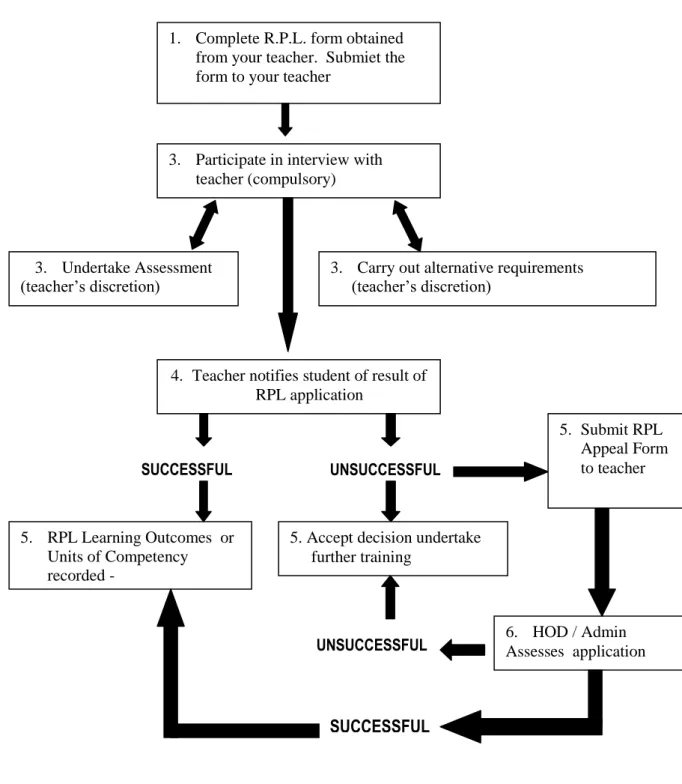
Appendix 6). The process is summarised in the flowchart on page 16 (Figure 1).
RPL will allow you to:
Progress through the course at a faster rate
Do only new work (and not repeat the work in which you are already competent) Have your knowledge and skill level formally recognised.
What learning might count towards RPL?
Knowledge and skills learnt in: Other subjects
Work experience or industry placement A part-time job or unpaid work
Hobbies, activities, clubs and sports interests inside or outside school Activities you undertake as part of your family, holiday, home routines
In what parts of the course does RPL apply?
RPL can only be granted for the Vocational Training Programs (Modules) in the course you are studying. (These are the job-related knowledge and skills areas of the course.)
Each Vocational training program (module) has a number of learning outcomes.
You can apply for RPL in either an entire training program (Module) or in individual learning outcomes.
If you decide to take advantage of RPL:
Ask for specific information about the learning outcomes of the module/training program Complete the RPL Application Form in detail from the back of the booklet (and attach all relevant evidence).
You may be asked to attend an interview, or to do a practical task, or to provide more information.
How does RPL assessment work?
An assessor (usually your class teacher) will take through your application.
The assessor will look at the evidence you have provided in the application (and perhaps in an interview) to decide on the outcome of your application. This will be completed with either one of the Head of Department, Deputy Principal or Chief of School (Principal) to maintain a high standard of processing for RPL and quality assurance this process. If the teacher, Head of Department, Deputy Principal or Chief of School does not have sufficient evidence to grant RPL, you may be asked to do a practical test to demonstrate competency.
After the RPL assessment is finished you will be notified of the result in writing, i.e.
successful
partially successful unsuccessful
If you disagree with the outcome you may appeal.
The evidence you gather for your application might include: Products and/or records of your work
A personal report A referee’s report
(A single piece of evidence may be relevant to one or more of the Learning Outcomes)
Examples: Products of your work
Samples of work you have completed
Work Experience/industry placement records Qualifications gained
Coaching Certificates
Senior First Aid Certificates
Magazine or Newspaper articles about you
Prizes, certificates or other forms of commendation
A Personal Report
The Personal Report is written by you and is a concise description of activities and functions that you have carried out. It should be related to the training program (module) for which you are seeking RPL.
The Personal Report can never stand alone as sufficient evidence of competence. Referee’s Report
Letters from others to support your claim – eg. managers, customers, colleagues, pervious employer.
Reports from a manager who witnessed specific activities undertaken.
A Referee’s report should include:
A company heading
The name of the supervisor or manager Period of employment
List of competencies developed or tasks undertaken Signature and position of the person verifying the claim
Figure 1. RECOGNITION OF PRIOR LEARNING (R.P.L.) FLOWCHART
1. Complete R.P.L. form obtained from your teacher. Submiet the form to your teacher
4. Teacher notifies student of result of RPL application
3. Participate in interview with teacher (compulsory)
3. Undertake Assessment (teacher’s discretion)
3. Carry out alternative requirements (teacher’s discretion) 5. Submit RPL Appeal Form to teacher 5. RPL Learning Outcomes or Units of Competency recorded - 6. HOD / Admin Assesses application 5. Accept decision undertake
further training
UNSUCCESSFUL SUCCESSFUL
UNSUCCESSFUL
RPL Checklist for students
To ensure an effective RPL process, students should: □ Obtain information about RPL.
□ Obtain a copy of the Student Record Book/Training Record Book for the vocational training program(s) of your subject
□ Read the relevant learning outcomes for the modules/training programs as listed in the Student Record Book/Training Record Book
□ Access your abilities/competencies, with guidance from your teacher and/or counsellor in the learning outcome(s)/modules/training programs
□ Decide if you think you possess the knowledge and skills of the learning outcome(s)/module/training programs and if so, you should apply for RPL □ Complete an RPL Application Form
□ Gather evidence that supports your application
□ Give the completed RPL Application Form and evidence to your teacher □ Receive notification from your teacher to show, either
1) that you have gained RPL (go to 10)
2) that you need to supply more information AND/OR attend an interview {go to 7} 3) that you have not gained full/partial RPL and you receive feedback {go to 12} □ (If you are successful) be exempt from those learning outcomes/modules/training
programs
□ Ensure your Student Record Book/Training Record Book is signed off
□ (If you were partially successful) you may decide to progress more quickly through the module/training program by completing only those aspects for which you do not have prior leaning. This completes the RPL process for your application
□ (If you were unsuccessful) you may decide to request an RPL Appeals Form □ Gather further evidence that supports your application
□ Submit your completed RPL Appeals Form and further evidence to the person nominated in the school’s grievance policy, who will arrange for a second suitably qualified person to access the evidence
□ Receive a notification about whether
you have gained RPL [go to 10]
you have not gained full/partial RPL and receive feedback [go to 17]
□ Seek to progress more quickly through the module/training program by completing only these aspects for which you do not have prior learning
SAMPLE QUALIFICATION
BILOELA STATE HIGH SCHOOL
(National Provider No: 30232)
This is to certify that
JANE SMITH
has fulfilled the requirements for
CERTIFICATE I
in
BUSINESS
(BSB10107)Dated 30 November 2013
(signature) John Adie PrincipalThe qualification certified herein is recognised within the Australian Qualifications Framework
SAMPLE STATEMENT OF RESULTS
BILOELA STATE HIGH SCHOOL
(National Provider No: 30232)
Statement of Results
This is a statement that
JANE SMITH
has achieved the following units of competency in completion of
BSB10107 Certificate I in Business:
BSBOHS201A Participate in OHS processes
BSBADM101A Use business equipment and resources
BSBIND201A Work effectively in a business environment
BSBCMM101A Apply basic communication skills
BSBITU101A
Operate a personal computer
BSBITU102A Develop keyboard skills
Dated 30 November 2013
(signature) John Adie Principal
Biloela State High School
SAMPLE STATEMENT OF ATTAINMENT
Statement of Attainment
A Statement of Attainment is issued by a Registered Training Organisation
when an individual has completed one or more units of competency from
nationally recognised qualification(s)/courses(s)
BILOELA STATE HIGH SCHOOL
(National Provider No: 30232)This is a statement that
JANE SMITH
has attained
BSBOHS201A Participate in OHS processes
BSBADM101A Use business equipment and resources
BSBIND201A Work effectively in a business environment
These competencies form part of
BSB10107 Certificate I in Business
Dated 30 November 2013 (signature)
John Adie Principal
BILOELA STATE HIGH SCHOOL Provider No 30232
Vocational Education and Training COMPLAINT FORM
Student's Name: Subject/Course:_______________
Date:-
Nature of Complaint
Please use specific details (dates etc)
How would you like to see this resolved?
Complaint Against ________________________________________________________
Student's Signature Parent's Signature _________________
BILOELA STATE HIGH SCHOOL
Provider No 30232
Vocational Education and Training
COMPLAINT RESOLUTION FORM
Student's Name: Subject/Course:
Date:-
Nature of Complaint (Brief description only)
Resolution
I AGREE TO THE ABOVE RESOLUTION
Parent/Guardian Name(if student under 18) Parent/Guardian Signature(if student under 18) Date
Student Name (if over 18) Student signature (if over 18)
Staff Member Name Staff Member Signature Date
You will be required to fill out a ASQA Learner Questionnaire for VET. Below is an example of this form.
Created on 25/01/2013 10:41:00 AM Created by Biloela State High School\\EQFCW2085001\Data\Coredata\Curriculum\Technology\VET Coordinator\RTO Management\Induction
BILOELA STATE HIGH SCHOOL
Provider Number 30232 Vocational Education and Training
RPL APPLICATION FORM
Student name:___________________________________ Date:_______________________
Course: ________________________________________________________
Units of competency Details of relevant previous experience
including formal training, work experience and life experience (interests, skills etc.) Attach copies of relevant evidence
FOR OFFICE USE
Code Name Assessor’s comments and recommendations Comp. NYC
Created on 25/01/2013 10:41:00 AM Created by Biloela State High School
\\EQFCW2085001\Data\Coredata\Curriculum\Technology\VET Coordinator\RTO Management\Induction material\VET
BILOELA STATE HIGH SCHOOL Provider Number 30232 Vocational Education and Training
RPL NOTIFICATION
………..(name of student) has been granted Recognition of Prior Learning for the following units of competency:
Competency code
Name
No information is printed below this line. OR
……….(name of student) has not been granted Recognition of Prior Learning for the following units of competency:
Competency code
Name
No information is printed below this line.
... ...
Created on 25/01/2013 10:41:00 AM Created by Biloela State High School
Provider Number 30232 Vocational Education and Training
Acknowledgements
I ………..……… as a student undertaking a VET course at Biloela SHS understand that my assessment is ongoing and as a result will not receive full accreditation of my Certificate until its completion.
... ...
Student signature Date
... ...
Parent signature Date
………
BILOELA STATE HIGH SCHOOL Provider Number 30232 Vocational Education and Training
Acknowledgements
I ……….……. as a student entering a VET course after its commencement at Biloela SHS, understand that I will not receive full credit points towards my QCE unless I have achieved all competencies across the course.
... ...
Student signature Date
... ...