1
EDUCATOR EVALUATION AND
SUPPORT PLAN
2015-2016
2
MISSION
Regional School District 4, Chester, Deep River, and Essex
will initiate, support,
and facilitate partnerships,
collaborations and regional solutions
that are responsive to the
needs of all learners
through exemplary programs,
3
Acknowledgements
The schools of Chester, Deep River, Essex and Region 4 wish to thank the
following people for their contributions in time, knowledge, expertise and sharing
best practices in the development of this plan.
Committee Members:
Michael Barile – Chester Elementary School
Joanne Beekley, Ed.D. – Central Office
Jennifer Byars, Ed.D. – Deep River Elementary School
Teresa Cobb - Valley Regional High School
Heidi Degree – Deep River Elementary School
Jessica Dwyer – Valley Regional High School
Maria Ehrhardt – Valley Regional High School
Peter Foxen – John Winthrop Middle School
Shannon O’Donnell VanderMale – Essex Elementary School
Judith Redhead – Valley Regional High School
Andrea Ricci – Essex Elementary School
Rebecca Suntheimer – John Winthrop Middle School
Philip Unghire – John Winthrop Middle School
4
OVERVIEW
The purpose of the Teacher/Administrator Evaluation and Support Program of the Chester, Deep River, Essex, and Region 4 Schools is to ensure quality instruction and promote growth and reflection among our professional staff. The teachers in the Chester, Deep River, Essex, and Region 4 Schools are well-educated and committed professionals who are current in their instructional practices. The supervision and evaluation program is focused on these strengths.
The Teacher Evaluation and Support Program is a comprehensive system that is based on clearly defined expectations that consist of domains of skills, knowledge, and qualities articulated in the Common Core of Teaching (2010) for teacher evaluation, the Common Core of Leading-Connecticut’s Leadership Standards (2012) for administrator evaluation, and the national standards for the evaluation of educators in pupil services, as well as what
current research tells us about the relationship between teaching and learning.
Teaching and learning is an extremely complex process. The teacher’s knowledge and skills, the learning standards within each curriculum to be taught, the physical classroom setting, and the students’ prior knowledge and ability to learn comprise the framework for students and teachers in their daily interactions. The standards of effective teaching and professional performance are developed to support teachers and evaluators as they work together to provide quality educational experiences for students. Effective teaching can be observed, described, and evaluated. It is the primary responsibility of the teacher to work toward
continuous improvement in instruction and professional performance; it is the responsibility of the evaluator to assist and support in that effort. Reflection, collegial discussions, meaningful dialogue with evaluators and the support of professional workshops and literature are key components in supporting teachers as they work to improve teaching and learning in our schools.
UNDERSTANDINGS
A. Evaluation is a cooperative effort requiring a constructive and personalized dialogue between the evaluator and the teacher.
B. The goals and evaluations will adhere to the purpose, philosophy, and criteria identified in the Teacher Evaluation and Support Program as documented.
C. The Superintendent, central office administrators, principals, or associate/assistant principals may evaluate a teacher using this process and criteria.
5
D. In any year for teachers rated Proficient or above, if the evaluator becomes aware of a performance of teaching that is below the district standards of effective teaching
he/she must initiate a formal evaluation process. If it is determined though the formal evaluation process, that the teacher is not meeting the standards, the evaluator must place the teacher on an Individualized Support and Assistance Plan to address the performance concerns. The teacher being evaluated shall be allowed to gather and provide additional information on his/her performance. Such information will be provided in no less than ten working days and must be considered by the evaluator during the development of the Individualized Support and Assistance Plan.
E. The purpose of the Individualized Support and Assistance Plan is to improve
instruction and provide the teacher with support to raise the level of teaching to meet the district standards of effective teaching. Any document that is part of the evaluation and is placed in his/her personnel file must contain an area to be signed by the
teacher stating he/she has read the document before it is filed.
F. The evaluation process shall be free of age, racial, sexual, religious, and other forms of discrimination and biases as defined in state and federal laws.
G. All rights of the teacher relative to the grievance procedure in the contract will be observed throughout this process.
6
CORE VALUES AND BELIEFS
Teaching: We believe in high academic standards in an environment where all students are challenged, supported, and engaged.
Learning: We believe that all students can learn at high levels. Our attitudes, expectations, and effort directly impact student achievement and life-long learning.
Leadership: We believe that effective leadership exhibits all aspects of our mission and beliefs, and creates an environment of trust, cooperation, and understanding, where all members of the school community strive for continuous district-wide improvement. Culture and Climate: We believe a safe and supportive learning environment requires a culture of collaboration, trust, open communication, tolerance, and respect for and among all stakeholders.
Community: We value every child and believe that it is the shared responsibility of the entire community to educate, support, and nurture each child. We should be held accountable for the results, for the resources provided, and for the accomplishment of our mission and goals. The professional growth and evaluation process will increase student achievement and
improve professional practices. It is based on the assumption that teachers, like students, must be continual learners and are motivated to examine and reflect upon their behavior in order to improve instruction. To that end, the Teacher/Administrator Evaluation and Support Program of the Chester, Deep River, Essex, and Region 4 Schools is based on our Strategic Goals developed in 2012.
To ensure the continuous progress of each student by implementing a challenging curriculum with clearly stated benchmarks.
To attract, retain, develop, and support the best possible staff for our schools. To build community support and involvement for the school system.
To foster and sustain a climate of professionalism, trust, and high expectations that is collaborative, respectful, nurturing, and safe for all members of the school community. To promote, model, and implement the mission, vision, beliefs, goals, and
7
PHILOSOPHY
The philosophy of instructional excellence and evaluation in the Schools of Chester, Deep River, Essex, and Region 4 is based on professional teaching standards that consist of domains of skills, knowledge, and disposition articulated in the Common Core of Teaching (2010) for teacher evaluation, the Common Core of Leading-Connecticut’s Leadership Standards (2012) for administrator evaluation, and the national standards for the evaluation of educators in pupil services.
The underlying premise is that supervision, evaluation, mentoring, and professional
development in the areas of planning and preparation, classroom environment, instruction, and professional responsibility are essential in promoting improved student learning. Trust and confidence promoted through conversation based on these key elements are essential in implementing and maintaining successful educational programs. A district-wide commitment is necessary for evaluation to be effective. Included in this commitment is an obligation to provide the necessary resources, time, and professional development activities, maintaining the belief that supervision, evaluation, professional development, and mentoring are part of a cooperative effort among the Board of Education, administration, and
professional staff to achieve excellence in education for students.
The Professional Learning Program supports the development of educators at all stages of their careers, as it weaves together professional standards with expectations for student learning, and ongoing evaluation with access to professional learning and support. The Program’s teacher observation and evaluation instrument, the CCT Performance and Practice Continuum is designed to align with the processes and professional performance profiles outlined in Connecticut’s Teacher Education and Mentoring (TEAM) program, which provides differentiated professional learning for all beginning teachers. Such alignment promotes the establishment of common, consistent vocabulary and understandings about teacher practice at all levels, among administrators and teachers, throughout the district. Chester, Deep River, Essex, and Regional School District 4 define effective teaching in accordance with the National Teaching Standards:
Effective teachers have high expectations for all students and help them learn, as demonstrated on value-added, test-based, or alternative measures.
Effective teachers contribute to positive academic, attitudinal, and social outcomes for students such as regular attendance, on-time promotion to the next grade and graduation, self-efficacy, and cooperative behavior.
Effective teachers use diverse resources to plan and structure engaging learning opportunities, monitor student progress formatively, adapt instruction as needed, and evaluate learning using multiple sources of evidence.
8
Effective teachers contribute to the development of classrooms and schools that value diversity and civic-mindedness.
Effective teachers collaborate with other teachers, administrators, parents, and education professionals to ensure students' success, particularly the success of students with special needs and those at high risk of failure.
Chester, Deep River, Essex, and Regional School District 4 professional evaluation program takes into account school improvement goals, curricular goals, student learning goals, and evidence of educators’ contributions to the school as a whole. Performance expectations within our Program also include those responsibilities that we believe to be the key in promoting a positive school climate and the development of a professional learning community.
PROFESSIONAL LEARNING AND EVALUATION PROGRAM GOALS 1. Professionalize the Profession
• Document and share educators’ best practices that result in meaningful advancement of student learning.
• Enhance expert knowledge and collective efficacy in the field.
• Create new opportunities for educators to collaborate and develop leadership skills in their schools and disciplines.
• Recognize excellence in teaching, administration, and exemplary contributions to Chester, Deep River, Essex, and Regional School District 4 schools and programs.
• Ensure that only high-quality professionals are selected for tenure in Chester, Deep River, Essex, and Regional School District 4 schools and programs.
• Provide a process for validating personnel decisions, including recommendations for continued employment of staff.
2. Improve the quality and focus of observation and evaluation
• Establish collaborative examinations of instructional practice among administrators and teachers to develop shared understanding of the strengths and challenges within our schools and programs to improve student learning.
• Define and clarify criteria for evaluation and measurement of student learning, using research-based models for evaluation.
• Establish multiple measures to assess professional practice, such as: teacher portfolios; teacher-designed objectives, benchmarks, and assessments of student learning; teacher contributions to school/district level research on student learning and professional resources; mentoring and peer assistance; achievement of learning objectives for student growth, as measured by appropriate standardized assessments, where applicable, or other national or locally-developed curriculum benchmarks and expectations for student learning.
9 Align evaluation findings with professional learning program and support
systems.
3. Support organizational improvement through the Professional Learning and Evaluation Program
• Align district- and school-level professional learning opportunities with the collective and individual needs of educators, based on data acquired through professional learning goal plans and observations of professional practice.
• Provide educators with multiple avenues for pursuing professional learning.
• Integrate Chester, Deep River, Essex, and Regional School District 4 district resources to support and provide professional learning opportunities.
• Create formal and informal opportunities for educators to share professional learning with colleagues.
ROLES AND RESPONSIBILITIES
Definition of Teacher and Evaluator
Evaluator refers to all individuals (including school and district administrators) whose job responsibilities include supervision and evaluation of other teachers. Teacher, as used in this document, shall mean all certified instructional and non-instructional persons below the rank of Administrator.
Superintendent’s Role in the Evaluation Process • Arbitrate disputes.
• Allocate and provide funds or resources to implement the plan.
• Serve as liaison between Chester, Deep River, Essex, and Regional School District 4 Boards of Education and the evaluation process.
• The Superintendent will be responsible for ensuring that the Professional Development Committee receives information regarding school and program improvement and individual professional growth goals for use in planning staff development programs.
Responsibility for Evaluations
Administrators will be responsible for evaluations, including, but not limited to, personnel in the following categories:
Teachers
Social Workers
Guidance Counselors
Psychologists
Speech Therapists
10
Roles and Responsibilities of Evaluators and Educators
The primary purpose of educator evaluation is to strengthen individual and collective practices to improve student growth. Therefore, evaluators and educators share responsibilities for the following:
The review and understanding of Connecticut’s Common Core of Teaching 2014
(CCT).
The review and understanding of Connecticut’s Common Core of Leading (CCL) and
the Leadership Practice Rubric.
The review and familiarity with applicable portions of Connecticut’s Common Core State Standards, Connecticut’s Frameworks of K-12 Curricular Goals and Standards, the CMT/CAPT Assessments (and Smarter Balanced Assessments, when available), as well as locally-developed curriculum standards. Adherence to established timelines.
Completion of required components in a timely and appropriate manner.
Sharing of professional resources and new knowledge about professional practice. Evaluator Roles
Participation in collaborative conferences with educators.
Assistance with assessment of goals, student-learning indicators, learning activities developed and implemented by educators, and outcomes.
Analysis and assessment of performance, making recommendations as
appropriate.
Clarification of questions, identification of resources, facilitation of peer assistance and other support as needed.
Provide support for inquiry-based professional learning opportunities. Educators Roles
Reflection on previous feedback from evaluations.
Engagement in inquiry-based professional learning opportunities.
Participation in collaborative conferences with evaluator.
Development, implementation, and self-assessment of goals, student learning indicators, learning activities, and outcomes.
Request clarification of questions or assistance with identification of professional resources and/or peer assistance.
IMPLEMENTATION AND MONITORING OF EDUCATOR EVALUATION AND SUPPORT PROGRAM
Training and Orientation of Teachers and Administrators
Each school year, the district will provide to all educators several orientation and update training sessions (through in-service sessions, target group sessions, and individual conferences) that explain the processes for professional learning planning, protocol for
11
evaluation and observation (including timelines and rubrics), and documents that will be used by all staff.
Teachers and administrators new to Chester, Deep River, Essex, and Regional School District 4 will be provided with copies of the Professional Learning and Evaluating Program and will engage in training to ensure that they understand the elements and procedures of the Program, processes and documents. This training will take place upon employment or prior to the beginning of the school year with members of Chester, Deep River, Essex, and Regional School District 4 Administration and/or Human Resource Offices.
New Educator Support and Induction
In the interest of supporting all educators, administration and staff will offer localized support to staff members new to district or building. A variety of general topics will be addressed, including:
School philosophy and goals
Policies and procedures
Assignments and responsibilities
Facility and staffing
Curriculum and instructional support
Resources for professional learning
Schedules and routines
Support services
In addition, periodic meetings with school personnel will focus on domains of the Common Core of Teaching, Common Core of Leading, Common Core Standards in English and Language Arts, Mathematics, and the Content Areas, discipline policies, stakeholder communication, effective collaboration, classroom interventions, special education, evaluation and professional responsibilities.
Evaluator Orientation and Support
Understanding of Chester, Deep River, Essex, and Regional School District 4 Professional Learning and Evaluation Program’s features, Connecticut’s Common Core of Teaching (CCT), Common Core of Leading (CCL), Common Core State Standards, Standards for Professional Learning, and the components of professional evaluation and observation is essential to facilitating the evaluation process and promoting student growth. To that end, evaluators will be provided with on-going training and support in the use and application of Chester, Deep River, Essex, and Regional School District 4 Evaluation Program. Evaluators will review Program elements and procedures prior to the beginning of each school year and at other appropriate intervals, to be determined. Plans for staff training will be coordinated annually by Chester, Deep River, Essex, and Regional School District 4 Professional Development and Evaluation Committee in concert with district administration. Resources for Program Implementation
Funds to provide material and training as well as time for Professional Learning options and collaboration necessary to support the successful achievement of the teachers' goals, objectives and implementation of the Evaluation Program will be allocated annually and determined on a program-by-program basis.
12
DISPUTE RESOLUTION
The purpose of the resolution process is to secure at the lowest possible administrative level, equitable solutions or disagreements which from time to time may arise related to the
evaluation process. The right of appeal is a necessary component of the evaluation process and is available to every participant at any point in the evaluation process. As our evaluation system is designed to ensure continuous, constructive and cooperative processes among professional educators, most disagreements are expected to be worked out informally between evaluators and educators.
The resolution process may be implemented when there is a question as to whether or not: 1. Evaluation procedures and/or guidelines have been appropriately followed;
2. Adequate data has been gathered to support fair and accurate decisions.
The evaluator’s competence shall not be the focus of a dispute. The resolution process shall be conducted in accordance with the law governing confidentiality.
Time Limits
1. Since it is important that appeals be processed as rapidly as possible, the number of days shall be considered maximum. The time limits specified may be extended by written agreement of both parties.
2. Days shall mean school days. Both parties may agree, however, to meet during breaks at mutually agreed upon times.
3. If an educator does not initiate the appeals procedure within five days of acknowledged receipt of evaluation materials, the educator shall be considered to have waived the right of appeal.
Procedures
1. Within five days of acknowledged receipt of evaluation materials, the educator must initiate the appeals procedure.
2. Within three days of initiating the appeals procedure, the educators will meet and discuss the matter with the evaluator with the objective of resolving the matter informally. The two parties have the option of choosing a facilitator who will review the areas of difference and suggest compromises or resolutions. The educator shall be entitled to Association
representation at all levels of the process.
3. If there has been no resolution, the Superintendent shall review the recommendations of the facilitator and any additional information from the evaluator and educators and shall meet with both parties as soon as possible. Within three days of the meeting, and review of all documentation and recommendations, the Superintendent will act as arbitrator and make a final decision. The educator shall be entitled to Association representation at all levels of the process.
13
Failure of the educator at any level to appeal to the next level within the specified time shall be deemed to be acceptance of the decision rendered at that level.
14
TEACHER EVALUATION PLAN
15
TEACHER EVALUATION PLAN Overview
Chester, Deep River, Essex, and Regional School District 4 Professional Learning and Evaluation Program supports an environment in which educators have the opportunity to regularly employ inquiry into and reflection on practice, to give each other feedback, and to develop teaching practices that positively affect student learning.
To help foster such an environment, we have created the Professional Learning and
Evaluation Program as a district-wide system that provides multiple opportunities and options for teachers to engage in individual and collaborative activities in which they collect, analyze, and respond to data about student learning, within and among Chester, Deep River, Essex, and Regional School District 4 schools and programs. Teachers and administrators are expected to provide evidence related to the effectiveness of instructional practices and their impact on student learning. Teachers and administrators are also expected to take an active role in a cycle of inquiry into their practice, development, implementation, and analysis of strategies employed to advance student growth, and reflection on effectiveness of their practice. The Program includes an additional component, Individualized Support and
Assistance (ISA), for those teachers and administrators in need of additional support to meet performance expectations.
Standards and Indicators of Teaching Practice
The expectations for teacher practice in Chester, Deep River, Essex, and Regional School District 4 Professional Learning and Evaluation Program are defined using the four domains and their indicators of the Common Core of Teaching Rubric (CCT, 2014). The CCT Rubric articulates components of teaching and establishes designations of levels of practice,
including: Below Standard; Developing; Proficient; Exemplary. The CCT (2014) is provided in Appendix A of this document.
Core Requirements of the Evaluation Program
Chester, Deep River, Essex, and Regional School District 4 Professional Learning and Evaluation Program is aligned with the Core Requirements of the State Board-approved Guidelines for Educator Evaluation, as provided in subsection (a) of Sec. 10-151b (C.G.S.), as amended by Sec. 51 of P.A. 12-116. The following is a description of the processes and components of Chester, Deep River, Essex, and Regional School District 4 program for teacher evaluation, through which the Core Requirements of the Guidelines shall be met.
16
Chester, Deep River, Essex and Region 4 Schools
Educator Evaluation and Support Plan Outline
EDUCATOR PRACTICE-RELATED INDICATORS
Accounts for 50% of Summative Rating
STUDENT-RELATED INDICATORS Accounts for 50% of Summative Rating
PERCENTAGE IN THE SUMMATIVE RATING
40%
10%
45%
5%
CATEGORY OBSERVATION OF EDUCATOR PERFORMANCE AND PRACTICE STAKEHOLDER FEEDBACK STUDENT LEARNING OBJECTIVES WHOLE SCHOOL MEASURE OF STUDENT LEARNING TEACHER GOALS Educator Performance and Practice Goal Stakeholder Feedback Goal Minimum of 2 SMART goals: Standardized SMART goal (comprises 22.5% of teacher’s evaluation rating): For those teaching tested grades and subjects, SMART goals will be developed based on an analysis of results of student achievement on the appropriate state test and other standardized assessments where available. Teachers in non-tested grades and subjects may establish common SMART goals based on student learning needs and targets revealed in aggregate data from state tests or other standardized assessments where available Whole School Learning Indicator (school target)
17
Non-standardized SMART goal (comprises 22.5% of teachers evaluation rating): Sources for the development of SMART goals based on non-standardized indicators may include: District Benchmark Assessments of student achievement. Other curricular benchmark assessments Student portfolios of examples of work in content areas, collected over time and reviewed annually.
SMART goals for all certified personnel must demonstrate alignment with school-wide student achievement priorities. SOURCE OF TEACHER GOALS Based on prior observational evidence and performance
Linked to the school goals related to Parent Survey results
Standardized/district-approved or other agreed upon assessments Aggregate of Administrators 45% A teacher’s indicator rating shall be equal to the aggregate rating for multiple student learning indicators established for his/her administrator’s evaluation rating. EVIDENCE Observation by evaluator Evidence of progress toward goal Evidence of progress toward goal Evidence of progress towards goals Data from assessments Aggregate of Administrators 45%
This will be based on the school
performance index (SPI) and the administrator’s progress on SMART Goal targets, which correlates to the Student Learning rating on an administrator’s evaluation.
18
PROCESS AND TIMELINE
The annual evaluation process for a teacher will at least include, but not be limited to, the following steps, in order:
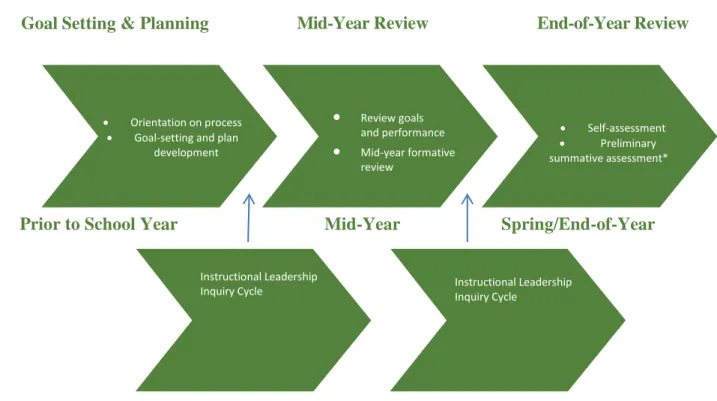
1. Orientation – by September 15:
To begin the annual evaluation process, evaluators meet with teachers, in a group and/or individually, to discuss the evaluation process and their roles and
responsibilities within it. In this meeting, they will discuss any school or district
priorities that should be reflected in teacher performance and practice goals, SMART goals related to student outcomes and achievement, and whole-school indicators of student learning. Evaluators and teachers will establish a schedule for collaboration required by the evaluation process.
2. Goal-setting Conference – by November 15:
Teacher Reflection – In advance of the Goal Setting Conference, the teacher will examine data related to current students’ performance (including, but not limited to: standardized tests, portfolios and other samples of student work appropriate to teacher’s content area, etc.), prior year evaluation and survey results, previous professional learning goals, and the Connecticut Common Core of Teaching (CCT). First-year teachers may find it helpful to reflect on their practice goals with their mentor teachers, using the TEAM program’s Module Resources and Performance Profiles, to determine a baseline for establishing goals. The teacher will draft the following goals: a) two SMART Goals to address student learning and achievement objectives, which will comprise 45% of a teacher’s summative evaluation; b) a performance and practice goal(s), based on data from teacher reflection and evaluator observations; and c) a goal aligned with a whole-school goal determined by the school administrator based on a stakeholder feedback goal, and d) a goal based on whole school indicators of student learning for the school year. The teacher may collaborate in grade-level or subject-matter teams to support the goal-setting process.
Goal-setting conference – No later than November 15 of the school year, the
administrator and teacher will meet to discuss the teacher’s proposed goals in order to arrive at mutual agreement about them. The goals for the year must be informed by data and evidence collected by the teacher and evaluator about the teacher’s practice. The evaluator may request revisions to the proposed goals and objectives if they do not meet approval criteria.
3. Observations of practice
Evaluators will observe teacher practice in formal and informal in-class observations and non-classroom reviews of practice throughout the school year, with frequency based on the year of implementation of the plan and the teacher’s summative
evaluation rating. After formal or informal observations, feedback (written or verbal) will be provided within ten school days.
19 The teacher collects evidence about his/her practice and student learning that is
relevant to the agreed-upon professional goals. The evaluator also collects evidence about teacher practice for discussion in the interim conference and summative review. 5. Interim Conference/Mid-year check-ins (by January 30; April 15 to accommodate
second semester in high school):
The evaluator and teacher will hold at least one mid-year conference. The conference should focus on processes and progress toward meeting the goals established in the goal-setting conference. Evidence about practice and student-learning data should be reviewed at this conference. If necessary, teachers and evaluators may mutually agree to revisions to strategies or approaches used and/or mid-year adjustment of SMART goals to accommodate changes (e.g., student populations, assignment). They also discuss actions that the teacher can take and supports the evaluator can provide to promote teacher growth in his/her development areas.
6. End-of-year summative review (by June 1st):
Teacher self-assessment – The teacher reviews and reflects on all information and data collected during the year related to the goals and completes a self-assessment for review by the evaluator. This self-assessment may focus specifically on the areas for development established in the goal-setting conference.
End-of-year conference – The evaluator and the teacher meet to discuss all evidence collected to date. Following the conference, the evaluator assigns a summative rating and generates a summary report of the evaluation before the end of the school year.
Summative Rating – The evaluator reviews submitted evidence, self-assessments, and observation data to generate category and focus area ratings. The category
ratings generate the final, summative rating using the summative rating matrix. After all data, including state test data, are available, the evaluator may adjust the summative rating if the state test data change the student-related indicators significantly to change the final rating. Such revisions should take place as soon as state test data are
available, and before September 15.
7. Summative rating revisions (by September 15):
After all data, including state test data, are available, the evaluator may adjust the summative rating if the state test data have a significant impact on a final rating. A final rating may be revised when state test data are available, before September 15 of a school year.
20
COMPONENTS OF TEACHER EVALUATION AND RATING
The Core Requirements of the CT Guidelines for Teacher Evaluation require that districts weight the components of teacher’s annual summative evaluations and ratings as follows:
CATEGORY 1: Student Outcomes and Achievement (45%)
Forty-five percent (45%) of a teacher’s evaluation will be based on achievement of student learning outcomes defined by teacher-created SMART goals that are aligned with both standardized and non-standardized measures. Teachers are required to develop two SMART goals related to student growth and development.
Standardized SMART goal (comprises 22.5% of teacher’s evaluation rating): For those teaching tested grades and subjects, SMART goals will be developed based on an analysis of results of student achievement on the appropriate state test and other standardized assessments where available.
Teachers in non-tested grades and subjects may establish common SMART
goals based on student learning needs and targets revealed in aggregate data from state tests or other standardized assessments where available
Non-standardized SMART goal (comprises 22.5% of teachers evaluation rating): Sources for the development of SMART goals based on non-standardized indicators may include:
District Benchmark Assessments of student achievement.
Other curricular benchmark assessments
Student portfolios of examples of work in content areas, collected over time and reviewed annually.
SMART goals for all certified personnel must demonstrate alignment with school-wide student achievement priorities. Teachers in non-tested grades and subjects may develop two (2) SMART goals based on non-standardized indicators.
21
Goal Setting
Chester, Deep River, Essex, and Regional School District 4 teachers’ SMART goals address the learning needs of their students and are aligned to the teacher’s assignment. The student outcome related indicators will be written to meet SMART goal criteria, i.e., Specific,
Measurable, Attainable, Relevant, and Time-Bound. Teachers will write two (2) SMART goals that will address targeted areas for student growth and/or achievement.
Each SMART goal will:
1. Take into account the academic track record and overall needs and strengths of the students that teacher is teaching that year/semester.
2. Address the most important purposes of a teacher’s assignment through self-reflection. 3. Align with school, district, and state student achievement objectives.
4. Take into account students’ learning needs vis-à-vis relevant baseline data. 5. Consider Public School Information System (PSIS) factors.
6. Be mutually agreed upon by teacher and his/her evaluator. 7. Be fair, valid, reliable and useful to the greatest extent possible. SMART Goals and Student Progress
The following diagram illustrates the processes involved in establishing and assessing SMART goals for student learning.
To write meaningful and relevant SMART goals that align to their teaching assignment and result from a thorough knowledge of their students, data analysis is required. Examples of data that teachers will be required to analyze are:
1. Student outcome data (academic) 2. Behavior data (absences, referrals)
Phase I: Learn about this
year’s students by examining baseline data Phase 2: Set SMART goals for student growth Phase 3: Monitor and document student progress Phase 4: Assess students to determine progress towards or achievement of SMART goals Phase I: Learn about this
year’s students by examining baseline data
22
3. Program data (participation in-school or extracurricular activities or programs) 4. Perceptual data (learning styles and inventories, anecdotal)
Teachers must learn as much as they can about the students they teach, be able to document baseline data that they have used to determine their instructional focus and be able to write SMART goals on which they will, in part, be evaluated.
Analysis of these initial pieces of data on incoming students for the year should be completed by mid-October of the academic year.
Phase 2:
Each teacher will write TWO SMART goals. Teachers whose students take a state
assessment will create one SMART goal based on that assessment and one SMART goal based on a non-standardized assessment. All other teachers may develop their two SMART goals based on non-standardized assessments.
Each SMART goal should make clear (1) what evidence was or will be examined, (2) what level of performance is targeted, and (3) what proportion of students is projected to achieve the targeted performance level. SMART goals can also address student subgroups, such as high or low-performing students or ELL students. It is through the Phase I examination of student data that teachers will determine what level of performance to target for which students.
Teachers will submit their SMART goals to their evaluator for review. The final determination of SMART goals is made through mutual agreement between the teacher and his/her
evaluator. The review and approval process of the SMART goal will take place during the Goal-Setting conference, on or before November 15. Evaluators will review and approve the SMART goals based on the following criteria:
• Priority of Content: SMART goal is deeply relevant to teacher's assignment and address a large proportion of his/her students.
• Rigor of SMART goal: SMART goal is obtainable, but ambitious, and represents at least one year's student growth (or appropriate growth for a shorter interval of instruction).
• Analysis of Student Outcome Data: SMART goal provides specific, measurable evidence of student outcome data analysis and demonstrates knowledge about students' growth and development.
Phase 2: Set SMART goals for student growth
Phase 3: Monitor and document student
23
Once SMART goals are approved, teachers must monitor students’ progress toward achieving student learning SMART goals.
Teachers may monitor and document student progress through: 1. Examination of student work
2. Administration of interim assessments
3. Tracking of students’ accomplishments and struggles
Teachers may choose to share their interim findings with colleagues during collaborative time. They may also wish to keep their evaluator apprised of progress. Artifacts related to the teacher’s monitoring practices can be reviewed and discussed during the Mid-Year
Conference.
Interim Conferences – Mid-year check-ins:
Evaluators and teachers will review progress toward the goals/objectives at least once during the school year, using available information and data collected on student progress. This review may result in revisions to the instructional strategies or approaches teachers use. Teachers and evaluators may mutually agree to mid-year adjustments to SMART goals to accommodate changes (e.g., student populations, assignment). The Mid-Year Conference will take place by January 30 of the academic year (or April 15 for second semester courses in high school).
End-of-year review of SMART goals/ Student Outcomes and Achievement:
Teacher Self-Assessment – The teacher reviews all information and data collected during the year and completes a self-assessment for review by the evaluator. Teachers will reflect on the SMART goals by responding to the following four statements:
1. Describe the results and provide evidence for each action step. 2. Describe what you did that produced these results.
3. Provide your overall assessment of whether the goal was met.
4. Describe what you learned and how you will use that information going forward. One half (or 22.5%) of the SMART goal used as evidence of whether goals/objectives are met shall not be determined by a single, isolated test score, but shall be determined through the comparison of data across assessments administered over time, including the state test for those teaching tested grades and subjects or another standardized indicator for other grades and subjects where available. A state test can be used only if there are interim
Phase 4: Assess students to determine progress towards or achievement of SMART goals
24
assessments that lead to that test, and such interim assessments shall be included in the overall score for those teaching tested grades and subjects. Those without an available standardized indicator will select an assessment, through mutual agreement, subject to the local dispute-resolution procedure.
End of Year Conference – The teacher shall collect evidence of student progress toward meeting the student learning goals/objectives. This evidence will reflect student progress toward meeting SMART goals for learning. The evidence will be submitted to the evaluator, and the teacher and evaluator will discuss the extent to which the students met the learning goals/objectives. Following the conference, the evaluator will rate the extent of student progress toward meeting the student learning goals/objectives, based on criteria for the four performance level designations shown in the table below. If state test data may have a significant impact on a final rating, a final rating may be revised before September 15 when state test data are available.
Evaluators will review the evidence and the teacher’s self-assessment and assign one of four ratings to each SMART goal: Exceeded (4 points), Met (3 points), Partially Met (2 points), or Did Not Meet (1 point). These ratings are defined as follows:
Exceeded (4) Exceeded SMART goal(s) by 10% margin or higher. Met (3) Met the SMART goal(s).
Partially Met (2) Did not meet the SMART goal(s) by 15% margin.
Did Not Meet (1) Did not meet the SMART goals by 15% or greater.
To arrive at a rating for each SMART goal, the evaluator will review the results from data collected as a body of evidence regarding the accomplishment of the goal and score the achievement of the SMART goals holistically.
The final rating for Category 1: Student Outcomes and Achievement rating for a teacher is the average of their two SMART goal scores. For example, if one SMART goal was Partially Met, for 2 points, and the other SMART goal was Met, for 3 points, the student growth and development rating would be 2.5 [(2+3)/2]. The individual SMART goal ratings and final
Student Outcomes and Achievement rating will be shared and discussed with teachers during the End-of-Year Conference.
NOTE: For SMART Goals that include an indicator based on state standardized tests, results may not be available in time to score the SMART Goal prior to the June 30 deadline. In this instance, if evidence for other indicators in the SMART Goal is available, the evaluator can score the SMART Goal on that basis. Or, if state tests are the basis for all indicators, then the
25
teacher’s student growth and development rating will be based only on the results of the SMART Goal that is based on non- standardized indicators. However, once the state test evidence is available, the evaluator is required to score or rescore the SMART Goal, then determine if the new score changes the teacher’s final (summative) rating. The evaluation rating can be amended at that time as needed, but no later than September 15.
End-of-Year Summative Review:
Timeframe: May and June; must be completed by June 1
1. Educator Self-Assessment - The educator reviews all information and data collected during the year and completes a assessment for review by the evaluator. This self-assessment may focus specifically on the areas for development established in the goal-setting conference.
2. Scoring - The evaluator reviews submitted evidence, self-assessments, and
observation data to generate component and category ratings based on the timeframe listed above. The category ratings generate the final, summative rating. After all data (including state test data) is available, the evaluator may adjust the summative rating if the state test data impacts the student-related indicators enough to change the final rating. Such revisions should take place as soon as state test data are available and before September 15th.
3. End-of-Year Conference - The educator and evaluator meet to discuss all evidence collected to date and to discuss category ratings. Following the conference, the evaluator assigns a summative rating and generates a summary report of the evaluation before the end of the school year (June 15 at the latest).
Training for Teachers and Evaluators
Specific training will be provided to develop evaluators’ and teachers’ data literacy and creation of the two SMART goals by which teachers will be evaluated. Training will support and/or enhance the abilities and skills of teachers to communicate their goals for student learning outcomes and achievement. The content of the training will include, but not be limited to:
SMART Goal Criteria: Specific, Measurable, Attainable, Relevant, Time-bound • Data Literacy as it relates to: Analyzing and interpreting assessment data,
understanding root cause, and decision-making based on inferences.
• Quality of measures and indicators used to determine student growth.
• Alignment of SMART goals to school and/or district goals.
• Writing plans that articulate the strategies and progress monitoring tools teachers will implement to achieve their SMART goals.
All teachers and evaluators will be required to attend this training to ensure a standardized approach to the documentation of student learning outcomes and achievement. Should
26
additional training be needed, it will be decided on a case-by-case basis at the school or individual level.
CATEGORY 2: TEACHER PERFORMANCE AND PRACTICE (40%)
Forty percent (40%) of a teacher’s evaluation will be based on observation of teacher practice and performance, using The Common Core of Teaching and CCT Rubric.
The Common Core of Teaching and CCT Rubric (2014)
The CCT has defined for Connecticut’s educators key aspects of effective teaching, correlated with student learning and achievement that has been evidenced in professional literature.
The Common Core of Teaching and CCT Rubric (Rubric for Effective Teaching 2014 and Rubric for Effective Service Delivery 2014), which observers will use in conducting teacher observations and reviews of practice, was developed by teams of educators (including teachers, building-level administrators, central office administrators, and professional
developers), who reviewed the four domains and 12 indicators that comprise the CCT Rubric, relevant research on effective instructional practices that improve student learning and
achievement, and other models for observation of professional teaching practice (Danielson, 2011; Marshall, 2011; Marzano, et al., 2011 ). The Common Core of Teaching and CCT Rubric represents a distillation of each of these resources to essential elements, crucial to effective practice, which can be observed and applied in appraisals of teachers.
The Common Core of Teaching and CCT Rubric addresses several principles, which are essential components of effective teacher performance and practice. These principles are explicitly embedded in the Common Core of Teaching and CCT Rubric as observable practices, and teachers and evaluators are required to reflect on these practices during pre- and post-observation conferences and self evaluations.
Key attributes of teacher performance and practice outlined in The Common Core of Teaching and CCT Rubric are reflected in the descriptors so that evaluators and teachers may understand how these attributes apply in practice, observations, and evaluation.
Teacher lesson plans and associated documentation, pre-observation, post-observation, and teacher self-reflection forms and related conversations, as well as non-classroom reviews of practice, such as communication with families, collaboration with colleagues, participation in data teams, professional learning presentations by faculty members, participation in
mentoring, instructional rounds, PPTs and action research, all provide rich data related to The Common Core of Teaching and CCT Rubric and the effectiveness of teachers’ performance and practice.
In employing The Common Core of Teaching and CCT Rubric as its foundation, the schools of Chester, Deep River, Essex, and Regional School District 4 maintain consistency with Connecticut’s TEAM program of mentorship and professional development of new teachers.
27
TEAM’s Performance Profiles, which also describe attributes of effective teaching practice along a continuum for each of its professional growth modules, apply The Common Core of Teaching and CCT Rubric as the focus for new teacher reflection on their practice and
development of differentiated professional growth plans. The Common Core of Teaching and CCT Rubric and TEAM both rely on rich professional discussion about and reflection on professional practice to advance teacher effectiveness and student learning. Therefore, consistency between these two programs makes it possible for all educators to acquire common understandings and language about teaching and learning, with the intent of enriching collaboration, communication, and community to pave the way for school improvement and success for all students.
Teacher Goal Setting for Performance and Practice
In preparation for instructional planning and Goal-Setting Conferences with evaluators, teachers will analyze their student data and use the CCT Rubric to reflect on their own practices and their impact on student performance. Based on that reflection, teachers will develop a performance and practice goal to guide their own professional learning and improvements in practice that will ultimately promote student growth and achievement of student outcome goals. Teacher practice goals will not be evaluated, but should result in improvements in teacher knowledge and skills, which will be evidenced in observations of teacher performance and practice.
Data Gathering Process
Chester, Deep River, Essex, and Regional School District 4 administrators will use the CCT Rubric to guide data collection from three sources: teacher conferences, classroom
observations and reviews of practice.
Over the course of the school year, evaluators will gather evidence for all Indicators and Domains of the CCT Rubric which will allow teachers to demonstrate: the context for their work, their ability to improve student learning and performance, their ability to engage in reflective practice to improve their own knowledge and skills, and how they exercise leadership skills within their classrooms, schools and district.
Observation of Teacher Practice
Observations, both formal and informal, provide valuable information to all professional staff about instructional practice. Data collected through observations allow school leaders to understand more about the nature of learning and instruction in our schools, and feedback from observation provides individual teachers with insights regarding the impact of their management, planning, instruction, and assessment practices on student growth. Annually, administrators will engage in professional learning opportunities, including online options and collaborative sessions that will develop their skills in effective observation, providing
meaningful, useful feedback, and engaging in productive professional conversations with teachers.
28
Administrators and other instructional leaders use a combination of formal and informal, announced and unannounced observations to:
1. Gather evidence of and facilitate professional conversation regarding the quality of teacher practice.
2. Provide constructive oral and written feedback of observations (formal and informal) within ten (10) school days and useful for educators.
3. Provide information for the ongoing calibration of evaluators and evaluation practices in the district in a confidential manner. (Identifiers redacted)
Administrators may differentiate the number of observations based on experience, prior ratings, needs and goals of individual teachers.
In addition to formal conferences for goal-setting and performance review and formal observations, informal observations of teachers by evaluators will occur periodically. Teachers will be provided written or verbal feedback within ten school days for formal or informal observations. Observations are for the purpose of helping teachers to gain insights about their professional practice and its impact on student learning. Formal and informal observation of teachers is considered a normal part of the evaluator’s job responsibilities. More importantly, observation is essential for establishing a culture of continuous learning for educators and for understanding the nature, scope and quality of student learning in a school as a whole.
• Non-tenured teachers shall receive at least three in-class formal observations. Each of the three observations will include a pre-conference and a post-conference with oral feedback and written feedback within ten school days.
• Teachers who receive a performance evaluation designation of below standard or developing shall receive a number of observations appropriate to their individual development plan, but no fewer than three in-class formal observations. Each of the three observations will include a pre-conference and a post-conference with oral feedback and written feedback within ten school days.
• Tenured teachers who receive and maintain a performance evaluation designation of proficient or exemplary shall be evaluated with a minimum of one formal in-class observation no less frequent than every three years and three informal in-class
observations in all other years. One review of practice shall be completed every year. Evaluation Ratings for Performance and Practice
Evaluation ratings will be assigned at the end of each school year. After gathering and analyzing evidence for all Indicators within each of the Domains 1-4, evaluators will use the CCT Rubric to initially assign ratings of Below Standard, Developing, Proficient or Exemplary. Ratings will be made at the Domain level only.
Once Domain ratings have been assigned, evaluators will use the Rating Guidelines for Observation of Teacher Performance and Practice to assign a rating.
29
Ratings Guidelines for
Observation of Teacher Performance and Practice
Rating Criteria
Exemplary Minimum of three exemplary ratings at the domain level and no ratings below proficient
Proficient Minimum of three proficient ratings at the domain level and no rating below standard
Developing Minimum of 2 proficient ratingat the domain level and not more than one rating below standard
30
OBSERVATION SCHEDULE:
Non-Tenured Evaluation Timelines
Non-Tenured Educator Evaluation TimelineDates Minimum
Observations
At least three (3) formal and two (2) informal
Goal Setting by November 15 One (1) Formal Observation completed by November 15th
Participate in orientation meeting with evaluator Educator reflection & goal setting
Goal setting conference
Mid-Year Check-in January 30 Two (2) Additional observations (Formal/Informal) by February 28th
Educator & evaluator reflect on evidence/data collected to date Educator and Evaluator complete at least one conference
Summative Review by June 1 Two (2) Additional (Formal/Informal) Observations will be completed by the summative review.
Educator completes self-assessment End of year conference with evaluator
Rating Adjustment by September 15
Adjustment to summative scores based on district and state test data if necessary
31
Tenured Evaluation Timelines
Tenured Educator Evaluation TimelineEducator Rated
Below Standard (1) or Developing (2)
Educator Rated
Proficient (3) or Exemplary (4)
Dates At least 3 formal and 5 informal At least one (1) formal observation every three (3) years and at least three (3) informal observations during the other
years. One review of practice shall be completed every year.
Goal Setting by November 15
Participate in orientation meeting with evaluator
Participate in orientation meeting with evaluator
Educator reflection & goal setting Educator reflection & goal setting
Goal setting conference 1 Informal or Formal Observation
Goal setting conference On-Cycle 1 Formal Observation 1 Review of Practice Off-Cycle 3 Informal Observations 1 Review of Practice Mid-Year Check-in January 30
Educator & evaluator reflect on evidence/data collected to date Educator and Evaluator complete at least
one conference 3 additional observations
Educator & evaluator reflect on evidence/data collected to date Educator and Evaluator complete at least
one conference End of Year Summative Review by June 1 4 additional observations Educator completes self-assessment End of year conference with evaluator
Educator completes self-assessment End of year conference with evaluator
Rating Adjustment by September 15
Adjustment to summative scores based on state test data if necessary
Adjustment to summative scores based on state test data if necessary
Evaluator Training and Proficiency
Formal observations of classroom practice are guided by The Common Core of Teaching and CCT Rubric. Evaluators will be required to participate in training provided by the RESCs. Additionally, as part of the DLT (District Leadership Team) structure, we review lessons for on-going calibration of our ratings. All Chester, Deep River, Essex, and Regional School District 4 evaluators will be required to demonstrate proficiency in the use of The Common Core of Teaching and CCT Rubric for educator evaluation. Any evaluator who does not
32
initially demonstrate proficiency will be provided with additional practice and coaching opportunities as needed and will be required to successfully complete proficiency activities.
CATEGORY 3: Stakeholder Feedback (10%)
Ten percent (10%) of a teacher’s evaluation shall be based on stakeholder feedback, including data from surveys, and may also include focus group data.
Chester, Deep River, Essex, and Regional School District 4 schools strive to meet the needs of all of the students all of the time. To gain insight into what parents perceive about our ability to accomplish this, a school-wide parent survey will be used. A school-based committee consisting of teachers and administrators from each school in Chester, Deep River, Essex, and Regional School District 4 will develop the parent survey questions. The school-developed survey, administered online, will allow for anonymous responses and demonstrates fairness, reliability, validity and usefulness. All Chester, Deep River, Essex, and Regional School District 4 schools will collect and analyze stakeholder feedback data that will be used for continuous improvement. Surveys will be administered one time per year, in April. The spring survey data will be used by teachers as baseline data for the following academic year. Analysis of survey data will be conducted on a school-wide basis, with all certified staff engaged in the analysis, and result in one school-wide goal to which all certified staff will be held accountable.
Once the school-wide stakeholder feedback goal has been determined by the school, teachers will identify the strategies they will implement to achieve the school-wide goal. Measuring Progress on Growth Targets
Teachers and their evaluators should use their judgment in setting growth/improvement targets for the stakeholder feedback category. There are two ways a teacher can measure and demonstrate progress on their growth targets. A teacher can (1) measure how
successfully they implement a strategy to address an area of need (like the examples in the previous section), and/or (2) they can collect evidence directly from parents to measure parent-level indicators they generate. For example, a teacher could conduct interviews with parents or a brief parent survey to see if they improved on their growth target.
33
Arriving at a Stakeholder Feedback Rating
The Stakeholder Feedback rating should reflect the degree to which a teacher successfully reaches his/her parent goal and improvement targets. This is accomplished through a review of evidence provided by the teacher and application of the following scale:
Exemplary (4) Proficient (3) Developing (2) Below Standard (1)
Exceeded the goal Met the goal Partially met the goal Did not meet the goal
l
ow Standard (1)
CATEGORY 4: Whole-School Student Learning Indicators (5%)
Five percent (5%) of a teacher’s evaluation shall be based on whole school student learning indicators or student feedback. A teacher’s indicator rating shall be equal to the aggregate rating for multiple student learning indicators established for his/her administrator’s evaluation rating. Pending U.S. Department of Education’s approval of CT’s request for flexibility on the use of student test data in 2015-16, Chester, Deep River, Essex and Regional School District 4 schools will not require that the administrator’s student learning component incorporate SPI progress. Therefore, this rating will be based on the administrator’s aggregate progress on SMART goal targets, which will correlate to the full student learning rating on an
administrator’s evaluation (equal to the 45% component of the administrator’s final rating). Chester, Deep River, Essex, and Regional School District 4 schools will define and
communicate a whole school student learning indicator that is based on the school
performance index (SPI) to which all certified staff will be held accountable. Certified staff will be asked to articulate in writing how they will, through their instructional practice, contribute to the achievement of the whole school student learning indicator.
Teachers’ efforts and actions taken towards achievement of the whole school student learning indicator will be discussed during the pre-, mid-year, and post-conferences. Teachers will be expected to bring artifacts from their practice that support and provide evidence of their contributions to the attainment of this indicator.
Using the whole-school student learning indicator in teacher evaluations means that a teacher’s indicator rating shall be equal to the aggregate rating for multiple student learning indicators established for the principal’s evaluation rating at that school. This will be based on the school performance index (SPI), and the administrator’s aggregate progress on SMART goal targets which correlates to the whole-school student learning on a principal’s evaluation.
34
SUMMATIVE TEACHER EVALUATION AND RATINGS
In accordance with The CT Guidelines for Educator Evaluation, Chester, Deep River, Essex, and Regional School District 4 Professional Learning and Evaluation Plan employs a four-level matrix rating system, as follows:
1. Annual summative evaluations must provide each teacher with a summative rating aligned to one of four performance evaluation designations: Exemplary, Proficient, Developing, or Below Standard.
2. The performance levels are defined as follows:
a. Exemplary – Substantially exceeding indicators of performance b. Proficient – Meeting indicators of performance
c. Developing – Meeting some indicators of performance but not others d. Below standard – Not meeting indicators of performance
3. In order to determine summative rating designations for each teacher, Chester, Deep River, Essex, and Regional School District 4 evaluators will:
A. Rate teacher performance in each of the four Categories: 1. Student Outcomes and Achievement;
2. Observations of Teacher Performance and Practice; 3. Stakeholder Feedback, and
4. Whole-School Student Learning Indicators.
B. Combine the Student Outcomes and Achievement (Category 1, above) and Whole-School Student Learning Indicator rating (Category 4, above) into a single rating, taking into account their relative weights. This will represent an overall “Outcomes Rating” of Exemplary, Proficient, Developing, or Below Standard.
C. Combine the Observations of Teacher Performance and Practice rating
(Category 2, above) and the Stakeholder Feedback rating (Category 3, above) into a single rating, taking into account their relative weights; this will represent an overall “Practice Rating” of Exemplary, Proficient, Developing, or Below Standard.
D. Combine the Outcomes Rating and Practice Rating into a final rating. In undertaking this step, teachers will be assigned a summative rating category of Exemplary, Proficient, Developing, or Below Standard.
35 4 3 2 1 4 Rate Exemplary Rate Exemplary Rate Proficient Gather further information 3 Rate Exemplary Rate Proficient Rate Proficient Rate Developing 2 Rate Proficient Rate Proficient Rate Developing Rate Developing 1 Gather further information Rate Developing Rate Developing Rate Below Standard
Overall Practice Rating
O
ve
ra
ll
O
utc
om
es
Ra
ti
ng
Definition of Effective Teaching
Non-tenured teachers shall generally be deemed effective if said educator receives at least two sequential proficient ratings, one of which must be earned in the fourth year of a novice teacher’s career. A below standard rating shall only be permitted in the first year of a novice teacher’s career, assuming a pattern of growth of developing in year two and two sequential
proficient ratings in years three and four. Superintendents shall offer a contract to any
educator he/she deems effective at the end of year four. This shall be accomplished through the specific issuance to that effect.
A tenured educator shall generally be deemed ineffective if said educator receives at least two sequential developing ratings or one below standard rating at any time.
INDIVIDUALIZED SUPPORT and ASSISTANCE (ISA)
Teachers who receive a summative evaluation rating of “Developing” or “Below Standard” will be required to work with their local association president (or designee) and evaluator to design an ISA plan. Teachers must receive a summative evaluation rating of “Proficient” within a year of the ISA Plan being developed. The plan will be created within the first 30 days of the next school year. The teacher performance remediation plan will identify areas of