Document Number: DSP-IS0301 2 Date: 2012-05-20 3 Version: 1.0.0 4
Software Identification and Entitlement Usage
5Metrics
6Document Type: White Paper 7
Document Status: DMTF Informational 8
DMTF is a not-for-profit association of industry members dedicated to promoting enterprise and systems 13
management and interoperability. Members and non-members may reproduce DMTF specifications and 14
documents provided that correct attribution is given. As DMTF specifications may be revised from time to 15
time, the particular version and release date should always be noted. 16
Implementation of certain elements of this standard or proposed standard may be subject to third party 17
patent rights, including provisional patent rights (herein "patent rights"). DMTF makes no representations 18
to users of the standard as to the existence of such rights, and is not responsible to recognize, disclose, 19
or identify any or all such third party patent right, owners or claimants, nor for any incomplete or 20
inaccurate identification or disclosure of such rights, owners or claimants. DMTF shall have no liability to 21
any party, in any manner or circumstance, under any legal theory whatsoever, for failure to recognize, 22
disclose, or identify any such third party patent rights, or for such party’s reliance on the standard or 23
incorporation thereof in its product, protocols or testing procedures. DMTF shall have no liability to any 24
party implementing such standard, whether such implementation is foreseeable or not, nor to any patent 25
owner or claimant, and shall have no liability or responsibility for costs or losses incurred if a standard is 26
withdrawn or modified after publication, and shall be indemnified and held harmless by any party 27
implementing the standard from any and all claims of infringement by a patent owner for such 28
implementations. 29
For information about patents held by third-parties which have notified the DMTF that, in their opinion, 30
such patent may relate to or impact implementations of DMTF standards, visit 31
http://www.dmtf.org/about/policies/disclosures.php. 32
33 34
CONTENTS
35 Abstract ... 5 36 Foreword ... 6 37 1 Executive summary ... 7 38 1.1 Recommendations ... 7 39 2 Common terminology ... 9 403 Software licensing concepts and environment ... 16 41 4 Scenarios ... 20 42 4.1 Scenario actors ... 20 43 4.2 Usage scenarios ... 21 44
4.2.1 End user scenarios ... 21 45
4.2.2 End user request software for a desktop system ... 21 46
4.2.3 End user entitlement to software use via a licensing server ... 21 47
4.2.4 Serving a single pool of licenses using multiple license server instances ... 22 48
4.2.5 End user access to software as a service ... 22 49
4.2.6 End user access to software- plus service ... 23 50
4.2.7 End user use of remote application ... 23 51
4.2.8 Entitlement consumption scenarios ... 23 52
4.3 Packaging and deployment scenarios ... 24 53
4.3.1 Packaging for data center deployments... 24 54
4.3.2 Cloud deployment ... 24 55
4.3.3 Product deployment in an enterprise data center ... 25 56
4.3.4 Data center/Server software deployment... 25 57
4.3.5 Administrator-deployed software on desktop system ... 25 58
5 Management data artifacts requirements ... 25 59
5.1 Software usage lifecycle ... 26 60
5.1.1 Product identification ... 26 61
5.1.2 Entitlement usage metrics ... 27 62
6 Relevant standards ... 28 63
7 Standards currently under development ... 29 64
ANNEX A Use cases ... 30 65
A.1 Use cases for end user desktop system ... 30 66
A.1.1Make software available ... 30 67
A.1.2Request software ... 30 68
A.1.3Deploy software ... 30 69
A.1.4Identify relationship ... 30 70
A.1.5Use software ... 30 71
A.1.6Change software ... 30 72
A.1.7Discovery and reporting ... 31 73
A.1.8Remove software ... 31 74
ANNEX B (informative) Change log ... 39 75
76
Figures
77Figure 6 – Use software ... 36 83
Figure 7 – Discovery and reporting ... 37 84
Figure 8 – Remove software ... 38 85
Abstract
87The Software License Management (SLM) Incubator was created and its charter approved in December 88
2010. 89
The Incubator was formed to develop recommendations focused on the challenges surrounding software 90
licensing management and to move the industry in a direction to effectively manage licensed software 91
product(s), and work toward interoperable solutions. 92
The intent of this work is to be applicable to licensed software. It is applicable to software products that 93
are developed in various ways, including open source software. 94
This white paper outlines the technical aspects required to address the requirements, use cases, 95
scenarios and solutions identified. For example: 96
The representation of the identity of a licensable product (i.e. virtual machine instance, on premise 97
product, etc.) 98
How it is associated with a running instance or a particular operating system 99
Who and what (device) are assessing that instance, and 100
The ability to discover if and where the product instance is running. 101
The Software Identification and Entitlement Usage Metrics (DSP-IS0301) was prepared by the DMTF 103
Software License Management Incubator. 104
DMTF is a not-for-profit association of industry members dedicated to promoting enterprise and systems 105
management and interoperability. For information about the DMTF, see http://www.dmtf.org. 106
Acknowledgments
107The DMTF acknowledges the following individuals for their contributions to this document: 108
Howard Hastings, Blazent, Inc. and Apptria Technologies (editor) 109
John Parchem, Microsoft Corporation (editor) 110
Arul Murugan Alwar, Hewlett-Packard Company 111
Curt Barrentine, JP Morgan Chase 112
Winston Bumpus, VMware Inc. 113
Alan Clark, Novell 114
Josh Cohen, Microsoft 115
Stephen DiGianno, JP Morgan Chase 116
Steve Klos, TagVault.org 117
Monica Martin, Microsoft Corp 118
Shishir Pardikar, Citrix System Inc. 119
Sharon Pitt, George Mason University 120
Niranjan Ramarajar, Hewlett-Packard Company 121
Zhexuan Song, Huawei 122
Dr. Brad Topol, IBM 123
David Znidarsic, Flexera 124
Software Identification and Entitlement Usage Metrics
125
1 Executive summary
126Today’s data center already places a heavy burden on the enterprises to manage the licensing of their 127
products. In spite of being a primarily static environment in terms of mobility of desktops and applications, 128
enterprises have significant difficulty in tracking entitlements and confirming compliance. The emergence 129
of cloud computing along with virtualization adds additional complexity to software license management 130
for platform vendors, application providers and their customers. Desktop and application migration makes 131
the problem of getting an accurate inventory and ensuring compliance an order of magnitude more 132
difficult. While the cloud brings the pay-as-you-go model for end customers, the cloud providers face 133
added complexity of licensing and compliance. 134
The increased mobility of workloads and the ability to clone virtualized systems increases the challenge 135
for organizations to track software license compliance associated with the virtualized instances. The 136
mobility of licensed software to public and private clouds makes it more difficult to accurately identify and 137
inventory deployed software, to trace its use and correlate the use to an entitlement. These challenges, 138
however, create an opportunity to address customer pain points and to unlock the value and realize the 139
efficiencies offered by these new virtualized and cloud technologies. 140
In order to fully realize the value of virtualization and cloud technologies standards are needed to 141
sufficiently identify licensed software products, and to trace and gather the use of the software and other 142
entitlement usage metrics across the span of deployments. 143
To effectively manage their licensed software product(s) and product usage, customers have the need to: 144
Record and enumerate software product usage. This could encompass what instances, users, 145
CPUs or other measurable units that may be running, where (e.g., whether in an operating 146
system on hardware server, or a virtualized or cloud computing environment), with what device 147
(i.e., on which processor of a given hardware server), and by whom. 148
Include non-hardware usage in entitlement usage metrics to accommodate virtualization 149
technologies (for example, usage of features or capacities within the software product). 150
Uniquely identify the software licensed product(s) associated with a particular usage. 151
Technically express product usage information of licensed product(s) for pre-deployment or 152
reporting purposes. For example, software entitlement usage metrics requirements in a 153
package such as Open Virtualization Format (OVF). 154
Rationalize and serialize usage metrics that are generated by software products which run on or 155
migrate between virtualized environments 156
1.1 Recommendations
157The SLM Incubator has identified four key recommendations for future work. These recommendations 158
seek to address the requirements identified in the preceding summary and suggest the development or 159
use of: 160
Standard for the identity of a licensed product offering 161
Standard format for capturing the core entitlement usage metric requirements that reflect 162
measurable product use rights 163
Standard log format and a normative schema to capture the consumption of an entitlement 164
One intended usage of the above standards is that the product identity and the core metric requirements 168
can be carried in an Open Virtualization Format (OVF) package for use by an automated deployment 169
system or as part of a private or public cloud deployment package. 170
2 Common terminology
172Term Definition DMTF Reference
External Reference
Application Software that provides functions that are required by an IT Service. Each application may be part of more than one IT Service. An application instance can run on one or more computing systems.
CIM_ApplicationSystem
Client Software The part of a client-server Application that the user directly interfaces with.
For example: an email client.
Client Access License (CAL)
A software license that legally permits client computers to connect to server software. CALs apply to either a "device" (as defined in the license agreement) or a "user".
A Per-User CAL allows one user to connect to the server software. Any user can connect, but only one user may use a given CAL at any given time. Any number of devices may connect to the server software, but only a set number of users can connect to it at once. A Per device CAL operates in much the same way, but limits connections made by devices, rather than users. One CAL enables one device to connect to and use the server software, regardless of how many users are connecting.
http://en.wikipedia. org/wiki/Client_Ac cess_License
Cloud Computing A model for enabling ubiquitous, convenient, on-demand network access to a shared pool of configurable computing resources (e.g., networks, servers, storage, applications, and services) that can be rapidly provisioned and released with minimal management effort or service provider interaction.
http://www.nist.go v/manuscript- publication-search.cfm?pub_i d=909616
Computing Device The hardware technology upon which the software is installed or executed.
Computing System One or more virtual or physical computing devices including applicable operating system or firmware that support installation and execution of applications.
Consumer Consumer is a legal entity that purchases, installs, deploys or uses a product.
Central Processing Unit (CPU)
An integrated circuit chip installed in a computing device comprised of one or more processors that perform the instructions of a computer's programs. Modern CPUs usually contain on-chip memory referred to as "level 1" cache.
Data Center A data center is a physical location that provides computing resources and may contain physical and virtual systems, storage and networking.
Deployment The process of installing a service instance in a reserved or prepared environment.
CIM_Action
Deployment System
The system that installs a software package or appliance.
Entitlement (Software)
Legal ownership of software license use rights as defined through agreements between a software purchaser and the software copyright holder.
Feature (Software) A collection of software elements that performs a particular function or role of a software product. This level of granularity is intended to be meaningful to a consumer or user of the application to choose. This concept allows software products or application systems to be decomposed into units that have a meaning to users rather than units that reflect how the product or application was built (i.e., software elements).
DMTF Application Management Model
Globally Unique Identifier (GUID)
A unique reference number used as an identifier in computer software.
Guest Software The software running on a virtual machine, stored on the virtual disks, that runs when a virtual machine is powered on The guest is typically an operating system and some user-level applications and services.
Identity A name that is used to uniquely identify a user or person for the purposes of granting/assigning software use rights. Example might be the username “SmithJ”.
Image Exact copy of the storage (disk) contents of a computing device for the purposes of recovery or provisioning of a duplicate system. This encompasses the full instantiation of a deployed operating environment, all applications, data and configuration settings.
Term Definition DMTF Reference
External Reference
Infrastructure as a Service (IaaS)
A service delivery model where the capability provided to the consumer is to provision processing, storage, networks, and other fundamental computing resources where the consumer is able to deploy and run arbitrary software, which can include operating systems and applications. The consumer does not manage or control the underlying cloud infrastructure but has control over operating systems, storage, deployed applications, and possibly limited control of select networking components (e.g., host firewalls). http://www.nist.go v/manuscript- publication-search.cfm?pub_i d=909616 Instance (Software)
An installed copy of a software product or application whose presence can be identified through manual or automated means.
IT Service A set of related functions provided by IT systems in support of one or more business areas, which in turn may be made up of software, hardware and communications facilities, perceived by the customer as a coherent and self-contained entity. An IT service may range from access to a single application, such as a general ledger system, to a complex set of facilities including many applications, as well as office automation that might be spread across a number of
hardware and software platforms.
http://www.knowle dgetransfer.net/dic tionary/ITIL/en/IT_ Service.htm
License (Software) Legal rights to use software in accordance with terms and conditions specified by the software copyright owner
Licensee (Software)
A legal entity, typically a person or
organization, contractually bound to a given software license agreement that provides rights to use the associated software in accordance with the terms and conditions as specified by the copyright owner.
Physical Location A physical place associated with a specific geographical reference.
Platform A combination of hardware and software operating environment upon which applications can be installed and operate.
Platform as a Service (PaaS)
A service delivery model where the capability provided to the consumer is to deploy onto the cloud infrastructure consumer-created or acquired applications created using
programming languages and tools supported by the provider. The consumer does not manage or control the underlying cloud infrastructure including network, servers, operating systems, or storage, but has control over the deployed applications and possibly application hosting environment configurations. http://www.nist.go v/manuscript- publication-search.cfm?pub_i d=909616
Processor The set of logic circuitry within a CPU that responds to and processes the basic instructions that perform the intended functions of a computing device. Modern processors may contain more than one core and/or have multithread capabilities that allow for execution of multiple instructions.
Product Activation Activation associates an event that recognizes the intended use of a software product with a specific device or system.
Product Edition A specific edition (i.e. a SKU variation) related to a specific version of a licensed software product.
Product Version A specific release of a licensed software product.
Provisioning (Software)
The process of selecting, reserving resources, or creating an instance of a service offering.
Relationship (Software)
A connection or interaction between one or more products, solutions, software
components, applications or IT Service. Suites and bundles are clear examples of where knowledge of the relationships involved is important to properly manage a product or solution during packaging, provisioning, or addressing license
compliance. A more complex example is an IT Service and its requisite applications, where documenting and maintaining the relationships between all the various elements involved is crucial for proper change and performance management.
Resource A generic term that includes IT infrastructure, people, money, hardware components or anything else that might help to deliver an IT Service.
Term Definition DMTF Reference
External Reference
Server (Software) The part of a client-server application that the client software interacts with.
For example: an email server.
Service Delivery Model
The approach used to deliver a given service to its intended consumers. As it applies to software, Service Delivery Models vary to address different ways in which software can be sold, managed and accessed, such as Software as a Service vs. software that must be installed by the customer on their own server, etc.
Service Catalog Self-service portals and/or eProcurement systems that contain a list of available services and products that can be
requested/ordered in an automated manner.
Software as a Service (SaaS)
A service delivery model where the capability provided to the consumer is to use the provider’s application(s) running on a cloud infrastructure accessible from various client devices through a thin client interface such as a web browser (e.g., web-based email). The consumer does not manage or control the underlying cloud infrastructure including network, servers, operating systems, storage, or even individual application capabilities, with the possible exception of limited user-specific application configuration settings.
http://www.nist.go v/manuscript- publication-search.cfm?pub_i d=909616
Software Bundle A grouping of software products which is the result of a marketing/licensing strategy to sell entitlements to multiple products as one purchased item. As these are multiple licensed products there may be no way to determine that an individual installed product was purchased as a bundle.
CIM_SoftwareFeature
Software Catalog A subset of the service catalog that contains the list of software titles available for request/order through self-service portals and/or eProcurement systems.
Software Element A general term that is used to mean one discrete software part of a more complex software product or application.
CIM_SoftwareElement
Software Product One or more applications governed by one license, which may include procedures, documentation and data, commercially available as a single item for a fee to a licensee.
Software Package A set of related software components that are combined into a single payload or a
distributable installable item.
For example, a software package is a set of files that can be used to install software on a computing device and can be distributed via CD or electronic means. An Open
Virtualization Format (OVF) package is an example of a package for cloud deployment.
Software Suite A set of individually licensable software products or software features, that is combined and licensed as a separate single product.
Solution A combination of one or more applications, which may also include one or more computing systems, made available as a single IT Service.
CIM_ApplicationSystem
Solution Multiplexing
Correlation of use of multiple individually licensed software components that compose a licensed application. For example, a web tier application with a single sign on to a data tier application may need to track those requests on a user’s behalf that result in requests to the data tier
Stock-Keeping Unit (SKU)
A number or string of alpha and numeric characters that uniquely identify a product. SKUs are often called part numbers, product numbers, and product identifiers, and may be represented by a universal number such as a UPC.
http://www.techter ms.com/definition/ sku
Thread In programming, a part of a program that can execute independently of other parts. Operating systems that support
multithreading capabilities of processors enable programmers to design programs whose threaded parts can execute concurrently.
Uniform Resource Identifier (URI)
A string of characters used to identify a name or a resource usually on the internet.
User A person who uses an IT service. Users are distinct from customers, as some Customers do not use IT services directly.
Virtual As it applies to information technology, not physically existing as such but made by software to appear to do so.
Virtualization Platform
Infrastructure enabling virtualization provided by a host system that enables the
Term Definition DMTF Reference
External Reference
Virtual Machine (VM)
The virtual representation of a computing device including the CPU, memory, controllers, network interfaces, and storage that supports the execution of guest software in a virtualized environment.
Virtual System A virtual operating system environment that includes virtual machine(s), the operating systems and applications. The virtual system is a computer system operated in a
virtualized environment that includes its software running in that environment.
173 174
The variability of software packaging and distribution methods increases the complexity to uniquely 177
identify and track usage for any given licensed software product. Licensing models, programs, and 178
licensing terms also may influence how a licensed software product is packaged or made available. 179
Licensed software products are packaged or made available in some of the following ways: 180
End user acquired products 181
Organizational acquired products 182 Single Executable 183 Single product 184 Software Suite 185 Server offering 186 Software Bundle 187
Software products are licensed based on factors such as: their use, the party that will use or access 188
them, on what device, number of processors, and the amount of system memory, running location, and 189
what other products are required to run them. 190
Licensed software products are to be used based on one or more software entitlements. Common metrics 191
used to define and determine software entitlements include: 192
Site (by physical geographic location or logical location(s) within an organizational entity) 193
Subscription (within a specified timeframe) 194
Type of use (i.e., personal vs. business) or consumption (how the software is accessed or 195
duration of access) 196
Client Access License (CAL) 197 – Device 198 – User 199 – Internal, external 200
Concurrent Use (by a maximum number of concurrent accesses by discrete, individual users or 201
devices) 202
Instance (by each installation on each given computing device) 203
Feature (by one or more specific “features” within a software product) 204
Capacity (by one or more definable “capacity” attributes typically associated with the computing 205
device upon which the software product is installed) 206
Product specific entitlements 207
The Use Rights for and consumption of a licensed software product are tied to its entitlement. Use Rights 209
typically provide boundaries for: 210
Operating System requirements 211
License Life span 212 Transfer rights1 213 – Computer System 214 – Physical Location 215
Number of unique Users 216
Number of Installations 217
Number of unique Devices 218
Maximum number of processors\ virtual processor 219
Maximum amount of system memory
220
Location
221
Type of Device/system (desktop, server, phone, …) 222
Secondary Use Rights 223
Entitlement usage metrics are generated from events that measure the use of a software product 224
instance. Entitlement usage metrics may be gathered on the consumption of a licensed software product 225
instance. 226
A licensed software product and its constituent components, where applicable, should be normatively 227
identifiable to enable traceability through its lifecycle for identification and consumption purposes to 228
correlate entitlement usage metrics. 229
Today products are delivered to a physical or virtual computing through a virtualized environment, from 230
the cloud and through an enterprise data center. The characteristics of and consumption of a licensed 231
software product instance should be traceable regardless of the environment of which it may be made 232
available. 233
Application virtualization is where the technology isolates and packages applications in a way that 234
they are dissociated from the underlying physical machine and operating system. Correspondingly, 235
desktop virtualization is where the technology isolates the entire user experience (or desktop) from a 236
physical machine and makes it available across one or more client devices. 237
The characteristics of a licensed software product may be captured in a computable package such as an 238
Open Virtualization Format (OVF) package. OVF 1.1 (see Relevant standards, page 28) is a DMTF 239
Standard, and very recently was approved as an ISO/IEC International Standard. OVF is a standard 240
format for packaging virtual appliances or machines. This allows the virtual machine to be more easily 241
moved and deployed across virtualization platforms. 242
243 244
1
There is no requirement for a standard derived from this whitepaper to accommodate the transfer of license rights from a system that does not follow the same standard. Support for such a transfer is out of scope.
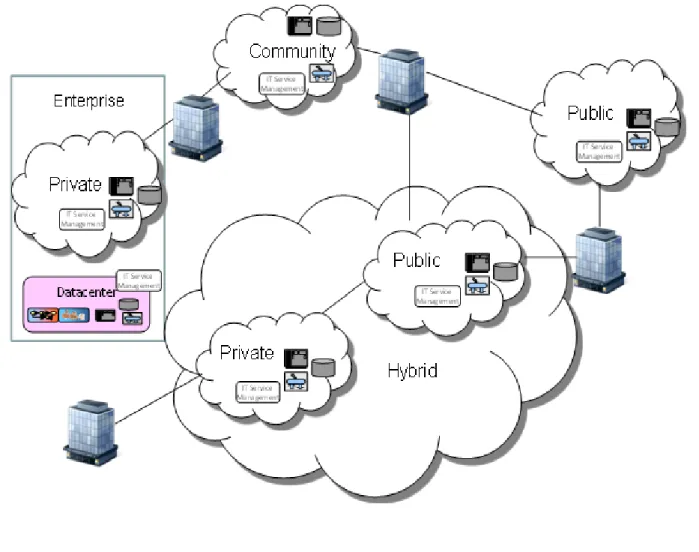
Private Cloud - A private cloud is one that serves a single organization. Private clouds facilitate 247
security, compliance, and quality of service improvements due to network optimization and 248
isolation. 249
Public Cloud - A public cloud is one that is available to the general public and is owned by an 250
organization selling cloud services. Public clouds provide efficiencies through large economies 251
of scale. 252
Community Cloud - A Community cloud shares infrastructure between several organizations 253
from a specific community with common concerns (security, compliance, jurisdiction, etc.), 254
whether managed internally or by a third-party and hosted internally or externally. The costs are 255
spread over fewer users than a public cloud (but more than a private cloud), so only some of the 256
benefits of cloud computing are realized. 257
Hybrid Cloud - A hybrid cloud is a composition of two or more clouds (private, public, or 258
community) that remain separate and autonomous but allow for data and/or application 259
portability between themselves via standard or proprietary technologies. 260
262
Figure1 evidences the complexity of identifying and tracking consumption for licensed software product 263
instances through the product lifecycle. 264
265 266
Figure 1 – Cloud deployment environments 267
In the following clauses, we identify several key scenarios that further describe the identification of and 268
consumption for a licensed software product instance through its lifecycle. 269
This clause describes key entitlement usage metric scenarios that focus on top level product deployment 272
scenarios. The entitlement usage metric scenarios can be summarized as below: 273
What software do I have 274
Who or what is using the software 275
Where and when is the software being used 276
The scenarios are written to illustrate the requirements needed to answer these questions in a normative 277
process across a range of deployment scenarios. The Use Cases derived from the deployment scenarios 278
place requirements on software packaging, deployment, installation and upgrade, and runtime logging by 279
the software. These requirements are the focus of this white paper. 280
Also note that parts of the included scenarios are outside of the scope of Software License Management 281
Incubator and their inclusion is not an effort to make a recommendation for standardization. They are 282
listed to explore and illustrate the requirements for the data artifacts required to standardize product 283
identification and entitlement usage metrics. 284
The scenarios focus on separate environments with some overlapping requirements. 285
1) The packaging and development of software, solutions or applications for deployment in a 286
cloud. 287
2) Desktop deployment of software in an enterprise 288
3) Software delivered as a service 289
4) Application and desktop virtualization 290
5) The packaging and installation of software on a server in a data center. It is possible that the 291
data center is an enterprise data center or a cloud data center. 292
6) Cloud deployment scenarios 293
The packaging and development requirements focus on software identity and a manifest of licensable 294
software within a package. The data center use cases utilizes a software identity artifact, but also focuses 295
on the entitlement usage metrics to track the “who”, “what”, “when” and “where” of an installed software 296
instance throughout its lifecycle. Entitlement usage metrics should be traceable, discoverable and 297
available for reporting. The cloud deployment scenarios focus on the additional requirements of tracking 298
software utilization or entitlement usage metrics in a remote computing environment. The scenarios are 299
described from the perspective of the described set of actors. 300
4.1 Scenario actors
301A group of actors are identified that may participate in the scenarios defined in this document. 302
IT Pro/Administrator 303
a) Software or Asset Administrator: Corporate software assets – match assets against the 304
licenses acquired [Persona: IT Pro] 305
b) System Administrator [Persona: IT Pro] 306
c) Deployment Manager – Deployment on virtual machine [Persona: IT Pro] 307
Product Provider 308
Procurement Manager [Persona: Business Development Manager] 309
Business Manager: Vendor or contract manager [Persona: Business Development Manager] 310
Compliance officers 311
a) Compliance Manager: Assesses reports against regulatory, corporate and other 312
requirements (i.e., Business Conduct). Responds to information provided by IT Auditor. 313
Compliance Manager develops set of criteria for IT auditor. [Persona: Business 314
Development Manager] 315
b) IT Auditor (internal) [Persona: Business Development Manager] 316
c) Auditor (external): Reviews Compliance Manager’s output and verifies or certifies the 317
results, and approves the compliance plans. 318
Security Manager: Access control [Persona: none defined] 319
Service Manager [Persona: IT Pro] 320
End user 321
4.2 Usage scenarios
322The usage scenarios focus on the usage of licensed software products. Usage scenarios are identified for 323
on-premise and enterprise or cloud data centers. 324
4.2.1 End user scenarios
325The end user scenarios are a set of scenarios that focus on software used on a desktop computer, 326
terminals or mobile devices. Multiple core scenarios are in practical use today: 327
On-premise deployment of end user requested desktop software from a software offering 328
catalog 329
End user use of virtual applications on a client device 330
End user access of server resources 331
End user use of a virtualized desktop 332
4.2.2 End user request software for a desktop system
333An end user requests software from an enterprise software catalog for use on a desktop target system. 334
The software is licensed by the enterprise and available for use. The software is provided, installed and 335
then used by the end user. 336
When the software is installed, a trial license may be activated by the software and may have an expiry 337
date. 338
Entitlement, utilization, and product metrics are gathered from both the software catalog and the user’s 339
desktop system to track the lifecycle of the software instance including additions, upgrades and removal. 340
Refer to ANNEX A for a detailed look at the use cases and the need for entitlement usage metrics across 341
the life cycle of a product for this scenario. 342
4.2.3 End user entitlement to software use via a licensing server
343An enterprise acquires software and a number of licenses for a software product and ties the acquired 344
licenses to a licensing server. 345
End user software is deployed and installed though any means, CD, software download or preload in an 346
image file. As part of installation a license server is discovered or the user is prompted to provide the 347
address of the license server. 348
If the customer has “Per User/Device License” and if a license is available, the client is granted 352
access. 353
If the license server is not found, the client is either not allowed to run the software or given a 354
temporary use license. 355
In an enterprise, an end user can check out licensed software any time (not necessary at the use time), 356
as long as the check-out/check-in period covers the usage period. 357
Entitlement usage metrics should be gathered on the acquisition and release or expiry of a license and 358
the products use. Entitlement usage metrics are also generated on the licensing server. 359
The license is validated per usage. User access is based on consumption (per-use). 360
In cases where the software cannot access the server due to network restrictions or network failure, the 361
end user may provide a file containing the details of the machine (in which the software is installed) to a 362
System Administrator and request that the license be withdrawn for a specific term on the end user’s 363
behalf. The System administrator inputs the file to the license server, generates the license, and sends it 364
to the end user. 365
4.2.4 Serving a single pool of licenses using multiple license server instances
366In a distributed system, a shared pool of licenses may be served by multiple license server instances. For 367
example, these multiple server instances may be needed to implement failover, load balancing, or 368
regional access scenarios. 369
These multiple license server instances must consistently represent the license rights specified by their 370
shared pool and must consistently log usage of license rights from that pool. 371
For example, increased use of virtualization can cause these multiple license server instances to 372
frequently migrate between host environments or run on a host environment that is decommissioned or 373
deleted. These server instances must guarantee that data input to them and output from them will persist, 374
regardless of the properties of their host environment. 375
Another potential scenario is that a license may be acquired from one server instance and returned to 376
another instance. 377
Therefore, these multiple server instances must log usage for their shared pool of licenses so that the log 378
accurately represents the sequence in which the usage has occurred. 379
For example, consistent usage logging can be implemented using a shared log, a shared logging service, 380
or a store and forward mechanism. 381
4.2.5 End user access to software as a service
382Software may also be provided through an application delivery system or appliance which provides 383
enterprise level services to an end user commonly through a web based interface. The software is 384
delivered as a service to the end user. 385
In this scenario the software mainly exists on the servers providing the service. Often a thin software 386
client (i.e., applet or ActiveX control) is downloaded or installed on the client. Entitlement usage metrics 387
are gathered on the servers providing the service. 388
4.2.6 End user access to software- plus service
389A Solution may consist of a “thick” client software that, to implement particular features, accesses 390
configuration data or additional software on potentially remote servers providing a service that controls 391
the associated entitlement(s). 392
Entitlement usage metrics are gathered on the servers providing the service and on the thick client 393
software. These metrics need to be collected in such a way that they can be processed as metrics for the 394
Solution. 395
4.2.7 End user use of remote application
396Stateless client application can be virtualized on a server and run on demand by a user and delivered to 397
the user through a remote console protocol like Microsoft Remote Desktop Services or Citrix XenApp. In 398
these cases it is assumed that the license tracking would be performed on the server that is hosting the 399
application. 400
When a virtualized client application is not delivered through a remote console protocol, such as when it 401
is run directly from the file system of, for example a hardware dongle, usage tracking would be performed 402
on the client. 403
4.2.8 Entitlement consumption scenarios
404When a license is requested by software product, there are two major dimensions that drive how that 405
software product acquires and returns the license: 406
Whether the request is for use of a single capability or for use of a capacity count 407
Whether the requested capability or capacity count can be returned after it has been used so 408
that it can be: 1) available to be used by others or 2) once used, cannot be used again, even by 409
the original requester. 410
The return of a capability or capacity count can be triggered by a variety of events. For example, 411
application termination, completion of a task, etc. 412
Not all entitlement usage metrics will include both capabilities and capacity counts; some may include one 413
but not the other. 414
In addition to the entitlement usage metrics listed in 5.1.2, the usage that should be logged for this 415
scenario is: 416
the request parameters, including the capability or capacity count requested and whether the 417
capability or capacity count is returnable or not, and if the capacity count is returnable, whether 418
a subset of the count can be returned 419
the grant of the request, along with any conditions 420
the denial of the request and the reason(s) for the denial 421
the return of the grant and the reason(s) for the return 422
The log of the denials will help the customer to plan for upgrading his entitlement or optimizing their 423
usage policies. 424
The entity granting requests, honoring returns, and logging usage metrics is a license service. Two 425
example implementations of this service are: 1) as a server process with which the software product 426
communicates or 2) as a library embedded into the software product. 427
ease the burden of licensing management the deployment scenarios place requirements on the software 430
developer, systems integrator or software vendor to include the product identification for each licensable 431
product in the package in a normative and machine readable format. The following scenarios illustrate the 432
value of a normative list of licensable products and required entitlement usage metrics contained in the 433
software deployment package. 434
4.3.1 Packaging for data center deployments
435Broader use of virtualization in enterprise data centers or private clouds has changed the typical data 436
center deployments from an install in place or provisioning of software on a server to the deployment of 437
fully provisioned images. Without the knowledge of the licensed software contained in the image it is hard 438
for the IT Pro to assure licensing compliance. A normative manifest in the deployment package could 439
contain both a list of the installed products and the metric requirements for those products to complete the 440
following scenario. 441
A standards compliant OVF deployment package is scheduled for deployment in a data center. Before 442
deployment the Software Administrator opens the package and extracts the product identification section 443
from the package and, if available, any packaged license entitlements to assure that the proper 444
entitlements are available to comply with the licensing requirements of the products in the package. 445
Based on the available entitlements for each product the Software Administrator either appends to an 446
existing set of entitlement usage metric requirements or places an entitlement usage metric requirements 447
data structure into the package for deployment by the Deployment Manager. 448
4.3.2 Cloud deployment
449Four cloud deployment scenarios have been identified as follows: 450
Product provider packages a solution targeted at a cloud deployment that contains multiple separately 451
licensed products. Included in the package is a manifest that contains the software Identification of all of 452
the products contained in the product. The products included in the package may possess an inbuilt 453
activation mechanism for instant activation of the product, with or without user interaction. Such inbuilt 454
activation mechanism that does not require any user interaction may be used by the product in scenarios 455
where the solution needs to be activated as part of automated cloud deployment. 456
Deployment manager receives a packaged solution to deploy into an enterprise private cloud. Before 457
deployment the licensed products in the package are inventoried and checked against available 458
entitlements to assure license usage compliance. The deployment manager determines whether to 459
constrain a deployment, migration or movement of a package. 460
An IT Pro wants to move a line of business application from a set of dedicated servers to the enterprises 461
private cloud. The IT Pro queries each of the servers to obtain a list of the software products contained in 462
the servers that are used in the application. The IT Pro includes this list in the application package being 463
developed to deploy the application in the private cloud. The IT Pro also delivers the list to the asset 464
manager to obtain free up or transfer the entitlements that are required to run the package in the private 465
cloud. IT Pro also places a data structure into the package that includes the entitlement usage metric 466
requirements before deploying the package on the cloud service. 467
In a public cloud, a licensing server could be hosted and maintained by cloud providers as a licensing 468
service. Cloud consumers use standard interfaces supplied by cloud providers to manage licensing usage 469
information. The license usage information is generated by cloud providers and queried by cloud 470
consumers for various purposes such as auditing. The definitions of communication between cloud 471
consumers and cloud providers are out of the scope of this Incubator. 472
4.3.3 Product deployment in an enterprise data center
473Three enterprise data center scenarios have been identified as follows: 474
Compliance Manager takes an inventory of all the licensable software products in a data center. For each 475
of the discovered products, entitlement usage metrics are harvested from the system logs identifying life 476
cycle and usage events for the product. The Compliance Manager correlates the lifecycle and usage logs 477
against the relevant entitlements to assure that the data center is in compliance with the entitlements for 478
the products. This includes inventory usage for product instances accessed indirectly through another 479
licensed software product on behalf of a user. 480
The Software Administrator uses the correlation between the entitlements and the installed products, and 481
entitlement usage metrics to forecast, adjust the continuing license requirements. For example, product 482
usage and activations could determine the necessity to adjust licensing requirements. 483
An IT Pro set up an automated system to track product usage against a set of entitlement policies set by 484
the Software Administrator. An example is a service that requires a Client Access License (CAL) per 485
unique user or client device. The IT Pro registers for the relevant indications (events) based on the 486
standard set of entitlement usage metrics delivered by each software product instance. Based on the 487
dynamic usage events received each month the IT Pro is able to deliver a report to the Software 488
Administrator with recommendations to increase or decrease the available entitlements or the type of 489
entitlement required. For example, the IT Pro uses an automated system to differentiate per-processor or 490
per-server product usage for the same license type and different entitlement usage metrics. Or, the IT Pro 491
tracks product usage based on access to domain and member servers irrespective of where the usage 492
occurs. 493
4.3.4 Data center/Server software deployment
494During deployment of software or a packaged software solution, suite, or bundle, a deployment manager 495
is able to discover the products contained in the package and the required entitlement usage metrics 496
before the installation on the server(s). Entitlement usage metrics requirements are expressed in a 497
standard way. 498
The Deployment Manager uses the available metric requirements to select a suitable server and/or create 499
a virtual machine template that matches the entitlement usage metrics requirements. 500
When a licensed software product(s) are deployed, an artifact for each product is created that captures 501
the relevant entitlement usage metrics relating to the environment into which the software is deployed (i.e. 502
location, hardware definition, and VM definition). 503
As part of the deployment the Deployment Manager may also configure any settable system 504
configurations parameters that are expressed in the entitlement usage metric requirements as packaged 505
by the software asset manager. 506
4.3.5 Administrator-deployed software on desktop system
507A software administrator deploys software products to an individual or a group of desktop system. 508
Entitlement usage metrics are generated when the software is actually deployed, used or removed from a 509
system. An example would be an IT managed installation of an antivirus product across an enterprise’s 510
desktop systems. 511
5 Management data artifacts requirements
512To support the monitoring and management of relevant events related to software entitlements, events for 513
the installed instance should be logged according to the defined standards for entitlement usage metrics. 514
instance should be logged according to a to-be-defined standard for entitlement usage metrics. The 519
following list shows the relevant software life cycle events that should be captured. 520
Request for software 521
Acquisition of software and/or entitlement 522
Addition to software offering catalog or software made available for use (consumption). 523 Deployment or installation 524 Product use 525 Application migration 526 VM migration 527 Removal 528
Modification of the software instance 529 Upgrade or Downgrade 530 Expiry 531 Retirement 532
An example of a detailed description of a complete lifecycle, the end user request for software scenario is 533
included in ANNEX A. The following two clauses Product Identification and Entitlement usage metric 534
Requirements describe the relevant aspects that should be captured in each event. 535
5.1.1 Product identification
536A licensed software product instance should be identifiable by a normative set of properties. This structure 537
should contain all of the information required to completely identify the software product and optionally to 538
describe the entitlement usage metrics that the product generates through its life cycle. For example: 539 Vendor 540 Software ID 541 Software ID Type 542 Product Title 543 Product Category 544 Product Family 545 Edition 546 Release Date 547 Software version 548 Software edition 549 Version Type 550 Patch Level 551 Product Dependencies 552 Certificates 553 Security Token 554
5.1.2 Entitlement usage metrics
555Entitlement usage metrics capture the relevant measureable or discoverable events in a system that 556
relate to the licensing of a product. Since a software product instance can be run within multiple 557
environments during its lifetime (e.g., Hyper-V Live Migration, VMotion, etc.), a software product instance 558
may have more than one of the following records associated with it. 559
The environment, unique users, devices, and usages related to the licensed software product 560
instance 561
– Number and type of virtual processors\cores 562
– Amount of memory 563
– Number and type of underlying hardware processors\cores 564
– Timestamp 565
– Administration domain 566
– File location of binaries\executable 567 – User Identity 568 – User privilege 569 – privilege level 570
– Client device identity and\or 571
– server identity 572
– Tenant 573
– Server or device type 574
– Operating system Identity 575
– Event type (reflect the life cycle) 576
Use 577
Operation state change (running, paused, stopped …) 578 Installation 579 Uninstall 580 Migration departure 581 Migration arrival 582 Upgrade/ 583 Servicing 584 Usage Metrics 585 – running time 586 – processor time 587 – memory usage 588
– timer based metrics 589
– feature usage 590
– capacity usage 591
DMTF DSP0140 Application White Paper
June 2003 The CIM Application Management Model is an information model that describes the details commonly required to manage software products and applications. This model can describe applications with various structures – ranging from standalone desktop applications to a sophisticated, multi-platform distributed, Internet-based application.
Likewise, the model can be used to describe a single software product as well as a group of interdependent software products that form a business system.
DMTF DSP0243 Open Virtualization Format (OVF 1.1)
January 2010 The Open Virtualization Format (OVF) Specification describes an open, secure, portable, efficient and extensible format for the packaging and distribution of software to be run in virtual machines.
DMTF DSP1054 1.2.0 Indications Profile
June 2011 The Indications Profile defines the CIM elements that are used to subscribe for indications of unsolicited events, to advertise the possible indications, and to represent indications used to report events in a managed system.
OASIS Solution Deployment Descriptor (SDD)
Sept. 2008 This specification defines schema for two XML document types: Package Descriptors and Deployment Descriptors. Package Descriptors define characteristics of a package used to deploy a solution. Deployment Descriptors define
characteristics of the content of a solution package, including the requirements that are relevant for creation, configuration and maintenance of the solution content. The semantics of the descriptors are fully defined, allowing software
implementations to precisely understand the intent of the descriptor authors and to use the information provided in the descriptors to support solution deployment.
IETF Application Management MIB May 1995 This specification defines an experimental portion of the Management Information Base (MIB) for use with network management protocols in the Internet Community. In particular, it defines objects used for the management of applications. This MIB complements the System Application MIB, providing for the management of applications' common attributes which could not typically be observed without the cooperation of the software being managed
ISO/IEC 19770-2:2009 Software Identification Tag Standard
2009 ISO/IEC 19770-2:2009 establishes specifications for tagging software to optimize its identification and management.
593 594
595
7 Standards currently under development
596597
ISO/IEC 19770-3 Software Entitlement Tag Standard
Under development
ISO/IEC 19770-3 focuses on capturing and defining the information necessary to describe how software may be used, known as the entitlement. This standard will provide a framework and criterion of measurement for creating unambiguous definitions of entitlements.
Use cases
600A.1 Use cases for end user desktop system
601The following are the use cases for just one of the above scenarios, automated end user requested 602
software for their desktop system. The diagrams are shown only as an illustration of the type of 603
interactions and the metrics required completing the scenario and track and managing the software 604
licenses involved in the scenario. The scenario and the use cases described were used to determine the 605
necessity and the requirements for software license management. Although this use case addresses a 606
desktop deployment scenario, many of the use cases around the usage metrics and licensable events are 607
true for the server scenarios that were discussed in the Incubator. 608
Short descriptions are followed by representative diagrams of these use cases. 609
A.1.1
Make software available610
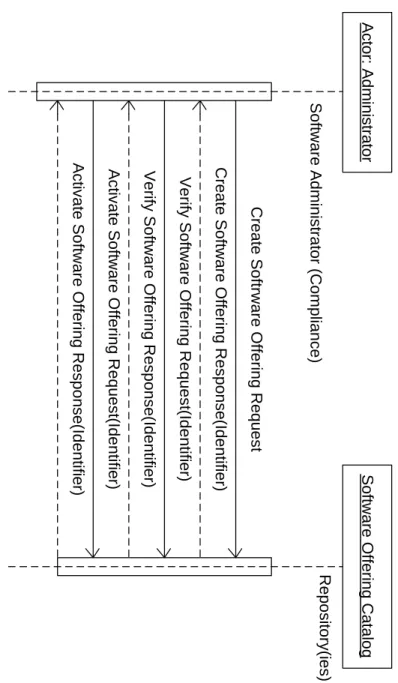
An administrator adds a software offering to a software catalog and makes it available for request. An 611
administrator may verify the software offering and activate it in the software catalog. 612
A.1.2
Request software613
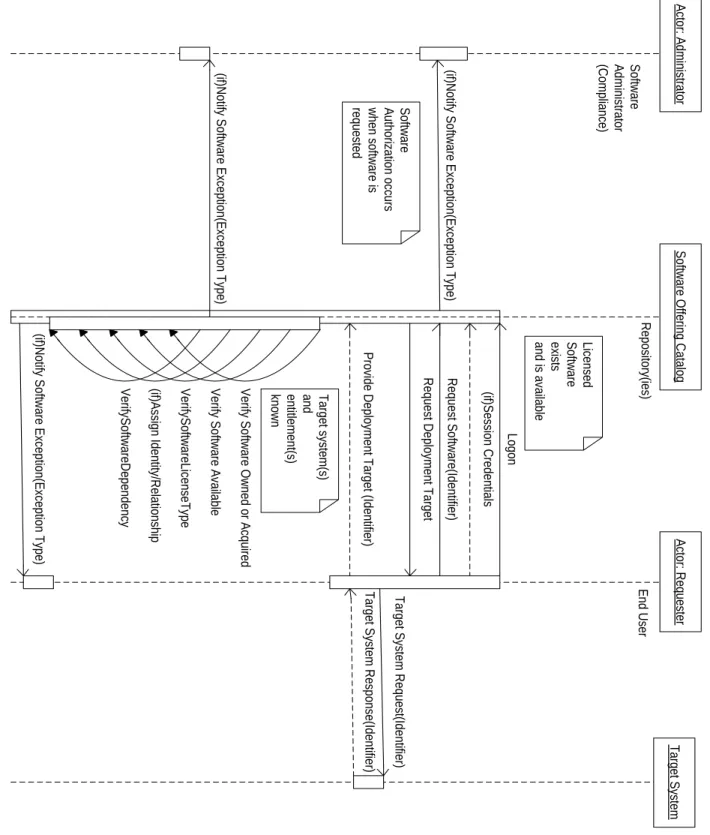
A requestor (actor) requests software from a software catalog to deploy to a desktop system. The 614
software request and deployment environment are used to complete the request. Software should be 615
owned and available in the software offering to fulfill the request. As this is a licensable event, other 616
licensing and software dependency checks are made before the software request can be completed. An 617
authorization occurs when the request for software and other checks are made. 618
A.1.3
Deploy software619
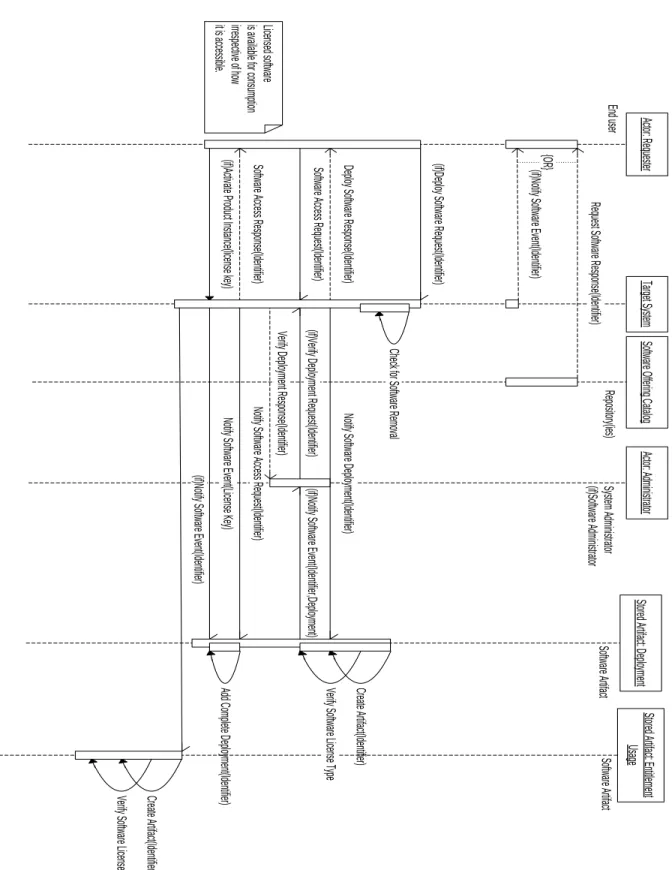
When a software request is complete, software is delivered to the desktop system for 620
deployment. Deployment can be by manual or automated means. Entitlement usage metrics are captured 621
throughout the deployment of the software. A licensing key may be required to activate the software 622
instance. 623
A.1.4
Identify relationship624
A software request, and deployment and access are related to and accounted for by a business 625
entity. Entitlement usage metrics are created and captured on the software instance once the business 626
entity-software instance relationship is set. The business entity is the consumer of the entitlement. 627
Creating the relationship between the software request, the business entity, and the entitlement could 628
occur in parallel to or in conjunction with other phases (i.e. Request Software, Deploy Software). 629
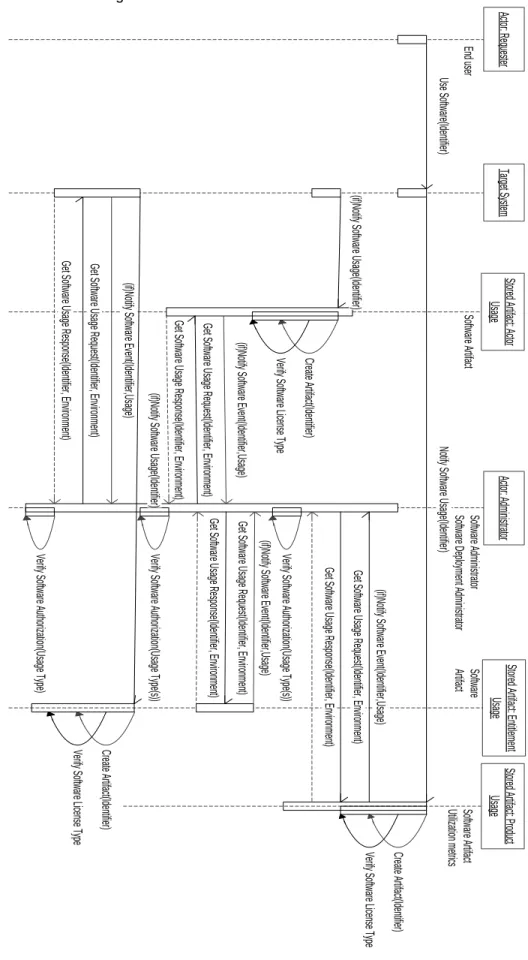
A.1.5
Use software630
Entitlements metrics are captured when a software instance is accessed and used for the lifecycle of the 631
software instance. 632
A.1.6
Change software633
Requests to change a software instance may occur during its lifecycle and metrics captured on licensable 634
events. Software may be added (i.e. for upgrade or new) or software removed (i.e. for replacement). A 635
software upgrade may require a new software request and deployment, and removal of existing 636
software. Such a request may result in a change in entitlement. 637
A.1.7
Discovery and reporting 638The Entitlement usage metrics are available for discovery and reporting. The metrics are created at key 639
points in the software instance lifecycle - at deployment, by actor usage, when an entitlement is used, and 640
if the software instance is used or accessed (utilization). 641
A.1.8
Remove software642
The software instance may be retired or returned to the software offering catalog when a request is made 643
to remove that instance. The software may be returned to the software catalog and made available for re-644
deployment. If required, licensing keys may also be returned. The entitlement usage metrics are created 645
to reflect the removal of the software instance and the associated entitlement. 646
C re a te S o ftw a re O ffe rin g R e s p o n s e (Id e n tif ie r) V e rif y S o ftw a re O ffe rin g R e s p o n s e (Id e n tif ie r) d m in is tr a to r S o ftw a re O ffe rin g C a ta lo g A c tiv a te S o ftw a re O ffe rin g R e s p o n s e (Id e n tif ie r) S o ftw a re A d m in is tr a to r ( C o m p lia n c e ) C re a te S o ftr w a re O ffe rin g R e q u e s t V e rif y S o ftw a re O ffe rin g R e q u e s t( Id e n tif ie r) A c tiv a te S o ftw a re O ffe rin g R e q u e s t( Id e n tif ie r) R e p o s ito ry (ie s ) 647
Figure 2 – Make software available 648
649 (if )S e ss io n C re d e n tia ls S o ftw a re O ffe rin g C a ta lo g A cto r: R e q u e ste r T a rg e t S ys te m L ic e n se d S o ftw a re e xis ts a n d is a va ila b le T a rg e t s ys te m (s ) a n d e n titl e m e n t(s ) kn o w n P ro vid e D e p lo ym e n t T a rg e t ( Id e n tifi e r) R e q u e st S o ftw a re (Id e n tifi e r) V e rif yS o ftw a re L ic e n se T yp e V e rif yS o ftw a re D e p e n d e n cy E n d U se r V e rif y S o ftw a re O w n e d o r A cq u ire d V e rif y S o ftw a re A va ila b le T a rg e t S ys te m R e sp o n se (Id e n tifi e r) L o g o n R e q u e st D e p lo ym e n t T a rg e t T a rg e t S ys te m R e q u e st( Id e n tifi e r) (if )N o tify S o ftw a re E xc e p tio n (E xc e p tio n T yp e ) S o ftw a re A u th o riz a tio n o cc u rs w h e n s o ftw a re is re q u e ste d A cto r: A d m in is tra to r S o ftw a re A d m in is tra to r (C o m p lia n ce ) (if )N o tify S o ftw a re E xc e p tio n (E xc e p tio n T yp e ) (if )N o tify S o ftw a re E xc e p tio n (E xc e p tio n T yp e ) (if )A ss ig n Id e n tity /R e la tio n sh ip R e p o sit o ry (ie s) 650
Figure 3 – Request software 651
Acto r: R equ este r Tar get Sys tem De plo y S oftw are Re spo nse (Ide ntifi er) (if)A ctiv ate Pro duc t In sta nce (lic ens e k ey) Acto r: A dm inis trato r ens ed s oftw are vaila ble for co nsu mp tion spe ctiv e o f ho w ac ces sib le. So ftw are O ffer ing Ca talo g So ftw are Ac ces s R equ est( Ide ntifi er) (if)D eplo y S oftw are Re que st(Id enti fier) So ftw are Ac ces s R esp ons e(Id enti fier) Sys tem Ad min istra tor (if)S oftw are Ad min istra tor En d u ser No tify So ftw are Ev ent( Lic ens e K ey) Sto red Art ifac t: D eplo ym ent So ftw are Art ifac t No tify So ftw are Ac ces s R equ est( Ide ntifi er) Cre ate Art ifac t(Id enti fier) (if)V erify De plo ym ent Re que st(Id enti fier) (if)N otify So ftw are Ev ent( Ide ntifi er,D eplo ym ent) Ve rify De plo ym ent Re spo nse (Ide ntifi er) Ch eck for So ftw are Re mo val Re que st S oftw are Re spo nse (Ide ntifi er) No tify So ftw are De plo ym ent( Ide ntifi er) Ad d C om ple te D eplo ym ent( Ide ntifi er) (if)N otify So ftw are Ev ent( Ide ntifi er) Cre ate Art ifac t(Id enti fier) Sto red Art ifac t: E ntitl em ent Usa ge So ftw are Art ifac t Re pos itory (ies ) Ve rify So ftw are Lic ens e T ype {O R} (if)N otify So ftw are Ev ent( Ide ntifi er) Ve rify So ftw are Lic ens e T ype 654
Figure 4 – Deploy software 655
So ftw are O ffer ing C ata log Ta rge t S yste m Ge t S oftw are Ide ntity R esp ons e(Id enti fier ) Act or: Ad min istra tor (if)N otify So ftw are Ev ent( Ide ntifi er,E nvir onm ent) Act or Bu sin ess En tity D ata R esp ons e Sto red Art ifac t: E ntitl em ent Us age Pu rch ase -ab le ow ned pa rt So ftw are art ifac t (if)V erify So ftw are De pen den cy (if)A pply En title me ntM etric So ftw are Ad min istra tor En terp rise So ftw are As set Ma nag er (if)C rea te A rtifa ct R esp ons e(Id enti fier ) (if)C rea te A rtifa ct R equ est( Me tric Ty pe) Cre ate Art ifac t(Id enti fier ) Ge t S oftw are Ev ent Re que st(Id enti fier , E nvir onm ent) Ge t S oftw are Ev ent Re spo nse (Id enti fier , E nvir onm ent) Ge t B usin ess En tity D ata R equ est Ge t S oftw are Ide ntify R equ est( Ide ntifi er) Re pos itor y(ie s) Ve rify So ftw are Lic ens e T ype 656
Ta rge t S yste m Sto red A rtifa ct: Ac tor Us ag e Ve rify S oftw are A uth oriz atio n(U sa ge Ty pe (s)) Ac tor: A dm inis tra tor So ftw are A dm inis tra tor So ftw are D ep loy m en t A dm inis tra tor Ge t S oftw are U sa ge R eq ue st(I de ntif ier, E nvir on m en t) Ge t S oftw are U sa ge R esp on se (Id en tifie r, E nvir on m en t) So ftw are A rtifa ct Sto red A rtifa ct: En title m en t Us ag e So ftw are Arti fac t No tify S oftw are U sa ge (Id en tifie r) (if)N otif y S oftw are E ve nt(I de ntif ier, Us ag e) Ge t S oftw are U sa ge R eq ue st(I de ntif ier, E nvir on m en t) Ge t S oftw are U sa ge R esp on se (Id en tifie r, E nvir on m en t) Cre ate A rtifa ct(I de ntif ier) Sto red A rtifa ct: Pro du ct Us ag e (if)N otif y S oftw are U sa ge (Id en tifie r) (if)N otif y S oftw are U sa ge (Id en tifie r) Cre ate A rtifa ct(I de ntif ier) (if)N otif y S oftw are E ve nt(I de ntif ier, Us ag e) Ge t S oftw are U sa ge R eq ue st(I de ntif ier, E nvir on m en t) Ge t S oftw are U sa ge R esp on se (Id en tifie r, E nvir on m en t) Ve rify S oftw are A uth oriz atio n(U sa ge Ty pe (s)) (if)N otif y S oftw are E ve nt(I de ntif ier, Us ag e) Sy ste m ch an ge s or u sa ge tha t a ffe ct en title m en t m etri cs be co m e dis co ve rab le So ftw are A rtifa ct Util iza tio n m etri cs e S oftw are (Id en tifie r) Cre ate A rtifa ct(I de ntif ier) (if)N otif y S oftw are E ve nt(I de ntif ier, Us ag e) Ge t S oftw are U sa ge R eq ue st(I de ntif ier, E nvir on m en t) Ge t S oftw are U sa ge R esp on se (Id en tifie r, E nvir on m en t) Ve rify S oftw are A uth oriz atio n(U sa ge Ty pe ) Ve rify S oftw are Lic en se Ty pe Ve rify S oftw are Lic en se Ty pe Ve rify S oftw are Lic en se Ty pe 658
Figure 6 – Use software 659
So ftw are O ffe rin g C ata log Ta rge t S yste m Ac tor: R eq ue ste r Sto red A rtifa ct En title m en t M etri cs R eq ue st(M etri c T yp e) En title m en t M etri cs R esp on se (M etri c T yp e) (if)N otif y E ntit lem en t M etri cs( M etri c T yp e) Sy ste m A dm inis tra tor So ftw are A dm niis tra tor So ftw are D ep loy m en t M an ag er En d u se r Ag en tle ss d isc ove ry Dis co ve ry A ge nt So ftw are In fo R eq ue st(I de ntif ier) So ftw are In fo R esp on se (Id en tifie r) So ftw are is ( is n ot) ass ocia ted to oth er so ftw are Lo go n (if)S ess ion C red en tia ls So ftw are In fo R eq ue st(I de ntif ier) So ftw are In fo R esp on se (Id en tifie r) De plo ym en t Ac tor Us ag e En title m en t U sa ge Pro du ct u sa ge En title m en t M etri cs R eq ue st(M etri c T yp e) En title m en t M etri cs R esp on se (M etri c T yp e) So ftw are art ifa ct Re po sito ry(i es) 660
Tar get Sys tem ve S oftw are Ac ces s R esp ons e(Id enti fier) Re turn Pro duc t In sta nce Re spo nse (lic ens e k ey) Acto r: A dm inis trato r So ftw are O ffer ing Ca talo g ve S oftw are Ac ces s R equ est (Ide ntifi er) Sto red Art ifac t Ch eck -in S oftw are Re spo nse (Ide ntifi er) So ftw are Ad min istra tor Ge t S oftw are Ev ent Re que st(Id enti fier, Re mo val Eve nt) So ftw are Ev ent Re spo nse (Ide ntifi er,R em ova l E ven t) (if)N otify So ftw are Ev ent( Ide ntifi er,R em ova l) No tify Re turn Pro duc t In sta nce (Ide ntifi er) No tify Re mo ve S oftw are Ev ent( Ide ntifi er,E nvir onm ent) (if)N otify So ftw are Ev ent( Ide ntifi er,L ice nse Ke y) (if)N otify So ftw are Ev ent( Ide ntifi er,E ntitl em ent) No tify So ftw are Ch eck -in( Ide ntifi er) De plo ym ent Acto r U sag e En title me nt U sag e Pro duc t us age (if)C hec k-in So ftw are Re que st(Id enti fier) (if)R etu rn P rod uct Ins tan ce R equ est( lice nse ke y) otify So ftw are Ac ces s R em ova l(Id enti fier) So ftw are arti fac t Re pos itory (ies ) 662
Figure 8 – Remove software 663
ANNEX B
665(informative)
666 667 668Change log
669Version Date Description
1.0.0 2012-05-20