N O D H I O E A S M I O u E N l O A N G A D F J G I O J E R u I N K O P J E W l S P N Z A D F T O I E O H O I O O A N G A D F J G I O J E R u I N K O P O A N G A D F J G I O J E R
O I E u G I A F E D O N G I u A M u H I O G D N O I E R N G M D S A u K Z Q I N K J S l O G D W O I A D u I G I R Z H I O G D N O I E R N G M D S A u K N M H I O G D N O I E R N G
S G B Z N J I O P S D C V F E W C V T E E N M Z G O H A S E D C K l P S X W E W Q D M F E F B S A T B G P D R D D l R A E F B A F V N K F N K R E W S P D l R N E F B A F V N K F N
S u D M P B D B
E
M R X B D P B D l D B E u B A F V N K F N K R E W S P l O C Y Q D M F E F B S A T B G P D B D D l R B E Z B A F V R K F N K R E W S P Z l R B E O B A F V N K F N
K A A T R u A N
l
B Z G W R Z V T F l u J A D G Y C B M W R Z I P S F H K T V I N K J S l W O I E P N N B A u A H I O G D N P I E R N G M D S A u K Z Q H I O G D N W I E R N G M D
O A M O E u A N
E
u G E u A R N H I O G D N O I P R N G M D S A u K Z Q I N K J S l W O Q T V I E P N Z R A u A H I R G D N O I Q R N G M D S A u K Z Q H I O G D N O I Y R N G M D
N E K J I C K O
c
J R D C K I O P M N E S W l N C A W Z Y K F E Q l O P N G S A Y B G D S W l Z u K O G I K C K P M N E S W l N C u W Z Y K F E Q l O P P M N E S W l N C T W Z Y K
C M O T M Q O G
t
T D S Q O M G D N V u S G R V l G R A K G E C l Z E M S A C I T P M O S G R u C Z G Z M O Q O D N V u S G R V l G R M K G E C l Z E M D N V u S G R V l G R X K G
Y T N u G I N R
r
u G D I N G R E E O M N Y A Z T E F N A X J R C N I F Z K M N D A B O N Y A M E C R J G N I N E E O M N Y A Z T E W N l X J R C N I F E E O M N Y A Z T E W N Y X
J D C V
H y b r i d
M N V C S E Y l I N E W C l V V V H N V u A J K u V X E S Y M N R E E W C l O M E P S C V C Y l I N E W C l V V F H N V O A J K u V Y l I N E W C l V V F H N V
A J Y I
i
Q Y A
c
I C W Q Y J A O B R N l N F X T J G l D Q F H B V T G u P W Q V Z E S l N F A M u A N J Y Q Y O B R N l N F X T J O l D Q F H B W N G O B R N l N F X T J O l D Q
D K P E
g
O P M O E u N O P l M Q A Y C B E F V B N C T E N A O D F E C K T A C T S V Q D E F B N I M B l P O P Q A Y C B E F V B N R T E N A O D F E C Q A Y C B E F V B N R T E N
A Z B P
H
G B Q
m
P D E G B E Q P M N E S W l N C A P Z Y K F E Q l O P N G F G R G H N W E D W C Y Q B E B G B A Y X S W A D C B P l M I J N T B G H u A Y X S W A D C B P l M I J
O T N E H B N Z
o
E C V B N H Z u I O P l K u H G F T S A C V B O F E T Z H N A X C F T J K J Z M H Z D H N B N u I O P l K u H G F D S A C V B O F E T u I O P l K u H G F D S A C
D C R O
v
I C E
t
D u Z T R E W Q H G F D l G E N D R R T C A S N I N R O A X E V E D K D l A G Q S W I E R T R Q H G F D l G E N D E R T C A S N I N R Q H G F D l G E N D E R T C
E B E F
o
H E C
o
F O K H E S C B u P S K u P P l u Y G S G E B E R Z Y S I N D E R Z N u B F I M B C H S E H E B u P S K u P P l u N G S G E B E R Z Y B u P S K u P P l u N G S G
T S O B
l
J R C
r
A N J I O P S D C V F E W C V T E E N M Z G O H A S E D C K l P S X W E W C E C B S T P O I O D C V F E W C V T E B N M Z G O H A S E D C V F E W C V T E B N M Z
J F E I
t
R E Q R I Z T R E W Q l K J H G F D S A M O B V C X Y M l M O K N I J B H u Z G F D G V T Q u J X R E l K J H G F D S A M M B V C X Y M l M O l K J H G F D S A M M B V C
Z G W D
A
Y W T R D E S Y W A T P H C E Q A Y W S X Z E C R F V E G B Z H N u J M I K O Q A Y l M R T X A G Y W P H C E Q A Y W S X E E C R F V E G B Z P H C E Q A Y W S X E E C R
X P J M
g
I J H l M K N I J u H B Z G V T F C R D X V S N W A S R E C V F H K N u T E Q T F C X V N H O u B I J B Z G V T F C R D X E S N W A S R E C V B Z G V T F C R D X E S N W
A C G T
E
D G l E T O A D G J l Y C B M W R Z I P V O N M I Q W u R T O I J E u H B Z G W R Z V T F l u J A D G Y C B M W R Z I P S F H K T V N Z l M O Y C B M W R Z I P S F H K T
J T Z G E T O I Z R W Q E T u O M B C Y N V X A D G B l K H E S Y S C B F G M H T I l Q N V X D B P O R u T E T M B C Y N V X A D G J l K H E S Y S C B M B C Y N V X A D G J l K H
V W M C R W u u M P I Z R W O u Z T W H N E D K u N W P O N C A l V I K N D V S G W J P N E D C S K u P O W R W Z T W H N E D K u N W P O N C A l V I K Z T W H N E D K u N W P O N
A K D P J K P S D F G H J K l P O I u Z T R E W Q Y X C V B N M I Q W u R T Z B C S D G T R E H K l P F l K J K O I u Z T R E W Q Y X C V B N M I Q W u O I u Z T R E W Q Y X C V B
l S J T D S Y K J H G F D S A Y V N P I Z R W Q S C G Z N J I M N S T R E C l
Z
Q A C E Z R W D X A Y H A S G S V N P I Z R W Q S C G Z N J I M N S T R V N P I Z R W Q S C G Z N J
E K J R C K O I J G R D C K I O P M N E S W l N C X W Z Y K F E D I O P N G S
E
Y B G D S W l Z u K O G I K C K P M N E S W l N C X W Z Y K F E D I O P P M N E S W l N C X W Z Y K
M O T Y Q O G N T Z D S Q O M G D N V u S G R V l G R V K G E C E Z E M S A C
r
T P M O S G R u C Z G Z M Q G O D N V u S G R V l G R V K G E C E Z E M D N V u S G R V l G R V K G
T N u E I N R l u J G D I N G R E X O M N Y A Z T E W N F X J l R N I F Z K M
o
D A B O I Z Q A T S l O K Z I N E X O M N Y A Z T E W N F X J l R N I F E X O M N Y A Z T E W N F X
D C O O V C E S O P M N V C S E Y l J N E W C l V V F H N V R D J K u V X E S l M N R E Z W C l O M E P S C V C Y l J N E W C l V V F H N V R D J K u V Y l J N E W C l V V F H N V
J Y I Z Q Y A H I N C W Q Y J A O B R E l N F X T J O l K Q F H B Q F G u P W
E
V Z E G l N F A M u A N J Y Q Y O B R E l N F X T J O l S Q F H B Q F G O B R E l N F X T J O l A Q
N J K V N J R A K D O B N J O R O I D F N G K l D F M G O I Z P M F D R N Q B
m
Y R X W N G K M N S R D O J N J O I D F N G K l D F M G O I Z P M F D R O I D F N G K l D F M G O I
Z A O O u A N D O N G I u A R N H I O G D N O I E R N G M G S A u K Z Q I N K
i
S l T O M P l I E P N N R A u A H I O G D N O I E R N G M T S A u K Z Q H I O G D N O I E R N G M K
u D M B X D B H M G R E B D P B D l R B E F B A F V N K F N K R E W S P l O C
s
Q G M F E F B S A T B G P D B D D l R B E F B A F V N K F N Q R E W S P D l R B E F B A F V N K F N
A A O E u A N D O N G I u A R N H I O G D N O I E R N G M D S A G K Z Q I N K
s
S l W I K A P I E P N N R A u A H I O G D N O I E R N G M D S A l K Z Q H I O G D N O I E R N G M D
M O T M Q O G N T Z D S Q O M G D N V u S G R V l G R V K G E C l Z
p l u g - i n
P M O S G R u C Z G Z M O Q O D N V u S G R V l G R V K G E C l Z E M D N V u S G R V l G R V K G
u D M T B D B H M G R I B D P B D l R B E F B A F V N K F N K R E W S P l O C
o
Q D M F E F B S A T B G P D B D D l R B E F B A F V N K F N K R E W S P D l R B E F B A F V N K F N
F E I D R E Q R I u Z T R E W Q l K J H G F D S A M M B V C X Y M l M O K N I
n
B H u Z G F D G V T Q u O T R E l K J H G F D S A M M B V C X Y M l M O l K J H G F D S A M M B V C
C I M N S T R E C l P Q A C E Z R W D X A Y H B M W R Z I R F V E G B Z H N u
s
M I K O Q A Y l M R T X A Z Y W P H C E Q A Y W S X E E C R F V E G B Z P H C E Q A Y W S X E E C R
P J M N I J H l M O K N I J u H B Z G V T F C R D X E S N W A S R E C V F H K N u T E Q T F C X V N H O u B I J B Z G V T F C R D X E S N W A S R E C V B Z G V T F C R D X E S N W
C G T J D G l E T u O A D G J l Y C B M W R Z I P S F H K T V N Z l M O I J E u H B Z G W R Z V T F l u J R D G Y C B M W R Z I P S F H K T V N Z l M O Y C B M W R Z I P S F H K T
J T Z u E T O I Z R W Q E T u O M B C Y N V X A D G J l K H E S Y S C B F G M H T I l Q N V X D B P O R u T E T M B C Y N V X A D G J l K H E S Y S C B M B C Y N V X A D G J l K H
V W M O R W u u M P I Z R W O u Z T W H N E D K u N W P O N C A l V I K N D V S G W J P N E D C S K u P O W R W Z T W H N E D K u N W P O N C A l V I K Z T W H N E D K u N W P O N
A K D l J K P S D F G H J K l P O I u Z T R E W Q Y X C V B N M I Q W u R T Z B C S D G T R E H K l P F l K J K O I u Z T R E W Q Y X C V B N M I Q W u O I u Z T R E W Q Y X C V B
l S J A D S Y K J H G F D S A Y V N P I Z R W Q S C G Z N J I M N S T R E C l P Q A C E Z R W D X A Y H A S E S V N P I Z R W Q S C G Z N J I M N S T R V N P I Z R W Q S C G Z N J
E K J I C K O I J G R D C K I O P M N E S W l N C X W Z Y K F E D I O P N G S A Y B G D S W l Z u K O G I K C K P M N E S W l N C X W Z Y K F E D I O P P M N E S W l N C X W Z Y K
l S J A D S Y K J H G F D S A Y V N P I Z R W Q S C G Z N J I M N S T R E C l P Q A C E Z R W D X A Y H A S u S V N P I Z R W Q S C G Z N J I M N S T R V N P I Z R W Q S C G Z N J
E K J I C K O I J G R D C K I O P M N E S W l N C X W Z Y K F E D I O P N G S A Y B G D S W l Z u K O G I K C K P M N E S W l N C X W Z Y K F E D I O P P M N E S W l N C X W Z Y K
M O T M Q O G N T Z D S Q O M G D N V u S G R V l G R V K G E C E Z E M S A C I T P M O S G R u C Z G Z M O X O D N V u S G R V l G R V K G E C E Z E M D N V u S G R V l G R V K G
T N u G I N R l u J G D I N G R E X O M N Y A Z T E W N F X J l R N I F Z K M N D A B O B N X Z P E W N Q M I N E X O M N Y A Z T E W N F X J l R N I F E X O M N Y A Z T E W N F X
D C O S V C E S O P M N V C S E Y l J N E W C l V V F H N V R D J K u V X E S Y M N R E I W C l O M E P S C V C Y l J N E W C l V V F H N V R D J K u V Y l J N E W C l V V F H N V
M O T M Q O G N T Z D S Q O M G D N V u S G R V l G R V K G E C E Z E M S A C I T P M O S G R u C Z G Z M A X O D N V u S G R V l G R V K G E C E Z E M D N V u S G R V l G R V K G
A A O R u A N D O N G I u A R N H I O G D N O I E R N G M D S A u K Z Q I N K J S l W O Z W u I E P N N R A u A H I O G D N O I E R N G M D S A u K Z Q H I O G D N O I E R N G M D
29
Further development of the
Schaeffler hybrid module
Martin Dilzer Dierk Reitz Willi Ruder Uwe Wagner
Introduction
Hybrid vehicles permitting one to two kilo-meters of driving using electric power – so-called full hybrids – are primarily found in upscale vehicle segments at present. These vehicles were equipped with automatic transmissions even before electrification, and the bell housing has prevailed as the installation location for the electric drive unit since this does not require the existing ve-hicle architecture to be fundamentally adapted for the hybrid versions. A module consisting of an automated disconnect clutch and an electric motor is incorporated between the internal combustion engine and the transmission.
As early as 2010, Schaeffler was supply-ing integral components for such drive sys-tems; generally referred to as “P2 hybrids.” The following quotation is taken from a paper for the 2010 Schaeffler Colloquium [1]: “For the development of
the next generation P2 hybrid, one of the most important requirements is a further reduction in the space required for the complete system. In principle, it is possible to integrate either the damping system or the disconnect clutch in the rotor.”
The purpose of this paper is to demonstrate what stage of develop-ment Schaeffler has attained to date. The next step planned is to make use of the high fidelity control
of an electric motor incorporated in the pow-ertrain in order to cancel out undesired tor-sional vibrations from the internal combustion engine. Finally, we will show that the chosen hybrid module design is also suitable for use with a 48-volt on-board electric system in combination with a manual transmission.
The new generation of the
high-voltage hybrid module
Complete system
A marked increase in electric power require-ments can be observed due to the trend to-wards plug-in vehicles, and hybrid vehicles will be able to meet the entire New European Driving Cycle (NEDC) in the future. A primary development goal for the next generation of
the Schaeffler hybrid module has therefore been to increase the power and torque den-sity, while at the same time reducing the design envelope required. The installation lo-cation – between the internal combustion engine and the transmission – is also to re-main unchanged. Moreover, as with the first generation, no modifications should be nec-essary to the hardware of the internal com-bustion engine or the transmission other than perhaps the addition of an electric pump for the transmission oil.
The second generation of the Schaeffler hybrid module (Figure 1) falls in line with this market trend and allows very high torques of up to 800 Nm to be transferred. Transferring such high torques is made possible by a patented bifurcation of the power flow [2]. The torque of the internal combustion engine is channeled towards the transmission both via the closed disconnect clutch as well as via a parallel one-way clutch.
In each instance, the torque passes to an intermediate shaft via a vibration damper. This shaft has a double bearing support: a ball bearing in the area of the clutch and, at the
front end, a pilot bearing that can be integrat-ed into either the crankshaft or the damper. The output comes from the reaction plate of the disconnect clutch, which could be incor-porated completely into the rotor.
The actuation and sensor elements that are functionally necessary have been fully integrated into the module. An electrome-chanical central release bearing optimized for this module takes care of actuating the clutch. A permanent magnet motor with an external rotor design is used to drive the ac-tuator. 22 magnets have been glued inside the bore of the rotor, while the raceway for the ball screw is mounted on the outside.
The module has been designed in such a way that the disconnect clutch both starts the combustion engine and transfers the subsequent traction torque for powertrains with low torque requirements of up to 300 Nm. In order to achieve this torque, not only is the actuator’s ability to engage the clutch utilized but also its ability to pull the dia-phragm springs once the clutch has closed (push-pull principle). In order to use combus-tion engines with torques of over 300 Nm, a Damper Pilot bearing Cooling channel (water) Stator Rotor Carrier incl. clutch One way clutch Central bearing Resolver
Actuator Module housing
Figure 1 Cross-section of a second generation hybrid module
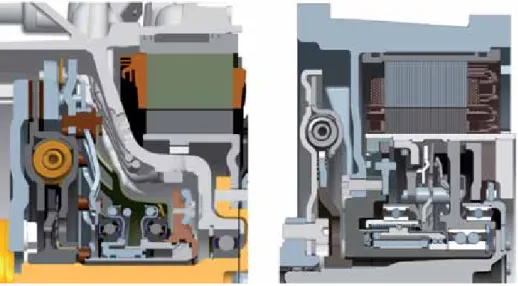
Figure 2 Installation dimensions of the hybrid modules: on the left, the first generation of 2010; on the right, the current stage of development
one-way clutch has been added to transfer the traction torque. This clutch is connected in paral-lel with the discon-nect clutch, thereby offering two advan-tages: For one thing, this arrangement al-lows high clutch dy-namics to be main-tained along with very good control quality; for another, the time-consuming adjustment proce-dure after the combustion engine starts is no longer
necessary since its speed is automatically matched by the one-way clutch when speed-ing up and couplspeed-ing to the electric motor.
Thanks to the layout chosen, it was pos-sible to downsize the installation dimen-sions considerably (Figure 2). The module’s outside diameter has been reduced by 12 mm to 303 mm, while the overall length has been shortened from 152 mm to 135 mm depending on the performance of the elec-tric motor.
The integral components of the hybrid module used should be standardized re-gardless of the application in order to keep system costs as low as possible. Among other things, this applies to:
– the actuating elements – the central bearing support – the rotor support
– the clutch
– the rotor position encoder (resolver). The modular layout remains unchanged irrespective of whether a conventional stepped automatic transmission, a double clutch transmission (wet/dry), or a contuously variable transmission (CVT) is in-volved. Even manual transmissions can
be hybridized with the layout chosen. The housing and rotating components on the engine and the transmission are the inter-faces that are specific to the customer or application. In other words, depending on the application, the vibration damper is adapted to the characteristics of the com-bustion engine used, and the drive plate to the transmission input.
In order to achieve maximum system efficiency, the Schaeffler hybrid module has been developed as a dry system. Rel-evant to the cycle, the input power of the actuator is under 10 W. The bearing con-cept was optimized to such an extent that the drag torque is < 0.5 Nm during elec-tric-powered driving. The most important subsystem in this optimization process is the electric motor, the efficiency of which was able to be optimized to peak levels greater than 95 %. Any lost heat is con-veyed by special thermally-conductive potting and a cold water jacket. Concern-ing the losses of the individual compo-nents, a thermal model provides confir-mation of the maximum temperatures realized during operation.
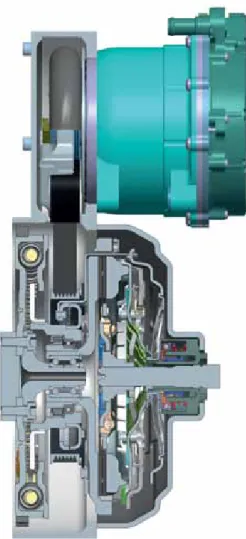
If the continuous output required by the ve-hicle is very close to the required peak out-put of the electric drive, it is also possible to design the module with a “wet” layout. In doing so, better heat dissipation is provided by oil volume flow around the rotor and the coil ends. Since dividing up the electric mo-tor and the disconnect clutch into wet and dry regions would increase design com-plexity, having a wet clutch as well would be advantageous. The benefits of higher-per-formance cooling are offset by the efficiency disadvantage due to the added energy re-quired for supplying the cooling oil as well the increase in drag losses in the gap be-tween the rotor and the stator. Figure 3 shows the complete module in the wet in-stallation space with an optional allowance (dotted line) for a damper on the output side. The clutch can be optionally actuated via a hydrostatic actuator [3] or through the transmission.
Clutch system
Since the traction torque of the combus-tion engine is transferred via the one-way clutch, the basis for the clutch design mainly depends on the torque that is re-quired for combustion engine re-start. In doing so, it is necessary to use a high de-gree of precision to set a torque of approx. 110 Nm (depending on the combustion en-gine) in the < 100 ms that is required to ac-celerate the crankshaft. Motor speeds dur-ing electric-powered drivdur-ing of up to 4,000 rpm result in a load cycle during which the crankshaft is accelerated to the corresponding differential speed. The wear reserve required by the linings is based on this cycle and a total number of 800,000 start-ups over the operating life of a plug-in hybrid.
As was already described above, the clutch is actuated by an electromechanical central release bearing (ECRB). The
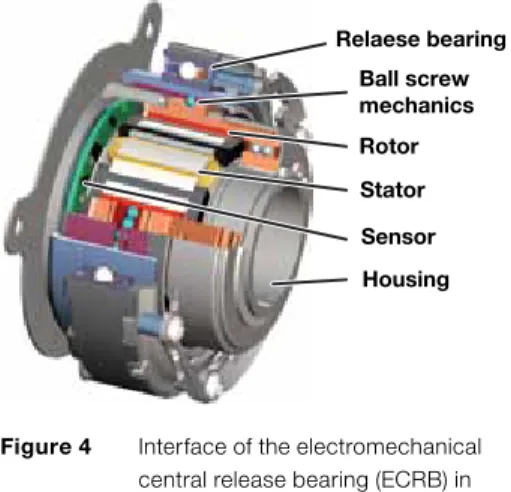
neces-sary axial motion is generated via a ball screw drive directly linked to the rotor mo-tion by means of a carriage running along a corresponding track (Figure 4). The actual release bearing that actuates the dia-phragm spring is mounted on the carriage. The stroke from the touch point to the 100 Nm point of the clutch can be traveled in less than 100 ms, and the release force of the actuator is at most 1,800 N in the cho-sen design. Unlike with a hydraulic design, the electromechanical actuator can transfer forces in two directions. The fact that the clutch has been designed as a so-called “push-pull clutch” makes it possible to in-crease the transferable torque considerably. When not actuated, the clutch is closed.
Electric motor
The Schaeffler hybrid module uses a per-manently excited synchronous motor that possesses high reluctance, thereby reduc-ing the quantity of rare earth elements re-quired. Since the clutch sitting inside the rotor is standardized, the electric motor al-ways has the same inside diameter; thanks to the modular design, the outside diameter is adjusted depending on the required ca-Figure 3 Second generation hybrid module in a wet space
Relaese bearing Ball screw mechanics Rotor Stator Sensor Housing
Figure 4 Interface of the electromechanical central release bearing (ECRB) in installation position
pacity as well as on the available radial space. The available diameters are 260 mm, 270 mm, and 290 mm. Further adjustment of the length of the electric motor results in an almost infinitely variable matching of mo-tor performance to the application require-ments.
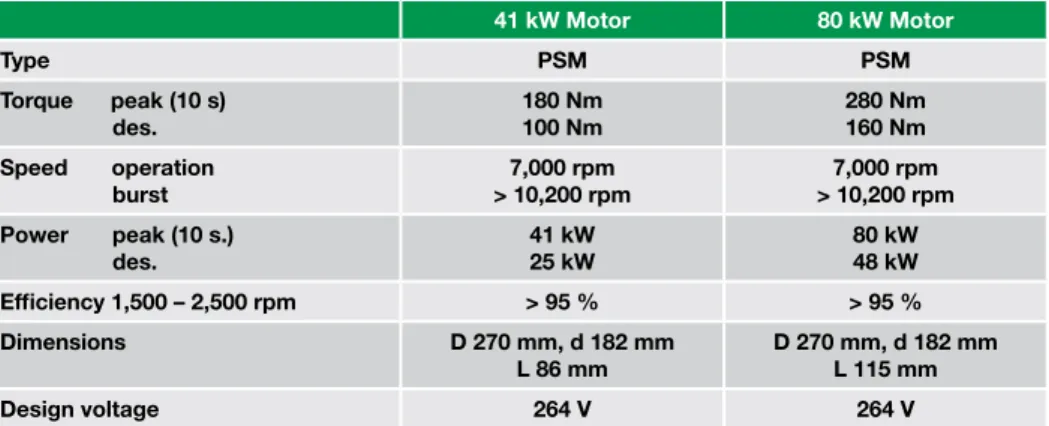
The following table shows the designs of two electric motors of this type for plug-in hybrid vehicles of the B/C and D segments; (Figure 5).
The goal of production development is standardization on the functional level. The following advantages result when control and power elements are separated: – The one control unit, once developed,
can be reused again and again, since, as a rule, the basic functions remain nearly the same for all engine-power classes.
– The control and power units can thus be joined as flexibly as required by each existing installation space. – The power output stages are freely
scalable, and can be integrated into the system; at present, their designs range from 300 W to 100 kW.
Besides reduced cabling expenditures, the linked cooling and one-piece housing design result in further cost and weight savings at the system level. Moreover, the overall installation space required is less than with discrete components.
Active vibration
damping
Active damping of speed fluctuations in the powertrain by using an electric motor is an idea that was already pursued in the 1990s. Solutions aiming to provide the crankshaft with complete damping mainly failed due to the power demands involved. A basic requirement for effectively using this function is connecting a damper up-stream of the electric motor. This power-train layout is given by the module and enables designers to focus on the cancel-ing function by targetcancel-ing the main order of the combustion engine. Any additional energy requirements are thus limited to recording (sensor elements) and pre-cise phase regulation in the range up to approx. 80 Hz.
The basic function of such a system is portrayed schematically in Figure 8. In the process, the electric motor only smoothes out the already damped main order on the secondary side of the damper, which is possible with an ex-traordinarily low amount of energy. Thus, the torque required for cancelation (de-pending on the damper design) drops to about one tenth of the value required by the electric motor mounted directly on top of the crankshaft.
Active vibration cancelation is being developed with the goal of achieving ide-al comfort and efficiency in an available installation space by means of mechani-cal damping, active vibration cancel-ation, and damping through starting ele-ment micro-slip. In the actual design process, an ideal compromise is struck between these two objectives that is primarily oriented to the required NVH vehicle behavior and the energy input required.
Following the electric motor design all the way to vehicle testing is part of developing the complete hybrid module at Schaeffler. As described above, the electric motor is designed with a high degree of reluctance. This initially results in the advantage that peak output can be provided up to high speeds. Furthermore, the efficiency of the upper speed range is clearly improved, and self-heating is reduced by cutting ed-dy-current losses in the magnets, thereby simplifying rotor cooling. The interdepen-dence of torque and speed is represented in Figure 6.
Power electronics
Power electronics which, in future gen-erations, will be slated as a hybrid mod-ule component, are still in the preliminary development stage (Figure 7). By using new electronic components, it is possi-ble to achieve dimensions that are con-siderably more compact, thereby en-abling them to be integrated in the module despite being positioned below the powertrain. This way the disadvan-tages involved with external wiring of power electronics and motors (costs, EMC, etc.) can be avoided.
Figure 5 Technical data of the EM-H-270
Speed in rpm 5 % 10 % 15 % 20 % 25 % 0 2,000 4,000 6,000 20 40 60 80 100 120 140 160 180 Torque in Nm
Figure 6 Reluctance percentage of electric motor EM-H-270-86
Figure 7 Hybrid module with directly mounted power electronics 41 kW Motor 80 kW Motor Type PSM PSM Torque peak (10 s) des. 180 Nm100 Nm 280 Nm160 Nm Speed operation burst 7,000 rpm > 10,200 rpm 7,000 rpm > 10,200 rpm Power peak (10 s.) des. 41 kW25 kW 80 kW48 kW Efficiency 1,500 – 2,500 rpm > 95 % > 95 % Dimensions D 270 mm, d 182 mm L 86 mm D 270 mm, d 182 mm L 115 mm Design voltage 264 V 264 V
Particularly in the event that any power-train resonances occur, the electric motor can be used to actively reduce them in a narrow speed range. In some cases, de-pending on the rigidity of the transmis-sion, this approach will allow a second damper positioned downstream of the hy-brid module to be eliminated.
By means of a simulation, it was pos-sible to show that interplay between ac-tive damping via the electric motor and starting clutch micro-slip offers ideal en-ergy conditions coupled with a high de-gree of vibration comfort (Figure 9). While the slippage generated in the clutch at 1,200 rpm results in power losses of 700 W, the electric motor operates at 350 W in this range. For speeds greater than 1,500 rpm, however, slippage regulation is more energy-efficient, while the power requirements placed on the electric motor continue to climb. Nevertheless, this ideal depends on the specific application and can therefore vary. What must be kept in mind is that these power losses refer to full-throttle operation of the internal com-bustion engine. In relevant cycles, these power requirements are much smaller.
For a long time, active vibration can-celation and the associated rapid chang-es in discharge current required for this strategy appeared to have a negative ef-fect on the operating life of the battery.
Since, however, the overall battery size became significantly smaller with the in-troduction of plug-in hybrid vehicles, the energy throughput for cancelation is re-duced accordingly, down to less than 2 %. What is more, it has since been empiri-cally proven that cell damage due to cyclic micro-discharge events is much less than originally feared. This is especially true when there is no ion conversion in the battery, i.e. if the current is regulated with-in the generator or drive mode. [4]
The development of special control al-gorithms for active vibration cancelation is currently being tested on internal combus-tion engine test rigs and in vehicle tests.
The 48-volt hybrid module
Motivation
The first steps with hybridization can natu-rally be taken using lower power systems. For one thing, this approach makes it pos-sible for the voltage to stay below the safe-ty-critical value of 60 V. What is more, the expenditure for the complete system can be decreased considerably. In particular, the
energy storage device is reduced in size by a factor of three, with a useful capacity of approx. 300 Wh. If the new voltage level is used, equipping vehicles with a mildly hybridized drive is all that is necessary to make substantial consumption savings possible. Simulations show, for instance, that a 12 kW electric motor with an asyn-chronous design can lower the consump-tion in the standard European driving cycle by around 10 %.
When a hybrid module with an inte-grated transmission is used, this system is more efficient due to the fact that the gear ratio can also be used to operate the electric motor with ideal efficiency.
Compared to HV systems, ideal efficien-cy comes at lower speeds since the combustion engine runs more of the time, thereby determining the speed of the electric motor.
A further and significant improvement in fuel consumption can be achieved by re-placing today’s conventional asynchronous motor with a synchronous motor with a higher power density. The layout and the effect on consumption are explained in greater detail in the chapter on the 48-volt electric motor.
ICE Clutch +hybrid eMot
M M Drivetrain Vehicle Torque Speed Torsion-damper
Figure 8 Functional diagram of active vibration damping in a hybrid powertrain
0 250 500 750 1,000 800 1,200 1,600 2,000 2,400 2,800 3,200 3,600 4,000 Engine speed in rpm Power loss in W 0 2,000 4,000 6,000 Acceleration amp. in rad/s² Engine
Transmission input shaft with Arc spring damper + CPA Arc spring + CPA
+ Clutch slip control
Arc spring + CPA
+ active damping
Transmission input shaft with Arc spring damper 300
target
Clutch slip control active damping
Figure 9 Power losses from combined active vibration damping of an electric motor and slippage monitoring, depending on the engine speed
Combination with a manual
transmission
As a rule, the structural design of a hybrid module employs the same concepts when used with a 48-volt application as with a high voltage application. One particular challenge stems from the fact that manual transmissions are still frequently used today in price-sensitive compact and mid-sized segments.
Using function matrices, Schaeffler has chosen four designs from a host of possible topologies, studying the specific advantag-es and disadvantagadvantag-es that distinguish them when it comes to linking the combustion engine to the fixed-transmission hybrid module:
– Impulse clutch
– Adaptation of the existing hybrid mod-ule for 48 V without further changes – One-way clutch combined with a
lock-up clutch – coaxial
– One-way clutch combined with a lock-up clutch – axially parallel
Due to this module’s limited capacity, it is not feasible to start the engine via the disconnect clutch. A basic distinction was therefore made initially between continuing to start the combustion en-gine via the conventional starter or by means of the rotating masses. This iner-tia is utilized by using an impulse clutch (Figure 10), and the combustion engine is brought up to speed solely by closing the clutch. Involved here is a very rapidly ac-tuating clutch that has to be able to transfer very high fluctuating torques of up to 1,500 Nm. This clutch is not modu-lated, but rather is either completely opened or closed. An important require-ment for this system is reducing the crankshaft related inertia to a minimum. The complete hybrid module is installed along with the electric motor on the side of the crankshaft and is supported by
two rows of ball bearings. The clutches are actuated by two release bearings which are controlled via a diaphragm spring (startup clutch) and a lever spring (disconnect clutch). The expenditure in-volved in the design is similar to that of a double clutch in a double clutch trans-mission.
Other combustion engine concepts in-volve a separate starter system in order to re-couple the engine after a coast/drive phase. In this way, the use of a one-way clutch as a low-cost alternative to the standard clutch is conceivable. With this topology, the combustion engine is start-ed by the conventional starter and me-chanically coupled once it reaches the speed of the electric motor.
The disadvantage of such a solution is that a vehicle parked in first gear would no longer have a “gear brake.” Since the
one-way clutch does not block the powertrain in one direction of rotation, the vehicle would start to roll if the parking brake is not set on a hill.
This disadvantage can be avoided by equipping the one way clutch with a lock-ing function. To this end, for instance, a shift sleeve can be used that provides a form-fit connection between the second-ary damper side and the rotor holder. This spline connection is initially closed and can be opened via a tie-rod linked to the starting clutch. A hydrostatic clutch actuator (HCA) – produced by Schaeffler recently for double clutch transmissions – is used as for actuation [5]. Moreover, particularly with a small energy storage device and a high state-of-charge (SOC), it is necessary to be able to re-couple the combustion engine in order for it to take up the driving torque. This function is fa-cilitated by one-way clutch locking as well. Since actuation of the already exist-ing startexist-ing clutch can also be used for the shift sleeve, no additional actuator is necessary.
Locking the one-way clutch also en-sures that the driving feel does not change for the driver during the drive phase when the energy storage device has a high SOC. The combustion engine then takes up the driving torque again.
With respect to time and comfort, a warm start from a stop-start situation can be initiated directly via the 48-volt electric motor.
The configuration in the installation space can be either axially parallel or co-axial. An axially parallel layout permits the use of an asynchronous motor which al-ready exists due to the development of the belt-driven starter generator. In this system, torque is transferred via a belt with two-fold to three-fold ratio.
An essential requirement for realizing such a layout is that the installation space above the clutch bell must be able to be
used for the electric motor (Figure 11). This appears to be feasible, especially with front-transverse powertrains. This layout results in the least amount of pow-ertrain lengthening.
Figure 10 Structural design of an impulse clutch
Figure 11 Typology and structural design of the hybrid module with an asynchronous motor in parallel arrangement
In comparison, the coaxial model is shown in Figure 12. The one-way clutch, one-way clutch locking mechanism, and, in part, the starting clutch are radially nested under the rotor. Thanks to good thermal coupling of the electric motor, the stator can be air-cooled.
48-volt PSM electric motor
For cost reasons, asynchronous motors are primarily being introduced to the market for mild hybrid applications; a fact that is also
recommended in Figure 11. In order to take advantage of the available installation space, especially with the coaxial layout shown in Figure 12, it is preferable to use a permanently-excited synchronous motor (PSM), the power density of which is up to 30 % greater depending on the demand. In addition, the greater efficiency of the PSM in conjunction with optimizing the speed range relevant to the cycle (Figure 13), yet again re-sults in a markedly improved CO2 balance.
The increased efficiency of the PSM compared to the ASM results in an added consumption benefit of up to 3.5 %. This delta is due to improved efficiency – and also to the fact that any recuperated energy that cannot be directly reused in the on-board electric system “flows through” the electric motor multiple times.
Operation strategy with a manual
transmission
Driver acceptability is vital for successfully launching mild hybrid vehicles with manual transmissions in the market. An essential component for this is that the powertrain always delivers the acceleration required by the driver. The power distribution be-tween the combustion engine and the electric motor must be configured in such a way that it is practically imperceptible to the driver.
The combustion engine not only switches on automatically when a lot of power is required, but also for high electric motor rpm levels when the driver does not upshift. For acoustics reasons as well, the switch-on point is at about 3,500 rpm. In order to maintain good vehicle drivability, the constant speed of the electric motor in the consumption cycle is limited to 50 km/h despite reduced CO2-emission
potential. At higher speeds, the combus-tion engine is only decoupled during the drive phase.
As has already been recommended for pure start-stop systems, due to the sailing func-tion and improved market acceptance, the starting clutch has been automated for this hybrid module. This configuration makes it possible to use creep in the starting clutch in order to be able to realize a very comfort-able motor startup feel.
Outlook
At present, B-model testing is being con-ducted on the next generation of high-voltage models of the Schaeffler hybrid module. The current projects cover all conventional automatic transmissions. In the process, it has become clear that the hardware for the various configurations can indeed be designed with standard-ized basic components.
With a P2 hybrid module, it is already possible to realize consumption benefits of around 10 % based on a 48-volt system with an asynchronous motor. Additional potential of up to 3.5 % is available by us-ing a synchronous motor. Combined with the possibility of moving the vehicle at low speeds of up to approx. 15 km/h us-ing only electricity, this module makes for entry-level electrification that is ideal.
Thanks to mild hybridization, manual transmissions are fit for the next generation. Vehicle testing will show whether drivers ac-cept the extra functions without noticing any sacrifices in comfort. Adjusted acoustic factors and automated clutch action will help with this.
Literature
[1] Wagner, U.; Reitz, D.: The future comes automatic: Efficient automatic transmissions provide a basis for hybrid capable drive trains. 9th Schaeffler Symposium, 2010
[2] Schutzrecht DE 102012207941A1: Hybridmodul für einen Triebstrang eines Fahrzeuges.
[3] Mueller, B.: Transmission Actuation: Downsiz-ing Complexity, UpsizDownsiz-ing Performance. 10th Schaeffler Symposium, 2014
[4] Wang, J.: Cycle-life model for graphite-LiFePO4 cells. Journal of Power Sources, 2011 [5] Mueller, B.; et. al.: Smaller, Smoother, Smarter:
Advance development components for double-clutch transmissions. 9th Schaeffler
Symposium, 2010
Figure 12 Topology and structural design of the hybrid module with a locking one-way clutch in coaxial arrangement
6,000 4,000 2,000 10 90 80 70 60 50 40 30 20 10 90 80 70 60 50 40 30 20 Speed in rpm Torque in Nm
Figure 13 Efficiency range of a permanently-excited synchronous motor employed in the 48-volt hybrid module