• No results found

SRI LANKA SPATIAL DATA INFRASTRUCTURE ROAD MAP

N/A
N/A
Protected

Academic year: 2021

Share "SRI LANKA SPATIAL DATA INFRASTRUCTURE ROAD MAP"

Copied!
116
0
0

Loading.... (view fulltext now)

Full text

(1)

SRI LANKA SPATIAL DATA

INFRASTRUCTURE ROAD MAP

(Including DMEM Pilot Project Road Map)

(2)
(3)

SRI LANKA SPATIAL DATA

INFRASTRUCTURE ROAD MAP

DRAFT REPORT

26 NOVEMBER 2014

This document has been reviewed by the NSDI Working Group on 10-11

th

November 2014

Prepared by Dr Lesley Arnold

Spatial Data Infrastructure Consultant to the World Bank

Director Geospatial Frameworks

71 Darlington Road

(4)
(5)

TABLE OF CONTENTS

TABLE OF CONTENTS ... 4

EXECUTIVE SUMMARY ... 5

SECTION ONE: SETTING THE SCENE ... 8

1. INTRODUCTION ... 9

SECTION TWO: SLSDI MAJOR PROJECTS ... 18

2.1 SRI LANKA SPATIAL DATA INFRASTRUCTURE ... 18

2.2 SLSDI GOVERNANCE ... 21

2.3 SLSDI STAKEHOLDER ENGAGEMENT ... 25

2.4 LEGAL AND POLICY FRAMEWORK ... 28

2.5 NATIONAL MAP PORTAL... 32

2.6 NATIONAL SPATIAL DATA FRAMEWORK ... 37

2.7 NATIONAL SPATIAL DATA CATALOGUE ... 41

2.8 NATIONAL SPATIAL DATA WAREHOUSE ... 45

2.9 SPATIAL DATA MANAGEMENT ... 48

2.10 NATIONAL SPATIAL DATA ACQUISITION PROGRAM ... 52

2.11 EDUCATION AND AWARENESS PROGRAMS ... 56

SECTION THREE: DMEM PILOT PROJECT ACTVITIES ... 60

3.1 DMEM PILOT PROJECT ... 61

3.2 PROJECT GOVERNANCE ... 67

3.3 PROJECT PLANNING ... 71

3.4 DRAFT SLSDI POLICY ... 74

3.5 DMEM NATIONAL MAP PORTAL PILOT ... 77

3.6 DATA INVENTORY... 80

3.7 DESCRIPTIVE METADATA ... 83

3.8 DATA STORAGE SOLUTION ... 86

3.9 DATA MANAGEMENT PROCESS ... 88

3.10 DMEM SPATIAL DATA ACQUISITION PLAN ... 91

3.11 DMEM EDUCATION AND AWARENESS PROGRAM ... 94

SECTION FOUR: BUDGET ALLOCATION AND SCHEDULE ... 98

4.1 BUDGET ALLOCATION ... 100

4.2 SLSDI GANTT CHART ... 102

APPENDIX A:DISASTER MANAGEMENT WORKSHOP ... 104

(6)
(7)

EXECUTIVE SUMMARY

The Sri Lanka Spatial Data Infrastructure (SLSDI) Road Map is a companion manual to the SLSDI Strategy and SLSDI Framework documents. It contains the Disaster Management and Environment Management (DMEM) Pilot Project Road Map.

The SLSDI Road Map provides detailed steps towards achieving the short-term and long-term strategic goals outlined in the SLSDI Strategy and draws on the recommended methods documented in the SLSDI Framework along with justification of the approach.

The SLSDI Road Map identifies projects, which have an overarching objective to make government spatial information capabilities much more powerful and less expensive in the future.

A Focus on Priorities

The spatial infrastructure does not need to be completed in its entirety to start realising benefits. The Small steps made early in the process will achieve the most value and begin to accumulate economic benefits to the government and user community at large. It is not necessary to develop everything at once. Considerable benefits can be achieved by focusing on key priorities including.

• Setting up the NSDI Office and committees (Section 2.2)

• Understanding SLSDI Stakeholder Needs (Section 2.3)

• Developing the requirements design for National Map Portal (Section 2.5)

• Developing the spatial data sharing policies (Section 3.4)

• Drafting and implementing the Spatial Data Management Charter (Section 2.9)

• Developing the Spatial Data Framework document as a common government resource (Section 2.6)

• Conducting an inventory of all fundamental and DMEM data themes (Sections 2.7 and 3.7)

• Piloting the DMEM Thematic Area (Section 3.6)

Taking smaller steps is also more cost effective, as the cost of implementation can be spanned over a number of years rather than all in the first year. Spatial data made available to the community in the early stages, while not a complete government set, can start to accrue a return on investment that can be allocated to achieving the next steps in the implementation.

Piloting the SLSDI

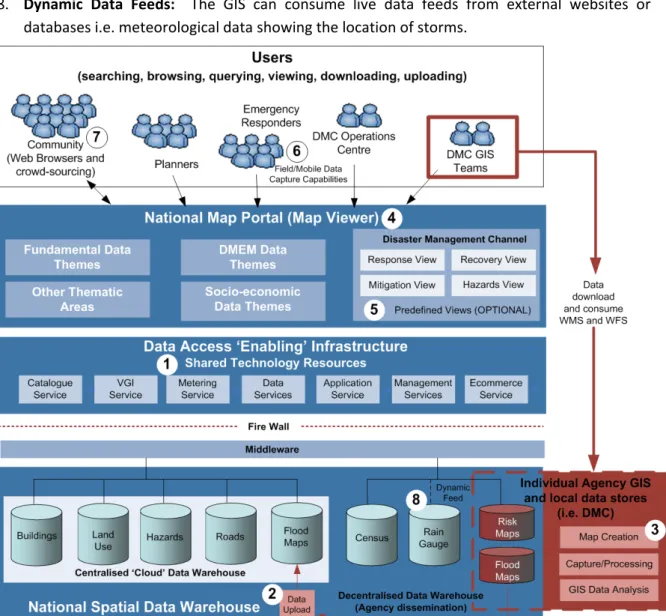
The DMEM Thematic Area of the SLSDI will be developed through the DMEM Pilot Project. This pilot will provide a test case for spatial data sharing across government. The pilot aims to deliver early results so that the capabilities of the SLSDI are made visible, benefits accrued early, and momentum is maintained towards the longer-term vision.

The DMEM Pilot will also build technical and policy skills required for the implementation and ongoing management of the SLSDI. It will establish a means of online access to fundamental data themes and DMEM data themes.

Fundamental Data

Socio Economic Data

Application Data

Health Data National Security Data

Disaster Management Data Environmental Data V ir tu a l D a ta W a re h ou s e

National Map Portal (Map Viewer)

Access data via catalogue

DM and EM Thematic

(8)

High Level Road Map

A Gantt chart for the SLSDI and DMEM Pilot Projects is included in this document (Section 4). A high-level view is provided below.

The planning stage includes establishing the SLSDI governance structure, engaging with stakeholders and developing a Spatial Data Management Charter and SLSDI policies. These are the first projects that require implementation. They are crucial at getting stakeholders on board and generating a common understanding of SLSDI goals and an awareness of policy compliance to support effective data sharing.

The Data and Technology stages deliver the National Map Portal, catalogue and data warehouse. The most critical step is to get the requirements for the technology correct in the first instance. Stakeholder input is essential. The organisation of government data is achieved through the Spatial Data Framework. This document will become a common reference point for all government agencies that acquire and use spatial information. A data inventory and gap analysis is required to understand current government capabilities and plan for future needs.

Understanding future needs and setting government priorities is an essential input to the Data Acquisition phase. This phase adopts a collaborative cross-government approach to acquiring data in order to eliminate government duplication in the collection of data.

The way data is collected and managed is to be compliant with standards and principles defined in policy. It is envisaged that government agencies will progressively adopt best practise methods overtime. The focus will be on the DMEM Thematic Area in the first instance.

The DMEM Pilot will provide test cases for the Planning, Data and Technology, Data Acquisition and Compliance Projects. It will also be used as a demonstrator to educate and raise awareness of the National Map Portal within the community and in doing so promote the use of spatial data more widely. Charter Governance Policy Data Framework Stakeholder Engagement

Disaster Management Pilot Project

Education and Awareness Data Acquisition

Data Warehouse Catalogue Map Portal

Year 1 Year 2 Year 3

Legal

Spatial Data Management Compliance

Requirements Data Inventory Planning Data and Technology Data Acquisition Compliance Pilot Communication

High level SLSDI Road Map Budget Allocation

The costs shown in this document are indicative only (Section 4) and subject to clarification through a more comprehensive financial analysis and request for proposals.

(9)

SECTION ONE

SRI LANKA SPATIAL DATA

INFRASTRUCTURE -

SETTING THE SCENE

(10)
(11)

1. INTRODUCTION

1.1 ABOUT THIS ROAD MAP

The Sri Lanka Spatial Data Infrastructure (SLSDI) Road Map is a companion manual to the SLSDI Strategy and SLSDI Framework documents.

The SLSDI Road Map provides detailed steps towards achieving the short-term and long-term strategic goals outlined in the SLSDI Strategy and draws on the recommended methods documented in the SLSDI Framework along with justification of the approach.

The SLSDI Road Map includes a Disaster Management and Environment Management (DMEM) Pilot Project, which will deliver the Disaster Management and Environment Management (DMEM) Thematic Area for the SLSDI.

This DMEM Pilot Project will evaluate the SLSDI methods and importantly, demonstrate the value of integrated and accessible spatial information.

The DMEM Pilot Project requires the completion of some SLSDI activities as these are prerequisites for the DMEM Pilot, including the:

• drafting of policies that support data sharing across government; and

• implementation of the National Map Portal to enable spatial data to be viewed online Consequently, the SLSDI and the DMEM Pilot Project Road Maps are interdependent and as such should be implemented simultaneously. In this way, components can be completed once - with benefits accruing to both the SLSDI implementation as well as the DMEM Thematic Area. This will make for a more cost effective SLSDI implementation.

1.2 STRATEGIC CONTEXT

The SLSDI and DMEM Pilot Project Road Maps have been developed with a view to delivering the strategic outcomes of the Spatial Data Infrastructure Strategy for Sri Lanka – Powering Decision Making and Innovation Using Spatial Information Technologies.

The vision for the Sri Lanka Spatial Data Infrastructure is to achieve:

“Sustainable development through effective use of spatial information for evidence-based decision making.”

This vision will be realised through four strategic goals. These goals are directed towards achieving:

• An accurate nationwide representation of the landscape that is readily accessible and easily integrated with economic, social and environmental geographies.

• Greater efficiency and productivity in the management and sharing of spatial data.

• Evidence-based decision making in government, business and the wider community through access to integrated spatial information.

• Spatial solutions readily available and widely used across Sri Lanka in response to emerging opportunities.

(12)

1.3 DELIVERING ON THE SLSDI STRATEGY 1.3.1 SLSDI Governance Model

The SLSDI Strategy proposes a new governance model for effective and sustainable data sharing across institutions and to meet accountability and outcome provisions of government. The process for establishing this new governance model is explained in Section 3.2 of the SLSDI Road Map. It includes guidelines for collaboration with Lead Agencies that acquire spatial information assets through major projects. The proposed project governance model for SLSDI projects is specified in Section 3.2 using the DMEM Pilot as an exemplar.

1.3.2 SLSDI Integrated Strategies

The SLSDI Strategy also proposes ten integrated strategies for delivering the Spatial Data Infrastructure for Sri Lanka. These integrated strategies combined will deliver the communication and coordination aspects of the SLSDI, as well as policy and standards, data and technology and education and awareness requirements. The integrated strategies are:

1. Stakeholder Engagement 2. Legal and Policy Framework 3. National Map Portal 4. Spatial Data Framework 5. National Spatial Data Catalogue 6. Spatial Data Warehouse

7. Spatial Data Management 8. Spatial Data Acquisition Program 9. Disaster Management Pilot 10. Education and Awareness Programs

The DMEM Pilot is one of these integrated strategies. The DMEM Pilot will case study and deliver a number of the SLSDI requirements including the Disaster Management and Environment Management Thematic Area of the SLSDI (Figure 1.1).

Fundamental Data

Socio Economic Data

Application Data

Health Data

National Security Data

Disaster Management Data Environmental Data V ir tu a l D a ta W a re h ou s e

National Map Portal (Map Viewer)

Access data via catalogue

DM and EM Thematic

Area

(13)

1.4 KEY OBJECTIVES

The SLSDI and DMEM Pilot Project Road Maps are designed to:

• Make sure that the NSDI Working Group, NSDI Office and DMEM Project Teams are aware of the technologies and capabilities required and the time they will be needed in order to deliver on the SLSDI strategy

• Build a common understanding and shared ownership of the SLSDI and DMEM Pilot Project

• Incorporate ideas and insights from team members representing the many functions involved in order to achieve a successful development process

• Forecast and prioritise project budgets based on stakeholder needs, business drivers and/or technology investments

• Set realistic time-frames and risk management strategies including identifying events or changes in conditions that signal a need to revisit the plan during the development journey 1.5 STRUCTURE OF THE DOCUMENT

This document is divided into four sections:

Section One: Setting the Scene – explains the relationship between the SLSDI and DMEM Pilot Project.

Section Two: Sri Lanka Spatial Data Infrastructure Road Map – details the major projects required to deliver on the spatial data infrastructure for Sri Lanka. Major Projects include:

- SLSDI Governance

- SLSDI Stakeholder Engagement - Legal and Policy Framework - National Map Portal

- National Spatial Data Framework - National Spatial Data Catalogue - National Spatial Data Warehouse - Spatial Data Management

- National Spatial Data Acquisition Program - SLSDI Education and Awareness Program

Section Three: DMEM Pilot Project Road Map – details the project activities that pilot aspects of the SLSDI. Project Activities include:

- Project Governance - Project Planning - Draft SLSDI Policy

- Disaster Management Channel (Optional) - Data Inventory

- Descriptive Metadata - Data Storage Solution

(14)

- Data Management Processes - DMEM Spatial Data Acquisition Plan

- DMEM Pilot Education and Awareness Program

Section Four: Budget Allocation and Schedule

1.6 RELATIONSHIP BETWEEN THE SLSDI AND DMEM PILOT PROJECT ROAD MAPS The DMEM Pilot Project is a pilot implementation of the SLSDI. The objective is to:

• Pilot aspects of the SLSDI implementation so that lessons learned can be adopted early

• Complete some of the SLSDI deliverables, which are major dependencies for progressing towards full implementation of the SLSDI in the future

The SLSDI has ten major projects and these projects have a direct link with the DMEM Pilot Project. These linkages are explained in Table 1.1 In a number of instances the SLSDI Major projects are essential prerequisites for delivering the DMEM Pilot Project and the DMEM Thematic Area of the SLSDI. Prerequisites are noted in the DMEM Pilot Project Road Map where they occur.

Table 1.1 Interrelationship between the SLSDI Road Map and DMEM Pilot Project

SLSDI Major

Projects

Relationship and Rationale

DMEM Pilot Project Activities

SLSDI

Governance

Establish the NSDI Office, Steering Committee, NSDI Council and Subcommittees

The SLSDI Governance (Section 2.2) seeks to promote information sharing and cooperation between organisations through the establishment of the NSDI Office.

The Project Governance (Section 3.2) will demonstrate how lead agencies cooperate with the NSDI office when implementing projects that have significant spatial information components.

The objective is to ensure that these projects do not operate in a silo, which is the customary approach; but rather promote an environment of collaboration. The NSDI office will then have oversight of project aims and these can be broadcast more broadly across the government sector.

DMEM Project

Governance

Establish the lead agency and DMEM Project Team

SLSDI

Stakeholder

Engagement

Explore, analyse and document stakeholder requirements and aspirations

SLSDI Stakeholder Engagement (Section 2.3) is a critical stage in SLSDI implementation and requires a Stakeholder Engagement Model and Plan. The DMEM stakeholder group will form a subset of the SLSDI stakeholder community.

The Project Planning phase (Section 3.3) will develop a stakeholder requirements matrix – describing common, essential and aspirational needs for the DMEM Thematic Area. This analysis will provide a case study for SLSDI stakeholder engagement processes from which lessons learned can be applied to the broader SLSDI community.

Project

Planning

Develop the DMEM Project Plan with input from stakeholders

(15)

SLSDI Major

Projects

Relationship and Rationale

DMEM Pilot Project Activities

Legal and

Policy

Framework

Identify laws and policies that encourage the effective

management and exchange of spatial data

The SLSDI Legal and Policy Framework (Section 2.4) is a prerequisite for the DMEM Pilot Project as these legal and policy instruments are the lever by which government can promote best practise data sharing among organisations. The DMEM Pilot Project will draft the SLSDI policiesand case study policy compliance(Section 3.4). These drafts will be used as a basis for evaluating the SLSDI Legal and Policy Framework to determine any impediments. This is an important step as it will highlight any issues with policy execution early and identify potential unintended consequences of policy implementation.

Draft SLSDI

Policy

Draft policy and case study policy compliance

National Map

Portal

Build a system that enables people to view layers of integrated spatial data produced by government sector agencies

The National Map Portal (Section 2.5) is the most visual component of the SLSDI. The DMEM Thematic Area will be delivered as part of the National Map Portal.

Development will focus on delivering integrated layers of spatial information via a web portal and include fundamental data themes and disaster management and environment management data themes.

The Disaster Management Channel (Optional) (Section 3.5) will deliver enhanced capabilities according to the priority needs of the DM community, such as predefined data views.

Disaster

Management

Channel

(Optional)

Implement predefined views for the disaster management community

National

Spatial Data

Framework

Create a nationally recognised authoritative source of spatial data themes

The National Spatial Data Framework (Section 2.6) is the classification of spatial data into thematic areas. It provides users with an intuitive way to access data and a common reference for data custodians and system administrators. The National Data framework is a prerequisite for the DMEM Pilot Project as it requires spatial information from across the government sector.

The Data Inventory (Section 3.6) is required to understand what information is currently available, what information needs to be captured and what information requires updating. This process will highlight any access restrictions.

DMEM

Thematic Area

Data Inventory

Identify and list critical data sets for the DMEM Thematic Area

(16)

SLSDI Major

Projects

Relationship and Rationale

DMEM Pilot Project Activities

National

Spatial Data

Catalogue

Develop a library of metadata to enable people to search and query spatial data sets

The National Spatial Data Catalogue (Section 2.7) requires metadata for each spatial data set to enable users to search and access spatial information.

The DMEM Pilot Project will create descriptive metadata (Section 3.7) for each of the data sets required for disaster management and environment management operations, as well as the fundamental spatial information datasets that provide contextual information for a range of applications. The DMEM Metadata Profiles will provide a standard that can be adopted for other government data sets.

Descriptive

Metadata

Develop descriptive metadata for DMEM data sets

National

Spatial Data

Warehouse

Build a secure and sustainable data storage and dissemination environment

The National Spatial Data Warehouse (Section 2.8) is the government storage solution for spatial data. This data is accessed via the National Map Portal and Spatial data Catalogue. The Spatial Data Warehouse is a virtual environment consisting of both centralised and decentralised storage solutions. The DMEM Pilot Project will evaluate data storage solutions (Section 3.8) with a view to providing a secure gateway to government held data.

Data Storage

Solution

A secure data storage environment for DMEM data

Spatial Data

Management

Charter

Develop a set of common principles for the

management and exchange of spatial data

The SLSDI will require government agencies that manage spatial data to agree on a common set of ‘best practise’ principles for the management and exchange of spatial information. This memorandum of understanding is referred to as the Spatial Data Management (SDM) Charter (Section 2.9). The Charter will form the basis for, and input to, the principles underpinning the Legal and Policy Framework.

The charter is a prerequisite for the DMEM Pilot Project. It is expected that agencies involved in the DMEM Pilot Project will adopt the SDM Charter.

The DMEM Pilot Project will adopt data management processes (Section 3.9) that comply with the SDM Charter and, in doing so, provide an exemplar for the new SLSDI collaborative spatial data management environment.

Data

Management

Process

Develop processes aligned to best practice

management and exchange of spatial data

(17)

SLSDI Major

Projects

Relationship and Rationale

DMEM Pilot Project Activities

National

Spatial Data

Acquisition

Program

Develop a program for spatial data collection, procurement and management

The National Spatial Data Acquisition Program (Section 2.10) provides cross-government oversight of any new spatial data sets acquired. The objective is to reduce the likelihood of duplicate data capture. Agencies are required to submit their Data Acquisition Plans as input to the National Program. The DMEM Pilot Project will require a strategic DMEM SpatialData Acquisition Plan (Section 3.10) to progressively capture and update data essential to disaster management and

environment management.

DMEM Spatial

Data

Acquisition

Plan

Develop a yearly plan for procuring and collecting spatial data for DMEM Thematic Area

SLSDI

Education and

Awareness

Program

Encourage people to change their perceptions and behaviours towards the use of spatial data

The SLSDI Education and Awareness Program(Section 2.11) is required for future capacity planning and to raise the

awareness of SLSDI initiatives. The DMEM Education and Awareness Program(Section 3.11) will be conducted as a component of the DMEM Pilot Project to demonstrate the value of integrated spatial data and effective data sharing to the SLSDI community

DMEM

Education and

Awareness

Program

Demonstrate the value and capabilities of integrating spatial data to SLSDI Community

1.7 MONITORING AND EVALUATION

A monitoring and evaluation mechanism will be developed as part of the SLSDI Governance Program to ensure effective monitoring of whole-of-government spatial information activities as well as progress of activities supported under the Road Map.

Monitoring and Evaluation of the SLSDI Road Map will be performed by the NSDI Office. Information on progress will be collected and reported at agreed internals. The NSDI Office will post the SLSDI Road Map on its website, along with progress reports.

The reporting Frameworks (to be developed) will include formal updates to the NSDI Steering Committee, NSDI Council and NSDI Subcommittees. These will be delivered by the Director NSDI Office. Other target groups, determined through the stakeholder engagement process (Section 2.3.6) will also be informed of progress (Section 2.2.6).

(18)
(19)

SECTION TWO

SRI LANKA SPATIAL DATA

INFRASTRUCTURE ROAD MAP -

MAJOR PROJECTS

(20)
(21)

2.1 SRI LANKA SPATIAL DATA INFRASTRUCTURE

The term infrastructure suggests a large expensive development. While the foundations of the infrastructure laid down today come at a cost, the overarching objective is to make government capabilities much more powerful and less expensive in the future.

The good news is that unlike other infrastructures, a spatial infrastructure does not need to be completed in its entirety to start realising benefits. In fact, the small steps made early on in the process will achieve the most value and begin to accumulate economic benefits to the government and user community at large. It is not necessary to develop everything at once. Considerable benefits can be achieved by focusing on key priorities.

Taking smaller steps is also more cost effective, as the cost of implementation can be spanned over a number of years rather than all in the first year. Spatial data made available to the community in the early stages, while not a complete set, can start to accrue a return on investment that can be allocated to achieving the next steps in the implementation process.

The road map identifies activities in a logical progression. However, there are some activities that are more important than others and critical to shaping the SLSDI in the early stages. There are six priorities:

• Priority 1: Set up the NSDI Office (Section 2.2)

• Priority 2: Understand Stakeholder Needs (Section 2.3)

• Priority 3: Requirements Design for National Map Portal (Section 2.5)

• Priority 4: Custodianship Policy (Section 2.4)

• Priority 5: Spatial Data Management Charter (Section 2.9)

• Priority 6. National Spatial Data Framework and data inventory of Fundamental Data Themes and DMEM Thematic Area (Section 2.6 and 2.7)

(22)

2.2 SLSDI GOVERNANCE

Establish a governance model to lead the reform in spatial

data exchange across government

2.2.1 AGENCIES INVOLVED

Lead Ministry: Ministry of Land and Land Development

Implementation Agency: NSDI Working Group on behalf of government.

SLSDI Community: Organisations responsible for generating data, such as the Survey Department, Land and Land Use Policy Development, Forestry Department, Census and Statistics Department; and government departments who are significant users of spatial information.

2.2.2 BACKGROUND AND RATIONALE

Institutional coordination and collaboration will need to be strengthened in order to support the development of the SLSDI. Currently, institutional arrangements are based on official channels of information flows. The approach it subject to a high degree of bureaucracy for data requests, preparation and signing of agreements, and data transfers. Delays are frequent and the process is costly.

Fast tracking procedures is possible in the event of emergencies. However, the process is reliant on personal relationships, which while assisting with communication and action, can collapse when changes in personnel occur.

There is a need to develop enduring underpinning structures. The emerging changes in the spatial information industry require new governance arrangements that take into account the balance between public and private sectors, data sources and data users. It is also important to recognise the potential contribution from research and development bodies.

2.2.3 PROPOSED APPROACH

The SLSDI Strategy proposes the following framework (Figure 2.1). It includes the creation of a NSDI Office, NSDI Steering Committee, NSDI Council and subcommittees with subject matter expertise. From time to time the NSDI Office will implement spatial information related projects in collaboration with other institutions/organisations. This will require the establishment of short-term project teams through joint collaboration with lead agencies.

(23)

NSDI OFFICE

Reports to Sec. MLLD

National Map Portal

Project

NSDI Council

NSDI Steering Committee

Chaired by Secretary for MLLD Ministry of Land and

Land Development Directs Chairs NSDI Project Teams Lead Agency NSDI Policy Subcommittee NSDI Technical Subcommittee NSDI Data Subcommittee Reports to

Minister Reports to

Lead Agency Stakeholder Community Industry, academia, Commercial Organisations, Professional Bodies and Interest Groups Figure 2.1 SLSDI Governance Model

Staffing for the NSDI Office coordination roles are proposed as follows:

• Director NSDI Office

• 1 Project Coordinator – NSDI Portal, Data Warehouse,

• 1 Project Coordinator – Spatial Data Framework and Catalogue

• 1 Project Manager – SLSDI Implementation Planning and Monitoring and Evaluation, Stakeholder Engagement Plan, Education and Awareness Program

• 1 Policy Officer- MOU Spatial Data Management, Policy development, Legal Act, Annual Policy Review

• Administrative Assistant

Importantly, positions will require staff to have a background in spatial information sciences and preferably have knowledge in the use of Geographic Information Systems.

2.2.4 OBJECTIVES

The objectives for establishing the NSDI Governance structure are:

• Provide a forum for the effective management and sharing of spatial information across the government sector.

• Provide a focal point for strategic national imperatives as well as institutional requirements.

• A governance model that is easily accessible and credible to participating institutions.

• A model that is driven from the top, so that participating institutions are well supported and guided in their daily tasks and decisions where the SLSDI mandate is concerned.

• Alertness to inter-agency cost-shifting where SLSDI programs and projects complement changing cross-government practises.

(24)

• Regular cross-sector and cross-committee SLSDI reporting and monitoring, complemented by re-evaluation of performance expectations and adjustments where necessary.

2.2.5 IMPLEMENTATION TIMEFRAME

First to second Quarter Year 1

2.2.6 ACTIVITIES

• Establish the NSDI Office as the central hub for the coordination and accountability for all NSDI activities.

- Seek Cabinet Approval

- Establish the organisational structure

- Develop Terms of Reference, roles and responsibilities and code of conduct.

- Determine number of staff required and create Position (job) Descriptions for permanent/part-time roles

- Identify funding required for resourcing the office - Identify staff delegations and reporting structure

• Establish the following Committee Structure

- NSDI Steering Committee, NSDI Council and Subcommittees (Legal and Policy, Technical Data) to provide strategic direction and endorse overall policy and strategic plans, ensuring alignment with whole-of-government policies and strategic priorities.

- Seek Cabinet Approval for committees (if required)

- Identify Committee Chair, Executive Officer, Committee Members and Administrative Support

- Develop Terms of Reference, and roles and responsibilities - Frequency of Meetings, and Monitoring and Reporting Structure

• Develop a detailed SLSDI Implementation Plan using the Road Map as a guide and include prioritisation of future Thematic Areas

• Develop a Reporting Framework to monitor the achievement of Road Map outcomes. This includes formal updates to the NSDI Steering Committee, NSDI Council and NSDI Subcommittees. These will be delivered by the Director NSDI Office. Other target groups, determined through the stakeholder engagement process (Section 2.3.6), will also be informed of progress.

2.2.7 DELIVERABLES

• Approval for the creation of the NSDI Office, NSDI Steering Committee, NSDI Council and NSDI subcommittees.

• Terms of Reference for the NSDI Office and each Committee

(25)

• Appropriate staff with delegated powers, funding and computing resources for NSDI Office

• Detailed SLSDI Implementation Plan

• Monitoring and Evaluation Framework for effective multi-stakeholder monitoring of activities under the Road Map.

2.2.8 OUTCOMES

• Delivery of the SLSDI strategic outcomes through effective leadership and coordination of governments spatial data resources

2.2.9 RISK MITIGATION

The ability to establish a governance framework to operationalise the NSDI has the following risks:

Risk Likelihood

(1 low-5 high)

Severity

(1 low-5 high) Mitigation Strategy

Cabinet does not endorse the proposed governance model

1 5 Seek clarification on issues and develop a new model based on feedback.

Stakeholder Community are suspicious of the proposed governance model and does not accept it.

1 5 Seek further consultation and

feedback to understand issues with adoption

Lack of commitment from SLSDI community to resource

committee/council member roles

3 3 Reduce scope and minimise

number of meetings to what is achievable

2.2.10 BUDGET

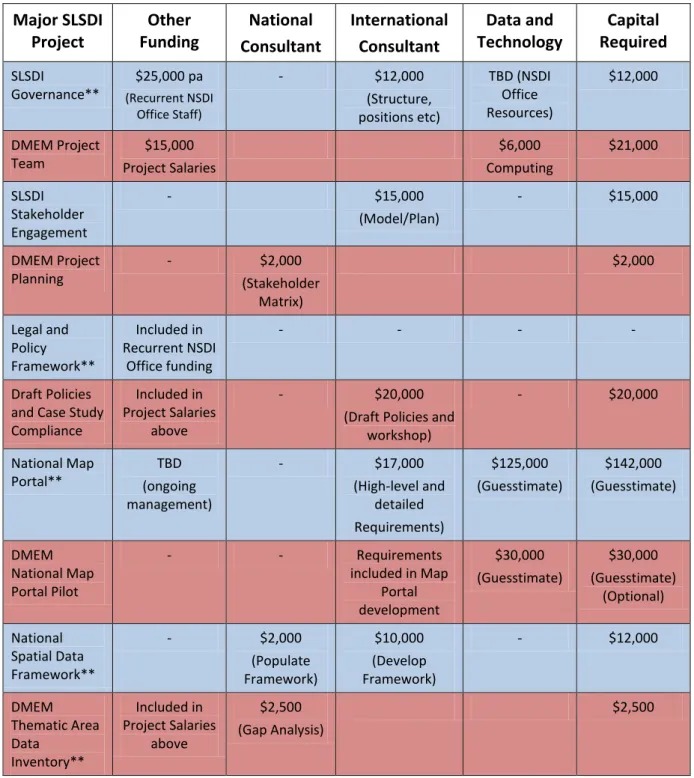
• Single allocation of funds of US$12,000 for a consultant to develop the organisation structure for the NSDI Office including position descriptions and committee charters/ToRs

• Recurrent budget allocation required to fund the NSDI Office positions and operations

• Single allocation of funds to set-up the NSDI Office (to be determined)

2.2.11 FUNDING STATUS

Local funding required. Ministry of Land and Land Development

2.2.12 CONTACT PERSONS

(26)

2.3 SLSDI STAKEHOLDER ENGAGEMENT

Explore, analyse and document stakeholder requirements

and aspirations

2.3.1 AGENCIES INVOLVED

Implementation Agency: Ministry of Land and Land Development with guidance from the NSDI Working Group (and later the NSDI Office once established).

SLSDI Stakeholder Community:

• Organisations responsible for generating data, such as the Survey Department, Forestry Department and Disaster Management Centre.

• Government departments and commercial enterprises who add value to the data.

• Information users such as administrators, managers, farmers co-operatives, individuals and the general public who acquire benefits from the availability of information.

• Community groups with a special interest in spatial information and its use such as professional bodies, and volunteered geographic information providers and hobbyists.

2.3.2 BACKGROUND AND RATIONALE

Stakeholders are integral to the development of the SLSDI and therefore buy-in and commitment, particularly from senior management, is critical to success. It is therefore important to develop a supportive governance environment that embraces stakeholders and acknowledges the importance of their role in the SLSDI development. Potential stakeholders will only become active participants if they see advantages for their organisations and if they do not feel threatened by the governance arrangements.

In Sri Lanka, the majority of stakeholders are the government data suppliers and users. Their role in the development and operation of the data access component of the infrastructure depends largely on government policies regarding data management, distribution and access, and cost recovery. In addition, the objectives of SLSDI must reflect the needs of the society and interest groups, and not just the internal needs of institutions. Commercial entities will play a strong role as users of the National Map Portal; however they may also be suppliers of primary and value added data in the longer term.

The end-user community will be concerned about data access, functionality of the infrastructure tools, the amount and quality of the content - its accessibility, fees for data access and usage policies.

(27)

2.3.3 PROPOSED APPROACH

A participative approach to cooperation and coordination will be adopted to build on common interests and requirements. The approach will be documented as a Stakeholder Engagement Model and Plan

A stakeholder requirements matrix will be used to determine common, essential and aspirational needs. The following principles are adopted:

• Apply open and effective communication strategies

• Use clear and agreed information and feedback processes

• Work collaboratively to seek mutually beneficial outcomes where feasible

• Be inclusiveness by recognising, understanding and involving stakeholders in the process

• Conduct engagement in a manner that fosters mutual respect and trust

Identifying stakeholders will require the creation of a spatial information community profile and include groups who traditionally are underrepresented in planning efforts.

2.3.4 OBJECTIVES

The objectives for engaging with stakeholders are:

• Understand stakeholder concerns, views, requirements and expectations

• Better awareness of and ability to deal with issues of significance to stakeholders

• Respond coherently and appropriately to stakeholder needs

• Enhance the understanding and acceptance of the SLSDI

• Early identification of potential problems leading to better risk management

• Provide transparency, accountability and integrity in planning and implementation

• Opportunities to develop long-term and trusting relationships

2.2.5 IMPLEMENTATION TIMEFRAME

Second Quarter Year 1 and ongoing.

2.3.6 ACTIVITIES

• Develop the Stakeholder Engagement Model - PLAN, ENGAGE, RESPOND and MEASURE.

• Develop the Stakeholder Engagement Plan including: - Spatial Information Community Profile

- Stakeholder Engagement Matrix: Identification of stakeholders and their level of influence - Design of the engagement process and methods including a checklist and communication

plan

- Consideration of logistics - A Risk Management Model

• Engage with Stakeholders - Case Study the SLSDI Stakeholder Engagement Model and Processes (Section 3.2)

(28)

• Evaluate the Engagement Process

2.3.7 DELIVERABLES

• A high quality Stakeholder Engagement Model and Plan (Document)

• Spatial Information Community Profile

• A Stakeholder requirements matrix – describing common, essential and aspirational needs

• Stakeholder Engagement Evaluation Plan and checklist

2.3.8 OUTCOMES

• All identified stakeholders have been engaged in the SLSDI planning and implementation.

• A survey of stakeholders indicates a sense of being valued contributors to the outcomes of SLSDI decisions.

• An SLSDI that meets user’s requirements in terms of data availability, quality and usability.

• Increase in the number of non-government users of national map data for environmental, social and economic purposes year on year throughout the term of the SLSDI strategy.

2.3.9 RISK MITIGATION

The following risks to SLSDI performance from not being able to meet user requirements are tabled below along with mitigation strategies.

Risk Likelihood

(1 low-5 high)

Severity

(1 low-5 high) Mitigation Strategy

Available spatial data sets do not meet user

requirements

1 5 Seek further consultation and feedback to understand issues with adoption.

Funding not available to meet all user

requirements

4 2 Produce a 5 year Plan showing future SLSDI developments and disseminate to

stakeholders. In this way stakeholders will know that their needs are being considered.

2.3.10 BUDGET

• Single allocation of funds of US$15,000.00 for an International consultant to develop the Stakeholder Engagement Model Plan

2.3.11 FUNDING STATUS

Local and foreign funding required.

2.3.12 CONTACT PERSONS

(29)

2.4 LEGAL AND POLICY FRAMEWORK

Identify laws and policies that encourage the effective

management and exchange of spatial data

2.4.1 AGENCIES INVOLVED

Implementation Agency: Ministry of Land and Land Development, NSDI Office

Committees: Legal and Policy Subcommittee with direction from NSDI Steering Committee, and with input from NSDI Council and Legal and Policy Subcommittee

SLSDI Community: Organisations responsible for generating data, such as the Survey Department, Land and Land Use Policy Development, Forestry Department, Census and Statistics Department; and Government departments who are significant users of spatial information.

2.4.2 BACKGROUND AND RATIONALE

Currently there are no policies or Legal Act for the management and sharing of spatial information in Sri Lanka. Policies are required to promote best practice in spatial data management, particularly in the areas of accessibility to, and usability of spatial information.

When developed in conjunction with government organisations and the private sector, policies can be used to overcome many barriers to information access, such as organisational boundaries; lack of consistent information standards; and use of incompatible or inappropriate technologies.

2.4.3 PROPOSED APPROACH

The proposed Legal and Policy Framework (Figure 2.2) considers all aspects of the spatial data management life cycle: from creation and initial storage; its dissemination and use as an information product; to the time when it becomes obsolete and is deleted. The data life-cycle management approach involves institutional in-house procedures and practices for policy compliance.

The Proposed Policy Framework is designed to address the concerns of government agencies through an integrated approach that:

• Explains the organisations role within the broader context of the SLSDI by designating roles and responsibilities for data custodians

• Includes guiding principles for data collection that can be readily adopted to ensure data collection is not duplicated

• Facilitates an environment of data sharing across the government sector by providing guidelines and techniques that assist in the streamlined management and exchange of spatial information

• Identifies how data should be managed by an organisation in terms of their existing operations. The intent is to enable organisations to progressively move towards the adoption

(30)

of standards, formats, metadata collection, and storage and archiving of data without having to reinvent workflows or build databases from scratch

• Addresses the concerns of data security and sensitivity by providing guiding principles that can be adopted by organisations in the course of their normal operations

• Specifies the requirements for data access and allows organisations to set their own pricing conditions

Importantly, it leaves the control of spatial data in the hands of the data producing organisations. This alleviates concerns associated with change, as change can be managed within the control of each participating organisation.

1. Custodianship 2. Data Acquisition

3. Spatial Data Management

4. Information Privacy

5. Sensitive Information

7. Data Access and Pricing

6. Intellectual Property Management PLAN COLLECT INTEGRATE & TRANSFORM PUBLISH DISCOVER

DATA STANDARDS Mandates Policy Register Communication Strategy Policy Management Economic Incentives Laws and Regulations Policy Instruments

Guidelines Procedures and process models Roles and Responsibilities Quality Audit Policy Analysis (Measurement) METADATA CREATIVE COMMONS ICT STANDARDS Data Lifecycle Management

Spatial Data Sharing Policies

Standards

Policy Tools

Checklists DATA

EXCHANGE

Figure 2.2 Proposed Legal and Policy Framework for SLSDI

2.4.4 OBJECTIVES

The objectives of the Legal and Policy Framework are to provide the foundation for:

• Effective spatial data management and sharing

• Easy, efficient and equitable access to spatial data

• Maximise the net benefits of spatial information to the community

• Data custodians manage spatial data as trustees for the Strategic use of resources for planning, recording and acquiring spatial data

• Eliminating duplication of effort in the collection and management of spatial data.

• Preserving confidentiality, privacy, security and intellectual property rights

• Promoting public/private partnerships to foster innovation and value-adding.

• Applying spatial data standards compatible and consistent with internationally recognised standards and guidelines

• Information security of stored and transmitted spatial data and provisions for long term care

(31)

2.4.5 IMPLEMENTATION TIMEFRAME

First Quarter Year 1

2.4.6 ACTIVITIES

• Develop a Policy Framework

• Policy Implementation (Drafting of Policy to be completed as part of the DMEM Pilot Project (Section 3.4.6))

• Develop a Policy Management Plan - Policy Register, Communication Strategy, Quality Audit, Policy Analysis (Measures) and Compliance Criteria

• Develop a Reporting Framework to monitor the benefits of policy adoption overtime

• Review policy annually

• Legal Documents:

- Review existing Legal Documents for applicability to Spatial information e-government, Intellectual Property, Computer Crimes Act etc

- Develop a Legal Act for Spatial Data Sharing (if required) to mandate compliance with policies

2.4.7 DELIVERABLES

• A set of policies designed to promote best practise in spatial data management and exchange

• A Legal and Policy Management Plan, Compliance Strategy and Reporting Framework for sound policy governance

• Legal ‘Data Sharing’ Act (optional at this stage)

2.4.8 OUTCOMES

• All government agencies that collect and use spatial information have adopted the Spatial Data Infrastructure Policies within policy timeframes

2.4.9 RISK MITIGATION

The following risks to the implementation of best practise spatial data management and exchange are tabled below along with mitigation strategies.

Risk Likelihood

(1 low-5 high)

Severity

(1 low-5 high) Mitigation Strategy

Government institutions do not adopt the principles underpinning the policies.

1 5 Seek further consultation and

feedback to understand issues with adoption.

The adoption of policy is not making a difference to data sharing practises across government.

1 5 Seek support from government

leadership and conduct further education and awareness training with respect to policy compliance and value.

(32)

2.4.10 BUDGET

• Recurrent funding for NSDI Office Policy Officer to develop the Legal and Policy Framework (already allocated in NSDI Office budget allocation – (Section 2.2.10)).

2.4.11 FUNDING STATUS

Local funding required

2.4.12 CONTACT PERSONS

(33)

2.5 NATIONAL MAP PORTAL

Build a system that enables people to view layers of

integrated spatial information

2.5.1 AGENCIES INVOLVED

Lead Agency: Ministry of Land and Land Development, NSDI Office Implementation Agency: To be determined (TBD)..

SLSDI Community: Organisations responsible for making data available via the National Map Portal, such as the Survey Department, Land and Land Use Policy Development, Forestry Department, Census and Statistics Department; and government departments who are significant collectors of spatial information.

2.5.2 BACKGROUND AND RATIONAL

There is currently no central information portal for spatial information. The current mechanism for sharing spatial data is to replicate the data via customised exchanges of bulk data. This approach is cumbersome, resource intensive, and data is prone to becoming out-of-date. The methodology also limits the potential to capitalise on the true value of the nation’s geographic information asset. It also results in inefficiencies, as limited awareness of existing datasets has lead organisations to duplicate data collection.

A National ‘Web’ Map Portal is required. This is a practical solution to accessing and visualising government spatial information. The Portal provides access to spatial information collected by various agencies and common tools to develop applications, which utilise spatial information.

2.5.3 PROPOSED APPROACH

The proposed approach is to evaluate alternative system designs to make an informed decision on the best way forward. There are three methods by which the National Map Portal can be deployed:

• A bespoke system using an open source software solution

• A commercial off-the-shelf (COTS) system

• A hybrid system

There are advantages and disadvantages with each approach. They are:

• A bespoke system is currently deployed by ICTA for eSriLanka (e-Government services). Electronic services are delivered via a comprehensive integrated platform called ‘Lanka Gate’. At present, there is no facility to make spatial information available. However, Lanka Gate can be extended to include a National Map Portal using open source software. The advantage is that the portal can be integrated with the Lanka Gate existing infrastructure thereby reducing duplication. However, there is often higher implementation costs associated with bespoke systems and longer set-up times. These costs can be minimised by implementing essential functionality in the first instance and building capability overtime.

(34)

With a bespoke system, the government will not be tied to a particular vendor/IT company or maintenance contract. With this approach the government will have to maintain human resource skill sets for open source software development otherwise the approach will be unsustainable.

• Alternatively, COTS systems are often cheaper due to economies of scale and generally faster to set-up. They also frequently have more functionality than bespoke systems, although capabilities do not necessarily match requirements. With COTS there are usually ongoing monthly licenses and maintenance costs that may make the solution financially unsustainable. Nonetheless, with an annual maintenance contract the skills and expertise to manage implementation issues are always available through the vendor/supplier.

• A hybrid system provides the best of both worlds. It is usually cheaper and faster to set-up than fully bespoke software, but can be developed to closely match requirements than plain off-the-shelf software. This is only possible if there is off-the-shelf software available that is either open source, or otherwise flexible enough to be extended. Internal human resource skills in online technologies are a requirement.

Given the range of strengths and weaknesses, the proposed approach is to develop a detailed Requirements Design that can be used to issue a Request for Proposal (RFP). The RFP will include a request for a solution architecture, development costs and timeframes, maintenance services and ongoing recurrent costs.

In addition, given the difficulty in gauging the cost to build the National Map Portal it is proposed that a Request for Information (RFI) be conducted in the first instance to better understand costs and capabilities of solutions currently available in the marketplace.

Consideration needs to be given to open source as well as vendor-specific solutions.

2.5.4 OBJECTIVES

The objectives for creating the National Map Portal are to:

• Develop a system of spatial data sharing that can be sustained in the long term

• Provide government, industry and the community with streamlined access to nationwide spatial information

• Improve the quality of decision-making and service delivery times through having accessible, and current spatial information

• Increase the value of government spatial data by integrating it with other datasets

2.5.5 IMPLEMENTATION TIMEFRAME

(35)

2.5.6 ACTIVITIES

• Request for Information

- Develop high-level requirements for the National Map Portal and seek an indication of costs and capabilities through an invitation to potential vendors for a Request for Information

• Analysis of Requirements

- Develop a detailed Requirements Design that identifies the attributes, capabilities, characteristics, and qualities required of the NMP Enabling Infrastructure. It should include customer, architectural, functional and performance requirements.

• Request for Proposal – Solution architecture and development - Develop Proposal Documentation

- Seek proposals for solution architecture to meet required capabilities, implementation costs and timeframes, and ongoing maintenance costs.

- Develop a requirements matrix. This will form part of the selection criteria.

• Options Analysis

- Compare costs (development, installation, ongoing maintenance) - Comparison of capabilities against the Requirements Matrix

- Select an option (supplier) based on outcomes of cost/benefits analysis

• System Design

- Based on the solution architecture, the developer to undertake the detailed design of solutions in order to refine requirements and develop a detailed implementation plan

• Build, Test and Deploy

- Deploy the map viewer and spatial services for visualisation and querying of agency data. - Connect data services from external agencies to allow refinement of technology, testing of

the system and development of prototypes

- Connect agency data through to the Map Portal (see interdependent Projects 2.6 and 2.7). - Deploy security services for identity and access management.

- Specify the catalogue services including the ability to upload and export metadata (see interdependent Project 2.6)

- Build the data upload and download capabilities.

- Develop e-commerce facilities for chargeable products, such as subscriptions, cost per unit download

- Incorporate metering services for availability, capacity, and incident and configuration management

• Pilot the Methods (See DMEM National Map Portal PilotSection 3.5)

• Ongoing Operations Management

- Develop a Business Operations Management Plan including hours of operation, incident management and monitoring and reporting

(36)

- Produce the manuals for end-users, system administrators and support staff

- Prepare a marketing plan to raise awareness of data products to community (See also Stakeholder Engagement section 2.2)

2.5.7 DELIVERABLES

• An operational National Map Portal that delivers online access to layers of integrated spatial information for viewing and download

• A mechanism for government organisations to easily upload data for access by other government agencies, private sector, academia and the broader community.

2.5.8 OUTCOMES

• Savings in time for users through spatial information being available online to the community for fast and easy access through a single portal

• Increased government revenue generating capacity through the number of value added map based products available to the wider community

• Savings through improved productivity and decision making relating to rights and responsibilities relating to land due to better integration of data themes

• Increased level of trust and satisfaction with fundamental data sets and interactions with government

2.5.9 RISKS

The following risks to the implementation of the National Map Portal are tabled below along with mitigation strategies.

Risk Likelihood

(1 low-5 high)

Severity

(1 low-5 high) Mitigation Strategy

Funding for development of the National Map Portal is not available

1 5 Implement essential components in first year and progressively fund new functionality overtime The human resources for National

Map Portal development are not available

1 5 Go out to market for development by external company

Limited skills in online technologies 1 2 Provide training and skills development

2.5.10 BUDGET

The National Map Portal is an essential prerequisite for the DMEM Thematic Area and will need to be developed as part of the DMEM Pilot Project

• Single Allocation of funds US$2,000 for a consultant to develop the National Map Portal High-level Requirements for the Request for Information

(37)

• Single Allocation of funds US$15,000 for a consultant to develop the National Map Portal Detailed Requirements Design

• Single allocation of funds to develop the National Map Portal (costs to be determined through the Request for Information (RFI) Process).

• Recurrent Budget allocation to fund the ongoing operational requirements of the National Map Portal (Costs to be determined through the Request for Information (RFI) Process).

2.5.11 FUNDING STATUS

Local and foreign funding required.

2.5.12 CONTACT PERSONS

(38)

2.6 NATIONAL SPATIAL DATA FRAMEWORK

Create a nationally recognised authoritative source of

spatial data themes

2.6.1 AGENCIES INVOLVED

Lead Agency: Ministry for Land and Land Development, NSDI Office

Implementation Agency: Survey Department (to be confirmed) with guidance from the NSDI Council and NSDI Data Subcommittee

SLSDI Community: Organisations responsible for generating data, such as the Survey Department, Land and Land Use Policy Development, Forestry Department, Census and Statistics Department; and Government departments who are significant users of spatial information.

2.6.2 BACKGROUND AND RATIONALE

A key deliverable of the SLSDI is the formalisation of the Spatial Data Framework into commonly recognised themes. Currently, it is difficult to know what information is available and where it is held. This has led to several organisations collecting the same information. The Spatial Data Framework provides a way to organise spatial data so that it can be easily accessed by users, and managed by data custodians and system administrators.

The National Spatial Data Framework supports best practice data management and ensures that institutions are able to meet their obligations to government, improve the efficiency of work processes, and make data available for sharing, validation and reuse. To support these obligations, it is imperative that data management is done properly from the outset; through the stages of planning, collection, analysis, publication, archiving and later reuse.

There are numerous spatial data sets collected for specific business needs across government. The number and quality of these data sets is unknown. Socio-economic data is available from the Department of Census and Statistics; however, the usability of this data is not well understood. There is a need to understand what spatial information is collected, by whom and for what purpose it is used for. Building a National Spatial Data Framework will answer these questions and provide the government with access to integrated fundamental, application and socio-economic data themes for decision making.

2.6.3 PROPOSED APPROACH

The proposed approach to the National Spatial Data Framework is to implement three primary tiers of information:

• Fundamental data themes that support multiple purposes

• Specific business application data layers, such as flood

(39)

There will be 14 fundamental data themes and these themes will be a priority for the National Map Portal. These Data Themes are the responsibility of the Ministry of Land and Land Development, Survey Department. They are:

• Administrative Boundaries • Reserves

• Geodetic Network • Place Names

• Cadastre (Future data set) • Imagery

• Transportation • Buildings

• Utility • Topography

• Hydrography • Elevation

• Land Use • Street Address (future data set)

Application and socio-economic data sets will be added progressively. A fourth tier for community layers can be considered for future implementation if required.

2.6.4 OBJECTIVES

The objectives for establishing the NSDI Data Framework are:

• To understand the range of spatial data sets currently collected by government

• To define data custodians for each data set to ensure the responsible management and ongoing integrity of the data sets

• To understand the gaps in data coverage and quality

2.6.5 IMPLEMENTATION TIMEFRAME

Second to Third Quarter Year 1

2.6.6 ACTIVITIES

• Conduct a Data Inventory of all data sets currently collected by government

- Determine gaps in national coverage and prioritise for National Spatial Data Acquisition Program (Section 2.10)

- Assess data sets according to ‘Fit for Purpose’ Criteria – currency, completeness, accuracy and coverage

• Document the Data Framework

- Identify Data Themes and group data sets with similar characteristics

- Incorporate Data Theme Profiles and Data Set Profiles specified for the Spatial Data Catalogue (Section 2.6)

- Specify data standards and models

- Set quality standards and compliance measures - Specify update frequency and version control

- Prepare a Change Management Plan - Document current ‘State to Future State’ for each data theme/data set

(40)

• Data Access and Pricing (to be implemented in line with Policy (Section 2.3))

- Develop a risk assessment tool to determine data access levels – government, public views, restricted views

- Set the pricing structure (free and fee for value-added services) - Provide Open Data Certification for data sets that can be accessed free

• National Spatial Data Framework Consultation

- Release the National Data Framework for Consultation

- Conduct Information Session and or Workshops to achieve buy-in from participating agencies

- Review feedback and adjust the National Spatial Data Framework document accordingly

• Operationalise the Data Framework

- Establish the Governance model for the Data Framework including leadership roles and responsibilities - Theme Sponsors, Data Custodians, Users and Project Managers

- Develop a Data Framework work plan with measurable outcomes

2.6.7 DELIVERABLES

• The Sri Lanka Spatial Data Framework – A Publication for reference by government, private sector and the community. Includes data theme classifications, data sets, data purpose, pricing and licensing arrangements, applicable data standards, and future status of each theme.

2.6.8 OUTCOMES

• Recognition of the National Spatial Data Framework as the authoritative reference by government, private, community, research and academia for all projects relating to infrastructure development, natural resource and environmental monitoring, disaster management and socio economic studies etc.

2.6.9 RISKS

As with any major undertaking, the development of the National Spatial Data Framework is subject to external influences that may delay progress. The risks to SLSDI implementation are tabled below along with mitigation strategies.

Risk Likelihood

(1 low-5 high)

Severity

(1 low-5 high) Mitigation Strategy

Changing business activities in one or more organisations

3 1 A change in custodianship to be

managed according to

custodianship policy/guidelines A requirement for greater levels of

consultation than anticipated

3 2 Focus on getting the

fundamental data themes/sets right in the first instance

(41)

2.6.10 BUDGET

The National Spatial Data Framework is an essential prerequisite for the DMEM Thematic Area and will need to be developed as part for the DMEM Pilot Project

• Single allocation of funds of US$10,000 for an International Consultant to develop the National Spatial Data Framework Template

• Single allocation of US$5,000 for a National Consultant to populate the National Spatial Data Framework Template

2.6.11 FUNDING STATUS

Local and foreign funding required.

2.6.12 CONTACT PERSONS

Director NSDI Office, Ministry of Land and Land Development

(42)

2.7 NATIONAL SPATIAL DATA CATALOGUE

Develop a library of metadata to enable people to search

and query spatial data sets

2.7.1 AGENCIES INVOLVED

Implementation Agency: Ministry of Land and Land Development - NSDI Office. Lead Agency: To be confirmed

SLSDI Community: Organisations responsible for collecting spatial data, such as the Survey Department, Land and Land Use Policy Development, Forestry Department, Census and Statistics Department; and other government departments who are significant collectors of spatial information

2.7.2 BACKGROUND AND RATIONALE

A major deliverable of the spatial data infrastructure is the catalogue (or data library), which allows users to search for specific information. Building the catalogue requires descriptive metadata; that is, information about the spatial data. It includes the following:

• Purpose for which the data is intended

• Data collection methods and accuracy

• Projection specifications, scale, exchange format, compression and file type

• Content, quality and geographic extent

• Constraints and limitations on how the data can be used

• Data custodian’s contact information

Descriptive metadata is important from the perspective of an organisation, user and system administrator/developer. Without descriptive metadata it is difficult for a user to access data and impossible to determine its suitability for mapping and analysis.

In establishing the National Spatial Data Catalogue all agency metadata will be converted to digital form, and metadata structures and definitions will be referenced to a standard.

A National Spatial Data Dictionary (vocabulary) will be created to permit the searching of metadata via the National Map Portal.

2.7.3 PROPOSED APPROACH

The National Spatial Data Catalogue will be structured according to the National Spatial Data Framework (Section 2.6).

The National Spatial Data Catalogue will be managed by a central coordinating team (to be advised) on behalf of government to ensure a consistent means of data access via the National Map Portal.

Figure

Figure 1.1 The DMEM Pilot Project will deliver the DMEM Thematic Area of the SLSDI
Figure 2.2 Proposed Legal and Policy Framework for SLSDI
Figure 3.1 DMEM Conceptual Model
Figure 3.2 Project Governance Model within the context of the SLSDI  Staffing for the DMEM Project Team is proposed as follows:
+2

References

Related documents

Wireless Configuration Utility Wireless Setup Utility Wireless mode Wireless router router WLAN Wireless Local Area Network.

AM/FM CD player, MP3/WMA playback capability, six speakers, auxiliary audio jack, USB 2.0 port 3 with iPod ®4 connectivity and control, voice.. recognition, 5 hands-free

System Model: While they might be different in purpose and technique, most active end-to-end measure- ment tools share a similar system model consisting of a verifier and a

Keywords: Operating room crises, Cognitive aids, Crisis checklists, Emergency manuals, Implementation of innovations, Organizational context, Implementation process,

Bertelsmann Stiftung (2010), in their comprehensive study of leadership development best practices, suggested that in the future, organizations could choose to invest their

For further information regarding speech-language-hearing services for individuals with brain injury, contact the American Speech-Language and Hearing Association, 10801 Rockville

With the Chinese case in mind, we assume that a country that creates a basket currency chooses the weights of component currencies so as to stabilize the trade balance

As you may recall, last year Evanston voters approved a referendum question for electric aggregation and authorized the city to negotiate electricity supply rates for its residents