1
BIG DATA INFORMATION MANAGEMENT OF SMART GRID USING
SECURE CLOUD COMPUTING
1
RATHIKA.J, 2Dr. M. SORANAMAGESWARI, 1,2
Assistant Professor,1Department of Computing, 2Department of Information Technology
1
Coimbatore Institute of Technology Coimbatore,2Government Arts College Coimbatore 1
[email protected],[email protected]
ABSTRACT
The rise of cloud computing and cloud data stores has been a precursor and facilitator to the
emergence of big data. Cloud computing is the commodification of computing time and data storage
by means of standardized technologies. Smart Grid is the methodology that states how efficiently we
manage and utilize the energy resources and it plays a crucial role in modern energy infrastructure.
Smart Grid is used to increase the sustainability of electricity services and it also processes the huge
amount of data received from the power assets. For processing such huge data, cloud computing is
used. The key idea of our framework is to build a hierarchical structure of cloud computing centers
to provide different types of computing services for information management and big data analysis.
In addition to this Identity Based Encryption and Advanced Encryption Standards are used for
protecting the data in cloud.
Keywords
Cloud Computing, Big Data, Smart Gride, Proxy re-encryption, Authentication.
1. INTRODUCTION
Smart grids are gradually replacing
traditional power grids due to increased
efficiency, reliability, economy, and
substantiality of electricity services. Following
the success of ENEL Telegestore which
yielded an annual savings of 500 million
Euros, other smart grid projects such as Hydro
One project in Canada, the Evora InovGrid
project in Portugal, and the Modellstadt
Mannheim (Moma) project in Germany have
followed suit. Due to constraints in receiving
huge amount of information from a large
number of front-end intelligent devices, smart
grids could not be deployed at a very large
scale (e.g., in the whole country). To quote an
example, the amount of data required to
process transactions of two million customers
at a particular utility reached 22 gigabytes per
day. Hence, the selection, deployment,
monitoring and analysis of such enormous
smart grid data is not an easy task. Further,
real-time information processing is usually
required in the smart grid. Any delay may
cause a serious consequence in the whole
2 computing has been employed due to its
flexibility, scalability, agility, energy
efficiency, and cost saving properties.
1. SOFTWARE DEVELOPMENT
1.1Authentication and Authorization
Module Authorization is the process by which
a server determines if the client has permission
to use a resource or access a file.
Authorization is usually coupled with
Authentication, so that the server has some
concept of who the client is that is requesting
access. Authorization and Authentication
involves obtaining the details of the User of
the application before accessing the data base
to avoid unauthorized usage. The Registration
involves getting the details of the users who
wants to use this application
1.2 File Encryption and Data Storage in
Cloud In this module, the user uploads the
files which he intends to share. Initially, the
uploaded files are stored in the Local System
and later uploaded to the real Cloud Storage.
While uploading to the Cloud the file gets
encrypted by using IES (Identity Based
Encryption Standard) Algorithm and generates
Private key. Again the Encrypted Data is
re-encrypted using AES (Advance Encryption
Standard) Algorithm. The data is then
converted into Binary Data for security
purposes and stored in Cloud.
1.3 Signature And Proxy Re-Encryption
Proxy re-encryption lets a proxy to transform a
cipher text produced under Alice’s public key
in such a way that the transformed cipher text
can be decrypted under another party Bob’s
private key. The concept of proxy
re-encryption was first introduced by Mambo and
Okamoto whose main goal was to achieve
efficiency better than decrypt and encrypt
approaches. The first fully functioning proxy
re-encryption scheme was proposed by
Ateniese et al. Compared with the previous
approaches, their proxy re encryption scheme
was unidirectional, so it does not require
delegators to reveal their secret keys to anyone
in order to allow proxy to re-encrypt their
cipher texts. Since Ateniese et al.’s work,
numerous proxy re-encryption schemes with
various functionalities have been proposed.
Among them, the identity-based proxy
re-encryption scheme proposed by Green and
Ateniese is closely related to our
Smart-Frame. In an identity-based proxy re
encryption scheme, a delegator allows a proxy
to transform an encryption under Alice’s
identity into one encrypted one under Bob’s
identity. The proxy then uses re-encryption
keys to conduct the transformation without
being able to learn any information about the
plaintext. Also, no information about the
private keys of Alice and Bob would be
deduced from the re-encryption keys. Note
that identity based proxy re-encryption
combine the two functionalities of IBE and
3 security. Note also that Green and Ateniese’s
identity-based proxy re-encryption scheme.
1.4 Information Management And Big Data
Analysis The data uploaded by an average
person is 15 times more than the data
uploaded three years ago, and according to
IDC the amount of digital information in the
world is more than doubling every two years.
The practice of syncing data in batches has
given way to more frequent updates, and
real-time streaming of data. Cloud computing
clusters require a new breed of data capture
and analytics infrastructure that can handle the
increasing volume and velocity of data. The
best way to get big data flowing in real-time is
with middleware that takes care of message
queuing and delivery so publishing
applications and sensors can send data without
worrying about where it needs to go or how it
needs to get there. This entails the
establishment and management of topics and
queues, dynamic routing rules, and intelligent
handling of fault conditions (such as
applications or network links being down or
slow).
1.5 Our Contributions To summarize, our
contributions in this paper are twofold: We
introduce Smart-Frame. A cloud computing
based framework for big data information
management in smart grids, which provides
not only flexibility and scalability but also
security features. We present a security
solution for the proposed framework based on
identity-based encryption and proxy
re-encryption schemes, which provides secure
communication services for the Smart-Frame.
We further implement the prototype of our
proposed solution to show its practicality.
2 RELATED WORKS
Smart Grid Information Management
Smart grid information management usually
involves three basic tasks: information
gathering, information processing, and
information storing. For information
gathering, since smart grids have to collect
information from heterogeneous devices at
different locations, the main research
challenge is to build efficient communication
architecture. Several solutions have been
proposed to address this challenge and most of
them can be found in the recent surveys. In
terms of information processing, data
integration also lays a challenge as
information can be received from a number of
devices, which may use different data
structures to handle the information.
Fortunately, a proposal for standardization of
data structures used in smart grid applications
has recently been proposed to address this
issue of data inter-operability. However, how
to process a large amount of data efficiently
still remains as a big challenge. Cloud
computing appears to meet this demand and
also satisfy challenges of information storing.
As a result, initial works on cloud computing
4
properties of smart grid and cloud computing
were analyzed to prove that cloud computing
is a good candidate for information
management in smart grids. Use cases of a
smart grid were discussed to understand
detailed requirements of information
management and cloud computing properties
were studied to show that they meet the
requirements. These two works are different
from ours in that they only presented analysis
while we introduce a concrete design for the
platform as well as a security solution for it.
Other Approaches to Smart Grid Security
Due to their large-scale deployment, smart
grids suffer from several security
vulnerabilities. Since any security breach in
smart grids may lead to a big loss, there are
initiatives to address security challenges in
this type of systems. Proposed different
methods to address the security issues related
to information processing of smart
respectively introduced security frameworks
to control the consistency of security
requirements across all smart grid components
and to protect smart grids against cyber
attacks. On the other hand, discussed key
components for security in smart grids
presented an authentication and integrity
approach that used digital signatures and
timestamps. Recently identity-based
cryptography was considered as good
apparatus for secure cloud computing and grid
computing as discussed.
In addition to the security architectures
for smart grid, secure aggregation protocols
were proposed The secure aggregation
protocols pursue the bottom-up traffic model
(i.e., device-to-center), which is spread widely
in power systems, for example, meter-reading
in the advanced metering infrastructure
network. Other efforts include securing
distributed networking protocol 3.0 protocols
for US power systems using IPSec or TLS and
IEC 62351, which is a standard proposed to
handle the security for a series of protocols
including IEC 61850, a recent standard for
substation communication.
Our work is inspired by theseworks but
we provide a new security framework based
on identity-based proxy re-encryption,
different from those considered in the previous
work. More precisely, mainly concerned with
a new identitybased key agreement protocol
based on RSA primitive, which is different
from ours. Discusses applying identity- based
signature (IBS) schemes in non-hierarchical
cloud environment. The main focus of
construct identitybased key agreement
protocol in general grid computing
environment while our work focuses
specifically on providing our Smart-Frame
with security framework based on
identity-based encryption/signature and identity-identity-based
proxy reencryption schemes. We note that in
the recent work by Tysowski and Hasan, the
5
provide mobile applications in cloudswith
security. Although our work is related to theirs
as our security framework is based on cloud
computing, we specifically apply
identity-based cryptographic techniques to address the
scalability issues of smart grid applications.
3 CHALLENGES AND
CONTRIBUTIONS
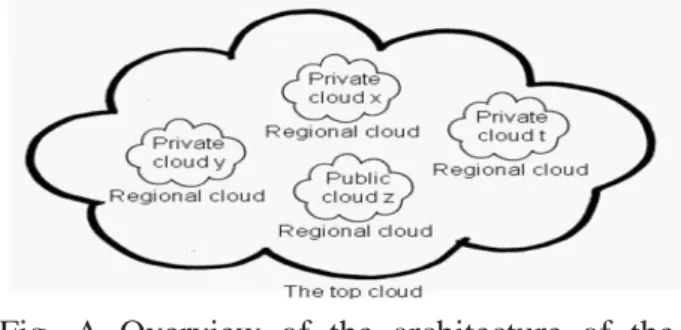
General System Architecture In this
architecture, a smart grid can be divided into
several regions each of which is managed by a
cloud computing center that can be setup from
either a public cloud or a private cloud. The
role of a regional cloud computing center is to
manage intelligent devices in the region as
well as to provide an initial processing for
information received from these devices.
Besides regional cloud computing centers,
there is a special cloud computing center at the
top level, which is in charge of managing and
processing data for the whole grid. In each of
these cloud computing centers, the following
cloud computing services could be deployed:
Infrastructure-as-a-service (IaaS). This type of
service forms the backbone of the system. It
helps to provide resources on demand for all
applications and services deployed in the
system. Main tasks of information
management in smart grids such as
information gathering, information processing,
and information storing, are all executed
inside this layer of service.
Software-as-a-service (SaaS). While IaaS is the backbone of
the system, all smart grid services will be
deployed as SaaS at the top of the system.
Examples include services that allow
customers to save or optimize their energy
usage such as Google Power Meter.
Platform-as-a-service (PaaS). PaaS provides tools and
libraries to develop cloud computing
applications and services. Salesforce is a
typical PaaS example, which provides libraries
to develop some specific types of applications
in saleforce or fieldforce domains. In smart
grid domain, since a number of applications
could be required to follow special security
requirements and have to allow lawful
interceptions, it is useful to have a general
PaaS that has already integrated these
requirements to implement applications.
Data-as-a-service (DaaS). DaaS could be deployed
to provide useful information for statistics
purpose. Since smart grid data is often
extremely large, it is useful to provide such
statistics services for users. Statistics can be
used for optimization purposes for not only
electricity users but also electricity providers
at different levels.
Fig. A Overview of the architecture of the
6
4. METHODOLOGY OVERVIEW
Security of Smart-Frame Supported by
Identity-Based Cryptography Since security
is a major concern in the smart grids, it is of
great importance for our Smart-Frame to
provide a solution to address that. As
mentioned earlier, one of the huddles for
widely deploying security solutions based on
public key cryptography is the high cost for
maintaining PKI. We envision that
Identity-based cryptography can be a good solution
(though it is not perfect) for resolving this
problem since identity-based cryptography has
the following advantages in regards to the
Smart-Frame security.
1) Under traditional public key cryptography,
each participating entity must locate and
verify the public keys of the receivers. This is
especially burdensome for end-user Sevices
in our Smart-Frame, which are usually
assumed as limited in power and networking
capacity.
2) Although traditional public key
cryptography is scalable in theory, a number
of issues regarding user interfaces for
maintaining public-key certificates (involving
certificate revocation) have to be resolved.
However, since any identifier strings can serve
as encryption key or signature verification
keys, identity- based cryptography could
provide better scalability for the system. This
is important in Smart- Frame in which
numerous end-user devices can join and leave
the system often.
3) For the convenience of the participating
entities in the system, implementing key
recovery is easy using identity-based
cryptography. In contrast, in traditional public
key cryptography, key recovery system is hard
to implement requiring to keep secure
database of private and public key pairs of the
users. Due to the generic nature that private
keys can be derived from the users’ identities
and master key of the private key generator,
no secure database can be required for the
systembased on identity-based cryptography.
4) In terms of encryption, traditional public
key cryptography always require a setup phase
to generate public-keys of the receiving
parties. However, identity- based
cryptography does not need such phase and
users can encrypt their messages using the
receiving parties’ identities even before the
receivers get the private keys form the PKG.
This can be useful in the Smart-Frame where
availability is an issues in the power grid.
Availability will be assured by minimizing the
time and frequencies for updating identities
(public-keys).
5) Identities used as public keys in
identity-based cryptography are flexible and versatile
in format and description. They do not have to
be restricted like the X.509 certificate format
7
This versatility will be useful in our
Smart-Frame in which identities can describe
participating entities more flexibly.
There is, of course, a key escrowing
problem in identitybased cryptography.
However, this can be relatively a mild issue
for our setting as the Smart-Frame is mainly
concerned with power grids which cannot
fully be open to public network. In this setting,
confidentiality, integrity and availability will
have more priorities.
Note that Shamir already showed that a
functional IBS scheme can be constructed
using the RSA primitive. More recent work by
Galindo and Garcia demonstrated that a very
efficient IBS scheme can be constructed using
discrete-logarithm primitive. In terms of IBE,
it would be difficult to compare the
performance of IBE schemes with that of
normal public-key encryption schemes as the
latter can be constructed using a number of
different kinds of computational primitives. In
general, IBE schemes would slightly be more
costly than most efficient public key
encryption schemes such as ElGamalstyle
encryption schemes based on elliptic curves,
due to the pairing operations which have been
used in many functional IBE schemes since
Boneh and Franklin’s IBE scheme. However,
we note that research has been being
performed actively to improve the
performance of pairing computation as
surveyed.
4.2 High Level Description
In realizing the security framework for the
Smart-Frame, we make the following
assumptions:
_ There is a private key generator that can
issue private keys for top and regional clouds,
and end-users when they register. We assume
that the PKG is a party that has responsibility
and capacity of maintaining the Smart-Frame
usually at the national level and its credential
is fully trusted.
_ The top cloud, regional clouds and end-users
(e.g., smart meters at home) are identified by
unique strings, which are to be used as
encryption keys or signature verification keys.
_ Each entity will obtain a private key
associated with its identity, so it can decrypt
the confidential data.
_ Each entity will send confidential data to the
entity which is only one-level higher. That is,
the end-users send confidential data to the
entities in the regional cloud only. Similarly
entities in the regional cloud can send
confidential data to the top cloud only.
_ Each entity will authenticate data using the
8
Fig B Hierarchical architecture
Based on the above assumptions, our main
idea can be described using the following
scenario, which is also depicted. At the top of
the hierarchy is the top cloud, which consists
of power stations, distribution services or
management services. Below the top cloud,
there are regional clouds that consist of
general user services and information storages.
These regional clouds, in turn, have higher
hierarchy than smart (intelligent) end-user
devices (simply we call “end-users”), which
are at the bottom of the hierarchy. Based on
the principle of identity-based cryptography,
the PKG will generate private keys for top
cloud and any entities in regional clouds and
end-users. Using their identifiers and private
keys, each entity can utilize IBE schemes to
secure information flow depicted. In addition
to IBE schemes, any parties can authenticate
their data employing IBS schemes.
CONCLUSION AND FEATURE WORKS
In this paper, we have introduced the
Smart-Frame, a general framework for big
data information management in smart grids
based on cloud computing technology. Our
basic idea is to set up cloud computing centers
at three hierarchical levels to manage
information: top, regional, and end-user levels.
While each regional cloud center is in charge
of processing and managing regional data, the
top cloud level provides a global view of the
framework. Additionally, in order to support
security for the framework, we have presented
a solution based on identity-based
cryptography and identity-based proxy
re-encryption. As a result, our proposed
framework achieves not only scalability and
flexibility but also security features. We have
implemented a proof-of-concept for our
framework with a simple identity-based
management for data confidentiality. Our
immediate next step is to also support proxy
re-encryption for the framework.
REFERENCES
[1] G. Ateniese, K. Fu, M. Green, and S.
Hohenberger, “Improved proxy re-encryption
schemes with applications to secure
distributed storage,” ACM Trans. Inf. Syst.
Security, vol. 9, no. 1, pp. 1–30, 2006.
[2] J. Baek, Q. Vu, A. Jones, S. Al-Mulla, and
C. Yeun, “Smart-frame: A flexible, scalable,
and secure information management
framework for smart grids,” in Proc. IEEE Int.
Conf. Internet Technol. Secured Trans., 2012,
pp. 668–673.
[3] A. Bartoli, J. Hernandez-Serrano, M.
9
aggregation for smart grid M2M networks,” in
Proc. IEEE Conf. Smart Grid Commun., 2010,
pp. 333–338.
[4] K. P. Birman, L. Ganesh, and R. V.
Renesse, “Running smart grid control software on cloud computing architectures,” in Proc.
Workshop Comput. Needs Next Generation
Electric Grid, 2011, pp. 1–33. Fig. 8. Basic
processes for encryption and description in the
Smart-Frame.
[5] Z. Bojkovic and B. Bakmaz, “Smart grid
communications architecture: A survey and
challenges,” in Proc. 11th Int. Conf. Appl.
Comput. Appl. Comput. Sci., 2012, pp. 83–89.
[6] D. Boneh and M. K. Franklin, “Identity-based encryption from the weil pairing,” in
Proc. 21st Annu. Int. Cryptol. Conf. Adv.
Cryptol., 2001, vol. 2139, pp. 213–229.
[7] X. Boyen, “A tapestry of identity-based encryption: practical frameworks compared,”
Int. J. Appl. Cryptograph., vol. 1, no. 1, pp. 3–
21, 2008.
[8] C.-K. Chu, J. K. Liu, J. W. Wong, Y.
Zhao, and J. Zhou, “Privacypreserving smart
metering with regional statistics and personal
enquiry services,” in Proc. 8th ACM SIGSAC
Symp. Inf., Comput. Commun. Soc., 2013, pp.
369–380.
[9] G. M. Coates, K. M. Hopkinson, S. R.
Graham, and S. H. Kurkowski, “A trust
system architecture for SCADA network
security,” IEEE Trans. Power Delivery, vol.
25, no. 1, pp. 158–169, Jan. 2010.
[10] R. Davies, “Hydro one’s smart meter
initiative paves way for defining the smart grid
of the future,” in Proc. Power Energy Soc.
Gen. Meeting, 2009, pp. 1–2.
[11] IEC 61850: Communication Networks
and Systems in Substations, IEC 61850. Dec.
2013.
[12] IEC 62351: Data and Communication
Security, IEC 62351, May 2007.
[13] C. Dong. Jpair [Online]. Available:
https://personal.cis.strath.ac.
uk/changyu.dong/jpair/intro.html, Oct. 2010.
[14] J. Duff, “Smart grid challenges,” in Proc.
Workshop High Perform. Trans. Syst., 2009,
[Online]. Available:
http://www.hpts.ws/papers/2009/session4/duff
[15] C. Efthymiou and G. Kalogridis, “Smart
grid privacy via anonymization of smart
metering data,” in Proc. 1st Int. Conf. Smart
Grid Commun., 2010, pp. 238–243.
[16] Eucalyptus. [Online]. Available:
http://www.eucalyptus.com,2014.
[17] Z. Fan, P. Kulkarni, S. Gormus, C.
Efthymiou, G. Kalogridis, M. Sooriyabandara,
Z. Zhu, S. Lambotharan, and W. Chin, “Smart
grid communications: Overview of research
10
activities,” IEEE Commun. Survey Tutorials,
vol. 15, no. 1, pp. 21–38, Jan. 2012.
[18] H. Farhangi, “The path of the smart grid,”
IEEE Power Energy Mag., vol. 8, no. 1, pp.
18–28, Jan./Feb. 2010.
[19] D. Galindo and F. Garcia, “A
Schnorr-like lightweight identitybased signature
scheme,” in Proc. 2nd Int. Conf. Cryptol.
Africa, 2009, pp. 135–148.
[20] C. Gentry and A. Silverberg,
“Hierarchical ID-based cryptography,” in
Proc. 8th Int. Conf. Theory Appl. Cryptol. Inf.
Security: Adv. Cryptol., 2002, pp. 548–566.
[21] Google PowerMeter. [Online]. Available:
http://www.google. com/powermeter/about,
2011.
[22] M. Green and G. Ateniese,
“Identity-based proxy re-encryption,” in Proc. 5th Int.
Conf. Appl. Cryptograph. Netw. Security,
2007, vol. 4521, pp. 288–306.
[23] A. Hamlyn, H. Cheung, T. Mander, L.
Wang, C. Yang, and R. Cheung, “Trust
infrastructures for future energy networks,” in
Proc. IEEE Power Energy Soc. Gen. Meeting,
2008, pp. 1–7.
[24] B. Hayes, “Cloud computing,” Commun.
ACM, vol. 51, no. 7,pp. 9–11, 2008.
[25] IEEE, P2030/D7.0 draft guide for smart
grid interoperability of energy technology and
information technology operation with the
electric power system (EPS), and end-user
applications and loads, P2030/D670, 2011.
[26] Inovgrid. [Online]. Available:
http://www.inovcity.pt/en/pages/inovgrid.aspx
, 2010.
[27] G. Kalogridis, C. Efthymiou, S. Denic, T.
Lewis, and R. Cepeda, “Privacy for smart
meters: Towards undetectable appliance load
signatures,” in Proc. 1st Int. Conf. Smart Grid
Commun., 2010, pp. 232–237.
[28] H. Khurana, M. Hadley, N. Lu, and D.
Frincke, “Smart-grid security issues,” IEEE
Security Privacy, vol. 8, no. 1, pp. 81–85, Jan./
Feb. 2010.
[29] N. Kuntze, C. Rudolph, M. Cupelli, J.
Liu, and A. Monti, “Trust infrastructures for future energy networks,” in Proc. IEEE Power
Energy Soc. Gen. Meeting, 2010, pp. 1–7.
[30] H. Li, Y. Dai, L. Tian, and H. Yang,
“Identity-based authentication for cloud computing,” in Proc. 1st Int. Conf. Cloud
Comput., 2009, vol. 5931, pp. 157–166.
[31] F. Li, B. Luo, and P. Liu, “Secure
information aggregation for smartgrids using
homomorphic encryption,” in Proc. IEEE
Conf. Smart Grid Commun., 2010, pp. 327–
332.
[32] H. Li, R. Mao, L. Lai, and R. Qiu,
11
in Proc. 1st Int. Conf. Smart Grid Commun.,
2010, pp. 114–119.
[33] H. Lim and K. G. Paterson, “Identity-based cryptography for grid security,” Int. J.
Inf. Security, vol. 10, no. 1, pp. 15–32, 2011.
[34] M. Mambo and E. Okamoto, “Proxy
cryptosystems: Delegation of the power to
decrypt ciphertexts,” IEICE Trans. Fundam.
Electron. Commun. Comput. Sci., vol. E-80,
no. 1, pp. 54–63, 1997.
[35] A. Metke and R. Ekl, “Smart grid security technology,” in Proc. Eur. Conf. Innovative
Smart Grid Technol., 2010, pp. 1–7.
[36] Moma. [Online]. Available:
http://www.modellstadt-mannheim.de, 2012.
[37] National Energy Technology Laboratory
for the U.S. Department of Energy, “Modern grid benefits,” White Paper, 2007.
[38] S. Rogai, “ENEL Telegestore Project,”
Economic Commission for Europe,
Committee on Sustainable Energy, Steering
Committee of the Energy Efficiency 21, Ad
Hoc Group of Experts on Energy Efficiency,
Investments for Climate Change Mitigation,
Eighth meeting, Geneva, 31 May 2006.
[Online]. Available at http://
www.unece.org/fileadmin/DAM/ie/se/pp/adho
c/adhoc8May 06/2_Rogai.pdf
[39] K. Rogers, R. Klump, H. Khurana, A.
Aquino-Lugo, and T. Overbye, “An
authenticated control framework for
distributed voltage support on the smart grid,”
IEEE Trans. Smart Grid, vol. 1, no. 1, pp. 40–
47, Jun. 2010.
[40] S. Rusitschka, K. Eger, and C. Gerdes,
“Smart grid data cloud: A model for utilizing cloud computing in the smart grid domain,” in
Proc. 1st Int. Conf. Smart Grid Commun.,
2010, pp. 483–488. [41] Salesforce. [Online].
Available: http://www.salesforce.com
[42] C. Schridde, T. D_ornemann, E. Juhnke,
B. Freisleben, and M. Smith, “An
identity-based security infrastructure for cloud
environments,” in Proc. IEEE Wireless
Commun., Netw. Inf. Security, 2010, pp. 644–
649.
[43] A. Shamir “Identity-based cryptosystems and signature schemes,” in Proc. CRYPTO
Adv. Cryptol., 1984, vol. 196, pp. 47–53.
[44] M. Shargal and D. Houseman, “The big picture of your coming smart grid,” Smart
Grid News, Mar. 2009. (Online). Available:
http://www.smartgridnews.com/artman/publis
h/commentary
/The_Big_Picture_of_Your_Coming_Smart_