Oviedo University Press 125
Economics and Business Letters
5(4), 125-133, 2016
Central bank transparency and exchange rate volatility effects
on inflation-output volatility
Stephanos Papadamou1*• Moïse Sidiropoulos2,4 • Eleftherios Spyromitros3,4
1 University of Thessaly, Department of Economics, Greece
2 Aristotle University of Thessaloniki, Department of Economics, Greece 3 Democritus University of Thrace, Department of Economics, Greece
4 University of Strasbourg, Bureau d'Economie Théorique et Appliquée (BETA), France
Received: 23 July 2016 Revised: 5 September 2016 Accepted: 5 September 2016
Abstract
While the tendency towards more transparent central banks is irrefutable, the effects of more transparent monetary policies mainly on output volatility are not clear-cut. In this note, we es-timate our panel for 36 countries over the period 1998-2005 which is characterized by signifi-cant changes in central bank transparency levels, using the Prais-Winsten method with PCSEs and controlling for the exchange rate volatility that positively affects inflation and output. We provide evidence in favor of transparency and exchange rate stability policies since they reduce both output and inflation volatility.
Keywords: central bank transparency; macroeconomic volatilities; exchange rate volatility; panel data.
JEL Classification Codes: E52, E58, F31
1. Introduction
While in the past the predominant policy strategy was monetary targeting, the adoption of an inflation targeting framework by a growing number of central banks highlights the tendency towards greater central bank transparency. As a matter of fact, for a long time, central banks used to be very secretive, but the last fifteen years numerous central banks have started to
embrace openness. In this respect, a comprehensive survey of 94 central banks by Fry et al.
(2000) reveals that 74 percent of the central banks consider transparency a vital or very important component of their monetary policy framework. The idea behind this study is that there is a role for central bank transparency in the implementation and efficiency of monetary
* E-mail: [email protected].
policy. In effect, monetary policy decisions do not come as a surprise for investors. By affecting
thus the effectiveness of the transmission process through its impact on inflation expectations which are better anchored, heightened transparency leads to a better stabilization of inflation but the effects on output are less clear-cut. This study evaluates the impact of monetary policy transparency on inflation-output volatility and therefore the impact on macroeconomic stability. Moreover, through the price stability effect, exchange rate volatility can also be an important factor affecting macroeconomic stability through its effect on prices and output.
The effects of central bank transparency on macroeconomic and financial variables are highlighted by the existing literature (see among others, Geraats, 2002; Beetsma and Jensen, 2003; Mishkin, 2004; de Mendonça and Simão Filho, 2007; Liu et al., 2008; Wilhelmsen and Zaghini, 2011; Papadamou, 2013; Papadamou et al., 2014, 2015; Horváth and Vaško, 2016)1. Specifically, a number of authors have examined the link between central bank
transparency indices and macroeconomic volatility2. Demertzis and Hughes Hallett (2007), by
employing the Eijffinger-Geraats (2006) index, they examine the relationship between central bank transparency and the level and variability of inflation and the output gap over the period 1990-2001. Their results suggest a negative relationship between inflation variability and central bank transparency, which vanishes however when considering the link between the level of inflation and transparency. Moreover, they find a strong positive relationship between transparency and the variability of output. In other words, they suggest that a more transparent monetary policy may be associated with more output volatility because it prevents the authorities from using policy as actively to offset output fluctuations3. In the same spirit, Cecchetti and Krause (2002), using the Fry et al. (2000) index find a weak positive association between output variability and transparency. However, these studies are based on very limited country samples or utilize evidence for a single point in time.
Dincer and Eichengreen (2007), expanding the index of Eijffinger and Geraats (2006), they find that the inflation variability is negatively correlated to central bank transparency. They also suggest a negative but relative weak impact of monetary policy transparency on output variability. By conducting a number of robustness checks, they re-estimated the equations using fixed effects and by doing so, and relying exclusively on the time series variation in the data, they produce weaker evidence of real effects of transparency.
In addition, exchange rate volatility is also an important factor affecting inflation and output growth and dispersion. There are numerous studies that have investigated the negative effect of exchange rate volatility on economic growth (see among others, Aghion et al., 2009; Schnabl, 2009; Arratibel et al. 2011) as well as its impact on inflation (Gosh et al. 1996;
Bleaney, 1999; Bleaney and Francisco, 2005; Hutchison et al. 2012). However, less attention
has been given to the effects of exchange rate volatility on inflation and output volatility. There is a part of the literature suggesting that exchange rate volatility is not important to macroeconomic volatilities (Flood and Rose, 1995; Obstfeld and Rogoff, 2000; Duarte and Stockman, 2002). Another part of the literature considers that there is a relationship between
1 The issue of central bank transparency has been investigated extensively by the literature. Recent studies on
central transparency are mainly focused on the relationship between transparency and independence of the central banks (Spyromitros, 2014), the effect of heightened transparency on stock returns via the interest rate (Papadamou et al., 2016), the effect of monetary policy opacity on macroeconomic efficiency in the presence of fiscal corruption (Dai et al., 2015), and James and Lawler (2015) explores whether public disclosure of the central banks information concerning aggregate shocks can serve as a substitute for active stabilization policy.
2 For a theoretical explanation of the favorable effects of central bank transparency on output and inflation
vola-tility, see Demertzis and Hughes Hallett (2007) and Carboni and Ellison (2011).
3 In this context, in a more recent study, Demertzis and Hughes Hallett (2015) highlight the important role of
exchange rate volatility and output and inflation volatility (Barone-Adesi and Yeung, 1990;
Ghosh et al., 1997; Bleaney and Fielding, 2002; Sutherland, 2002; Keating and Valcarcel, 2012).
To sum up, despite the fact that central bank transparency seems to be negatively related to the inflation volatility, there is ambiguity regarding the effects of transparency and exchange rate volatility on output volatility. In this context, the examination of both of these variables in a common model allowing for contemporaneous and serial correlation could provide additional empirical information.
In this note, using panel data on transparency from 36 central banks for the period 1998-20054, and historical volatility measures for GDP growth, nominal effective exchange rate
changes and inflation5, we examine the link between central bank transparency and
inflation-output volatility allowing for contemporaneous correlation and exchange rate volatility effects, by providing empirical evidence in favor of a negative relationship between transparency and output volatility. The main argument behind this result is that highly transparent central bank, by anchoring inflation expectations, provide a smoothing of both short and long term interest rates changes, leading to a better stabilization of consumption, investment decisions and therefore output. Concerning the effects of transparency on inflation volatility, we confirm previous theoretical studies arguing that central bank transparency negatively affects inflation volatility. Additionally, in order to take into account for any possible correlation within panels, we estimate our model by using the Prais-Winsten method with panel corrected standard errors (PCSEs). Finally, as far as exchange rate volatility is considered, it has a significant positive effect on both output and inflation volatilities without affecting the transparency effects.
2. Empirical analysis
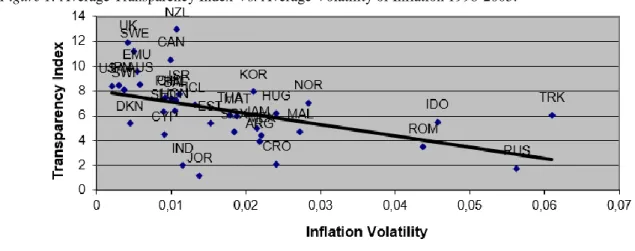
Before getting into regression results, as preliminary analysis, the scatter plot figures among the two variables of interest each time can show some of the hidden part in the relation. More specifically, figure 1 shows the relationship between the average historical volatility of inflation
and the average level of transparency over the whole period.
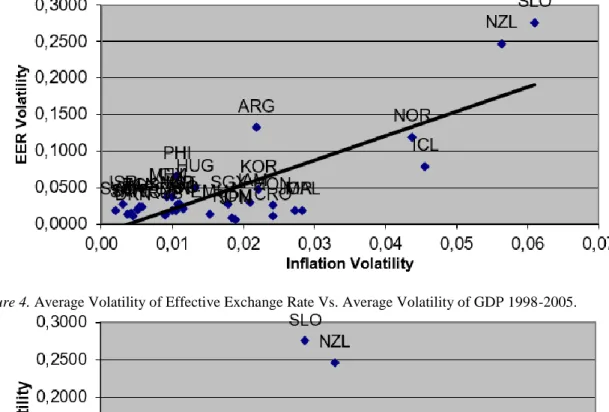
Similarly figure 2 presents the average GDP volatility versus average transparency, and figure 3 stock price volatility versus transparency level. The first two graphs confirm what we expected from the theoretical model. Higher level of transparency in the way that monetary policy is conducted coexists with lower level of variability in macro data like inflation and GDP variability.
Figure 1. Average Transparency Index Vs. Average Volatility of Inflation 1998-2005.
4 It is to notice that major changes in central bank transparency have been contacted over the period 1998-2005. 5 Gdp growth rates and inflation are taken from International Financial Statistics database of the IMF, while
Figure 2. Average Transparency Index Vs. Average Volatility of GDP 1998-2005.
Figure 3. Average Volatility of Effective Exchange Rate Vs Average Volatility of inflation 1998-2005.
Figure 4. Average Volatility of Effective Exchange Rate Vs. Average Volatility of GDP 1998-2005.
Table 1. Summary Statistics (Averages over the period 1998-2005).
Country Symbol Inflation
Volatility
GDP Volatility
EER Volatility
Transparency Index
Argentina ARG 0.0218 0.0254 0.1317 3.9375
Australia AUS 0.0058 0.0118 0.0237 8.5000
Canada CAN 0.0100 0.0111 0.0189 10.5000
Chile CHIL 0.0101 0.0144 0.0367 7.3750
Croatia CRO 0.0241 0.0150 0.0111 2.1250
Cyprus CYP 0.0091 0.0128 0.0134 4.5000
Denmark DKN 0.0045 0.0098 0.0112 5.3750
Eurozone EMU 0.0054 0.0063 0.0234 9.5625
Estonia EST 0.0152 0.0240 0.0143 5.3750
Hong Kong HON 0.0104 0.0204 0.0189 6.3750
Hungary HUG 0.0241 0.0139 0.0249 6.1875
Iceland ICL 0.0132 0.0438 0.0503 6.8750
Indonesia IDO 0.0456 0.0180 0.0785 5.5000
India IND 0.0115 0.0215 0.0205 2.0000
Israel ISR 0.0111 0.0208 0.0267 7.8125
Jamaica JAM 0.0215 0.0082 - 4.9375
Jordan JOR 0.0138 0.0192 - 1.1875
Japan JPN 0.0031 0.0068 0.0267 8.4375
Korea KOR 0.0210 0.0187 0.0302 7.9375
Malaysia MAL 0.0273 0.0186 0.0187 4.7500
Malta MAT 0.0189 0.0113 0.0064 5.9375
Mexico MEX 0.0221 0.0104 0.0480 4.4375
Norway NOR 0.0284 0.0139 0.0189 7.0625
New Zealand NZL 0.0108 0.0117 0.0265 12.9375
Philipines PHI 0.0093 0.0146 0.0371 7.4375
Romania ROM 0.0437 0.0344 0.1191 3.5000
Russia RUS 0.0563 0.0236 0.2465 1.7500
S. Africa SAF 0.0107 0.0107 0.0668 7.2500
Singapore SGX 0.0184 0.0322 0.0083 4.7500
Slovenia SLO 0.0090 0.0143 0.0127 6.2500
Sweden SWE 0.0051 0.0112 0.0198 11.2500
Switzerland SWI 0.0037 0.0063 0.0141 8.0625
Thailand THA 0.0179 0.0181 0.0272 6.0625
Turkey TRK 0.0610 0.0207 0.2748 6.0625
United Kingdom UK 0.0042 0.0088 0.0158 11.8750
United States of America USA 0.0021 0.0108 0.0185 8.3750
Avg Across Countries 0.0175 0.0165 0.0453 6.4514
Table 1 provides evidence concerning the values of the transparency index, and the different measures of macro variables volatilities, namely the GDP, inflation and exchange rate volatilities. Our sample covers a wide range of countries with various level of central bank transparency.
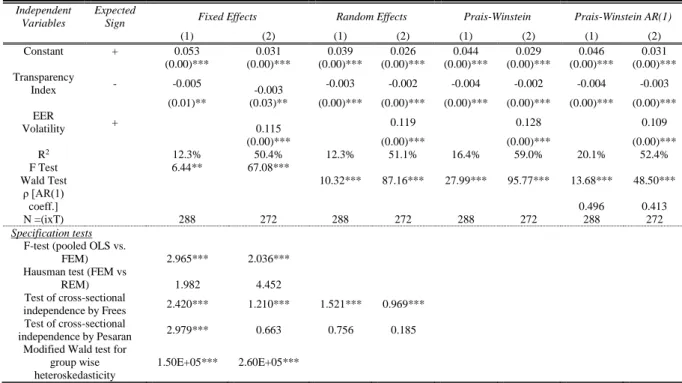
Table 2. Panel data estimation results for Inflation volatility vs. Transparency.
Independent Variables
Expected
Sign Fixed Effects Random Effects Prais-Winstein Prais-Winstein AR(1)
(1) (2) (1) (2) (1) (2) (1) (2)
Constant + 0.053 0.031 0.039 0.026 0.044 0.029 0.046 0.031
(0.00)*** (0.00)*** (0.00)*** (0.00)*** (0.00)*** (0.00)*** (0.00)*** (0.00)*** Transparency
Index - -0.005 -0.003 -0.003 -0.002 -0.004 -0.002 -0.004 -0.003
(0.01)** (0.03)** (0.00)*** (0.00)*** (0.00)*** (0.00)*** (0.00)*** (0.00)*** EER
Volatility + 0.115 0.119 0.128 0.109
(0.00)*** (0.00)*** (0.00)*** (0.00)***
R2 12.3% 50.4% 12.3% 51.1% 16.4% 59.0% 20.1% 52.4%
F Test 6.44** 67.08***
Wald Test 10.32*** 87.16*** 27.99*** 95.77*** 13.68*** 48.50***
ρ [AR(1)
coeff.] 0.496 0.413
N =(ixT) 288 272 288 272 288 272 288 272
Specification tests
F-test (pooled OLS vs.
FEM) 2.965*** 2.036***
Hausman test (FEM vs
REM) 1.982 4.452
Test of cross-sectional
independence by Frees 2.420*** 1.210*** 1.521*** 0.969*** Test of cross-sectional
independence by Pesaran 2.979*** 0.663 0.756 0.185 Modified Wald test for
group wise heteroskedasticity
1.50E+05*** 2.60E+05***
Table 3. Panel data estimation results for GDP volatility vs. Transparency. Independent
Variables
Expected
Sign Fixed Effects Random Effects Prais-Winstein Prais-Winstein AR(1)
(1) (2) (1) (2) (1) (2) (1) (2)
Constant + 0.0182 0.0168 0.0214 0.0208 0.0242 0.0241 0.0243 0.0244
(0.00)*** (0.00)*** (0.00)*** (0.00)*** (0.00)*** (0.00)*** (0.00)*** (0.00)*** Transparency
Index - -0.0003 -0.0001 -0.0008 -0.0007 -0.0012 -0.0012 -0.0012 -0.0012
(0.65) (0.85) (0.05)* (0.04)** (0.00)*** (0.00)*** (0.00)*** (0.00)*** EER
Volatility + 0.0113 0.0115 0.0092 0.0069
(0.21) (0.20) (0.00)*** (0.02)**
R2 6.9% 5.6% 6.9% 9.7% 8.3% 9.1% 38.3% 37.5%
F Test 0.21 1.00
Wald Test 3.73** 4.23 27.95*** 48.26*** 17.53*** 29.48***
ρ [AR(1)
coeff.] 0.2963 0.2528
N =(ixT) 288 272 288 272 288 272 288 272
Specification tests
F-test (pooled OLS vs.
FEM) 4.394*** 4.214***
Hausman test (FEM vs
REM) 2.357 3.964
Test of cross-sectional
independence by Frees 1.037*** 1.312*** 1.045*** 1.399***
Test of cross-sectional
independence by Pesaran 8.078*** 9.022*** 8791*** 9.806***
Modified Wald test for group wise heteroskedasticity
39737.52*** 16865.45***
variability. A result that confirms previous findings in the study of Dincer and Eichngreen
(2007).
The F- tests in the specification tests indicate that the fixed effects models outperform the pooled OLS. Moreover, the Hausman test generally indicates that the random-effects model is superior to the fixed-effects model. Therefore, particular attention is given on the random-effects results presented in columns 5 and 6 of Tables 2 and 3. However, for robustness check FE estimates are also presented. As can be easily seen, there is a significant negative effect of transparency on inflation volatility and on GDP volatility. This effect is not affected by the inclusion of the exchange rate volatility that has a significant positive effect on both volatilities. Additionally, by comparing the two models we can say that the explanation power of transparency on inflation volatility is higher compared to GDP volatility.
The results of the tests suggested by Frees (1995), and by Pesaran (2004) provide evidence for the existence of contemporaneous correlations of errors while the Wald test provides evidence for group wise heteroskedasticity. Therefore, we proceed to the estimation of the models by OLS with PCSEs. In order to take into account for any possible correlation within panels we also estimate models by Prais-Winsten method with PCSEs. Our main results concerning the negative relation between transparency and GDP and inflation volatility are not affected.
3. Conclusion
In our model, we empirically investigate the link between central bank transparency and exchange rate variability with inflation and output variability for 36 countries from 1998 to 2005. Our results point out a negative relationship between central bank transparency and inflation and output variability. In effect, monetary policy transparency allows the public to react more quickly to monetary policy actions, discouraging thus the authorities from attempting to manipulate inflation in the pursuit of other objectives. Consequently, in the absence of surprise inflation or unexpected shocks hitting the economy, output is less volatile. An important policy implication of this study could be the identification of which types of central bank disclosure may be responsible for the above results. According to the taxonomy proposed by Geraats (2002) and the measure of transparency employed in this study, there are five aspects of monetary policy transparency, namely, political transparency, economic transparency, policy transparency, operational transparency and procedural transparency. However, the more relevant aspects in actual monetary policy making seem to be political, economic and policy transparency. Firstly, an important step towards more political transparency can be considered the adoption of an inflation targeting strategy in monetary policy. Then, the publication of macroeconomic forecasts helps the public to infer the central bank’s intentions from its monetary policy actions and outcomes and thus can be seen as an economic transparency feature. Finally, the disclosure of forward guidance about policy actions (i.e., policy transparency). This allows the private sector to form expectations similar with those of the central bank, enhancing thus the effectiveness of monetary policy.
Additionally, monetary policy should give more attention to exchange rate volatility because it clearly negatively affects its performance in terms of increased inflation and output volatility. Such volatilities, by creating higher uncertainty, affect inflation expectations and therefore the work of monetary authorities becomes more challenging.
References
Aghion, P., Bacchetta, P., Ranciere, R. and Rogoff, K. (2009) Exchange Rate Volatility and
Productivity Growth: The Role of Financial Development, Journal of Monetary
Arrtibel, O., Furcen, D., Martin, R. and Zdzienicka, A. (2011) The Effect of Nominal Exchange
Rate Volatility on Real Macroeconomic Performance in the CEE Countries, Economic
Systems, 35, 261-277.
Barone-Adesi, G. and Yeung, B. (1990) Price flexibility and output volatility: the case for flexible exchange rate, Journal of International Money and Finance, 9, 276- 298.
Beetsma, R.M. and Jensen, H. (2003) Why money talks and wealth whispers: Monetary
uncertainty and mystique: Comment, Journal of Money, Credit, and Banking, 35(1),
129-36.
Bleaney, M. (1999) The Disappearing Openness - Inflation Relationship: A Cross-Country
Analysis of Inflation Rates, IMF Working Paper 99-161.
Bleaney, M. and Fielding, D. (2002) Exchange rate regimes, inflation and output volatility in
developing countries, Journal of Development Economics, 68, 233-245.
Bleaney, M. and Francisco, M. (2005) Exchange rate regimes and inflation: only hard pegs
make a difference, Canadian Journal of Economics, 38(4), 1453-1471.
Carboni, G. and Ellison, M. (2011) Inflation and output volatility under asymmetric incomplete information, Journal of Economic Dynamics and Control, 35(1), 40-51.
Cecchetti, S. G. and Krause, S. (2002) Central bank structure, policy efficiency, and macroeconomic performance: exploring empirical relationships, Federal Reserve Bank of St Louis Review, 84, 47-60.
Dai, M., Sidiropoulos, M. and Spyromitros, E. (2015) Fiscal policy, institutional quality and
central bank transparency, The Manchester School, 83(5), 523-545.
Demertzis, M. and Hughes Hallett, A. (2007) Central bank transparency in theory and
practice, Journal of Macroeconomics, 29(4), 760-789.
Demertzis, M. and Hughes Hallett, A. (2015) Three different approaches to transparency in monetary policy, Economia Politica, 32(3), 277-300.
Dincer, N. and Eichengreen, B. (2007) Central bank transparency: where, why, and with what
effects?, NBER Working Paper 13003.
Duarte, M. and Stockman, A.C. (2002) Comment on: Exchange rate pass-through, exchange rate volatility, and exchange rate disconnect, Journal of Monetary Economics, 49(5), 941-946.
Eijffinger, S. C. and Geraats, P. M. (2006) How transparent are central banks?, European Journal of Political Economy, 22(1), 1-21.
de Mendonça, H.F. and Simão Filho, J. (2007) Economic transparency and effectiveness of
monetary policy, Journal of Economic Studies, 34(6), 497-514.
Flood, R.P. and Rose, A.K. (1995) Fixing exchange rates–a virtual quest for fundamentals,
Journal of Monetary Economics, 36, 3-37.
Frees, E.W. (1995) Assessing cross-sectional correlations in panel data, Journal of
Econometrics, 69, 393-414.
Fry, M., Julius, D., Mahadeva, L., Roger, S. and Sterne, G. (2000) Key issues in the choice of monetary policy framework. In Lavan Mahadeva and Gabriel Sterne, eds., Monetary Policy Frameworks in a Global Context, London: Routledge, 3-17.
Geraats, P. M. (2002) Central bank transparency, The Economic Journal, 112(483), F532-F565.
Ghosh, A. R., Gulde, A.-M., Ostry, J. D. and Holger, C. W. (1996) Does the Exchange Rate
Regime Matter for Inflation and Growth?, IMF Economic Issues 2.
Ghosh, A. R.; Gulde, A.M., Ostry, J. D. and Holger, C. W. (1997) Does the nominal exchange
rate regime matter? NBER Working Paper 5874.
Horváth, R., and Vaško, D. (2016) Central bank transparency and financial stability, Journal of Financial Stability, 22, 45-56.
Hutchison, M., Sengupta, R. and Singh, N. (2012) India’s Trilemma: Financial Liberalisation,
James, J. G. and Lawler, P. (2015) Heterogeneous private sector information, central bank
disclosure, and stabilization policy, Southern Economic Journal, 82(2), 620-634.
Keating, J. and Valcarcel, V. (2012) Greater moderations, Economics Letters,115(2), 168-171.
Liu, M. H., Margaritis, D. and Tourani-Rad, A. (2008) Monetary policy transparency and pass-through of retail interest rates, Journal of Banking & Finance, 32(4), 501-511.
Mishkin, F.S. (2004) Can central bank transparency go too far?, NBER Working Paper 10829.
Obstfeld, M. and Rogoff, K. (2000) The six major puzzles in international macroeconomics: is
there a common cause?, NBER Working Paper 7777.
Papadamou, S. (2013) Market anticipation of monetary policy actions and interest rate
transmission to US Treasury market rates, Economic Modelling, 33, 545-551.
Papadamou, S., Sidiropoulos, M. and Spyromitros, E. (2014) Does central bank transparency affect stock market volatility? Journal of International Financial Markets, Institutions and Money, 31, 362-377.
Papadamou, S., Sidiropoulos, M. and Spyromitros, E. (2015) Central Bank Transparency and the Interest Rate Channel: Evidence from Emerging Economies, Economic Modelling, 48, 167-174.
Papadamou, S., Sidiropoulos, M. and Spyromitros, E. (2016) Interest rate dynamic effect on stock returns and Central Bank Transparency: Evidence from Emerging markets,
Research in International Business and Finance, forthcoming,
http://dx.doi.org/10.1016/j.ribaf.2016.01.020.
Pesaran, M.H. (2004) General diagnostic tests for cross section dependence in panels,
Cambridge Working Papers in Economics 0435.
Schnabl, G. (2009) Exchange Rate Volatility and Growth in Emerging Europe and East Asia,
Open Economic Review, 20, 565-587.
Spyromitros, E. (2014) The link between transparency and independence of central banks
Journal of Risk & Control, 1(1), 51-60.
Sutherland, A. (2002) Incomplete pass-through and the welfare effects of exchange rate variability, CEPR Discussion Paper 3431.
Wilhelmsen, B. R. and Zaghini, A. (2011) Monetary policy predictability in the euro area: an