Numerical study of the effect of channel and nano-fluid characteristics
on the heat transfer parameters in triangular-quadratic and
rectangular channels
Sajjad rastad1, Seyed ali agha mirjalilily21- Department of Mechanical Engineering, Darab Branch, Islamic Azad University, Darab, Iran (corresponding author) 2- Assistant Professor, Department of Mechanical Engineering, Yazd Branch, Islamic Azad University, Yazd, Iran
Received: 22, June , 2018 Accepted: 20, July, 2018 Online Published: 30, July, 2018
Abstract
Nanosilates are a new heat transfer medium that consists of suspensions of particles usually made of metal in Nano dimensions in the base fluid. Using Nano silicates that have higher thermal conductivity and displacement coefficients compared to conventional fluids, can save energy consumption by reducing the dimensions of heat exchangers and increasing their efficiency. However, the use of Nano fluids due to increased pressure drop sometimes leads to an excessive increase in pump power, hence the theoretical review of this subject is necessary using Nano silicates in ductile, shell and tube heat exchangers. In this research, we tried to study the performance of heat exchangers with square, rectangular and triangular sections for different nan ofluid ratios. For this purpose, the parameters of the pressure drop coefficient and the non-dimensional heat transfer coefficient were investigated by modeling the converters under different geometries using Anis software. The results of this study showed that, by increasing the volume percentage of particles inside the Nano silver, the calculated Nusselt number decreased to a negligible amount. It should be noted that a small reduction in the Nusselt number does not mean a decrease in the amount of heat transfer, and because of the increase in the heat transfer coefficient in the high volumetric ratios, the amount of uncontained heat transfer has increased.
Keywords: Heat exchangers, Nano fluids, heat transfer, pressure drop
1. INTRODUCTION
Polymer nanoparticles (poly Nano-liquids) are made by adding polymer particles in nanometers in fluids, in order to increase the thermal conductivity and improve the heat transfer performance. The results of experiments carried out on the heat transfer method on several Nano silver polymer samples showed that the performance of polymer nanoparticles in heat transfer is generally more than predicted theoretically. This fact is a fundamental discovery in the problem of heat transfer. The impact of nanotechnology on particles and materials produced by this technology is so much that these substances can be distinguished from macromolecular size and have new properties for them[17]. Among the properties influenced by nanotechnology, the physical properties of nanoscale particles and the fluid content of the particles contained in them can be noted, which are very different from macromolecular materials[18]. The mechanism of conducting fluids on a macromolecular scale is very low because the conductivity of the conductivity of fluids (K) is lower than that of solids [9]. On the other hand, microcrystalline particles and solids have a conductivity of about 31 times the fluid conductivity. In this way, the conductivity of the fluids can be greatly increased by using suspended particles in them. These particles can be metal oxides of the genus or they can be used instead of carbon nanotubes suspended in fluid[19]. The use of polymer nanoparticles in fluids increases the heat transfer coefficient and, consequently, increases heat transfer, increases efficiency, and reduces production and operating costs[20]. Also, this increase in heat transfer reduces the power required by the pump and the heat transfer surface, which in turn reduces fixed costs (although environmental impacts of the Nano fluid should also be taken into account). Subsequently, the increase in efficiency results in better control of the transferred heat, which results in better heat exchanger performance. [10]
Today, the need for heat transfer with high thermal intensity in a short time is of interest to many industries[21]. For this purpose, non-metallic media or Nano-fluid oxides (usually containing metal particles) can significantly increase the heat transfer coefficient. This increase depends on several factors in the heat transfer coefficient. In this regard, as well as in the case of Nano silials in triangular, rectangular and rectangular channels, and the effect of nanosilial on heat transfer, several studies have been carried out. In this chapter, a summary of each of them, the method The results are considered. In 1995, Choi was the first to use nanosilver for nanoparticle suspensions at the Argo net Research Institute in the United States, and also claimed that such fluids were both in terms of preparation and in terms of persistent and transitional properties compared to suspensions Conventional solid / liquid and macrocycles have many differences [11]. Couderno, Bucharest, Gavarila and Morjan (1999) investigated the experimental effects of liquid properties on the thermal conductivity of nanosilates. Nano-fluids based on the dispersion of iron nanocomposite particles in distilled water and ethylene glycol were prepared and their thermal properties were studied as the basis of the nature of the fluids. In this paper, it has been shown that in addition to the nature and characteristics of nanosilates, the nature and characteristics of fluids also have an important role in increasing the thermal conductivity of nanofluids [1]. Lee, Chouy and Myst (1999) studied nanosilver oxide. In fact, they produced nanosilicate oxides and measured their thermal conductivity by hot wire method. The experimental results in this paper showed that these nanosilates, which contained a small amount of nanoparticles, had a higher thermal conductivity than the same fluids without nanoparticles. The comparison between these experiments and the Hamilton and Krasser model showed that this model can predict the thermal conductivity of nanoparticles that contain particles. But this model seems to be inadequate for nanosilicates containing CuO particles [2].
Bianco, Chiacio, Manca and Nardini (2009) developed a smooth flow of nanofluid-water in circular tubes. In this paper, single-phase and two-phase models with temperature-dependent properties were used. Finally, the heat transfer
Corresponding Author. Mail. [email protected]
68 coefficient obtained between the single-phase and two-phase models was about 11%. It was also shown that the heat transfer coefficient for nanofluids is larger than the base fluid and intensifies with the concentration of the heat transfer particles, and heat transfer is also continuously increased by increasing the Reynold number [3]. Izadi, Behzadmehr and Jalali (2009) studied the heat transfer of nanosilicates, which include Al2O3 and water. In this study, a single-phase approach was used to model nanosilates, and finally it was shown that the axial velocity of the dimensionless profile does not change with the fraction of nano particles. But the temperature distribution is influenced by the concentration of nanoparticles; in other words, the convective heat transfer coefficient increases with the focus on nanoparticles, but the energy consumption is much higher than that of motor (momentum), which depends on the concentration of nanoparticles. By increasing the Reynold numbers that increase the energy of the motor, this dependence decreases on the volume of nano particles [4]. Gold, a kind of gardener and zeinalis of Harris (2009) In an article, the heat transfer of the slow forced displacement of nano-fluid AL2O3-water under the boundary conditions of the constant wall temperature in channels with triangular cross-section and numerical variation of Nusselt number relative to diameter And the particle concentration was compared and compared to pure state. In this study, a dispersion model was used to study the heat transfer of nanofluid displacement. Studies have shown that increasing the heat transfer of the fluid by converting it into a suspension containing nano particles in the triangular cross section, and increasing the amount by increasing the concentration and decreasing the size of the nanoparticles [5]. Tahounchi Shandiz, a kind of gardener and zeinalis of Haris (2011), in another paper, presents the simulation of the heat transfer of the AL2O3-water-scattered nanofluid with the boundary condition of the constant wall temperature in channels with square cross-section, and how the Nusselt number changes in terms of Reynolds number obtained. The results of this study indicate that the Nusselt number of nano-fluid is increased with increase in concentration and decreases with increasing nanoparticle diameter [6]. In a further study in this regard, Burhanipour, Zinealie Harris and some kind of gardener, an experimental study of the heat transfer of free turbulent compression-titanium dioxide nanofluids in a square valve was investigated. The results of this study show that, in contrast to compulsory displacement, the free transfer of nanoparticles to oil reduces the heat transfer coefficient and increases with increasing nanoparticle concentrations. In some numerical studies, heat transfer has increased with increasing nanoparticle concentration and density, while laboratory results show a decrease in heat transfer. Also, in all of them, heat transfer increases with increasing number of drives. The authors believe that the change in thermophysical properties such as thermal conductivity and viscosity can not compensate for this decrease, and other parameters, such as particle-fluid interaction, play an important role [7] A kindergarten, justice and zeinalis of Harris (2015) compared the experimental results of the transfer of heat of alumina-water and CuO-alumina-water nanofluids into an equilateral triangular canal in a constant wall thermal flux. The experimental results show that the forced transfer heat transfer coefficient of the nanofluids used is higher than the experimental heat transfer coefficient of pure water. Also, the Nusselt number and the transfer heat transfer coefficient for the CuO-water nanosilver show more values than the alumina-water nanosilver [8].
The main objective of this study was to investigate the effect of nanosilver volume ratio, such as the effect of concentration of nanoparticles, on heat transfer in canals, which also allows
for designing square, rectangular and triangular cross-sectional channels using nano-fluid based on the required heat transfer and It is also economical and has the ability to apply special nano-fluid in the field.
Nanosilial Properties
The nanofluid is intended for a CuO heat exchanger with different volumetric percentages. The relationships used to calculate the density, specific heat, thermal conductivity and viscosity are as follows.
1- ( )
2- (( ) )
3- ( )
4-
( ) ( ) ( ) ( ) ( )
By assuming constant spherical nanosilver particles, the value of 3 is considered. Using the above relations, the nanosilver characteristics in different volumetric proportions are as shown in Table 1. Data on the thermal properties of Cuo particles are extracted from references [15] and [16].
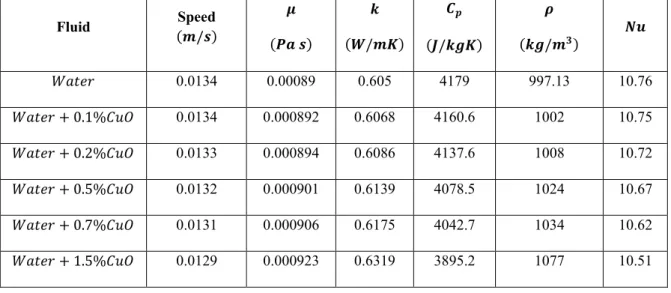
Table 1. Properties of Nano fluid in different volumetric proportions [15] and [16]
Fluid D en st y (k g/ m 3 ) Sp ec if ic h ea t (J/ kg K ) Th er m al co nd uc tiv ity co ef fi ci en t (W /mK ) V isco si ty (P as)
997.13 4179 0.60500 0.00089
6302 959.1 76.5
1002 4160.6 0.6068
0.000892
1008 4137.6 0.6086
0.000894
1024 4078.5 0.6139
0.000901
1034 4042.7 0.6175
0.000906
1077 3895.2 0.6319
0.000923
2. MOLDELING
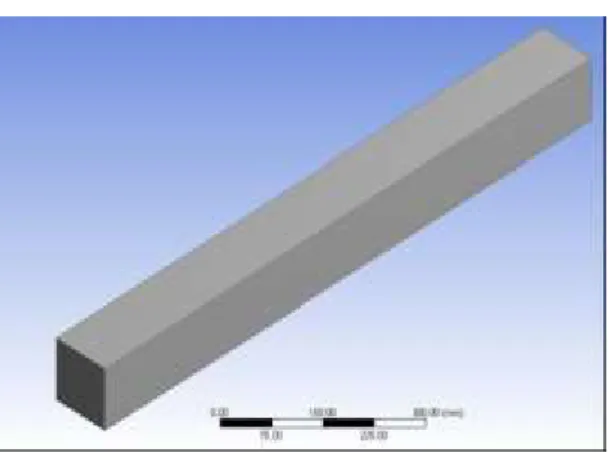
69 Fig. 1. Three-dimensional geometry of a square-shaped
channel
Fig. 2. Three-dimensional geometry of the channel with rectangular cross-section
Fig. 3. Three-dimensional geometry of the channel with a triangular cross section
The results of gridding were checked to ensure the accuracy of the results obtained. The increase in the number of elements and their diminution were also studied. For this purpose, according to Table 2, the number of elements was increased and the results were obtained for the final Nusselt number. As can be seen, after the number of elements of 16910, the number of model elements increased, a lot changed.
The final results are not generated and it can be said that the results are independent of networking and the final results are calculated using this number of elements.
Table 2. Review the independence of the results of networking
Number of
elements
7680 5.25
12672 5.29
22000 5.32
31200 5.26
2. DISCUSSION OF RESULTS
By modeling the nanofluid flow inside the channel, the pressure, velocity and temperature fields were determined by considering the boundary conditions. Despite the characteristics of the field at different points, the parameters of the channel function were calculated in different modes. To characterize the channel performance, the Nesselt dimensionless number was calculated as a characteristic of the heat transfer rate.
The thermal flux is considered to be the thermal flux of the transition between the horizontal pipes and the fluid around them. The results showed that with increasing the volume percentage of nanoparticles inside the nanosilver, the calculated Nusselt number decreased to a negligible amount. The values of the Nusselt numbers in a given reynolds are plotted in different volumes in the graphs of Figs. 4-8.
Fig. 4. Numbers of Numbers of Numbers in a Reynolds 100
Fig. 5. Numbers of Numbers of Numbers in a Reynolds 600
70 Fig. 7. Numbers of Numbers of Numbers in a Reynolds 1500
Fig. 8 Numbers of Numbers of Numbers in a Reynolds 2000
For triangular geometry, the results showed that with the increase in the volume percentage of particles inside the nanofill, the calculated Nusselt number decreased to a negligible amount. It should be noted that a small reduction in the Nusselt number does not mean an increase in the amount of heat transfer, and because of the increase in the heat transfer coefficient in high volumetric ratios, the amount of uncontained heat transfer has decreased. The values of the Nusselt numbers in a specified reynolds are plotted in different volumes in the graphs of Figures 9 to 13.
Fig 9. Numbers of Numbers of Numbers in a Reynolds 100
Fig 10. Numbers of Numbers in a Reynolds 600
Fig. 11. Charts of Nusselt numbers in a Reynolds 1000
Fig 12. Numbers of Numbers in a Reynolds 1500
Fig 13. Numbers of Numbers of Numbers in a Reynolds 2000
The results of different physical conditions of the fluid in different reynolds are presented in tables 3 to 7 for the reynolds number 100 to 2000 and the channel with rectangular cross section.
Table 3: Calculated Nusselt number for different nanofacies in rectangular and reynolds converters 100
( )
( )
( )
( ) speed( )
Fluid
5.26 997.13
4179 0.605
0.00089 0.0009
5.27 1002
4160.6 0.6068
0.000892 0.0009
5.27 1008
4137.6 0.6086
0.000894 0.0009
5.26 1024
4078.5 0.6139
0.000901 0.0009
71
Table 4: Calculated Nusselt number for different nanofacies in rectangular and reynolds converters 600
( ) ( ) ( ) ( ) Speed ( )
Fluid 8.23 997.13 4179 0.605 0.00089 0.0054 8.18 1002 4160.6 0.6068 0.000892 0.0053 8.17 1008 4137.6 0.6086 0.000894 0.0053 8.15 1024 4078.5 0.6139 0.000901 0.0053 8.14 1034 4042.7 0.6175 0.000906 0.0053 8.01 1077 3895.2 0.6319 0.000923 0.0051
Table 5: Calculated Nusselt number for different nanofacies in rectangular and reynolds converters 1000
( ) ( ) ( ) ( ) ( ) Speed Fluid 9.50 997.13 4179 0.605 0.00089 0.0089 9.49 1002 4160.6 0.6068 0.000892 0.0089 9.49 1008 4137.6 0.6086 0.000894 0.0089 9.43 1024 4078.5 0.6139 0.000901 0.0088 9.42 1034 4042.7 0.6175 0.000906 0.0088 9.29 1077 3895.2 0.6319 0.000923 0.0086
Table 6: Calculated Nusselt number for different nanofacies in rectangular and reynolds converters 1500
72 Rectangular Converter and Reynolds 2000
As can be seen, with the increase in the volume percentage of particles inside the nanosilver, the Nusselt number calculated is reduced to a negligible amount. It should be noted that a small reduction in the Nusselt number does not mean an increase in the amount of heat transfer, and because of the increase in the heat transfer coefficient in high volumetric ratios, the amount of uncontained heat transfer has decreased.
3. DISCUSSION
In this research, we tried to study the performance of heat exchangers with square, rectangular and triangular sections for different nanofluid ratios. The results of this research are as follows. For this purpose, the parameters of the coefficient were calculated by modeling the converters under different geometries using Ansys software The pressure drop and non-dimensional heat transfer coefficient were investigated. - By increasing the volume percentage of particles inside the nanofill, the calculated Nusselt number is reduced to a negligible amount.
- For triangular geometry, the results showed that with increasing the volume percentage of particles inside the nanofill, the calculated Nusselt number decreased to a negligible amount.
- In rectangular sections, by increasing the volume percentage of particles inside the nanosilver, the Nusselt number calculated is reduced to a negligible amount.
FUNDING/SUPPORT
Not mentioned any Funding/Support by authors.
ACKNOWLEDGMENT Not mentioned.
AUTHORS CONTRIBUTION
This work was carried out in collaboration among all authors.
CONFLICT OF INTEREST
The author (s) declared no potential conflicts of interests with respect to the authorship and/or publication of this paper.
REFERENCES
1- Lee, S., Choi, S. S., Li, S. A., & Eastman, J. A. (1999). Measuring thermal conductivity of fluids containing oxide nanoparticles. Journal of Heat transfer, 121(2), 280-289. [scholar]
2- Hamilton, R. L., & Crosser, O. K. (1962). Thermal conductivity of heterogeneous two-component systems. Industrial & Engineering chemistry fundamentals, 1(3), 187-191. [scholar]
3- Bianco, V., Chiacchio, F., Manca, O., & Nardini, S. (2009). Numerical investigation of nanofluids forced convection in circular tubes. Applied Thermal Engineering, 29(17-18), 3632-3642.
[scholar]
4- Choi, S. U. S. (2002). Two are better than one in nanofluids, presented at the Colloquium on Micro/Nano Thermal Engineering, Seoul National University, Seoul. Korea, February, 17.
[scholar]
5- Keblinski, P., Phillpot, S. R., Choi, S. U. S., & Eastman, J. A. (2002). Mechanisms of heat flow in suspensions of nano-sized particles (nanofluids). International journal of heat and mass transfer, 45(4), 855-863. [scholar]
6- Eastman, J. A., Choi, S. U. S., Li, S., Yu, W., & Thompson, L. J. (2001). Anomalously increased effective thermal conductivities of ethylene Table 7: Calculated Nusselt number for different nanofluids
( )
( )
( )
( ) ( )
Speed Fluid
11.77 997.13
4179 0.605
0.00089 0.0179
11.74 1002
4160.6 0.6068
0.000892 0.0178
11.71 1008
4137.6 0.6086
0.000894 0.0177
11.66 1024
4078.5 0.6139
0.000901 0.0176
11.62 1034
4042.7 0.6175
0.000906 0.0175
11.46 1077
3895.2 0.6319
0.000923 0.0171
73 glycol-based nanofluids containing copper nanoparticles. Applied physics letters, 78(6), 718-720. [scholar]
7- Choi, S. U. S., Singer, D. A., & Wang, H. P. (1995). Developments and applications of non-Newtonian flows. ASME FED, 66, 99-105.
[scholar]
8- Lee, S., Choi, S. S., Li, S. A., & Eastman, J. A.
(1999). Measuring thermal conductivity of fluids containing oxide nanoparticles. Journal of Heat transfer, 121(2), 280-289. [scholar]
9- Lee, S., Choi, S. S., Li, S. A., & Eastman, J. A. (1999). Measuring thermal conductivity of fluids containing oxide nanoparticles. Journal of Heat transfer, 121(2), 280-289. [scholar]
10- Khanafer, K., & Vafai, K. (2011). A critical synthesis of thermophysical characteristics of nanofluids. International Journal of Heat and Mass Transfer, 54(19-20), 4410-4428. [scholar]
11- Hamilton, R. L., & Crosser, O. K. (1962). Thermal conductivity of heterogeneous two-component systems. Industrial & Engineering chemistry fundamentals, 1(3), 187-191. [scholar]
12- Haddad, Z., Oztop, H. F., Abu-Nada, E., & Mataoui, A. (2012). A review on natural convective heat transfer of nanofluids. Renewable and Sustainable Energy Reviews, 16(7), 5363-5378. [scholar]
13- Kuznetsov, A. V., & Nield, D. A. (2014). Natural convective boundary-layer flow of a nanofluid past a vertical plate: A revised model. International Journal of Thermal Sciences, 77, 126-129.[scholar]
14- Nield, D. A., & Kuznetsov, A. V. (2009). The Cheng–Minkowycz problem for natural convective boundary-layer flow in a porous medium saturated by a nanofluid. International Journal of Heat and Mass Transfer, 52(25-26), 5792-5795. [scholar]
15- Hwang, Y. J., Ahn, Y. C., Shin, H. S., Lee, C. G., Kim, G. T., Park, H. S., & Lee, J. K. (2006). Investigation on characteristics of thermal conductivity enhancement of nanofluids. Current Applied Physics, 6(6), 1068-1071. [scholar]
16- Leitner, J., Sedmidubský, D., Doušová, B., Strejc, A., & Nevřiva, M. (2000). Heat capacity of CuO
in the temperature range of 298.15–1300 K. Thermochimica Acta, 348(1-2), 49-51.
[scholar]
17- Sadeghi, M., Thomassie, R., & Sasangohar, F. (2017, June). Objective Assessment of Patient Portal Requirements. In Proceedings of the International Symposium on Human Factors and Ergonomics in Health Care (Vol. 6, No. 1, pp. 1-1). Sage India: New Delhi, India: SAGE Publications. [scholar]
18- Khanade, K., Sasangohar, F., Sadeghi, M., Sutherland, S., & Alexander, K. (2017, September). Deriving Information Requirements for a Smart Nursing System for Intensive Care Units. In Proceedings of the Human Factors and Ergonomics Society Annual Meeting (Vol. 61,
No. 1, pp. 653-654). Sage CA: Los Angeles, CA: SAGE Publications. [scholar]
19- Sadeghi, M., Thomassie, R., & Sasangohar, F. (2017, September). Objective Assessment of Functional Information Requirements for Patient Portals. In Proceedings of the Human Factors and Ergonomics Society Annual Meeting (Vol. 61, No. 1, pp. 1788-1792). Sage CA: Los Angeles, CA: SAGE Publications. [scholar]
20- Sadeghi, M., & Sasangohar, F. (2018, September). Investigating Nursing Task Interruptions in Intensive Care Units: A Scoping Literature Review. In Proceedings of the Human Factors and Ergonomics Society Annual Meeting (Vol. 62, No. 1, pp. 478-479). Sage CA: Los Angeles, CA: SAGE Publications. [scholar]
21- Sadeghi, M., Khanade, K., Sasangohar, F., & Sutherland, S. C. (2018, September). Design of a Wearable Stress Monitoring Tool for Intensive Care Unit Nursing: Functional Information Requirements Analysis. In Proceedings of the Human Factors and Ergonomics Society Annual Meeting (Vol. 62, No. 1, pp. 1348-1352). Sage CA: Los Angeles, CA: SAGE Publications.