127
THE RADICULAR AND FOLIAR FERTILIZATION INFLUENCE
UPON GRAINS YIELD TO COWPEA
RETA DRĂGHICI Research - Development Center for Field Crops on Sandy Soils, Dabuleni, Dolj County, Romania, Phone: +40251334402, Fax: +40251334347, E-mail [email protected];
http://www.ccdcpndabuleni.ro/
Corresponding author: [email protected]
Key words: psamosoil, radicular, foliar, photosynthesis, production
ABSTRACT
Due to the low content of organic matter, high content of coarse sand and clay very low reserves of the sandy soils micro elements are very small and rapidly depleting under irrigation conditions. To mitigate the negative impact that these soil deficient qualities have on soil plants were carried out research on the implications extraroot and radicular fertilization on yield of cowpea, specific plant sandy soils. The results obtained, highlight the role of foliar fertilization with Green Plant products, which are composed of NPK + microelements, in achieving production increases of 21-56%, compared to foliar unfertilized. The highest production of cowpea (2757 kg / ha) was recorded by foliar fertilization with Green Plant, which is composed N15P45K15 + 6 microelements on the N60P60K60 agrofond.
INTRODUCTION
Valorisation of sandy soils with low natural fertility supposes a specific farming system, rational and integrated with less demanding plants to soil fertility and tolerance to
stress factors that ensure profitability and environmental protection (Gheorghe D. et al,
2001, Grings E.E. and S.S. Tarawali, 2010). Due to the low content of organic matter (0.59%), high content of coarse sand, 74.34% and clay very low, 2.5-3%, reserves of microelements on the sandy soils are very small and rapidly depleting conditions irrigation. Studies in West Africa, shows that low levels of mobile phosphorus in the sandy soils, can significantly affect the growth and development of cowpea root system (Yvonne Ohui Kugblenu et al, 2014). Research conducted at the cowpea crop in terms of sandy soils in southern Oltenia have shown higher effect on the quantity and quality of cowpea production of fertilization on soil and plant with Mo, Zn, Mg (Drăghici Reta et al, 1994). Based on these considerations, research in this experiment were aimed at optimizing plant growth and development of cowpea, under the influence radicular and foliar fertilization, in order to maximize grain yield.
MATERIAL AND METHOD
128
four foliar fertilized with foliar application compared to foliar unfertilized. The radicular fertilization was performed as follows:
- phosphorous, potassium and nitrogen 1/3 of the dose, was applied in seedbed preparing;
- 2/3 of nitrogen dose was applied in the vegetation phase, of 4-5 true leaves. Foliar fertilization was conducted in two phases of cowpea vegetation:
- treatment I was applied at a concentration 0.5%, to 4-5 true leaf stage;
- treatment II was applied in a concentration of 1%, in the phase of 3-5 ramifications of the plant.
Was determined the plant productivity (number of pods per plant, number of grains per pod, grain yield) and cowpea plant photosynthesis rate.
The results were interpreted using analysis of variance and mathematical functions.
RESULTS AND DISCUSSIONS
Grown on a psamosoil with poor physicochemical properties (high of 74.3% coarse sand, very low percentage of between 2.5-3% clay, containing less than 1% organic matter, porosity and aeration great), cowpea plant reacted positively to radicular and foliar fertilization. Analyzing the influence of NPK fertilization on the grain yield at cowpea, was highlighted the plant nutrition role in the formation of productivity elements. Cultivated on the poorest land, although synthesizes on the symbiotic way approx. 80.6% of the nitrogen in the feed, the cowpea plant needs this macroelement at the beginning of vegetation until install microbial activity in the soil. (Gheorghe D., Şuteu G.E.,1988). Also, the role of phosphorus and potassium was highlighted by significant results in the fructification and ripening of cowpea pods.
Production results obtained, emphasizes achieving a production increase of 31% at applying the formula N60P0K0 fertilization and 48% at fertilization with N60P60K60, compared to unfertilized control (Table 1).
Table 1
Influence of radicular fertilization on the cowpea yield
No. Dose of NPK Grain yield in cowpea Difference compared to the control
Kg/ha % kg/ha significance
1 N0P0K0 1705.5 100 Control Control
2 N60P0K0 2228 131 522.5 **
3 N60P60K60 2534.1 148 828.6 ***
LSD 5% - 242 kg/ha LSD 1% - 451 kg/ha LSD 0.1% - 750.5 kg/ha
129
Table 2
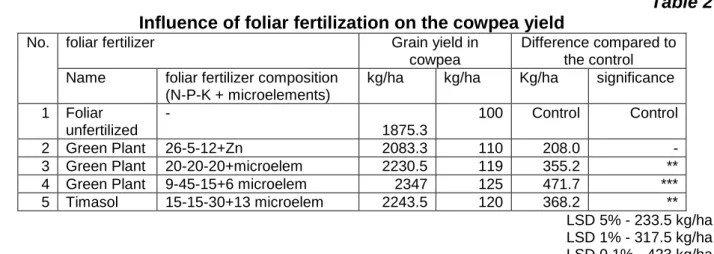
Influence of foliar fertilization on the cowpea yield
No. foliar fertilizer Grain yield in
cowpea
Difference compared to the control
Name foliar fertilizer composition
(N-P-K + microelements)
kg/ha kg/ha Kg/ha significance
1 Foliar unfertilized
-
1875.3
100 Control Control
2 Green Plant 26-5-12+Zn 2083.3 110 208.0 -
3 Green Plant 20-20-20+microelem 2230.5 119 355.2 **
4 Green Plant 9-45-15+6 microelem 2347 125 471.7 ***
5 Timasol 15-15-30+13 microelem 2243.5 120 368.2 **
LSD 5% - 233.5 kg/ha LSD 1% - 317.5 kg/ha LSD 0.1% - 423 kg/ha
Analyzing the influence of foliar fertilization on the grain yield obtained at cowpea, there is production increases differentiated by agrofond ensured basic NPK fertilization (Table 3). From the interaction of the two factors studied (radicular and foliar fertilization), the maximum grain yield of 2757 kg / ha, was recorded at fertilization the cwpea plannt with N60P60K60 + Green Plant (9-45-15 + 6 microelem). The foliar fertilization has brought production increases, statistically assured at agrofunds of N0P0K0 and N60P0K0.
Table 3
The radicular and foliar fertilization influence on production obtained in cowpea
Variant of fertilization Grain yield in
cowpea
Difference compared to the control No.
var.
Radicular fertilizer
Foliar fertilizer kg/ha % Kg/ha significance
Name foliar fertilizer
composition
(N-P-K + microelements)
1
N0P0K0
Foliar
unfertilized - 1262.5 100 Mt. Mt.
2 Green Plant 26-5-12+Zn 1811.5 143 549 *
3 Green Plant 20-20-20+microelem 1964 156 701.5 **
4 Green Plant 9-45-15+6 microelem 1791.5 142 529 **
5 Timasol 15-15-30+13 microelem 1699 135 436.5 *
6
N60P0K0
Foliar
unfertilized - 1976.5 100 Mt. Mt.
7 Green Plant 26-5-12+Zn 2069.5 105 92.52 -
8 Green Plant 20-20-20+microelem 2215 112 238.5 -
9 Green Plant 9-45-15+6 microelem 2492.5 126 515.5 **
10 Timasol 15-15-30+13 microelem 2386.5 121 410 **
11
N60P60K60
Foliar
unfertilized - 2387 100 Mt. Mt.
12 Green Plant 26-5-12+Zn 2369 99 -18 -
13 Green Plant 20-20-20+microelem 2512.5 105 125.5 -
14 Green Plant 9-45-15+6 microelem 2757 116 370 -
15 Timasol 15-15-30+13 microelem 2645 111 258 -
LSD 5% - 408 kg/ha LSD 1% - 554.5 kg/ha LSD 0.1% - 740 kg/ha
130
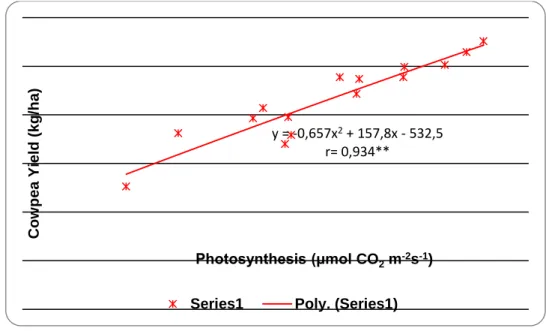
correlation, showing growth obtained in cowpea production with increasing intensity of the plant photosynthetic process, phenomenon highlighted well by using the tool polynomial of degree 2 with coefficient r = 0.934 **, which highlights a significant distinct correlation between cause and effect (Fig. 1).
Figure 1. Correlation between cowpea production and photosynthesis rate registered in different fertilization variants
The grain yield at cowpea, obtained in different fertilization variants, was distinct significantly positively correlated with the number of pods / plant and number of grains per pod (Fig. 2).
Figure 2. Correlation between grain yield and productivity elements of cowpea plant (number pods / plant, number of seeds / pod)
y = -0,657x2+ 157,8x - 532,5 r= 0,934**
Co
w
p
ea
Y
iel
d
(
kg/h
a)
Photosynthesis (μmol CO2m-2s-1)
Series1 Poly. (Series1)
ygrains = 0,0017x + 4,8833 r = 0,926**
ypods = 0,003x + 2,4843 r = 0,949**
N
o
p
o
d
s /
p
lan
t
N
o
gr
ai
n
s
/
p
o
d
Cowpea Yield (kg/ha)
No grains/pod No pods/plant
131
CONCLUSIONS
1. Cultivated on a psamosoil with poor physicochemical properties, the cowpea plant has reacted positively at radicular and foliar fertilization.
2. Application, in phases to 4-5 true leaves and 3-5 of the cowpea plant ramifications, of two foliar fertilization with the Plant Green product, which has in its composition sa N9P45K15 + 6 microelements, on N60P60K60 agrofond has determined the obtaining of a maximum of 2757 kg / ha.
3. The grain yield, obtained in different variants fertilization cowpea, was positively correlated, significantly distinct, with photosynthesis rate (r = 0.934 **), number of pods per plant (r = 0.949 **) and the number of beans in the pod (r = 0.926 **).
REFERENCES
1. Drăghici Reta, Carşofschi Ileana, Drăghici Iulian, Pârâianu Malisanda, 1994.
The implications of macro and micronutrients fertilization in obtaining quantitative and qualitative at cowpea. Dăbuleni SCCCPN Scientific Papers, Vol. VIII.
2. Gheorghe D. et al., 2001. Improve sandy soils in southern Oltenia. Symposium "Improving poorly productive soils of Oltenia". Ed. Sitech, Craiova.
3. Gheorghe D., Şuteu G.E.,1988. The nitrogen derived from the sir un the psamosoil
grown cowpea (Vigna sinensis cv Jiana). European Society of Nuclear Methods in Agriculture XIX-th Annual Meeting (29 aug-2 sept ), Viena, Austria.
4. Grings E.E. and S.S. Tarawali, 2010. Cowpea in evolving livestock systems. 5th World Cowpea Research Conference Theme: “Improving livelihoods in the cowpea value chain through advancement in science”, 27 September–1 October, 2010, Senegal
5. Yvonne Ohui Kugblenu, Frank Kofi Kumaga, Kwadwo Ofor and J. J.
Adu-Gyamfi, 2014. Evaluation of cowpea genotypes for phosphorus use efficiency.