METHODS FOR OIL OBTAINING FROM OLEAGINOUS MATERIALS
IONESCU M.1), VLĂDUȚV.2), UNGUREANU N.1), DINCĂ M.1),
ZĂBAVĂ B.ST.1), ȘTEFAN M1)
1)U.P. Bucharest / Romania;2)INMA Bucharest; E-mail: [email protected]
Keywords: oil, oleaginous materials, oil extraction, extraction methods, extraction efficiency
ABSTRACT
Lipids are an important component in human food since ancient times, having a positive influence on the health of the human body. Thus, cultivation of oleaginous materials is an important component of the global economy. To obtain vegetable oils from oleaginous materials can be used different methods existent on the global scale. The method used is chosen depending on the type of oleaginous material subjected to processing, on the oil quality that we want to achieve and on the amount of oil that we want to extract. This paper presents an analysis of the literature, describing the various existing methods for obtaining vegetable oil.
INTRODUCTION
The oleaginous materials production on global scale presents a continuous increasing demand in the next years, due to the higher edible oil consumption, the development of the biofuels industry and the needs for green chemistry, [7].
In plants, fatty matter is concentrated only in some parts such as seeds, fruits and tubers, stone fruits, sprouts, representing a reserve substance that the plant uses during its development as a source of energy. Although the oilseeds field is very wide, plants that can be used as raw material in vegetable oils industry are slightly because many of them have low oil content - being unprofitable, others with higher oil content present difficulties in oil extraction because of the special structure of the plant, [4].
Of more than 110 species of oleaginous plants, on the world market there are presently about 50, grouped in 15 important botanical families, namely: compositae (sunflower), cruciferae (rape), leguminous plants (soya), malvaceae (cotton), papaveraceae (poppy), rozaceae (almond tree, hazel tree), peduliaceae (sesame), vitaceae (grape seed), jugladaceae (nut tree), palmae (oil palm, coconut palm, palm kernel), foleaceae (olive tree), linaceae (flax), cucurbitaceae (pumpkin seeds), leufobiaceae (castor oil plant) and solanaceae (tomato seeds, tobacco seeds), [6].
In our country, the main raw material is represented by the oleaginous plants which produce seed. The oil can be obtained from different categories of plants: plants with oil concentrated in seeds (sunflower, soybean, rapeseed etc.), plants producing oleaginous fruits (olive, coconut and palm), plants producing oleaginous tubers (peanuts) and plants producing oleaginous germ (corn). The main oleaginous crops, used for oil obtaining in Romania, are: soybean, sunflower, line, rapeseed, mustard and castor, [2].
developed, there is still a major concern to improve the existing methods for the extraction, using new processing conditions and new equipments, even developing new methods with high extraction efficiency, [12]. In Romania, to extract vegetable oils from oleiferous seeds, in most cases the combined process is used: pressing the seed material, ensuring oil separation of up 80…85% , is followed by the solvent based extraction, a method by which the oil is separated from the remainder (up to 99…99.5%), [1].
The oil extraction methods from oleaginous materials are designed to obtain high quality oil with minimal undesirable components, achieve high extraction yields and produce high value meal, [10]. In this paper are presented the methods available for the extraction of vegetable oil from oleaginous materials, such as those are presented in the literature.
MATERIAL AND METHOD
Numerous references and clues are found that indicate the use of these oils during stone age and bronze age. Documented oil extraction dates back to 1650 B.C. when ripened olives were pressed by hand in Egypt using wooden pestles and stone mortars. The extracted olive oil was filtered through goat hair filters and used as a lubricant. Sesame, linseed, and castor oils were recovered in Egypt by hand pressing as far back as 259 B.C. By 184 B.C., the Romans developed more sophisticated technology such as edgerunner mills and screw and wedge presses. These technologies combined leverage and the use of animal power to aid in the milling and extraction of the oil. From Roman times until the eighteenth century, similar technology was used for oil extraction, [8].
From the eighteenth century, various mechanized and innovative methods were adopted for oil extraction from oilseeds. The purpose of those methods was to optimize the process by collecting the maximum quantity of the existing oil in oilseeds with the minimum costs. The wind and water power was used to replace the animal power in the construction of equipments used for the oil extraction. Currently, there are four basic methods for obtaining vegetable oil from oleaginous material: chemical extraction, supercritical fluid extraction, steam distillation and mechanical extraction (Fig.1).
In recent years, claim for natural and organic products has been growing, and new clean technologies for producing natural ingredients have been developed. In fact, present attention is paid to the real quality of products and their potency, reliability and naturalness. Owing to the increasing demand in bioactive compounds from plant origin, new extraction methods was used to obtain products with high quality and safety features. The conventional extraction methods are time consuming, laborious, have low selectivity and/or low extraction yields, and possible solvent contamination of final products, [18].
Fig. 1. Basic methods for oil extraction, [15]
SOLVENT ENZYMES HYDRAULICPRESS SCREW PRESS
MECHANICAL DISTILLATION
HIGH PRESSURE
CO2
CHEMICAL
OIL EXTRACTION
RESULTS AND DISCUSSIONS
One of the most used and most ancient methods for oil extraction is represented by the mechanical pressing. Mechanical oil extraction (also known as pressing) is based on mechanical compression of oleaginous materials. Through pressing, oil is separated from the oleaginous material (solid-liquid mixture) under the action of compressive external forces that arise in special machines called presses, [3].
In practice, this operation can take two shapes: a hydraulic, uni-axial press or a screw press (also called extruder or expeller). The advantages of a screw press (Fig. 2) compared to a hydraulic press (Fig. 3) are its slightly higher yield and its continuous mode of operation.
Fig. 2. Schematic representation of a screw press, [16]
Hydraulic oil press, so named because it works on the principle of the hydraulic ram, are originary from England and was first patented in 1795 by Joseph Bramah,[5]. Hydraulic expression of oil involves application of pressure through a ram to digested oleaginous material mash in a cylindrical cage. The cylindrical cage is usually perforated laterally. This results in axial compaction and radial oil flow. In a typical hydraulic pressing of vegetable oil seeds three distinct stages can be identified (Fig. 3), [11]. The first cottonseed oil mill constructed in the United States (1920) utilized a hydraulic press.
The first screw oil press was developed in 1900 by V.D. Anderson in the United States. This press permitted continuous operation of hydraulic presses which resulted in greater capacities with smaller equipments and less labor, [5]. The mechanical screw press (Fig. 2) consists of a vertical feeder and a horizontal screw with increasing body diameter to exert pressure on the oilseeds as it advances along the length of the press. The barrel surrounding the screw has slots along its length, allowing the increasing internal pressure to first expel air and then drain the oil through the barrel. Oil is collected in a trough under the screw and the de-oiled cake is discharged at the end of the screw. The main advantage of the screw press is that large quantities of oilseeds can be processed with minimal labor, and it allows continuous oil extraction, [10].
This method ensures extraction of a non-contaminated, protein-rich low fat cake at relatively low-cost. The disadvantage of this method is that the mechanical presses do not have high extraction efficiencies, about 8-14% of the available oil remain in the press cake. Generally it is only used for smaller capacity plants, speciality products or as a prepress operation in a large scale solvent extraction plant, [19].
Distillation is the extracting oil process, converts volatile liquid (essential oils) into vapor state and then condenses the vapor into a liquid state. The extracting method is cost to produce essential oils. In steam distillation method, the botanical material is placed in a still and steam is forced over the material. The hot steam is used to release the aromatic molecules from the plant material. The steam forces to open the pockets and then the molecules of these volatile oils, escape from the plant material and evaporate into the steam. The steam contains the essential oil, is passed through a cooling system to condense the steam, which forms a liquid form of essential oil and then water is then separated. The steam is produced at greater pressure than the atmospheric pressure and therefore boils at above 100°C which is used to the remove the essential oil from the plant material.
The major advantage of steam distillation is that the temperature never goes above 100°C so temperature sensitive compounds can be distilled. The disadvantage is that not many compounds can be steam distilled - usually aromatic ones, [14].
The chemical methods are another technology used for oil extraction from oilseeds. In the case of chemical methods, enzymes or solvents are used for the oil extraction, [15]. The overwhelming majority of all vegetable oil is extracted using solvent extraction. The advantage of solvent extraction is the high yield that can be obtained economically with this method (>99 wt.%), but this is at the expense of a reduced oil quality and a high initial capital cost to construct a facility. This quality reduction is caused by the extensive solvent recovery processes that are necessary and the fact that the solvent co-extracts undesired components from the seeds. Especially for high value added oils this quality reduction is unacceptable, limiting the production process to mechanical expression, [13].
In 1855, Deiss of Marseilles, France, was first to employ solvent extraction. He used carbon disulfide to dissolve olive oil retained in spent olive cakes. This technology used batch solvent extraction, where the material was held in a common kettle for both the extraction process as well as the subsequent meal desolventizing process. Deiss obtained a patent for batch solvent extraction of olive oil in 1856, [8].
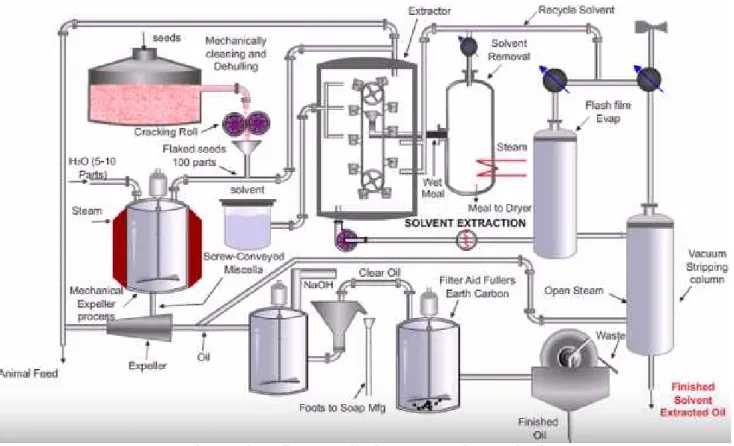
In solvent extraction, the seeds are first flaked (this operation is necessary in order to increase the contact area of the seed with the solvent, resulting in a increasing of the oil yield) and cooked (cooking denatures cell tissues so that solvent can penetrate the flakes more readily). After theses operations, the cooked seed flakes are mixed with the solvent in order to extract the oil. It results a mixture of oil and solvent, called miscella, which is heated in evaporators at 80°C. Steam is injected on the shell side to vaporize and reduce hexane to about 5% of the oil, then the oil is directly steam-stripped in a vacuum tower at temperatures rising to a final 110°C. For oil extraction using solvents, the following light paraffinic petroleum fractions are used: pentane, hexane, heptanes and octanes.
Fig. 5. Flow diagram of solvent extraction method
cooking of the seeds and after that, the cooked sedds are put into water. The following step is the enzymes adding which digest the solid material. At the end, the separation of the residual enzymes and oil are made using a liquid-liquid centrifuge, [15].
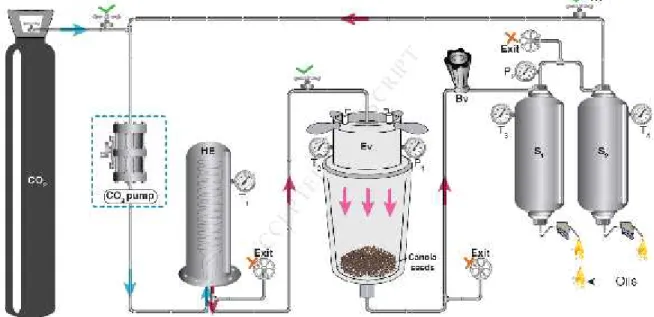
Supercritical fluid extraction using carbon dioxide (SC-CO2) is a particularly suitable isolation method for isolation of the valuable components from plant materials. A natural plant extract, free from chemical alterations brought about by heat and water, and without solvent residues and other artifacts can be obtained by this method. Carbon dioxide is non-toxic, non-explosive, readily available and easily removed from the extracted products, [17]. Supercritical fluids have gas-like diffusivities but liquid-like densities. These properties vary as a function of pressure and temperature. Supercritical carbon dioxide (SC-CO2) has been the most frequently used supercritical fluid for oil extraction, since it is nontoxic, nonflammable, inexpensive, and easily separated from the extract, [9]. In the supercritical carbon dioxide technique, the seeds are mixed with high pressure carbon dioxide in liquid form (at 31°C temperature and 7,3 MPa pressure). Then, oil dissolves in the carbon dioxide. When pressure is released from the system, the carbon dioxide returns to the gas phase and oil precipitates out from CO2-oil mixture.
The use of supercritical carbon dioxide is an green method to obtain cosmetic product, functional and nutraceutical food, pure and free solvents for natural products and environmentally friendly.
Fig. 6. Supercritical CO2 pilot scale equipment
CONCLUSIONS
BIBLIOGRAPHY
1. Arișanu A.O., Hodîrnău E., 2011 - Particularities of oil extraction by pressing hulled and hydrothermally processed sunflower seeds, Journal of EcoAgriTourism, vol. 7, no. 2, p. 32-37;
2. Avram M., Stoica A., Dobre T., Stroescu M., 2014 - Extraction of vegetable oils from ground seeds by percolation techniques, U.P.B. Sci. Bull., Series B, Vol. 76, Iss. 2, ISSN 1454 – 2331;
3. Bamgboye A., Adejumo A., 2007 - Development of a sunflower oil expeller, Agricultural Engineering International: the CIGR Ejournal. Manuscript EE 06 015, vol IX; 4. Banu C., 1999 - Manualul inginerului din industria alimentară, vol. I și II, Editura Tehnică, București;
5. Bargale P.C., 1997 - Mechanical oil expression from selected oilseeds under uniaxial compression, Ph.D. Thesis, University of Saskatchewan, Canada;
6. Ghimbășan R., 2000 - Tehnologii în industria alimentară, Vol. 1, Brașov, Editura Universității Transilvania din Brașov;
7. Jolivet P., Deruyffelaere C., Boulard C., Quinsac A., Savoire R., Nesi N., Chardot T., 2013 - Deciphering the structural organization of the oil bodies in the Brassica napus seed as a mean to improve the oil extraction yield, Industrial Crops and Products, vol. 44, pp. 549-557;
8. Kirschenbauer H. G.,1944 - Fats and Oils, Reinhold Publishing, New York, pp. 122– 123;
9. Naik, S.N., Lentz, H., Maheshwari, R.C., 1989 - Extraction of perfume and flavours from plant materials with liquid carbon dioxide under liquid vapour equilibrium condition. Fluid Phase Equilibria 49, pp. 115–126;
10. Nurhan D., - Oil and Oilseed Processing II, Robert M. Kerr Food & Agricultural Products Center, FAPC-159;
11. Owolarafe O.K.,
Osunlekehttp://www.sciencedirect.com/science/article/pii/S1537511008002468 - aff2 A.S., Odejobi O.A., Ajadi S.O., Faborode M.O.,2008 - Mathematical modeling and simulation of the hydraulic expression of oil from oil palm fruit, Biosystems Engineering 101, pp. 331-340;
12. Perez E. E., Carelli A. A., Crapiste G. H., 2011 - Temperature-dependent diffusion coefficient of oil from different sunflower seeds during extraction with hexane, Journal of Food Engineering, vol. 105, no. 1, pp. 180-185;
13. Pradhan R.C., Meda V., Rout P.K., Naik S., Dalai A.K., 2010 - Supercritical CO2
extraction of fatty oil from flaxseed and comparison with screw press expression and solvent extraction processes,Journal of Food Engineering vol. 98, pp. 393–397;
14. Ranjitha J., Vijiyalakshmi S., 2014 -Facile methods for the extraction of essential oil from the plant species - a review, IJPSR, Vol. 5(4), pp. 1107-1115, E-ISSN: 0975-8232; P-ISSN: 2320-5148;
15. Sari P., 2006 - Preliminary design and construction of a prototype canola seed oil extraction machine,Ph.D. Thesis, Middle East Technical University, Ankara, Turkey;
16. Savoire R., Lanoiselle J.L., Vorobiev E., 2013 - Mechanical continuous oil expression from oilseeds: A review, Food Bioprocess Technology, vol. 6, pp. 1-16;
17. Sovilj M.N.,2010 -Critical review of supercritical carbon dioxide extraction of selected oil seeds,APTEFF, 41, 1-203, pg. 105-120;
![Fig. 1. Basic methods for oil extraction, [15]](https://thumb-us.123doks.com/thumbv2/123dok_us/8070206.2137705/2.892.124.769.863.1064/fig-basic-methods-for-oil-extraction.webp)
![Fig. 2. Schematic representation of a screw press, [16]](https://thumb-us.123doks.com/thumbv2/123dok_us/8070206.2137705/3.892.143.751.322.644/fig-schematic-representation-screw-press.webp)
![Fig. 4. Steam distillation process, [14]](https://thumb-us.123doks.com/thumbv2/123dok_us/8070206.2137705/4.892.192.759.708.1113/fig-steam-distillation-process.webp)