119
THE ESTABLISHMENT OF INTENSIVE APPLE ORCHARDS IN
SERBIA
D. RADIVOJEVIC, J. MILIVOJEVIC, M. VELICKOVIC, C. OPARNICA University of Belgrade-Faculty of Agriculture Nemanjina 6, 11080 Zemun E-mail: [email protected]
ABSTRACT
Serbia at the present time grows apple on an area of 25.917 ha with an average production of 412.000 tons per year. This production is almost 2.5 fold higher than in the period of 2001-2005., which is associated with establishment of new intensive orchards, starting from 2006. Apple production was moving from the locations, typically used for traditional apple production to the regions, mostly located in the different valleys, that poses enough quantity of fresh water for drip irrigation. The new established orchards are equipped with anti-hail net preventing fruit damages against hail or intensive sunlight. The most dominant cultivars are different clones of Golden Delicious, Granny Smith, Gala and Red Delicious, which are mostly grafted on M9 rootstock. Spacing between the rows is the same as in the past (3.0-3.5 m), while distance within the rows is significantly reduced and now is 0,5-0,9 m, which provide 3,200-6,250 trees ha-1. Tree height reaches 2.20-3.0 m. Large and well feathered nursery trees are used for planting, which provide fast returns of high investment. “Knip” nursery trees as 2-year-old trees with one-year old crown are preferred for establishing new orchards. After planting, light pruning is usually applied. Only lateral shoots at the tip which are too steep and too vigorous lateral shoots along the leader are removed in its base. This type of pruning, which promotes fruit bud production and early cropping, reduces vegetative growth of the tree. In the case of good development of the trees after planting , they can be loaded up to 40 fruits in the second growing year, providing a yield of more than 30 tons per hectare. Production in the third leaf can achieve 40-50 t ha-1 and full production, which usually started in the fourth leaf, more than 60 t ha-1 can be expected depends on cultivar and growing conditions. Pruning of the mature trees means cutting of the strong watersprouts, the upright shoots and the strong terminal shoots at the top of the tree at their base, remaining only weak fruit-bearing wood. The fruit thinning is regularly applied in modern apple orchards, starting from the second growing year, in order to achieve regular yield and uniform fruit quality.. For this purpose plant growth regulators such as auxins [naphthalene acetic acid (NAA) or naphthalene acetamide (NAAm)] and cytokinin [6 - benzyladenine (BA)] are used. Recently, herbicide metamitron, as a new chemical thinners that at a low dosage reduces photosynthesis and consequently enhances fruit drop are also used. Metamitron exhibited thinning activity when applied to apple fruitlets at the 6 to 15 mm in diameter, or even later, at 20 mm. It can be applied once or twice, depend on the weather conditions in the day of application and three days after.
120
INTRODUCTION
This paper presents the current state in apple growing in Serbia, including the apple varieties/rootstock combination that are currently being planted, type of plant material and modern orchard management which are applied in order to achieve regular and high yield of quality fruits.
Over the last 15 years intensity of apple growing has increased quickly in Serbia (from 2006. to 2018.). The planting of new orchards has on average increased by 200 to 400 ha per year. In 2018, total apple growing area was 25.917 ha. Average yearly production for a five-year period (2014-2018) was 412.000 t. This production is almost 2.5 fold higher than in the period of 2001-2005 (Statistical yearbook, 2018). Since acreage is similar in both periods, significant increasing of total production is result of establishing new modern apple orchards with high density planting (3000-6.000 trees per hectare). Apple production is moving from locations typically used for traditional apple production to the regions mostly located in different valleys that possess enough quantity of fresh water for drip irrigation. Since the annual precipitation is low and not well distributed over the year, almost all new planted orchards are covered with drip irrigation systems. Large temperature fluctuations and spring frosts are often caused the freezing of flowers and fruitlets. However, small part of whole apple growing area is equipped with overhead irrigation for frost protection. Fertile soils, with good water holding capacity and rich in minerals, sometimes provided excessive vegetative growth. For this reason, controlling shoot growth has become a major issue in apple growing. The new orchards are equipped with anti-hail
net, which prevent damage of fruit against hail or intensive sunlight. Increasing of apple production is not completely followed by construction of cold storage (especialy ULO or DA cold storage); so most of the harvested fruit must be sold immediately after harvest, which significantly reduces their price. About half of the total production is exported to Russian market and EU countries, while the rest is sold in the local markets.
Cultivars and rootstocks
121 The most dominant rootstock is M9 clone T337, imported from Holland. It expressed excellent productive characteristics as suitable rootstock for different types of soils. M26 or MM106 can be considered only for spur types (Super Chief or Red Cap Delicious).
Plant material
The most important factor for a good beginning of an orchard is to use the best possible plant material (Werth, 2003) because the quality of nursery trees has a large impact on early production and profitability of high density systems (Sazo and Robinson, 2011). Apple producers dont want to be nurserymen, they want to produce fruits in their orchards. Therefore, trees without lateral branches should not be planted anymore because they take at least 1 to 2 years longer to come into full production. One of the best young tree is “knip” tree, 2-year-old nursery tree with one-year old crown. It has many wide-angled lateral branches at the wanted height. These branches are positioned for formation of fruiting spurs in the year of planting and therefore the first fruits in the second growing year. Even though, if the growing conditions are favourable and planting process was finished before beginning of April, in some cultivars first significant yield can be obtained in the first year. Radivojevic et al. (2012) concluded that planted trees of ‘Granny Smith’ and ‘Golden Reinders’ can be loaded up to 6 fruits, which provide yield of 4 t ha-1 and 4,7 t per hectare, respectively.This yield did not prevent formation of reproductive buds for optimal yield in the second year. However, first yield on planted trees of ‘Red Chief’ inhibited fruit-bud formation for the subsequent year.
The main disadvantage of “knip” nursery trees is their high price and necessity for high investments. Some producers want to use cheaper option
but without reducing of yield potential in the second year. Well feathered one-year-old nursery tree can be good choice. However, both production techniques are lasted two years. Nine-month-old trees, which are produced in a short nursery cycle, i.e. from bench grafting, can be used successfully. However, they have to be well developed and tall enough. They usually do not branch easily and form insufficient number of lateral branches at the proper height appropriate to form a crown. It is found that ability of nursery trees for lateral branches formation is related to growth strength, which can be promoted by application of appropriate quantity of nitrogen and promalin (BA+GA4+7) (Radivojevic et al., 2016)
122 young high-density apple orchards because, over the years, the length of time for full orchard productivity has become shorter and shorter (Treder et al., 2010). However, in the past when trees without or with only a few lateral branches are planted, the tree canopy had to be formed and developed in the orchard. Planted trees were hardly pruned after planting, 70-80 cm above ground. Also, in the next 3 years central leader was heading back in order to achieve strong tree architecture. This resulted in a vigorous frame, which needed a lot of pruning labor in summer to maintain good light distribution in the tree for good fruit quality. These circumstances normally bring about vigorous growth and delayed onset of yield (Mantinger, 1998). Applied pruning required a high amount of labour, because after the hard pruning many shoots emerged which needed to be removed in the next year. Also, total yield, share of the first class of fruit in total yield, as well as fruit colour were low.
Taking all problems into consideration, training philosophy had been changing significantly for last 15 years. We started to plant large, well feathered nursery trees, which provide fast return of high investments. Light pruning after planting, which reduce vegetative growth of the tree and promote fruit bud production, is usually applied. The best way of restricting vegetative growth is to produce early cropping. It should keep in mind that every excessive cut promotes vegetative growth and valuable “capital,” that is, potential fruit, is lost (Werth, 2003). The presence of many laterals on trees at planting makes it possible to leave the central leader intact after planting (Balkhoven-Baart et al., 1998). Eventualy, if the trees are taller than 2 m, it can be slightly shortened. In the orchard, the leader must be trained upward as slowly as possible and must never be
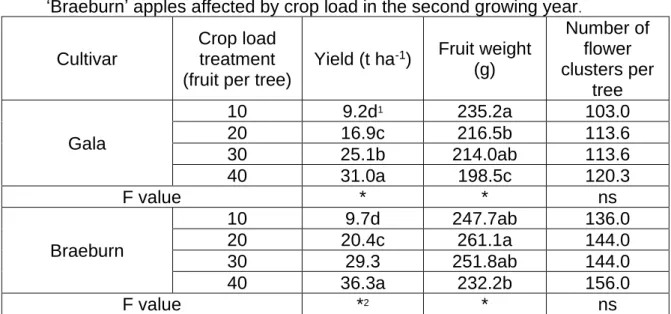
123 between early cropping and vegetative growth, resulted in a high yield and good fruit quality. This early high yield did not have a negative influence on formation of fruiting bud for the
following year. Furthermore, a heavier crop load induced a decrease in shoot growth, which is very important in high-density apple orchards (Radivojevic et al., 2014).
Table 1. Yield, fruit weight and number of flower clusters per tree of ‘Gala’ and ‘Braeburn’ apples affected by crop load in the second growing year.
Cultivar
Crop load treatment (fruit per tree)
Yield (t ha-1) Fruit weight (g)
Number of flower clusters per
tree
Gala
10 9.2d1 235.2a 103.0
20 16.9c 216.5b 113.6
30 25.1b 214.0ab 113.6
40 31.0a 198.5c 120.3
F value * * ns
Braeburn
10 9.7d 247.7ab 136.0
20 20.4c 261.1a 144.0
30 29.3 251.8ab 144.0
40 36.3a 232.2b 156.0
F value *2 * ns
1Means within a column followed by different letters are significantly different at P ≤ 0.05 by LSD test; 2ns, * indicates no significant or significant differences at P ≤ 0.05.
Production in the third leaf is 40-50 t ha -1 and full production, which usually started in the fourth leaf, is from 60 to 80 t ha-1, depends on cultivar and growing conditions.
Pruning of mature trees
Winter pruning are only applied on mature trees . It means pruning the strong terminal shoots at the top of the three, remaining only weak fruit-bearing wood. The ideal top should have calm tips, good fruit set and low vegetative reaction. Also, the strong watersprout and the upright shoots are cut at their base. Lateral branches should never be too large in comparison to the main trunk. Large branches should be removed earlier, before its growth begin to be too competitive. They must be removed at the base, not shortened. Only hanging fruit-bearing wood should or must be shortened. Excesive
two-year-old fruiting wood can be thinned in order to reduce potential excessive fruit number. Weaker side shoots are calmer and more fruitful. Keeping an upright central leader with weak laterals ensures an open well illuminated tree.
Fruit thinning
124 which time only increases in fruit size are achieved but there is no reduction in alternate bearing (Mass, 2006). Since well feathered apple trees in favourable growing conditions can produce high yield in the second leaf, thining excessive fruitlets has to be performed. In the past, fruit thinning was usually done by hand only in the young apple orchards. However, due to the increasing lack of seasonal workers and high labour costs, this job is becoming unrealizable, especially in large areas, so that chemical thinning have to be done (Radivojević et al., 2011; Radivojević et al., in press). For this purpose plant growth regulators such as auxins [naphthalene acetic acid (NAA) or naphthalene acetamide (NAAm)] and cytokinin [6 - benzyladenine (BA)] can be used. The effect of chemical thinners is dependent on the interaction between genotype and climatic conditions, and in some years, NAA and BA, alone or in combination, fail to thin apples when applied at a fruit diameter of 5 - 16 mm
due to low temperature after applications (Yuan, 2007). Climatic variability observed in past years in Serbia makes chemical thinning difficult at the appropriate fruit size. One of the new chemical thinners is the triazinone herbicide metamitron (MM) that at a low dosage reduces photosynthesis and consequently enhances fruit drop (Dorigoni and Lezzer, 2007; Lafer, 2010;). Metamitron exhibited thinning activity when applied to apple fruitlets at the 10 to 12 mm in diameter (Lafer, 2010) or even later, at 20 mm (McArtney et al., 2012). In order to evaluate the thinning efficacy of metamitron applied as a single or double treatment in young ‘Golden Delicious’ apple trees we conducted experiment during the first three crop seasons at the commercial orchard located on mountain Fruska Gora, Serbia. Application of chemical thinners was carried out at two fruit diameter stages (6 - 9 and 12 - 15 mm).Results are showed in the table 2.
Table 2. The effect of metamitron on number of fruit per tree and fruit weight of ‘Golden Delicious’ apples in three experimental years
Treatment Number of fruit per tree Fruit weight (g)
2014 2015 2016 2014 2015 2016 MM1 225 mg L-1 (6-9 mm)
MM 225 mg L-1 (12-15 mm)
67.8bc
3 69.9 148.1b 208a 201a 180a
MM 300 mg L-1 (6-9 mm) 72.8b 85.7 203.0a 196a 176b 137b MM 300 L-1 (12-15 mm) 88.7a 70.4 137.6b 170b 182b 174a
UCT2 98.4a 75.7 222.3a 162b 170b 114c
Significance *4 ns *
1MM-metamitron, 2UCT-untreated control treatment; 3Means within a column followed by different
letters are significantly different at P ≤ 0.05 by LSD test; 4ns, * indicates no significant or significant differences at P ≤ 0.05.
Single metamitron treatments were effective only when the weather conditions are favourable in the day of application and 3 days after (minimum night temperature > 10 °C, maximum daily temperature > 20 °C) regardless of fruit diameter stages. Double metamitron application at lower
125
The future of apple growing in Serbia
There is forecast that an increase of acreage under apple orchards will slow down in the future. The most important reasons for this are as follows: over the last two years apple prices have been too low to ensure an adequate growers income; lack of cold storage capacity, especially modern ULO and DA storages, which presently cover less than one half of yearly apple fruit production in Serbia and this fact forces apple growers to sell a huge amount of apple immediately after harvest when their price is the lowest; a large number of traders of fruit went bankrupt; Serbian growers are also facing future difficulties with lack of seasonal workers.
In summary, the future of Serbian apple growing depends on future apple prices. To survive growers must improve the performance of commercial orchards, i.e., crop yield, fruit size, fruit quality, storability, and long term productivity. They have to continue using high quality plant material and optimal scion/ rootstock combinations. Training system should be selected that provide the best prospect for high production of good quality fruit combined with reduction of labor costs. Majority of apple orchards have to be covered with anti hail net and provided with enough quantity of fresh water, with improved efficiency of using.
References
Balkhoven-Baart, J.M.T.,
Wagenmakers, P.S., Bootsma, J.H., Groot, M.J. and Wertheim,
S.J. (1998): Developments in dutch apple plantings. Acta Hortic. 513, 261-270. DOI: 10.17660/ActaHortic.1998.513.3 1
https://doi.org/10.17660/ActaHo rtic.1998.513.31
Bound, S.A. (2006): Comparison of two 6-benzyladenine formulations and carbaryl for post-bloom thinning of apples. Scientia Horticulturae 111: 30–37. doi: 10.1016/j.scienta.2006.07.028 Costa. G, Dal Cin, V., Ramina, A.
(2006): Physiological, molecular and practical aspects of fruit abscission. Acta Horticulturae
727: 301-310. doi:
10.17660/ActaHortic.2006.727.3 6
Dorigoni, A., Lezzer, P. (2007): Chemical thinning of apple with
new compounds.
Erwerbs-Obstbau 49: 93–96
Hoying, S.A. and Robinson, T.L. (1998): The apple orchard planting systems puzzle. Acta Hortic. 513, 257-260. DOI: 10.17660/ActaHortic.1998.513.3 0
https://doi.org/10.17660/ActaHo rtic.1998.513.30
Lafer, G. (2010): Effects of chemical thinning with metamitron on fruit set, yield and fruit quality of ‘Elstar’. Acta Horticulturae 884: 531-536. doi:
10.17660/ActaHortic.2010.884.6 8
Maas, F. (2006): Thinning ‘Elstar’ apple with benzyladenine. Acta Horticulturae 727: 415-422. doi: 10.17660/ActaHortic.2006.727.5 0
Mantinger, H. (1998): The Cultivation of Fuji in South Tyrol and in Italy. Compact Fruit Tree, , Vol. 31 No. 1.
126 Djurovic, D. (2012): Effect of crop load on apple tree growth and productivity in the first year of planting. Acta Hortic. 940: 499-502.
Radivojević, D., Milivojević, J., Oparnica, Č., Vulić, T., Djordjević, B., Ercişli, S. (2014): Impact of early cropping on vegetative development, productivity, and fruit quality of Gala and Braeburn apple trees. Turkish Journal of Agriculture and Forestry. 38: 773-780. Radivojević, D., Živić, M., Milivojević, J.,
Oparnica, Č. and Veličković, M. (2016): Effect of 6-BA+GA(4+7) and nitrogen fertigation on feathering of 'Golden Reinders' apple nine-month-old nursery trees. Acta Hort. (ISHS) 1139:497-502
http://www.actahort.org/books/1 139/1139_85.htm
Radivojević, D., Milivojević, J, Pavlovic, M., Stopar, M. (In press):
Comparison of metamitron efficiency for postbloom thinning of young ‘Gala’ and ‘Golden Delicious’ apple trees. Turkish Journal of Agriculture and Forestry. doi:10.3906/tar-1902-22
Sazo, M., and Robinson, T. L. (2011): The Use of Plant Growth Regulators for Branching of Nursery Trees in NY State. New york fruit quarterly 19(2), 5-9. Statistical Yearbook of the Republic of
Serbia. (2018). Belgrade
Yuan, R. (2007): Effects of temperature on fruit thinning with ethephon in ‘Golden Delicious’ apples. Scientia Horticulturae 113: 8–12. doi: